T H E I N T O N A T I O N A L STRUCTURING OF DISCOURSE
Julia Hirschberg and J a n e t P i e r r e h u m b e r t A T & T Bell L a b o r a t o r i e s
600 M o u n t a i n Avenue M u r r a y Hill N J 07974 USA
A B S T R A C T
We propose a m a p p i n g between prosodic p h e n o m e n a and s e m a n t i c o - p r a g m a t i c effects based upon the hypothesis t h a t intona- tion conveys information a b o u t the i n t e n t i o n a l as well as the a t t e n - tional s t r u c t u r e of discourse. In p a r t i c u l a r , we discuss how varia- tions in pitch range and choice of accent and t u n e can help to con- vey such information as: discourse s e g m e n t a t i o n and topic struc- ture, a p p r o p r i a t e choice of referent, the d i s t i n c t i o n between 'given' and 'new' information, conceptual c o n t r a s t or parallelism between m e n t i o n e d items, and s u b o r d i n a t i o n relationships between proposi- tions s a l i e n t in t h e discourse. O u r goals for this research are prac- tical as well as theoretical. In p a r t i c u l a r , we are i n v e s t i g a t i n g the problem of i n t o n a t i o n a l a s s i g n m e n t in s y n t h e t i c speech.
1. I n t r o d u c t i o n
The role of prosody in discourse has been generally ack- nowledged b u t l i t t l e understood. Linguistic p r a g m a t i c i s t s have noted t h a t types of i n f o r m a t i o n s t a t u s (such as g l v e n / n e w , t o p l c / c o m m e n t , f o c u s / p r e s u p p o s i t i o n ) can be i n t o n a t i o n a l l y ' m a r k e d ' [1,2,3,4], t h a t r e f e r e n c e r e s o l u t i o n may depend criti- cally on i n t o n a t i o n [5, 6], t h a t i n t o n a t i o n can be used to disambigu- ate among p o t e n t i a l l y a m b i g u o u s u t t e r a n c e s [7,8], and t h a t i n d i r e c t s p e e c h a c t s may be signalled by i n t o n a t i o n a l means [9,10,11]. C o n v e r s a t i o n a l analysis of n a t u r a l l y occurring d a t a has found t h a t s p e a k e r s may signal t o p i c s h i f t , d i g r e s s i o n , and i n t e r r u p t i o n , as well as t u r n - t a k i n g , i n t o n a t i o n - ally [12, 13, 141 . A n d t h e fact t h a t i n t o n a t i o n a l contours c o n t r i b u t e in some way to u t t e r a n c e i n t e r p r e t a t i o n is itself unexception- able [8]. To date, however, identification of the prosodic p h e n o m e n a involved -- and t h e proper m a p p i n g between thcse p h e n o m e n a and t h e i r s e m a n t i c o - p r a g m a t i c effects -- has been largely i n t u i t i v e , and t h e i n t o n a t i o n a l p h e n o m e n a involved have n o t been precisely described.
Here, we describe how certain of the resources of the intona- tional s y s t e m are employed in discourse. In p a r t i c u l a r , we discuss how s p e a k e r s ' choice of p i t c h r a n g e , a c c e n t , and t u n e c o n t r i b u t e to the i n t e n t i o n a l and a t t e n t l o n a l s t r u c t u r i n g of discourse -- the way speakers c o m m u n i c a t e the relationships among their discourse goals and the relative salience of entities, a t t r i b u t e s , and relation- ships m e n t i o n e d in the d i s c o u r s e ) Our findings emerge from an intensive s t u d y of a simple example of speech synthesis: t h e s c r i p t of a c o m p u t e r - a i d e d i n s t r u c t i o n system, T N T ( T u t o r ' n ' Trainer) [16], which employs s y n t h e t i c speech to t u t o r c o m p u t e r novices in the t e x t editor vi. Using the Text to Speech s y s t e m (TTS) i17], we have been able, by s y s t e m a t i c v a r i a t i o n of pitch 1. Grosz and Sidaer [15] propose a tripartite view of discourse structure: a llngnlstlc structure, which is the text/speech itself; an attentlonal struc- ture, including information about the relative salience of objects, properties, relations, and intentions at a given point in the discourse; and an Intentional structure, which relates dlscourse segment purposes (those purposes whose recognition is essential to a segment achieving its intended effect) to one another.
range and by a principled choice of accent and tune, to h i g h l i g h t t h e s t r u c t u r e of t h e t u t o r i a l t e x t and t h u s to enhance its coherence. While most s t u d i e s of how i n t o n a t i o n is used in discourse, have been based solely on e x a m i n a t i o n of i n t o n a t i o n a l contours found in a n a t u r a l corpus, we have found t h a t i n t o n a t i o n s y n t h e s i s provides a unique o p p o r t u n i t y to m a n i p u l a t e t h e dimensions of v a r i a t i o n orthogonally. T h u s we can p i n p o i n t factors crucial for a given effect and e v a l u a t e various p a t t e r n s for a given u t t e r a n c e and con- text.
2. T h e D o m a i n
T N T was designed to teach computer-naive subjects vi, a simple UNIX screen-oriented t e x t editor. The t u t o r i a l portion pro- vides a brief i n t r o d u c t i o n to word processing, to general features of vi, and to t h e t u t o r ' s help facilities; the t u t o r t h e n guides subjects t h r o u g h a series of learning t a s k s of g r a d u a t e d difficulty. While the overall t a s k s t r u c t u r e is i m p l i c i t in the t u t o r i a l text, the sub- ject can influence the course of the i n t e r a c t i o n v i a h i s / h e r manipu- lation of a set of 'helper' keys; these keys provide h i n t s (HINT) and r e m i n d e r s (REMIND) as well as the option of s t a r t i n g a t a s k over again (DO OVER) or s u s p e n d i n g the t u t o r i a l t e m p o r a r i l y (HOLD).
The fact t h a t T N T is explicitly t a s k - o r i e n t e d , 2 makes it a good t e s t - b e d for our purposes. An a p p r o p r i a t e s e g m e n t a t i o n of the text, and a notion of the purpose of each s e g m e n t and t h e hierarchical r e l a t i o n s h i p s among segments, can be i n d e p e n d e n t l y d e t e r m i n e d from the t a s k a t hand. Also, certain c h a r a c t e r i s t i c s of t h e t e x t p r e s e n t e d a p a r t i c u l a r l y i n t e r e s t i n g challenge for our s t u d y . F i r s t , t h e s c r i p t contains l i t t l e p r o n o m i n a l reference and very f e w so-called c l u e w o r d s - w o r d s a n d phrases such as now, next, returning to, but, and on the other hand, which can identify discourse s e g m e n t b o u n d a r i e s and r e l a t i o n s h i p s among segments, signal i n t e r r u p t i o n s and digressions, and so on [19,20]. Both of these p h e n o m e n a ( t o g e t h e r w i t h i n t o n a t i o n ) have been identified as i m p o r t a n t s t r a t e g i e s for c o m m u n i c a t i n g discourse struc- ture [15,18,19]. Their v i r t u a l absence from t h e t e x t presents a convenient o p p o r t u n i t y for t e s t i n g the power of i n t o n a t i o n to s t r u c t u r e a discourse. Second, while we were n o t able to isolate points in t h e t e x t where s u b j e c t s had special difficulties, we did informally observe certain general problems w i t h t u r n - t a k i n g 3 in the t u t o r -- specifically, it was n o t always clear when the t u t o r ' s turn was over - which we addressed in our s y n t h e s i s of the text.
3. FO S y n t h e s i s
To s y n t h e s i z e t h e f u n d a m e n t a l frequency (f0) contours for the T N T script, we used t h e i n t o n a t i o n s y n t h e s i s p r o g r a m 2. That is, the tutorial is organized around a series of data processing tasks, which
the subject is guided through. See [18] for discussion of the characteristics of task-oriented domain discourse.
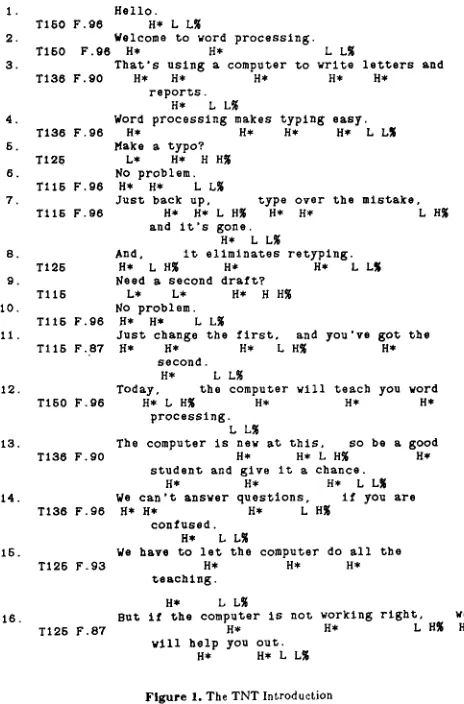
described in [22] in [23, 24]. It permits explicit control over the dif- ferent dimensions of variation in the intonation system. The dimensions we will discuss here are p h r a s i n g , p i t c h r a n g e , a c c e n t l o c a t i o n , and t u n e . We illustrate each in our synthesis of the introduction to TNT:
i. Hello.
TISO F.96 H* L L~
2. Welcome to word processing.
TISO F . g 6 H* H* L L~
3. That's u s i n g a c o m p u t e r to write letters and
T 1 3 6 F . 9 0 H* H* H* H* H*
r e p o r t s .
H* L L~
4. Word processing makes typing easy.
T 1 3 6 F . 9 6 H* H* H* H~ L L~
5 . M a k e a t y p o ?
T125 L* H* H H~
S. No problem.
TII5 F . 9 6 H* H* L L~
7 . J u s t b a c k u p , t y p e o v e r t h e m i s t a k e ,
T I 1 5 F . 9 6 H* H* L H~ H* H* L H~
and it's gone.
H* L L~
8 . A n d , i t e l i m i n a t e s r e t y p i n g .
T 1 2 5 H* L H~ H* H* L L~
9 . N e e d a second d r a f t ?
T115 L* L* H* H H~
1 0 . No problem.
T l 1 5 F . 9 6 if* H* L L~
1 1 . J u s t c h a n g e t h e f i r s t , a n d y o u ' v e got t h e
TII5 F.87 H* H* H* L H~ H*
second.
H* L L~
12. Today, t h e computer will teach you word
T 1 5 0 F . g 6 H* L HS H* H* H*
processing. L L~
1 3 . T h e c o m p u t e r is n e w a t thiS, s o be a good
T 1 3 6 F . g O H* H* L H~ H*
s t u d e n t a n d g i v e i t a c h a n c e .
H* H* H* L L~
14. We can't a n s w e r questions, if you are
T 1 3 6 F . 9 6 H* H* H* L H~
confused. H* L L~
1 5 . We h a v e t o let the c o m p u t e r d o a l l the
T 1 2 5 F . 9 3 H* H* H*
t e a c h i n g .
H* L b~
16. B u t if ~ h e c o m p u t e r is not w o r k i n g right, w e
T125 F.87 H* H* L H~ H *
will help you out.
H * H* L L~
F i g u r e 1. T h e T N T I n t r o d u c t i o n
In Figure 1 and in all figures below, ' T ' indicates the top of the pitch range in Hz, ' F ' indicates amount of compression of the pitch range at the end of declarative phrases, ' H ' and ' L ' indicate high and low tones, '*' indicates a tone's alignment with a stressed syll- able, and ' % ' indicates a phrase boundary tone. We discuss these phenomena and our notational system in more detail below. 3.1 P h r a s i n g
The first dimension of variation, p h r a s i n g , may be indi- cated by a pause, by a lengthening of the phrase-final syllable, and by the occurrence" of extra melodic elements on the end of the phrase. Variation in phrasing is illustrated in Figures 2 and 3. 4 In Figure 2, line 8 is produced as a single phrase, whereas in Figure 3,
A n d is set off as a separate phrase.
One consequence of this strategy is t h a t A n d becomes more prom- inent in the second version. Phrasing variation will not be of cen- tral concern here. Because of the syntactic simplicity of TNT, there were only a few cases where the phrasing could be varied in interesting ways.
4. N o t e t h a t p h o n e t i c t r a n s c r i p t i o n s g i v e n in t h e s e a n d s u b s e q u e n t figures r e p r e s e n t t h e s o m e w h a t eccentric o u t p u t o f t h e T T S s y s t e m .
150 _
t25
100
0
isti l i mulnei i s
i
!aiJp
ing
1] I I I I I I I I I I I I
0.5
1.5
2
2.5
AND IT ELIMINATES RETYPING
F i g u r e 2. One Phrase
'150
425
100
75
oe00°.j i jr el'
,
r i i t!
oi p i n qI I I I • I I I I~ f 1 I J I I
0
0.5
1.5
2.5
AND, IT ELIMINATES RETYPING
F i g u r e 3. Two Phrases
3.2 P i t c h R a n g e
When a speaker raises h i s / h e r voice, h i s / h e r overall p i t c h r a n g e - the distance betweer~ the highest point in the f0 contour and the speaker's b a s e l i n e (defined by the lowest point a speaker realizes over all utterances) -- is expanded. Thus, the highest points in the contour become higher and other aspects are propor- tionately affected. Figure 4 shows an f0 contour for line 1 in the scriot above in the default pitch range used by TTS.
150
125
t00
75
.
h e I o
I I l I I I I I
0
0.5
HELLO
F i g u r e 4. TTS Default Pitch Range
[image:2.612.299.540.38.421.2] [image:2.612.46.278.116.468.2] [image:2.612.304.541.501.638.2]450
125
1 0 0
75
0 . 5 H E L L O
F i g u r e 5. Actual Pitch Range
The shape of the actual contour is the same as in Figure 4 b u t its scaling is different. Changes in pitch range appear to reflect the overall s t r u c t u r e of the discourse, with major topic shifts marked by marked increases in pitch range.
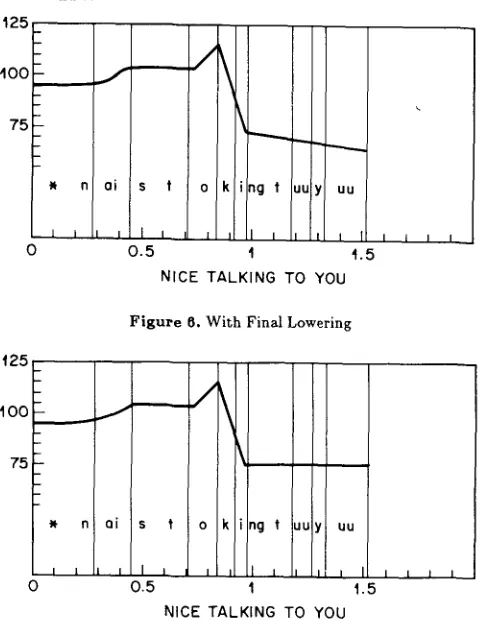
In addition to variations in overall pitch range, the intona- tion system exploits a local time-dependent type of pitch range variation, called f i n a l l o w e r i n g . In the experiments reported in [24], it was found t h a t the pitch range in declaratives is lowered and compressed in .anticipation of the end of the utterance. Final lowering begins about half a second before the end and gradually increases, reaching its greatest strength right at the end of the utterance. This phenomenon appears to reflect the degree of 'final- ity' of an utterance; the more final lowering, the more the sense t h a t an utterance 'completes' a topic is conveyed. Contrast Fig- ures 6 and 7.
125
1 o o -
/\
" ? 5 -
\
n ai s t o k ~g t uu!y uu
1 I I l I I I I I I i
0 0 . 5 I 4.5
NICE TALKING TO YOU
I I I
F i g u r e 0. With Final Lowering
125
-
\
1oo
75- \
- I I
- 1 I
n l a i i s t o k i n g t ! a u y l uu
/
I I il I l I
J
, li i i i i l i i0
0.5
1
1.5NICE TALKING TO YOU
I I 1 1
F i g u r e 7. W i t h o u t Final Lowering
In the notational system employed here, T represents the t o p l i n e , of a phrase -- the maximal value for the f0 contour in the phrase. F expresses the a m o u n t of final lowering in terms of the ratio of the lowered pitch range to the starting pitch range. The default value assumed below for T is 115 Hz and for F is 0.87. 3.3 Accent
P i t c h a c c e n t s , which fall on the stressed syllable of lexical items, mark those items as intonationally prominent. In line 16, for example,
right
has no pitch accent. Ifright
were to be especially emphasized, it would have an accent. (In our notation, the absence of a specified accent indicates t h a t a word is n o t accented; where we wish to highlight this point, we will employ '-' to mark a deac- cented word.) The contrasting outcomes are shown in Figures 8 and 9.75I !!J !!! L!!
i/,'
u .., ,,,
=
/--
/
olt
w e r ' k i n g r oi ti i I
0 . 5 1 1.5 2 2 . 5
BUT IF THE COMPUTER IS NOT WORKING RIGHT
F i g u r e 8.
Right
Deaccented150 _
125
I00
75
bl tl
J_
I
I
f duhkuimmp y L~u
/
I I II I I 1 I I I
0 O. 5 I
Ieni z v a I t w, er k i l g r a i t
i i i I i~ l [ I I I
1.5 2 2.5
BUT IF THE COMPUTER IS NOT WORKING RIGHT
F i g u r e 9.
Right
AccentedIn the first case, the last f0 peak occurs on
work
and there is a fall to a low pitch onright,
then a rise at the end of the phrase. In the second case, the entire peak-fall-rise configuration occurs on the wordright.
[image:3.612.72.313.61.209.2] [image:3.612.331.568.217.353.2] [image:3.612.69.311.366.678.2] [image:3.612.330.569.386.526.2]t 5 0 _
t 2 5
t 0 0
:l
7 5 -
I 0
a e nnd ~ i~ i I i rr Ir
i
!
I I I I I I l I I
0 . 5 I
AND, IT ELIMINATES
F i g u r e 1 0 . A n L + H *
i i
I
,
eilt
s r f i i l , a i ,p i iqI , I II I I I I I 1
t . 5 2 2.5
RETYPING
Accent
Note t h a t there are still peaks on the stressed syllables, but now a striking valley occurs just before each peak.
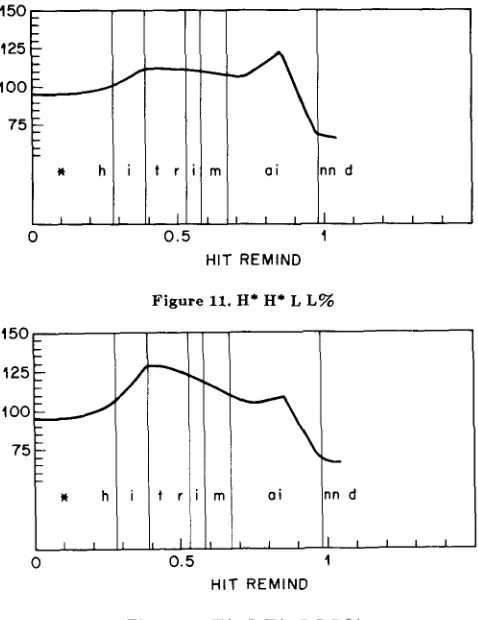
In our synthesis of the T N T script, we have made extensive use of the type of accent transcribed in [23] as H * + L . This accent, like other bitonal accents, triggers a rule which compresses the pitch range on following material in the phrase, a phenomenon known as d o w n s t e p or c a t a t h e s l s . For example, a simple con- trast between H* H* and H * + L H * + L is illustrated in Figures 11 and 12 in two versions of the tutorial command to hit the 'remind' helper key -- Hit remind.
'257
0 0 . 5
HIT REMIND
nn d
t 5 0
125
100
75
F i g u r e 1 1 . H * H * L L %
/
1
I i t r i m
II i I
0 0 . 5
i i ,I I I
I
d
I I
HIT REMIND
I I
F i g u r e 12. H * + L H * + L L L~o
We have made particular use of downstepped contours such as this -- i.e., sequences of H * 4 - L tones -- which we will term H * + L s e q u e n c e in the discussion below. (See Section 4.3.) The way a speaker is structuring a text helps to determine where pitch
accents will fall, as a speaker indicates how referents of accented or deaccented items are related to other items in the utterance or in some larger context.
In addition to pitch accents, each intonational phrase has a p h r a s e a c c e n t and a b o u n d a r y t o n e . These two extra tones may be either L or H. The boundary tone (indicated by '~o') falls exactly at the phrase boundary, while the phrase accent (indicated by an unadorned H or L) spreads over the material between the last pitch accent and the boundary tone. Each intonational phrase contains one or more pitch accents, a phrase accent, and a boun- dary tone.
3.4 T u n e
A phrase's t u n e or m e l o d y is defined by its particular sequence of pitch accents, phrase accent, and boundary tone. Thus, H* L L~o represents a tune with a H* pitch accent, a L phrase accent, and a L~:~ boundary tone. This is an ordinary declarative pattern with a final fall. A interrogative contour is represented by L* H H~o. The contrast between these two melo- dies is illustrated in Figures 13 and 14. Figure 13 shows the actual f0 contour for line 5 of the T N T introduction, produced as a ques- tion.
'150
125
'100
75
i / i
i
/
fJ
* m e l k ~ i t t a i p o
i
I I I I I I I I ti I i
0 0 , 5 I
MAKE A TYPO ?
I I I
F i g u r e 13. Interrogative Contour Figure 14 shows a declarative pattern for the same sentence.
150
125 I
t 0 0 75
I
___/\,__/\
,
',.__.
rn e i k ,if t r a i p o
I I I I I II i I I d B
0 . 5 I
MAKE A TYPO.
I I
F i g u r e 14. Declarative Contour
[image:4.612.46.280.69.218.2] [image:4.612.304.541.298.436.2] [image:4.612.46.285.342.652.2] [image:4.612.307.545.477.623.2]4. I n t o n a t i o n a l a n d D i s c o u r s e P h e n o m e n a
The major questions underlying our research are: First, what is the relationship between particular'-,intonational phenomena and particular discourse phenomena?~ F o r example, what discourse phenomena are associated with eh£~iges in pitch range? With the accenting or deaccenting of particular lexical items? With choice of tune? More generally, we also characterize the contributions of these intonational phenomena in terms of the theory.of, discourse structure developed in [15], by relating intoua- tionM .contributions to aspects of intentional and attentional discourse structure. Second, how do int0na~ionul features such as these interact with one another? Does an expansion of pitch range affect the interpretation of a r i s e - f a l l - r i s e contour [25], for exam- ple, and if so how? Third, when several discourse features predict conflicting intonational strategies, how is a decision made? When the information represented by a single referring expression, for example, is both 'given' and 'contrastive' -- and thus both deac- centable and accentable -- how is the choice to be made?
4 . 1 P i t c h R a n g e M a n i p u l a t i o n
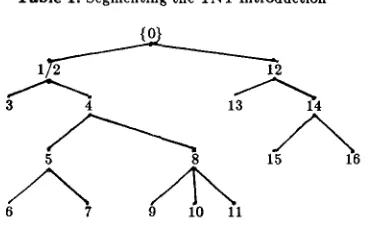
Students of discourse commonly observe t h a t discourses often exhibit a hierarchical structure - into major topics, their subtopics, sub-subtopics, and so on. In task-oriented domains, it has been claimed t h a t this structure reflects the hierarchical struc- ture of a task and its subtasks [18]. So, for example, the T N T introduction above might be segmented as follows (where utter- ances are labeled by line number): 5
T a b l e 1. Segmenting the T N T Introduction { 0
3 4
6 7 9 10 11
This bracketing schema defines a discourse segment as any node together with all the nodes it dominates; for example, lines 1-11 form a segment, as do lines 14-16, and so on. An alternative depic- tion of the hierarchy above would be [{0}[1/2 3 [4 [5 6 7] [8 9 10 11]]] [12 [13] [14 15 16]]]fi Evidence for such hierarchical segmenta- tion in general is found in instances of pronominal reference to referents linearly distant in the discourse; in such cases, a notion of hierarchical proximity appears plausible.
Previous research [12,14] has observed t h a t 'topic j u m p ' can be signalled by raised pitch, as well as increased a ~ p l i t u d e and markers of self-editing, hesitation, and discontinuity - . a n d t h a t pauses and changes in rate characterize segment boundaries. In our work with the T N T script, we found t h a t a hierarchical seg- mentation of discourse can be marked by systematic variation in pitch range, which can signal movement betweeen levels in the seg- ment hierarchy. In addition, by varying the a m o u n t of final rais'ihg or lowering at the end of phrases, we can indicate the degree of conceptual continuity between one phrase and the next. We have developed algorithms for assigning pitch range and fiual raising/lowering in terms of the discourse segmentation.
5. We do not claim this is the only possible segmentation, only that it is a plausi- ble one to convey.
6. Note that I and 2 are treated as a unit here, although they are synthesized as separate phrases, since it seemed semantically correct.
To illustrate the algorithms, we relate the T N T introduction presented in Figure 1 to its segmentation in Table 1. When the introduction is synthesized using the T T S ' d e f a u l t pitch range of 75-11~ Hz, the topline for each utterance will remain around 115 Hz. However, the hierarchical relationship schematized above among the various segments may be signalled more clearly if the pitch range is varied. In our version of the script, each segment boundary is marked by a variation in pitch range which correlates with the segment's position in the overall discourse. So, major boundaries are denoted by the largest increases, with smaller increases marking subsegment boundaries, and so on. The segment beginning at 1, for example, is marked by raising the f0 topline to 150 Hz; t h a t beginning at 14, by raising the topline to 136 Hz; and t h a t beginning at 15, by raising the topline to 125 Hz. 7 Human speakers do seem to employ a wider spectrum of pitch range varia- tion than we have been able to use in synthesis, however.
We would claim t h a t the appropriateness of changes in pitch range is a function of the segmentation hierarchy -- and is not inherent in the utterance in isolation. Our algorithm for pitch range assignment can in fact enforce one segmentation of a given discourse over another and, in so doing, can disambiguate among potentially ambiguous reference resolutions. For example, It in line 7 of Figure 1 coindexes mistake, while it in line 8 coindexes word processing. A simple linear approach to reference resolution (such as [26] ) would have the second coindexical with the previous noun-phrase (np), mistake, but a hierarchical approach to discourse structure holds out the possibility t h a t a referent in a segment dominating the current segment may also provide a referent [18], as, in fact, is the case here. While a little t h o u g h t will make the appropriate referent clear, it is clearer when line 8 is produced with a larger pitch range to signal the beginning of a new subseg- ment of the segment headed by 4. By so doing, we lessen the possi- bility t h a t a referent for this it will be sought in lines.:5-7..The most likely candidate, found in 4, is now both intonationally and conceptually 8's superordinate discourse segment.
While an increase in the pitch range indicates segment boun- daries, a decrease in the final lowering effects can indicate the absence of such boundaries, and t h u s indicate t h a t a given utter- ance and one which follows it are part of the same segment. So, manipulation of final lowering can also serve to indicate discourse structure, by identifying the internal structure of segments. For example, at one point in the T N T script, the following utterance constitutes an entire discourse segment, so it has ,the default final lowering (F=0.87); in consequence, the L ~ tone at the end of had
will be only 87% as high as it would have been if final lowering had not applied.
F . 8 7 Type had. H* H* L L~
Compare this with: Type had. F.93 H* H* L L~
When y o u ' r e d o n e , H* L H~
h i t changer. H* L L~
[image:5.612.104.291.343.461.2]may be associated with 'pops' of this stack. In our synthesis of the T N T text, we have varied degree of final lowering for such 'pops' based upon the level of the segment which this utterance 'com- pletes' (or, equivalently, the level of the segment the next utterance begins). So, to determine the a m o u n t of final lowering to assign when synthesizing line 7 in the T N T introduction, we first deter- mine whether it completes a segment (representing a pop) or not (representing a push). If the former, we may note either that it completes the segment begun at line 5 (with a topline of 136 Hz), or t h a t the subsequent segment is begun (by line 8) with a topline of 136 Hz. We assign final lowering of 0.90 when synthesizing line 7 based on either observation; this rather large amount (close to the synthesizer's default maximum of 0,87) conveys a relatively impor- t a n t change of subtopic within the larger discourse segment by indicating rather more disjunction than we would want, for exam- ple, between lines 9 and 10.
We are currently testing the associations between pitch r a n g e / final lowering variation and discourse structure proposed above in several ways: by pitch-tracking a large corpus of natural speech, 8 by recording and analyzing subjects reading structured texts, and by asking subjects to perform tasks such as reference resolution from texts synthesized with varying pitch ranges. 4.2 A c c e n t P l a c e m e n t
Accent placement, too, can convey information about the structure of a discourse. Traditionally, it has been noted t h a t stress, or accent, can convey information about the focus of an utterance, about given or new information in the discourse, o about parallelism, or about contrastiveness. In more general terms, one might say t h a t accent placement appears to be associated with Grosz and Sidner's [15] a t t e n t l o n a l structure -- the salience of discourse entities, properties, relations, and intentions at any point in the discourse. We have particularly noted t h a t the decision to accent or deaccent some item is sensitive to the position of t h a t item in the discourse structure - t h a t is, just as salience is always determined relative to some particular context, accent placement m u s t be determined with respect to the segment in which the accentable item appears. We take the position t h a t it is the signal- ing of salience relative to the discourse segment t h a t produces the secondary effects of given-new distinction, topic-hood or contras- tiveness, and the favoring of one reference resolution over another.
One of the more common observations about the role of accent placement and the structuring of discourse is t h a t accent can mark some item in the discourse as in f o c u s - i.e., as 'what is being talked about' [28,29} -- particularly when syntactic or thematic information might predict otherwise. For example, in the following instructions, erase is accented in line 2 to indicate t h a t the action of 'erasing' is the focus of the current task.
1. Type hello.
H* H* L L~
2 . Next, let's erase hello.
H* L H~ H* H* - L L~
3. Hit hint.
H* H* L L~
For similar reasons, we accent hello in line 1 and deaccent it in line 2.
While focus considerations clearly influence accent place- ment, determining accent placement solely on the basis of utterance-level focus (as proposed in Gussenhoven [29} and Cull- F r o m i n t e r v i e w s collected by A. K r o c h a n d G. W a r d a n d f r o m r e c o r d i n g s m a d e of a r a d i o f i n a n c i a l a d v i s e p r o g r a m by J. H i r s c h b e r g a n d M. P o l l a c k .
Prince [271 notes that the 'given/new' distinction has been variously defined as predictable/unpredictable, salient/not salient, shared/not shared knowledge, and proposes a more complex taxonomy of 'assumed familiarity' classifying discourse entities as new, inferrable, or evoked (either textually or situation- ally). T h i s is closely r e l a t e d -- a n d often confused w i t h -- t h e n o t i o n of u t t e r - ance t o p i c / f o c u s .
cover and Rochemont [30] ) is insufficient. Considerations such as the given/new distinction play an i m p o r t a n t role.
Speakers typically deaeeent given information and accent new information, as when the 'new' information typing is accented and the 'old' word processing is not in line 3 below:
W e l c o m e to word processing.
B* H* L L ~
T h a t ' s using a computer to write l e t t e r s
H* H* H* H* H*
and reports.
H* L L~
Word processing makes typing easy.
H* H* H* L L~
Note t h a t these items are marked as 'given' and 'new' within the current segment -- although they may have other status within the larger discourse. Furthermore, items appear 'given' or 'new' not simply because of prior mention (or lack thereof) in a context b u t via 'physical co-presence', where speaker, hearer, and referents are physically and openly present together; [31] shared world knowledge; or conceptual proximity [11. For example, the tutor can treat m as given in the following text because the student has just (incorrectly) typed mary; the character 'm', the student, and the tutor, are thus physically copresent.
Oops. capital m.
H* L H~ H* - L L~
The new information is t h a t 'm' is to be capitalized. T h u s cap~al is accented. Similarly, in the introduction to the t u t o r presented in Figure 1, we can deaccent m~take because it is a super-cQncept of the previously mentioned typo:
Make a type?
L* H* H H~
No problem.
H* H* L L~
Just b a c k up, type over t h e mistake,
H* H* L H~ H* H* L H~
a n d it's g o n e .
H* L L~
We also examine how pronominalization interacts with accent placement. Since the ability to pronominalize is itself a standard test of givenness, p r o w o r d s , like other given items, are commonly deaecented. If they are accented, the hearer may draw very different conclusions from an utterance. The following utter- ance, for example, may well convey an instruction to type the word something or even a reprimand for not typing anything yet:
Let's hegln by typing something.
H* H* H*
Since the T N T script employes little pronominalization, we often use deaccenting to 'intonationally pronominalize' repetitions of lex- ical items.
Accent can also signal t h a t a discourse referent other than t h a t which would be 'most likely' without special accentuation should be sought, as in:
I.
2.
We c a n ' t a n s w e r questions, if you are confused.
H* H* H* L H~ H* L L~
We have to le~ the c o m p u t e r do all the teaching.
H* H* H* H* L LS
tutorial system itself. Since pronouns -- as 'given' information -- are commonly deaccented, we accent this one to indicate that an 'unusual' referent should be sought, 10 So, both accent placement and manipulation of pitch range can be used to reorder the list of potential referents for a given referring expression.
FinMly, eontrastiveness or parallelism may also be commun- icated via accent. For example, second is accented in 3, although it is certainly given in this segment (via mention of second draft in 1):
I. Nned a second draft? L* L* L* H H~ 2. No problem.
H* H* L L~
3. Just change the first, and you've got the second.
H* H* L H~ H* H* L L~
Note that, while second may be 'given' at the discourse segment level, the decision to accent it is based on contrast within a smaller context, 3. Furthermore, if this function of accent is ignored, con- trastiveness may be inferred incorrectly. If we accent we in the last line of the tutorial introduction W E will help you out, for exam- ple, the s t u d e n t would be entitled to infer t h a t others will not be helpful.
We are currently developing Mgorithms for determining accent placement, based upon the interaction of focus, given/new, parallelism, contrastiveness, and pronominal reference within seg- ment and phrase.
4.3 C h o i c e o f T u n e
It is now widely accepted t h a t the overall melody a speaker employs in an utterance can communicate some semantic or prag- matic information. However, since there are few particular tune types for which we can specify with any confidence just w h a t the meaning might be, it is difficult to generalize about w h a t type of information tunes in generM can convey. F r o m those tunes whose 'meaning' seems fairly well understood -- namely, d e c l a r a t i v e , y e s - n o q u e s t i o n [23], s u r p r l s e / r e d u n d a n c y [10], c o n t r a d i c t i o n c o n t o u r [33] r i s e - f a l l - r l s e [25], and c o n t i n u a t i o n r i s e [34,35] contours -- we propose t h a t tunes convey two sorts of information about discourse.
First, we believe t h a t contours can convey p r o p o s i t i o n a l a t t l t u d e s n the speaker wishes to associate with the propositional content of an utterance. For example, the speaker may wish to convey t h a t s / h e knows x, or t h a t s / h e believes x, or t h a t s / h e is uncertain about x, or t h a t s / h e is ignorant of x. In the case of H * + L sequences, it appears t h a t a speaker may convey h i s / h e r (propositional) attitudes about a hearer's (propositional) attitudes toward an utterances. This tune seems to indicate the speaker's belief t h a t the speech act s / h e is performing is superfluous. For example, a speaker may employ it to convey t h a t the propositional content of h i s / h e r utterance is already known or would be obvious to the hearer (who, of course, may or may not be attending to it). Note t h a t the speaker may or may not believe t h a t this information is known, in order to wish to convey this meaning. Particularly in pedagogical texts, this contour seems appropriate to introduce straightforward material, as in the following instruction to hit the remind key.
Remind, tells you again what to do If you forget.
R* L H~ tt* H* H* H* L L~
Hit re~ind. H*+L H*+L L L~
However, an H * + L sequence is not appropriate in the following similar exchange:
I0. The standard example of accentuation influencing pronominal reference resolu- tion in this way is'john hit Bill and then HE hit HIM 1321.
11. Propositional attitudes include knowing, believing, intending, uncertainty, and ignorance.
Next, let's erase hello. H* L H~ H* H* L L~ Hit hint.
H* H* L L~
In general, such contours do n o t seem felicitous when the utterance conveys information which the speaker believes will be unexpected for the hearer. Here tune choice may reflect atten- tional as well as intentional aspects of the discourse structure. Like the deaccenting of references to given items, t t * + L sequence contours seem to convey 'givenness' at a more general level.
Second, we believe t h a t tune can convey the speaker's com- mitment to some semantico-pragmatic structural relationship hold- ing between the propositional content of utterances (as, t h a t one 'completes' another or is subordinate to another). Many such rela- tions have been proposed in textual analysis [36,37,15]. In the phonological literature, continuation rise has been commonly asso- ciated with some sense of 'continuation' or 'more to come' [34]. We have found, howe-rer, t h a t this contour can be characterized more precisely as conveying a subordination relationship between the phrase uttered with continuation rise and other utterances in the discourse segment. For example, if the second phrase of line 1 is uttered with continuation rise, then this utterance appears to be subordinated to 2.
I. We c a n ' t a n s w e r questions, if you are confused.
H* H* H* L H~ H* L H~
2. We have to let the c o m p u t e r do all the teachlng.
H* H* H* H* L L~
3. But if the c o m p u t e r is not w o r k i n g right, we will help
H* H* L H~ H* H*
you out. H* L L%
T h a t is, 2 'completes' I. Without continuation rise on 1, all three utterances will appear to have equal s t a t u s in th'esegfiaent. F u r t h - ermore, continuation rise is n o t felicitous in ~.ll ~ontexts in which the simple sense t h a t 'there is more to come' clearly should be appropriate; for example, continuation rise over 3 -- at the end of the tutorial introduction -- seems quite odd, even though more will clearly follow.
In synthesizing the T N T script, we have employed only a small subset of possible English tunes. Analysis of the 'meaning' of additional tunes is p a r t of our future research. More generally, we m u s t examine how structural relationships conveyed by tunes such as H * + L sequence are ~.ssociated with those conveyed by pitch range.
We have described certain mappings between intonational features and discourse phenomena, associating pitch range varia- tion with the identification of discourse segments and with their internal coherence; accent with types of information status such as topic (focus) and the given/new distinction, with reference resolu- tion and with contrastiveness; and tune choice with~ ~he, relation- ships among propositions in the discourse as well as w~l~b.,~ome pro- positional attitude the speaker wishes to associate with :those pro- positions. It appears t h a t pitch range and accent placement are most closely associated with a diseourse's attentional structure, while tune choice is more closely associated with its intentional structure. However, clearly this picture is too simple. SeverM into- national features may be used together to create some discourse effect; moreover, in some cases two distinct intonational phenomena seem to produce discourse effects t h a t seem intuitively to be closely related. And sometimes several discourse phenomena may indicate conflicting intonational strategies. These problems are the subject of our future research.
5. D i s c u s s i o n
speakers try to convey and to synthesize speech more effectively. We have described three major intonational phenomena -- pitch range, accent, and tune -- and some of the information they allow speakers to communicate about discourse, demonstrating some links between discourse and intonational phenomen~ which have not been noted in the literature and refining some notions which have. We also identify major issues which future research on the relationship between discourse and intonation must address, including a more precise mapping between discourse and intona- tional phenomena, the interaction of intonational phenomena to produce particular discourse effects, and the way conflict between intonational strategies signaled by various aspects of the discourse may be resolved.
We are currently testing and refining our hypotheses by 1) pitch tracking recorded natural discourse to determine pitch range manipulation, and 2) conducting pilot empirical studies of how principled manipulation of pitch range can affect reference resolu- tion. We are also examining in some detail the relationship between pronominalization and deaccenting, pursuant to the development of better accenting algorithms for synthetic speech. Our ultimate goals are practical as well as theoretical. Once we have determined how particular intonational phenomena are related to particular discourse phenomena, the next step is to determine how these find- ings can be applied to natural-language generation. In particular, how much intonational structuring of generated text can be done automatically? What sorts of information must be represented to support the assignment of rhetorically effective intonation?
ACKNOWLEDGEMENTS
We would like to thank Lloyd Nakatani and Dennis Egan for help with TNT, Barbara Gross and Candy Sidner for useful discussions, Mary Beckman, Diane Litman, and Ken Church for comments on earlier drafts, and Mark Liberman for assistance with the TTS sys- tem and the development of its prosody.
R E F E R E N C E S
[1]
Chafe, W., Givenness, contrastiveness, definiteness, subjects, topics, and point of view, in Subject and topic, ed. Li, C., Academic Press, New York (1976).[21
Schmerling, S., Presupposition and the notion of normal stress, Papers from the Seventh Regional Meeting of the Chi-cago Linguistic Society, Chicago, (1971).
[3] Sehmerling, S., A re-examination ,of the notion NORMAL STRESS, Language 50 pp. 66-73 (1974).
[41
Wilson, D., and Sperber, D., Ordered entailments: an alterna- tive to presuppositional theories, pp. 229-324 in Syntax and semantics 11, ed. Oh, C.-K., and Dinneen, D. A., Academic Press, New York (1979).[51 Gleitman, L., Pronominals and stress in English, Language Learning 11 pp. 157-169 (1961).
[6[
Gundel, J., Stress, pronominalization, and the given-new dis- tinction, University of Hawaii Working Papers in Linguistics 10(2) pp. 1-13 (1978).[7] Jwekendoff, R. S., Semantic interpretation in generative gram- mar, MIT Press, Cambridge MA (1972).
[8] Ladd, D. R., The structure of intonational meaning, Indiana University Press, Bloomington (1980).
[9] Austin, J. L., How to do things with words, Clarendon Press, Oxford (1962).
[10]
Sag, I. A. and Liberman, M., The intonational disambiguationof indirect speech acts, Papers from the Eleventh Regional Meeting of the Chicago Linguistic Society, pp. 487-498 Chi- cago, (1975).
[11[
[12[
[13]
[141
[151
[161
[171
I18[
[19]
[201
[211
[22[
[23]
[24[
[25[
Sadock, J., Toward a linguistic theory of speech acts, Academic, New York (1974).
Schlegoff, E. A., The relevance of repair, to syntax-for- conversation, pp. 261-288 in Syntaz and semantics 12: Discourse and syntax, ed. Givon, T., Academic, New York (1979).
Brazil, D., Coulthard, M., and Johns, C., Discourse intonation and language teaching, Longman, London (1980).
Butterworth, B., Hesitation and semantic planning in speech, Journal of Psyeholinguistie Research 4 pp. 75-87 (1975). Grosz, B. J., and Sidner, C. L., The Structures of discourse structure, 6097, BBN Laboratories Inc. (November 1985). Also appears as CSLI-85-39, as Technical Note #369 from t h e AI Center, SRI International, and will appear in Computational Linguistics, 1986.
Nakatani, L., Egan, D., Ruedisueli, L., and Hawley, P., TNT: A talking t u t o r ' n ' trainer for teaching the use of interactive
computer systems, To be presented the Conference on Human Factors in Computing Systems, April 13-17, 1986 (1986). Olive, J. P., and Liberman, M. Y., Text to speech -- An over- view, J. Aeoust. Soc. Am. Suppl. 1 78(Fall) p. s6 (1985). Levy, E. T. and Grosz, B., Communicating thematic structure in narrative discourse: the use of referring terms and gestures,
PhD thesis, University of Chicago (1984).
Reiehman, Rachel, Getting computers to talk like you and me, MIT Press, Cambridge MA (1985).
Cohen, R., A computational model for the analysis of argu- ments, PhD thesis, University of Toronto (1983).
Sacks, H., Sehlegoff, E., and Jefferson, G., A simple systemat- ies for the organization of turn-taking for conversation, Lanu- age 50 pp. 696-735 (1974).
Anderson, Mark D., Pierrehumbert, Janet B., and Liberman, Mark Y., Synthesis by rule of English intonation patterns, Proceedings of the International Conference on Acoustics, Speech, and Signal Processing, pp. 2.8.1-2.8.4 San Diego, (1984). Vol. 1
Pierrehumbert, J., The Phonology and phonetics of English intonation, PhD thesis, MIT (1980).
Liberman, M., and Pierrehumbert, J., Intonational invariants under changes in pitch range and length, in Language sound structure, ed. Aronoff, M., and Oehrle, R., MIT Press, Cam- bridge (1984).
Ward, G., and Hirschberg, J., Implicating Uncertainty: The Pragmatics of Fall-Rise Intonation, Language 01(4) pp. 747- 776 (1985).
[26] Winograd, T., Understanding natural language," Academic Press, New York (1972).
[27] Prince, E. F., Towards a taxonomy of given-new information, pp. 223-256 in Radical pragmatics, ed. Cole, P., Academic, New York (1981).
12s[
[291
Sidner, C. L., Towards a computational theory of definite ana- phora comprehension in English discourse, PhD thesis, MIT (1979). Also appears as TR 537, MIT AI Lab.
\
[30]
[31]
[32]
[34]
[35]
[36]
I~7]
Culieover, Peter W., and Rochemont, Michael, Stress and
focus in English, Language 59(1) pp. 123-165 (1983).
Clark, H. H., and Marshall, C. R., Definite reference and
mutual knowledge, in Elements of discourse understanding,
ed. Joshi, A., Webber, B., and Sag, I., Cambridge University Press, Cambridge (1981).
Lakoff, G., Presupposition and relative well-formedness, pp.
329-340 in Semantics, ed. Steinberg, D., and Jakobovits, L.,
Cambridge University Press, Cambridge (1971).
Liberman, M., and Sag, I., Prosodic form and discourse func-
tion, Papers from the Tenth Regional Meeting of the Chicago
Linguistic Society, pp. 416-427 Chicago, (1974).
Bolinger, D., Intonation and its parts, Language 58(3) pp.
505-533 (1982).
Bing, J., Aspects of English prosody, PhD thesis, University of
Massachusetts at Amherst (1979). Reprinted by the Indiana University Linguistics Club, 1980
Mann, W. C., Moore, M. A., Levin, J. A., and Carlisle, J. H.,
Observation methods for human dialogue, RR/75/33, ISI
(1975).
McKeown, K., Generating natu.ral language text in response to