Mixed Language Query Disambiguation
P a s c a l e F U N G , L I U X i a o h u a n d C H E U N G C h i S h u n H K U S T
H u m a n L a n g u a g e T e c h n o l o g y C e n t e r
D e p a r t m e n t of Electrical a n d E l e c t r o n i c E n g i n e e r i n g U n i v e r s i t y of Science a n d Technology, H K U S T
Clear W a t e r Bay, H o n g K o n g
{pascale, Ixiaohu, eepercy}@ee, ust. hk
A b s t r a c t
We propose a mixed language query disam- biguation approach by using co-occurrence in- formation from monolingual data only. A mixed language query consists of words in a primary language and a secondary language. Our m e t h o d translates the query into mono- lingual queries in either language. Two novel features for disambiguation, namely contextual word voting and 1-best contextual word, are in- troduced and compared to a baseline feature, the nearest neighbor. Average query transla- tion accuracy for the two features are 81.37% and 83.72%, compared to the baseline accuracy of 75.50%.
1 I n t r o d u c t i o n
Online information retrieval is now prevalent because of the ubiquitous World Wide Web. The Web is also a powerful platform for another application--interactive spoken language query systems. Traditionally, such systems were im- plemented on stand-alone kiosks. Now we can easily use the Web as a platform. Information such as airline schedules, movie reservation, car trading, etc., can all be included in HTML files, to be accessed by a generic spoken interface to the Web browser (Zue, 1995; DiDio, 1997; Ray- mond, 1997; Fung et al., 1998a). Our team has built a multilingual spoken language inter- face to the Web, named SALSA (Fung et al., 1998b; Fung et al., 1998a; Ma and Fung, 1998). Users can use speech to surf the net via vari- ous links as well as issue search commands such as "Show me the latest movie of Jacky Chan'. The system recognizes commands and queries in English, Mandarin and Cantonese, as well as mixed language sentences.
Until recently, most of the search engines han- dle keyword based queries where the user types
in a series of strings without syntactic structure. The choice of key words in this case determines the success rate of the search. In many situa- tions, the key words are ambiguous.
To resolve ambiguity, query expansion is usu- ally employed to look for additional keywords. We believe that a more useful search engine should allow the user to input natural lan- guage sentences. Sentence-based queries are useful because (1) they are more natural to the user and (2) more importantly, they provide more contextual information which are impor- tant for query understanding. To date, the few sentence-based search engines do not seem to take advantage of context information in the query, b u t merely extracting key words from the query sentence (AskJeeves, 1998; ElectricMonk,
1998).
In addition to the need for better query un- derstanding m e t h o d s for a large variety of do- mains, it has also become important to han- dle queries in different languages. C r o s s - l a n g u a g e i n f o r m a t i o n r e t r i e v a l has emerged as an i m p o r t a n t area as the a m o u n t of non- English material is ever increasing (Oard, 1997; Grefenstette, 1998; Ballesteros and Croft, 1998; Picchi and Peters, 1998; Davis, 1998; Hull and Grefenstette, 1996). One of the important tasks of cross-language IR is to translate queries from one language to another. T h e original query and the translated query are then used to match documents in b o t h the source and target lan- guages. Target language documents are either glossed or translated by other systems. Accord- ing to (Grefenstette, 1998), three main prob- lems of query translations are:
3. pruning translation alternatives for docu- ment matching.
In cross-language IR, key word disambigua- tion is even more critical than in monolin- gual IR (Ballesteros and Croft, 1998) since the wrong translation can lead to a large amount of garbage documents in the target language, in addition to the garbage documents in the source language. Once again, we believe that sentence- based queries provide more information than mere key words in cross-language IR.
In both monolingual IR and cross-language IR, the query sentence or key words are as- sumed to be
consistently
in one language only. This makes sense in cases where the user is more likely to be a monolingual person who is looking for information in any language. It is also eas- ier to implement a monolingual search engine. However, we suggest that the typical user of a cross-language IR system is likely to be bilin- gual to some extent. Most Web users in the world know some English. In fact, since En- glish still constitutes 88% of the current web pages, speakers of another language would like to find English contents as well as contents in their own language. Likewise, English speakers might want to find information in another lan- guage. A typical example is a Chinese user look- ing for the information of an American movie, s/he might not know the Chinese name of that movie. His/her query for this movie is likely to be in m i x e d l a n g u a g e .Mixed language query is also prevalent in
spoken language. We have observed this to
be a common phenomenon among users of our SALSA system. The colloquial Hong Kong lan- guage is Cantonese with mixed English words. In general, a mixed language consists of a sen- tence mostly in the
primary language
with some words in asecondary language.
We are inter- ested in translating such mixed language queries into monolingual queries unambiguously.In this paper, we propose a mixed language query disambiguation approach which makes use of the co-occurrence information of words between those in the primary language and those in the secondary language. We describe the overall methodology in Section 2. In Sec- tions 2.1-3, we present the solutions to the three
disambiguation problems. In Section 2.3 we
present three different discriminative features
for disambiguation, ranging from the baseline model (Section 2.3.1), to the voting scheme (Section 2.3.2), and finally the 1-best model (Section 2.3.3). We describe our evaluation ex- periments in Section 3, and present the results in Section 4. We then conclude in Section 5.
2 M e t h o d o l o g y
Mixed language query translation is halfway be- tween query translation and query disambigua- tion in that not all words in the query need to be translated.
There are two ways to use the disambiguated mixed language queries. In one scenario, all secondary language words are translated unam- biguously into the primary language, and the resulting monolingual query is processed by a general IR system. In another scenario, the primary language words are converted into sec- ondary language and the query is passed to another IR system in the secondary language. Our methods allows for both general and cross- language IR from a mixed language query.
To draw a parallel to the three problems of query translation, we suggest that the three main problems of mixed language disambigua- tion are:
1. generating translation candidates in the primary language,
2. weighting translation candidates, and
3. pruning translation alternatives for query translation.
non-parallel corpora (Smadja et al., 1996; Ku- piec, 1993; Wu, 1995; Tanaka and Iwasaki, 1996; Fung and Lo, 1998), or monolingual corpora (Smadja, 1993; Fung and Wu, 1994; Liu and Li, 1997; Shiitze, 1992; Yarowsky, 1995). As we noted in (Fung and Lo, 1998; Fung, 1998), parallel corpora are rare in most domains. We want to devise a m e t h o d that uses only mono- lingual data in the primary language to train co-occurrence information.
2.1 T r a n s l a t i o n c a n d i d a t e g e n e r a t i o n
W i t h o u t loss of generality, we suppose the mixed language sentence consists of the words S = ( E 1 , E 2 , . . . , C , . . . , E n } , where C is the only secondary language word 1. Since in our m e t h o d we want to find the co-occurrence in- formation between all Ei and C from a mono- lingual corpus, we need to translate the lat- ter into the primary language word Ec. This corresponds to the first problem in query translation--translation candidate generation. We generate translation candidates of C via an online bilingual dictionary. All translations of secondary language word C , comprising of mul- tiple senses, are taken together as a set {Eci }.
2.2 T r a n s l a t i o n c a n d i d a t e w e i g h t i n g
Problem two in query translation is to weight all translation candidates for C. In our method, the weights are based on co-occurrence informa- tion. The hypothesis is that the correct transla- tions of C should co-occur frequently with the contextual words Ei and incorrect translation of C should co-occur rarely with the contex- tual words. Obviously, other information such as syntactical relationship between words or the part-of-speech tags could be used as weights too. However, it is difficult to parse and tag a mixed language sentence. T h e only information we can use to disambiguate C is the co-occurrence information between its translation candidates { Ec, } and El, E2, . . . , En.
Mutual information is a good measure of the co-occurrence relationship between two words (Gale and Church, 1993). We first compute the m u t u a l information between any word pair from a monolingual corpus in the primary language 2
1In actual experiments, each sentence can contain multiple secondary language words
2This corpus does not need to be in the same domain as the testing data
using the following formula, where E is a word and f (E) is the frequency of word E.
M I ( E i , Ej) = log f ( E i , Ej)
f ( E i ) * f ( S j ) (1) Ei and Ej can be either neighboring words or any two words in the sentence.
2.3 T r a n s l a t i o n c a n d i d a t e p r u n i n g
The last problem in query translation is select- ing the target translation. In our approach, we need to choose a particular Ec from Ec~. We call this pruning process t r a n s l a t i o n d i s a m - b i g u a t i o n .
We present and compare three unsupervised statistical m e t h o d s in this paper. The first base- line m e t h o d is similar to (Dagan et al., 1991; Dagan and Itai, 1994; Ballesteros and Croft, 1998; Smadja et al., 1996), where we use the nearest neighboring word of the secondary lan- guage word C as feature for disambiguation. In the second m e t h o d , we chQose all contex- tual words as disambiguating feature. In the third m e t h o d , the most discriminative contex- tual word is selected as feature.
2.3.1 Baseline: single n e i g h b o r i n g w o r d
as d i s a m b i g u a t i n g f e a t u r e
The first disambiguating feature we present here is similar to the statistical feature in (Dagan et al., 1991; Smadja et al., 1996; Dagan and Itai, 1994; Ballesteros and Croft, 1998), namely the co-occurrence with neighboring words. We do not use any syntactic relationship as in (Dagan and Itai, 1994) because such relationship is not available for mixed-language sentences. The as- s u m p t i o n here is that the most powerful word for disambiguating a word is the one next to it. Based on m u t u a l information, the primary lan- guage target word for C is chosen from the set {Ec~}. Suppose the nearest neighboring word for C in S is E y , we select the target word Ecr, such that the m u t u a l information between Ec~ and Ev is maximum.
r = argmaxiMI(Ec,, Ey) (2) Ev is taken to be either the left or the right neighbor of our target word.
6 6
0
Word in the p r ~ I~guagu
Q ord in th¢ secondary language
Selected translation word MII > MI2
Figure 1: T h e neighboring word as disambiguat- ing feature
represented by the dotted line. Ey is the neigh- boring word for C. Since MI1 is greater t h a n MI2, Ecl is selected as the translation of C. 2.3.2 V o t i n g : m u l t i p l e c o n t e x t u a l
w o r d s as d i s a m b i g u a t i n g f e a t u r e The baseline m e t h o d uses only the neighboring word to disambiguate C. Is one or two neigh- boring word really sufficient for disambigua- tion?
The intuition for choosing the nearest neigh- boring word Ey as the disambiguating feature for C is based on the assumption t h a t they are part of a phrase or collocation term, and that there is only one sense per collocation (Dagan and Itai, 1994; Yarowsky, 1993). However, in most cases where C is a single word, there might be some other words which are more useful for disambiguating C. In fact, such long-distance dependency occurs frequently in natural lan- guage (Rosenfeld, 1995; Huang et al., 1993).
Another reason against using single neighbor- ing word comes from (Gale and Church, 1994) where it is argued that as many as 100,000 con- text words might be needed to have high disam- biguation accuracy. (Shfitze, 1992; Yarowsky, 1995) all use multiple context words as discrim- inating features. We have also demonstrated in our domain translation task that multiple con- text words are useful (Fung and Lo, 1998; Fung and McKeown, 1997).
Based on the above arguments, we enlarge the disambiguation window to be the entire sen- tence instead of only one word to the left or right. We use all the contextual words in the query sentence. Each contextual word "votes" by its m u t u a l information with all translation candidates.
Suppose there are n primary language words in S = E 1 , E 2 , . . . , C , . . . , E n , as shown in Fig- ure 2, we compute m u t u a l information scores
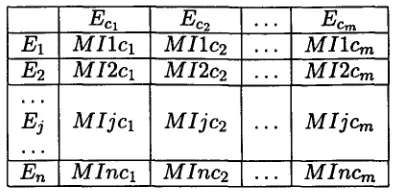
between all Ec~ and all Ej where Eci is one of the translation candidates for C and E j is one of all n words in S. A m u t u a l information score matrix is shown in Table 1. whereMIjc~ is the m u t u a l information score between contex- tual word Ej and translation candidate Eel.
E1
E2
° o .
E j
En
Eel Ec2 M I l c l MIlc2 MI2cl MI2c2
M l j c l Mljc2
M I n c l MInc2
° o o E c ~
... M I l c m ... MI2cm
. . . MXjc
... Mlncm
Table 1: M u t u a l information between all trans- lation candidates and words in the sentence
For each row j in Table 1, the largest scoring M I j c i receives a vote. T h e rest of the row get zero's. At the end, we s u m up all the one's in each column. T h e column i receiving the highest vote is chosen as the one representing the real translation.
m m L~ c 0
0 Selected tramlntion
Figure 2: Voting for the best translation To illustrate this idea, Table 2 shows that candidate 2 is the correct translation for C. There are four candidates of C and four con- textual words to disambiguate C.
E1 0 1 0 0
E2 1 0 0 0
E3 0 0 0 1
E4 0 1 0 0
Table 2: Candidate 2 is the correct translation
2.3.3 1 - b e s t c o n t e x t u a l w o r d as d i s a m b i g u a t i n g f e a t u r e
[image:4.612.81.300.63.151.2] [image:4.612.337.534.147.244.2] [image:4.612.323.549.377.456.2] [image:4.612.364.507.549.620.2]tual words equally
no m a t t e r how these words axe related to C. As an example, in the query"Please show me the latest dianying/movie of
Jacky Chan", the
andJacky
are considered to be equally important. We believe however, that if the mostpowerful
word is chosen for disam- biguation, we can expect better performance. This is related to the concept of "trigger pairs" in (Rosenfeld, 1995) and Singular Value Decom- position in (Shfitze, 1992).In (Dagan and Itai, 1994), syntactic relation- ship is used to find the most powerful "trigger word". Since syntactic relationship is unavail- able in a mixed language sentence, we have to use other type of information. In this method, we want to choose the best trigger word among all contextual words. Referring again to Table
1, Mljci
is the m u t u a l information score be- tween contextual word Ej and translation can- didate Ec~.We compute the
disambiguation contribution
ratio
for each context wordEj.
For each row j in Table 1, the largest MI scoreMljc~
and the second largest MI scoreMljc~
are chosen to yield the contribution for wordE j ,
which is the ratio between the two scoresMljc/
Contribution(Ej, Eci) = Mljc~
(3)If the ratio between
MIjc/and MIjc~
is close to one, we reason that Ej is not discriminative enough as a feature for disambiguating C. On the other hand, if the ratio betweenMIie/i
andMIie.~
is noticeably greater t h a n one, we can useEj as
the feature to disambiguate{Ec~}
with high confidence. We choose the word Ey with m a x i m u m contribution as the disambiguating feature, and select the target wordEcr ,
whose m u t u a l information score with Ey is the highest, as the translation for C.r = arg max MI(Ey, Ec,)
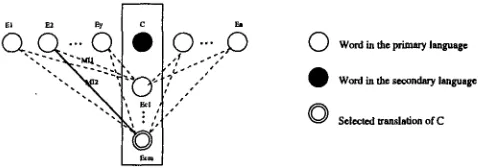
(4)This m e t h o d is illustrated in Figure 3. Since E2 is the contextual word with highest contri- bution score, the candidate
Ei
is chosen that the m u t u a l information between E2 andEci
is the largest.3 E v a l u a t i o n e x p e r i m e n t s
The m u t u a l information between co-occurring words and its contribution weight is ob-
i
• "'-. ~iI!j/J /
Q Word ia the primary
language
Word in die seconda~ language
S©lectcd mutslalion of C
Figure 3: The best contextual word as disam- biguating feature
tained from a monolingual training c o r p u s - - Wall Street Journal from 1987-1992. T h e train- ing corpus size is about 590MB. We evaluate our m e t h o d s for mixed language query disam- biguation on an automatically generated mixed- language test set. No bilingual corpus, parallel or comparable, is needed for training.
To evaluate our method, a mixed-language sentence set is generated from the monolingual ATIS corpus. T h e primary language is English and the secondary language is chosen to be Chi- nese. Some English words in the original sen- tences are selected randomly and translated into Chinese words manually to produce the test- ing data. These axe the mixed language sen- tences. 500 testing sentences are extracted from the ARPA ATIS corpus. T h e ratio of Chinese words in the sentences varies from 10% to 65%. We carry out three sets of experiments using the three different features we have presented in this paper. I n each experiment, the percentage of primary language words in the sentence is incrementally increased at 5% steps, from 35% to 90%. We note the accuracy of unambiguous translation at each step. Note that at the 35% stage, the primary language is in fact Chinese. 4 E v a l u a t i o n r e s u l t s
One advantage of using the artificially gener- ated mixed-language test set is that it becomes very easy to evaluate the performance of the disambiguation/translation algorithm. We just need to compare the translation o u t p u t with the original ATIS sentences.
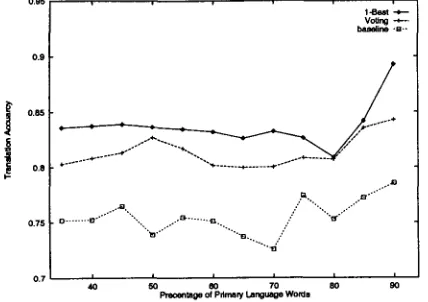
[image:5.612.303.542.60.144.2]secondary language (Chinese) words present in the testing sentences. T h e three different curves represent the accuracies obtained from the base- line feature, the voting model, and the 1-best model.
O.85
1
i
0,8VoOng ~ - . b a ~ i n e . e . -
m B " "
..u . . . .
i i i i i i
~ i a ~ o f p r i m a r y l . a ~ u i i t a W o r d s
Figure 4: 1-best is the most discriminating fea- ture
We can see that b o t h voting contextual words and the 1-best contextual words are more pow- erful discriminant t h a n the baseline neighboring word. T h e 1-best feature is most effective for disambiguating secondary language words in a mixed-language sentence.
5 C o n c l u s i o n a n d D i s c u s s i o n
Mixed-language query occurs very often in b o t h spoken and written form, especially in Asia. Such queries are usually in complete sentences instead of concatenated word strings because they are closer to the spoken language and more natural for user. A mixed-language sentence consists of words mostly in a primary language and some in a secondary language. However, even t h o u g h mixed-languages are in sentence form, they are difficult to parse and tag be- cause those secondary language words introduce an ambiguity factor. To u n d e r s t a n d a query can mean finding the matched document, in the case of Web search, or finding the corresponding se- mantic classes, in the case of an interactive sys- tem. In order to u n d e r s t a n d a mixed-language query, we need to translate the secondary lan- guage words into primary language
unambigu-
ously.
In this paper, we present an approach of mixed,language query disambiguation by us- ing co-occurrence information obtained from a
monolingual corpus. Two new types of dis- ambiguation features are introduced, namely voting contextual words and 1-best contextual word. These two features are compared to the baseline feature of a single neighboring word. Assuming the primary language is English and the secondary language Chinese, our experi- ments on English-Chinese mixed language show that the average translation accuracy for the baseline is 75.50%, for the voting model is 81.37% and for the 1-best model, 83.72%.
T h e baseline m e t h o d uses only the neighbor- ing word to disambiguate C. T h e assumption is that the neighboring word is the most semantic relevant. This m e t h o d leaves out an important feature of nature language: long distance de- pendency. Experimental results show that it is not sufficient to use only the nearest neighbor- ing word for disambiguation.
T h e performance of the voting m e t h o d is bet- ter t h a n the baseline because more contextual words are used. T h e results are consistent with the idea in (Gale and Church, 1994; Shfitze, 1992; Yarowsky, 1995).
In our experiments, it is found that 1-best contextual word is even better t h a n multiple contextual words. This seemingly counter- intuitive result leads us to believe that choos- ing the most discriminative single word is even more powerful t h a n using multiple contextual word equally. We believe t h a t this is consistent with the idea of using "trigger pairs" in (Rosen- feld, 1995) and Singular Value Decomposition in (Shiitze, 1992).
We can conclude t h a t sometimes long- distance contextual words are more discrimi- nant t h a n immediate neighboring words, and that multiple contextual words can contribute to better disambiguation.Our results support our belief that natural sentence-based queries are less ambiguous t h a n keyword based queries. Our m e t h o d using multiple disambiguating con- textual words can take advantage of syntactic information even when parsing or tagging is not possible, such as in the case of mixed-language queries.
[image:6.612.80.294.135.286.2]monolingual queries in both primary and sec- ondary languages, enabling true cross-language IR.
In our future work, we plan to analyze the various "discriminating words" contained in a mixed language or monolingual query to find out which class of words contribute more to the final disambiguation. We also want to test the significance of the co-occurrence informa- tion of all contextual words
between themselves
in the disambiguation task. Finally, we plan to develop a general mixed-language and cross- language understanding framework for both document retrieval and interactive tasks.
R e f e r e n c e s
AskJeeves. 1998. http://www.askjeeves.com. Lisa Ballesteros and W. Bruce Croft. 1998.
Resolving ambiguity for cross-language re- trieval. In
Proceedings of the 21st Annual In-
ternational A CM SIGIR Conference on Re-
search and Development in Information Re-
trieval,
pages 64-:71, Melbourne, Australia, August.P. Brown, J. Lai, and R. Mercer. 1991. Aligning sentences in parallel corpora. In
Proceedings
of the 29th Annual Conference of the Associ-
ation for Computational Linguistics.
Ido Dagan and Kenneth W. Church. 1994. Ter- might: Identifying and translating technical terminology. In
Proceedings of the 4th Con-
ference on Applied Natural Language Process-
ing,
pages 34-40, Stuttgart, Germany, Octo- ber.Ido Dagan and Alon Itai. 1994. Word sense dis- ambiguation using a second language mono- lingual corpus. In
Computational Linguistics,
pages 564-596.
Ido Dagan, Alon Itai, and Ulrike Schwall. 1991. Two languages are more informative than one. In
Proceedings of the 29th Annual Con-
ference of the Association for Computational
Linguistics,
pages 130-137, Berkeley, Califor- nia.M. Davis. 1998. Free resources and advanced alignment for cross-language text retrieval. In
Proceedings of the 6th Text Retrieval Con-
ference (TREC-6),
NIST, Gaithersburg, MD, November.Laura DiDio. 1997. Os/2 let users talk back to 'net. page 12.
ElectricMonk. 1998.
http://www.electricmonk.com.
Pascale Fung and Yuen Yee Lo. 1998. An IR approach for translating new words from non- parallel, comparable texts. In
Proceedings of
the 36th Annual Conference of the Associ-
ation for Computational Linguistics,
pages 414-420, Montreal,Canada, August.Pascale Fung and Kathleen McKeown. 1997. Finding terminology translations from non- parallel corpora. In
The 5th Annual Work-
shop on Very Large Corpora,
pages 192-202, Hong Kong, Aug.Pascale Fung and Dekai Wu. 1994. Statistical augmentation of a Chinese machine-readable dictionary. In
Proceedings of the Second An-
nual Workshop on Very Large Corpora,
pages 69-85, Kyoto, Japan, June.Pascale Fung, CHEUNG Chi Shuen,
LAM Kwok Leung, LIU Wai Kat, and
LO Yuen Yee. 1998a. A speech assisted
online search agent (salsa). In
ICSLP.
Pascale Fung, CHEUNG Chi Shuen,
LAM Kwok Leung, LIU Wai Kat, LO Yuen Yee, and MA Chi Yuen. 1998b. SALSA, a multilingual speech-based web browser. In
The First AEARU Web Technolgy Workshop,
Nov.
Pascale Fung. 1998. A statistical view of bilin- gual lexicon extraction: from parallel corpora to non-parallel corpora. In
Proceedings of the
Third Conference of the Association for Ma-
chine Translation in the Americas,
Pennsyl- vania, October.William A. Gale and Kenneth W. Church. 1993. A program for aligning sentences in
bilingual corpora.
Computational Linguis-
tics,
19(1):75-102.William A. Gale and Kenneth W. Church. 1994. Discrimination decisions in 100,000 dimen- sional spaces.
Current Issues in Computa-
tional Linguistics: In honour of Don Walker,
pages 429-550.
W. Gale, K. Church, and D. Yarowsky. 1992a. Estimating upper and lower bounds on the performance of word-sense disambiguation programs. In
Proceedings of the 30th Con-
ference of the Association for Computational
Linguistics.
Association for Computational Linguistics.Using bilingual materials to develop word
sense disambiguation methods. In
Proceed-
ings of TMI 92.
W. Gale, K. Church, and D. Yarowsky. 1992c. Work on statistical methods for word sense disambiguation. In
Proceedings of A A A I 92.
W. Gale, K. Church, and D. Yarowsky. 1993. A method for disambiguating word senses in a large corpus. In
Computers and Humanities,
volume 26, pages 415-439.
Gregory Grefenstette, editor. 1998.
Cross-
language Information Retrieval.
Kluwer Aca- demic Publishers.Xuedong Huang, Fileno Alleva, Hisao-Wuen Hong, Mei-Yuh Hwang, Kai-Fu Lee, and Ronald Rosenfeld. 1993. The SPHINX- II speech recognition system: an overview.
Computer, Speech and Language,
pages 137- 148.David A. Hull and Gregory Grefenstette. 1996. A dictionary-based approach to multilingual informaion retrieval. In
Proceedings of the
19th International Conference on Research
and Development in Information Retrieval,
pages 49-57.
Julian Kupiec. 1993. An algorithm for finding noun phrase correspondences in bilingual cor- pora. In
Proceedings of the 31st Annual Con-
ference of the Association for Computational
Linguistics,
pages 17-22, Columbus, Ohio, June.Xiaohu Liu and Sheng Li. 1997. Statistic-based target word selection in English-Chinese ma- chine translation.
Journal of Harbin Institute
of Technology,
May.Chi Yuen Ma and Pascale Fung. 1998. Using English phoneme models for Chinese speech recognition. In
International Symposium on
Chinese Spoken language processing.
D.W. Oard. 1997. Alternative approaches for cross-language text retrieval. In
A A A I Sym-
posium on cross-language text and speech re-
trieval.
American Association for Artificial Intelligence, Mar.Eugenio Picchi and Carol Peters. 1998. Cross-
language information retrieval: a system
for comparable corpus querying. In Gregory Grefenstette, editor,
Cross-language Infor-
mation Retrieval,
pages 81-92. Kluwer Aca- demic Publishers.Lau Raymond. 1997. Webgalaxy : Beyond point and click - a conversational interface to
a browser. In
Computer Netowrks ~ ISDN
Systems,
pages 1385-1393.Rony Rosenfeld. 1995.
A Corpus-Based Ap-
proach to Language Learning.
Ph.D. thesis, Carnegie Mellon University.Hinrich Shfitze. 1992. Dimensions of meaning. In
Proceedings of Supercomputing '92.
Frank Smadja, Kathleen McKeown, and
Vasileios Hatzsivassiloglou. 1996. Translat- ing collocations for bilingual lexicons: A sta- tistical approach.
Computational Linguistics,
21(4):1-38.
Frank Smadja. 1993. Retrieving collocations
from text: Xtract.
Computational Linguis-
tics,
19(1):143-177.Kumiko Tanaka and Hideya Iwasaki. 1996.
Extraction of lexical translations from non-
aligned corpora. In
Proceedings of COLING
96,
Copenhagan, Danmark, July.Dekai Wu. 1995. Grammarless extraction of phrasal translation examples from parallel texts. In
Proceedings of TMI 95,
Leuven, Bel- gium, July. Submitted.D. Yarowsky. 1993. One sense per collocation. In
Proceedings of ARPA Human Language
Technology Workshop,
Princeton.D. Yarowsky. 1995. Unsupervised word sense disambiguation rivaling supervised methods. In
Proceedings of the 33rd Conference of
the Association for Computational Linguis-
tics,
pages 189-196. Association for Compu- tational Linguistics.Victor Zue. 1995. Spoken language interfaces to computers: Achievements and challenges. In