Learning From Collective Human Behavior to
Introduce Diversity in Lexical Choice
Vahed Qazvinian
Department of EECS University of Michigan
Ann Arbor, MI
Dragomir R. Radev
School of Information Department of EECS University of Michigan
Ann Arbor, MI
Abstract
We analyze collective discourse, a collective human behavior in content generation, and show that it exhibits diversity, a property of general collective systems. Using extensive analysis, we propose a novel paradigm for de-signing summary generation systems that re-flect the diversity of perspectives seen in real-life collective summarization. We analyze 50 sets of summaries written by human about the same story or artifact and investigate the diver-sity of perspectives across these summaries. We show how different summaries use vari-ous phrasal information units (i.e.,nuggets) to express the same atomic semantic units, called factoids. Finally, we present a ranker that em-ploysdistributional similaritiesto build a net-work of words, and captures the diversity of perspectives by detecting communities in this network. Our experiments show how our sys-tem outperforms a wide range of other docu-ment ranking systems that leverage diversity.
1 Introduction
In sociology, the termcollective behavioris used to denote mass activities that are not centrally coordi-nated (Blumer, 1951). Collective behavior is dif-ferent from group behavior in the following ways: (a) it involves limited social interaction, (b) mem-bership is fluid, and (c) it generates weak and un-conventional norms (Smelser, 1963). In this paper, we focus on the computational analysis ofcollective discourse, a collective behavior seen in interactive content contribution and text summarization in on-line social media. In collective discourse each
in-dividual’s behavior is largely independent of that of other individuals.
In social media, discourse (Grosz and Sidner, 1986) is often acollective reactionto an event. One scenario leading to collective reaction to a well-defined subject is when an event occurs (a movie is released, a story occurs, a paper is published) and people independently write about it (movie reviews, news headlines, citation sentences). This process of content generation happens over time, and each per-son chooses the aspects to cover. Each event has an onset and a time of death after which nothing is written about it. Tracing the generation of content over many instances will reveal temporal patterns that will allow us to make sense of the text gener-ated around a particular event.
To understand collective discourse, we are inter-ested in behavior that happens over a short period of time. We focus on topics that are relatively well-defined in scope such as a particular event or a single news event that does not evolve over time. This can eventually be extended to events and issues that are evolving either in time or scope such as elections, wars, or the economy.
In social sciences and the study of complex sys-tems a lot of work has been done to study such col-lective systems, and their properties such as self-organization (Page, 2007) and diversity (Hong and Page, 2009; Fisher, 2009). However, there is little work that studies a collective system in which mem-bers individually write summaries.
In most of this paper, we will be concerned with developing a complex systems view of the set of col-lectively written summaries, and give evidence of
the diversity of perspectives and its cause. We be-lieve that out experiments will give insight into new models of text generation, which is aimed at model-ing the process of producmodel-ing natural language texts, and is best characterized as the process of mak-ing choices between alternate lmak-inguistic realizations, also known as lexical choice (Elhadad, 1995; Barzi-lay and Lee, 2002; Stede, 1995).
2 Prior Work
In summarization, a number of previous methods have focused on diversity. (Mei et al., 2010) in-troduce a diversity-focused ranking methodology based on reinforced random walks in information networks. Their random walk model introduces the rich-gets-richer mechanism to PageRank with rein-forcements on transition probabilities between ver-tices. A similar ranking model is theGrasshopper
ranking model (Zhu et al., 2007), which leverages an absorbing random walk. This model starts with a regular time-homogeneous random walk, and in each step the node with the highest weight is set as an absorbing state. The multi-view point sum-marization of opinionated text is discussed in (Paul et al., 2010). Paul et al. introduce Compar-ative LexRank, based on the LexRank ranking model (Erkan and Radev, 2004). Their random walk formulation is to score sentences and pairs of sen-tences from opposite viewpoints (clusters) based on both their representativeness of the collection as well as their contrastiveness with each other. Once a lex-ical similarity graph is built, they modify the graph based on cluster information and perform LexRank on the modified cosine similarity graph.
The most well-known paper that address diver-sity in summarization is (Carbonell and Goldstein, 1998), which introduces Maximal Marginal Rele-vance (MMR). This method is based on a greedy algorithm that picks sentences in each step that are the least similar to the summary so far. There are a few other diversity-focused summarization sys-tems like C-LexRank (Qazvinian and Radev, 2008), which employs document clustering. These papers try to increase diversity in summarizing documents, but do not explain the type of the diversity in their in-puts. In this paper, we give an insightful discussion on the nature of the diversity seen in collective
dis-course, and will explain why some of the mentioned methods may not work under such environments.
In prior work on evaluating independent contri-butions in content generation, Voorhees (Voorhees, 1998) studied IR systems and showed that rele-vance judgments differ significantly between hu-mans but relative rankings show high degrees of sta-bility across annotators. However, perhaps the clos-est work to this paper is (van Halteren and Teufel, 2004) in which 40 Dutch students and 10 NLP searchers were asked to summarize a BBC news re-port, resulting in 50 different summaries. Teufel and van Halteren also used 6 DUC1-provided sum-maries, and annotations from 10 student participants and 4 additional researchers, to create 20 summaries for another news article in the DUC datasets. They calculated the Kappa statistic (Carletta, 1996; Krip-pendorff, 1980) and observed high agreement, indi-cating that the task of atomic semantic unit (factoid) extraction can be robustly performed in naturally oc-curring text, without any copy-editing.
The diversity of perspectives and the unprece-dented growth of the factoid inventory also affects evaluation in text summarization. Evaluation meth-ods are either extrinsic, in which the summaries are evaluated based on their quality in performing a spe-cific task (Sp¨arck-Jones, 1999) or intrinsic where the quality of the summary itself is evaluated, regardless of any applied task (van Halteren and Teufel, 2003; Nenkova and Passonneau, 2004). These evaluation methods assess the information content in the sum-maries that are generated automatically.
Finally, recent research on analyzing online so-cial media shown a growing interest in mining news stories and headlines because of its broad appli-cations ranging from “meme” tracking and spike detection (Leskovec et al., 2009) to text summa-rization (Barzilay and McKeown, 2005). In sim-ilar work on blogs, it is shown that detecting top-ics (Kumar et al., 2003; Adar et al., 2007) and sen-timent (Pang and Lee, 2004) in the blogosphere can help identify influential bloggers (Adar et al., 2004; Java et al., 2006) and mine opinions about prod-ucts (Mishne and Glance, 2006).
3 Data Annotation
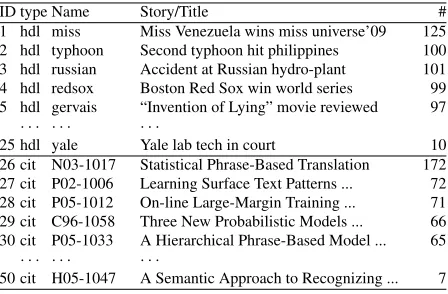
The datasets used in our experiments represent two completely different categories: news headlines, and scientific citation sentences. Theheadlinesdatasets consist of 25 clusters of news headlines collected from Google News2, and thecitationsdatasets have 25 clusters of citations to specific scientific papers from the ACL Anthology Network (AAN)3. Each cluster consists of a number of unique summaries (headlines or citations) about the same artifact (non-evolving news story or scientific paper) written by different people. Table 1 lists some of the clusters with the number of summaries in them.
ID type Name Story/Title #
1 hdl miss Miss Venezuela wins miss universe’09 125 2 hdl typhoon Second typhoon hit philippines 100 3 hdl russian Accident at Russian hydro-plant 101 4 hdl redsox Boston Red Sox win world series 99 5 hdl gervais “Invention of Lying” movie reviewed 97
· · · ·
25 hdl yale Yale lab tech in court 10 26 cit N03-1017 Statistical Phrase-Based Translation 172 27 cit P02-1006 Learning Surface Text Patterns ... 72 28 cit P05-1012 On-line Large-Margin Training ... 71 29 cit C96-1058 Three New Probabilistic Models ... 66 30 cit P05-1033 A Hierarchical Phrase-Based Model ... 65
· · · ·
[image:3.612.74.298.248.395.2]50 cit H05-1047 A Semantic Approach to Recognizing ... 7
Table 1: Some of the annotated datasets and the number of summaries in each of them (hdl = headlines; cit = cita-tions)
3.1 Nuggets vs. Factoids
We define an annotation task that requires explicit definitions that distinguish between phrases that rep-resent the same or different information units. Un-fortunately, there is little consensus in the literature on such definitions. Therefore, we follow (van Hal-teren and Teufel, 2003) and make the following dis-tinction. We define a nugget to be a phrasal infor-mation unit. Different nuggets may all represent the same atomic semantic unit, which we call as a
factoid. In the following headlines, which are ran-domly extracted from theredsoxdataset, nuggets are manually underlined.
red sox win 2007 world series
boston red sox blank rockies to clinch world series
2
news.google.com
3http://clair.si.umich.edu/clair/anthology/
boston fans celebrate world series win; 37 arrests re-ported
These 3 headlines contain 9 nuggets, which rep-resent 5 factoids or classes of equivalent nuggets.
f1:{red sox, boston, boston red sox}
f2:{2007 world series, world series win, world series}
f3:{rockies}
f4:{37 arrests}
f5:{fans celebrate}
This example suggests that different headlines on the same story written independently of one an-other use different phrases (nuggets) to refer to the same semantic unit (e.g., “red sox” vs. “boston” vs. “boston red sox”) or to semantic units corresponding to different aspects of the story (e.g., “37 arrests” vs. “rockies”). In the former case different nuggets are used to represent the same factoid, while in the latter case different nuggets are used to express different factoids. This analogy is similar to the definition of factoids in (van Halteren and Teufel, 2004).
The following citation sentences to Koehn’s work suggest that a similar phenomenon also happens in citations.
We also compared our model with pharaoh (Koehn et al, 2003).
Koehn et al (2003) find that
phrases longer than three words improve per-formance little.
Koehn et al (2003) suggest limiting phrase length to three words or less.
For further information on these parameter settings, confer (koehn et al, 2003).
where the first author mentions “pharaoh” as a contribution of Koehn et al, but the second and third use different nuggets to represent the same contribu-tion: use of trigrams. However, as the last citation shows, a citation sentence, unlike news headlines, may cover no information about the target paper.
The use of phrasal information as nuggets is an es-sential element to our experiments, since some head-line writers often try to use uncommon terms to re-fer to a factoid. For instance, two headlines from the
redsoxcluster are:
Following these examples, we asked two anno-tators to annotate all 1,390 headlines, and926 ci-tations. The annotators were asked to follow pre-cise guidelines in nugget extraction. Our guidelines instructed annotators to extract non-overlapping phrases from each headline as nuggets. Therefore, each nugget should be a substring of the headline that represents a semantic unit4.
Previously (Lin and Hovy, 2002) had shown that information overlap judgment is a difficult task for human annotators. To avoid such a difficulty, we enforced our annotators to extract non-overlapping nuggets from a summary to make sure that they are mutually independent and that information overlap between them is minimized.
Finding agreement between annotated well-defined nuggets is straightforward and can be cal-culated in terms of Kappa. However, when nuggets themselves are to be extracted by annotators, the task becomes less obvious. To calculate the agree-ment, we annotated 10 randomly selected head-line clusters twice and designed a simple evalua-tion scheme based on Kappa5. For each n-gram,
w, in a given headline, we look ifw is part of any nugget in either human annotations. If w occurs in both or neither, then the two annotators agree on it, and otherwise they do not. Based on this agreement setup, we can formalize the κ statistic asκ = Pr(1−a)Pr(−Pr(e)e) whereP r(a) is the relative ob-served agreement among annotators, and P r(e) is the probability that annotators agree by chance if each annotator is randomly assigning categories.
Table 2 shows the unigram, bigram, and trigram-based averageκbetween the two human annotators (Human1, Human2). These results suggest that human annotators can reach substantial agreement when bigram and trigram nuggets are examined, and has reasonable agreement for unigram nuggets.
4 Diversity
We study the diversity of ways with which human summarizers talk about the same story or event and explain why such a diversity exists.
4Before the annotations, we lower-cased all summaries and
removed duplicates
5Previously (Qazvinian and Radev, 2010) have shown high
agreement in human judgments in a similar task on citation an-notation
Averageκ
unigram bigram trigram
Human1 vs. Human2
[image:4.612.322.534.54.106.2]0.76±0.4 0.80±0.4 0.89±0.3
Table 2: Agreement between different annotators in terms of average Kappa in 25 headline clusters.
100 101 102
10−2
10−1 100
Pr(X
≥
c)
c headlines
Pr(X ≥ c)
100 101 102
10−2
10−1
100
Pr(X
≥
c)
c citations
Pr(X ≥ c)
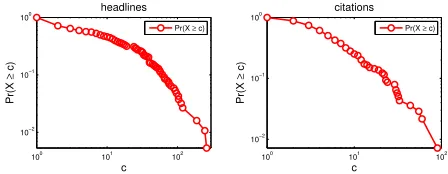
Figure 1: The cumulative probability distribution for the frequency of factoids (i.e., the probability that a factoid will be mentioned in c different summaries) across in each category.
4.1 Skewed Distributions
Our first experiment is to analyze the popularity of different factoids. For each factoid in the annotated clusters, we extract its count,X, which is equal to the number of summaries it has been mentioned in, and then we look at the distribution of X. Fig-ure 1 shows the cumulative probability distribution for these counts (i.e., the probability that a factoid will be mentioned in at leastcdifferent summaries) in both categories.
These highly skewed distributions indicate that a large number of factoids (more than28%) are only mentioned once across different clusters (e.g., “poor pitching of colorado” in the redsoxcluster), and that a few factoids are mentioned in a large number of headlines (likely using different nuggets). The large number of factoids that are only mentioned in one headline indicates that different summarizers in-crease diversity by focusing on different aspects of a story or a paper. The set of nuggets also exhibit similar skewed distributions. If we look at individ-ual nuggets, the redsox set shows that about 63
(or80%) of the nuggets get mentioned in only one headline, resulting in a right-skewed distribution.
[image:4.612.317.541.151.238.2](e.g., “celebrations” vs. “poor pitching of col-orado”). (2) writer use different nuggets to represent the same factoid (e.g., “redsox” vs. “bosox”). In the following sections we analyze the extent at which each scenario happens.
100 101 102 103
0 200 400 600 800 1000
number of summaries
Inventory size
headlines
Nuggets Factoids
100 101 102 103
0 50 100 150 200 250 300 350
number of summaries
Inventory size
citations
[image:5.612.103.255.132.359.2]Nuggets Factoids
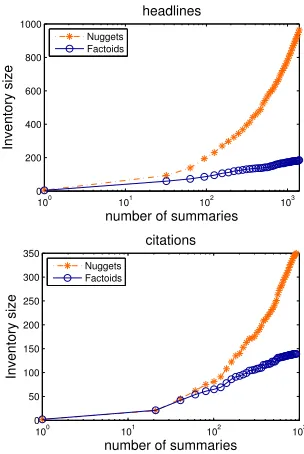
Figure 2: The number of unique factoids and nuggets ob-served by readingnrandom summaries in all the clusters of each category
4.2 Factoid Inventory
The emergence of diversity in covering different fac-toids suggests that looking at more summaries will capture a larger number of factoids. In order to ana-lyze the growth of the factoid inventory, we perform a simple experiment. We shuffle the set of sum-maries from all 25 clusters in each category, and then look at the number of unique factoids and nuggets seen after readingnthsummary. This number shows the amount of information that a randomly selected subset of n writers represent. This is important to study in order to find out whether we need a large number of summaries to capture all aspects of a story and build a complete factoid inventory. The plot in Figure 4.1 shows, at eachn, the number of unique factoids and nuggets observed by readingn
random summaries from the 25 clusters in each cat-egory. These curves are plotted on a semi-log scale to emphasize the difference between the growth pat-terns of the nugget inventories and the factoid
inven-tories6.
This finding numerically confirms a similar ob-servation on human summary annotations discussed in (van Halteren and Teufel, 2003; van Halteren and Teufel, 2004). In their work, van Halteren and Teufel indicated that more than 10-20 human sum-maries are needed for a full factoid inventory. How-ever, our experiments with nuggets of nearly2,400
independent human summaries suggest that neither the nugget inventory nor the number of factoids will be likely to show asymptotic behavior. However, these plots show that the nugget inventory grows at a much faster rate than factoids. This means that a lot of the diversity seen in human summarization is a result of the so called differentlexical choicesthat represent the same semantic units or factoids.
4.3 Summary Quality
In previous sections we gave evidence for the diver-sity seen in human summaries. However, a more important question to answer is whether these sum-maries all cover important aspects of the story. Here, we examine the quality of these summaries, study the distribution of information coverage in them, and investigate the number of summaries required to build a complete factoid inventory.
The information covered in each summary can be determined by the set of factoids (and not nuggets) and their frequencies across the datasets. For exam-ple, in theredsoxdataset, “red sox”, “boston”, and “boston red sox” are nuggets that all represent the same piece of information: the red sox team. There-fore, different summaries that use these nuggets to refer to the red sox team should not be seen as very different.
We use the Pyramid model (Nenkova and Pas-sonneau, 2004) to value different summary factoids. Intuitively, factoids that are mentioned more fre-quently are more salient aspects of the story. There-fore, our pyramid model uses the normalized fre-quency at which a factoid is mentioned across a dataset as its weight. In the pyramid model, the in-dividual factoids fall in tiers. If a factoid appears in more summaries, it falls in a higher tier. In princi-ple, if the termwi appears|wi|times in the set of
6
headlines it is assigned to the tier T|wi|. The
pyra-mid score that we use is computed as follows. Sup-pose the pyramid has n tiers, Ti, where tier Tn is the top tier and T1 is the bottom. The weight of
the factoids in tier Ti will bei(i.e. they appeared inisummaries). If |Ti|denotes the number of fac-toids in tierTi, andDi is the number of factoids in the summary that appear inTi, then the total factoid weight for the summary isD =Pn
i=1i×Di. Ad-ditionally, the optimal pyramid score for a summary isM ax=Pn
i=1i× |Ti|. Finally, the pyramid score
for a summary can be calculated as
P = D
M ax
Based on this scoring scheme, we can use the an-notated datasets to determine the quality of individ-ual headlines. First, for each set we look at the vari-ation in pyramid scores that individual summaries obtain in their set. Figure 3 shows, for each clus-ter, the variation in the pyramid scores (25th to 75th percentile range) of individual summaries evaluated against the factoids of that cluster. This figure in-dicates that the pyramid score of almost all sum-maries obtain values with high variations in most of the clusters For instance, individual headlines from
redsoxobtain pyramid scores as low as0.00 and as high as0.93. This high variation confirms the pre-vious observations on diversity of information cov-erage in different summaries.
Additionally, this figure shows that headlines gen-erally obtain higher values than citations when con-sidered as summaries. One reason, as explained be-fore, is that a citation may not cover any important contribution of the paper it is citing, when headlines generally tend to cover some aspects of the story.
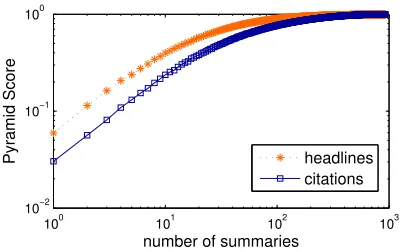
High variation in quality means that in order to capture a larger information content we need to read a greater number of summaries. But how many headlines should one read to capture a desired level of information content? To answer this question, we perform an experiment based on drawing random summaries from the pool of all the clusters in each category. We perform a Monte Carlo simulation, in which for each n, we draw n random summaries, and look at the pyramid score achieved by reading these headlines. The pyramid score is calculated us-ing the factoids from all 25 clusters in each
cate-gory7. Each experiment is repeated1,000times to find the statistical significance of the experiment and the variation from the average pyramid scores.
Figure 4.3 shows the average pyramid scores over different n values in each category on a log-log scale. This figure shows how pyramid score grows and approaches1.00 rapidly as more randomly se-lected summaries are seen.
100 101 102 103
10−2
10−1
100
number of summaries
Pyramid Score headlines
[image:6.612.320.520.176.302.2]citations
Figure 4: Average pyramid score obtained by readingn random summaries shows rapid asymptotic behavior.
5 Diversity-based Ranking
In previous sections we showed that the diversity seen in human summaries could be according to dif-ferent nuggets or phrases that represent the same fac-toid. Ideally, a summarizer that seeks to increase di-versity should capture this phenomenon and avoid covering redundant nuggets. In this section, we use different state of the art summarization systems to rank the set of summaries in each cluster with re-spect to information content and diversity. To evalu-ate each system, we cut the ranked list at a constant length (in terms of the number of words) and calcu-late the pyramid score of the remaining text.
5.1 Distributional Similarity
We have designed a summary ranker that will pro-duce a ranked list of documents with respect to the diversity of their contents. Our model works based on ranking individual words and using the ranked list of words to rank documents that contain them.
In order to capture the nuggets of equivalent se-mantic classes, we use adistributional similarityof
7
0 0.2 0.4 0.6 0.8 1
abortion amazon babies burger colombia england gervais google ireland maine mercury miss monkey mozart nobel priest ps3slim radiation redsox russian scientist soupy sweden typhoon yale A00_1023 A00_1043 A00_2024 C00_1072 C96_1058 D03_1017 D04_9907 H05_1047 H05_1079 J04_4002 N03_1017 N04_1033 P02_1006 P03_1001 P05_1012 P05_1013 P05_1014 P05_1033 P97_1003 P99_1065 W00_0403 W00_0603 W03_0301 W03_0510 W05_1203
Pyramid Score
[image:7.612.84.527.62.201.2]headlines citations
Figure 3: The 25th to 75th percentile pyramid score range in individual clusters
words that is inspired by (Lee, 1999). We represent each word by its context in the cluster and find the similarity of such contexts. Particularly, each word
wi is represented by a bag of words,`i, that have a surface distance of 3 or smaller towi anywhere in the cluster. In other words,`icontains any word that co-occurs with wi in a 4-gram in the cluster. This bag of wordsrepresentation of words enables us to find the word-pair similarities.
sim(wi, wj) = ~ `i·`~j
q
|~`i||`~j|
(1)
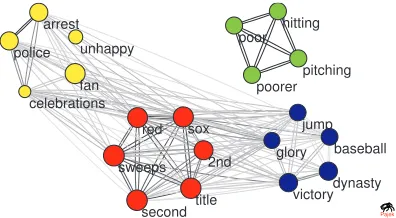
We use the pair-wise similarities of words in each cluster, and build a network of words and their simi-larities. Intuitively, words that appear in similar con-texts are more similar to each other and will have a stronger edge between them in the network. There-fore, similar words, or words that appear in similar contexts, will form communities in this graph. Ide-ally, each community in the word similarity network would represent a factoid. To find the communities in the word network we use (Clauset et al., 2004), a hierarchical agglomeration algorithm which works by greedily optimizing the modularity in a linear running time for sparse graphs.
The community detection algorithm will assign to each wordwi, a community label Ci. For each community, we use LexRank to rank the words us-ing the similarities in Equation 1, and assign a score to each word wi asS(wi) = |CRii|, whereRi is the
rank ofwi in its community, and|Ci|is the number of words that belong to Ci. Figure 5.1 shows part
police
second sox celebrations
red jump
baseball unhappy
sweeps
pitching hitting arrest
victory title
dynasty
fan poorer
2nd poor
glory
Pajek
Figure 5: Part of the word similarity graph in the redsox cluster
of the word similarity graph in theredsoxcluster, in which each node is color-coded with its commu-nity. This figure illustrates how words that are se-mantically related to the same aspects of the story fall in the same communities (e.g., “police” and “ar-rest”). Finally, to rank sentences, we define the score of each documentDj as the sum of the scores of its words.
pds(Dj) =
X
wi∈Dj S(wi)
Intuitively, sentences that contain higher ranked words in highly populated communities will have a smaller score. To rank the sentences, we sort them in an ascending order, and cut the list when its size is greater than the length limit.
5.2 Other Methods
5.2.1 Random
[image:7.612.328.526.246.355.2]per-mutations of the summaries. In the headlines datasets, where most of the headlines cover some factoids about the story, we expect this method to perform reasonably well since randomization will increase the chances of covering headlines that fo-cus on different factoids. However, in the citations dataset, where a citing sentence may cover no infor-mation about the cited paper, randomization has the drawback of selecting citations that have no valuable information in them.
5.2.2 LexRank
LexRank (Erkan and Radev, 2004) works by first building a graph of all the documents (Di) in a cluster. The edges between corresponding nodes (di) represent the cosine similarity between them is above a threshold (0.10 following (Erkan and Radev, 2004)). Once the network is built, the system finds the most central sentences by performing a random walk on the graph.
p(dj) = (1−λ) 1
|D|+λ
X
di
p(di)P(di →dj) (2)
5.2.3 MMR
Maximal Marginal Relevance (MMR) (Carbonell and Goldstein, 1998) uses the pairwise cosine simi-larity matrix and greedily chooses sentences that are the least similar to those already in the summary. In particular,
M M R= arg minDi∈D−A
h
maxDj∈ASim(Di, Dj)
i
where A is the set of documents in the summary, initialized toA=∅.
5.2.4 DivRank
Unlike other time-homogeneous random walks (e.g., PageRank), DivRank does not assume that the transition probabilities remain constant over time. DivRank uses a vertex-reinforced random walkmodel to rank graph nodes based on a diversity based centrality. The basic assumption in DivRank is that the transition probability from a node to other is reinforced by the number of previous visits to the target node (Mei et al., 2010). Particularly, let’s as-sumepT(u, v)is the transition probability from any nodeuto nodevat timeT. Then,
pT(di, dj) = (1−λ).p∗(dj) +λ.
p0(di, dj).NT(dj) DT(di)
(3)
whereNT(dj)is the number of times the walk has visiteddj up to timeT and
DT(di) =
X
dj∈V
p0(di, dj)NT(dj) (4)
Here, p∗(dj) is the prior distribution that deter-mines the preference of visiting vertexdj. We try two variants of this algorithm: DivRank, in which
p∗(dj) is uniform, and DivRank with priors in whichp∗(dj) ∝ l(Dj)−β, wherel(Dj)is the num-ber of the words in the documentDj andβ is a pa-rameter (β = 0.8).
5.2.5 C-LexRank
C-LexRank is a clustering-based model in which the cosine similarities of document pairs are used to build a network of documents. Then the the network is split into communities, and the most salient doc-uments in each community are selected (Qazvinian and Radev, 2008). C-LexRank focuses on finding communities of documents using their cosine simi-larity. The intuition is that documents that are more similar to each other contain similar factoids. We ex-pect C-LexRank to be a strong ranker, but incapable of capturing the diversity caused by using different phrases to express the same meaning. The reason is that different nuggets that represent the same factoid often have no words in common (e.g., “victory” and “glory”) and won’t be captured by a lexical measure like cosine similarity.
5.3 Experiments
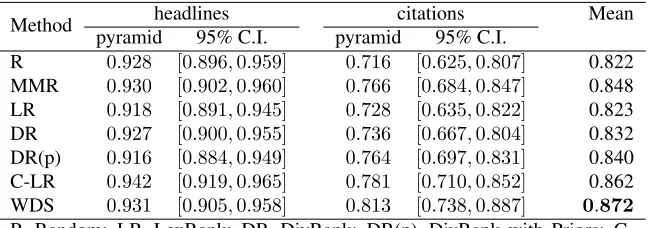
We use each of the systems explained above to rank the summaries in each cluster. Each ranked list is then cut at a certain length (50 words for headlines, and 150 for citations) and the information content in the remaining text is examined using the pyramid score.
Method headlines citations Mean pyramid 95% C.I. pyramid 95% C.I.
R 0.928 [0.896,0.959] 0.716 [0.625,0.807] 0.822 MMR 0.930 [0.902,0.960] 0.766 [0.684,0.847] 0.848 LR 0.918 [0.891,0.945] 0.728 [0.635,0.822] 0.823 DR 0.927 [0.900,0.955] 0.736 [0.667,0.804] 0.832 DR(p) 0.916 [0.884,0.949] 0.764 [0.697,0.831] 0.840 C-LR 0.942 [0.919,0.965] 0.781 [0.710,0.852] 0.862 WDS 0.931 [0.905,0.958] 0.813 [0.738,0.887] 0.872
R=Random; LR=LexRank; DR=DivRank; DR(p)=DivRank with Priors; C-LR=C-LexRank; WDS=Word Distributional Similarity; C.I.=Confidence In-terval
Table 3: Comparison of different ranking systems
Method Top 3 headlines
WDS
1: how sweep it is
2: fans celebrate red sox win 3: red sox take title
C-LR
1: world series: red sox sweep rockies 2: red sox take world series
3: red sox win world series
MMR
1:red sox scale the rockies
[image:9.612.145.471.54.168.2]2: boston sweep colorado to win world series 3: rookies respond in first crack at the big time C-LR=C-LexRank; WDS=Word Distributional Similarity
Table 4: Top 3 ranked summaries of the redsox cluster using different methods
headlines produced by WDS cover two important factoids: “red sox winning the title” and “fans cel-ebrating”. However, the second factoid is absent in the other two.
6 Conclusion and Future Work
Our experiments on two different categories of human-written summaries (headlines and citations) showed that a lot of the diversity seen in human summarization comes from different nuggets that may actually represent the same semantic informa-tion (i.e., factoids). We showed that the factoids ex-hibit a skewed distribution model, and that the size of the nugget inventory asymptotic behavior even with a large number of summaries. We also showed high variation in summary quality across different summaries in terms of pyramid score, and that the information covered by readingnsummaries has a rapidly growing asymptotic behavior asnincreases. Finally, we proposed a ranking system that employs word distributional similarities to identify semanti-cally equivalent words, and compared it with a wide
range of summarization systems that leverage diver-sity.
In the future, we plan to move to content from other collective systems on Web. In order to gen-eralize our findings, we plan to examine blog com-ments, online reviews, and tweets (that discuss the same URL). We also plan to build a generation sys-tem that employs the Yule model (Yule, 1925) to de-termine the importance of each aspect (e.g. who, when, where, etc.) in order to produce summaries that include diverse aspects of a story.
Our work has resulted in a publicly available dataset8 of 25 annotated news clusters with nearly
1,400 headlines, and 25 clusters of citation sen-tences with more than900citations. We believe that this dataset can open new dimensions in studying di-versity and other aspects of automatic text genera-tion.
7 Acknowledgments
This work is supported by the National Science Foundation grant number IIS-0705832 and grant number IIS-0968489. Any opinions, findings, and conclusions or recommendations expressed in this paper are those of the authors and do not necessarily reflect the views of the supporters.
References
Eytan Adar, Li Zhang, Lada A. Adamic, and Rajan M. Lukose. 2004. Implicit structure and the dynamics of
8
Blogspace. InWWW’04, Workshop on the Weblogging Ecosystem.
Eytan Adar, Daniel S. Weld, Brian N. Bershad, and Steven S. Gribble. 2007. Why we search: visualiz-ing and predictvisualiz-ing user behavior. InWWW’07, pages 161–170, New York, NY, USA.
Regina Barzilay and Lillian Lee. 2002. Bootstrapping lexical choice via multiple-sequence alignment. In Proceedings of the ACL-02 conference on Empirical methods in natural language processing - Volume 10, EMNLP ’02, pages 164–171.
Regina Barzilay and Kathleen R. McKeown. 2005. Sen-tence fusion for multidocument news summarization. Comput. Linguist., 31(3):297–328.
Herbert Blumer. 1951. Collective behavior. In Lee, Al-fred McClung, Ed., Principles of Sociology.
Jaime G. Carbonell and Jade Goldstein. 1998. The use of MMR, diversity-based reranking for reordering docu-ments and producing summaries. InSIGIR’98, pages 335–336.
Jean Carletta. 1996. Assessing agreement on classifi-cation tasks: the kappa statistic. Comput. Linguist., 22(2):249–254.
Aaron Clauset, Mark E. J. Newman, and Cristopher Moore. 2004. Finding community structure in very large networks.Phys. Rev. E, 70(6).
Michael Elhadad. 1995. Using argumentation in text generation. Journal of Pragmatics, 24:189–220. G¨unes¸ Erkan and Dragomir R. Radev. 2004. Lexrank:
Graph-based centrality as salience in text summa-rization. Journal of Artificial Intelligence Research (JAIR).
Len Fisher. 2009. The Perfect Swarm: The Science of Complexity in Everyday Life. Basic Books.
Barbara J. Grosz and Candace L. Sidner. 1986. Atten-tion, intentions, and the structure of discourse. Com-put. Linguist., 12:175–204, July.
Lu Hong and Scott Page. 2009. Interpreted and generated signals. Journal of Economic Theory, 144(5):2174–2196.
Akshay Java, Pranam Kolari, Tim Finin, and Tim Oates. 2006. Modeling the spread of influence on the blogo-sphere. InWWW’06.
Klaus Krippendorff. 1980. Content Analysis: An Intro-duction to its Methodology. Beverly Hills: Sage Pub-lications.
Ravi Kumar, Jasmine Novak, Prabhakar Raghavan, and Andrew Tomkins. 2003. On the bursty evolution of blogspace. InWWW’03, pages 568–576, New York, NY, USA.
Lillian Lee. 1999. Measures of distributional similar-ity. InProceedings of the 37th annual meeting of the Association for Computational Linguistics on Compu-tational Linguistics, pages 25–32.
Jure Leskovec, Lars Backstrom, and Jon Kleinberg. 2009. Meme-tracking and the dynamics of the news cycle. In KDD ’09: Proceedings of the 15th ACM SIGKDD international conference on Knowledge dis-covery and data mining, pages 497–506.
Chin-Yew Lin and Eduard Hovy. 2002. Manual and au-tomatic evaluation of summaries. In ACL-Workshop on Automatic Summarization.
Qiaozhu Mei, Jian Guo, and Dragomir Radev. 2010. Di-vrank: the interplay of prestige and diversity in infor-mation networks. In Proceedings of the 16th ACM SIGKDD international conference on Knowledge dis-covery and data mining, pages 1009–1018.
Gilad Mishne and Natalie Glance. 2006. Predicting movie sales from blogger sentiment. In AAAI 2006 Spring Symposium on Computational Approaches to Analysing Weblogs (AAAI-CAAW 2006).
Ani Nenkova and Rebecca Passonneau. 2004. Evaluat-ing content selection in summarization: The pyramid method.Proceedings of the HLT-NAACL conference. Scott E. Page. 2007. The Difference: How the Power of
Diversity Creates Better Groups, Firms, Schools, and Societies. Princeton University Press.
Bo Pang and Lillian Lee. 2004. A sentimental educa-tion: sentiment analysis using subjectivity summariza-tion based on minimum cuts. InACL’04, Morristown, NJ, USA.
Michael Paul, ChengXiang Zhai, and Roxana Girju. 2010. Summarizing contrastive viewpoints in opin-ionated text. InProceedings of the 2010 Conference on Empirical Methods in Natural Language Process-ing, pages 66–76.
Vahed Qazvinian and Dragomir R. Radev. 2008. Scien-tific paper summarization using citation summary net-works. InCOLING 2008, Manchester, UK.
Vahed Qazvinian and Dragomir R. Radev. 2010. Identi-fying non-explicit citing sentences for citation-based summarization. In Proceedings of the 48th Annual Meeting of the Association for Computational Linguis-tics, pages 555–564, Uppsala, Sweden, July. Associa-tion for ComputaAssocia-tional Linguistics.
Neil J. Smelser. 1963. Theory of Collective Behavior. Free Press.
Karen Sp¨arck-Jones. 1999. Automatic summarizing: factors and directions. In Inderjeet Mani and Mark T. Maybury, editors,Advances in automatic text summa-rization, chapter 1, pages 1 – 12. The MIT Press. Manfred Stede. 1995. Lexicalization in natural language
generation: a survey. Artificial Intelligence Review, (8):309–336.
the HLT-NAACL 03 on Text summarization workshop, pages 57–64, Morristown, NJ, USA. Association for Computational Linguistics.
Hans van Halteren and Simone Teufel. 2004. Evaluating information content by factoid analysis: human anno-tation and stability. InEMNLP’04, Barcelona. Ellen M. Voorhees. 1998. Variations in relevance
judg-ments and the measurement of retrieval effectiveness. InSIGIR ’98: Proceedings of the 21st annual interna-tional ACM SIGIR conference on Research and devel-opment in information retrieval, pages 315–323. G. Udny Yule. 1925. A mathematical theory of
evo-lution, based on the conclusions of dr. j. c. willis, f.r.s. Philosophical Transactions of the Royal Society of London. Series B, Containing Papers of a Biological Character, 213:21–87.