A N E M P I R I C A L M O D E L O F A C K N O W L E D G M E N T
F O R S P O K E N - L A N G U A G E
S Y S T E M S
D a v i d 6:. N o v i c k a n d S t e p h e n
S u t t o n
Interactive Systems Group
Department of Computer Science and Engineering
Oregon Graduate Institute
20000 N.W. Walker Rd.
P.O. Box 91000
Portland, OR 97291-1000
n o v i c k ~ c s e ,
ogi.
edu
A b s t r a c t
We refine and extend prior views of the descrip- tion, purposes, and contexts-of-use of acknowledg- ment acts through empirical examination of the use of acknowledgments in task-based conversa- tion. We distinguish three broad classes of ac- knowledgments (other--*ackn, self--*other--*ackn, and self+ackn) and present a catalogue of 13 pat- terns within these classes t h a t account for the spe- cific uses of acknowledgment in the corpus.
1
M O T I V A T I O N
This study is motivated by the need for better di- alogue models in spoken-language systems (SLSs). Dialogue models contribute directly to the interac- tion by providing inter-utterance coherence. Flu- ent understanding and use of acknowledgments should improve spoken-language systems in at least the following ways:
• P r e v e n t i n g m i s c o m m u n i c a t i o n . Acknowledg- ments are an i m p o r t a n t device for establishing mutual knowledge and signaling comprehension. E a r l y detection and correction of cases of mis- communication and misunderstanding should prevent failure that would otherwise have been even more catastrophic.
• I m p r o v e d naturalness. Acknowledgments are a prominent feature of human-human dialogue. Supporting the use of acknowledgments for both the system and the user will emphasize the "nat- uralness" of interfaces and improve their utility.
• Dialogue control. Humans cope with dialogue control (e.g., turn-taking) with seemingly little or no effort. Acknowledgments form an intricate relationship with dialogue control mechanisms. Understanding these control mechanisms is cen- tral to the development and success of spoken language systems in order to "track" dialogues and determine appropriate system actions.
• I m p r o v e d recognition. To the extent that a di- alogue model can narrow the range of possible
contexts for interpretation of a user's utterance, a spoken-language system's speech recognition performance will be improved (Young et al.,
1989).
We seek to refine and extend prior views of the description, purposes, and contexts-of-use of acknowledgment acts through empirical examina- tion of the use of acknowledgments in task-based conversation. In particular, we seek to describe systematically (1) the communicative value of an acknowledgment and (2) the circumstances of its use. T h e scope of our inquiry involves spoken interaction. We present a catalogue of types of acknowledgment. This catalogue is based on a process model of acknowledgment t h a t explains instances of these acts in a corpus of task-based conversations.
2
R E L A T E D W O R K
Clark and Schaefer (1989) suggested that acknowl- edgments are an important component of a larger framework through which communicating parties provide evidence of understanding. Conversants have a range of means, which vary with respect to strength, for indicating acceptance of a presen- tation. These include continued attention, initi- ation of the next relevant contribution, acknowl- edgment, demonstration, and display.
Thus acknowledgments are common linguistic devices used to provide feedback. Broadly speak- ing, acknowledgments are responsive acts. 1 T h a t is, they are usually uttered in (possibly partial) response to a production by another speaker; ac- knowledgment acts express beliefs and intentions of one conversant with respect to the mutuality of prior exchanges involving some other conversant. The intended perlocutionary effect of an acknowl- edgment act is generally the perception of mutu- ality of some belief.
In previous research, the function of acknowl- edgments has been most readily characterized in terms of attention, understanding and acceptance on the recipient's behalf (Kendon, 1967; Schegloff, 1982). In addition, it has been suggested that they serve to facilitate active participation in dia- logues and promote "smooth" conversations (Dun- can and Fiske, 1987).
Schegloff (1982) described two main types of acknowledgment: continuers and assessments. Continuers, such as "uh huh," "quite," and "I see," act as bridges between units. Conversants use acknowledgments as continuers to signal con- tinued attention and to display the recipient's un- derstanding that the speaker is in an extended turn that is not yet complete. Moreover, con- tinuers indicate the turning down of an oppor- tunity to undertake a repair subdialogue regard- ing the previous utterance or to initiate a new turn. Assessments--such as "oh wow" and "gosh, r e a l l y ? " - - are essentially an elaboration on con- tinuers. T h a t is, they occur in much the same environment and have similar properties to con- tinuers, but in addition express a brief assessment of the previous utterance.
Empirical analysis of conversations has in- dicated that the occurrence of acknowledgments is not arbitrary. Acknowledgments mostly occur at or near major grammatical boundaries, which serve as transition-relevance places for turn-taking (Sacks et al., 1974; Hopper, 1992). In particu- lar, work by Orestrom (1983) and Goodwin (1986) suggested a tendency for continuers to overlap with the primary speaker's contribution, in such a way that they serve as bridges between two turn- constructional units. Assessments, on the other hand, are generally engineered without overlap. Goodwin suggested that conversants make special efforts to prevent assessments from intruding into subsequent units. T h a t is, the speaker typically delays production of the subsequent unit until the recipient 's assessment has been brought to com- pletion.
Clearly, acknowledgments are an important device for providing evidence of understanding and for avoiding miscommunication between parties. Just as next-relevant-contributions include the en- tire range of potential task or domain actions, the task-based role of acknowledgments can be differ- entiated within their class as acceptances. Beyond continuers and assessments, we will demonstrate that acknowledgments incorporate a larger set of conversational actions, many of which relate to co- herence of multi-utterance contributions.
3 D I A L O G U E A N A L Y S I S
In this section, we describe the task characteris- tics and the corpus used for this study, present a theoretical model of acknowledgment acts in task-based dialogue, and present an analysis of ac- knowledgment acts based on corpus material.
3 . 1 T H E V E H I C L E N A V I G A T I O N S Y S T E M C O R P U S
The corpus we analyzed was collected by U S W E S T Advanced Technologies in the domain of a vehicle navigation system (VNS). A VNS is in- tended to provide travel directions to motorists by cellular telephone: the system interacts with the caller to determine the caller's identity, current location and destination, and then gives driving directions a step at a time under the caller's con- trol. U S W E S T collected the dialogues through a Wizard-of-Oz experiment (Brunner et M., 1992) in which the wizard was free to engage in linguis- tically unconstrained interaction in the VNS task. Each of the 21 subjects performed three tasks in the VNS domain. As a whole, the corpus con- tained 2499 turns and 1107 acknowledgments.
3.2 A T A S K - B A S E D M O D E L O F A C K N O W L E D G M E N T A C T S
T h e generally accepted view of acknowledg- ments, as noted earlier, distinguishes between two classes--namely continuers and assessments (Schegloff, 1982). Indeed, there were m a n y oc- currences of continuers (and a few assessments) in the VNS corpus. However, our analysis suggests that acknowledgments perform functions beyond these two classes. For instance, we observed sev- eral instances of acknowledgment being used at the beginning of a turn by the same speaker. This contrasts with the notions of continuers and as- sessments which, by definition, occur as unitary productions in the context of extended turns by another speaker. Clearly, an acknowledgment oc- curring at the beginning of a turn is not serving as a prompt for the other speaker to continue.
To account for the evidence provided by the VNS corpus, we propose to extend Schegloff's clas- sification scheme into a task-based model of ac- knowledgment acts. This model formalizes the meaning and usage characteristics of acknowledg- ments, based On an analysis of what acknowledg- ments mean and when acknowledgments are used in the VNS dialogues.
fer, 1989). An adjacency pair is formed by two consecutive utterances t h a t have a canonical re- lationship, such as question-answer and greeting- greeting. An acknowledgment can be produced as the second phase of an adjacency pair or follow- ing a complete adjacency pair; in each case, the u t t e r a n c e m a y contain multiple acceptances. Of course, an acknowledgment can be produced also as a single t u r n t h a t does not relate to an adja- cency pair. Thus, based on exchange structure one can distinguish three broad structural classes of acknowledgments: 2
• Other-*ackn, where the acknowledgment forms
the second phase of an adjacency pair;
• Sclf--*other--*ackn, where Self initiates an ex-
change, O t h e r (eventually) completes the ex- change, and Self t h e n utters an acknowledg- ment; and
• Self÷ackn, where Self includes an acknowledg- m e n t in an u t t e r a n c e outside of an adjacency pair.
In the other--*ackn class, the exchange is a ba- sic adjacency pair; O t h e r ' s act will be composed of a single turn. In the self--*other-*ackn class, the exchange initiated a n d eventually acknowledged by Self m a y be composed of multiple turns, with multiple u t t e r a n c e s by b o t h Self and Other. In the self÷ackn class, the acknowledgment occurs in a single, extended t u r n by Self t h a t m a y contain multiple utterances.
3 . 3 A C A T A L O G U E O F
A C K N O W L E D G M E N T A C T S I N T A S K - B A S E D D I A L O G U E
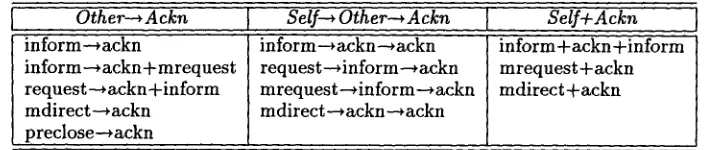
In this section, we e l a b o r a t e the structural classes of acknowledgment t h r o u g h a catalogue of pat- terns of speech acts t h a t occur in each class. This catalogue provides b r o a d coverage of p a t t e r n s typically encountered in task-oriented discourse. These p a t t e r n s describe the context of acknowl- edgments in t e r m s of exchanges and are derived from utterances in the VNS corpus. Each act in an exchange is represented in t e r m s of speech-act verbs based on the set described by Wierzbicka (1987) . Table 1 summarizes the speech-act pat- terns in the catalogue. In the following sections, we will consider each of the structural classes in turn and provide examples of selected p a t t e r n s from the VNS corpus. We also consider embed-
2The notation for structural class names indicates turns delimited by arrows (--*). Acts combined within a turn are joined with a plus (+) symbol. Other and self refer to non-acknowledgment acts by the respec- tive conversants. "Self" refers to the party producing the acknowledgment; "Other" is the other party.
ded exchanges, in which basic p a t t e r n s are used to build more complex patterns.
3.3.1 O t h e r - * A e k n Acknowledgments in the other--*ackn class relate principally to the im- mediately antecedent u t t e r a n c e as opposed to the prior exchange, which is covered by the self-*other-*ackn class. In Clark and Schae- fer's (1989) terms, Self's acknowledgment in the other-*ackn class serves as the acceptance phase for O t h e r ' s presentation. As listed in Table 1, the canonical other--* ackn p a t t e r n s axe inform--* ackn, inform-*ackn+mrequest, request-*ackn÷inform, mdirect-~ackn and preclose-*ackn. 3 In each of these cases, the first turn is by O t h e r and the sec- ond t u r n is Self's acknowledgment. In some cases, Self's turn also extends to include other signifi- cant utterances. We illustrate the other-*ackn class t h r o u g h e x a m i n a t i o n of the inform-*ackn and inform-*ackn+mrequest patterns.
I n f o r m - * A e k n
T h e inform-*aekn p a t t e r n covers cases where O t h e r performs an inform act and Self responds with an acknowledgment of t h a t act. In the follow- ing example 4 of an inform-* ackn, the wizard gives directions to the user, who acknowledges these di- rections. This is an e x a m p l e of an acknowledg- m e n t t h a t Schegloff (1982) would call a continuer.
E x a m p l e 1 ( U 6 . 3 . 1 ) 5
(1.1) Wizard: On Evans, you need to t u r n left and head West for a p p r o x i m a t e l y three quarters of a mile to Clermont.
( 1 . 2 ) User: O k a y .
(1.3) Wizard: And, urn, on Clermont you turn left, heading South for a b o u t two blocks to Iliff.
Here, the "okay" at turn 1.2 indicates the user's acceptance of the wizaxd's utterance. T h a t is, the acknowledgment implies t h a t the user understood information given by the w i z a r d - - more emphatically t h a n a simple next-relevant- contribution response. Use of the acknowledg-
3The mrequest and redirect acts are forms of meta- act in which the speaker initiates a clarification subdi- alogue or otherwise explicitly addresses the control of the conversation; rarequest and redirect are extensions of Wierzbicka's (1987) speech-act categories following Novick's (1988) meta-act analysis.
4In the examples, the acknowledgment of principal interest is highlighted.
Other--~ Ackn
[
Self--~Other--~
Ackn
Self÷ Ackn
i n f o r m ~ a c k n
inform--*ackn-bmrequest request--*ackn+inform mdirect-*ackn
preclose--*ackn
i n f o r m ~ a c k n - * a c k n request--*inform---~ackn mrequest--*inform--~ackn mdirect--~ackn--*ackn
i n f o r m + a c k n + i n f o r m mrequest+ackn m d i r e c t + a c k n
Table 1: A S u m m a r y of Speech-Act Patterns for Structural Classes of Acknowledgment
ment would be strong evidence of understanding in Clark and Schaefer's (1989) terms. An important point to stress here is t h a t the wizard cannot rely on the user necessarily having received the infor- mation that was actually conveyed or formed the intended interpretation. Rather, the wizard is left with the user's response indicating that the user was apparently satisfied with the wizard's original presentation.
Inform--* Ackn+ MRequest
T h e
inform--*ackn+mrequest
class repre- sents a significant functional variation on theinform--~ackn
class just considered. It covers caseswhere Other performs an inform act, Self responds with an acknowledgment of that act and then goes on to seek clarification of the content of the inform act. Requests for clarification are kinds of meta- act because they are concerned with aspects of di- alogue control rather than the task itself. T h a t is, requests for clarification are concerned with the specifics of old information rather than seeking to elicit largely new information--unlike request- inform acts.
Example 2 (U4.3.1)
( 2 . 1 ) Wizard: Okay. Then you want to go north on Speer Boulevard for one and one half miles to Alcott Street.
( 2 . 1 ) User: O k a y . I want to go right on Speer?
(2.2) Wizard: It will be a left.
In this example, the repair is a potential re- quest for specification (Lloyd, 1992). T h a t is, the user's clarification at 2.2 ("I want to go right on Speer?") focuses on information which was missing from the surface structure of the origi- nal inform act but which is potentially available-- namely "right" instead of "north."
3.3.2 Self--~Other---~Ackn Acknowledgments in the
self--~other--*ackn
class relate to the pre- vious exchange, rather than just the previous ut- terance. Broadly speaking, they express the cur- rent state of the dialogue in addition to embody- ing the functionality ofother--~ackn
acknowledg-ments. T h a t is, they explicitly mark the com- pletion of the antecedent exchange and indicate that the dialogue will either enter a new exchange or resume an existing exchange. Furthermore,
self--~other--~ackn
acknowledgments signal under-standing and acceptance of both the previous ex- change and the previous utterance. T h e canon- ical patterns of the
self--* other--* ackn
class, as listed in Table 1, includeinform--*ackn---~ackn,
request-* inform-~ ackn, mrequest-* inf orm--~ ackn
and
mdirect--~ackn--*ackn.
We illustrate theself--*other--~ackn
class through examination ofthe
request-~inform--, ackn
pattern.R e q u e s t --*Inform--~Aekn
The
request--~inform--*ackn
class covers caseswhere Self requests an
inform
act of Other. Other then performs thatinform
act and Self acknowl- edges. Note that the acknowledgment in this case follows a completed request-inform adjacency pair. Earlier, we mentioned that question-answer adja- cency pairs can be regarded as special cases of request-inform adjacency pairs (Searle, 1969). In the following example, the wizard requests the user's start location. T h e user satisfies this re- quest by communicating the desired information and the wizard then acknowledges. Here the ac- knowledgment at 3.3 serves to indicate acceptance (that is, receipt, understanding and agreement) of the user's inform act and is a signal that the re- quest initiated by the wizard at 3.1 has been sat- isfied and thus the exchange is complete.E x a m p l e 3 ( U 2 . 1 . 1 )
(3.1) Wizard: Okay and uh, what's your starting location?
(3.2) User: I'm at 36th and Sheridan at the Park-n-Ride.
(3.3) Wizard: O k a y , one moment please.
[image:4.612.125.478.48.123.2]listed in Table 1, include
inform+ackn+inform,
mrequest+ackn,
andmdirect+ackn.
We illustratethe
self+ackn
class through examination of thein-
form +ackn +inform
pattern.Inform+Ackn+Inform
In this pattern, Self uses an acknowledgment in the middle of an extended turn. Consider the following example:
Example 4 (U5.3.1)
( 4 . 1 ) Wizard: All right, urn, the first thing you need to do is go South on Logan Street for one and a half miles to Evans Avenue. T h e n turn left on Evans Avenue and go one and a quarter miles to South Josephine Street. O k a y , then you'll turn left on South Josephine Street. Nineteen Forty South Josephine is within the first block.
This particular self-acknowledgment is very similar to a continuer--indeed it may be regarded
as a self-continuer.
T h e wizard's acknowledgmentin this example represents a sort of temporizing, a chance for the wizard to "catch his mental breath." For the user, this sort of
"Okay"
thus signals that the wizard intends to continue his turn. This is functionally distinct from a meta-request of the form "Okay?" because there is no rising intona- tion and the wizard does not wait for a response. In fact, use of a self-acknowledgment at the end of a turn would be peculiar.3 . 3 . 4 E m b e d d e d E x c h a n g e s We noted earlier t h a t basic patterns can used to build more com- plex patterns. This can lead potentially to vari- ations in patterns of acknowledgments. In par- ticular, it is possible to observe cascades of ac- knowledgments as nested exchanges are "popped" one by one. Simple acts may be replaced by more complex exchanges, so that an inform act may be replaced by an exchange that accomplishes an in- form via a sequence of informs, clarifications and acknowledgments. In this section we will consider one of the variations encountered in the VNS cor- pus; where an
{nform---*ackn--~ackn
replaces theinform
act in aninform--*ackn
sequence. In thefollowing example, there are three successive ac- knowledgment acts. T h e first acknowledgment at 5.2 is accompanied by a verbatim response by the user. It is the second phase of the
inform--*ackn
adjacency pair, indicating understanding and ac- ceptance of the wizard's
inform
act in which a di- rection was clarified. T h e second acknowledgment, issued by the wizard at 5.3, marks the completion of theinform--*ackn
exchange. T h a t is, the wiz- ard recognizes t h a t it is his or her turn yet has nothing more to add, so indicates passing up the turn with an acknowledgment. T h e third acknowl-edgment, issued by the user at 5.4, is associated with the user recognizing t h a t the wizard has fin- ished clarifying directions; the user thus acknowl- edges this embedded
inform
act. T h e user then indicates satisfaction and approval of the wizard's directions with the assessment "Sounds good."E x a m p l e 5 ( U 6 . 2 . 1 )
(5.1) Wizard: Okay, it was, urn, on Evans it's three and three quarter miles to Jas- mine.
( 5 . 2 ) User: Three, o k a y . (5.3) Wizard: O k a y .
(5.4) User: A l l r i g h t , sounds good.
4 CONCLUSION
Why is a conversation-analytic study of acknowl- edgment useful in the development of spoken language systems? SLSs developers face the dual challenges of creating both domain-based dialogues and repair-oriented dialogues. Lack- ing systematic mechanisms for natural mainte- nance of mutuality, SLSs tend to rely on do- main s t r u c t u r e s - - p r o d u c i n g rather stolid interac- tion. T h e most advanced systems incorporate re- pair acts, but are unable to relate the repairs to the main dialogue structures in a natural way. T h e ac- knowledgment model described in this paper pro- vides a systematic m e t h o d of maintaining mutu- ality of knowledge for both domain and control information.
More concretely, using this model SLSs can account for acknowledgments by both user and system. T h e corpus evidence suggests t h a t users' utterances in unconstrained dialogues contain many instances of acknowledgment. In interpret- ing these utterances, identification of the appro- priate acknowledgment function affects the state of the dialogue model and thus plays an i m p o r t a n t role in determining an appropriate response by the system. In producing such responses, the acknowl- edgment model can provide structurally appropri- ate utterances. T h e fundamental idea is to pro- duce contextually appropriate acknowledgments that advances the dialogue seamlessly with respect to both domain and control functions. T h a t is, the system needs to give the right signals at the right time.
directions, either step-by-step or all at once. The choice of presentation method by the conversants was a dynamic one: in cases where it became ap- parent that the user was experiencing difficulties with either hearing or understanding directions, the wizard often resorted to the step-by-step ap- proach. This form of repair changed the process of interaction so that the comprehension of each in- stallment was verified before proceeding with the next.
The conversants in the VNS corpus displayed relatively higher rates of use of acknowledgment in repair situations or when unplanned events arose (e.g., the user had gotten lost). Intuitively, people make more effort to establish mutual knowledge when it is apparent that miscommunication has occurred than at other times; their certainty cri- terion for mutuality (Clark and Marshall, 1981) is raised as a result of the need for repair. This suggests that a facility for acknowledgment is an important element in the development of robust SLSs because use of acknowledgment is most crit- ical precisely when the conversation has gone awry. We are currently developing a computational model of acknowledgment based on the empirical work presented in this paper. This model is in- tended for integration into a SLS where it will serve both to predict when acknowledgments are appropriate from the system and when to expect acknowledgments from the user. Briefly, deter- mining the applicability of an acknowledgment in- volves interpreting exchanges in terms of speech acts and then mapping these speech-act patterns onto the acknowledgment classes described. This, we believe, will facilitate improved SLS robustness through achievement of a greater degree of mutual understanding and provide a more natural and in- tuitive interaction. The utility and implementa- tion of the empirical model will be the focus of a later paper.
5 A C K N O W L E D G M E N T S
This work was supported by U S WEST Advanced Technologies and the Oregon Advanced Comput- ing Institute.
R e f e r e n c e s
H. Brunner, G. Whittemore, K. Ferrara, and J. Hsu. 1992. An assessment of writ- ten/interactive dialogue for information re- trieval applications. Human Computer Inter- action, 7:197-249.
H.H. Clark and C.R. Marshall. 1981. Definite reference and mutual knowledge. In A.K. Joshi, B.L. Webber, and I.A. Sag, editors, El-
ements of discourse understanding, pages 10- 63. Cambridge University Press, Cambridge. H.H. Clark and E.F. Schaefer. 1989. Contributing
to discourse. Cognitive Science, 13:259-294. S. Duncan and D.W. Fiske. 1987. Face-to-face in-
teraction: Research methods and theory. Wi- ley, New York.
C. Goodwin. 1986. Between and within: Alterna- tive sequential treatments of continuers and assessments. Human Studies, 9:205-217. R. Hopper. 1992. Telephone conversations. Uni-
versity of Indiana, Bloomington, IN.
A. Kendon. 1967. Some functions of gaze in social interaction. Acta Psychologica, 26:22-63. P. Lloyd. 1992. The role of clarification requests in
children's communication of route directions by telephone. Discourse Processes, 15:357- 374.
D.G. Novick. 1988. Control of mixed-initiative discourse through meta-locutionary acts: A computational model. Doctoral dissertation, Department of Computer Science and Infor- mation Science, University of Oregon, Decem- ber.
B. Orestrom. 1983. Turn-taking in english con- versation. Gleerup, Lund, Sweden.
H. Sacks, E. Schegloff, and G. Jefferson. 1974. A simplest systematics for the organization of turn-taking in conversation. Language, 50:696-735.
E.A. Schegloff and H. Sacks. 1973. Opening up closings. Semiotica, 8:289-327.
E.A. Schegloff. 1982. Discourse as an interac- tional achievement: Some uses of 'uh huh' and other things that come between sentences. In D. Tannen, editor, Analyzing Discourse: Text and Talk, pages 71-93. Georgetown University Press, Washington, D.C.
J.R. Searle. 1969. Speech acts: An essay in the philosophy of language. Cambridge University Press, Cambridge.
A. Wierzbicka. 1987. English speech act verbs: A semantic dictionary. Academic Press, Sydney, Australia.