Proceedings of the 49th Annual Meeting of the Association for Computational Linguistics:shortpapers, pages 379–383,
Dealing with Spurious Ambiguity in Learning ITG-based Word Alignment
Shujian Huang State Key Laboratory for Novel Software Technology
Nanjing University [email protected]
Stephan Vogel
Language Technologies Institute Carnegie Mellon University
Jiajun Chen State Key Laboratory for Novel Software Technology
Nanjing University [email protected]
Abstract
Word alignment has an exponentially large search space, which often makes exact infer-ence infeasible. Recent studies have shown that inversion transduction grammars are rea-sonable constraints for word alignment, and that the constrained space could be efficiently searched using synchronous parsing algo-rithms. However, spurious ambiguity may oc-cur in synchronous parsing and cause prob-lems in both search efficiency and accuracy. In this paper, we conduct a detailed study of the causes of spurious ambiguity and how it ef-fects parsing and discriminative learning. We also propose a variant of the grammar which eliminates those ambiguities. Our grammar shows advantages over previous grammars in both synthetic and real-world experiments.
1 Introduction
In statistical machine translation, word alignment at-tempts to find word correspondences in parallel sen-tence pairs. The search space of word alignment will grow exponentially with the length of source and target sentences, which makes the inference for complex models infeasible (Brown et al., 1993). Re-cently, inversion transduction grammars (Wu, 1997), namely ITG, have been used to constrain the search space for word alignment (Zhang and Gildea, 2005; Cherry and Lin, 2007; Haghighi et al., 2009; Liu et al., 2010). ITG is a family of grammars in which the right hand side of the rule is either two nonterminals or a terminal sequence. The most general case of the ITG family is the bracketing transduction grammar
A→[AA]| hAAi |e/f |/f |e/
Figure 1: BTG rules.[AA]denotes a monotone concate-nation andhAAidenotes an inverted concatenation.
(BTG, Figure 1), which has only one nonterminal symbol.
Synchronous parsing of ITG may generate a large number of different derivations for the same under-lying word alignment. This is often referred to as the spurious ambiguity problem. Calculating and saving those derivations will slow down the parsing speed significantly. Furthermore, spurious deriva-tions may fill up the n-best list and supersede po-tentially good results, making it harder to find the best alignment. Besides, over-counting those spu-rious derivations will also affect the likelihood es-timation. In order to reduce spurious derivations, Wu (1997), Haghighi et al. (2009), Liu et al. (2010) propose different variations of the grammar. These grammars have different behaviors in parsing effi-ciency and accuracy, but so far no detailed compari-son between them has been done.
A
A
A A A
e1 e2 e3
f1 f2 f3 A
A A
A A
e1 e2 e3
f1 f2 f3 A
A
A A A
e1 e2 e3
f1 f2 f3 A
A A
A A
e1 e2 e3
f1 f2 f3
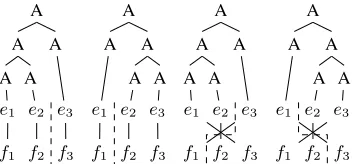
Figure 2: Possible monotone/inverted t-splits (dashed lines) under BTG, causing branching ambiguities.
2 ITG Alignment Family
By lexical rules likeA→ e/f, each ITG derivation actually represents a unique alignment between the two sequences. Thus the family of ITG derivations represents a family of word alignment.
Definition 1. The ITG alignment familyis a set of word alignments that has at least one BTG deriva-tion.
ITG alignment family is only a subset of word alignments because there are cases, known as inside-outside alignments (Wu, 1997), that could not be represented by any ITG derivation. On the other hand, an ITG alignment may have multiple deriva-tions.
Definition 2. For a given grammarG,spurious am-biguity in word alignment is the case where two or more derivationsd1,d2, ... dk ofGhave the same underlying word alignmentA. A grammarGis non-spuriousif for any given word alignment, there exist at most one derivation underG.
In any given derivation, an ITG rule applies by ei-ther generating a bilingual word pair (lexical rules) or splitting the current alignment into two parts, which will recursively generate two sub-derivations (transition rules).
Definition 3. Applying a monotone (or inverted) concatenation transition rule forms a monotone t-split (or inverted t-split) of the original alignment (Figure 2).
3 Causes of Spurious Ambiguity
3.1 Branching Ambiguity
As shown in Figure 2, left-branching and right-branching will produce different derivations under
A→[AB]|[BB]|[CB]|[AC]|[BC]|[CC] B → hAAi | hBAi | hCAi | hACi | hBCi | hCCi
[image:2.612.98.274.73.155.2]C→e/f |/f |e/
Figure 3: A Left heavy Grammar (LG).
BTG, but yield the same word alignment. Branching ambiguity was identified and solved in Wu (1997), using the grammar in Figure 3, denoted as LG. LG uses two separate non-terminals for monotone and inverted concatenation, respectively. It only allows left branching of such non-terminals, by excluding rules likeA→[BA].
Theorem 1. For each ITG alignment A, in which all the words are aligned, LG will produce a unique derivation.
Proof: Induction on n, the length ofA. Case n=1 is trivial. Induction hypothesis: the theorem holds for anyAwith length less than n.
For A of length n, let sbe the right most t-split which splitsAintoS1andS2.sexists becauseAis an ITG alignment. Assume that there exists another t-splits0, splittingAintoS11and(S12S2). Because
Ais fixed and fully aligned, it is easy to see that if
sis a monotone t-split,s0 could only be monotone, andS12andS2in the right sub-derivation of t-splits0 could only be combined by monotone concatenation as well. Sos0 will have a right branching of mono-tone concatenation, which contradicts with the def-inition of LG because right branching of monotone concatenations is prohibited. A similar contradic-tion occurs ifsis an inverted t-split. Thussshould be the unique t-split forA. By I.H.,S1andS2have a unique derivation, because their lengths are less than n. Thus the derivation forAwill be unique.
3.2 Null-word Attachment Ambiguity
Definition 4. For any given sentence pair(e, f)and its alignment A, let (e0, f0) be the sentence pairs with all null-aligned words removed from (e, f). Thealignment skeletonASis the alignment between
(e0, f0)that preserves all links inA.
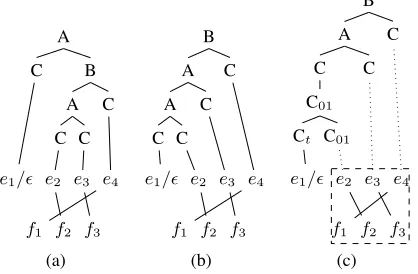
From Theorem 1 we know that every ITG align-ment has a unique LG derivation for its alignalign-ment skeleton (Figure 4 (c)).
A
C B
A
C C C
e1/ e2 e3 e4
f1 f2 f3
(a)
B
A
A
C C C
C
e1/ e2 e3 e4
f1 f2 f3
(b)
B
A
C
C01
Ct C01 C
C
e1/ e2 e3 e4
f1 f2 f3
[image:3.612.83.292.78.215.2](c)
Figure 4: Null-word attachment for the same alignment. ((a) and (b) are spurious derivations under LG caused by null-aligned words attachment. (c) shows the unique derivation under LGFN. The dotted lines have omitted some unary rules for simplicity. The dashed box marks the alignment skeleton.)
A→[AB]|[BB]|[CB]|[AC]|[BC]|[CC] B→ hAAi | hBAi | hCAi | hACi | hBCi | hCCi
C→C01|[CsC]
C01→C00|[CtC01]
C00→e/f, Ct→e/, Cs→/f
Figure 5: A Left heavy Grammar with Fixed Null-word attachment (LGFN).
no explicit correspondence in the other language and tend to stay unaligned. These null-aligned words, also called singletons, should be attached to some other nodes in the derivation. It will produce dif-ferent derivations if those null-aligned words are at-tached by different rules, or to different nodes.
Haghighi et al. (2009) give some restrictions on null-aligned word attachment. However, they fail to restrict the node to which the null-aligned word is attached, e.g. the cases (a) and (b) in Figure 4.
3.3 LGFN Grammar
We propose here a new variant of ITG, denoted as LGFN (Figure 5). Our grammar takes similar tran-sition rules as LG and efficiently constrains the at-tachment of null-aligned words. We will empirically compare those different grammars in the next sec-tion.
Lemma 1. LGFN has a unique mapping from the derivation of any given ITG alignment A to the derivation of its alignment skeletonAS.
Proof: LGFN maps the null-aligned source word sequence, Cs1, Cs2, ..., Csk, the null-aligned target
word sequence,Ct1, Ct2, ..., Ctk0, together with the
aligned word-pairC00 that directly follows, to the nodeCexactly in the way of Equation 1. The brack-ets indicate monotone concatenations.
C →[Cs1...[Csk[Ct1...[Ctk0C00]...]]...] (1)
The mapping exists when every null-aligned se-quence has an aligned word-pair after it. Thus it requires an artificial word at the end of the sentence. Note that our grammar attaches null-aligned words in a right-branching manner, which means it builds the span only when there is an aligned word-pair. After initialization, any newly-built span will contain at least one aligned word-pair. Compara-tively, the grammar in Liu et al. (2010) uses a left-branching manner. It may generate more spans that only contain null-aligned words, which makes it less efficient than ours.
Theorem 2. LGFN has a unique derivation for each ITG alignment, i.e. LGFN is non-spurious.
Proof: Derived directly from Definition 4, Theo-rem 1 and Lemma 1.
4 Experiments
4.1 Synthetic Experiments
We automatically generated 1000 fully aligned ITG alignments of length 20 by generating random per-mutations first and checking ITG constraints using a linear time algorithm (Zhang et al., 2006). Sparser alignments were generated by random removal of alignment links according to a given null-aligned word ratio. Four grammars were used to parse these alignments, namely LG (Wu, 1997), HaG (Haghighi et al., 2009), LiuG (Liu et al., 2010) and LGFN (Sec-tion 3.3).
% 0 5 10 15 20 25 LG 1 42.2 1920.8 9914.1+ 10000+ 10000+
[image:4.612.334.519.71.165.2]HaG 1 3.5 10.9 34.1 89.2 219.9
Table 1: Average #derivations per alignment for LG and HaG v.s. Percentage of unaligned words. (+ marked parses have reached the beam size limit of 10000.)
600
s) HaG LiuG
200 300 400 500
sing time (
s HaG LiuG
LFG LG
0 100
0 5 10 15 20 25
Par
s
P t f ll li d d
[image:4.612.76.303.72.108.2]Percentage of null-aligned words
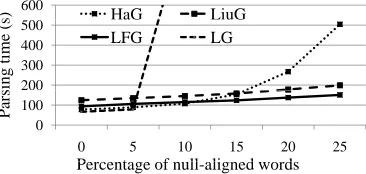
Figure 6: Total parsing time (in seconds) v.s. Percentage of un-aligned words.
the 10-best alignments for sentence pairs that have 10% of words unaligned, the top 109 HaG deriva-tions should be generated, while the top 10 LiuG or LGFN derivations are already enough.
Figure 6 shows the total parsing time using each grammar. LG and HaG showed better performances when most of the words were aligned because their grammars are simpler and less constrained. How-ever, when the number of null-aligned words in-creased, the parsing times for LG and HaG became much longer, caused by the calculation of the large number of spurious derivations. Parsings using LG for 10 and 15 percent of null-aligned words took around 15 and 80 minutes, respectively, which can-not be plotted in the same scale with other gram-mars. The parsing times of LGFN and LiuG also slowly increased, but parsing LGFN consistently took less time than LiuG.
It should be noticed that the above results came from parsing according to some given alignment. When searching without knowing the correct align-ment, it is possible for every word to stay unaligned, which makes spurious ambiguity a much more seri-ous issue.
4.2 Discriminative Learning Experiments To further study how spurious ambiguity affects the discriminative learning, we implemented a frame-work following Haghighi et al. (2009). We used a log-linear model, with features like IBM model1
0 2 0.21
0 17 0.18 0.19 0.2
A
ER
0.15 0.16 0.17
1 6 11 16
A
HaG-20best LFG-1best LFG-20best
[image:4.612.94.277.166.253.2]Number of iterations
Figure 7: Test set AER after each iteration.
probabilities (collected from FBIS data), relative distances, matchings of high frequency words, matchings of pos-tags, etc. Online training was performed using the margin infused relaxed algo-rithm (Crammer et al., 2006), MIRA. For each sentence pair (e, f), we optimized with alignment results generated from the nbest parsing results. Alignment error rate (Och and Ney, 2003), AER, was used as the loss function. We ran MIRA train-ing for 20 iterations and evaluated the alignments of the best-scored derivations on the test set using the average weights.
We used the manually aligned Chinese-English corpus in NIST MT02 evaluation. The first 200 sen-tence pairs were used for training, and the last 150 for testing. There are, on average, 10.3% words stay null-aligned in each sentence, but if restricted to sure links the average ratio increases to 22.6%.
We compared training using LGFN with 1-best, 20-best and HaG with 20-best (Figure 7). Train-ing with HaG only obtained similar results with 1-best trained LGFN, which demonstrated that spu-rious ambiguity highly affected the nbest list here, resulting in a less accurate training. Actually, the 20-best parsing using HaG only generated 4.53 dif-ferent alignments on average. 20-best training us-ing LGFN converged quickly after the first few it-erations and obtained an AER score (17.23) better than other systems, which is also lower than the re-fined IBM Model 4 result (19.07).
2009), we further reduced AER on the test set to 12.25. An average improvement of 0.52 BLEU (Pa-pineni et al., 2002) score and 2.05 TER (Snover et al., 2006) score over 5 test sets for a typical phrase-based translation system, Moses (Koehn et al., 2003), validated the effectiveness of our experi-ments.
5 Conclusion
Great efforts have been made in reducing spurious ambiguities in parsing combinatory categorial gram-mar (Karttunen, 1986; Eisner, 1996). However, to our knowledge, we give the first detailed analysis on spurious ambiguity of word alignment. Empirical comparisons between different grammars also vali-dates our analysis.
This paper makes its own contribution in demon-strating that spurious ambiguity has a negative im-pact on discriminative learning. We will continue working on this line of research and improve our discriminative learning model in the future, for ex-ample, by adding more phrase level features.
It is worth noting that the definition of spuri-ous ambiguity actually varies for different tasks. In some cases, e.g. bilingual chunking, keeping differ-ent null-aligned word attachmdiffer-ents could be useful. It will also be interesting to explore spurious ambi-guity and its effects in those different tasks.
Acknowledgments
The authors would like to thank Alon Lavie, Qin Gao and the anonymous reviewers for their valu-able comments. This work is supported by the Na-tional Natural Science Foundation of China (No. 61003112), the National Fundamental Research Program of China (2010CB327903) and by NSF un-der the CluE program, award IIS 084450.
References
Peter F. Brown, Stephen Della Pietra, Vincent J. Della Pietra, and Robert L. Mercer. 1993. The mathematic of statistical machine translation: Parameter estima-tion. Computational Linguistics, 19(2):263–311. Colin Cherry and Dekang Lin. 2007. Inversion
transduc-tion grammar for joint phrasal translatransduc-tion modeling. InProceedings of the NAACL-HLT 2007/AMTA Work-shop on Syntax and Structure in Statistical
Transla-tion, SSST ’07, pages 17–24, Stroudsburg, PA, USA. Association for Computational Linguistics.
Koby Crammer, Ofer Dekel, Joseph Keshet, Shai Shalev-Shwartz, and Yoram Singer. 2006. Online passive-aggressive algorithms. J. Mach. Learn. Res., 7:551– 585, December.
Jason Eisner. 1996. Efficient normal-form parsing for combinatory categorial grammar. In Proceedings of the 34th annual meeting on Association for Compu-tational Linguistics, ACL ’96, pages 79–86, Strouds-burg, PA, USA. Association for Computational Lin-guistics.
Aria Haghighi, John Blitzer, and Dan Klein. 2009. Bet-ter word alignments with supervised itg models. In
Association for Computational Linguistics, Singapore. Lauri Karttunen. 1986. Radical lexicalism. Technical
Report CSLI-86-68, Stanford University.
Philipp Koehn, Franz Josef Och, and Daniel Marcu. 2003. Statistical phrase-based translation. In HLT-NAACL.
Shujie Liu, Chi-Ho Li, and Ming Zhou. 2010. Dis-criminative pruning for disDis-criminative itg alignment. In Proceedings of the 48th Annual Meeting of the Association for Computational Linguistics, ACL ’10, pages 316–324, Stroudsburg, PA, USA. Association for Computational Linguistics.
Franz Josef Och and Hermann Ney. 2003. A system-atic comparison of various statistical alignment mod-els. Comput. Linguist., 29(1):19–51.
Kishore Papineni, Salim Roukos, Todd Ward, and Wei-Jing Zhu. 2002. Bleu: a method for automatic evalua-tion of machine translaevalua-tion. InACL ’02: Proceedings of the 40th Annual Meeting on Association for Compu-tational Linguistics, pages 311–318, Morristown, NJ, USA. Association for Computational Linguistics. Matthew Snover, Bonnie J. Dorr, and Richard Schwartz.
2006. A study of translation edit rate with targeted human annotation. InProceedings of AMTA.
Dekai Wu. 1997. Stochastic inversion transduction grammars and bilingual parsing of parallel corpora.
Comput. Linguist., 23:377–403, September.
Hao Zhang and Daniel Gildea. 2005. Stochastic lexi-calized inversion transduction grammar for alignment. In Proceedings of the 43rd Annual Meeting on As-sociation for Computational Linguistics, ACL ’05, pages 475–482, Stroudsburg, PA, USA. Association for Computational Linguistics.