M a r k J o h n s o n " B r o w n U n i v e r s i t y
Feature structures are a representational device used in several current linguistic theories. This paper shows how these structures can be axiomatized in a decidable class of first-order logic, which can also be used to express constraints on these structures. Desirable properties, such as compactness and decidability, follow directly. Moreover, additional types of feature values, such as "set-valued" features, can be incorporated into the system simply by axiomatizing their properties.
1. Introduction
M a n y m o d e r n linguistic theories, such as Lexical-Functional G r a m m a r (Bresnan 1982), Functional Unification G r a m m a r (Kay 1985), G e n e r a l i z e d Phrase Structure G r a m m a r ( G a z d a r et al. 1985), Unification Categorial G r a m m a r ( H a d d o c k et al. 1987), (Uszkoreit 1986), a n d H e a d - D r i v e n P h r a s e Structure G r a m m a r (Pollard a n d Sag 1987), replace the a t o m i c categories of a context-free g r a m m a r w i t h a "feature structure" that represents the syntactic a n d s e m a n t i c p r o p e r t i e s of the phrase. These feature structures are spec- ified indirectly in t e r m s of constraints that they m u s t satisfy. Lexical entries constrain the feature structures that can be associated w i t h t e r m i n a l n o d e s of the syntactic tree, a n d p h r a s e structure rules s i m u l t a n e o u s l y constrain the feature structures that can be associated w i t h a p a r e n t n o d e a n d its i m m e d i a t e descendants.
That is, lexical entries a n d syntactic rules u s e d to construct a syntactic p h r a s e structure tree all contribute constraints on the feature structures that a p p e a r as the labels on n o d e s in the syntactic tree. The tree is well f o r m e d if a n d o n l y if all of these constraints are s i m u l t a n e o u s l y satisfiable. T h u s for the p u r p o s e s of recognition a m e t h o d for d e t e r m i n i n g the satisfiability of such constraints is required; the precise nature of the satisfying feature structures (of w h i c h there m a y be infinitely m a n y ) is of s e c o n d a r y i m p o r t a n c e . 1
A v a r i e t y of different t y p e s of feature structures h a v e b e e n p r o p o s e d in the liter- ature, b u t m o s t w o r k on unification-based g r a m m a r has centered on a certain t y p e of feature structure k n o w n as an attribute-value structure. The e l e m e n t s in an attribute- v a l u e structure c o m e in t w o k i n d s : constant elements a n d complex elements. C o n s t a n t e l e m e n t s are a t o m i c entities w i t h no internal structure: i.e. t h e y h a v e no attributes. C o m p l e x e l e m e n t s h a v e zero or m o r e attributes, w h o s e values m a y be a n y other ele- m e n t in the structure, including a c o m p l e x element. A n e l e m e n t can be the v a l u e of zero, o n e or several attributes. Attributes are partial: it n e e d not be the case that e v e r y attribute is defined for e v e r y c o m p l e x element.
* Department of Cognitive and Linguistic Sciences, Providence, RI 02912 USA
Computational Linguistics Volume 17, Number 2
"Mary seems to like John"
eo
-pred =
subj =
e3
comp : seem
-
11
I num = sg i agre5 ~pers 3rd
pred = mary pred = like
I
pred = johnobj= ~ ~num=
e2 ~agr e4~pers = tense = none
subj = e 3
tense = pres
3;:11
Figure 1
An attribute-value structure for Mary seems to like John
E x a m p l e 1
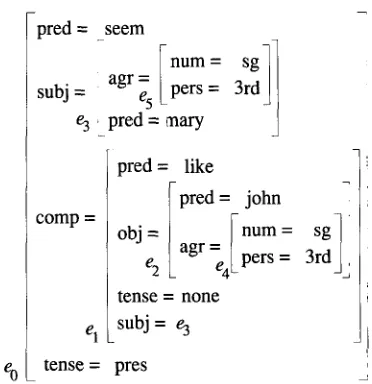
Figure 1 depicts an attribute-value structure. The attribute-value element labeled eo in Figure 1 might be associated with the sentence Mary seems to like John.
The attribute-value structure depicted in Figure 1 contains six complex elements eo,..., e5 and eight constant elements seem, like, john, sg, 3rd, mary, none, and pres. The element eo is a complex attribute-value element with four attributes: pred, subj, comp, and tense: the order in which the attributes appear in the diagram is irrelevant. The value of its pred attribute is the constant seem (which abbreviates the relation denoted by the verb seem), and the value of its tense attribute is the constant element pres (which indicates that the clause is in the present tense). The values of the subj and comp attributes are the complex elements e3 and el (which represent the subject and the complement of the verb seem, respectively). The element e3 also appears as the subject of el, indicating that Mary is also the (understood) subject of the verb likes as well.
The element el is a complex attribute-value element with four attributes pred, obj, subj, and tense. The value of its pred attribute is the constant element like (which abbre- viates the relation denoted by the verb like) and the value of its tense attribute is the constant element none (which indicates that the clause is untensed). The values of the attributes obj and subj of el are the complex elements e2 and e3, respectively (which represent the subject and object of the clause). Both e4 and e5 have the same attributes hum and pets, and the values of these attributes of e4 are identical to the corresponding values of these attributes of e5. Nevertheless, e4 and e5 are distinct elements.
[image:2.468.75.413.54.266.2] [image:2.468.224.410.58.250.2]salmon
swims
e'
-pred = salmon a g r = ~pers= 3rdlp ~
~0 L J ,
pred = swim
~num = subj = agr f = , [_pers --
e" 2 " tense = pres
3rd
Figure 2
Lexical entries for salmon and swim
"The salmon swims"
pred =
• subj = e' e" tense =
swim
s !l
/ ;Lpers--
~pred = salmonpres
Figure 3
An example of attribute-value unification
constant elements (a constant-constant clash) or the unification of a constant element a n d a complex element (a constant-complex clash).
Example 2
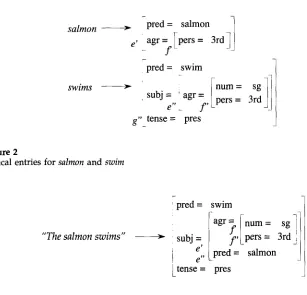
A g r a m m a r might assign the attribute-value structures in Figure 2 to the N P the salmon a n d the VP swims, respectively. Note that e' does not have a num attribute, since the salmon can be either singular or p l u r a l and that e" does not have a pred attribute.
The attribute-value structure for the sentence (the) salmon swims is obtained by unifying e' and e ' , which corresponds to identifying salmon as the subject of swims. The resulting element inherits the value of the pred attribute from e' and the value of the num attribute from e'. The unification of e' a n d e" requires the unification of f~ a n d f " as well.
Although it might not be obvious from this simple example, a large n u m b e r of syntactic constructions from a variety of natural languages can be described in such a unification-based framework (many of the analyses presented in Bresnan 1982 can be expressed in such a "pure" unification-based framework). Nevertheless, it is often convenient a n d sometimes necessary to extend the basic unification f r a m e w o r k to include a wider variety of feature structures.
[image:3.468.53.360.49.344.2]Computational Linguistics
Volume 17, Number 2
d/e
__ m
cat = determiner
/ ~ n u m b e r : singular-~ \
agr= ~_gender: femininel~
\ ~number: plural ~ /
[image:4.468.73.353.55.337.2] [image:4.468.136.344.60.167.2]nom
case= (acc /
Figure 4
Disjunction in the lexical entry for
dieswim
I
pred = swim
I
~num= sg
l j l
subj =
agr = --,
tense e ~ pre s
f~eers = 3rd
g
Figure 5
Negation in the lexical entry for
swimExample 3
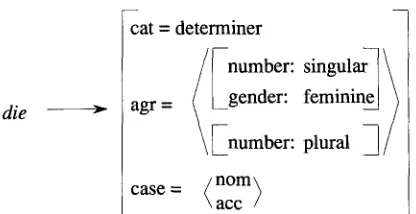
In German the determiner
diemust have accusative or nominative case, and agrees
with either feminine singular nouns or plural nouns of any gender. In a framework
with disjunctive values only one lexical entry for
dieis required. 2
Example 4
In the basic unification framework described above the tensed verb
swimwould require
multiple lexical entries, since it agrees with first person, second person, and plural third
person subjects; i.e., a subject with any agreement features other than third person
singular. In a framework with "negative values" it requires only the single lexical
entry in Figure 5, where "-~" identifies a "negative value."
As mentioned earlier, other kinds of feature structures besides attribute-value
structures have been proposed in the literature. Johnson and Klein (1986) and Johnson
and Kay (1990) show how "set-valued" features can be used to express Discourse Rep-
resentation Theory (Kamp 1981) in a complex-feature based grammar formalism. The
highly simplified example below is meant solely to show one way in which set-valued
features can be used--no claims are made for its linguistic correctness.
~
at = NP lindex ~ s Jshe -- I refs-in = s | woman
u ~efs-out = s ~
I cat = N r index = i'
J
Jj refs-in = s'
i refs-out = s' u { i' }
v [ _
Figure 6
Set-values in the lexical entries for she and woman
~
at = N , I index = i I refs-in = { } v ~efs-out = { i'}Figure 7
The result of unifying s' in Figure 6 with the empty set
E x a m p l e 5
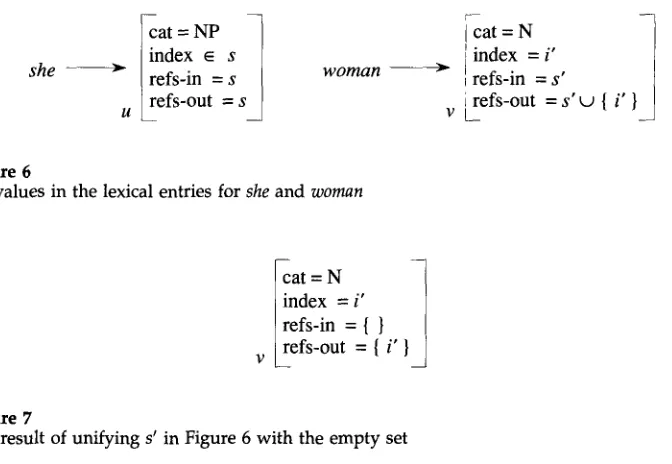
A naive t h e o r y of anaphoric d e p e n d e n c i e s b e t w e e n indefinite NPs a n d anaphoric pro- n o u n s can be constructed as follows. Each N P has an index attribute w h o s e value is a "reference marker," and two N P s are coreferential iff they share the same reference marker. 3 E v e r y feature structure associated with a n o d e in the syntactic tree has at- tributes refs-in and refs-out, w h o s e values are the sets of discourse entities available preceding and following this node, respectively. The g r a m m a r constrains the value of the refs-out attribute of an indefinite N P to be the u n i o n of its refs-in attribute a n d the singleton set containing the value of the N P ' s index attribute; this a d d s the NP's index to the set of available indices. Similarly, the g r a m m a r requires the values of a p r o n o u n ' s refs-in and refs-out attributes to be identical, a n d that its index attribute be a m e m b e r of the value of its refs-in attribute. This requires that the p r o n o u n refer to an entity previously i n t r o d u c e d into the discourse. In a f r a m e w o r k with set values the lexical entries for (a) woman and she could be as seen in Figure 6.
Unifying the value s' of the refs-in attribute of the lexical e n t r y for woman with the e m p t y set (which c o r r e s p o n d s to the e m p t y discourse context) p r o d u c e s the feature structure depicted in Figure 7.
Further, the unification of the value of the refs-out attribute in Figure 7 with the value of the refs-in attribute of u in Figure 6 (the lexical e n t r y for she), w h i c h corre- s p o n d s to interpreting the p r o n o u n as an a n a p h o r within the context established b y the single N P a woman p r o d u c e s the feature structure depicted in Figure 8.
Extending the possible feature structures b e y o n d the basic attribute-value features complicates the basic unification operation, however. For example, Moshier a n d R o u n d s (1987) and Pereira (1987) point out that it is not obvious h o w to extend unification
[image:5.468.56.392.56.288.2]Computational Linguistics Volume 17, Number 2
cat = NP [
]
[image:6.468.66.408.184.368.2]index = i' I refs-in = { i'} u ~efs-out = { i'}
Figure 8
The result of unifying the value of the refs-out attribute of Figure 7 with s in Figure 6
this > d e f = T n u m = sg u a g r v L pers = 3rd
these .def = +
num = pl
~agr-- LPers= 3rd
U' V'
salmon > IP red= salm°n3rd] 1
e, Lagr = f [ P e rs=
swim
rpre
i pers nUm sgll
agr= 3rd
subj =e
g ~ tense = pres
Figure 9
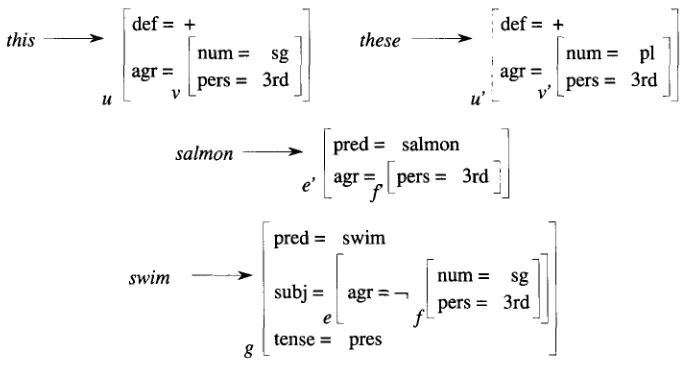
Feature structures demonstrating interaction of negative values and unification
to negative feature values; specifically, some apparently plausible extensions lose the associativity property of unification.
Example 6
Consider the feature structures in Figure 9, which might be assigned to the singular
determiner this, the plural determiner these, the n o u n salmon, and the verb swim (the
latter two structures are the same as those depicted in Figures 2 and 5). These can be
u s e d to analyze utterances such as these salmon swim and (the ill-formed utterance) this
salmon swim, which involve the unification of u, e', and e or u', e', and e, respectively.
Suppose a negative value is interpreted as a constraint that a feature structure
of negation and unification, the success or failure of a sequence of unifications depends on the order in which they are performed. 4
2. Feature Structures and Function-free Formulae
These problems have generated a considerable body of work on the mathematical properties of feature structures and the constraints and operations that apply to them. Following Kaplan and Bresnan (1982), Pereira and Shieber (1984), Kasper and Rounds (1986, 1990), and Johnson (1988, 1990a) the constraints that determine the feature struc- tures are regarded as formulae from a language for describing feature structures, rather than as feature structures themselves.
Disjunction and negation appear only in expressions from the description lan- guage, rather than as components of the feature structures that these expressions de- scribe. Thus the lexical entries in the examples above will be interpreted as formulae that constrain the feature structures that can be associated with these lexical items in a syntactic tree, rather than the feature structures themselves. For example, the feature matrices depicted in Figures 2, 4-6, and 9 will be interpreted as graphical depictions of formulae expressing constraints on linguistic objects, rather than the linguistic objects that satisfy these constraints. This avoids any need to refer to "negative" or "disjunc- tive" objects as entities appearing in a feature structure.
As explained below, the familiar attribute-value "unification algorithm" can be interpreted as computing the atomic consequences of a purely conjunctive formula (where the graphs it operates on are data structures efficiently representing such for- mulae), and unification failure corresponds to the unsatisfiability of that conjunction (Kasper and Rounds 1990; Johnson 1988, 1990a; Pereira 1987).
The most widely known model of feature structures and constraint language is the one developed to explain disjunctive feature values by Kasper and Rounds (1986, 1990) and Kasper (1986, 1987). The Kasper-Rounds treatment resolves the difficulties in interpreting disjunctive values by developing a specialized language for expressing these constraints. Various proposals to extend the Kasper-Rounds approach to deal with negative feature values are described by Moshier and Rounds (1987), Moshier (1988), Kasper (1988), Dawar and Vijayashanker (1989, 1990), Langholm (1989); other extensions to this framework are discussed by D6rre and Rounds (1989), Smolka (1988, 1989), and Nebel and Smolka (1989); and Shieber (1989) discusses the integration of such feature systems into a variety of parsing algorithms.
One difficulty with this approach is that the constraint language is "custom built," so important properties, such as compactness and decidability, must be investigated from scratch. Moreover, it is often unclear if the treatment can be extended to handle other types of feature structures as well. Rounds (1988) proposes a model for set-valued features, but he does not provide a language for expressing constraints on such set-valued entities, or investigate the computational complexity of systems of such constraints.
This paper follows an alternative strategy suggested in Johnson (1990a): axiomatize the relevant properties of feature structures in some well-understood language (here first-order logic) and translate constraints on these structures into the same language.
Computational Linguistics Volume 17, Number 2
Thus the satisfiability p r o b l e m for a set of constraints on feature structures is r e d u c e d to the satisfiability p r o b l e m for the axioms conjoined with the translation of these constraints in the target language. Importantly, techniques used to d e t e r m i n e satisfia- bility in the target language can be used to d e t e r m i n e the satisfiability of the feature constraints as well. In this p a p e r the properties of attribute-value structures a n d con- straints on them are expressed in a decidable class of first-order formulae: this m e a n s that the satisfiability p r o b l e m for such formulae, and hence the feature constraints that they express, is always decidable.
Of course, some linguistic analyses m a k e use of feature structure constraint sys- tems that can e n c o d e u n d e c i d a b l e problems. For example, s u b s u m p t i o n constraints, w h i c h are useful in the description of a g r e e m e n t p h e n o m e n a in coordination con- structions (Shieber 1989) can be u s e d to encode u n d e c i d a b l e problems, as D6rre a n d R o u n d s (1989) have shown. Clearly such constraints cannot be expressed in a decidable class, b u t often they can be axiomatized in other s t a n d a r d logics. Johnson (1991) shows h o w (positively occurring) s u b s u m p t i o n constraints can be axiomatized in first-order logic, and sketches treatments of sort constraints and n o n m o n o t o n i c devices such as A N Y values (Kay 1985) a n d 'constraint equations' (Kaplan a n d Bresnan 1982) can be formalized in s e c o n d - o r d e r logic using circumscription.
2.1 Axiomatizing Feature Structures with Function-Free Formulae
This section shows h o w the i m p o r t a n t properties of feature structures can be axioma- tized using f o r m u l a e from the S c h 6 n f i n k e l - B e r n a y s class, w h i c h is the class of first-order formulae of the form
3 X 1 . . . X n ~ y l . . . yng~
w h e r e ~ contains no function symbols or quantifiers. (Thus no existential quantifier can a p p e a r in the scope of a universal quantifier.) This class of formulae was chosen because it is b o t h decidable (see e.g. Lewis and P a p a d i m i t r i o u 1981) a n d can express the quantification n e e d e d to describe the particular set operations p r o p o s e d here, as well as a variety of other interesting types of feature structures and constraints. (For a general discussion of decidable classes see G u r e v i c h 1976 a n d Dreben a n d Goldfarb 1979.) The next section shows h o w the various kinds of constraints on feature struc- tures described a b o v e can be translated into this class of formulae, so a n y s y s t e m of such feature constraints is decidable as well.
The elements of a feature structure, both c o m p l e x a n d constant, constitute the d o m a i n of individuals in the i n t e n d e d interpretation. The attributes are b i n a r y relations o v e r this domain, s We p r o c e e d b y axiomatizing the conditions u n d e r w h i c h an interpretation c o r r e s p o n d s to a w e l l - f o r m e d feature structure, formulating t h e m in essentially the same w a y as Smolka (1988, 1989) does.
The axiomatization begins b y describing the properties of the constant elements of attribute-value structures. The attribute-value constants are the d e n o t a t i o n of certain constant symbols of the language of first-order logic, b u t not all constants (of the first- o r d e r language) will d e n o t e attribute-value constants since it is c o n v e n i e n t to have constants that d e n o t e other entities as well. The following axiom schemata express the r e q u i r e m e n t that attribute-value constants have no attributes a n d that all attribute-
value constants are distinct; i.e., that distinct attribute-value constants denote different entities.
1. For all attribute-value constants c and attributes
a, V x -~a(G x).
2. For all distinct pairs of attribute-value constants Cl, c2, Cl # c2. The next axiom schema requires attributes to be single-valued.
3. For all attributes a, V
xyz a(x,y) Aa(x,z) ~ y = z.
This completes the axiomatization of attribute-value feature structures. 6 The claim is that
any
interpretation that satisfies these axioms is an attribute-value structure, i.e. 1-3 constitute adefinition
of attribute-value structures. Such interpretations can be viewed as (possibly infinite and disconnected) directed graphs, where the individuals constitute the graph's nodes and the attribute relations the arcs between those nodes. Thus these axioms admit a much wider class of models than do most other treat- ments of feature structures (e.g., Kasper and Rounds (1990) require feature structures to be a certain type of finite automata). In fact it is easy to add axioms requiring attribute-value structures to have additional properties such as acyclicity. But since the axioms that define attribute-value structures are in effectassumptions
thatstipulate
the nature of linguistic entities, we obtain a more general theory the weaker these axioms are. Thus 1-3 are intended to stipulate only the properties of attribute-value structures that are required by linguistic analyses.
Note that the
partiality
of attributes is of crucial importance: if attributes were required to be total rather than partial functions, we could not axiomatize them with formulae from the Sch6nfinkel-Bernays class. (An axiom schema requiring attributes to be total functions would have instances of the formVx 3y a(x,y),
which do not belong to the Sch6nfinkel-Bernays class).Example 7
The interpretation corresponding to the attribute-value structure depicted in Figure 1 has as its domain the set D =
{seem, like, john, sg, 3rd, mary, pres, none}
U {e0,..., es}. The attributes denote relations on D x D. For example,pred
denotes the relation{leo~seem), (el, like), le2,johnl~ (e3~ maryl}.
It is straightforward to check that all of the axioms hold in this interpretation.Instead of providing entities in the interpretation that serve as the denotation for "dis- junctive" or "negative" features, we follow Kasper and Rounds (1986, 1990), Moshier and Rounds (1987), and Johnson (1988, 1990) in permitting disjunction and negation only in the constraint language. Since the classical semantics of disjunction and nega- tion for first-order languages is consistent and monotonic, a consistent, monotonic semantics for negative and disjunctive feature constraints follows directly. (An exam- ple is presented below; see Johnson (1990) and especially Section 2.10 of Johnson (1988) for further discussion).
We turn now to the set-valued features. The most straightforward way of introduc- ing set-valued features would be to combine some standard axiomatization of set the- ory with the axiomatization of attribute-value structures just presented. Unfortunately,
Computational Linguistics Volume 17, Number 2
all of the formulations of set-theory I am aware of, such as Z e r m e l o - F r a e n k e l set- theory, are expressed in languages w h o s e satisfiability p r o b l e m is undecidable. While this does not i m p l y that the satisfiability p r o b l e m for set-valued feature-structure con- straints is also u n d e c i d a b l e (since the feature constraint language m a y have restricted expressiveness), it does m e a n that its decidability cannot be s h o w n b y noting that a translation into a decidable class of formulae exists.
Also, as an a n o n y m o u s r e v i e w e r points out, since the i n t e n d e d linguistic applica- tions only require finite sets a n d operations such as u n i o n and intersection, s t a n d a r d theories of sets (such as Z e r m e l o - F r a e n k e l set-theory) are m u c h m o r e p o w e r f u l than needed.
Instead, w e axiomatize just those properties of set-valued features that o u r feature constraints require using formulae from the Sch6nfinkel-Bernays class. We interpret the two-place relation in as the m e m b e r s h i p relation; i n ( x , y ) is true in a m o d e l iff x is a m e m b e r of y. We place no restrictions on this relation, b u t in other formulations axioms of f o u n d a t i o n and extensionality could be u s e d to ensure that the in relation can be interpreted as the set-membership relation of Z e r m e l o - F r a e n k e l set theory. Thus this axiomatization presented here will a d m i t models in w h i c h the values of set-valued fea- tures d o not have these properties. 7 These additional properties of the s e t - m e m b e r s h i p relation d o n ' t seem to be n e e d e d in linguistic analyses, so such stipulations are not m a d e here.
The axiom of f o u n d a t i o n requires that all sets are well f o u n d e d ; i.e., that the tran- sitive closure of the s e t - m e m b e r s h i p relation is irreflexive, or m o r e informally, that no set directly or indirectly contains itself as a member. Versions of set-theory that relax this restriction have been p r o p o s e d by, e.g., Aczel (1988), a n d R o u n d s (1988) argues that n o n - w e l l f o u n d e d sets m a y be a p p r o p r i a t e models of set values in feature struc- tures. The p a r a d o x e s associated with n o n - w e l l f o u n d e d set theories are a v o i d e d here because the axiom of c o m p r e h e n s i o n that asserts the existence of paradoxical sets is not included in this axiomatization; i.e., the only w a y of defining a set is either b y explicitly listing its m e m b e r s or b y m e a n s of u n i o n a n d intersection operations.
The axiom of extensionality requires that if sets $1 and $2 contain exactly the same m e m b e r s then $1 = $2; w i t h o u t extensionality it is possible for t w o different sets to contain exactly the same members. A d m i t t e d l y the p r i m a r y reason for omitting an extensionality axiom is that it does not a p p e a r to be axiomatizable using Sch6nfinkel- Bernays' formulae, b u t three other reasons motivate this decision.
First, as n o t e d in Shieber (1986) a n d in Example 1 above, feature structures in general are not extensional (e.g., two distinct attribute-value elements can h a v e ex- actly the same attributes and values), and it seems reasonable to treat set-values in a nonextensional fashion as well.
Second, extensionality could p r o d u c e undesirable interactions with the attribute- value c o m p o n e n t of feature structures. Since set-valued features can also have at- tributes (for example, in LFG (Kaplan and Bresnan 1982)) a conjunction is associated with a set-value that also has attributes), extensionality w o u l d prohibit there being
7 In fact there are Sch6nfinkel-Bernays axioms that require the in relation to be acyclic. Define a new relation, say in + , by the axioms
V es in(e,s) ---* in+(e,s) V ess' in+(e,s) A in+(s,s ') ~ in+(e,J).
Then in any model in + denotes a superset of the transitive closure of the in relation. The following axiom requires that this transitive closure is irreflexive, i.e. that no set is contained in itself.
two set-valued features that contain exactly the same elements but that differ on the value of some attribute, something a linguistic analysis might reasonably require.
Third, as far as I a m aware, no linguistic analysis requires sets to be extensional. Appealing to the same general considerations that were used to justify the attribute- value axioms, since the assumption that sets are extensional is not required, the stip- ulation is not m a d e here.
It is necessary to define some predicates that describe set-values. We begin by pre- senting a general first-order axiomatization of these predicates, and then approximate these with formulae from the Sch6nfinkel-Bernays class.
Most of the definitions are straightforward, and are given without explanation, s The u n a r y predicate null is true of an element iff that element has no members.
4. Vx null(x) ~ - ~ y in(y,x)
The ternary relation union(x, y, z) is true only if every element in z is in x or y. 5. Vxyz union(x,y,z) ~ Vu in(u,z) ~ in(u,x) V in(u,y)
The ternary relation intersection(x, y, z) is true only if every element in z is in x and in y. 6. Vxyz intersection(x,y,z) ~ Vu in(u,z) *--* in(u,x) A in(u,y)
The binary relation singleton(u, x) is true if and only if u is the only member of x. 7. Vux singleton(u, x) ~ in(u, x) A Vv in(v, x) ~ u = v
Unfortunately the axioms 4-7 do not belong to the Sch6nfinkel-Bernays class, so we cannot guarantee the decidability of systems of constraints defined using them simply by noting a translation into this class exists. However, in all of the linguistic applica- tions I am aware of these predicates always appear positively, a n d in this case these axioms can be replaced b y the corresponding "one-sided" axioms given below. (The predicate null is an exception, since some HPSG analyses (Pollard and Sag 1987) re- quire the set of unsaturated arguments of some phrases to be non-null. However, it is possible to require that a set s is n o n e m p t y b y introducing a n e w constant u a n d require that in(u, s).)
4'. Vxy null(x) --* -,in(y, x)
5'. Vuxyz union(x,y,z) --. (in(u,z) ~ in(u,x) V in(u,y)) 6'. Vuxyz intersection(x,y,z) --. (in(u,z) ~ in(u,x) A in(u,y)) 7'. Vuxv singleton(u, x) --. (in(u, x) A in(v, x) --* u = v)
These one-sided definitions are incorrect w h e n these predicates appear negatively (i.e., in the scope of an o d d n u m b e r of negation symbols after all other proposition con- nectives have been expressed in terms of A, V, and -,). For example, an interpretation
Computational Linguistics Volume 17, Number 2
with an empty
in
relation can satisfy=null(x).
As Johan van Benthem and the anony- mous reviewer independently pointed out to me, it is possible to prove that so long as the relationsnull, union, intersection,
andsingleton
appear only positively in linguistic constraints, any model satisfying 4'-7' differs from a :model satisfying 4-7 at most in the denotation of these relations; other relations, in particular the attribute relations or even thein
relation, are not affected by the one-sided approximation. The following proposition expresses this.Proposition
Let x be a tuple of variables, A be any relation symbol, ~(A) be any formula in which A appears only positively, and ~(x) be a formula in which A does not appear. Then
(i)
.M ~ @(A) A Vx A(x) *-+ ~(x)
if and only if there is a model M ' differing from A4 only on the denotation it assigns to A such that
(ii)
A4' ~ @(A) A Vx A(x) -+ ~(x).
Proof
The left to right direction is obvious. The proposition follows from right to left as follows. Let A,/' be any model that satisfies (ii). A model A4 that satisfies (i) can be constructed as follows. Let A4 be the model that agrees with A4' except possibly on A, where IAIM = IAI~, U ~Ax~(x)~,. Now we check that M satisfies (i). Since ~ A ~ 2
~ A ~ , and A appears only positively in @(A), A4 ~ ~(A). Further dr4 ~
VxA(x) *-- ~(x)
by construction. Since A does not appear in ~(x),
~Ax~(x)~
= ~Ax~(x)~,, and since~A~M D
[ A ~ , ,M ~ VxA(x) --+ ~(x)
as well. Thus M satisfies (i) as required. In fact we have shown something stronger; the denotation of A in A4' is a subset of the denotation of A in d~4. •2.2 Expressing Constraints
Example 2 (continued)
The lexical entries for
salmon
andswims
in Figure 2 are the following formulae, w h e r e e ~, e ' , f~, f " and g" are constants of the first-order language that are not attribute-value constants. 98a.
pred(e'~ salmon) A agr(e', f') A pers(f', 3rd)
8b.
pred(g", swim)A tense(g", pres)A subj(g",
e")Aagr(e',f")A
num(f", sg)A pers(f", 3rd).
Example 3 (continued)
The lexical e n t r y for the d e t e r m i n e r
die
of Figure 4 is the following formula, w h e r e x is a (non-attribute-value) constant that denotes the feature structure of the determiner, and y and z are constants that are not attribute-value constants.9. cat(x, determiner) A agr( x, y ) A (case(x, nom ) V case(x, acc ) ) A
(number(y, plural) V (number(y, singular)A gender(y, feminine) ) )
Example 4 (continued)
The lexical e n t r y for the verb
swim
of Figure 5 is the following formula, w h e r e g is a constant that denotes the feature structure of the verb, and e and f are constants that are not attribute-value constants. 1°10.
pred(g, swim)A tense(g, pres)A subj(g,
e)Aagr(e,f)A
-~(num(f, sg)A pers(f , 3rd) )
The lexical entries for the determiners
this
andthese
of Figure 9 are the following formulae, w h e r e u, v, u ~ a n d v ~ are constants that are not attribute-value constants, and u denotes the feature structure ofthis
and u ~ denotes the feature structure ofthese.
11.
def(u, +) A agr(u, v) A num(v, sg) A pers(v, 3rd)
12.
def(u', +) A agr(u',
v') Anum(v',pl) A pers(v',3rd)
9 Instead of naming all of the nonroot attribute-value elements with constants as is done here, it is possible to merely assert their existence using an existential quantification. For example, the lexical entry for salmon could be the formula
3f'pred(e', salmon) A agr(e', f I) A pers(f , 3rd)
where fr is an existentially quantified variable. This formulation has the advantage that no 'renaming' is needed when determining subsumption of systems of attribute-value constraints. (The subsumption relation between systems of constraints is used in certain types of 'unification based' parsers (Shieber 1989).) That is, a system of constraints represented by a formula ~ subsumes another system of constraints represented by 8 iff A ~ 0 ~ ~, where A is the conjunction of the axioms defining the relevant types of feature structures.
10 The formulation (10) of the negative constraint depicted in Figure 5 does not imply that f has either a
num or pers attribute. Conceivably, one might want to interpret such a negative constraint as requiring f to have both num and pers attributes with values differing from either sg or 3rd, respectively. The formula below expresses this interpretation.
Computational Linguistics Volume 17, Number 2
Example 5 (continued)
The lexical entries for
she
andwoman
of Figure 6 are the formulae (13) and (14), where u denotes the feature structure of the pronoun, v denotes the feature structure of the noun, and w, s, s', s ' , i, a n d i' are constants that are not attribute-value constants.13.
cat(u, np) A refs-in(u, s) A refs-out(u, s) A index(u, i) A in(i, s)
14.
cat(v,
n)Aindex(v,
i')Arefs-in(v,
s')Arefs-out(v,
s")Asingleton(i',
w)Aunion(s', w,
s")In general then, a system of feature structure constraints can be viewed as a function- free a n d quantifier-free formula. These constraints are satisfiable if a n d only if there is an interpretation that simultaneously satisfies the corresponding formula a n d the ax- ioms presented in the previous section, or equivalently, the conjunction of this formula and the relevant axioms from the axiomatization. This conjunction is itself a formula from the Sch6nfinkel-Bernays class, and so the satisfiability problem for systems of feature structure constraints is decidable.
Further, we can apply results on the computational complexity of the satisfiability problem for the Sch6nfinkel-Bernays class to determine the computational complexity of the satisfiability problem for systems of such feature constraints. Since (universal) quantifiers appear only in the axiomatization of feature structures a n d not in the feature constraints themselves, the n u m b e r of quantifiers appearing in the conjunction of the feature constraints and the axiomatization is a constant, a n d does not vary with the size of the system of feature constraints. By Proposition 3.2 of Lewis (1980), the satisfiability problem for a formula F with u universal quantifiers in the Sch6nfinkel- Bernays class requires nondeterministic time polynomial in IFI u, so the problem is in NP. The reductions presented in Kasper and Rounds (1986) and Johnson (1988) can be used to show that the problem is NP-hard, so the satisfiability problem for feature constraints with set-values (as defined above) is NP-complete.
2.3 Unification and Satisfaction
This section discusses the relationship between unification a n d the axiomatization presented above.
Unification identifies or merges exactly the elements that the axiomatization im- plies are equal. The unification of two complex elements e and e' causes the unification of the values of all attributes a that are defined on both e a n d e'. Similarly, the con- junction of the formulae e = e',
a(6 f), a(e', f')
and the axioms given above implies that f = f , since axiom schema (3) requires that attributes are single valued.Similarly, the unification of two attribute-value structures fails either w h e n two distinct constant elements are unified (a constant-constant clash) or w h e n a constant a n d a complex element are unified. The formula x = x ~ is unsatisfiable u n d e r exactly the same circumstances in the theory axiomatized above. The formula x = x' conjoined with x = c and x' = c' for distinct attribute-value constants c, c' is unsatisfiable, since c ¢ c' by axiom schema (2). Also, x = x' is unsatisfiable w h e n conjoined w i t h
a(x,y)
for a n y y and x' =
c,
since~a(c,y)
by axiom schema (1).If attention is restricted to purely conjunctive attribute-value systems, the corre- sponding formulae can be represented as a directed graph, where nodes represent (first-order) constants, a n d an arc labeled a from x to y encodes the atom
a(x,y).
attribute-value relations and returns (the graph encoding of) the conjunction of all of their atomic consequences.
As Kasper (1986, 1987) noted in a different setting, the steps of the attribute-value unification algorithm are just applications of the axioms 1-3. It 'forward chains' using axiom schema (3) (for which the graph representation provides efficient indexing), and checks at each step that 1 and 2 are not falsified; if they are falsified the unifi- cation algorithm halts and reports a unification failure. Atomic equalities x = y are represented by a 'forwarding pointer' from x to y (as in the U N I O N - H N D algorithm (Gallier 1986; Nelson and Oppen 1980; Johnson in press)).
Example 2 (continued)
The unification of e ~ and e" in Figures 2 and 3 corresponds to conjoining the formula e ~ = e" to the conjunction of 8a and 8b, resulting in the formula 15a.
15a. e ' = e"A
pred(e', salmon) A agr(e', f') A pers(f', 3rd)A pred(g", swim)A
tense(g", pres)A subj(g",
e")Aagr(e", f")A num~f", sg )A pers(~", 3rd).
This formula can be simplified by substituting e r for e" to yield 15b (this substitution
corresponds exactly to the first step of the unification algorithm,
viz.
redirecting e"to e0. The affected subformulae are in boldface below.
15b. e' = e"A
pred(e'~ salmon)A agr(e',f')A pers~f', 3rd)A pred(g"~ swim)A
tense(g", pres)A subj(g"~
e')Aagr(e'~f")A num(f", sg)A pers(f", 3rd).
Since 15b contains the conjunction of
agr(e',f')
andagr(e',f"),
axiom schema (3) re-quires that f' = f", so 15b can be further simplified by substituting f' for f" to yield 15c.
15c. e' = e"A f' = f"A
pred(e', salmon)A agr(e',f')A pers(f', 3rd)A
pred(g", swim)A tense(g"~ pres)A subj(g",
e')Aagr(e'~
f')Anum~f'~ sg)A
pers(f'~ 3rd).
The duplicate occurrences of
agr(d,f')
andpers(fr,3rd)
can be deleted, yielding 15d(these last two steps correspond exactly to the unification of f~ and f" in Figure 3).
15d. e' = e"A f ' = f"A
pred(e', salmon)A agr(e',f')A pers(f',3rd)A
pred(g", swim )A tense(g", pres )A subj(g",
e')Anum(f', sg).
No further simplifications are possible, and 15d is satisfiable. In fact 15d describes the structure depicted in Figure 3, as expected.
Computational Linguistics Volume 17, Number 2
- pred = swim
I pred = salmon subj = [ agr = -! n u m = ~ s g 1
[image:16.468.160.317.57.134.2]~'L 3 f L p e r s = 3rd tense = pres
Figure 10
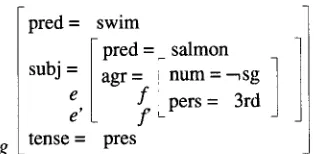
A graphical depiction of the formula 16b
Example 4 (continued)
The unification of e ~ and e (i.e. the lexical entries for
salmon
a n dswim)
of Figure 9 c o r r e s p o n d s to the conjunction of the f o r m u l a e = e I to the conjunction of 8a a n d 10, w h i c h is the f o r m u l a 16a.16a. e = e'A
pred(e', salmon)A agr(e',f)A pers(f', 3rd)A pred(g, swim)A
tense(g, pres)A subj(g,
e)Aagr( G f)A -~(num(f , sg)A pers(f , 3rd) )
This can be simplified b y straightforward applications of axiom schema (3), equality substitution, a n d propositional equivalences to obtain 16b.
16b. e = e'A f = f'A
pred(G salmon)A pers(f, 3rd)A pred(g, swim)A
tense(g, pres)A subj(g,
e)Aagr(G f)A -~num(f , sg).
This f o r m u l a could be depicted as in Figure 10, w h e r e such matrices are n o w to be u n d e r s t o o d as graphical depictions of formulae. The further unification of e' w i t h u, the lexical e n t r y for
this,
c o r r e s p o n d s to the conjunction of e ~ = u to the conjunction of the f o r m u l a e 16b a n d 11, w h i c h is the f o r m u l a 16c.16c. e = e'A f = f'A e' = uA
pred(G salmon)A pers(f, 3rd)A pred(g, swim)A
tense(g, pres)A subj(g,
e)Aagr(e, f)A -~num(f , sg)A def(u,
+)Aagr(u,
v)Anum(v, sg)A pers(v, 3rd).
By substituting e for b o t h e I a n d u in 16c, w e obtain 16d.
16d. e = e'A f = f'A e = uA
pred(e, salmon)A pers(f, 3rd)A pred(g, swim)A
tense(g, pres)A subj(g,
e)Aagr(e,f)A -~num(f, sg)A def(e~
+)Aagr(e~
v)Anum(v, sg)A pers(v, 3rd).
Again, since 16d contains the conjunction of
agr(e,f)
a n dagr(G
v), axiom schema (3) requires that f = v, so 16d can be f u r t h e r simplified b y substituting f for v, yielding 16e.16e. e = e'A f = f'A e = uA f = vA
pred(e, salmon)A pers(f, 3rd)A
pred(g, swim)A tense(g, pres)A subj(g,
e)Aagr( G f)A -~num(~, sg)A
- pred =
subj
e,
e,
u
tense = swim
- pred = salmon
def = +
agr= I n u m = p l 1
!,~
pers = 3rd)res
F i g u r e 11
A graphical depiction of the formula 16f'
The formula 16e is unsatisfiable, since it contains conjunction of both
num(f, sg)
andits negation
-~num(f, sg).
This is the desired result, since the utterancethis salmon swim
is ill formed.
On the other hand, the unification e' in 16b (c.f. Figure 10) is with u', the lexical
entry for
these,
corresponds to the conjunction of e' = u', 16b and 12, which is theformula 16c'.
16c'. e = e'A f = f'A e' = u'A
pred(e, salmon)A pers(f, 3rd)A pred(g, swim)A
tense(g, pres)A subj(g,
e)Aagr(e, d)A -~numff , sg)A def(u',
+)Aagr(u',
v')Anum(v', pl)A pers(v', 3rd).
By following the same steps as were used to simplify 16c to 16e, 16c' can be simplified to 16e'.
16e'. e = e'A f = f ' A e = u'A f = v'A
pred(e, salmon)A pers(f, ard)A
pred(g, swim)A tense(g, pres)A subj(g,
e)Aagr(e, f)A -~nurn(f , sg)A
def(e,
+)Aagr(e,f)A num(f , pl)A pers(f , 3rd).
One of duplicate conjuncts
agr(e,f)
can be deleted, and sincenum(f, pl)
implies-~num(f, sg)
(by instancessg • pl
of (2) andVxyz num(x,y) A num(x,z) --+ y = z
of(3)), 16e' can be further simplified to 16f', where
-~num(f, sg)
has also been deleted.16f'.
e = e'A
f = f'A e = u'A f = v'Apred(e, salmon)A pers(f, 3rd)A
pred(g, swim)A tense(g, pres)A subj(g,
e)Aagr(e, f)A def(e,
+)Anum(f , pl)A
pers(f, 3rd).
This formula is satisfiable, as desired, since the utterance
these salmon swim
is wellformed. This formula could be depicted as in Figure 11, where again the matrix is to be u n d e r s t o o d as a graphical depiction of the formula 16f'.
Computational Linguistics Volume 17, Number 2
Example 5 (continued)
The unification of s' with the empty set in Figure 6 corresponds to the conjunction of
14 with the formula
null(s'),
as given in 17a.17a.
cat(v, n)A index(v,
i')Arefs-in(v,
s')Arefs-out(v~
s")Asingleton(i',
w)Aunion(d, w, s")A null(s').
N o w
singleton(i', w) A union(d, w, s")
implies by axioms (5) and (7) thatVu in(u~
s') *-*u = i' V in(u,
s'). Further, sincenull(s')
implies by axiom (4) thatVu-~in(u,
s'), it follows that 17a is equivalent to 17b.17b. cat(v, n)A index(v,
i')Arefs-in(v,
s')Arefs-out(v,
s')Asingleton(i',
w)Aunion(s',w,s")A null(s')A Vu (in(u,s")
~ u = i').Unifying the value of the
refs-out
attribute of Figure 7 with the value of the refs-inattribute of u in Figure 6 corresponds to conjoining s = s" with the conjunction of 17b and 13, yielding 17c.
17c. s = s"A
cat(u, np)A refs-in(u,s)A refs-out(u,s)A index(u,
i)Ain(i,s)A
cat(v,
n)Aindex(v,
i')Arefs-in(v,
s')Arefs-out(v,
s')Asingleton( i',
w)Aunion(s',w,s")A null(s')A Vu (in(u,s') ~ u = i').
This can be simplified by substituting s for s" and noting that
Vu (in(u,
s) ~ u = i')and
in(i, s)
implies that i = i', as required.17d. s = s'A
cat(u, np)A refs-in(u,
s)Arefs-out(u,
s)Aindex(u,
i)Ain(i,
s)Acat(v,
n)Aindex(v,
i)Arefs-in(v,
s')Arefs-out(v,
s)Asingleton(i,
w)Aunion(d, w,
s)Anull(s')A Vu (in(u, s) ~ u = i).
3. Conclusion
The general approach adopted here of separating the feature structures and the con- straints that they must satisfy is used in most accounts of feature structures. The novel aspect of this work is that feature structures are axiomatized in and the constraints on feature structures are expressed in a decidable class of first-order logic, so important results such as decidability and compactness follow directly. The Sch6nfinkel-Bernays class of formulae used in this paper are sufficiently expressive so that "set-valued" features can be axiomatized quite directly.
We conclude with some tentative remarks about the implementation of the system described here. Although a general-purpose first-order logic theorem prover could be used to determine the satisfiability of Sch6nfinkel-Bernays formulae, it should be possible to take advantage of the syntactic restrictions these formulae satisfy to obtain a more efficient implementation. One w a y in which this might be done is as follows.
First, the axioms should be expressed in
clausal form,
i.e. in the form3xl ... xnV yl ... yn A1 A ... A Am --~ B1 V ... V Bn
where the
Ai
andBj
are atoms. These can be used in a 'forward chaining' inference pro-For example, the clausal form expansion of axiom (5') for union is 18a. V xyzu union(x,y,z) A in(u,z) ~ in(u,x) V in(u,y)
18b. V xyzu union(x,y,z) A in(u,x) --* in(u,z) 18c. V xyzu union(x,y,z) A in(u,y) ~ in(u,z).
Second, if efficiency c o m p a r a b l e to the standard (purely conjunctive) unification algo- rithm is to be achieved, it is necessary to efficiently index atoms on their a r g u m e n t s (both from the original constraints a n d those p r o d u c e d as consequences d u r i n g the in- ference process just described). If w e were dealing with only p u r e l y conjunctive f o r m u - lae w e could use a graph-based representation similar to the one used in the s t a n d a r d attribute-value unification algorithm, b u t since axioms such as 18a have disjunctive consequents w e need a data structure that can represent nonconjunctive formulae, even if all of the linguistic constraints associated with lexical entries a n d syntactic rules are p u r e l y conjunctive. This p r o b l e m is an instance of the general p r o b l e m of disjunction, a n d it seems that some of the techniques p r o p o s e d in the feature-structure literature to deal with disjunction (e.g. Eisele and D6rre 1988; D6rre a n d Eisele 1990; Maxwell and Kaplan 1989a, 1989b) can be applied here too.
Acknowledgments
I would like to thank Nick Asher, Jochen D6rre, Andreas Eisele, Martin Emele, Martin Kay, Ron Kaplan, Lauri Karttunen, Harry Lewis, John Maxwell, Bill Rounds, Gert Smolka, Stuart Shieber, Rich
Thomason, Johan van Benthem, and J6rgen Wedekind as well as an anonymous reviewer and audiences at the CLIN Dag in Utrecht and at the DFKI in Saarbrficken for their important contributions to the material presented in this paper. The idea of
translating feature constraints into a specialized language with desirable computational properties arose in
conversation with J/irgen Wedekind. Harry Lewis noted that attribute-value structures could be axiomatized using formulae from the Sch6nfinkel-Bernays class, and guided me to the relevant results. Naturally, all errors remain my own. The final revision of this paper was completed at the Institut f/Jr maschinelle Sprachverarbeitung, Universitat Stuttgart, which I thank for providing a congenial research environment.
References
Aczel, P. (1988). Non-Well-Founded Sets. CSLI Lecture Notes Series, University of Chicago Press, Chicago.
Bresnan, J. (1982). The Mental Representation of Grammatical Relations. The MIT Press, Cambridge, Mass.
Dawar, A. and Vijayashanker, K. (1990). Three-Valued Interpretation of Negation in
Feature Structure Descriptions. University of Delaware Technical Report 90-03. Dawar, A. and Vijayashanker, K. (1989). "A
Three-Valued Interpretation of Negation in Feature Structures," in The 27th Annual Meeting of the Association of Computational Linguistics, Vancouver.
D6rre, J. and Eisele, A. (1990). "Feature Logic with Disjunctive Unification," in The Proceedings of COLING--1990, Helsinki, Finland.
D6rre, J. and Rounds, W. (1989). On Subsumption and Semiunification in Feature Algebras. IWBS Report, IBM Germany. Dreben, B. and Goldfarb, W. D. (1979). The
Decision Problem: Solvable Classes of Quantificational Formulas. Addison-Wesley, Reading, Mass.
Eisele, A. and D6rre, J. (1988). "Unification of Disjunctive Feature Descriptions," in The Proceedings of the 26th Annual Meeting of the Association for Computational Linguistics, Buffalo, New York, 286--294. Gallier, J. H. (1986). Logic for Computer
Science. Harper and Row, New York. Gazdar, G.; Klein, E.; Pullum, G.; and Sag, I.
(1985). Generalized Phrase Structure Grammar. Blackwell, Oxford, England. Genesereth, M. and Nilsson, N. (1987).
Logical Foundations of Artificial Intelligence. Morgan Kaufmann, Los Altos.
Gurevich, Y. (1976). "The Decision Problem for Standard Classes," The Journal of Symbolic Logic. 41.2, 460-464.
Computational Linguistics Volume 17, Number 2
Grammar. University of Edinburgh Edinburgh Working Papers in Cognitive Science 1.
Johnson, M. (1991). "Logic and Feature Structures," in Proceedings of IJCAI 1991,
Sydney.
Johnson, M. (1990a). "Expressing Disjunctive and Negative Feature Constraints with Classical First-order Logic," in The Proceedings of the 28th Annual Meeting of the Association for Computational Linguistics, Pittsburgh, PA. Johnson, M. (1990b). "Features, Frames and
Quantifier-Free Formulae," in
P. Saint-Dizier and S. Szpakowicz, eds., Logic and Logic Grammars for Language Processing, Ellis Horwood, New York. Johnson, M. (1988). Attribute-Value Logic and
the Theory of Grammar. CSLI Lecture Notes Series, University of Chicago Press, Chicago.
Johnson, M. (in press). "Attribute-Value Logic and Natural Language Processing," in J. Wedekind, ed., Studies in Unification Grammar, The MIT Press, Cambridge, Mass. (originally presented at the Titisee Conference, Germany, 1988).
Johnson, M. and Kay, M. (1990). "Semantic Operators and Anaphora," in The Proceedings of COLING 1990, Helsinki, Finland.
Johnson, M. and Klein, E. (1986). "Discourse, Parsing and Anaphora," in The Proceedings of COLING 1986, Bonn, West Germany.
Kamp, H. (1981). "A Theory of Truth and Semantic Representation," in
J. A. G. Groenendijk, T. M. V. Janssem and M. B. J. Stokhof, eds., Formal Methods in the Study of Language, Mathematical Centre Tracts, Amsterdam.
Kaplan, R. and Bresnan, J. (1982). "Lexical-functional grammar, a formal system for grammatical representation," in J. Bresnan, ed., The Mental
Representation of Grammatical Relations, The MIT Press, Cambridge, Mass. Karttunen, L. (1984). "Features and Values,"
in COLING-1984, The Association for Computational Linguistics, Stanford University.
Kasper, R. T. (1988). "Conditional Descriptions in Functional Unification Grammar," in Proceedings of the 26th Annual Meeting of the Association for Computational Linguistics, Buffalo, New York.
Kasper, R. T. (1987). "A Unification Method for Disjunctive Feature Structures," in The Proceedings of the 25th Annual Meeting of the Association for Computational
Linguistics, Stanford University. Kasper, R. T. (1986). Feature Structures: A
Logical Theory with Application to Language Analysis, Ph.D. Thesis, University of Michigan.
Kasper, R. T. and Rounds, W. C. (1990). "The Logic of Unification in Grammar," Linguistics and Philosophy. 13.1, 35-58. Kasper, R. T. and Rounds, W. C. (1986). "A
Logical Semantics for Feature Structures," in The Proceedings of the 24th Annual Meeting of the Association for Computational Linguistics, Columbia University, New York.
Kay, M. (1985). "Unification in Grammar," in V. Dahl and P. Saint-Dizier, eds., Natural Language Understanding and Logic Programming, North Holland, Amsterdam, The Netherlands.
Langholm, T. (1989). How to Say No with Feature Structures. Department of Mathematics, University of Oslo, COSMOS Report No. 13.
Lewis, H. (1980). "Complexity Results for Classes of Quantificational Formulae," Journal of Computer and System Sciences. 21, 317-353.
Lewis, H. and Papadimitriou, C. (1981). Elements of the Theory of Computation. Prentice Hall, New Jersey.
Maxwell, J. and Kaplan, R. (1989a). A Method for Disjunctive Constraint Satisfaction. Xerox PARC ms.
Maxwell, J. T., III and Kaplan, R. (1989b). "An Overview of Disjunctive Constraint Satisfaction," in International Workshop on Parsing Technologies, Carnegie Mellon, Pittsburgh, PA.
Moshier, M. (1988). Extensions to Unification Grammar for the Description of Programming Languages, Ph.D. Thesis, University of Michigan.
Moshier, M. D. and Rounds, W. C. (1987). "A Logic for Partially Specified Data Structures," in The ACM Symposium on the Principles of Programming Languages, Association for Computing Machinery, Munich, Germany.
Nebel, B. and Smolka, G. (1989). Representation and Reasoning with Attributive Descriptions. IBM Stuttgart IWBS Report 81.
Nelson, G. and Oppen, D. C. (1980). "Fast Decision Procedures Based on
Congruence Closure," Journal of the Association for Computing Machinery. 27.2, 245-257.
Australia.
Pereira, E C. N. and Shieber, S. M. (1984). "The Semantics of Grammar Formalisms Seen as Computer Languages," in COLING-84, The Association for Computational Linguistics, Stanford University.
Pollard, C. and Sag, I. (1987).
Information-Based Syntax and Semantics, Volume 1. CSLI Lecture Notes, Chicago University Press, Chicago.
Rounds, W. (1988). Set Values for
Unification-Based Grammar Formalisms and Logic Programming. Center for the Study of Language and Information CSLI Report 129.
Shieber, S. M. (1989). Parsing and Type Inference for Natural and Computer
Languages. SRI International Technical Note 460.
Shieber, S. M. (1986). An Introduction to Unification-Based Approaches to Grammar. CSLI Lecture Notes Series, University of Chicago Press, Chicago.
Smolka, G. (1989a). Attributive Concept Descriptions with Unions and Complements. IBM Stuttgart IWBS Report 68.
Smolka, G. (1989b). Feature Constraint Logics for Unification Grammars. IBM
Deutschland Wissenschaftliches Zentrum IWBS Report No. 93.
Smolka, G. (1988). A Feature Logic with Subsorts. IBM Deutschland GmbH. Lilog Report No. 33.