Development of Sustainable Echo Friendly
Composite Material using Coir Fiber and Bone
Edwin Joy Pulikkottil1, Jasir V F2
1, 2
Department of Mechanical Engineering, Anna University Chennai
Abstract: Aim or this project work is to develop the bio-Degradable Green coir fiber or felt composite with Bone Particles, Coir is a natural fiber which is selected for this study as it is non-toxic, low cost, high lignin content, low density, low tensile strength, low tensile modulus and high range of elongation compared to other fibers. But the coir fiber having limited industrial use due to its hydrophilic, non-uniform property low impact resistance, moisture degradation, and low impact resistance and rot sensitivity. Composites were prepared using Coir fiber in the rough (raw) stage, alter washing with tap water, and also subjected to various other treatments. After which their mechanical, chemical composition, morphological properties were determined in the laboratory and the results are discussed. There was a good improvement in their properties due to Chemical composition modification and surface modification (fiber / matrix adhesion).The fundamental structural properties of bone greatest importance are generally the stiffness, strength and toughness, together with more complicated properties such as the fatigue resistance. Biomechanical testing to evaluate the stiffness, which is defined in terms of the elastic modulus (generally Young's but sometimes shear), and the strength (assessed in terms or the hardness or the yield, ultimate or fracture strength tested in tension, compression, bending or shear) are well. Adding the bone particles to the coir fiber under controlled pressure and temperature will reduce the limitations of coir and this project will be another foot print for the generation of another eco-friendly green bio composites.
Keywords: Coir fiber. Bone particles, Sustainable development, Degradable material, Eco-friendly materials
I. INTRODUCTION
The aim and efforts to develop non–petroleum based composites that are eco-friendly and sustainable, using plant based fibers. Although the plant fiber are not so strong as carbon, or glass fiber, These green composites can be used in many applications such as mass production of non-durable consumer products and disposal materials such as packaging material and also used indoor applications requiring long term life such as furniture. Giant trees that have lived through several generations were cut down from the forests to meet the human needs at different points in time. With each passing of day, the rate of depletion of forest resources has become more and more alarming. The alarming rate at which the forest cover in the world is depleting has raised serious impact on world of climatic conditions.
II. PROPERTIESOFRAWMATERIALS
A. Coir Fiber
Coir fiber reinforced polymer composites developed for industrial and socio-economic applications such as automotive interior, paneling and roofing as building materials, storage tank, packing material, helmets and postboxes, mirror casing, paper weights, projector cover, voltage stabilizer.
Coir fibers are more efficient and superior in reinforcement performance when compared to other reinforcement composites. However the main limitations of coir fibers are high moisture content. It can be controlled with chemical treatment or by adding any natural particles.
The interface between the reinforcing agent and the matrix are the key issue in terms of overall performance. The performance of coir fiber reinforced epoxy composites are depends on alkali treatment and fiber length. Coir fibers were treated with sodium hydroxide (NaOH) 2,4,6,8 and 10 % for 10 days and adding some natural material like bones , minerals etc. Coir fiber length 30 mm and 8% alkali concentrations had better results.
TABLE I Contents of coir fiber
CONTENT %
Cellulose 32 – 43% Hemi Cellulose 0.15 – 0.25%
Lignin 40 – 45% Pectin 3 – 4%
Ash 2.22%
B. Bone
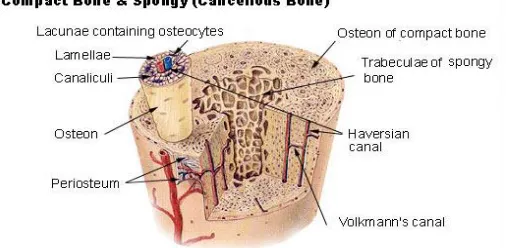
[image:2.612.182.436.258.382.2]Bone is high vascular dynamic tissue remarkable for its combinations of Mechanical properties. It is a composite that comprises of organic based collagens by which calcium containing in organic crystals are embedded. It contains about 60%Mineral, 30% Matrix and 10%Water.Hard tissues(bone and tooth) are intended to support loads, being stiffer (higher elastic modulus) and stronger (higher tensile strength)
Fig. 1 Compact &Cancellous bone
Hard tissues (bone and tooth) are intended to support loads, being stiffer (higher elastic modulus) and stronger (higher tensile strength) than soft tissues. On the other hand unreinforced polymers are typically more ductile but are not stiffer enough to be used to replace hard tissues in load-bearing applications. Nevertheless, polymer based composites can be designed to meet stiffness and strength requirements for hard tissue substitution.
III.EXPERIMENTALSETUP
A. Raw materials
1) Non woven Coir needled fiber mats
2) Roasted Bone particles and Fresh Bone particles
3) Urea-formaldehyde
4) Gudgen wood facing sheets
IV.SAMPLEPREPARATION
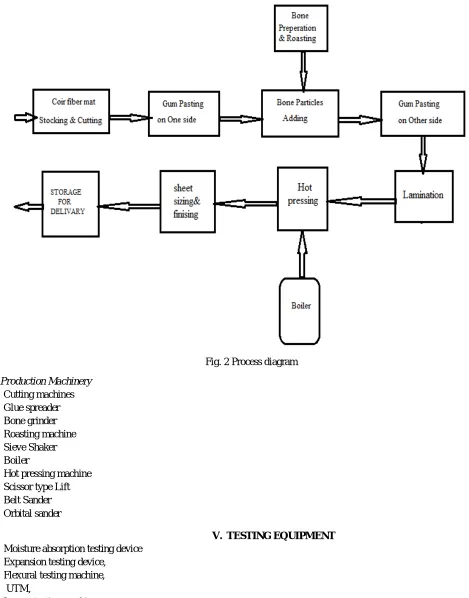
Procured 1000 GSM or 500 GSM Non woven Coir needled fiber mats are from production centre. Cut the coir fiber mat in to the standard ( required ) size (240 x120).
Pulverize cattle bone for different sizes (e.g. below7080µm and 1250µm.) Roasted some amount of bone particles for carburization bone powder
Bottom face of coir mat is pasted thoroughly with the plywood gum (Phenol-formaldehyde or urea formaldehyde)
Composite materials were developed by adding the Roasted or Fresh bone particles by the wt of 10% or 20% to each coir mat separately Penetrate the bone particles in to coir mat by damping or vibrating into the coir mats.
Face the Gudjan wood sheets on both sides of coir sheets.
Press the coir composite sheet (coir mat with bone particles) in the hot pressing machine at pre- determined temperate, pressure, and pressing time.(e.g. 1650c 90or120 Kg/cm2, 8or 12 minutes) take out the sheet from hot press by means of scissor type lift, then allowed to cool at least 2 hours minimum.
Fig. 2 Process diagram
A. Production Machinery 1) Cutting machines
2) Glue spreader
3) Bone grinder
4) Roasting machine
5) Sieve Shaker
6) Boiler
7) Hot pressing machine
8) Scissor type Lift
9) Belt Sander
10) Orbital sander
V. TESTINGEQUIPMENT
A. Moisture absorption testing device
B. Expansion testing device,
C. Flexural testing machine,
D. UTM,
E. Impact testing machine,
VI.TESTRESULT
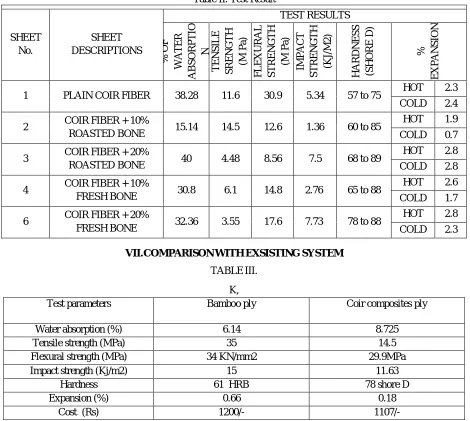
Table II. Test Result
SHEET No. SHEET DESCRIPTIONS TEST RESULTS % O F W A T E R A BS O RP T IO N T E N S IL E S RE N G T H (M P a ) F L E X U RA L S T RE N G T H (M P a ) IM P A CT S T RE N G T H (K J/ M 2) H A RD N E S S (S H O RE D ) % E X P A N S IO N
1 PLAIN COIR FIBER 38.28 11.6 30.9 5.34 57 to 75 HOT 2.3 COLD 2.4
2 COIR FIBER + 10%
ROASTED BONE 15.14 14.5 12.6 1.36 60 to 85
HOT 1.9 COLD 0.7
3 COIR FIBER + 20%
ROASTED BONE 40 4.48 8.56 7.5 68 to 89
HOT 2.8 COLD 2.8
4 COIR FIBER + 10%
FRESH BONE 30.8 6.1 14.8 2.76 65 to 88
HOT 2.6 COLD 1.7
6 COIR FIBER + 20%
FRESH BONE 32.36 3.55 17.6 7.73 78 to 88
HOT 2.8 COLD 2.3
VII.COMPARISONWITHEXSISTINGSYSTEM
TABLEIII.
K,
Test parameters Bamboo ply Coir composites ply
Water absorption (%) 6.14 8.725
Tensile strength (MPa) 35 14.5
Flexural strength (MPa) 34 KN/mm2 29.9MPa
Impact strength (Kj/m2) 15 11.63
Hardness 61 HRB 78 shore D
Expansion (%) 0.66 0.18
Cost (Rs) 1200/- 1107/-
X. CONCLUSIONS
This experimental investigation of mechanical behaviour of coconut coir Strengthened with bone particles composites leads to the following conclusions. This work shows that successful fabrication of a coir fiber reinforce bone composites with different size s (fresh and roasted) bone is possible. It has been noticed that the mechanical properties of the composites such as micro-hardness, tensile strength, flexural strength, impact strength % of water absorption, & expansion& impact strength etc. of the composites are also greatly influenced by the presents of bone particles.
The fracture surfaces study of coir fiber reinforced by bone composite after the tensile test, flexural test and impact test has been done. From this study it has been concluded that the poor interfacial bonding is responsible for low mechanical properties
The versatility and applications of coconut fibres in different fields is discussed in detail. Coconut fibers are reported as most ductile and energy absorbent material.
XI. ACKNOWLEDGMENT
I sincerely acknowledge my word of thanks to our Chairman Mr..T.D. Eswaramoorthy, M.Sc., EASA college of Engineering and Technology for his support by providing all opportunity for our education and development in this college. I wish to thank our beloved and respected principal Dr..Robert Z Kennedy, M.E., Ph.D., who has been a constant source of inspiration for the budding engineers. I feel immensely happy in acknowledging our sincere and heartfelt thanks to our Head of the Department Mr..S Subhash, M.Tech, Associate Professor for being and unending source of inspiration. I extend my gratitude to my guide Mr .M.Siva Subramaniam,M.E, Assistant Professor for his kind support in completion of the Design Project. I would like to thank my parents, teaching and non-teaching staff members and friends for their valuable help rendered during the completion of the paper.
REFERENCES
[1] Vasanta V., Cholachagudda, Udayakumar P. and Ramalingaiah A, (2013)‘Mechanicacharacterization of coir and rice husk reinforced hybrid polymer composites’. International .Journal of Innovative Research in Science, Engineering and Technology., Vol. 2, Issue 8,pp. 3779–3785
[2] SaifulIzwanAbdRazak, Noor Fadzliana Ahmad Sharif and Wan Aizan Wan Abdul. Rahman (2012) ‘Biodegradable Polymers and their Bone Applications- A Review’ International Journal of Basic& Applied Sciences, Vol.12, Issue 01, pp.31-46.
[3] Ritchie R.O., Koester K.J., S. Ionova S, Yao W. (2008) ‘Measurement of the toughness ofbone’, journal homepage: www.elsevier.com/locate/bone , pp. 801-812.
[4] Mueller D.H and Krobjilowski A “New Discovery in the Propertiesof Composites. Reinforced with Natural Fibers”, Journal of Industrial Textiles,33(2), 2003, pp.111-129.