BACHELOR THESIS
INCREASING TECHNICIAN’S EFFICIENCY IN
EXECUTING PROACTIVE MAINTENANCE TASKS
AN AUGMENTED REALITY CONCEPT
BEEREND GERATS
CREATIVE TECHNOLOGY
/ FACULTY OF EEMCS
SUPERVISORS:
DR. J. ZWIERS (UNIVERSITY OF TWENTE)
IR. R.G.A. BULTS (UNIVERSITY OF TWENTE)
IR. J. VAN KREIJ (INNOVADIS)
Abstract
Acknowledgements
Table of Contents
Abstract 3
Acknowledgements 5
List of Figures 8
List of Abbreviations 10
1. Introduction 11
1.1 Research Questions 11
2. Methods and Techniques 13
2.1 Design Process for Creative Technology 13
2.2 Participatory Design 13
2.3 Methods 14
3. State of the Art 18
3.1 Technology 18
3.2 Head-mounted Displays 19
3.3 Related Work 22
3.4 Tip4Support 26
4. Ideation 27
4.1 Stakeholder Identification 27
4.2 Observations 29
4.3 User Stories 32
4.4 Idea Generation 35
4.5 Product Idea 37
5. Specification 38
5.1 Prototype 38
5.2 Designer Perspective Scenarios 39
5.3 Product Requirements 44
6. Realization 46
6.1 System Architecture 46
6.2 Implementation 52
7. Evaluation 63
7.1 Functional Testing 63
7.2 User Evaluation 66
8. Discussion 72
8.1 Conclusions 72
8.2 Future Work 73
Bibliography 75
A. Observation Notes 77
B. Interview with Users 85
B. User Evaluation 87
List of Figures
Figure Description Page
3.1 Milgram’s Reality-Virtuality Continuum 18
3.2 Google Glass 20
3.3 Microsoft Hololens 20
3.4 Epson Moverio BT-300 20
3.5 Vuzix AR3000 smart glasses 20
3.6 Daqri Smart Helmet 21
3.7 Daqri Smart Glasses 21
3.8 Overview of all functionalities of Fieldbit’s technology 22
3.9 An augmented reality animation overlaying the SUN2000-KTL 23
3.10 CN2Tech “Assist”: an expert provides augmented reality instructions to the user 24
3.11 One of the two proof-of-concepts of Japan Airlines: a 3D hologram of a plane engine 24
3.12 An impression of one of the experiments within the ARMAN project 25
3.13 Tip4Support mock-up 27
4.1 Example of an organizational structure of a Dutch factory 28
4.2 A visualization of the product idea: visual communication for technicians 37
5.1 Augmented reality prototype, using Vuforia and Unity3D 38
5.2 Image of machine that could be detected by the protoype 39
6.1 Use Case Diagram 46
6.2 Black box 1: input and output of the entire system 47
6.3 Black box 2: the entire system consists of two iPads, communicating over a network 47
6.4 Black box 3: all components on the iPad used for the prototype 48
6.5 Black box 4: the four main components of the augmented reality application 49
6.6 Black box 5: all functionality included in the user interface 50
6.7 Black box 6: all functionality included in the augmented reality tracking 51
6.8 Black box 7: the two components of the networking part within the application 52
6.9 Object selection buttons and the delete button 53
6.10 Sign-in functionality on the regular application 53
6.11 Sign-in functionality on the assisting application 53
6.12 Message indicating the user to scan a target object 54
6.13 Machine information when (a) no machine is found (b) a machine is found and (c) the user has pressed the ‘show components’ button
6.14 Network settings in the assisting app 55
6.15 Network settings in the regular app 55
6.16 Four stages of network information 55
6.17 Screenshots of the regular application 56
6.18 Screenshots of the assisting application 56
6.19 Warning messages that are (a) not reliable for tracking and (b) reliable for tracking with Vuforia
57
6.20 The VuMark that is designed for this project 58
6.21 Screen of the application including virtual objects from the user and the assisting technician
59
7.1 The ‘freeze’ button, when the screen is unpinned and pinned 66
7.2 Set-up of the evaluation, scenario 1 68
7.3 Technician using the prototype 69
List of Abbreviations
Abbreviation Description
PIPO Periodieke Inspectie, Periodiek Onderhoud (English: Periodic Inspection, Periodic Maintenance)
PISA Poetsen, Inspecteren, Smeren, Afstellen (English: Clean, Inspect, Lubricate, Adjust)
HMD Head-mounted Display
AR Augmented Reality
VR Virtual Reality
OBD On Board Diagnostics
JIT Management Just In Time Management
DMS Document Management System
SAP System Applications Products
PC Personal Computer
HOTT Hands On Tool Time
1. Introduction
Technological evolution has caused major shifts in the industry environments over the last centuries. After three “industrial revolutions”, “advanced digitalization, […] Internet technologies and future-oriented technologies in the field of ‘smart’ objects seems to result in a new fundamental shift in industrial production.” [6] According to this study, this new way of production causes opportunities for customization and product batches with the size of one. Together with this fourth industrial revolution, the machines that are within the factory become more complex. This means that the machines consist out of more and smaller components, of which the percentage of electrical components increases compared to the amount of mechanical components. As a result from this complexity, highly customized products can be manufactured.
Although such an evolution offers many opportunities, the environment of the factory should also evolve in order to remain production processes optimal. Technicians, responsible for maintenance and repair of the machines, should obtain more challenging knowledge than before and they should use smart tools to work more efficiently and more effectively. Additionally, since factories are working with Just-In-Time management nowadays, including smaller buffers between machines, it forces technicians to respond quicker on a defect. According to technicians working at the factory of Apollo Vredestein, a combination of these factors has increased their workload substantially. They tell that while the total amount of technicians in the factory has decreased, the total amount of work has only increased since then. On the other hand, machines have become more reliable, causing less defects, and maintenance processes have increased in efficiency. This case asks for observations at the actual state of the technicians work and how their tasks could be performed more efficiently without the technicians losing value for their job.
In 2016, the software company Innovadis collaborated with the two companies Eluxis and Pelders Maintenance Management with the aim to build a digital tool assisting technicians in Dutch factories. This tool provides clear maintenance tasks towards technicians, at which they could give feedback. It is expected that this tool will increase the technicians’ efficiency and effectivity, since the tool will give these workers an opportunity to mobilize information. However, the processes within the way of working of technicians ask for further improvement, said by Leon Pelders, owner of Pelders Maintenance Management and an expert in the domain of factory maintenance. He aims to search for tools that include advanced technology to assist technicians and will enable them to work more efficiently and more effectively. Although it is expected that advanced technology can help the technicians, such tools are regularly not included in their toolboxes. This aims for a study that investigates the value of such an advanced tool for technicians in factories.
An advanced technology that is being explored with high interest by many technology firms nowadays is augmented reality (AR). This technology enables a person to see a layer of virtual objects over his view of the real world, meaning this world is enhanced with additional information. The augmented reality technology offers such large opportunities that leading technology firms are working intensively on augmented realty development or are changing their strategic choices towards it. This large amount of interest towards augmented reality leads to the question whether it would be useful for the maintenance domain, especially for assisting technicians in their way of working. When searching for literature about augmented reality, it can be found that many studies are focussed on the technology or are exploring the status quo of existing AR solutions. However, few studies can be found on how users react to an augmented reality experience in their own work field. This study helps filling this gap with researching the obtained value of technicians towards using an AR solution in their work.
1.1 Research Questions
to develop an augmented reality product, and to test whether technicians value this product as assisting them in working more efficiently. The scope of this research is to the proactive maintenance tasks of complex machines in factories. Proactive maintenance tasks are more easily to be observed, since they occur in a periodic manner. Complex machines of factories are chosen, since this is also the target of the digital tool of Innovadis. Combining these variables results in the following main research question of this study:
RQ: “Can an augmented reality solution improve technicians’ efficiency in executing proactive maintenance tasks to complex machines in factories?”
To be able to answer the main research question, four topics are examined first. These four topics resulted in four subquestions that are answered along the study. In order to obtain knowledge on what exists in the domain of augmented reality in combination with maintenance and repair, a state of the art study is performed. This provides the first subquestion:
SQ1: “Which categories of augmented reality products exist in the domain of maintenance and repair?”
Before thinking of an idea for an augmented reality product that could assist the technicians at Apollo Vredestein, it explored what technicians’ needs are that could be fulfilled by this product. To obtain these, the way of working of the technicians at the factory of Apollo Vredestein is examined and perceived in detail. Therefore, the second subquestion of this study is:
SQ2: “How are proactive maintenance tasks executed by technicians in the factory of Apollo Vredestein?”
After detailed information is obtained on the state of the art of augmented reality in the domain of maintenance and repair and on the way of working of technicians at the factory of Apollo Vredestein, concepts are described on how an augmented reality product could hypothetically improve these technicians’ efficiency. Therefore, the third subquestion is:
SQ3: “How will an augmented reality product possibly improve the technician’s efficiency at Apollo Vredestein?”
Last part of this study includes examination of the perceived value of the technicians at the factory of Apollo Vredestein towards a constructed prototype of an augmented reality product. This constructs the last subquestion of this study:
SQ4: “What are the added values for technicians at Apollo Vredestein when using the developed augmented reality product?”
2. Methods and Techniques
To be able to answer the research questions of this project, an augmented reality product has been designed. This product enables user testing at the evaluation phase, which results in description of conclusions and future work. In order to design a prototype fulfilling user needs, methods and processes are used to ensure the quality of the outcomes. Beneath, two processes are described that are used during this project. These from the framework of this project. Inside these processes a number of methods is used to obtain information in a theoretical ‘right way’. The methods are listed and explained briefly in this chapter as well.
2.1 Design Process for Creative Technology
A process used regularly in graduation projects of Creative Technology students is the ‘Design Process for Creative Technology’ in [4]. This literature describes the design process along four phases that are also implemented in this study: ideation, specification, realization and evaluation. Additionally, the design process describes these phases as an iterative process, meaning the project should include space for reconsidering design choices.
As described in [4] “result of the ideation phase is a (more) elaborated project idea, together with the problem requirements”, and includes the evaluation of early ideas with clients, users and experts. In order to understand the problem requirements, the way of working of the users should be understood first. To know who the end-user group will include and exclude, and to be able to understand the environment of this group, a stakeholder identification is performed at the Apollo Vredestein environment (section 4.1). In order to obtain a deeper understanding of the end-users’ way of working, observations are performed within this factory (section 4.2). These observations result in a PACT analysis including user scenarios that describes the current way of working of the end-users (section 4.3). To expand understanding, semi-structured interviews are performed with the end-user and an expert. During these interviews the results of the observations are evaluated as well as an early prototype.
Where the ideation phase ends with a product idea, the specification phase elaborates this idea to a concrete product concept. This phase includes a number of iterations that consists of the construction of mock-ups or prototypes and the evaluation with the end-user and the expert. This evaluations are performed in semi-structured interviews. Based on these evaluations, designer perspective scenarios are created that describes situations with the use of an augmented reality product. At the end of the iterative process in the specification phase, the final set of functional and non-functional requirements are determined together with the end-user and the expert. In order to prioritize these, the MoSCoW method [24] is used.
The requirements are fulfilled with a prototype that is build during the realization phase. Since the functional requirements are prioritized it is clear which functionalities are necessary to create first, and which later in the project.
The evaluation phase is the last phase of the design process, and includes methods on evaluating the prototype that is created during the realization phase. Two methods are used for the evaluation: functional evaluation and user evaluation. From the results of these evaluations, project conclusions and future work is described.
2.2 Participatory Design
In addition, the support by end-users for the functionality of a new system is an important factor for the acceptation of this system in a later phase. A realistic concern for designers of new technology is that end-users will not accept technology that changes to rapidly. Participatory design is “enabling people to develop realistic expectations, and reducing resistance to change, where the ambition is to ensure that the resulting artifacts support the current and planned changes” [26]. The participatory design methodology, described in [25], is a way to “ensure that participants’ interpretations are taken into account in the research.” Essential to this methodology is that these users are participating in design choices during all phases of the system design process.
Spinuzzi describes in [25] the three stages of participatory design:
1. Initial exploration of work: describing the importance of exploring the way of working of the users, including procedures, technology, routines and workflows.
2. Discovery processes: which uses the outcomes of the initial exploration, describes users’ goals and “envisions a future workplace” [25]. These goals and a future perspective should be constructed and discussed with the participating users.
3. Prototyping: iteratively, several prototypes should be constructed and discussed with the participating users.
The participatory design process is used in this research during the phases: ideation, specification and evaluation. During the ideation phase, initial exploration of work is performed with observations and interviews with the participating user. Also discovery processes are performed in this phase. These include the product idea that is evaluated with the user. During the specification phase these discovery processes remain present. After a number of iterations with the participating user, the research “envisions a future workplace” with three designer perspective scenarios. The last stage of participatory design, prototyping, is performed during the iterations in the specification phase. Last, the participatory design will be evaluated in the evaluation phase with the examination of the feeling of ownership towards the prototype at the participating user.
2.3 Methods
During the description of the design process and the participatory design process, several methods were named. These are listed beneath, and briefly explained per method.
2.3.1 Stakeholder Identification & Analysis
As described in the design process, a stakeholder identification and analysis is performed with the goal to understand the environment of an augmented reality product that is used by technicians in the factory of Apollo Vredestein. More specifically, a goal is to obtain information on who are possibly affected by such a product, and who of these are potentially end-users of the product. Although the definition for stakeholder varies a lot within different researches, the definition for a stakeholder is chosen to be a definition from Dix [7], since his definition is used frequently in software engineering. This definition describes a stakeholder as “anyone whose jobs will be altered, who supplies or gains information from it, or whose power or influence within the organization will increase or decrease.”
parties, suppliers are the relevant deliverers of resources for these parties. Satellite stakeholders are people that interact with the baseline stakeholders and are of any relevance concerning the product.
The stakeholder identification is performed within the same environment in which the prototype is evaluated, the factory of Apollo Vredestein. According to the maintenance expert Leon Pelders, this factory is a representative environment for other factories in the Netherlands. Information about organizational structure is obtained from an interview with the same expert.
2.3.2 User & Expert Interviews
Multiple interviews are conducted during several phases of the project. These interviews were performed with the following people: an expert in factory maintenance, a technician participating in the design process, a technician without pre-knowledge of the project and a team leader. The last three people were employees of Apollo Vredestein. Since all interviews included an explorative character, the interviews were semi-structured. This means that, in preparation of such an interview, a number of topics are chosen to be discussed. Although these topics are mentioned and evaluated during the interview, additional space is available for the interviewee to bring up new topics. Goal of these interviews is to obtain information about the Apollo Vredestein environment, the technicians’ way of working and to examine the validity of researcher its conclusions.
A number of interviews are conducted as informal interviews, as described in [17]. Where traditional interviews include meetings with participant for a pre-defined amount of time, informal interviews are unstructured and performed in the form of informal discussions. The goal of these informal interviews is both gaining trust with the participants as well as the researcher being as open as possible to all comments of its target group. Especially in situations in which as much information should be obtained as possible, like during observations, this open character is important.
2.3.3 Observations
To get to know the technicians’ needs it is important to understand their goals and, therefore, the daily practice of this group. In literature, many ways are described to obtain information of a way of working, like interviews, observations and surveys. Observations are chosen to be performed during the ideation phase for understanding the technicians’ way of working. Surveys are tightened in their questioning and therefore a better method when the researchers are known to the daily practices of the participants. Although interviews are assessed as a better method for understanding practices, participants of interviews tend to forget telling specific details or possibly remember things differently than these in reality are [10]. Additionally, it is possible that participants of interviews intentionally tell things differently to mask certain topics. Furthermore, observations are a method that is used frequently for generating new ideas and obtaining insights in new subjects. A combination of observations and evaluating these observations during interviews will include all advantages of both methods. Within this research, these methods are performed during the ideation phase.
Because naturalistic observations are often conducted with a small amount of participants, this method possibly lacks a representative sample. Additionally, naturalistic observations possibly are less reliable than controlled observations, since variables cannot be controlled by the researchers. However, [10] describes naturalistic observations to be a suitable method for generating new ideas.
Most of the naturalistic observations studies tend to be executed in a typical procedural arc, consisting of four phases: the descriptive phase, the focusing phase, the selective phase and the saturation point [11]. Since the scope of the observations of this study is to explore the technicians’ way of working generally, only the first two phases will be performed. The descriptive phase includes descriptive reporting, in which the researcher writes down as much information as possible, without a specified focus and without making assumptions to what is relevant or how things should be interpreted. Remarkable observations from the first phase are used as factors that are observed with higher interest in the selective phase of observations. However, the researcher remains considering how these factors fit into the larger context. In the third phase, the selective phase, the focus is narrowed to only the focus points and the researcher tries to deepen his knowledge about these points as much as necessary. A saturation point is reached when new observations by the researcher only lead to conclusions that are already drawn by observations done earlier, and no new findings will appear. It was decided to perform a two day observation of the technician’s work in the factory of Apollo Vredestein. Where the descriptive phase is executed on the first day, the researcher executed the selective phase on the second day of observations. Input for this phase are focus points that are observed in the first phase.
Elaborating on the quality of the observations, validity of the results are of importance. This means that what is observed also happens in reality. According to [11], researchers triangulate their research methods and conduct the observations with multiple observers. Although the resources of this study are making it impossible to perform the observations with multiple observers, it is possible to vary in methods while observing. Therefore, the observations are always conducted in combination with multiple informal interviews with the technicians. These informal interviews are conducted as described in [17].
2.3.4 PACT Scenarios
According to [20] a scenario is a proper tool for discussion since they represent concrete situations and people find it easier to reason and talk about concrete situations. PACT scenarios are written during the ideation phase of this project. The conclusions from the observations of the technicians at Apollo Vredestein are used as input for the PACT scenarios. Goal of these scenarios is to elaborate on these conclusions, and to combine these in user stories. [20] describes user stories as “the real or imagined experiences of people; what they do and what they want.” These scenarios sketch the current way of working of the technicians without the help of an augmented reality product. [20] argues for using the PACT framework in order to obtain more specific context to the scenarios. Within this framework it is important to think about people (users), activities, context and technology first, before writing the full scenario. During the specification phase, designer perspective scenarios are created that were used as a starting point for prototyping and the evaluation of design ideas. These scenarios are to the point and clear about which design decisions are not yet made, and describe the way of working of the technicians including the help of an augmented reality product.
2.3.5 Product Requirements & MoSCoW
rather than effectivity of the product, the list of functional requirements is more comprehensive than the list of non-functional requirements.
Because the time limit of this project, not all functionalities can be included in the prototype that will be evaluated in the last phase of the design process. To build a prototype that fits best to the user needs, the most important functionalities should be constructed first. Therefore, the list of product requirements is prioritized using the MoSCoW method that is frequently used for IT projects. In this method, all requirements are divided in one of the four categories ‘Must haves’, ‘Should haves’, ‘Could haves’, ‘Won’t haves’ [24]. Goal for this project is to build all ‘Must haves’ and ‘Should haves’ in the first prototype, which will cover all essential functionalities of the product idea. Product requirements that are prioritized differently, are not fulfilled during this project.
2.3.6 Evaluation
The goals of the evaluation are to examine wether the goal stated at 2.3.5 is achieved, and to experiment with the prototype in a real use situation. The experiment examines whether the functionalities that are expected to be useful appear to remain meaningful in the way of working of the users. [26] argues that in a participatory design project “ideally, a project outcome should be evaluated in a real use situation, when users have had a chance to integrate it into whatever they are doing and (eventually) develop new forms of practice.” However, for this project not enough resources are available to let the users integrate the technology into their own work. Additionally, the prototype is only ready for performing the three designer perspective scenarios and not for a pilot study. Therefore, it is chosen to evaluate these three user scenarios in which the prototype is expected to be of an advantage, in situations that are previously observed in the way of working of the technicians. After this experiment with end-users, the participating technicians are asked about their experiences with the product. This evaluation includes questions addressing ‘user gains’ [26]. These questions can be indirect, considering whether participants have the feeling that they are heard in the design process, as well as direct, considering whether personal skills and quality of work will improve when using the product in their daily work.
In order to met the two goals, the evaluation consist of two phases:
1. Functional testing, including an internal evaluation and an evaluation with the technician that contributed in the participatory design. Within the internal evaluation, all MoSCoW product requirements are tested with the prototype. Afterwards, a semi-structured interview with a technician is executed considering his expectations towards the prototype, and whether these are met.
3. State of the Art
Before starting with the ideation phase, an understanding of context around the research topics should be obtained by the researcher. Therefore, a brief literature study towards the status quo of augmented reality is performed first. The definition of augmented reality, how this technology has evolved during the last decades and what is generally expected from AR in the future, is described in section 3.1. To make a decision on what technological device to use for the AR product later in this study, the status quo of AR head-mounted display is researched (see section 3.2). Last, related work is found in the domain of augmented reality for technicians and described in section 3.3. This will prevent an AR product as outcome that is already available on the market.
3.1 Technology
Within this paper, augmented reality is defined according the definition of [1] “as a real-time direct or indirect view of a physical real-world environment that has been enhanced / augmented by adding virtual computer generated information to it.” Although many different ways to create an augmented reality system exist, all of them share the same three properties [2]:
• augmented reality combines objects from the real world with virtual objects and places these virtual objects in the real environment;
• includes an interactive, real time experience; and
• places the virtual objects in alignment with the real world objects.
In the reality-virtuality continuum of Milgram [8], displayed in figure 3.1, it can be seen how augmented reality is related to other definitions in this continuum. The two opposites in this continuum are the real environment and and a fully virtual environment. The real environment, which requires no technology to be seen by people, includes no virtual objects. The fully virtual environment, which requires virtual reality technology to be seen, includes no real objects. The term “mixed reality” includes an environment in which both virtual and real objects are combined. Although virtual reality has many appearances, this technology is generally known for the head-mounted devices like the HTC Vive and the Oculus Rift. These devices are being carried on the head of the user and includes two displays that cover the full view of the user. Virtual reality is regularly used for gaming purposes, but also offers solutions in more ‘serious’ fields like military training, surgery simulation and architecture. Augmented virtuality is an environment that is fully virtual, including objects that originate from the real world. A good example of a situation in which augmented virtuality is used is a presentation of a weatherman in front of a chromakey1. With the
use of this technology, the weatherman is cut out of the camera view and is pasted in a virtual environment, mostly in the form of a map including weather information. Since the environment, the virtual map, is computer generated and objects within that environment are both virtual or originating from the real wold, the weatherman, this technology falls into the domain of augmented virtuality.
Fig. 3.1 - Milgram’s Reality-Virtuality Continuum
1“Chroma keying, is a visual effects / post-production technique for compositing (layering) two images or
Although AV and VR are both interesting research topics, this paper goes deeper into the literature of augmented reality. As mentioned earlier, this technology uses a real world environment and enhances this world with computer generated objects that are placed in alignment with the real world objects. Examples of AR technology can be found in all sorts of domains: education, commerce, entertainment, medical science and transportation [1].
One of the earliest mentions of an augmented reality system, in the very broad definition of AR being technology combining real world and non-existing experiences, is a device named Sensorama that is described in the paper “The Cinema of the Future” by Morton Heilig, already in 1955 [16]. Morton is a multimedia specialist that used his knowledge as a cinematographer to create a device that tried to increase the experience of “standing inside the scene” by exciting more senses than only sight and hearing. According to [1], the first head-mounted display is invented by Ivan Sutherland in 1966. A head-mounted display (HMD) is a device that is meant to be put on the user’s head providing an AR, AV or VR experience to the user with the use of internal displays. Earlier mentioned examples of HMD’s in the field of VR are the HTC Vive or the Oculus Rift. From both the Sensorama and the head-mounted three dimensional display from Sutherland it can be concluded that people are experimenting with the augmented reality technology for over half a century. However, in [2] is written that this technology started making fast progress only from the 1990s. From these years, augmented reality and head-mounted displays have developed with large steps. This can also be concluded when comparing two studies about the status of augmented reality at their time, with one published in 2001 [2] and the other study published in 2010 [1]. Where in 2001 much is written about the limitations of technology, in 2010 the major limitations seems to be in the fields of social acceptance and privacy. In addition, since 2010 many has changed in the development of augmented reality devices, especially with head-mounted displays. Since 2010, Google has experimented with the Google Glass, which is a HMD able to show live content in the upper right corner of the users view, Epson developed HMD’s for businesses able to show virtual objects in the center of the users view that are aligned with the real world objects, and Microsoft has launched the Hololens in 2016, which is an HMD that is able to scan the users environment and place virtual objects over a part of the view of the user.
The evolution of augmented reality through the past decades is very promising, and therefore it can be very interesting to start developing with this technology in any domain. This is strengthened by calculations of Digi-Capital predicting a growth of the AR market from $3.9 billion in 2016 to $82 billion in 2021 [23]. Also the Global Market Insights expect such exponential growth and predicts that “the global market for AR products will surge 80 percent to $165 billion by 2024” [36]. Reasons for these predictions are leading technology firms announcing to start working intensively with AR in the near future. According to [36], “Apple has embarked on an ambitious bit to bring the technology [augmented reality] to the masses” and that an augmented reality device “may even supplant the iPhone.” In April 2017, Facebook announced to launch “the first mainstream augmented reality platform” within their services [37]. Although Google’s experiment with the Google Glass has stopped, they invested $793.5 billion in the augmented reality start-up ‘Magic Leap’ [38]. Other examples of augmented reality, especially found in the field of maintenance engineering, can be found in section 3.1.3, discussing related work. In the next section, available technology in the field of HMD’s will be discussed.
3.2 Head-mounted Displays
This section is meant to give an insight on the actual status of augmented reality HMD’s that are commercially available at this moment. This can become important when, later in the research, a platform for the augmented reality solution will be chosen.
Google Glass
virtual objects are projected (see figure 3.2). Although the Google Glass is not produced anymore, there are speculations say the company is working on new augmented reality technology. [31]
Microsoft Hololens
In 2016, Microsoft launched a first developer edition of the Hololens. Of all augmented reality HMD’s, it is considered as one of the most promising. This is caused by the fact that it is running without being wired to a computer, that it has four cameras for tracking and the virtual objects are placed realistically in the user’s view. The device should be operated with the use of hand gestures. In addition, a large number of companies, mostly within the domain of engineering and designing, have announced a collaboration with Microsoft for developing and using Hololens software. However, this technology has its disadvantages: it is a relatively heavy and large device compared to other HMD’s. Also, it is only possible to see the virtual objects when these are in the center of the user’s view [32]. An image of the Microsoft Hololens is given in figure 3.3.
Fig. 3.2 - Google Glass Fig. 3.3 - Microsoft Hololens
Epson
The company Epson is making augmented reality glasses mainly for businesses. It has already two glasses on the market: the Moverio BT-100, and the Moverio BT-200, which is a developer version. The successor of these glasses, the Moverio BT-300, has been launched in the spring of 2017 (see figure 3.4). All Epson devices glasses work with Android, and should be operated with an additional trackpad device. [33]
Vuzix
Vuzix has one glass for businesses on the market, called the M100. These glasses are enhanced with a small screen in the upper-right corner of the user’s view, like the Google Glass. The company is planning on launching two new device for enterprises, the M300 and the M3000. Last, Vuzix is experimenting with a glass in which holograms are projected on the user’s view, close to the experience that the Hololens can provide (see figure 3.5). [34]
Fig. 3.4 - Epson Moverio BT-300 Fig. 3.5 - Vuzix AR3000 smart glasses
Daqri
developer kits can be ordered. Images of these technologies can be found in the figures 3.6 and 3.7.
When looking at product video’s and reading documentation of these augmented reality HMD’s available it is clear that most of AR HMD’s are under development. Although there are some glasses that are fully ready, most glasses can only be ordered as a development kit. In addition, the HMD’s that are ready, are only meant for business purposes, not for the consumer market. Also, these HMD’s only offer an augmented reality experience that is not covering a large part of the user’s view. Although this suggests that the technology is not ready yet for consumer production, it can be interesting for businesses to start experimenting with the available HMD development kits. An overview of the researched augmented reality HMD’s can be found in table 3.1.
Fig. 3.6 - Daqri Smart Helmet Fig. 3.7 - Daqri Smart Glasses
Table 3.1 - Overview of AR HMD’s available or planned for launching, prices as of 1/12/2016
HMD AR technology Operating System Price
Google Glass Prisma in upper-right corner Android N/A
Microsoft Hololens See-through holograms projecten on center of view Windows 10 $3000
Epson Moverio BT-100
N/A Android $699,99
Epson Moverio BT-200
See-through holograms projecten on center of view Android $699,99
Epson Moverio BT-300
See-through holograms projecten on center of view Android $779,99
Vuzix M100 Display in upper-right corner Unkown $900
Vuzix M300 Display in upper-right corner Unkown N/A
Vuzix M3000 See-through holograms projecten on center of view Unkown N/A
Vuzix Blade 3000 See-through holograms projecten on center of view Unkown N/A
Daqri Smart Helmet
See-through holograms projecten on center of view N/A N/A
Daqri Smart Glasses
3.3 Related Work
Fieldbit
[image:22.595.56.539.332.574.2]The Israeli company Fieldbit is in the development phase of making a augmented reality product, meant for the industrial industry. Although a small amount of information is available on their new product, Fieldbit’s website is able to explain the product idea [12]. The company focusses on increasing the success rate of technicians repairing a machine at the first time they are visiting that machine, also called the “first-time fix rate”. Fieldbit believes in external guidance from an expert located in a service center. When the technician starts with a repairing task, contact can be established with an expert via an Epson Moverio BT-200 smart glass. These glasses are able to project an augmented reality layer in the center of the technician’s view, and is powered and controlled by a mobile touchpad. The technology makes it possible that the expert receives the camera view of the smart glasses to which the expert can react with advise and instructions to the technician. The advise or instructions can be communicated over audio, but also by the expert drawing instructions like circles and arrows in the augmented reality view of the smart glasses worn by the technician. Next to contact with an service center, the technology also enables communication with co-workers or supervisors via the smart glasses. Lastly, it is possible to connect with enterprise systems. However, the exact workings of this functionality is not clear. An overview of how these functionalities of Fieldbit’s technology works can be found in figure 3.8.
Fig. 3.8 - Overview of all functionalities of Fieldbit’s technology
Hyperindustry by Inglobe Technologies
performance is recorded and send to the maintenance managers for analysis. Outcomes of the case study included the finding that “compared with the traditional paper-based or digital instructions, one of the most obvious benefits […] is the technician’s immediate understanding of each step in the operation.” This outcome is possibly both helping the execution of procedures by new technicians, but also helping the experienced technicians in resolving occasional and complex issues.
Fig. 3.9 - An augmented reality animation overlaying the SUN2000-KTL
CN2Tech
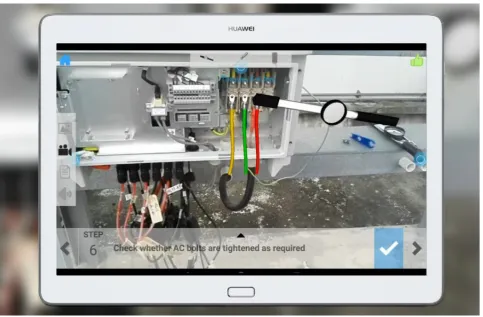
The American company CN2Tech offers augmented reality solutions in three different products: Insight, Assist and Experience [13]. From CN2Tech’s products, “Assist” and “Experience” are most relevant to this study, since they offer solutions for an industrial environment. “Insight” is meant for companies sales and makes it possible that customers of those companies can try products in their own environment, via augmented reality on a tablet. For example, a customer could try whether a set of tables and chairs from a furniture shop fits into its living room. The product “Assist” is a combination of the earlier mentioned Bitfield’s and Inglobe Technologies’ products: a tablet that enables a connection to an expert in a service center. The user then can ask assistance from the expert, who can draw instructions like circles and arrows to the tablet screen of the user. These instructions will overlay the camera view, and will maintain aligned with the objects in the real world. An example of this is displayed in figure 3.10.
Fig. 3.10 - CN2Tech “Assist”: an expert provides augmented reality instructions to the user
Japan Airlines
According to one of Microsoft’s blog writers Suzanne Choney, Japan Airlines has created two proof-of-concepts that are developed using the Microsoft Hololens, with the goal to train technicians more effectively [14]. Where the company worked with documents based on text and pictures in the past, Japan Airlines is now experimenting with a new way to train the technicians with augmented reality. A training with a real plane often results in waiting for an appointment, an available location or when a plane is placed in the hangar for maintenance, which is time consuming. Japan Airlines designed two training tools. First, a virtual plane engine floating in the users environment. Secondly, a virtual cock-pit that can be operated using voice and vision. Because the Microsoft Hololens is a head-mounted display that is able to overlay augmented reality objects over the full vision of the user, it is possible to place a plane engine anywhere in the surrounding, with an adjustable size and a possibility to walk around the engine entirely (see figure 3.11). In addition, the software enables the user to remove parts from the engine in order to see the parts that lay behind.
[image:24.595.62.540.496.767.2]Augmented Reality for Maintenance and Repair (ARMAR)
[image:25.595.58.542.222.584.2]At the Columbia University, Henderson and Feiner are working on their ARMAR project in which the potential is researched for the use of augmented reality to support technicians in the performance of maintenance and repair tasks [15]. Their experiments include real time computer graphics, overlaying the physical view of the user via head-worn motion tracking displays, that should “[…] improve the productivity, accuracy and safety of maintenance personnel.” These graphics includes “[…] sub-component labeling, guided maintenance steps, real time diagnostic data, and safety warnings”. An example of how such a set-up looks is given in figure 3.12. Within this figure, the message in the bottom left corner is warning the user for danger. In addition to the earlier mentioned advantages of augmented reality to the work of a maintenance engineer, the software preventing the user from causing harm is potentially an important aspect to the use of augmented reality.
Fig. 3.12 - An impression of one of the experiments within the ARMAR project
In the related work of other companies and researches that have created an augmented reality product for the maintenance and repair domain, three different existing concepts can be distinguished. This answers the first subquestion of this study. The three concepts are explained below.
1. Training of an technician with the use of interactive 3D models that can float in space. The technician gains a quicker understanding of a machine, since the technician can place the machine or parts of the machine in the surrounding space, walk around the machine and even take specific parts away from the machine to be able to see the inside.
a. Automatically; the software recognizes the user’s surroundings or a device in front of the user, and immediately displays an instruction for the next step on top of the technician’s view.
b. With the help of an expert, possibly working at a service center, who knows what task the technician would like to perform. This expert gives advice and instructions by drawing on the camera view of the technician. These drawings occur as augmented reality overlay to the view of te technician.
3. Software, recognizing the technician’s surroundings or nearby devices can warn the technician for possible causes of accidents.
3.4 Tip4Support
In order to come up with an augmented reality concept that is not only fitting the technicians’ needs, but also fits the related product (named Tip4Support) of Innovadis, it is important to understand reasons behind this product and to understand how this product will be build in the future. Together with the maintenance expert Leon Pelders and the company Eluxis, Innovadis started this project in September 2016. How the product idea of Tip4Support is established, is described below. This information is gathered during meetings with people from all three companies and interviews with the maintenance expert.
3.4.1 Product Description
PISA-Activities
In the past century, factories have become a place of large machines that are installed for very specific actions. These machines require maintenance and repairs in order to extend their economic lifetime. These maintenance-activities are described as “PISA-activities”, referring to “Poetsen, Inspecteren, Smeren en Afstellen”. Especially for companies producing for the food-industry, it is important that machine inspections are performed frequently and carefully, since these companies should guarantee the safety of their food. Pelders Maintenance Management is working with an spreadsheet-based system to provide lists including PISA-activities, which should be completed. These lists are given to operators and technicians so that they know which actions they should perform, including a small description of the actions.
Machine Documentation
In order to perform the maintenance actions correctly factories have extended documentation describing their machines in detail. Operators and technicians use this information to work more efficiently and to decrease the chance of making mistakes. Eluxis is creating documentation and instruction-content for factories. Their products varies from instruction-video’s to detailed descriptions of machines’ components. Clients of Eluxis are mainly using this documentation for training purposes. However, this information can also be used during work operations.
Product Specification
4. Ideation
The ideation phase is present with the goal to obtain a project idea, that serves the target-users’ needs. Since the specific needs, but also the target-users were not given at the start of this study, these were explored first. Future users of the system, together with other stakeholders, are identified in section 4.1. Afterwards, the way of working of the target-group is studied in section 4.2. From these observations, three PACT scenarios are filtered that describe the way of working (section 4.3). The augmented reality product should improve the way of working of the technicians in these three scenarios. In section 4.4, four potentially interesting project ideas are described. From these four projects, one project is chosen to work with during the next project phases. This idea is described and visualized in section 4.5.
4.1 Stakeholder Identification
4.1.1 Stakeholders
As described in the method section of this research, methodology of Sharp is used for stakeholder identification. Since the augmented reality product must have an opportunity to be implemented in the Tip4Support application, all stakeholders are identified in the hypothetical situation that the product is implemented in Tip4Support and frequently used at the factory of Apollo Vredestein.
All stakeholders identified as baseline stakeholders are given in table 4.1. It can be seen that the product has three potential users: technicians, operators and team leaders. In collaboration with Leon Pelders, the technicians are chosen as primary user group of the augmented reality product. This makes the technicians the target group for this project. Since operators will also be users of Tip4Support, it is expected that they will be able to use functionality of the augmented reality solution a later stadium. This makes the operators the secondary user group, which is left out of scope. Team leaders are expected to use Tip4Support to supervise the technicians and operators. Since supervising is also outside the scope for this project, and team leaders are expected to use the product less frequently than technicians and operators, they are identified as the tertiary user group.
Besides users, the baseline stakeholder group is filled with developers, legislators and decision-makers. It is important to identify the requirements and needs of these as well. However, since this project has the focus on a prototype that is working for the target group, these activities should be performed after this project. Additionally, because this project is focussed on the interaction between an augmented reality product and technicians, even further stakeholders like suppliers, clients and satellite stakeholders have not been investigated.
Role Company
Users Technicians (primary) Apollo Vredestein
Operators (secondary) Apollo Vredestein
Team leaders (tertiary) Apollo Vredestein
Developers Programmers Innovadis
Designers Innovadis
Testers and maintainers Innovadis
Programmers Eluxis
Maintenance expert Pelders Maint. Management
Table 4.1 - Baseline stakeholders, divided in four categories
4.1.2 Organizational Structure
The stakeholders that are identified in table 4.1 can be placed in an hierarchal structure. This will gain knowledge on how all stakeholders in the factory of Apollo Vredestein are connected. A structure of how an organizational structure of a factory generally look like is given in figure 4.1. This includes the hierarchal structure of Apollo Vredestein. Descriptions of these stakeholders are given below.
Fig 4.1 - Example of an organizational structure of a Dutch factory
Executive Board, Process Manager and Maintenance Manager
The roles of executive board, process manager and maintenance manager are on the level of policies and regulations. However, they all have a different amount of distance to the people carrying out the work, which are the operators, technicians and team leaders in the maintenance domain. The executive board has the largest distance, but has most influence on policies and regulations, since these cover all domains in the factory. They make financial and strategic decisions for the company. In the factory, multiple process managers are present. All of these have a different “process” or domain to which they make decisions on policy and regulations. An example of a domain is work-processes. Closer to the people carrying out the work in the maintenance domain is the maintenance manager. This function is responsible for the durability of the machines in the factory.
Legislators Government
-Safety executive Apollo Vredestein
Quality assurance Apollo Vredestein
Decision-makers Executive board/management/CEO Eluxis, Innovadis, Grolsch
Process manager Apollo Vredestein
Maintenance manager Apollo Vredestein
Operators, Technicians and Team Leaders
Teams of operators and technicians are formed with the task to execute the maintenance activities that they are receiving. The operators are responsible for the “first line maintenance” of the machines in the factory, including PISA-activities and production. This means that they are frequently inspecting the machines, set these machines in the right positions and keep them lubricated. When they see an error during the inspections, they send a request for repair to the technicians or, if possible, they fix the issue themselves. The technicians are responsible for repair of the machines when errors are detected, but also for planned maintenance and repair. Teams of operators and technicians are instructed by a team leaders or supervisors, which are monitoring the performance of their teams.
4.2 Observations
4.2.3 Observations of Technicians at Apollo Vredestein
Two days of focusing observations are performed at the factory of Apollo Vredestein. Mainly technicians, but also operators, have been observed in their way of working. During the analysis of the observations, all observations are divided between eight categories. In table 4.2, the categories are displayed together with a brief explanation. From the descriptive phase of observations that is executed on the first day, seven focus points are addressed. These focus points serve as input for the selective phase of the observations, executed on the second day. Beneath, the results of the observations at Apollo Vredestein are discussed. General observations are mentioned first, while the focus points are discussed afterwards. The full list of observations are given in appendix A.1.
Table 4.2 - Categories of the observations at Apollo Vredestein
General observations
The observations are performed within the extrusion department of the factory, which is one of the middle processes in the manufacturing process of tires. In this department different layers of rubber are combined and processed. Result of this process are materials that could be formed in to different kinds of tires. Machines within this department can be old, originating from 1950 or 1970, but are mostly build a couple of decades from now. Also newer machines are used within the extrusion-department. The technicians that were observed and interviewed worked at the ‘Quadruplex’ machine. This name refers to the working of the machine: extrusion with multiple
Category Explanation
Environment All observations addressed to the direct environment of the technicians are categorized here. In this study, the environment is the factory.
Tools All observations addressed to the tools and materials that the technicians are using to perform their daily tasks are categorized here.
Technician All observations addressed to the technicians itself, e.g. clothing, are categorized here.
Actions All observations addressed to specific actions that the technicians perform during their work are categorized here.
Learning All observations addressed to the way that technicians learn about their job are categorized here.
Information sources All observations addressed to sources that the technicians use to inform themselves to perform their work are categorized here.
Technology All observations addressed to technology, e.g. iPads, are categorized here.
Communication & planning
layers of rubber, with a maximum of four layers. It is a machine of approximately 60 meters, build around 1990. Like other machines in the factory, two groups of people are working with the machine: operators, responsible for operating the machine when producing, and technicians, responsible for maintenance and repair. The maintenance tasks can be both scheduled and incidental. Traditionally, two types of technicians exist: electricians and technicians. During the week, the technicians can work on two types of work. First, in production-shifts that include reactive maintenance on any machine. Second, in a PIPO (also called PISA) that includes planned maintenance to one or multiple machines. For example, a PIPO is executed at the Quadruplex every two weeks. In the factory of Apollo Vredestein, all machines have one expert-technician, which is the ‘emotional owner’ of the machine. This expert has extended knowledge about the machine and is responsible for assigning tasks to technicians within the preparations of the PIPOs.
The observations were during one day of preparation for the two weekly PIPO of the Quadruplex and one day of execution of the PIPO. During the preparation of the PIPO, it took the expert-technician approximately seven hours to be ready for the execution of the PIPO-activities. These preparations included: checking availability of technicians for the PIPO, checking whether ordered parts have arrived at the warehouse, moving the needed parts and material from the warehouse to the factory, searching on different information sources for tasks that should be executed to the machine, searching for personal tasks, prioritizing the maintenance tasks, deciding how many tasks to execute during the next PIPO, assigning the tasks to the available technicians and printing the required documents for the day after. During the day of the execution of the PIPO, five technicians were working on their assigned tasks. The expert-technician instructed the technicians, inspected the machine on abnormalities and checked if the executed work was performed correctly. At the end of the PIPO an unscheduled issue occurred. Since two defects caused the machine not to work, the issue was complex. Because of the knowledge of earlier issues to the machine of the expert-technician the issue was solved relatively fast, in three quarters of an hour.
Information sources
First focus point from the descriptive phase included information sources. All tangible sources that the technicians used for obtaining information are listed in table 4.3. It can be seen that the information is spread amongst a large number of different sources. This makes the work of the technician more complex and time consuming than necessary. Additionally, since most information sources are located at computers in a communal room and not at the machine itself, technicians spend more time than necessary on walking towards and from these computers to the machines. Also mentioned by the technicians themselves is that their work will become more efficient when they could obtain more information at the machines.
Also working at the computers is a time consuming activity for the technicians. This is caused by signing in time, working with different software programs, the time delay that SAP includes when the software is connecting to the database and a possible unavailability of the computers when all five are occupied by other technicians.
Tasks outsourced to specialists
Most of the maintenance work is executed by the technicians of Apollo Vredestein themselves. However, there are cases in which tasks are outsourced to specialists, or in which specialist are asked for assistance. For example, in the case that machine parts are cleaned with acid, this is outsources to a specialist. Also when issues are too complex to be fixed by the technicians of Apollo Vredestein, external specialists are asked for assistance in repairing the machine.
Physical and mental health
Table 4.3 - All information sources used by the technicians
Specialistic assistance
The way that the expert-technician is used within the factory is working effectively, but not efficient. Since this person is asked to handle a lot of issues and questions from other technicians, the workload for the expert-technician increases further. This causes that not all personal tasks can be executed in time for this technician.
Learning and tests
As mentioned in the general observations, every machine in the factory has an emotional owner. This person is a technician that in essence knows most about the machine, including mechanical and electrical parts. Whenever a complex issue occurs at the machine it is likely that this emotional owner, also called expert-technician, is called for assistance. When technicians are performing difficult maintenance tasks without the assistance of the expert-technician, it takes generally more time before the machine is ready for production again. Another observation in this category is that technicians mostly learn by doing. this means that, after they finished a MBO-education for technician, they learn by executing maintenance work and asking experienced colleagues if necessary.
Work pressure
Since the factory is working with a Just In Time (JIT) management, the machines are highly dependent on each other. When a machine has stopped producing unplanned, it causes delays at other machines easily since the factory strives to have as less buffers between machines as possible. In addition, it is only possible for a machine to run when no “red errors” are found, while there is a plausible chance to find one after a PIPO.
Name Description Place
Mail + calendar Work orders, notifications of arrived deliveries and other communication purposes.
PC
SAP Tasks assigned to technicians, including scheduled repair, inspection or calibration work.
PC
Machine logbook Including very short reports on the most important events that occurred at the machine, filled in by the operators.
PC
Weekly Excel from managers
Including short reports on all scheduled or unscheduled maintenance tasks that are executed in the week before.
PC
DOS-software with incidents
Generating a list of maintenance tasks that should be performed in the future, ordered per machine.
PC
Document Management System (DMS)
Overview of all parts and components of the machines, including wide information on availability at the warehouse, estimated price when ordering, schematic drawings, documentation and work instructions.
PC
Intranet Software a.o. for reading data from SAP, which is way more quickly. PC
Documents on personal drive
Every technician has a personal drive, meant for keeping own important documents. Some technicians use this often, others do not.
PC
Whiteboard at machine
Including very short reports on the most important events that occurred at the machine, filled in by the operators.
Mach.
Printed lists and schemes
Check-lists, list including tasks per technician and including particularities to the PIPO.
Mach.
Displays The machine has six displays where information for the operator and technician is placed. This varies from raw data (e.g. temperatures) to alerts of failures.
Hands On Tool Time
The average Hands On Tool Time (HOTT) of a technician when working on a maintenance task, can be improved significantly. This time, representing the amount of time that a technician is working directly or indirectly productively at the machine, is important to maintenance engineers since losses of HOTT means that the production of the machine has stopped while the technician is working unproductively. Examples of a technician working unproductively are waiting for a colleague or walking through the factory to pick the right up tools or machine documentation.
4.3 User Stories
In order to concretize the observations at Apollo Vredestein, three user stories are written. These stories include scenarios describing the way of working of the technicians. The product that will be examined in this study should eventually improve the way of working in these three scenarios. The user stories are created using the PACT method. Additionally, these user stories gives an answer on the second subquestion of this study.
Scenario 1 Scenario Title
Expert assistance
Scenario Type
User Story
Rationale
This scenario is written in order to give insights in the way of working of the technicians at Apollo Vredestein, and is based on observations at the factory. The topic that is described in this scenario is “expert assistance”. This topic includes the way that a technician is asking for assistance from an experienced colleague.
PACT analysis
People: Robert, a non-expert electrical technician, 23 years old, educated as electrical technician, working for four years in the factory. Joseph, an expert-technician, 40 years old, emotional owner of the Quadruplex, normally instructing other technicians working on ‘his’ machine, knowledge of mechanics and electronics.
Activities: Performing a planned maintenance task with the electrical panel of the Quadruplex.
Context: The Quadruplex is a machine in the factory of Apollo Vredestein.
Technology: The technicians use a cell phone to call each other.
Scenario
Robert is an electrical technician, working at the Apollo Vredestein factory for four years. He is 23 years old and finished his education to electrical technician four years ago. In this time he gained experience through asking, listening and trying to succeed the maintenance tasks on his own. It is 8:30 in the morning and Robert is assigned to a PIPO shift for the Quadruplex, a machine that he has never worked with before. At 8:00, when the PIPO started, Robert got instructions from the expert-technician. However, these instructions were brief since the machine was shut down making it important to get started with the maintenance tasks as soon as possible.