The Impact of Cognitive Style Balance:
How Cognitive Style of Intuitive and Analytic
Manager Team Members affects New Product
Development Performance
Patrick Schweers
University of Twente
P.O. Box 217, 7500AE Enschede
The Netherlands
Supervisors: Dr. Matthias de Visser, Dr. Michel Ehrenhard
Abstract
Prior studies have explored that certain jobs are correlating with specific cognitive styles. Analytic or intuitive people may have an advantage under particular circumstances. This research paper assumes and test if NPD teams composed of intuitive managers and analytic non-managers perform generally better than teams composed of analytic managers and intuitive non-managers. To test the hypothesis data from almost 200 individuals in 61 projects is gathered. After filtration 50 teams were remaining for a validated analysis. The investigation has shown that there is no significant association between the two cognitive style index (CSI) team composition types and team performance.
Keywords
New Product Development, team (composition), performance, cognitive style, intuitive, analytic, manager, non-manager
Permission to make digital or hard copies of all or part of this work for personal or classroom use is granted without fee pr ovided that copies are not made or distributed for profit or commercial advantage and that copies bear this notice and the full citation on the first page. To copy otherwise, or republish, to post on servers or to redistribute to lists, requires prior specific permission and/or a fee.
6th IBA Bachelor Thesis Conference, December 8th, 2015, Enschede, The Netherlands.
1.
INTRODUCTION
Companies and managers still perceive effective NPD team creation as challenging (Barczak & Wilemon, 2001) which triggers further research in the direction of effective NPD team composition. Additionally, there are acknowledgements that previous studies not adequately detected relationships between task performance and cognitive style (Hoegl & Parbotheeah, 2003). After that, the collaborative properties have not been explored sufficiently (Hoegl & Parbotheeah, 2003). NPD teams can still increase their performance potential. More recently, a knowledge gap has been identified concerning the structural settings of NPD teams and processes affecting the performance (de Visser, et al., 2010). The different CSI compositions of the team members count as structural settings as well. Therefore, the knowledge gap also concerns the cognitive style composition of the different team members. Moreover, science has revealed a shortage of results in the relationship of team composition, cognitive style and project performance (de Visser, Faems, Visscher, & de Weerd-Nederhof, 2014). Previous researcch has not addressed CSI relativity of managers and non-managers. The CSI relativity of managers and non-managers on an intuitive to analytic scale is the central topic of thís paper. The further examination of the team composition in cognitive style-performance is aim of this research.
This research paper intends to get deeper insight into the necessary conditions for good performance in NPD teams. One correlation that has not been tested yet is the association of NPD team´s cognitive style and team perforrmance. The nearer investigation of the relationship of cognitive style in NPD teams and team performance promises an explanation for performance benefits of certain team types. Consequently, companies and managers can make good use of the created knowledge if certain cognitve style combinations in NPD teams perform better. Since years, many researchers dedicated efforts to increase performance of new product development (NPD) teams (Ancona & Caldwell, 1992; Leonard-Barton, 1992; Sethi, Smith, & Park, 2001; Slotegraaf & Atuahene-Gima, 2011; Kahn, Kay, Slotegraaf, & Uban, 2013). Further scholars (Reilly, Lynn, & Aronson, 2002; Kim & Kim, 2009; de Visser, Faems, & van den Top, 2011; Knockaert, Ucbasaran, Wright, & Clarysse, 2011; de Visser, Faems, Visscher, & de Weerd-Nederhof, 2014) have searched for an advantageous team composition by investigating the individual characteristics of the team members.
Indeed, researchers have studied the relationship of cognitive style in work groups and performance but these studies have usually focused on the effect of cognitive style diversity on performance (e.g. Vanderheyden & de Baets, 2015). Contrary to previous research this paper will first, differentiate managers and non-managers as profession groups. Second, the paper measures the CSI as intuitive or analytic in the profession groups. The outcome will evaluate if a team consists of intuitive managers and analytic non-managers or if the team consists of analytic managers and intuitive non-managers. Third, the two group composition´s (intuitive manager or analytic manager team´s) performance will be examined on average and a conclusion will be made. The conclusion will indicate managerial recommendations if a certain team composition type dominates the good performance area.
This paragraph will describe the cognitive style combinations in NPD teams. The analysis will classify the team as an unit. The relevant classification scale is the cognitive style index (CSI). The attributes of the CSI are either intuitive or analytic. The classification differentiates teams with intuitive managers and analytic non-managers on the one hand. On the other hand analytic managers and intuitive non-managers are classified.
Consequently, individuals are assessed by their cognitive style, then the team is judged by the relativity of cognitive style of the team members. Teams whose managers are more intuitive than the non-managers in the team count as Intuitive Manager Teams. Teams whose managers are more analytic than the non-managers count as Analytic Manager Teams. The analysis of these two groups will generate new knowledge in the field of cognitive style in correlation to NPD team performance. To be more precise the performance difference between intuitive manager teams and analytic manager teams will be measured and examined. When this paper talks about the team composition or cognitive style team member combination the paper means the collocation of the diverse cognitive styles. The cognitive style groups consist of either intuitive managers with analytic non-managers or of analytic non-managers and intuitive non-non-managers. Starting with the ingredients of NPD: both years ago and recently, researchers explored team characteristics such as demographics, ethnical diversity, functional diversity, tenure diversity and task relation (Faems & Subramanian, 2013; Ancona & Caldwell, 1992). The results point out that on the one hand diversity can facilitate creativity and thus innovation, on the other hand diversity provokes problems with implementation of those innovations. Even, qualitative research shows a split outcome; for one thing: diversity affects group´s dynamics negatively, contrary diversity affects group´s information generation positively (Faems & Subramanian, 2013).
Innovation is a positive outcome of diversity and counts logically as important issue in the new product development. Business scientists have spent decades on investigating innovation and creativity as category of characteristics. The current literature allows a valuable view on the state of the art in science about characteristics that matter for teams. More precisely, certain characteristics has been researched, such as creativity and innovativeness that abuts the personal cognition (Hülsheger, Anderson, & Salgado, 2009). In essence, the meta-analysis of Hülsheger, Anderson and Salgado (2009) says “External and internal communication, vision, support for innovation, task orientation, and cohesion are especially conducive to innovation“, diversity and team size have moderate effect on innovation. The study makes clear that there are different perceptions of the effect of diversity on innovation. Innovation is one important factor that counts for the performance of NPD.
Nonetheless, external aspects for NPD teams and NPD team´s power must not be ignored. Factors from outside the NPD team have an impact on the project performance. Accordingly, the upper management can apply wrong types of control if intervention is too intensive. but presetting a strategy and temporal monitoring is related positively to project performance (Bonner, Ruekert, & Walker Jr., 2002). Moreover, top management is positively related to time based performance, design performance and financial performance (Swink, 2003). Therefore, external stimuli affect NPD teams as well as internal stimuli.
The link between characteristics and cognitive style has already been explored in the mid of the last century. Researchers have observed the individual´s recognition of their personal characteristics to solve a problem and the associated learn process, thus the researchers investigated the human cognition (Bruner, Goodknow, & Austin, 1956; retrieved from Hayes & Allinson, 1994). For simplification, the foregone sentence means that cognition is the ability to make use of the own characteristics in order to solve an assignment. To say it common, cognition is the application of somebody´s qualities to give an answer to a posted question.
For the further study a clear definition of what is meant with the terms of “cognition” or “cognitive style” is needed. “Cognition refers to the activities of thinking, knowing and processing information” (Armstrong & Priola, 2001, p.287). “Cognitive styles are process rather than content variables; they are pervasive dimensions of individual functioning; people tend to be stable over time in their standing on them; they are bipolar and value neutral” (Witkin, et al., 1977, p.198). A more recent defintion of cognitive style states: “Cognitive style refers to the possibility that different people may carry out these processes [of cognition, thus thinking, knowing and processing information] differently, perhaps idiosyncratically” (Armstrong & Priola, 2001, p.287).
Proceeding with this picture of cognition and cognitive style, here comes the basic categorization for the subsequent study. A first distinction in two forms of cognitive styles will be examined in this paper and therefore those two forms will be explained here. For the first time and much-cited Riding (1991) distinguished between two fundamental cognitive styles, namely wholists and analytics. Since wholists is indeed a comprehensive expression in this research, wholist is narrowed down to intuitive. Sinclair (2011) utters that „classical intuitions are holistic judgements that integrate complex information” (p.17). This statement legalizes to use intuitive and analytic as attributes of cognitive style. Individuals may be classified into intuitive or analytic information processors.
The goal of this research is to estimate a good team composition and team balance to make NPD teams most effective. To test the hypotheses data was gathered from four companies each in another industry. 61 projects with 195 participants delivered a quantitative basis. Analysing the sample this explorative study was not able to discover a significant relationship between team cognitive style balance in form of a performance benefit of intuitive managers and analytic non-managers towards analytic managers with intuitive non-managers.
Next to the introduction, the theoretical background delivers a deeper insight of what scientific knowledge has provided yet. The theoretical background will give a clear definition and differentiation of cognitive style and the relevant categories for the paper, thus intuitive and analytic cognitive style. Additionally, the effects of cognitive style categories on NPD teams and their performance will be evaluated.
2.
THEORETICAL BACKGROUND
The introduction has offered the access into the topic, now the theoretical background constricts the funnel to a deeper end and points more narrowly to the actual topic. In common, studying the significance and effects of cognitive style in a greater framework such as team composition and team development has a long tradition (Kirton , 1980; McHale & Flegg, 1985; Ash, 1986; Mitchell, et al., 2004; Armstrong & Hird). The theoretical background will reflect that by leading the reader from the common definition of cognitive style to the analytic and intuitive style characteristics. Thereby, the exact literature gap will be
specified. Later in the section the difficulties of the cognitive styles will be outlined. As a last point performance will be explained.
As short reminder: “Cognition is the way a person acquires, stores and uses knowledge” and cognitive style is referred as the “individual differences in information processing” (Hayes & Allinson, 1994, p.53). The motivation for extensive expression is reasoned in the need that NPD can be thought as a sequence of cognitive processes (Nightingale, 1998). Consequently, NPD is directly influenced by the attributes of cognitive style. Those attributes will be clarified subsequently.
Recently appeared some articles as book by Nickerson, Perkins, & Smith (2014) which sums up that certain authors “distinguished two types of thinking, one characterized by such descriptors as analytic, deductive, rigorous, constrained, convergent, formal, and critical, and the other by synthetic, inductive, expansive, unconstrained, divergent, informal, diffuse and creative” (p. 62). The summary names many terms and even if there is no direct speech of analytic or intuitive thinking, verbalism is similar to other writer´s additions addressing the topic. The following passages will confirm this statement. The Cognitive-Experiential Self-Theory (CEST) states that the rational system operates in first line on the conscious level and has assets such as “intentional, analytic, primarily verbal and relatively affect free” (Epstein, Pacini, Denes-Raj, & Heier, 1996, p.391). For Epstein et al. (1996) the opposing attribute to the rational system is the experiential system supposed to be “automatic, preconscious, holistic, associationistic, primarily non-verbal, and intimately associate with affect” (p. 391). From this distinct statement can be concluded that intuitive people are more emotional guided whereas rational individuals act as what they think is logical and reasonable.
Simply relying on Epstein et al (1996) seems to give an unfairly prejudiced view on intuitive people as if they solely trust on gut feeling or making good guesses. To give a more exhaustive view, other scholars perceptions will be included. Those scholars will affirm that intuitive decision making contains knowledge and experience integration, fostering innovative solutions in unpredictable, dynamic environments (Glaser, 1995). Especially under stress and confronted with multifaceted, complex conditions NPD teams can reach an advantage through intuitive judgement (Dayan & Di Benedetto, 2011). The time aspect has to be emphasized particularly since it counts as a performance dimension in NPD, manifested in overall project lead-time (Swink, Talluri, & Pandejpong, 2006).
Currently, literature assumes that NPD teams rely on their intuitive judgement due to the environmental uncertainty and task related complexity that is involved in NPD projects (Dayan & Di Benedetto, 2011). The properties of intuition combine attributes of knowledge, experience, decision-making and finally action for the innovative creativity process whereby the usual path of linear thinking is left (Glaser, 1995). Accordingly, intuitive thinking broadens the individual´s spectrum and opens new possibilities. Kickul, Gundry, Barbosa, & Whitcanack (2009) have assigned special skills to the cognitive style which describe
This quote clearly detects the strengths and weaknesses of each cognitive style. Equally important as to name the advantages of the investigated cognitive styles it is important to ponder eventual disadvantages. Investigators talk about a cognitive style problem causing communication and information processing drawbacks in cross-functional NPD teams (Park, Lim, & Birnbaum-More, 2009). The extent to which these drawbacks are caused by some kinds of cognitive style or a sort of team composition is not answered.
A definition of the dependent variable, performance is meaningful to show the impact of the study. Subsequently, the scope of performance in NPD is pointed out. A still common description of NPD performance factors involves development costs, product costs, product quality, and project lead-time (Smith & Reinertsen , 1998). It is just reasonable to argue and assume that those dimensions have not changed over the past decades. Nonetheless, for overcoming last concerns Swink, Talluri and Pandejpong (2006) categorized NPD performance inputs (product cost and product development) and project output (product qualitity and project lead time).
Research has shown that individuals in the team observe the team leader who is coined by certain characteristics and the leader´s ability to apply his skills plays an important role for the overall performance (Edmondson, 2003). Therefore, the project leader plays a central role for the whole team. The project leader can be identified as a manager because he administrates the team´s goals and assures continious progress. Regularly, authors write that decision making is a common manner among managers to reach strategic choice (e.g. Glaser, 1995; Burke & Miller, 1999; Sayegh, Anthony, & Perrewé, 2004; Dane & Pratt, 2007). It is widely known that managers depend on their intuitive cognitive style. There is a good chance that in project teams some managers make decisions on the basis of their intuition.
Hauptman and Hirji (1999) have differentiated systematic and intuitive cognitive style with the indication that systematic individuals try to get into a problem, operating with a deductictive work approach. Contrary intuitive people prefer a trial and error or an inductive approach. Again, systematic and systemic cognitive style can be seen as a synonym of analytic cognitive style. Hauptman and Hirji (1999) have discovered a positive relationship for systemic-receptive individuals to use incomplete and uncertain information and a negative relationship for interpretive-preceptive for overlapping problem-solving. Systemic-receptive and interpretive-preceptive are specified templates that can be applied in reality in a deductive manner. Hauptman and Hirji use more specified terms, therefore this research examines if the knowledge may also be applied at a more universal level. Consequently, this research universalizes existing knowledge.
Literature has assigned mutliple times skills and abilities to each of the two cognitive styles. What literature has not addressed yet is a) the allocation of a cognitive style (intuitive or analytic) to managers and non-managers as differentiated profession groups b) the team composition by cognitive style and occupation and c) the identification of performance advantage of a certain team composition type. This paper addresses these gaps in literature and gives a scientific impression of the behavior of the mentioned variables under each other. Thereby, this research will discover the distribution of intuitive manager and analytic non-manager teams. Moreover, the study investigates the performance benefits of the team composition types.
3.
HYPOTHESIS
Now, after theoretical background has provided the sophisticated basis, the following part will create a connection between theory
from the past and the present hypothesis. For this purpose, first of all a link between the analytic and intuitive cognitive styles to the respective profession will be generated, continuously paralleling both expressions. Afterwards, a more combined view of professions and cognitive style will be tackled. Subsequently, practical cases from previous field research will be adduced, so that in the end most narrow literature bridge to the hypothesis. Finally, the chapter concludes in the hypothesis.
Literature already has researched low- and high-analytic cognitive styles, each coined with own meaning for the determined character. Low analytics have the propensity to approach problems in a holistic manner. Low analytics search for practical solutions and for complete resolution by application of tactics that already worked once (McNally, Durmusoglu, Calantone , & Harmancioglu, 2009). The low analytic approach seems to be fitting for NPD managers who need a holistic perspective in order to manage the team and the development success in several dimensions such as quality, time and total satisfaction. Managers feel the time pressure and therefore apply fruitful concepts that have been established once because those concepts can be harnessed quickly.
On the other side, high analytics are likely to “reduce problems to a core set of underlying causal relationships and parameters”, evaluating the stimuli in relation to the consequence(s) (McNally, Durmusoglu, Calantone , & Harmancioglu, 2009, p.134). Up to now literature has not clearly differentiated managers and non-managers as such. This is the reason why high-analytics cannot immediately be matched to non-managers. Primarily, the manager group consist of team leaders and managers from different departments. The paper does not differentiate between project managers and functional managers. The non-manager group consists of engineers and designers, therefore instead of searching for information of non-managers more specific groups is credited by sophisticated knowledge. Attaching to the last paragraph, researchers have searched for association between certain occupations and the necessary cognitive style, which is desired, for that occupation to deliver high performance in corresponding job environments. For instance, a relationship between software developer´s cognitive style and performance is discovered whereby the connection is especially affected by the environment (Chilton, Hardgrave, & Armstrong, 2005). To give another example, scholars have noticed an affiliation of highly educated R&D professionals´ cognitive style and characteristics (Chang, Choi, & Kim, 2008). As shown, research on the relation between cognitive style, performance and work environment is common. Moreover, non-managers need a cognitive style that enables them to handle their work environment.
member in a team. Internal processes inside the group are merging managers and non-managers as well as analytics and intuitives. Group cohesiveness is reported as performance issue (Huang, 2009). The process can designate that managers and non-managers complement each other in a kind of group think. Managers organize the project while the different, specialized members focus on their allocated task.
Similar to the present hypothesis (see below) Allinson, Chell, and Hayes (2000) have explored that entrepreneurs are similar intuitive as senior managers but more intuitive than the average population or junior managers. They argue “The style of the successful entrepreneur will of necessity be intuitive because of the characteristics of the environment in which they are operating. These characteristics are incomplete information, time pressure, ambiguity, and uncertainty” (p. 32). The factors that are taken into account are similar as in this investigation. The performance aspect is regarded as “successful entrepreneur”, the environment is defined with comparable characteristics as in NPD projects. Consequently, dependent, independent and circumstance variables are compareable to the variables of this study.
This study will distinguish team members in two groups. Earlier, academics separated the group leader´s characteristics from the whole group to investigate the central person for the responsibility of the overall performance (Sarin & McDermott, 2003; Sarin & O´Connor, 2009; Zhang, Hempel, Han, & Tjosvold, 2007). These studies have shown that democratic leadership style and a clear goal structure are connected to performance. Processing and structuring of information by the group mediates the characteristic-performance link. In search for the effects on performance, the paper divides the two groups of managers and non-managers. The study aims to explore possible reciprocal influence of managers and non-managers inside the teams on each other and the resulting performance.
In this report the unit of analysis is the Intuitive Manager or Analytic Manager Team instead of an entrepreneur. Manager is a more general term than entrepreneur or senior manager as it is constituted as a superior expression for both. From the work of Allinson, Chell and Hayes (2000) this research deduces a more general hypothesis derived from existing theory. Formerly, research has shown a relationship in manager- team member relationship. Apperently intuitive managers are more popular, more supportive towards the team and more respected (Allinson, Armstrong, & Hayes, 2001). Correspondingly, the more analytic the team members are (relatively to the manager) the less dominant managers see themselves and the more dominant managers see the team members. Allinson, Armstrong and Hayes reveal an unexpected similar statement to the current hypothesis. One difference between Allinson, Amrstrong and Hayes statement to the present hypothesis is the team size. Nonetheless, similarly the occupation group of managers is differentiated to the rest of the team. This paper will further investigate the differentiated groups of managers and non-managaers.
Supposed intuitive managers are more accepted by the team members and the team members are better able to pursue their ideas: in that case it may be reasonable to question if intuitive managers in combination with analytic team members are performing better than analytic managers in an intuitive team member environment. Empirical evidence for a postive relationship and positive reciprocal influence in between the different cognitive styles of individuals is provided by Cheng, Luckett and Schulz (1998) Myers (1962) Leonard and Strauss (1997) Riding and Sadler-Smith (1992) Garlinger and Frank (1986) Witkin H., Moore, Goodenough, and Cox (1977) Armstrong, Allinson, and Hayes (1997).
Allinson, Armstrong, and Hayes (2001) explain that a better alignment of intuitive managers with analytic team members could be come into existence through: on the one hand the task oriented non-manager who chases his plans and ideas and on the other hand the allowing manager. The manager allows the non-managers to execute non-manager´s plans and supports these plans because the intuitive manager´s plans are rather vague. An analytic manager would rather try to realize the own plans and consequently the dominant, analytic manager would hinder the equally or less dominant intuitive non-manager. Therefore, a team composition of intuitive manager and analytic non-manager is a more productive one. The assumption would mean that intuitive managers and analytic non-managers composed perform better than a analytic manager- intuitive non-manager composition.
According to Allinson, Armstrong and Hayes, (2001) is the manager-non-manager interaction the crucial element that let intuitive manager and analytic non-manager dyads perform better through the associated characteristics. The paper will examine if the intuitive manager – analytic non-manager performance benefit is true for NPD teams. Consequently, the cognitive style combination would be the basic element for the team alignment and resulting performance advantage. The scientific explanation for analytic-intuitive cognitive style combination advantage is reasoned in the dominant-less dominant behavior associated by each cogntive style. Intuitive cognitive style is associated with flexible, passive, compliant and less dominant behavior plus openness to new ideas (Allinson, Armstrong, & Hayes, 2001). Analytic cognitive style is associated with a structured, undeviated and dominant approach (Allinson, Armstrong, & Hayes, 2001).
Above, there is elucidated what theories guide this research. Additionally, the previous paragraphs empiric knowledge and observations has been executed in the field of cognitive style of job profiles and NPD performance. Managers seem to need an efficient approach to make decisions and achieve their targets in a stressfull atmosphere. The outlook for an efficient approach may be manifested in intuitive management. Relative to the management position the non-managers may be less intuitive, thus more analytic than managers. In the sense of what Schweiger (1983) said “If research indicates [. . .] that particular cognitive styles are more appropriate than others for the conduct of particular managerial activities, then normative recommendations concerning the selection and placement of individuals for these activities may be warranted”. Previous research has shown the advantage of intuitive manager- analytic team member dyad (Allinson, Armstrong, & Hayes, 2001). This paper searches for a relative performance advantage of intuitive manager - analytic non-manager compared to analytic manager- intuitive non-manager in NPD teams. If the hypothesis can be confirmed that would mean Allinson´s, Armstrong´s and Hayes´ theory would be more universal applicable. The following dichotomous hypothesis will be further investigated in order to broaden theory:
H: Teams with intuitive managers and analytic non-managers perform relatively better than teams with intuitive non-managers and analytic managers.
4.
METHODOLOGY
4.1
Sample
company is comparitively the largest and counts 1700 employees, then the plastic pipes company has 385 employees, membrane technologies 340 and sensors and controls 320 employees. The frequency of project teams is nearly equally distributed with 24 in every company but the membrane technology company with 23. These projects are summed up into 95 teams. The common characteristics of the companies contains (a) a large collection of NPD projects from R&D departments plus (b) the willingness to give access to important and relevant information, and (c) the technology intensive manufacturing. Through a project documentation system there is the possibility to get data from projects over the past 5 years. The total dataset which serves as basis for this paper is drawn from 352 questionnaires distributed wherefrom 261 were filled in. For the study as valid teams count those which at least two third of the team members have participated in the survey (Post, 2012). The survey itself involved two parts; one that test the personality and characteristics of the individuals, and the other that asks the members about the NPD project properties and performance. With the explained procedure the remaining sample totals 95 projects with a mean team size of 3.7. The minimum and maximum team sizes ranged from 2 to 8. The average age of the sample was 40 years. The sexual distribution were 96% male to 4% female. The occupational balance was entailing 74% from R&D departments and 26% from other with R&D cooperating departments. The validation of the accepted instances for the study is further assured through the condition that only organizational team members were examined who at least spent 100 working hours in a project. The correctness of the information about significant contribution in a team by the member is ensured by the project leader. The team is identified as a group of organizational members who added substantial input to the planned product or product component.
After the necessary filtration processes for the purpose of the study the persisting numbers are the following. The enduring sample includes 165 employees divided into 50 teams, from four companies in the tires, membrane, plastic pipe, and sensors and controls industry. The sample consists of 47 managers and 117 non-managers. There are 30 teams which have at least one manager and one non-manager. Coincidentially, in those teams with managers and non-managers, the percentages of managers who are more analytic or more intuitive than their team is exactly segmented at 50%. Consequently, analytic and intuitive managers are fairly partitioned in halfs. The departments where the population comes from are various e.g. sales, labs, design engineering, quality engineering, marketing, process innovation, product development etc. Looking at deeper levels of the team composition the minimum number of managers in mixed teams is one and the maximum number is four, while the mean is 1,36. On average, there are more non-managers in each team, 2,43. The maximum is with five higher as well, while the minimum for mixed teams is the same, 1.
The remaining sample which is not scaled in teams with managers and non-managers counts 22 teams from which 17 teams are purely non-managers, 3 are purely managers and 2 teams are not valid in total. For common interest all valid units of analysis will be included in the statistics even if at least the number of Manager Teams is not representative for the population. Table 1 gives an exact overview of the distribution of a) Intuitive Manager Teams, b) Analytic Manager Teams, c) Non-Manager Teams and d) Manager Teams. The Intuitive Manager Team (a) is the group with intuitive managers and analytic non-managers; the Analytic Manager Teams (b) count the team number of analytic manager and intuitive non-managers; Non-Manager Teams (c) include just non-managers
and Manager Teams (d) only contain managers in the group. Commonly, the average team size is 3,18, with a minimum of 2 and a maximum of 8 team members.
Table 1: Sample Frequency
Valid Frequency Percent Valid Percent
Cumulative Percent Inuitive
Manager Team
15 30 30 30
Analytic Manager Team
15 30 30 60
Non-Manager Team
17 34 34 94
Manager Team
3 6 6 100
Total 50 100,0 100,0
Each project group was separated into managers and non-managers. Then, the CSI of every single individual was measured. The average of the managers and non-managers CSI in each project team was calculated. Teams that have a CSI average of managers, which is more intuitive than the CSI average of the non-managers in the team, are labeled as Intuitive Manager Teams. The teams that have a CSI average of managers, which is more analytic than the CSI average of the non-managers in the team, are labeled as Analytic Manager Teams. Teams without a manager (Non-Manager Teams) are recorded in table 1: Sample Frequency for completeness. Teams consisting of just Managers (Manager Teams) are listed for completeness of the data, too. For simplicity, table 2: the descriptive statistics is structured and labeled in the same style. Since Non-Manager Teams and Manager Teams are not analysed in this research those labels do not appear anymore in the analysis or Table 2.
Measures
Dependent variable. Accompanying to what scholars (Bonner,
Ruekert, & Walker Jr., 2002; Hoegl, Weinkauf, & Gemuenden, 2004; Olson, Walker Jr., Ruekert, & Bonnerd, 2001;de Visser, Faems, Visscher, & de Weerd-Nederhof, 2014) deployed before as a good definition: project performance is the degree to which a team is able to reach set targets. The overall project performance is subdivided into different ranges each respondent had to answer on the questionnaire. The questions are retrieved from Hoegl, Weinkauf, & Gemuenden (2004) measuring in the dimensions of (1) the project success, (2) project goals achieved, (3) project output quality, (4) team satisfaction of the project, and finally (5) top management satisfaction of the project. Each dimension of the performance aspects is weighted the same, thus counting 20% and aggregated 100%.
Independent variable. The independent variable affecting the performance is the NPD project team, on the one hand partitioned into teams with intuitive managers and analytic non-managers, on the other hand teams with analytic managers and intuitive non-managers. Up to now literature has not clearly differentiated managers and non-managers as such. Nonetheless, this paper differentiates team members into two groups named managers and non-managers. Managers and non-managers can be distinguished by intention and task array which is performed. The managers consist of project leaders and naturally project managers while the non-managers consist of various engineers and designers.
[image:8.595.54.282.357.552.2]For the differentiation of analytic and intuitive team members, this study relies on the Cognitive Style Index (CSI). Hayes and Allinson published 1994 a list of cognitive dimensions, differentiating analytic and holistic superordinate structures. Two years later, the manual to use these dimensions appeared, allowing to classify every person as analytic or intuitive. The tool is appropriate for large scale organizational studies to measure the superordinate cognitive style (Allinson & Hayes, 1996). The measurement of the CSI ranges on a scale from 0 to 76, where 0 is an extreme intuitive cognitive style and 76 an extreme analytic cognitive style. Allinson and Hayes (1996) argue that a result of under 38 indicates an intuitive and a result above 38 indicates an analytic cognitive style.
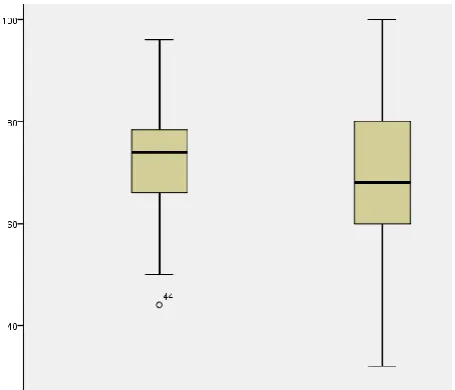
Figure 1: Performance assessments by team (left side) and individual (right side)
The application of such an instrument on the CSI of teams consisting of two categories seems not easy at the first moment. Therefore, a precise explanation makes sense. In each team the cognitive style of managers and non-managers is measured and the average is calculated. Afterwards, inside the team the groups are compared, resulting that the managers are either more intuitive or more analytic than the non-managers.
Caused by the measurement technique a further factor will be included. One weakness of the measurement method is the missing evaluation of the extent to which the managers are more intuitive or more analytic than the non-managers. Consequently, the potential strength in difference between the occupation groups is not respected. To catch up on this, subsequently to the t-test an alternative categorization will be operated. The alternative categorization is assembled by a sub-classification. The sub-classification describes two groups, managers and non-managers. Each group is classified by one of five cognitive style
attributes ranging from (0) extremely intuitive over (1) intuitive, (2) moderate, (3) analytic to (4) extremely analytic. The numbers allow calculations of difference in between these two job groups. The basic formula for calculating the strength in difference between cognitive style index managers (CSIM) and cognitive style index non-managers (CSINM) gives an outcome for the cognitive style index relativity (CSIR):
CSIM – CSINM = CSIR.
The cognitive style index relativity (CSIR) reflects the potential CSI difference relatively to the other profession´s group. The possible results can vary from -4 to +4. A divergence of 1 means a variation of CSI in between the professions inside the team. More than 1 is a strong variation and 0 means no significant difference. The frequency of the extent of any variations or strong variations are represented thus in such a measure and signifies how often a significant difference in the teams emerges. For the measurement in this study an independent sample t-test is appropriate because the significance of the difference in between the means of Intuitive Manager Teams and Analytic Manager Teams shall be measured. According to data and statistic literature an independent or two sample t-test is an appropriate measurement device for comparison of means (de Veaux, Velleman, & Bock, 2015).
5.
RESULTS
The mixed team intuitive manager group (n = 15) is associated with M = 72,75% performance on average with a standard deviation SD = 9,39%. By comparison, the mixed team with analytic manager group (n = 15) is associated with a percentual bigger mean (M = 74,75%) by a standard deviation of SD = 10,34. The greater percentual performance value for Analytic Manager Team already says that contrary to the hypothesis on average Analytic Manager Team performance is higher than Intuitive Manager Team performance. Therefore, the hypothesis is refuted. Nonetheless, to test the hypothesis in the other direction, to discover an eventual relation the research goes on. The hypothesis examines that Intuitive Manager Teams are associated with a statistically, significantly, different overall team performance mean greater than Analytic Manager Teams. For the test of the hypothesis an independent samples t-test was applied.
Table 2 measures the average distribution of the team´s performance evaluation of Intuitive Manager Teams on the one hand and Analytic Manager Teams on the other hand and tests if the distribution of the two groups is normal. Pure Manager and Non-Manager Teams are not listed in the table because they are not relevant for the hypothesis. As shown in table 2, the Analytic Manager Team and Intuitive Manager Team distribution was sufficiently normal for the purpose of performing a t-test (skews (intuitive and analytic) < |1|, kurtosis (intuitive) ~|1|, kurtosis (analytic) <|1| (Schmider, Ziegler, Danay , Beyer, & Bühner, 2010).
Table 2: Descriptive Statistics
Team performance (0-100)
Statistic Std. Error
Intuitive Manager Team
Mean 72,75 2,42
Skewness -0,84 0,58 Kurtosis 1,00 1,12 Analytic
Manager Team
Mean 74,75 2,67
Skewness -0,52 0,58 Kurtosis -0,79 1,12 Shapiro-Wilk test Intuitive
Sig.
0,479
Analytic Sig.
0,237
To verify the nearly normal condition a “Shapiro-Wilk test is the most powerful normality test” (Razali & Wah, 2011). Conducting a Shapiro-Wilk test the output data (see table 2) indicates that with a given α = 0.05 there are statistically, good chances by p = 0,479 and p=0,237 that the two (intuitive and analytic) distributions are normal. The test result justifies a nearly normal distribution assumption of the distribution graphs. Subsequently, the other assumptions are checked.
Additionally to the nearly normal condition, independence assumption and independent group assumption needs to be checked for the validity of the t-test (de Veaux, Velleman, & Bock, 2015). Due to the sampling method gathering data from four companies in four different industries, it may be assumed that those companies do neither intensively affect each other, nor the teams affect each other in between the companies. Nonetheless, the teams themselve may affect among themselves since certain team members are in more than one team at a time. However, the fact of various affection of team members does not necessarily say, that the independent variable (CSI) or dependent variable (performance evaluation) is influenced. Moreover, affection internally and externally is natural for teams. In conclusion, nearly normal properties are proven and independence assumptions are satisfied to such a degree that it is legal to work on with the data while keeping the circumstances in mind.
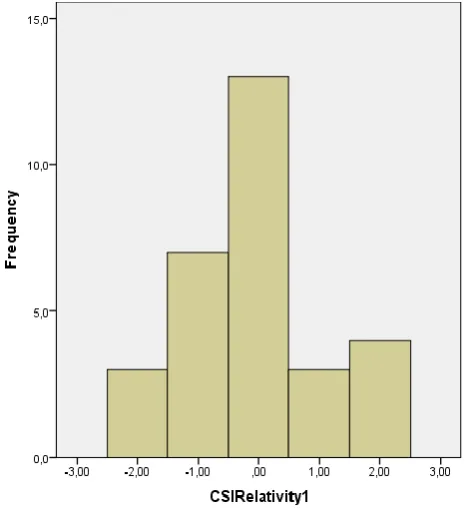
For more exact analysis of potential CSI difference as statistic in form of a histogram gives a valuable understanding. Therefore, this paper followingly discusses the diagram in figure 2. Obviously, the center with the zero is represented with 13 teams most frequently. The distribution to the right and to the left seems still balanced to some degree. Intuitive Manager Teams have ten units, while Analytic Manager Teams have seven units. Compared to the previous dispersion which was quite balanced, now Intuitive Manager Teams are slightly stronger represented. To persue the extreme values, Intuitive Manager Teams and Analytic Manager Teams are on similar levels. Conspiciously, Analytic Manager Teams have more extreme CSI differences than common CSI differences.
If the results of the frequency analysis has not shown that the largest share of mixed teams actually is not to the extent different as assumed, a second t-test with adapted data could have given a meaningful insight. Straightaway, the sample is narrowed too much to resume the analysis on the available data. Nonetheless, the investigated data can flatten the way for a later, second
[image:9.595.308.542.222.477.2]analysis. Therefore, the data will be analyzed up to the end squeezing as much information as possible from the data set. Subsequently, figure 3 gives a comparative insight between Intuitive Manager Teams, Analytic Manager Teams, Non-Manager Teams and Non-Manager Teams. The boxplots show in combination with the frequency table (see table 1) an interesting picture. Intuitive Manager Teams, Analytic Manager Teams, Non-Manager Teams are sufficiently represented for analysis purpose. Comparing the representation number of each group, Intuitive Manager Teams have the smallest range, followed by Analytic Manager Teams while Non-Manager Teams have the greatest range. Interestingly, the smaller ranges are always inside the boundaries of the next bigger range. The next chapter will give a meaning to these results.
Figure 2: Frequency in potential CSI difference
[image:9.595.309.548.458.682.2]6.
DISCUSSION
6.1
Team Cognitive Style Balance and
Performance
Based on the findings of previous scholars this paper has come to its hypothesis. Previous researchers have explored a correlation between CSI and certain occupations. Furthermore, empirical research has discovered a relationship of reciprocal efficiencies. These performance advantages have been investigated to a deeper end. The result states that intuitive managers with analytic team members combined as dyads perform better than other compositions of cognitive style of managers with team members. This approach has led to the reasoned assumption that intuitive managers combined with analytic non-managers in a team may perform better than analytic managers and intuitive non-managers. In the course of the paper this hypothesis has been refuted. Intuitive Manager Teams do not perform better than Analytic Manager Teams. No association between profession in combination of CSI and NPD team performance could be found.
Even, if previous research has shown that certain occupations are associated with certain cognitive styles to perform tasks efficiently. This research has pointed out that managers are compared to non-managers not any more intuitive or analytic. Additionally, the main finding is the rejection of the hypothesis which states that Intuitive Manager Team composition are better performing than Analytic Manager Team composition. Actually, Analytic Manager Teams are slightly more efficient. Nevertheless, Analytic Manager Teams have not been proven to be more efficient and thus better performing than Intuitive Manager Teams at a significant level. The paper cannot verify any association between Analytic Manager Teams and Intuitive Manager Teams on performance in NPD teams in the given sample. The cognitive style balance in NPD teams categorized in the specified units has no impact on team performance. An error analysis can be broad, so this paragraph just broach the subject in some core points. This study could not have shown that one of the team composition types is more dominant. The origin for the hypothesis without a significant relation of dependent and independent variable can be an over-interpretation or miss-interpretation of indications in literature. A revision into the theoretical background may minimize the error field. Additionally, the hypothesis that teams with intuitive managers and analytic non-managers work more successful can be rejected. No team composition type has a significant, general advantage towards the other team type. External and internal variables may have an unexpected influence. Not all conditions from internal and external environment on the NPD team performance may be respected sufficiently. The limitation part will further investigate these ideas.
This study has shown that even if there are tendencies in NPD teams for managers to be more intuitive or more analytic than the team members, these tendencies are for the most teams not strong (see: figure 2). Almost the half of all teams have no great variance of the cognitive style inside the team. Consequently, teams with no great CSI diversity are the most popular ones. The cause for similar cognitive style preference may be caused in the assumption that was earlier stated in the text. Namely, there are cognitive style problems promoting communication and information processing obstacles (Park, Lim, & Birnbaum-More, 2009). However, actually the study of Park, Lim and Birnbaum-More focuses rather on cross-functional teams and the way knowledge background affects team performance. Research may go on and investigate to what extent cognitive style variations impact communication and information processing.
The most similar approach in literature from Allinson, Armstrong and Hayes, (2001) states that intuitive leaders with analytic team members perform better than other CSI and profession relationships. One difference to the study of Allinson, Armstrong and Hayes is the team size. The scholars have inspected dyads while the team size in this study ranges from dyads to a team of 8 people. The difference in team size can mean a different need of characteristics of the team leader. According to Allinson, Armstrong and Hayes (2001) an important characteristic of intuitive people is that they are less dominant and thus more open to the ideas and plans of others. Contrary analytic people have concrete plans which they want to implement. The greater acceptance and better performance of intuitive leaders ascribed to the opennes to ideas of team members and flexibility to adapt the own plans. Now may it be that these characteristics of flexibility and openness to ideas is not questioned in big teams. Teams that are greater than dyads may ask for a team leader who drives the team to a corporate goal. The manager who has the role of the team leader cannot listen to and respect every single idea but has to look for an overall goal. Therefore, team size can be a third variable. Depending on the size of the team more intuitive or more analytic managers may be sought.
The scale of measurement of the dependent and independent variable can be a further explanation for varying results. While many researchers have measured NPD performance primarily in innovativeness, this study has a broader measurement scope including (1) the project success, (2) project goals achieved, (3) project output quality, (4) team satisfaction of the project, and finally (5) top management satisfaction of the project. This paper covers NPD performance as a whole while other studies examine performance punctually as e.g. the named innovativeness (Glaser, 1995). Similar to the view on performance by researchers, the polled individuals may value various performance aspects differently. Furthermore, in different companies and industries can count different performance ideals. Some companies or industries value innovation more than others do. Consequently, measurement across different companies and industries can have a moderating effect. A new measurement method for each industry could be the solution.
The mentioned similarities between the firms are (a) a large collection of NPD projects from R&D departments plus (b) the willingness to give access to important and relevant information, and (c) the technology intensive manufacturing industries. These similarities are rather gross. Rubber tires, sensors and controls, membrane technologies and plastic pipes are different companies. Therefore it generally can be stated that for technology intensive manufacturing firms there is no relationship of Intuitive Manager Teams or Analytic Manager Teams and NPD performance. Additionally this research states that the rejection of the hypothesis is generally true for all professional functions and departments which are usual in a technology intensive manufacturing firm.
6.2
Managerial Implications
CSI of the team appear in a balanced distribution. The number of Intuitive Manager Teams and Analytic Manager Teams is the same. Additionally, the performance in between these team composition types does not make a noteworthy performance difference. Consequently, companies need both, Intuitive Manager and Analytic Manager Teams.
Internal and external factors influence the performance of NPD teams. The internal factors include the individuals´ characteristics of the team members. The team members´ creativity is an essential factor for innovation and the correlating performance (Bonner, Ruekert, & Walker Jr., 2002). From outside the team upper management or top management can influence the NPD team performance. Literature has shown a negative outcome for intensive intervention by top management but a positive outcome for presetting a strategy and monitoring from time to time (Bonner, Ruekert, & Walker Jr., 2002). Generally, researchers have to pay attention to those third variable factors. For the following limitations internal and external factors mean an insecurity because they can have an overwhelming effect. The overwhelming effect can be large and therefore cover the actual relationship.
6.3
Limitations
As in the study discovered, the actual potential difference for most teams do not exceed a significant line. This result reduces the remaining units of analysis to a questioning level. Two groups with a size of n = 15 each, thus the total sample N = 30 is at the borderline to results that delivers valid and reliable results. Moreover, the questionnaires were filled out by every single employee him-/herself which means that the answers are subjective. On the one hand, the answers to the CSI questions are subjective with the consequence that the answers are not to such a level comparable than if they would have been determined objectively. On the other hand, the performance evaluation gets a subjective influence. The subjective influence on performance is moderated by the average evaluation per team but an assessment by outstanding people such as senior managers or customers is missing. Furthermore, through differences in between the industries performance criteria may vary.
Another limitation which can be at the same time the cause of the missing correlation is the environment. The environmental impact on performance and performance judgement can be enormous, for instance if unexpected challenges appear which can be handled. Those achievements could lead the team to evaluate their performance better while from an external, objective view the performance may keep the same. Due to lapse of time which involves a changing surrounding a team will never have exactly the same work environment. Those changes in work environment also provokes a different performance evaluation. Test variables and third factors were also not considered in the analysis. Yet, literature has not given a clue that managers and non-managers are affected by third factors but that does not have to mean that such variables do not exist. Further research could test imaginable factors such as stress levels. The topic of stress was broached in the theoretical background as one theme that provokes managers to use an intuitive approach to solve tasks. Nonetheless, the stress variable was not tested and examined. Further research could test the hypothesis if intuitive managers confronted with stress perform better than analytic managers. Additionally, in deeper research a bigger sample size is advised to get results that are more precise with smaller variances.
7.
CONCLUSION
Within the given sample of 195 participants in 61 projects this study was not able to show an association between cognitive style balance in form of Intuitive Manager Teams and Analytic
Manager Teams and performance output. Nonetheless, the result gives an advice for further research and eliminates the possible association analytic or intuitive CSI team composition and performance in the technology intensive manufacturing industry.
8.
REFERENCES
Allinson , C., & Hayes, J. (1996, January). The Cognitive Style Index: A Measure of Intuitiion-Analysis for Organizational Research. Journal of Management Studies, 33(1), pp. 119-135.
Allinson, C., Armstrong, S., & Hayes, J. (2001). The effects of cognitive style on leader—member exchange: A study of manager-subordinate dyads. Journal of Occupational and Organinzational Psychology(74), pp. 201-220.
Allinson, C., Chell, E., & Hayes, J. (2000, September 10). Intuition and entrepreneurial behavior. European Journal of Work and Organizational Psychology, Vol. 9(1), pp. 31-43.
Ancona, D., & Caldwell, D. (1992, August). Demography and Design: Predictors of New Product Team Performance. Organization Science, Vol. 3(No. 3). Armstrong, S., & Hird, A. (n.d.). Cognitive Style and
Entrepreneurial Drive of New and Mature Business Owner-Managers. Journal of Business Psychology, 24, pp. 419-430.
Armstrong, S., & Priola, V. (2001, June). Individual differences in Cognitive Style and their effects on task and social orientations of self-managed work teams. Small Group Research, Vol. 32(No. 3), pp. 283-312.
Armstrong, S., Allinson, C., & Hayes, J. (1997). The implications of cognidve style for the management of student-supervisor relationships. Educational Psychology, 17, pp. 209-217.
Ash, F. (1986). . Identifying learning styles and matching strategies for teaching and. Massachusetts.
Barczak, G., & Wilemon, D. (2001). Factors influencing product development team satisfaction. European Journal of Innovation Management, Vol. 4(1), pp. 32-36.
Bonner, J., Ruekert, R., & Walker Jr., O. (2002). Upper Management Control of New Product Development Projects and Project Performance. The Journal of Product Innovation Management, Vol. 19, pp. 232-245.
Bruner , J., Goodknow , J., & Austin, G. (1956). A study of thinking. Wiley.
Burke, L., & Miller, M. (1999, November). Taking the mystery out of intuitive decision making. Academy of Management Executive, Vol. 13(4), pp. 91-99.
Chang, J., Choi, J., & Kim, M. (2008, June). Turnover of highly educated R&D professionals: The role of pre-entry cognitive style, work values and career orientation.
Journal of Occupational & Organizational
Psychology, 81(2), pp. 299-317.
Chilton, M., Hardgrave, B., & Armstrong, D. (2005, Fall). Person-Job Cognitive Style Fit for Software Developers: The Effect on Strain and Performance. Journal of Management Information Systems, pp. 193-226.
Cohen, J. (1992). A power primer. Psychological Bulletin, 112, pp. 155-159.
Dane, E., & Pratt, M. (2007, January). Exploring Intuition and its Role in Managerial Decision Making. Academy of Management Review, Vol. 32(1), pp. 33-54.
Dayan , M., & Di Benedetto, C. (2011, March). Team intuition as a continuum construct and new product creativity: The role of environmental turbulence, team experience, and stress. Research Policy, Vol. 40(No.2), pp. 276-286.
de Veaux, R., Velleman, P., & Bock, D. (2015). Stats: Data and Models (4th edition ed.). Pearson Education, Inc.
de Visser, M., de Weerd-Nederhof, P., Faems, D., Song, M., van Looy, B., & Visscher, K.-j. (2010, May-June). Structural Ambidexterity in NPD Processes: A firm level assessment of the impact of differentiated structures on innovation performance. Technovation, Vol. 30(5-6), pp. 291-299.
de Visser, M., Faems, D., & van den Top, P. (2011). Exploration and Exploitation within SMES: Connecting the CEO´s Cognitive Style to Product Innovation Performance. 18th International Product Development Management
Conference (IPDMC). Delft. Retrieved from
http://purl.utwente.nl/publications/80217
de Visser, M., Faems, D., Visscher, K., & de Weerd-Nederhof, P. (2014). The Impact of Team Cognitive Style on Performance in Radical and Incremental NPD Projects. Journal of Product Innovation Management, pp. 1167-1180.
Dijksterhuis, A. (2004, November). Think Different: The Merits of Unconscious Thought in Preference Development and Decision Making. Journal of Personality and Social Psychology, 87(5), pp. 586-598.
Edmondson, A. (2003, Winter). Framing for Learning: Lessons in Successful Technology Implementation. California Management Review, Vol. 45(2).
Epstein, S., Pacini, R., Denes-Raj, V., & Heier, H. (1996, August). Individual Differences in Intuitive-Experiential and Analytical-Rational Thinking Styles. Journal of Personality and Social Psychology, Vol.71(No.2), pp. 390-405.
Faems, D., & Subramanian, A. (2013, November). R&D manpower and technological performance: The impact of demographic and task-related diversity. Research Policy, Vol 42(9), pp. 1624-1633.
Garlinger , D., & Frank, B. (1986). Teacher-student cognitive styles and academic achievement: A review and mini meta.-analysis. Journal oof Classroom Interaction, 21, pp. 2-8.
Glaser, M. (1995). Measuring intuition; A pilot study suggests that it´s possible to assess the intuitive ability of R&D personnel. Research Technology Management, Vol. 38(No. 2).
Hallowell, E. (2005, January). Overload Curcuits; Why smart people underperform. Harvard Business Review, pp. 1-10.
Harrison, D., Price, K., Gavin, J., & Florey , A. (2002). Time, teams and task performance: changing effects of surface and deep level diversity on group functioning. Acadamy of Management Journal, Vol. 45(No. 5), pp. 1029-1045.
Hauptman, O., & Hirji, K. (1999). Managing integration and coordination in cross-functional teams: an international study of Concurrent Engineering product development. R&D Management, 29.
Hayes, J., & Allinson, C. (1994). Cognitive Style and its Relevance for Management Practice. British Journal of Management, Vol. 5, pp. 53-71.
Hayes, J., & Allinson, C. (1994). Cognitive Style and its Relevance for Management Practice. British Journal of Management, Vol. 5, pp. 53-71.
Hoegl, M., & Parbotheeah, K. (2003, February). Goal Setting and Team Performance in Innovative Projects: On the moderating role of Teamwork Quality. Small Group Research(Vol.34), pp. 3-19.
Hoegl, M., Weinkauf, K., & Gemuenden, H. (2004, January/February). Interteam Coordination, Project Commitment, and Teamwork in Multiteam R&D Projects: A Longitudinal Study. Organization Science, Vol. 15(1), pp. 38-45.
Huang, C.-C. (2009, November). Knowledge sharing and group cohesiveness on performance: An empirical study of technology R&D teams in Taiwan. Technovation, 29(11), pp. 786-797.
Hülsheger, U., Anderson, N., & Salgado, J. (2009). Team-Level Predictors of Innovation at Work: A Comprehensive Meta-Analysis Spanning Three Decades of Research. Journal of Applied Psychology, Vol. 94(5), pp. 1128-1145.
Kahn, K., Kay , S., Slotegraaf, R., & Uban , S. (2013). The PDMA Handbook of New Product Development. USA: John Wiley & Sons, Inc.
Kickul, J., Gundry, L., Barbosa, S., & Whitcanack, L. (2009, March). Intuition Versus Analysis? Testing Differential Models of Cognitive Style on Entrepreneurial Self-Efficacy and the New Venture Creation Process. Entrepreneurship: Theory & Practice, 33(2), pp. 439-453.
Kim, B., & Kim, J. (2009, October). Structural Factors of NPD (new product development) team for manufacturability. International Journal of Project Management, Vol. 27(7), pp. 690-702.
Kirton , M. (1980). Adapters and innovators in organizations. Human Relations(3), pp. 213-214.
Knockaert, M., Ucbasaran, D., Wright, M., & Clarysse, B. (2011, July). The Ralationsship Between Knowledge Transfer, Top Management Team Composition and Performance: The Case of Science Based Entrepreneurial Firms. Entrepreneurship: Theory and Practice, pp. 777-803.
Leonard, D., & Strauss, S. (1997). Putting your company's wboie brain to work. Harvard Business Review(75), pp. 110-121.
McHale, J., & Flegg, D. (1985, November). . How Calamity Jane was put in her place. Transition, pp. 14-16.
McNally, R., Durmusoglu, S., Calantone , R., & Harmancioglu, N. (2009, January). Exploring new product portfolio management decisions: The role of managers' dispositional traits. Industrial Marketing Management, 38(1), pp. 127-143.
Mitchell, R., Busenitz , L., Lant, T., McDougall, P., Morse, E., & Smith, J. (2004). The distinctive and inclusive domain of entrepreneurial cognition research. Entrepreneurship Theory and Practice, 28, pp. 505-518.
Myers, I. (1962). The Myers Briggs Type Indi. Consulting Psychologists Press.
Nickerson, R., Perkins, D., & Smith, E. (2014). The Teaching of Thinking. Routledge.
Nightingale, P. (1998, November). A cognitive Model of innovation. Vol.27(7), pp. 689-709.
Olson, E., Walker Jr., O., Ruekert, R., & Bonnerd, J. (2001, July). Patterns of cooperation during new product development among marketing, operations and R&D: Implications for project performance. Journal of Product Innovation Management, Vol. 18(4), pp. 258-271.
Park, M.-J., Lim, J., & Birnbaum-More, P. (2009, January). The Effect of Multiknowledge Individuals on Performance inCross-Functional New Product Development Teams. Journal of Product Innovation Management, Vol. 2006(1), pp. 86-96.
Pelled, L., Eisenhardt, K., & Xin , K. (1999, March). Exploring the Black Box: An Analysis of Work Group Diversity, Conflict, and Performance. Vol. 44(No. 1), pp. 1-28. Post, C. (2012). Deep-level team composition and innovation:
The mediating roles of psychological safety and cooperative learning. Group and Organization Management, 37(5), pp. 555-588.
Razali, N., & Wah, Y. (2011). Power Comparison Shapiro-Wilk, Kolmogorov-Smirnov, Lilliefors and Anderson-Darling tests. Journal of Statistical Modeling and Analytics, 2(1).
Reilly, R., Lynn, G., & Aronson, Z. (2002, March). The role of personality in new product development team performance. Journal of Engineering and Technology Management, pp. 39-58.
Riding, R. (1991). Cognitive Styles Analysis. Learning and Training Technology.
Riding, R., & Sadler-Smith, E. (1992). Types of instructional material, cognitive style and learning performance. Educational Studies, 18, pp. 323-339.
Sarin, S., & McDermott, C. (2003, Fall). The Effect of Team Leader Characteristics on Learning, Knowledge Application, and Performance of Cross-Functional New Product Development Teams. Decision Sciences, Vol 34(4), pp. 707-739.
Sarin, S., & O´Connor, G. (2009). First among Equals: The Effect of Team Leader Characteristicson the Internal Dynamics of Cross-Functional Product Development Teams. Journal of Product Innovation Management, 26, pp. 188-205.
Sayegh, L., Anthony, W., & Perrewé, P. (2004, June). Managerial Decision Making Under Crisis: The role of
Emotion in an Intuitive Decision Process. Human Resource Management Review, Vol. 14(2), pp. 179-199.
Schmider, E., Ziegler, M., Danay , E., Beyer, L., & Bühner, M. (2010). Is it really robust? Reinvestigating the robustness of ANOVA against the normal distribution assumption. Methodology: European Journal of Research Methods for the Behavioral and Social Sciences, 6, pp. 147-151.
Schweiger, D. (1983). Measuring managers' minds: A critical reply to Robey and Taggart. Academy of Management review, 8, pp. 143-151.
Sethi, R., Smith, D., & Park, C. (2001, February). Cross-Functional Product Development Teams, and the Innovativenesss of New Consumer Products. Journal of Marketing Research.
Sinclair, M. (2011). Handbook of intuition research. Cheltenham, UK: Edward Elgar Publishing, Inc. Slotegraaf, R., & Atuahene-Gima, K. (2011, January). Product
Development Team Stability and New Product Advantage: The Role of Decision making Processes. Journal of Marketing, Vol. 75, pp. 96-108.
Smith, P., & Reinertsen , D. (1998). Developing the products in half the time: new rules, new tools (Vol. Vol. 298). New York: John Wiley & Sons.
Swink , M., Talluri, S., & Pandejpong, T. (2006, September). Faster, better, cheaper: A study of NPD project efficiency and performance tradeoffs. Journal of Operations Management, Vol.24(5), pp. 542-562.
Swink, M. (2003, September 30). Technological Innovativeness as a Moderator of New Product Design Integration and Top Management Support. Vol. 17(No. 3), pp. 208-220.
van Bruggen , K., Smidts, A., & Wierenga, B. (1998, May). Improving Decision making by means of Marketing Decision Support System. Management Science, Vol. 44(5), pp. 645-658.
Vanderheyden, K., & de Baets, S. (2015). Does cognitive style diversity affect performance in dyadic student teams? Learning and Individual Differences, 38, 143-150.
Wilson, D. (1988). Management learning: A grounded study of the written reflections of managers on their approach to real time work problems. University of Lancester, England.
Witkin, H., Moore, C., Goodenough, D., & Cox, P. (1977). Field-dependent and field-inField-dependent cognitive styles and tbeir educational implications. Review of Educational Research, 47, pp. 1-64.
Witkin, H., Moore, C., Oltman, P., Goodenough, D., Friedman, F., Owen , D., & Raskin, E. (1977). Role of the Field-Dependent and Field-Independent Cognitive Styles in Academic Evolution: A Longitudinal Study. Journal of Educational Pychology, Vol. 69(No.3), pp. 197-211.