Original citation:
Uzun, U. (1998) Towards distributed object design. University of Warwick. Department of Computer Science. (Department of Computer Science Research Report). (Unpublished) CS-RR-338
Permanent WRAP url:
http://wrap.warwick.ac.uk/61051
Copyright and reuse:
The Warwick Research Archive Portal (WRAP) makes this work by researchers of the University of Warwick available open access under the following conditions. Copyright © and all moral rights to the version of the paper presented here belong to the individual author(s) and/or other copyright owners. To the extent reasonable and practicable the material made available in WRAP has been checked for eligibility before being made available.
Copies of full items can be used for personal research or study, educational, or not-for-profit purposes without prior permission or charge. Provided that the authors, title and full bibliographic details are credited, a hyperlink and/or URL is given for the original metadata page and the content is not changed in any way.
A note on versions:
TOWARDS DISTRIBUTED OBJECT DESIGN
By
Ümit UZUN
1. ABSTRACT ... 2
2. MOTIVATION ON THE CASE STUDY... 2
3. OO DESIGN OF AN IR SYSTEM ... 3
3.1 REQUIREMENTS ... 3
3.2 CONSTRAINTS... 4
3.3 NOTATION ... 4
3.4 DESIGN DIAGRAMS ... 4
3.4.1 USE CASE DIAGRAM... 4
3.4.2 CLASS DIAGRAM ... 5
3.4.3 SEQUENCE DIAGRAMS ... 6
3.4.4 COLLABRATION DIAGRAMS... 8
4. ELEMENTS OF OBJECT ORIENTED DESIGN ... 11
5. DISTRIBUTED OBJECT COMMUNICATION ... 14
6. DISTRIBUTED OBJECT DESIGN ... 15
6.1 PROBLEMS ARISING IN DESIGN OF DISTRIBUTED OBJECT COMPUTING. ... 16
6.1.1 What to distribute? (Granularity)... 16
6.1.2 Where to put? (Allocation) ... 17
6.1.3 Physical / Virtual Network Schema? ... 17
6.1.4 How to cluster objects? (Clustering) ... 18
6.1.5 Exploiting and specifying parallelism. ... 18
6.1.6 How to evaluate the quality of the design in terms of distribution? ... 19
6.1.7 Refinement of the design according to distribution issues... 19
6.2 EXTRA ELEMENTS TO BE REPRESENTED IN A DISTRIBUTED OBJECT DESIGN... 19
6.3 PROPOSED SOLUTIONS... 20
6.3.1 What to distribute? ... 20
6.3.2 Where to put? (Allocation) ... 21
6.3.3 Physical / Virtual Network Schema? ... 21
6.3.4 How to cluster objects? (Clustering) ... 22
6.3.5 Exploiting and specifying parallelism. ... 23
6.3.6 How to evaluate the quality of the design in terms of distribution? ... 24
6.3.7 Refinement of the design according to distribution issues... 26
7. CONCLUSION ... 26
1. ABSTRACT
Today's object-oriented (OO) software development methodologies use a number of
graphical notations in analysis and design stages. There is an increasing research interest in
incorporating distribution issues into these development methods. Allocation of objects and
tasks, object replication and migration, remote interactions, multiple threads of control as well
as network topologies are important issues in distributed object systems. In this report, ways
to add distribution related issues to the object-oriented design methods (especially
UML-based methods) are discussed.
We have implemented a case study in the area of Information Retrieval to concretize
the issues. The implementation of the case study is done in Java [6] programming language,
the source code of the programs is located at http://ftp.dcs.warwick.ac.uk/~umit/IR.
2. MOTIVATION ON THE CASE STUDY
Information retrieval systems are used to retrieve documents from a large number of
document collections satisfying given criteria (queries). As an example, there is an
information retrieval system under the search facility of a university library, where the types
of documents are books, journals, theses, etc. Another example is the search engines on the
Internet where the types of documents are web pages, articles in newsgroups, etc.
As the number of documents in the collection increases the process of executing the
query and retrieving documents takes more time. The number of users making a query at the
same time is also another issue; the performance of such a system decreases if more queries
are being executed simultaneously. There have been various efforts to improve quality and
performance of information retrieval. Using hardware with higher performance or using
parallel computers is an effort in the hardware direction, so new hardware architectures are
proposed for that purpose. Another issue is the use of different algorithms in the retrieval task:
in the literature, there are quite a lot of algorithms developed to improve the search.
Distributed object computing may provide different solutions. Designing an
information retrieval system using OO techniques, and implementing the system over a set of
Implementing distributed object applications is now becoming easier using
technologies like RMI [1] (Remote Method Invocation), CORBA [3] (Common Object
Request Broker Architecture) or DCOM [2] (Distributed Component Object Model),
however, there is not much research work on designing distributed object systems. The point
of defining distribution concerns in the development methodologies is still unclear. In fact,
the design of such an information retrieval system is going to be used to uncover those issues
related to the design of distributed object applications.
The system is going to be designed in two stages. First, an object oriented design will
be produced ignoring the underlying distribution platform and assuming the system will be
running on one central machine. Next, a design including distribution aspects will be
produced. The reason for doing so is to identify the differences between OO and distributed
OO designs.
3. OO DESIGN OF AN IR SYSTEM
3.1 REQUIREMENTS
• The system is a multi-user information retrieval system, which is used to retrieve relevant documents to specific criteria from a collection of documents. The query will involve
some search terms.
• The collection will include different type of documents, such as books, journals, on-line documents in different formats, etc.
• The system should allow introducing new types of documents as well, or the design should be easily extendible to include new types of documents in the collection.
(Optional)
• Each type of document has its own properties; for example, a book has title, author and terms, etc., whereas an online document might have title, location, terms, etc., and an
article may have title, author, abstract, journal, volume, etc.
• After the user inputs the query to the system, the system will retrieve a list of relevant documents.
• Users will be classified in terms of their rights, some users will be able to add/delete/update documents in the collection, some users not. Some documents will be
marked as private and only users who have rights to access them will be able to retrieve
3.2 CONSTRAINTS
• The number of documents and the number of users are expected to be huge. Therefore, one computer will not be sufficient considering the response time (performance) and
space requirements, so there will be an underlying distributed computing platform. (a
network of computers using TCP/IP as the network protocol)
• The system would be able to utilize different types of computer hardware and operating systems, such as Unix and Windows 95/NT.
3.3 NOTATION
UML [4] (Unified Modeling Language) notation is used in the design diagrams. The
Unified Modeling Language (UML) is a language for specifying, visualizing, constructing,
and documenting software systems, as well as for business modeling and other non-software
systems. Extended information about UML notation is located in "UML v1.1 Notation Guide"
on http://www.rational.com/uml.
3.4 DESIGN DIAGRAMS
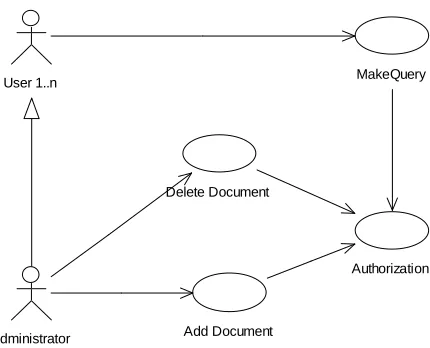
Looking at the requirements above the most important use cases are: addition and
deletion of documents and searching the document collection. The basic objects to be
involved in such a system are: User, (Administrator), Document, Term, Document Collection,
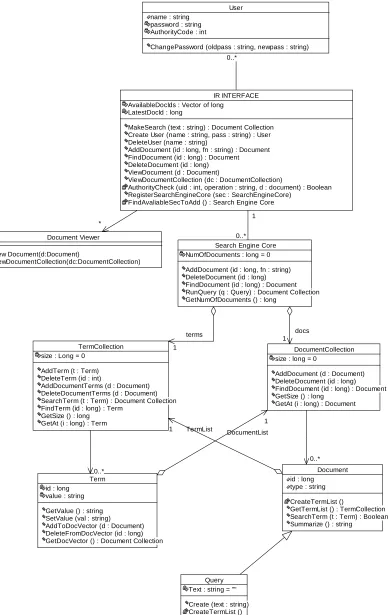
Search Engine and Query. The following diagrams explain the static structure of this system
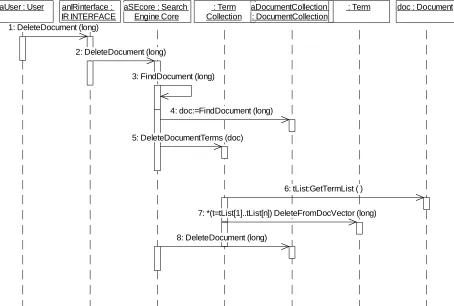
(relationship among objects) and the interaction among objects to make the system work.
3.4.1 USE CASE DIAGRAM
User 1..n
Delete Document
MakeQuery
[image:5.612.187.402.537.711.2]3.4.2 CLASS DIAGRAM
Query Text : string = "" Create (text : string) CreateTermList ()
0..* User name : string
password : string AuthorityCode : int
ChangePassword (oldpass : string, newpass : string)
* Document Viewer View Document(d:Document) ViewDocumentCollection(dc:DocumentCollection) 0..* 1 IR INTERFACE AvailableDocIds : Vector of long
LatestDocId : long
MakeSearch (text : string) : Document Collection Create User (name : string, pass : string) : User DeleteUser (name : string)
AddDocument (id : long, fn : string) : Document FindDocument (id : long) : Document DeleteDocument (id : long) ViewDocument (d : Document)
ViewDocumentCollection (dc : DocumentCollection)
AuthorityCheck (uid : int, operation : string, d : document) : Boolean RegisterSearchEngineCore (sec : SearchEngineCore)
FindAvaliableSecToAdd () : Search Engine Core 0..* * DocumentList 1 docs 1 0..* Term id : long
value : string GetValue () : string SetValue (val : string) AddToDocVector (d : Document) DeleteFromDocVector (id : long) GetDocVector () : Document Collection
terms 1
Search Engine Core NumOfDocuments : long = 0 AddDocument (id : long, fn : string) DeleteDocument (id : long) FindDocument (id : long) : Document RunQuery (q : Query) : Document Collection GetNumOfDocuments () : long
0..* 1
DocumentCollection size : long = 0
AddDocument (d : Document) DeleteDocument (id : long) FindDocument (id : long) : Document GetSize () : long
GetAt (i : long) : Document 1 1 0..* TermList 1 TermCollection
size : Long = 0 AddTerm (t : Term) DeleteTerm (id : int)
AddDocumentTerms (d : Document) DeleteDocumentTerms (d : Document) SearchTerm (t : Term) : Document Collection FindTerm (id : long) : Term
GetSize () : long GetAt (i : long) : Term
0..*
1
Document id : long
type : string CreateTermList ()
GetTermList () : TermCollection SearchTerm (t : Term) : Boolean Summarize () : string
[image:6.612.114.502.86.701.2]0..* 1
3.4.3 SEQUENCE DIAGRAMS
aUser : User anIRinterface : IR INTERFACE
aSEcore : Search Engine Core
q : Query : TermCollection : Term
1: MakeSearch (string)
2: q:=Create (string)
3: Create Term List ( )
4: RunQuery (q)
5: tList=Get Term List ( )
6: *(t=tList[1]..tList[n]) SearchTerm (t)
[image:7.612.102.557.98.399.2]7: GetDocVector ( )
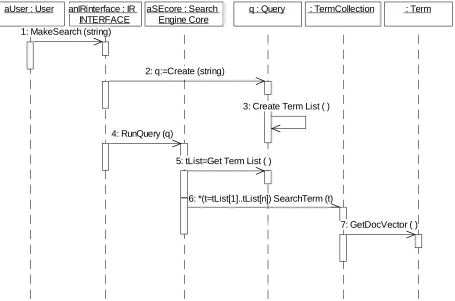
Figure 3 - Sequence Diagram for MakeQuery
anIRinterface : IR INTERFACE
aUser : User aSEcore : Search Engine Core
aDocumentCollection : DocumentCollection
doc : Document : Term : Term Collection 1: AddDocument (long, string)
2: AddDocument (long, string)
3: doc:=Create (long, string)
4: AddDocument (Document)
5: AddDocumentTerms (doc)
6: tList:=GetTermList ( )
[image:7.612.101.542.321.648.2]7: *(for t=tList[1]..tList[n]) AddToDocVector
aUser : User anIRinterface : IR INTERFACE
aSEcore : Search Engine Core
: Term Collection
aDocumentCollection : DocumentCollection
: Term doc : Document
1: DeleteDocument (long)
2: DeleteDocument (long)
3: FindDocument (long)
4: doc:=FindDocument (long)
5: DeleteDocumentTerms (doc)
6: tList:GetTermList ( )
7: *(t=tList[1]..tList[n]) DeleteFromDocVector (long)
[image:8.612.106.560.45.351.2]8: DeleteDocument (long)
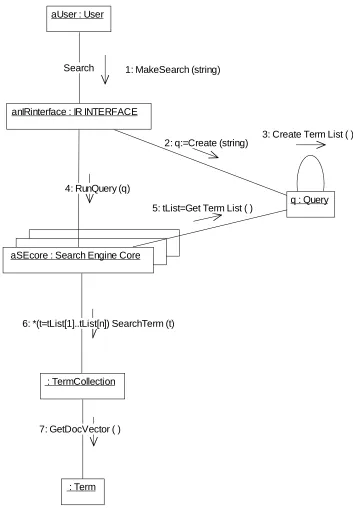
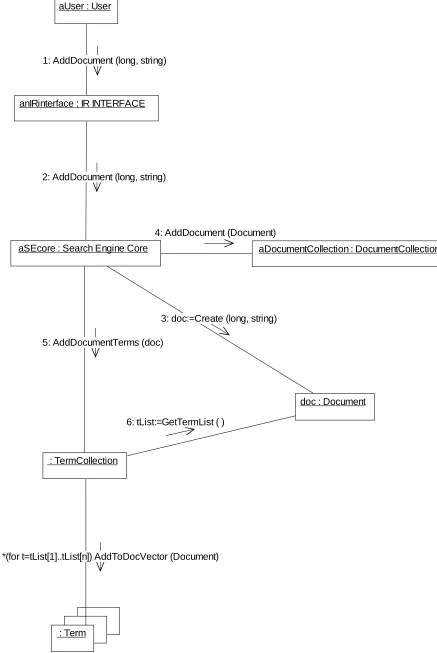
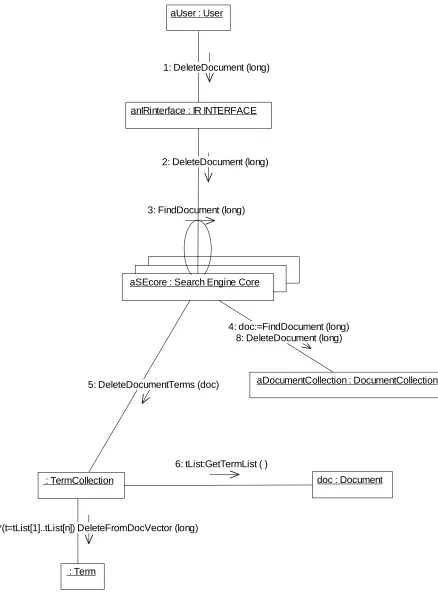
3.4.4 COLLABRATION DIAGRAMS
aUser : User
anIRinterface : IR INTERFACE
aSEcore : Search Engine Core
q : Query 3: Create Term List ( )
: TermCollection
: Term
Search 1: MakeSearch (string)
2: q:=Create (string)
4: RunQuery (q)
6: *(t=tList[1]..tList[n]) SearchTerm (t)
5: tList=Get Term List ( )
[image:9.612.126.479.94.606.2]7: GetDocVector ( )
aUser : User
anIRinterface : IR INTERFACE
aSEcore : Search Engine Core aDocumentCollection : DocumentCollection
doc : Document
: Term : TermCollection
1: AddDocument (long, string)
2: AddDocument (long, string)
4: AddDocument (Document)
3: doc:=Create (long, string)
5: AddDocumentTerms (doc)
[image:10.612.107.544.48.701.2]7: *(for t=tList[1]..tList[n]) AddToDocVector (Document) 6: tList:=GetTermList ( )
aUser : User
anIRinterface : IR INTERFACE
aSEcore : Search Engine Core
: TermCollection
aDocumentCollection : DocumentCollection
: Term
3: FindDocument (long)
doc : Document 1: DeleteDocument (long)
2: DeleteDocument (long)
4: doc:=FindDocument (long) 8: DeleteDocument (long)
5: DeleteDocumentTerms (doc)
7: *(t=tList[1]..tList[n]) DeleteFromDocVector (long)
[image:11.612.105.543.41.637.2]6: tList:GetTermList ( )
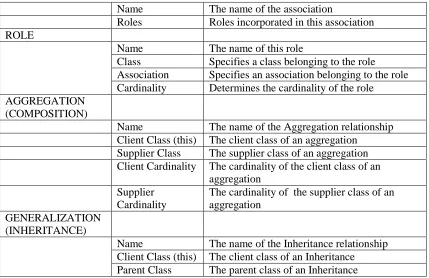
4. ELEMENTS OF OBJECT ORIENTED DESIGN
Object oriented methodologies focus on determining the objects in a system, and their
relationships and interaction. Several graphical notations are used to express the static
structure and interaction of objects. The notation used in our case study is based on one of the
most versatile methodologies, which is UML (the Unified Modeling Language).
In order to incorporate distribution issues in OO methodologies we should first look
at the elements of object oriented design and attributes of those elements. Then, we will
identify the new elements needed in the design for distributed systems. In the following parts
elements and properties of those elements, which are most common in all OO methodologies,
are shown. These fundamental elements of object orientation are discussed heavily in the
literature hence detailed descriptions will not be included here. The following information
[image:12.612.92.522.353.736.2]will be useful to form a basis for distributed object design elements and properties.
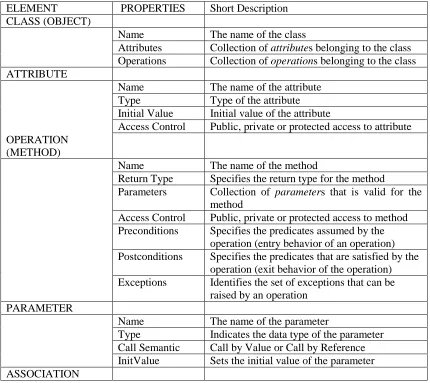
Table 1 - STATIC STRUCTURE ELEMENTS
ELEMENT PROPERTIES Short Description
CLASS (OBJECT)
Name The name of the class
Attributes Collection of attributes belonging to the class Operations Collection of operations belonging to the class ATTRIBUTE
Name The name of the attribute Type Type of the attribute Initial Value Initial value of the attribute
Access Control Public, private or protected access to attribute OPERATION
(METHOD)
Name The name of the method
Return Type Specifies the return type for the method
Parameters Collection of parameters that is valid for the method
Access Control Public, private or protected access to method Preconditions Specifies the predicates assumed by the
operation (entry behavior of an operation) Postconditions Specifies the predicates that are satisfied by the
operation (exit behavior of the operation) Exceptions Identifies the set of exceptions that can be
raised by an operation PARAMETER
Name The name of the parameter
Name The name of the association
Roles Roles incorporated in this association ROLE
Name The name of this role
Class Specifies a class belonging to the role Association Specifies an association belonging to the role Cardinality Determines the cardinality of the role
AGGREGATION (COMPOSITION)
Name The name of the Aggregation relationship Client Class (this) The client class of an aggregation
Supplier Class The supplier class of an aggregation Client Cardinality The cardinality of the client class of an
aggregation Supplier
Cardinality
The cardinality of the supplier class of an aggregation
GENERALIZATION (INHERITANCE)
[image:13.612.93.522.44.322.2]Name The name of the Inheritance relationship Client Class (this) The client class of an Inheritance Parent Class The parent class of an Inheritance
Table 2 - INTERACTION STRUCTURE ELEMENTS
MESSAGE
Name The name of the message
Sender The sender object of the message Receiver(s) The receiver object (s) of the message
Receiver Method The method of the receiver object that responds to the message
INTERACTION
Name The name of the Interaction sequence.
Messages The ordered collection of messages take place in the interaction sequence
STATE
Name Name of the state
Transitions Collection of possible transitions to other states Nested States Collection of states included in the state EVENT
Name Name of the event
Transitions Collection of transitions to trigger TRANSITION
Name Name of the transition
Source State The state which transition will occur from Destination State The state which transition will occur to Destination
Transitions
In the class diagram, Figure-2, we can see the static structure elements of a typical
object-oriented design in a graphical notation, the following table includes examples from the
[image:14.612.91.523.150.457.2]class diagram.
Table 3 - EXAMPLES OF STATIC STRUCTURE ELEMENTS
CLASS (OBJECT)
Name Document
Attributes Id
Operations Type
ATTRIBUTE
Name Text (in Class Query)
Type String
Initial Value "" Access Control Private OPERATION
(METHOD)
Name FindDocument (in Class DocumentCollection) Return Type Document
Parameters Id
Access Control Public Preconditions N/A Postconditions N/A
Exceptions N/A
PARAMETER
Name Id
Type Long
Call Semantic Call by Reference (Default)
InitValue N/A
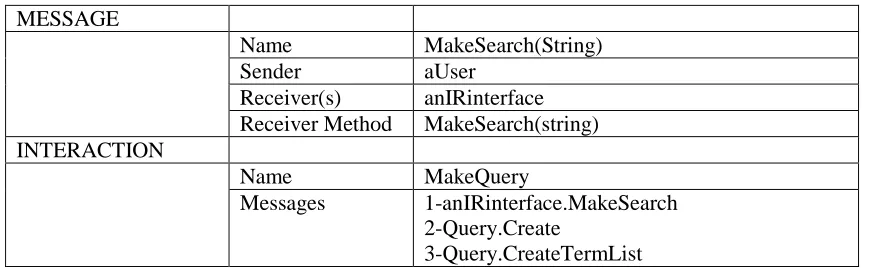
In the Sequence diagram, Figure-3, we can see the interaction structure elements of
an OO design in a graphical notation. Following table includes examples from the sequence
[image:14.612.90.525.608.742.2]diagram.
Table 4 - EXAMPLES OF INTERACTION STRUCTURE ELEMENTS
MESSAGE
Name MakeSearch(String)
Sender aUser
Receiver(s) anIRinterface Receiver Method MakeSearch(string) INTERACTION
Name MakeQuery
4-aSecore.RunQuery 5-Query.GetTermList
6-TermCollection.SearchTerm (*=repeated) 7-GetDocVector
5. DISTRIBUTED OBJECT COMMUNICATION
Distributed systems require that computations running in different address spaces,
potentially on different hosts, be able to communicate. The primary goal of Distributed Object
Computing is to provide solutions to allow communication between objects on different
computing environments (usually connected through a network). Objects may reside on
different types of architectures and might be implemented in different programming
languages.
For a basic communication mechanism, there are sockets which can be seen as a
communication channel between two networked computer (server and client), which are
flexible and sufficient for general communication. However, sockets require the client and
server to engage in applications-level protocols to encode and decode messages for exchange,
and the design of such protocols is difficult and can be error-prone.
An alternative to sockets is Remote Procedure Call (RPC), which abstracts the
communication interface to the level of a procedure call. Instead of working directly with
sockets, the programmer calls remote procedures as if they were local, when in fact the
arguments of the call are packaged up and sent to the remote target of the call. RPC systems
encode arguments and return values. RPC, however, is not very suitable for distributed object
systems, where communication between program-level objects residing in different address
spaces is needed. In order to match the semantics of object invocation, distributed object
systems require remote method calls (invocations). In such systems, a local surrogate (stub)
object manages the invocation on a remote object.
The biggest effort to support the DOC idea is CORBA (Common Object Request
Broker Architecture). After Java assumed a dominant role in Internet based programming,
DOC became more important to the general users of OO techniques. Now all OO
programming language tool providers are putting some level of remote object communication
mechanism into their products. For example, Sun provides RMI for Java, Microsoft provides
DCOM for Windows based programming, and the OMG (Object Management Group) defines
language independence. Microsoft's DCOM is providing solutions to a certain level under
Windows platforms.
6. DISTRIBUTED OBJECT DESIGN
Object Oriented design methodologies are known to be a good way to develop
applications. [5] As the communication technology improved, modern applications brought
new needs in terms of making better use of new networking environments. New Object
Oriented programming languages (Java) have arisen providing networking capabilities as
language constructs. New specifications (CORBA) have been developed to implement
distributed object computing, utilizing communication of remote objects living on different
hosts. Consequently, most of the vendors in software industry have some sort of stake in
Distributed Object Computing (DOC) nowadays. In DOC, the implementation level
technologies are preceding design level methodologies, as happened for object orientation
development itself.
We may define a distributed object oriented application as an object-oriented
application where its objects are located in different hosts. Although this difference might not
seem great, it requires many changes to distribute an OO application.
If we take the above case study as an example, the implementation of the system as a
distributed application is not very difficult using RMI, CORBA, or other distributed object
communication platforms. However, the design characteristics of such a distributed object
system is not easily expressed in any of the current software development methodologies.
Moreover, it is very difficult to predict the performance or error-prone parts of the system
without having a good design prior to the implementation.
In this part of the document, necessary elements in distributed object design in
addition to the elements of OO design will be discussed demonstrating problems that emerged
6.1 Problems arising in design of distributed object computing.
6.1.1 What to distribute? (Granularity)
The unit of distribution may depend on the application domain, problem size, possible
parallelism (concurrency) potential in the system, physical constraints on resource allocation,
etc. Coarser grain distributions will reduce the communication cost but decrease the level of
distribution. On the other hand, finer grain distributions will increase the communication cost
since even more messages will need to be sent across network, which is costly. The following
questions related to our case study will make this problem clearer.
Shall we distribute the documents, terms, the whole search engine, collection type
objects in the system or any object as small as an Integer?
Actually, all of these cases are possible. Intuitively (seeing a search engine as a
worker in the system) we can say the best is to assign a different search engine to a different
host (increasing the number of co-workers) , where each search engine is responsible for its
own documents. In this case a central controller interface may control and/or query those
distributed search engines. This is the basic supervisor/worker model of distributed
computing.
Another option may be to distribute all the documents over the hosts and create many
search engines, which are accessing the documents that they need. In this way, they could
send broadcast messages to all documents hence increasing the concurrency. The same idea
may be applied to any collections: distributing the items in a collection and accessing them
concurrently.
One can think of different levels of granularity in distribution. The problem is which
one is suitable or better with respect to certain criteria (the response time to a query in our
case). Would it be possible to decide this without knowing the actual physical network
characteristics? Would someone decide differently, if there were only a small number of hosts
connected with a high-speed network or a large number of hosts with varying speed of
We therefore need a way of specifying distribution units in our system and a way of
evaluating the quality of this choice. None of the object oriented design methodologies
supports this type of feature at this time.
6.1.2 Where to put? (Allocation)
Assuming we have identified the objects to be distributed, the question now is how to
allocate objects to physical hosts. From our case study again shall we randomly distribute the
objects over the network or would it be better in terms of performance if we allocate them in a
predefined structure? Intuitively again we may argue that to put more objects onto more
powerful hosts and put highly interacting objects onto closer (in terms of network speed)
hosts would increase the performance. Is this true? If so, how are we going to prove that this
is better than another way of allocation?
Another issue in allocation may come from the constraints in physical situations. For
example, an object or the objects of a certain class may require a certain resource that is only
available on a certain host, therefore this object should always reside on the host or hosts for
which this resource is available. An object that prints to a printer may be this kind of an object
where a printer may only be available only on some hosts
We can also consider the migration of objects in this section. Would the objects be
able to move or would the reallocation of an object (migration) be possible in our system? If
so, how is this going to be modeled in the design? The same argument applies to replication
of objects. For reliability reasons, we may consider replicating objects.
Therefore, to handle the allocation problem we need a mechanism to specify and
evaluate the allocation of objects in the object oriented design methodologies.
6.1.3 Physical / Virtual Network Schema?
As we have already mentioned, in order to answer some of the critical questions
coming from distribution the physical network that a system will work on is also important.
Therefore, we need to specify network characteristics in the design of the system, which
should be integrated into the methodology used to specify the software structure of the
However, in distributed object systems we believe that this is not true. We claim that
the network characteristics play a significant role in important parameters (e.g. performance,
reliability, cost etc.) of a distributed object system, hence the network to be used should be
clearly specified and utilized in a distributed object design.
If we look at our case study again, without knowing or proposing a network structure
we cannot say anything about performance or reliability of our design. For example, we
would like to be able to say: with N hosts having a network with speed S and D documents
the cost of a query operation would be C. Moreover, this information would be very useful in
the case of a decision to upgrade. This way one could decide on the feasibility of adding a
new host to the system or upgrading one or more of the hosts in the system.
6.1.4 How to cluster objects? (Clustering)
Clustering of highly interacting objects is an important issue. If we can analyze the
message interactions between the objects to identify the highly interacting objects, and group
them together it would greatly reduce the network traffic, hence increase the performance of
the system.
UML and other design methodologies support collaboration (object interaction)
diagrams, however the focus is only on the sequence of messages among objects. The objects
are used as members of a certain class, therefore, collaboration diagrams are not enough to
express exact interaction among objects. Another important issue is the multiplicity of objects
and frequency of messages involved in an interaction, and this is also missing in the design.
Differentiation of concurrent and sequential messages would also be useful.
This is also related to the allocation problem, because once a good way of clustering
objects is found, the allocation of these clusters to different hosts would be useful. In our case
study we don't know if we shall put the documents and it’s terms onto the same host or put the
documents on one host and it's terms onto another one.
same time. For example in the case of multiple queries, while one search engine is searching
in a document another search engine may search in another document. Alternatively, in the
case of single query, while one search engine is searching for a keyword another search
engine may search for another keyword.
We therefore need to specify clearly which interactions are going to take place
concurrently.
6.1.6 How to evaluate the quality of the design in terms of distribution?
Once the design of a system reaches a certain level one can begin worrying about the
quality of the design in terms its expected performance on a distributed system. If there is any
bottlenecks in the system, it is preferable to identify them in the design stage. If there were
alternative ways of designing a part of the system, is it be possible to determine the better one
in a rational or mathematical way?
6.1.7 Refinement of the design according to distribution issues.
As we can see, distributing an object-oriented system brings a whole lot of problems
with its advantages, so the question of changing the design according to the distribution
parameters is becoming inescapable. That change may cover addition of new objects (like
proxies) or composition of some objects to a larger object to avoid high network interaction or
decomposition of an object into smaller objects to increase parallelism.
However, without having necessary parameters about the design in terms of
distribution, the revision of the design may become meaningless because the reason behind
the change to the design would not be apparent.
We will discuss possible solutions to these problems in later sections.
6.2 Extra elements to be represented in a distributed object design
In addition to the elements listed above for the object oriented design, the following
information should be represented at the design stage. So that evaluation of the design
becomes possible and some of the ambiguities, which may cause a failure in the
Node, Host
- Average memory available
- Average load
Communication Link
- Speed
- Average bandwidth available (or number of simple messages per time unit)
Remotely accessible object
-Location (specific node?)
-Services provided (interface)
-Mobility (allow to move?)
Message (method)
-Size (parameters and return value)
-Computation time
-Structure of message sequence in that message (including concurrency &
syncronization)
-Number of target objects (1 or collection?)
-Frequency of this message to be sent
6.3 Proposed solutions
Firstly, the above elements should be included in the design. Some of those elements
have already been introduced but others should also be included in a useful manner.
Assuming we can have the above information from the design of the system, we can then
begin answering the above questions.
6.3.1 What to distribute?
Introducing a notion of remote object will allow the designer to choose the level of
granularity, i.e. once a class is defined to be remotely accessible, the objects of this class can
be accessible from other hosts in the system. This way any class (basic or complex) may be
marked as remotely accessible. Allocation of objects is another problem and will be explained
6.3.2 Where to put? (Allocation)
Once we decide which classes are going to be remote then we can think of allocation
of objects of this class. In other words, we shall decide the creation location of the objects in
the first place. The choices are :
Minimum distribution: Force creation of all of the objects in a certain host.
Maximum distribution: Force the creation of objects in different hosts.
Optimum distribution: Force creation of objects on a lightly loaded host.
On the creator host: Create the object in the same host that creates that object.
Continuing the same example of documents, we may want to create every document
on a specific host, or distribute them all over the hosts, or keep them on the same host where
the search engine core is located that creates documents.
6.3.3 Physical / Virtual Network Schema?
As we discussed earlier, the description of the network is a necessity. We can use a
descriptive language and/or graphical representation of the network.
Suppose we have 4 hosts in the system named varsity, gem, sun, mypc, we can
roughly describe the network as follows:
Host:
Name: Gem
CPU: Sparc something Memory: don't know Average load: 50%
Connected to: Ethernet Segment Connection speed: 100Mbps
Host:
Name: Sun
CPU: Sparc something Memory: don't know Average load: 20%
Connected to: Ethernet Segment Connection speed: 10Mbps
Host:
Name: Varsity CPU: Ultra 170 Memory: 32M Average load: 60%
Connection speed: 10Mbps Host:
Name: MyPC CPU: Pentium 200 Memory: 32M Average load: 20% Connected to: DialupNet Connection speed: 33.6 Kbps
Network
Name: Ethernet Segment Average bandwidth: 1Mbps Network
Name: Dialup Net
Average bandwidth: 33.6 Kbps Connection
End1: Ethernet Segment End2: Dialup Net
Average Bandwidth: 5Mbps
Note that host descriptions implicitly define connections as well.
6.3.4 How to cluster objects? (Clustering)
In order to be able to do this we need to know a lot about the message interactions
between objects. We may use a pseudo-code like language to define the message interactions
only. This information can be obtained from collaboration diagrams as well. For the query
operation, this code may be something like:
Operation
Name: MakeSearch(str:String)
Target Object: anIRInterface:IR_INTERFACE Input: String str Size: 255;
Interacting objects: q:Query(1);
tlist:TermCollection(1), aSecore:SearchEngineCore(1), dlist:DocumentCollection(1) Message Sequencing :
q:=q.Create(str) . dlist:=aSecore.Runquery(q) Result: dlist
RunTime: 10 units. (excluding messages sent to other objects)
Operation
Name: RunQuery(q:Query)
Target Object: anIRInterface:IR_INTERFACE Input: Query q, Size: evaluated;
Interacting objects: q:Query(1),
tlist:=q.GetTermList() . for each t in tlist
dlist:=t.GetDocVector() for each d in dlist
resultdlist.AddDocument(d); endfor
endfor
Result: resultdlist
RunTime : 0 (Excluding messages send to other objects)
Once we get the message interaction among objects, we may discover ways to find
out which objects in the system are communicating more than others so that we can group
them together. On the other hand, we have to relate this information to the allocation of
objects since sending a message to an object on the same host and sending a message located
on another host is different.
How to do the clustering is still a question but we believe clustering methods used in
other areas of computing research (e.g. Information Retrieval) may be applied to here.
6.3.5 Exploiting and specifying parallelism.
This can be clearly specified in the message interaction scripts by introducing parallel
activation of messages. For example, "||" notation can be used to specify two messages are
going to be send at the same time and "par for" kind of notation can be used to specify parallel
execution of loops. Thus for example
for each t in tlist
dlist:=t.GetDocVector() for each d in dlist
resultdlist.AddDocument(d); endfor
endfor
can be expressed as a parallel sending of messages as:
par for each t in tlist dlist:=t.GetDocVector() for each d in dlist
resultdlist.AddDocument(d); endfor
endparfor
This sort of specification not only helps us identifying possible parallel sending of
messages but also helps us determining possible problems in parallelism. In the above
example dlist and resultdlist objects are being updated in a parallel execution which puts the
6.3.6 How to evaluate the quality of the design in terms of distribution?
As we now have enough information about object location and object interactions we
can calculate a cost function for each system-wide operation and object under certain
configuration. Example cost functions that can be useful in our case study would be.
TimeCost of MakeSearch operation when Documents are randomly allocated to
hosts.
TimeCost of MakeSearch operation when SearchEngineCores are randomly allocated
to hosts and Documents are allocated with their SearchEngineCores.
From the above two costs if one is significantly smaller than the other one than we
would make a rational decision on our design of distribution and be more sure that we are
going in the right direction to implementation. Other criteria may also be important such as
memory and CPU usage of different hosts under a certain input. In order to be able to evaluate
these costs we should integrate the logical design and physical design characteristics of the
system. There are two ways of evaluating the design, by calculation or by simulation.
By Calculation :
We need to extract required values from the design and express them in a manner that
we can use in a calculation. We can set up different tables to achieve this such as :
Host Description Table(System wide)
Host-Conection Table (System Wide)
Connection Description Table (System Wide)
Connection Connection Table (System Wide)
Class Description Table(System wide)
Object Allocation Table (System wide)
Object-Attribute Table (System Wide)
Object-Message Table (System wide)
Attribute Description Table(Object wide)
Message Description Table (Object Wide)
By simulation :
In this method each entity (class, message, host, connection etc) in the design is going
to be represented as an object and the message interaction is going to simulated as if it is
actually running. But these objects are only going to change the cost that we calculate. For
example to calculate the time cost of a MakeSearch operation the script in the definition of
MakeSearch is going to be executed. The global time value is going to be initialized as 0 and
memory and cpu usage of hosts and bandwidth of connections are going to be initialized to
their default values. An example scenario is as follows.
Name: MakeSearch(str:String)
Target Object: anIRInterface:IR_INTERFACE Input: String str Size: 255;
Interacting objects: q:Query(1);
tlist:TermCollection(1), aSecore:SearchEngineCore(1), dlist:DocumentCollection(1) Message Sequencing :
q:=q.Create(str) . dlist:=aSecore.Runquery(q) Result: dlist
RunTime: 10 units. (excluding messages sent to other objects)
Create an ie:IR_interface
Reduce memory on host H by size of(ie) (including references to other object
Create a connection to ie
Send Runquery(q) over connection
Call ie.MakeSearch()
Increase time by runtime
Increase load on host H
Create a Connection between ie and q
Send q.Create() over Connection
Connection will increase the time by calculating time using bandwidth and
message size. If both objects are on the same host then time=0
Call q.Create()
This is going to execute Create's script which will use the conection to return
the result.
Create a Connection between ie and aSecore
Send Runquery(q) over connection
Connection will increase the time by calculating time using bandwidth and
Call aSecore.Runquery()
This is going to execute Runquery's script which will use the conection to
return the result.
Return dlist over connection
At the end of this simulation, we can obtain required information such as: the time it
takes to handle the message, connections used, processing time on each host etc. Changing
the allocation mechanism, we can then look at the same values and decide which option is
better.
6.3.7 Refinement of the design according to distribution issues.
Since we can now have a metric for the distribution performance of our design we
can make improvements in our design to resolve the possible bottleneck or optimization of
some operations. The important issue is to prove that our changes in the design will yield a
better design and we can show this by evaluating our design under certain criteria as we
discussed earlier.
The ways of refining the design may be similar in different application domains,
which may then form a design pattern for distributed object systems.
7. CONCLUSION
We believe that object oriented methodologies may play an important role in
distributed systems. However, object oriented design methodologies do not have enough
support for distribution issues. In this document we have introduced initial new elements that
should be added into object oriented design techniques to address the distribution of objects.
We also demonstrated the problems and possible solutions based on our experience on a case
8. References
[1] SunSoft, “Remote Method Invocation Specification”, Sun Microsystems Inc., 2550 Garcia
Avenue Mountain View, CA 94043, USA, 1997
http://www.javasoft.com/products/jdk/1.1/docs/guide/rmi/
[2] N.Brown and C.Kindel “Distributed Component Object Model Protocol - DCOM/1.0”
Internet Draft, Microsot Corporation, Network Working Group, May 1996.
http://www.microsoft.com/oledev/olecom/
[3] Object Management Group “Common Object Request Broker Architecture”, OMG
Technical Documentation Archive, 1997. http://www.omg.org/corba/
[4] G.Booch and J.Rumbaugh and I. Jacobson, “The Unified Modelling Language for Object
Oriented Development Documentation Set”, Version 1.1, Rational Software Corporation,
September 1997.
http://www.rational.com/uml/documentation.html
[5] Grady Booch. Object-Oriented Analysis And Design With Applications. The
Benjamin/Cummings Publishing Company, Inc., 390. Bridge Parkway Redwood City,
California 94065, USA, second edition, 1994.
[6] SunSoft, “The Java Language Specification”, Sun Microsystems Inc., 2550 Garcia