1
AX Semantics’ Submission to the SIGMORPHON 2019 Shared Task
Andreas Madsack and Robert Weißgraeber
AX Semantics, Stuttgart, Germany
{firstname.lastname}@ax-semantics.com
Abstract
This paper describes the AX Semantics’ sub-mission to the SIGMORPHON 2019 shared task on morphological reinflection. We im-plemented two systems, both tackling the task for all languages in one codebase, without any underlying language specific features. The first one is an encoder-decoder model using AllenNLP; the second system uses the same model modified by a custom trainer that trains only with the target language resources after a specific threshold. We especially focused on building an implementation using AllenNLP with out-of-the-box methods to facilitate easy operation and reuse.
1 Introduction
This paper describes our implementation and re-sults for Task 1 of the 2019 Shared Task ( Mc-Carthy et al., 2019). The task is to gener-ate inflected word forms given the lemma and a morphological feature specification (Kirov et al.,
2018). See Figure 1 for an example in German, where a verb lemma is inflected according to the specified number, mood, tense and person.
sehen(V;IND;PST;3;PL)→sahen
Figure 1: Task 1 Example, German: putting the verb ”sehen” into 3rd person past tense indicative plural.
In contrast to last year, where the training data was only in the respective target language, this year the given data consists of up to 10000 ex-emplars of one high resource language combined with up to 100 exemplars of a low resource lan-guage. The target language is the low resource language. The task is to use the high resource data to improve the inflection of the low resource lan-guage. Including the surprise language pairs the task consists of 99 language pairs.
2 Motivation
After participating last year (Madsack et al.,2018) we started to rebuild everything we needed for our production system using AllenNLP (Gardner et al.,2017). Our main goal here is reproducibility and full logging of everything as default. In our experience AllenNLP brings best practices that, while sometimes opinionated, are way better than building everything from scratch, and which we wanted to apply to this problem.
Our two systems represent our learning curve in the attempt to solve the given shared task. The first system is a solution entirely based on given AllenNLP components. The second system has a custom trainer that, only at the start, trains with all given training data for a pair and then continues only with the (low-resource) target language.
The source code of our submission can be found at: https://301.ax/ github-sigmorphon2019
3 System 1 - softmax baseline in AllenNLP
Our first system is the soft-attention baseline re-built in AllenNLP. It basically serves as a starting point for our second system.
The model is an encoder-decoder (Cho et al.,
2014) and is using the readily implemented ver-sion in AllenNLP (named SimpleSeq2Seq). We modified the model code to add accuracy and edit-distance metrics. The attention used is dot-product attention (Luong et al., 2015). All other hyper parameters are inspired by Wu et al. (2018) and shown in Table1.
used a tabulator) followed by the morphologi-cal features as a string. One example input of the encoder looks like the following: zmrzlina N;DAT;SG. Besides, AllenNLP wraps inputs and target outputs with start and end markers.
parameter value
System 1 System 2 embedding dimension 200 100
beam size 10 10
hidden size 400 200 number of hidden
en-coder layers
2 1
[image:2.595.359.477.66.146.2]encoder dropout 0.4 0.3 optimizer adam adam
Table 1: hyper parameters for System 1 and System 2
4 System 2 - transfer learning
The second system uses the same encoder-decoder-model as System 1. The major modifica-tion is a trainer that first learns on all training data (high and low resource data) and after a threshold is reached continues learning only with the target language. This threshold marks the transfer learn-ing point: The cross-llearn-ingual model is reused as a basis for training with the monolingual data.
The first 10 epochs are always trained with all training data. The switch to only training with low resource data happens after 5 epochs without train-ing improvement. As metric for this improvement a lower loss on validation data is used. Most hy-per parameters (Table1) for System 2 were halved after some experimental evaluation. We did not do an exhaustive search of these parameters, so minor improvements with the help of hyperparameter op-timization (e.g. using cross-validated grid search) are possible here.
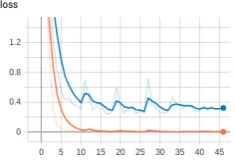
Figure3shows a loss curve where training with only the target language Khakas (and without the high-resource language Bashkir) started at epoch 17. For comparison the loss curve of System 1 for the same language pair is shown in Figure2. In this example System 2 gains a smaller loss than System 1 on the validation data - System 2 reaches with about 0.2 half as much loss as System 1 with about 0.4.
5 Results
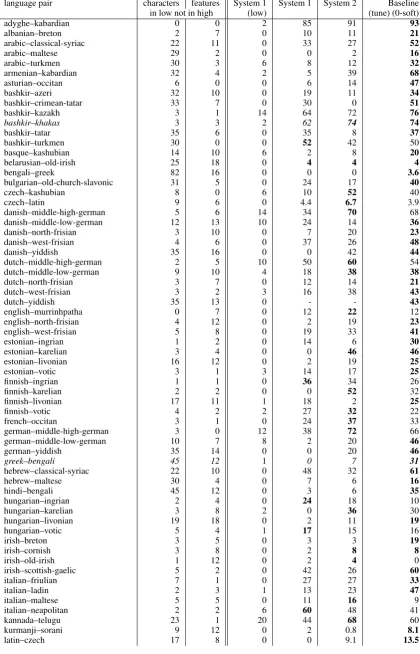
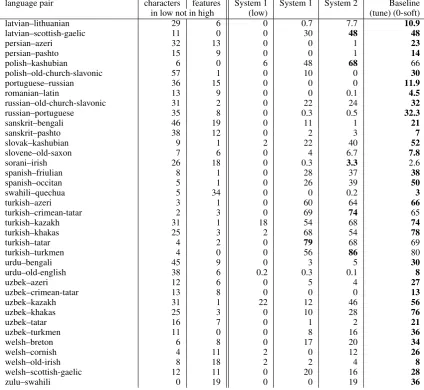
The results for System 1 and System 2 shown in
[image:2.595.73.290.140.270.2]Figure 2: Loss for train (orange) and validation (blue) forSystem 1language pair “bashkir–khakas”
Figure 3: Loss for train (orange) and validation (blue) forSystem 2language pair “bashkir–khakas”
baseline from the organizers (Wu and Cotterell,
2019) are the unmodified results from the subsion to the task. We found minor tooling mis-takes on the surprise languages after the submis-sion deadline which we didn’t correct in the table.
In the trained models we can observe big differ-ences in the accuracy for different language pairs. To better understand the results we trained a new version of System 1 with only the low data given and ignored the high-resource language data com-pletely. As expected this version of System 1 per-formed worst in comparison to the other systems due to the lack of a sufficient amount of training data.
In general, the very low results on some pairs seem to be based on very different character sets and/or feature sets between the concerning lan-guage pairs. For example a lanlan-guage pair with a lot of different characters and different features is “bengali–greek”. The amount of Greek data alone is not enough to train an encoder-decoder-model (see System 1 low results) and the data for Bengali doesn’t help either way (see System 1, System 2 and baseline results).
[image:2.595.362.477.211.290.2]language pair characters features System 1 System 1 System 2 Baseline in low not in high (low) (tune) (0-soft)
adyghe–kabardian 0 0 2 85 91 93
albanian–breton 2 7 0 10 11 21
arabic–classical-syriac 22 11 0 33 27 52
arabic–maltese 29 2 0 0 2 16
arabic–turkmen 30 3 6 8 12 32
armenian–kabardian 32 4 2 5 39 68
asturian–occitan 6 0 0 6 14 47
bashkir–azeri 32 10 0 19 11 34
bashkir–crimean-tatar 33 7 0 30 0 51
bashkir–kazakh 3 1 14 64 72 76
bashkir–khakas 3 3 2 62 74 74
bashkir–tatar 35 6 0 35 8 37
bashkir–turkmen 30 0 0 52 42 50
basque–kashubian 14 10 6 2 8 20
belarusian–old-irish 25 18 0 4 4 4
bengali–greek 82 16 0 0 0 3.6
bulgarian–old-church-slavonic 31 5 0 24 17 40
czech–kashubian 8 0 6 10 52 40
czech–latin 9 6 0 4.4 6.7 3.9
danish–middle-high-german 5 6 14 34 70 68
danish–middle-low-german 12 13 10 24 14 36
danish–north-frisian 3 10 0 7 20 23
danish–west-frisian 4 6 0 37 26 48
danish–yiddish 35 16 0 0 42 44
dutch–middle-high-german 2 5 10 50 60 54
dutch–middle-low-german 9 10 4 18 38 38
dutch–north-frisian 3 7 0 12 14 21
dutch–west-frisian 3 2 3 16 38 43
dutch–yiddish 35 13 0 - - 43
english–murrinhpatha 0 7 0 12 22 12
english–north-frisian 4 12 0 2 19 23
english–west-frisian 5 8 0 19 33 41
estonian–ingrian 1 2 0 14 6 30
estonian–karelian 3 4 0 0 46 46
estonian–livonian 16 12 0 2 19 25
estonian–votic 3 1 3 14 17 25
finnish–ingrian 1 1 0 36 34 26
finnish–karelian 2 2 0 0 52 32
finnish–livonian 17 11 1 18 2 25
finnish–votic 4 2 2 27 32 22
french–occitan 3 1 0 24 37 33
german–middle-high-german 3 0 12 38 72 66
german–middle-low-german 10 7 8 2 20 46
german–yiddish 35 14 0 0 20 46
greek–bengali 45 12 1 0 7 31
hebrew–classical-syriac 22 10 0 48 32 61
hebrew–maltese 30 4 0 7 6 16
hindi–bengali 45 12 0 3 6 35
hungarian–ingrian 2 4 0 24 18 10
hungarian–karelian 3 8 2 0 36 30
hungarian–livonian 19 18 0 2 11 19
hungarian–votic 5 4 1 17 15 16
irish–breton 3 5 0 3 3 19
irish–cornish 3 8 0 2 8 8
irish–old-irish 1 12 0 2 4 0
irish–scottish-gaelic 5 2 0 42 26 60
italian–friulian 7 1 0 27 27 33
italian–ladin 2 3 1 13 23 47
italian–maltese 5 5 0 11 16 9
italian–neapolitan 2 2 6 60 48 41
kannada–telugu 23 1 20 44 68 60
kurmanji–sorani 9 12 0 2 0.8 8.1
[image:3.595.74.495.64.719.2]latin–czech 17 8 0 0 9.1 13.5
language pair characters features System 1 System 1 System 2 Baseline in low not in high (low) (tune) (0-soft)
latvian–lithuanian 29 6 0 0.7 7.7 10.9
latvian–scottish-gaelic 11 0 0 30 48 48
persian–azeri 32 13 0 0 1 23
persian–pashto 15 9 0 0 1 14
polish–kashubian 6 0 6 48 68 66
polish–old-church-slavonic 57 1 0 10 0 30
portuguese–russian 36 15 0 0 0 11.9
romanian–latin 13 9 0 0 0.1 4.5
russian–old-church-slavonic 31 2 0 22 24 32
russian–portuguese 35 8 0 0.3 0.5 32.3
sanskrit–bengali 46 19 0 11 1 21
sanskrit–pashto 38 12 0 2 3 7
slovak–kashubian 9 1 2 22 40 52
slovene–old-saxon 7 6 0 4 6.7 7.8
sorani–irish 26 18 0 0.3 3.3 2.6
spanish–friulian 8 1 0 28 37 38
spanish–occitan 5 1 0 26 39 50
swahili–quechua 5 34 0 0 0.2 3
turkish–azeri 3 1 0 60 64 66
turkish–crimean-tatar 2 3 0 69 74 65
turkish–kazakh 31 1 18 54 68 74
turkish–khakas 25 3 2 68 54 78
turkish–tatar 4 2 0 79 68 69
turkish–turkmen 4 0 0 56 86 80
urdu–bengali 45 9 0 3 5 30
urdu–old-english 38 6 0.2 0.3 0.1 8
uzbek–azeri 12 6 0 5 4 27
uzbek–crimean-tatar 13 8 0 0 0 13
uzbek–kazakh 31 1 22 12 46 56
uzbek–khakas 25 3 0 10 28 76
uzbek–tatar 16 7 0 1 2 21
uzbek–turkmen 11 0 0 8 16 36
welsh–breton 6 8 0 17 20 34
welsh–cornish 4 11 2 0 12 26
welsh–old-irish 8 18 2 2 4 8
welsh–scottish-gaelic 12 11 0 20 16 28
[image:4.595.73.498.64.454.2]zulu–swahili 0 19 0 0 19 36
Table 3: Left: Feature/character differences between language pairs. (in low, not in high language) Right: Results (accuracy) for test data compared to baseline (Part 2)
6 Conclusion
Our continual goal is to improve our morphology system component in our Natural Language Gen-eration SaaS (Weißgraeber and Madsack,2017).
In our production setup the System 1 described above competes against a handcrafted morphology and a reasonable lexicon (which were not used for the Shared Task). This handcrafted morphology together with the lexicon is always better on very regular part of speech (POS) types (i.e. German adjectives). Therefore not for every language POS combination a system shown here is used in our production NLG inflection system. For every lan-guage and POS type we evaluate which solution fits best.
AllenNLP successfully helped us to reproduce the same results even with newer versions of
li-an importli-ant quality for our NLG system.
References
Kyunghyun Cho, Bart van Merrienboer, Caglar Gul-cehre, Dzmitry Bahdanau, Fethi Bougares, Holger Schwenk, and Yoshua Bengio. 2014. Learning phrase representations using RNN encoder–decoder for statistical machine translation. InProceedings of the 2014 Conference on Empirical Methods in Nat-ural Language Processing (EMNLP), pages 1724– 1734, Doha, Qatar. Association for Computational Linguistics.
Matt Gardner, Joel Grus, Mark Neumann, Oyvind Tafjord, Pradeep Dasigi, Nelson F. Liu, Matthew Peters, Michael Schmitz, and Luke S. Zettlemoyer. 2017. Allennlp: A deep semantic natural language processing platform.
Xia, Manaal Faruqui, Sebastian J. Mielke, Arya Mc-Carthy, Sandra K¨ubler, David Yarowsky, Jason Eis-ner, and Mans Hulden. 2018. UniMorph 2.0: Uni-versal Morphology. In Proceedings of the 11th Language Resources and Evaluation Conference, Miyazaki, Japan. European Language Resource As-sociation.
Thang Luong, Hieu Pham, and Christopher D. Man-ning. 2015. Effective approaches to attention-based neural machine translation. InProceedings of the 2015 Conference on Empirical Methods in Natu-ral Language Processing, pages 1412–1421, Lis-bon, Portugal. Association for Computational Lin-guistics.
Andreas Madsack, Alessia Cavallo, Johanna Heininger, and Robert Weißgraeber. 2018.
AX semantics’ submission to the CoNLL– SIGMORPHON 2018 shared task. InProceedings of the CoNLL–SIGMORPHON 2018 Shared Task: Universal Morphological Reinflection, pages 43–47, Brussels. Association for Computational Linguistics.
Arya D. McCarthy, Ekaterina Vylomova, Shijie Wu, Chaitanya Malaviya, Lawrence Wolf-Sonkin, Gar-rett Nicolai, Christo Kirov, Miikka Silfverberg, Se-bastian Mielke, Jeffrey Heinz, Ryan Cotterell, and Mans Hulden. 2019. The SIGMORPHON 2019 shared task: Crosslinguality and context in morphol-ogy. In Proceedings of the 16th SIGMORPHON Workshop on Computational Research in Phonetics, Phonology, and Morphology, Florence, Italy. Asso-ciation for Computational Linguistics.
Robert Weißgraeber and Andreas Madsack. 2017. A working, non-trivial, topically indifferent nlg system for 17 languages. InProceedings of the 10th Inter-national Conference on Natural Language Genera-tion, pages 156–157. Association for Computational Linguistics.
Shijie Wu and Ryan Cotterell. 2019. Exact hard monotonic attention for character-level transduction. arXiv preprint arXiv:1905.06319.
Shijie Wu, Pamela Shapiro, and Ryan Cotterell. 2018.