112
Abstract
This paper describes POSTECH’s submis-sion to the WMT 2019 shared task on Au-tomatic Post-Editing (APE). In this paper, we propose a new multi-source APE mod-el by extending Transformer. The main contributions of our study are that we 1) reconstruct the encoder to generate a joint representation of translation (mt) and its
src context, in addition to the conventional
src encoding and 2) suggest two types of multi-source attention layers to compute attention between two outputs of the en-coder and the deen-coder state in the deen-coder. Furthermore, we train our model by apply-ing various teacher-forcapply-ing ratios to alle-viate exposure bias. Finally, we adopt the ensemble technique across variations of our model. Experiments on the WMT19 English-German APE data set show im-provements in terms of both TER and BLEU scores over the baseline. Our pri-mary submission achieves -0.73 in TER and +1.49 in BLEU compared to the base-line, and ranks second among all submit-ted systems.
1
Introduction
Automatic Post-Editing (APE) is the task of au-tomatically correcting errors in a given the ma-chine translation (MT) output to generate a better translation (Chatterjee et al., 2018). Because APE can be regarded as a sequence-to-sequence prob-lem, MT techniques have been previously applied to this task. Subsequently, it is only natural that neural APE has been proposed following the ap-pearance of neural machine translation (NMT).
Among the initial approaches to neural APE, a log-linear combination model (Junczys-Dowmunt and Grundkiewicz, 2016) that combines bilingual
* Both authors equally contributed to this work
and monolingual translations yielded the best re-sults. Since then, In order to leverage information from both MT outputs (mt) and its corresponding source sentences (src), a multi-encoder model (Libovický et al., 2016) based on multi-source translation (Zoph and Knight, 2016) has become the prevalent approach (Bojar et al., 2017). Re-cently, with the advent of Transformer (Vaswani et al., 2017), most of the participants in the WMT18 APE shared task proposed Transformer-based multi-encoder APE models (Chatterjee et al., 2018).
Previous multi-encoder APE models employ separate encoders for each input (src, mt), and combine their outputs in various ways: by 1) se-quentially applying attention between the hidden state of the decoder and the two outputs ( Junczys-Dowmunt and Grundkiewicz, 2018; Shin and Lee, 2018) or 2) simply concatenating them (Pal et al., 2018; Tebbifakhr et al., 2018). However, these approaches seem to overlook one of the key dif-ferences between general multi-source translation and APE. Because the errors mt may contain are dependent on the MT system, the encoding pro-cess for mt should reflect its relationship with the source sentence. Furthermore, we believe that it would be helpful to incorporate information from the source sentence, which should ideally be er-ror-free, in addition to the jointly encoded mt in generating post-edited sentence.
From these points of view, we propose a multi-source APE model by extending Transformer to contain a joint multi-source encoder and a decod-er that involves a multi-source attention laydecod-er to combine the outputs of the encoder. Apart from that, we apply various teacher-forcing ratios at training time to alleviate exposure bias. Finally, we ensemble model variants for our submission. The remainder of the paper is organized as fol-lows: Section 2 describes our model architecture.
Transformer-based Automatic Post-Editing Model
with Joint Encoder and Multi-source Attention of Decoder
WonKee Lee
*, Jaehun Shin
*, Jong-hyeok Lee
Department of Computer Science and Engineering,
Pohang University of Science and Technology (POSTECH), Republic of Korea
Section 3 summarizes the experimental results, and Section 4 gives the conclusion.
2
Model Description
We adopt Transformer to the APE problem, which takes multiple inputs (src, mt) to generate a post-edited sentence (pe). In the following subsections, we describe our modified encoder and decoder.
2.1 Encoder
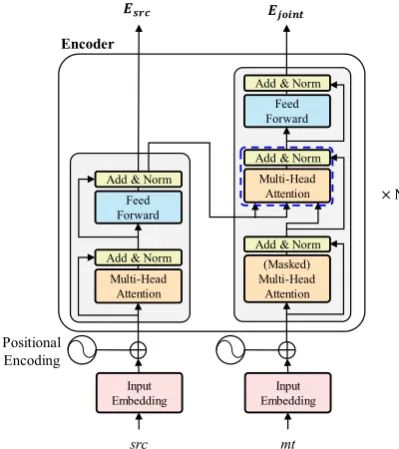
The proposed encoder structure for multi-source inputs, as shown in Figure 1, is an exten-sion of what is introduced in Vaswani et al. (2017) developed considering single-source input. Simi-lar to recent APE studies, our encoder receives two sources: src x = (𝑥1, … , 𝑥𝑇𝑥) and mt y = (𝑦1, … , 𝑦𝑇𝑦), where 𝑇𝑥 and 𝑇𝑦 denote their se-quence lengths respectively, but produce the joint representation E𝑗𝑜𝑖𝑛𝑡= (𝑒1
𝑗
, … , 𝑒𝑇𝑗𝑦), in addition to encoded src E𝑠𝑟𝑐= (𝑒1𝑠, … , 𝑒𝑇𝑠𝑥).
Joint representation. Unlike previous studies, which independently encode two input sources using separate encoding modules, we incorporate
src context information into each hidden state of
mt through the single encoding module, resulting in a joint representation of two sources. As shown with the dashed square in Figure 1, jointly repre-sented hidden states are obtained from the
residu-al connection and multi-head attention that takes
𝐻𝑠𝑟𝑐 ∈ ℝ𝑇𝑥×𝑑 as keys and values and 𝐻𝑚𝑡∈ ℝ𝑇𝑦×𝑑 as queries. Therefore, the joint representa-tion of each level of the stack (𝑖 = 1, … , 𝑁) can be expressed with MultiHead(Q, K, V) and
Lay-erNorm described in Vaswani et al. (2017) as
fol-lows:
𝐻𝑗𝑜𝑖𝑛𝑡𝑖 = LayerNorm(𝐻𝑚𝑡𝑖 + 𝐶𝑠𝑟𝑐𝑖 )
where
𝐶𝑠𝑟𝑐𝑖 = MultiHead(𝐻𝑚𝑡𝑖 , 𝐻𝑠𝑟𝑐𝑖 , 𝐻𝑠𝑟𝑐𝑖 ) (1)
Stack-level attention. When applying attention across source and target, the original Transformer only considers source hidden states retrieved from the final stack, whereas our encoder feeds into each attention layer the src embeddings from the same level, as can be seen in (1).
Masking option. The self-attention layer that is the first attention layer of the mt encoding module optionally includes a future mask, which mimics the general decoding process of MT systems that depends only on previously generated words. We conduct experiments (§3.2) for two cases: with and without this option.
2.2 Decoder
[image:2.595.76.276.74.299.2]Our decoder is an extension of Transformer de-coder, in which the second multi-head attention layer that originally only refers to single-source
Figure 2: The architecture of the decoder
Encoder
Input Embedding
Masked Multi-Head
Attention Add & Norm
Feed Forward Add & Norm
Multi-source Attention
Softmax Linear Output Probabilities
× N
pe (Shfited right)
Positional Encoding
Figure 1: The architecture of the proposed encoder
– the dashed square indicates the joint hidden repre-sentation of two sources
-Input Embedding Multi-Head Attention Add & Norm
Feed Forward
Input Embedding
(Masked) Multi-Head
Attention Feed Forward
× N
src mt
Positional Encoding
Multi-Head Attention Add & Norm
Add & Norm Add & Norm
Encoder
[image:2.595.320.492.74.321.2]
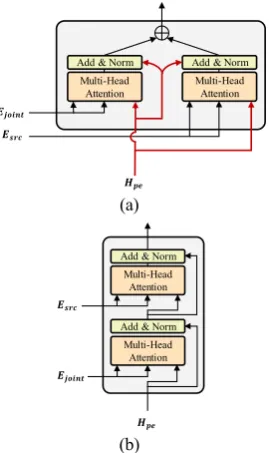
encoder states is replaced with a multi-source at-tention layer. Figure 2 shows our decoder archi-tecture including the multi-source attention layer that attends to both outputs of the encoder. Fur-thermore, we construct two types of the multi-source attention layer by utilizing different strate-gies in combining attention over two encoder out-put states.
Multi-source parallel attention. Figure 3a illus-trates the structure of parallel attention. The de-coder's hidden state simultaneously attends to each output of the multi-source encoder, followed by residual connection, and the results are linearly combined by summing them at the end:
𝐻𝑝𝑎𝑟𝑎𝑙𝑙𝑒𝑙= 𝐻1+ 𝐻2
where
𝐻1= LayerNorm(𝐻𝑝𝑒+ 𝐶𝑗𝑜𝑖𝑛𝑡)
𝐻2= LayerNorm(𝐻𝑝𝑒+ 𝐶𝑠𝑟𝑐)
𝐶𝐽𝑜𝑖𝑛𝑡= MultiHead(𝐻𝑝𝑒, 𝐸𝑗𝑜𝑖𝑛𝑡, 𝐸𝑗𝑜𝑖𝑛𝑡)
𝐶𝑠𝑟𝑐= MultiHead(𝐻𝑝𝑒, 𝐸𝑠𝑟𝑐, 𝐸𝑠𝑟𝑐).
Note that 𝐻𝑝𝑒∈ℝ𝑇𝑧×𝑑 denotes the hidden states
for decoder input pe z = (𝑧1, … , 𝑧𝑇𝑧).
[image:3.595.113.248.72.299.2]Multi-source sequential attention. As shown in Figure 3b, two outputs of the encoder are sequen-tially combined with the decoder’s hidden state:
𝐸𝑗𝑜𝑖𝑛𝑡 and the decoder’s hidden state are first
assigned to multi-head attention and residual
con-nection layers, then the same operation is per-formed between the result and 𝐸𝑠𝑟𝑐.
𝐻𝑠𝑒𝑞= LayerNorm(𝐻′+ 𝐶𝑠𝑟𝑐)
where
𝐻′ = LayerNorm(𝐻𝑝𝑒+ 𝐶𝑗𝑜𝑖𝑛𝑡)
𝐶𝑠𝑟𝑐 = MultiHead(𝐻′, 𝐸𝑠𝑟𝑐, 𝐸𝑠𝑟𝑐)
𝐶𝑗𝑜𝑖𝑛𝑡 = MultiHead(𝐻𝑝𝑒, 𝐸𝑗𝑜𝑖𝑛𝑡, 𝐸𝑗𝑜𝑖𝑛𝑡).
This approach is structurally equivalent to Junczys-Dowmunt and Grundkiewicz (2018), except that the encoder states being passed on are different.
3
Experiments
3.1 Dataset
We used the WMT19 official English-German APE dataset (Chatterjee et al., 2018) which con-sists of a training and development set. In addition, we adopted the eSCAPE NMT dataset (Negri et al., 2018) as additional training data. We extracted sentence triplets from the eSCAPE-NMT dataset according to the following criteria, to which the official training dataset mostly adheres. Selected triplets have no more than 70 words in each sen-tence, a TER less than or equal to 75, and a recip-rocal length ratio within the monolingual pair (mt,
pe) less than 1.4. Table 1summarizes the statistic of the datasets.
3.2 Training Details
Settings. We modified the OpenNMT-py (Klein et al., 2017) implementation of Transformer to build our models. Most hyperparameters such as the dimensionality of hidden states, optimizer set-tings, dropout ratio, etc. were copied from the “base model” described in Vaswani et al. (2017). We adjusted the warm-up learning steps and batch size per triplets to 18k and ~25k, respectively. For data preprocessing, we employed subword encod-ing (Kudo, 2018) with 32k shared vocabulary.
(a)
(b)
Figure 3: Illustrations of the multi-source attention layer. (a) and (b) refer to the linear and sequential combinations, respectively.
Multi-Head Attention
Multi-Head Attention Add & Norm Add & Norm
Multi-Head Attention Multi-Head
Attention
Add & Norm Add & Norm
Dataset Triplets TER
official training set 13,442 14.89
official development set 1,000 15.08
eSCAPE-NMT 7,258,533 60.54
eSCAPE-NMT-filtered 4,303,876 39.65
Two-step training. We separated the training process into two steps: the first phase for training a generic model, and the second phase to fine-tune the model. For the first phase, we trained the model with a union dataset that is the concatena-tion of eSCAPE-NMT-filtered, and the upsam-pled official training set by copying 20 times. Af-ter reaching the convergence point in the first phase, we fine-tuned the model by running the second phase using only the official training set. Model variations. In our experiment, we con-structed four types of models in terms of the ex-istence of the encoder future mask and the type of the multi-source attention layer in the decoder as follows:
Parallel w/ masking where the model involves the multi-source parallel atten-tion layer with the encoder mask.
Parallel w/o masking in which the en-coder mask is excluded from Parallel w/ masking.
Sequential w/ masking where the mod-el involves the multi-source sequential attention layer with the encoder mask.
Sequential w/o masking in which the encoder mask is excluded from Seq. w/ masking.
Teacher-forcing ratio. During training, because the decoder takes as input the target shifted to the right, the ground-truth words are passed to the decoder. However, at inference time, the decoder consumes only previously produced output words, causing exposure bias. To overcome this problem,
we have empirically adjusted the teacher-forcing ratio in the second phase of training, so that teacher-forcing is applied stochastically in such a way that given a ratio 𝛼, the greedy decoding output of the previous step is fed into the next input with a probability of 1 − 𝛼.
Ensemble. To leverage all variants in different architectures and teacher-forcing ratios, we com-bined them using an ensemble approach accord-ing to the followaccord-ing three criteria:
Ens_set_1: top-N candidates among all variants in terms of TER.
Ens_set_2: top-N candidates for variants in each architecture, in terms of TER.
Ens_set_3: two candidates for variants in each architecture, achieving the best TER and BLEU scores, respectively.
3.3 Results
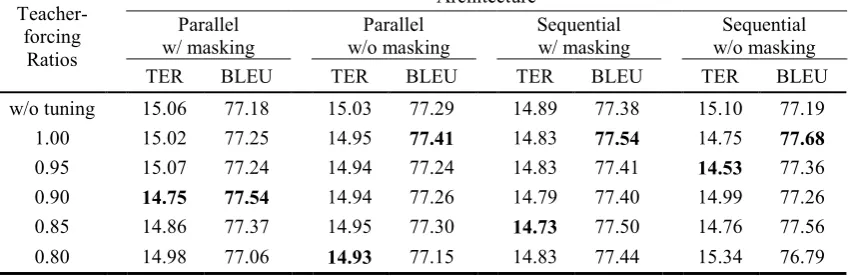
We trained a generic model for each of the four model variations mentioned in §3.2. Then, we fine-tuned those models using various teacher-forcing ratios. For evaluation, we used TER (Snover et al., 2006) and BLEU (Papineni et al., 2002) scores on the WMT official development dataset. Table 2 shows the scores of the generic and fine-tuned models according totheir architec-tures and teacher-forcing ratios. The result shows that adjusting teacher-forcing ratio helps improve the post-editing performance of the models.
Table 3 gives the results of the ensemble mod-els. The ensemble models had slightly worse TER scores (+0.02 ~ +0.13) than the best TER score in the fine-tuned variants, but better BLEU scores (+0.09 ~ +0.27) than the best BLEU score. We
Teacher-forcing Ratios
Architecture Parallel
w/ masking w/o masking Parallel w/ masking Sequential w/o masking Sequential
TER BLEU TER BLEU TER BLEU TER BLEU
w/o tuning 15.06 77.18 15.03 77.29 14.89 77.38 15.10 77.19
1.00 15.02 77.25 14.95 77.41 14.83 77.54 14.75 77.68
0.95 15.07 77.24 14.94 77.24 14.83 77.41 14.53 77.36
0.90 14.75 77.54 14.94 77.26 14.79 77.40 14.99 77.26
0.85 14.86 77.37 14.95 77.30 14.73 77.50 14.76 77.56
[image:4.595.87.512.83.221.2]0.80 14.98 77.06 14.93 77.15 14.83 77.44 15.34 76.79
selected the three best ensemble models for sub-mission, expecting to reap the benefits from lev-eraging different architectures in the decoding process. The names and types for submission are noted in Table 3.
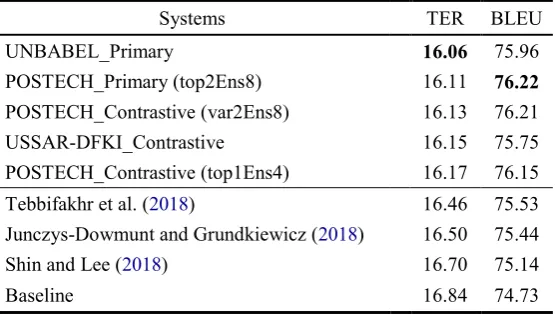
Submission results. The results of primary and contrastive submission on the official test set are reported in Table 4. Our primary submission achieves improvements of -0.73 in TER and +1.49 in BLEU compared to the baseline, and shows better results than the state-of-the-art of the last round with -0.35 in TER and +0.69 in BLEU. While our primary system ranks second out of 18 systems submitted this year, it shows the highest BLEU score.
4
Conclusion
In this paper, we present POSTECH's submissions to the WMT19 APE shared task. We propose a new Transformer-based APE model comprising a joint multi-source encoder and a decoder with two types of multi-source attention layers. The pro-posed encoder generates a joint representation for MT output with optional masking, in addition to the encoded source sentence. The proposed
de-coder employs two types of multi-source attention layers according to the post-editing strategy. We refine the eSCAPE-NMT dataset and apply two-step training with various teacher-forcing ratios. Finally, our ensemble models showed improve-ments in terms of both TER and BLEU, and out-perform not only the baseline but also the best model from the previous round of the task.
References
Ondřej Bojar, Rajen Chatterjee, Christian Federmann, Yvette Graham, Barry Haddow, Shujian Huang, Matthias Huck, Philipp Koehn, Qun Liu, and Varvara Logacheva. 2017. Findings of the 2017 conference on machine translation (wmt17). In
Proceedings of the Second Conference on Machine Translation, page 169-214.
Rajen Chatterjee, Matteo Negri, Raphael Rubino, and Marco Turchi. 2018. Findings of the WMT 2018
Shared Task on Automatic Post-Editing. In
Proceedings of the Third Conference on Machine Translation: Shared Task Papers, page 710-725. Marcin Junczys-Dowmunt, and Roman Grundkiewicz.
2016. Log-linear Combinations of Monolingual and Bilingual Neural Machine Translation Models for Automatic Post-Editing. In Proceedings of the
Systems TER BLEU
UNBABEL_Primary 16.06 75.96
POSTECH_Primary (top2Ens8) 16.11 76.22
POSTECH_Contrastive (var2Ens8) 16.13 76.21
USSAR-DFKI_Contrastive 16.15 75.75
POSTECH_Contrastive (top1Ens4) 16.17 76.15
Tebbifakhr et al. (2018) 16.46 75.53
Junczys-Dowmunt and Grundkiewicz (2018) 16.50 75.44
Shin and Lee (2018) 16.70 75.14
Baseline 16.84 74.73
Table 4: Submissionresults – the top-5 systems among official results of the WMT19 APE shared task. We
also include the previous round results for comparison. The bold values indicate the best result in each metric.
Models TER BLEU Submission Name
Ens_set_1-top4 14.66 77.79 -
Ens_set_1-top6 14.62 77.79 -
Ens_set_1-top8 14.62 77.81 -
Ens_set_2-top1 14.58 77.86 Contrastive (top1Ens4)
Ens_set_2-top2 14.55 77.95 Primary (top2Ens8)
Ens_set_3 14.61 77.86 Contrastive (var2Ens8)
[image:5.595.159.437.220.377.2]First Conference on Machine Translation: Volume 2, Shared Task Papers, page 751-758.
Marcin Junczys-Dowmunt, and Roman Grundkiewicz. 2018. MS-UEdin Submission to the WMT2018 APE Shared Task: Dual-Source Transformer for Automatic Post-Editing. In Proceedings of the Third Conference on Machine Translation: Shared Task Papers, page 822-826.
Guillaume Klein, Yoon Kim, Yuntian Deng, Jean Senellart, and Alexander Rush. 2017. OpenNMT: Open-Source Toolkit for Neural Machine
Translation. Proceedings of ACL 2017, System
Demonstrations, 67-72.
Taku Kudo. 2018. Subword Regularization: Improving Neural Network Translation Models with Multiple Subword Candidates. In Proceedings of the 56th Annual Meeting of the Association for Computational Linguistics (Volume 1: Long Papers), page 66-75.
Jindřich Libovický, Jindřich Helcl, Marek Tlustý, Ondřej Bojar, and Pavel Pecina. 2016. CUNI System for WMT16 Automatic Post-Editing and Multimodal Translation Tasks. In Proceedings of the First Conference on Machine Translation: Volume 2, Shared Task Papers, page 646-654. Matteo Negri, Marco Turchi, Rajen Chatterjee, and
Nicola Bertoldi. 2018. ESCAPE: a Large-scale Synthetic Corpus for Automatic Post-Editing. In
Proceedings of the Eleventh International Conference on Language Resources and Evaluation (LREC-2018).
Santanu Pal, Nico Herbig, Antonio Krüger, and Josef van Genabith. 2018. A Transformer-Based
Multi-Source Automatic Post-Editing System. In
Proceedings of the Third Conference on Machine Translation: Shared Task Papers, page 827-835. Kishore Papineni, Salim Roukos, Todd Ward, and
Wei-Jing Zhu. 2002. BLEU: a method for automatic evaluation of machine translation. In
Proceedings of the 40th annual meeting on association for computational linguistics, page 311-318.
Jaehun Shin, and Jong-hyeok Lee. 2018. Multi-encoder Transformer Network for Automatic Post-Editing. In Proceedings of the Third Conference on Machine Translation: Shared Task Papers, page 840-845.
Matthew Snover, Bonnie Dorr, Richard Schwartz, Linnea Micciulla, and John Makhoul. 2006. A study of translation edit rate with targeted human annotation. In Proceedings of association for machine translation in the Americas.
Amirhossein Tebbifakhr, Ruchit Agrawal, Matteo Negri, and Marco Turchi. 2018. Multi-source
transformer with combined losses for automatic
post editing. In Proceedings of the Third
Conference on Machine Translation: Shared Task Papers, page 846-852.
Ashish Vaswani, Noam Shazeer, Niki Parmar, Jakob Uszkoreit, Llion Jones, Aidan N Gomez, Łukasz Kaiser, and Illia Polosukhin. 2017. Attention is all you need. In Advances in Neural Information Processing Systems, page 5998-6008.