392
User Evaluation of a Multi-dimensional Statistical Dialogue System
Simon Keizer,∗ Ondˇrej Dušek,∗†Xingkun Liu∗ and Verena Rieser∗
∗Interaction Lab, Heriot-Watt University, Edinburgh, Scotland, UK
†Charles University, Faculty of Mathematics and Physics, Prague, Czechia
[email protected], [email protected], {x.liu,v.t.rieser}@hw.ac.uk
Abstract
We present the first complete spoken dia-logue system driven by a multi-dimensional
statistical dialogue manager. This framework has been shown to substantially reduce data needs by leveraging domain-independent di-mensions, such as social obligations or feed-back, which (as we show) can be transferred between domains. In this paper, we conduct a user study and show that the performance of a multi-dimensional system, which can be adapted from a source domain, is equivalent to that of a one-dimensional baseline, which can only be trained from scratch.
1 Introduction
Data-driven approaches to spoken dialogue sys-tems (SDS) are limited by their reliance on substan-tial amounts of annotated data in the target domain. This can be addressed by considering transfer learn-ing techniques, e.g. (Taylor and Stone,2009), in which data from a source domain is leveraged to improve learning in a target domain. In particular, domain adaptation has been used in the context of dialogue systems (Gaši´c et al.,2017;Wang et al., 2015;Wen et al.,2016), focusing on identifying and exploiting similarities between domain ontolo-gies in slot-filling tasks.
In contrast to this previous work, we take a multi-dimensionalapproach, which combines machine learning with linguistic theory. Following Bunt (2011), we exploit the linguistic phenomenon that utterances serve more than one function in a con-versation, i.e. they have more than onedimension
(see Section2).1 For example, the utterance “On what date would you like to fly to London?” both asks a task-oriented question, and provides feed-back about understanding the requested destination. We take advantage of this phenomenon by training
1See alsohttps://dit.uvt.nl/.
separate, fully-statistical dialogue models for each dimension and generating system responses along multiple dimensions simultaneously. Such an SDS thus has the potential to adapt more efficiently to new domains by exploiting previously trained poli-cies of the domain-independent dimensions, such as feedback and social conventions.
Previous implementations of multi-dimensio-nal SDSs were mostly handcrafted (Akker et al., 2005;Petukhova et al.,2016). Keizer and Rieser (2017) were the first to present a statistical multi-dimensional dialogue manager (DM). Their results suggest an up to 80% reduction in data: a task suc-cess rate of over 90% can be achieved after only 2,000 dialogues when using pre-trained policies, whereas at least 10,000 dialogues are required with-out pre-training. In comparison,Gaši´c et al.(2017) achieve similar success rates for in-domain systems trained on 5,000 dialogues. However,Keizer and Rieser’s findings are only tested in simulation.
In this paper, we present the first complete statis-tical SDS with multi-dimensional DM, and the first crowdsourced human user evaluation of this type of system, comparing a one-dimensional baseline and three multi-dimensional variants, using a novel web-based setup. A novel aspect of our statistical analysis is testing forequivalence. The four system variants were designed in such a way that we would expect their performance levels to be indistinguish-able when using fully trained policies. Should the data provide statistical evidence for this, the multi-dimensional variants can be preferred due to their inherent potential for domain transfer.
2 A Multi-dimensional Dialogue Manager
Usr:Hi, I need a Thai restaurant in the city centre
SOCIAL: GREET; TASK: INFORM; TURN: RELEASE
Sys:Okay, let me see, . . .
TURN: TAKE; AUTOFEEDBACK:AUTOPOSITIVE TIME: PAUSING; TASK: INFORMSEARCH
Sys:Bangkok City is a Thai restaurant;
it is in the city centre
AUTOFEEDBACK: INFORM; TASK: INFORM
Figure 1: An example of multiple dimensions in a di-alogue: the user both greets the system and asks for a cheap Indian restaurant, before releasing the turn; the system then takes the turn while giving positive feed-back, and indicates that it needs some time to retrieve the requested information; in the second part the sys-tem both provides this information and gives feedback about understanding the user’s question (underlined).
updates the dialogue state and then selects a re-sponse in the form of one or more dialogue acts. Rather than selecting a single action from one set of possible actions, our DM consists of multiple
dialogue act agents, each of which selects an ac-tion from a separate acac-tion set, associated with one dimension. These action sets are based on three of the ten dimensions defined in the ISO standard for dialogue act annotation (ISO,2012): Task (e.g. recommending a restaurant), AutoFeedback (e.g. asking the user to repeat/rephrase after a process-ing problem), and Social Obligations Management (SOM; e.g. responding to the user saying good-bye). These dimensions were considered to be the most important for supporting the kind of task-oriented dialogues targeted (see Fig.1for an exam-ple). While the Task dimension is domain-specific, AutoFeedback and SOM are applicable across do-mains.
Training the statistical DM on these three di-mensions involves optimising three policies in par-allel. A set of priority rules is used to combine the output of these policies into a single system response. The key advantage of such a design is that the domain-independent policies (AutoFeed-back and SOM) can be transferred and adapted to a new domain, leaving only the Task policy to be trained from scratch. In our previous work (Keizer and Rieser, 2017), we have shown that a multi-dimensional DM with pre-trained policies reaches higher performance levels during the early stages of training. Here, we take an important step in confirming this advantage in a real user study.
Restaurants Hotels
#venues 149 39
#slots 4 5
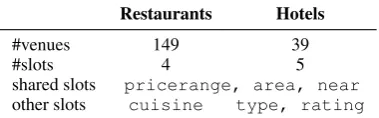
[image:2.595.322.512.64.123.2]shared slots pricerange, area, near other slots cuisine type, rating
Table 1: Overview of task domains.
Our framework currently supports information-seeking domains, such as recommending restau-rants or hotels based on the user’s preferences. The domains are specified in terms of an ontology (de-scribing slots such as price range and cuisine) and a database. Our domains are presented in Table1. We use restaurant information as target domain, but two of the system variants were trained for the hotels domain (source) and then adapted to the restaurant domain.
2.1 Model Variants
For the evaluation, we followKeizer and Rieser (2017)’s four DM variants and training regime: The one-dimensionalone-dimbaseline system contains a single dialogue act agent (ALL) and the corre-sponding policy was trained from scratch in the target domain. The multi-dimensional systems use three dialogue act agents, one of which is domain-specific (TASK) and the other two domain-general (AUTOFEEDBACKand SOM). For the base
multi-dim system, the three policies are trained from scratch in the target domain, whereas the
trans-fixedandtrans-adaptvariants employ trans-fer learning (Pan and Yang,2010;Torrey and Shav-lik,2010): only the task-specific policy is trained from scratch and the two domain-general policies are previously trained in the source domain. For
trans-fixed, the pre-trained policies are kept fixed during training in the target domain, whilst for
trans-adapt, these are further trained in the target domain. The four fully trained DM versions are outlined in Table2.
2.2 Training Details
All policies are optimised in simulation using multi-agent reinforcement learning with linear value func-tion approximafunc-tion, based on a single reward signal shared between the agents.2 To train all systems,
2
we use the agenda-based user simulator ofKeizer and Rieser(2017), which is based on (Schatzmann et al.,2007), along with the following error model: In addition to creating an n-best list of user dia-logue act hypotheses from the ‘true’ user act, we also occasionally insert so-called ‘processing prob-lems’, at the levels of perception (no ASR results received) or interpretation (ASR successful, but no NLU results received). We simulate a perception problem with 10% probability, and in case of no perception problem (90%), we simulate an interpre-tation problem with 10% probability; only in case no processing problems are generated (81%), an n-best list of dialogue act hypotheses is generated. FollowingThomson et al.(2012), the n-best lists are populated by taking the true user act and dis-torting it at a given semantic error rate for each of the positions, after which semantically equivalent hypotheses are merged. Based on the error rate, a Dirichlet distribution is used to generate confidence scores for the n-best list (resulting in a semantic top accuracy equal to the error rate), interpreted as probabilities by the DM when updating its user goal belief state.3
In order to correctly interpret the evaluation re-sults, note that in the current setup, the one-dim
system serves as an upper bound baseline system, as it needs no coordination between different agents during training whilst generating (by construction) the same range of actions as the multi-dimensional systems. This is ensured by a set of priority heuris-tics which map action combinations to single acts.4
2.3 DM Evaluation in Simulation
To get a better picture of what we might expect during the human evaluation, we first ran evalu-ations with simulated data. The results obtained with the same settings as those during training are shown in Table3. As we hypothesised, the scores are very similar, theone-dimsystem only slightly outperforming the multi-dimensional systems.
We then extended the setup with different seman-tic error rates (Thomson et al.,2012); the results are shown in Fig.2. The performance levels of the
For each of the four DM versions, 5 training runs over 60k dialogues were carried out, resulting in a pool of 5 fully trained policies.
3The n-best size was set to 3 and the error rate was set to 30% for the target domain (restaurants) and 20% for the source domain (hotels).
4E.g. if the Task agent generates a recommendation action and the AutoFeedback agent generates a negative feedback action, the latter gets priority and the former is cancelled.
four systems are very similar at error rates between 10% and 40%, showing that the construction of the multi-dimensional versions in relation to the
one-dimbaseline is sound, and showing there is no negative transfer, i.e., the adapted systems are not performing worse.5
3 Evaluation Setup
We use crowdsourcing to evaluate our system, fol-lowing Jurˇcíˇcek et al. (2011) and Crook et al. (2014). In both of these works a phone-based sys-tem was deployed, using a bespoke ASR and Voice over IP (VoIP) to connect speech input/output with the dialogue system. Here, we follow a similar evaluation methodology, but with a novel, simpler web-based interface using Google Chrome’s built-in web speech API, embedded built-into the crowdsourc-ing task webpages. A detailed description of the technical setup can be found in AppendixA.
3.1 Crowdsourcing Setup
The users are recruited on the FigureEight crowd-sourcing platform and asked to have a conversation with the system to find a venue meeting certain criteria (e.g. cheap Chinese food) and get certain information about that venue (e.g. phone number and address). This scenario is specified in natural language, generated automatically from a set of task specifications randomly generated from the domain ontology. After each conversation, the user is given a questionnaire to rate the system.
3.2 Evaluation Metrics
The subjective evaluation metrics are derived from the following questionnaire, with one yes/no ques-tion (Q1) and four 6-point Likert Scale ratings.
Q1 [SubjSucc]: Did you find all the information you were looking for?
Please state your attitude towards the following statements:
Q2 [VoiceInt]: The system was easy to understand (the voice was intelligible).
Q3 [Understand]: In this conversation, the system under-stood what you said.
Q4 [AsExpect]: The system worked the way you expected it to during the conversation.
Q5 [WdUseAgain]: From your experience with the system, you think you would use it in the future to find a place to eat.
5
Dialogue Act Agent one-dim multi-dim trans-fixed trans-adapt
ALL source: – – – –
target: trained – – –
TASK – source: – source: – source: –
– target: trained target: trained target: trained AUTOFEEDBACK – source: – source: trained source: trained
– target: trained target:fixed target:adapted
SOM – source: – source: trained source: trained
[image:4.595.72.527.208.303.2]– target: trained target:fixed target:adapted
Table 2: Evaluated systems:one-dimis a one-dimensional (upper) baseline, other systems are multi-dimensional.
[image:4.595.91.274.346.407.2](a) Success rate. (b) Average dialogue length. (c) Average reward.
Figure 2: Results in simulation at different error rates.
system SuccRate AvgLen AvgRew
one-dim 97.8% 14.69 66.36
multi-dim 97.6% 15.68 64.97
[image:4.595.85.276.465.542.2]trans-fixed 96.8% 15.08 65.23 trans-adapt 97.4% 16.41 64.20
Table 3: Test results on simulated data (same error rates as in training): task success rate (SuccRate), average dialogue length (AvgLen), average reward (AvgRew).
DM version NumDials NumTurns (StDev)
one-dim 245 6.67 (2.55)
multi-dim 228 6.30 (1.97)
trans-fixed 261 6.57 (2.33) trans-adapt 248 6.64 (2.33)
Total 982 6.55 (2.31)
Table 4: Corpus statistics: the number of dialogues col-lected (NumDials) and the average number of turns per dialogue (NumTurns) with standard deviation (StDv).
The following objective success metrics are de-rived from the logs:
EntProv: the system recommended an entity matching the task constraints,
ConstrConf: the system confirmed all task constraints in its recommendation,
InfoProv: the system provided all information requested by the user.
4 Human User Evaluation
In total, 982 dialogues were collected (see Table4), i.e. 246 dialogues per system variant on average.
We carried out a number of statistical tests to anal-yse the observed effect sizes in comparing the systems, including chi-squared (for success rates) and Mann-Whitney tests (for the Likert scale rat-ings), but also the ‘two one-sided test’, or TOST (Schuirmann,1987), forequivalence, as argued in Section2.1. In a TOST scenario, the null hypoth-esis is that the difference in performance between two systems,∆, is greater than a given threshold (a hyperparameter). This translates into two one-sided null hypotheses:
Hlo: ∆≤ − (1)
Hhi: ∆≥+ (2)
If bothHloandHhiare rejected, we can conclude that− <∆<+, i.e. the difference lies below the threshold. This test is much more conservative than failing to reject the null hypothesis in a con-ventional statistical test of significant difference. The underlying one-sided tests can differ according to the nature of data at hand. The default proposed by Schuirmann (1987) is t-tests. However, our data fails the normal distribution assumption of a t-test. Therefore, we use the robust t-test ofYuen and Dixon(1973) for testing equivalence on Likert scale data, which does not assume normality, and a pooled z-test with continuity correction (Fleiss et al.,2003, p. 53ff.) for success rates.6 We used a
6The z statistic is the square root of theχ2statistic, which
DM SubjSucc VoiceInt Underst AsExpect WdUseAgain EntProv ConstrConf InfoProv [Q1] [Q2] [Q3] [Q4] [Q5]
one-dim 87.3% 5.49 4.80 4.81 4.67 72.2% 57.7% 45.7%
multi-dim 83.3% 5.37 4.68 4.68 4.59 68.4% 52.7% 44.7%
trans-fixed 81.6% 5.47 4.66 4.64 4.63 70.1% 53.1% 41.0%
[image:5.595.75.523.67.135.2]trans-adapt 85.9% 5.38 4.67 4.64 4.57 72.2% 53.1% 46.6%
Table 5: Overview of subjective and objective evaluation results (cf. Section3.2for metrics).
DM version NumDials WER
one-dim 120 17.2%
multi-dim 124 15.6%
trans-fixed 137 15.4%
[image:5.595.114.252.179.238.2]trans-adapt 115 19.1%
Table 6: WER analysis results (NumDials indicates the number of dialogues transcribed for each system).
threshold of= 10%for the equivalence tests.
4.1 Evaluation Results
Table5shows the results for both objective and sub-jective metrics. When considering the metrics for task success (SubjSucc, EntProv, ConstrConf, In-foProv), theone-dimsystem is the highest scoring, although thetrans-adaptsystem is often a close sec-ond and in some cases the top scorer. However, no statistically significant differences were detected, and the one-dim system was moreover found to be equivalent to themulti-dim (p = 0.024) and
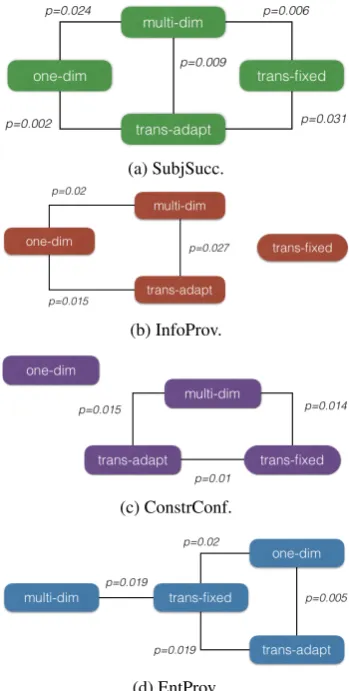
trans-adapt(p= 0.002) systems in perceived suc-cess (SubjSucc), and all three multi-dimensional systems were found to be equivalent to each other (p = 0.006,0.009, and0.031). Similarly, several equivalences were detected for the three objective success metrics, as illustrated in AppendixB.7All systems are equivalent on the other subjective rat-ings Q2–Q5.
To get a sense of the noise levels encountered by the different system variants, we collected crowd-sourced transcriptions of 2,931 utterances from 496 dialogues (45.6% of the total number of turns in the evaluation corpus and 50.5% of collected di-alogues), spread approximately evenly across all system variants. We then computed word error rate (WER).8Results in Table6show comparable noise
7FollowingArmstrong(2014), we do not apply a correc-tion for multiple comparisons (Lauzon and Caffo,2009) since we only performed a limited number of pre-planned compar-isons and did not require testing against the universal null hypothesis “nothing is significant”.
8The reference transcriptions were obtained by majority voting over the three transcriptions collected for each utter-ance, with manual fixes in case of a tie (20% of the utterances).
levels for all system variants. No significant differ-ences were found and equivalence tests confirmed WER to be equivalent for all the systems. This con-firms that none of the systems was disadvantaged and the results in Table5are indeed comparable.
5 Conclusion and Future Work
In this paper, we have shown that a multi-dimensional, data efficient dialogue manager per-forms equally to a one-dimensional, more data-hungry (upper) baseline. In doing so, we have de-veloped a web-based platform for spoken dialogue system evaluation, carried out a crowdsourced user evaluation, and introduced statistical testing for equivalence in our analysis of the results. All code and data used in our experiments are available at:
https://bitbucket.org/skeizer/madrigal
The results show that none of the systems out-performed the other systems consistently across various metrics, and more importantly, that several statistical equivalences between the systems could be detected. We believe that these results are en-couraging, especially since we suspect that the use of a web-based speech interface (with inherently varying quality of the microphone used) and the crowdsourcing setup (with inherently varying con-ditions in which workers do their tasks) resulted in a relatively high level of variance in the data, making it harder to draw strong conclusions.
In the next stage of our research, we aim to fur-ther demonstrate the cross-domain transfer capabil-ity of the dialogue manager, for example by eval-uating partially trained policies, and showing that policies that use transfer learning reach higher per-formance levels in the early stages of training, or that they achieve a given performance threshold with much less data.
Acknowledgements
References
Rieks op den Akker, Harry Bunt, Simon Keizer, and Boris van Schooten. 2005. From Question Answer-ing to Spoken Dialogue: Towards an Information Search Assistant for Interactive Multimodal Infor-mation Extraction. In Proceedings of the 9th Eu-ropean Conference on Speech Communication and Technology (Interspeech), Lisbon, Portugal.
Richard A. Armstrong. 2014. When to use the Bonfer-roni correction. Ophthalmic and Physiological Op-tics, 34(5):502–508.
Harry Bunt. 2011. Multifunctionality in dialogue.
Computer Speech & Language, 25(2):222–245.
Paul A Crook, Simon Keizer, Zhuoran Wang, and Wenshuo Tang. 2014. Real user evaluation of a POMDP spoken dialogue system using automatic belief compression. Computer Speech & Language, 28(4):873–887.
Joseph L. Fleiss, Bruce Levin, and Myunghee Cho Paik. 2003. Statistical methods for rates and proportions, 3rd edition. Wiley series in probability and statistics. J. Wiley, Hoboken, NJ, USA.
Milica Gaši´c, Nikola Mrkši´c, Lina M. Rojas-Barahona, Pei-hao Su, Stefan Ultes, David Vandyke, Tsung-Hsien Wen, and Steve Young. 2017. Dialogue man-ager domain adaptation using Gaussian process rein-forcement learning. Computer Speech & Language, 45:552–569.
ISO. 2012. ISO 24617-2 Language resource manage-ment – Semantic annotation framework – Part 2: Dialogue acts. International Organization for Stan-dardization, Geneva, Switzerland.
Filip Jurˇcíˇcek, Simon Keizer, Milica Gaši´c, François Mairesse, Blaise Thomson, Kai Yu, and Steve Young. 2011. Real user evaluation of spoken dia-logue systems using Amazon Mechanical Turk. In
Proceedings of Interspeech, Florence, Italy.
Simon Keizer and Verena Rieser. 2017. Towards Learn-ing Transferable Conversational Skills usLearn-ing Multi-dimensional Dialogue Modelling. In Proceedings 21stWorkshop on the Semantics and Pragmatics of Dialogue (SemDial/SaarDial), Saarbruecken, Ger-many. Extended version: arXiv:1804.00146.
Carolyn Lauzon and Brian Caffo. 2009. Easy Multiplicity Control in Equivalence Testing Using Two One-Sided Tests. The American Statistician, 63(2):147–154.
Sinno Jialin Pan and Qiang Yang. 2010. A Survey on Transfer Learning. IEEE Transactions on Knowl-edge and Data Engineering, 22(10):1345–1359.
Volha Petukhova, Christopher Stevens, Harmen de Weerd, Niels Taatgen, Fokie Cnossen, and An-drei Malchanau. 2016. Modelling multi-issue bar-gaining dialogues: Data collection, annotation
de-sign and corpus. InProceedings of the 10th Interna-tional Conference on Language Resources and Eval-uation (LREC), Paris, France.
Jost Schatzmann, Blaise Thomson, Karl Weilhammer, Hui Ye, and Steve Young. 2007. Agenda-based user simulation for bootstrapping a POMDP dia-logue system. InHuman Language Technologies: The Annual Conference of the North American Chap-ter of the Association for Computational Linguistics (NAACL-HLT), Rochester, NY, USA.
Donald J Schuirmann. 1987. A comparison of the two one-sided tests procedure and the power approach for assessing the equivalence of average bioavailabil-ity. Journal of Pharmacokinetics and Biopharma-ceutics, 15:657–680.
Matthew E Taylor and Peter Stone. 2009. Transfer Learning for Reinforcement Learning Domains: A Survey.The Journal of Machine Learning Research, 10(Jul):1633–1685.
Blaise Thomson, Milica Gaši´c, Matthew Henderson, Pirros Tsiakoulis, and Steve Young. 2012. N-best error simulation for training spoken dialogue sys-tems. In Spoken Language Technology Workshop (SLT), Miami, FL, USA.
Lisa Torrey and Jude Shavlik. 2010. Transfer learn-ing. InHandbook of research on machine learning applications and trends: algorithms, methods, and techniques, pages 242–264. IGI Global.
Zhuoran Wang, Tsung-Hsien Wen, Pei-hao Su, and Yannis Stylianou. 2015. Learning domain-independent dialogue policies via ontology param-eterisation. InProceedings of the 16thAnnual Meet-ing of the Special Interest Group on Discourse and Dialogue (SIGdial), Prague, Czechia.
Tsung-Hsien Wen, Milica Gaši´c, Nikola Mrkši´c, Lina M. Rojas-Barahona, Pei-Hao Su, David Vandyke, and Steve Young. 2016. Multi-domain neural network language generation for spoken di-alogue systems. In Proceedings of the 2016 Con-ference of the North American Chapter of the Asso-ciation for Computational Linguistics: Human Lan-guage Technologies, pages 120–129, San Diego, CA, USA.
Jason D Williams, Eslam Kamal, Hani Amr Mokhtar Ashour, Jessica Miller, and Geoff Zweig. 2015.Fast and easy language understanding for dialog systems with Microsoft language understanding intelligent service (LUIS). InProceedings of the 16th Annual Meeting of the Special Interest Group on Discourse and Dialogue (SIGDIAL), Prague, Czechia.
Steve Young, Milica Gaši´c, Blaise Thomson, and Ja-son D. Williams. 2013. POMDP-Based Statistical Spoken Dialog Systems: A Review. Proceedings of the IEEE, 101(5):1160–1179.
A Dialogue System Setup
An overview of our crowdsourced dialogue sys-tem evaluation setup is shown in Fig.3. The core component of the spoken dialogue system is the Dialogue System Server, which contains the DM (see Section 2), extended with a template-based NLG component and code for processing NLU re-sults from Microsoft’s LUIS (Williams et al.,2015) Our LUIS model was trained with 299 manually constructed and annotated example utterances.
The system is completed by a web-based user interface, which connects with both the Dialogue System Server and the Google Web Speech API.9
User audio input is first sent to Google ASR to get user utterance hypotheses with confidence scores. These are sent to the Dialogue System Server, which returns a system response utterance. Finally, this utterance is sent to Google TTS, which returns the synthesised system response audio to be played back to the user. The web interface is integrated into the FigureEight crowdsourcing platform for managing the evaluation (Section3.1).
B Equivalence test results
See Figure4for a diagram of all statistically signif-icant equivalences that we detected with respect to the individual evaluation criteria (see Sections3.2 and4).
9https://w3c.github.io/speech-api/
speechapi.html
FigureEight
Dialogue System Server
(DM+NLG)
LUIS NLU
Server Google Web
Speech (ASR+TTS)
Dialogue System Web Interface
User
user audio system utterance
▼▼ ▲▲ system audio user utterance
▲▼ dialogue
turns
▲ ▲ task IDs
tokens
user utterance
▼
▲ ▲ user intent user entities user audio
behaviour ▼▼
▲
system audio ▲task/scenario ▼questionnaire
Figure 3: Overview of dialogue system evaluation setup.
(a) SubjSucc.
(b) InfoProv.
(c) ConstrConf.
(d) EntProv.
[image:7.595.328.503.371.717.2]