BOUNCE: Sentiment Classification in Twitter using Rich Feature Sets
Nadin K¨okciyan†, Arda C¸ elebi†, Arzucan ¨Ozg ¨ur, Suzan ¨Usk ¨udarlı
Department of Computer Engineering Bogazici University
Istanbul, Turkey
{nadin.kokciyan,arda.celebi,arzucan.ozgur,suzan.uskudarli}@boun.edu.tr
Abstract
The widespread use of Twitter makes it very interesting to determine the opinions and the sentiments expressed by its users. The short-ness of the length and the highly informal na-ture of tweets render it very difficult to auto-matically detect such information. This paper reports the results to a challenge, set forth by SemEval-2013 Task 2, to determine the posi-tive, neutral, or negative sentiments of tweets. Two systems are explained: System A for de-termining the sentiment of a phrase within a tweet and System B for determining the senti-ment of a tweet. Both approaches rely on rich feature sets, which are explained in detail.
1 Introduction
Twitter consists of a massive number of posts on a wide range of subjects, making it very interesting to extract information and sentiments from them. For example, answering questions like ‘What do Twitter users feel about the brandX?’ are quite interesting. The constrained length and highly informal nature of tweets presents a serious challenge for the auto-mated extraction of such sentiments.
Twitter supports special tokens (i.e. mentions and hashtags), which have been utilized to determine the sentiment of tweets. In (Go et al., 2009), emoticons are used to label tweets. In (Davidov et al., 2010), Twitter emoticons as well as hashtags are used to la-bel tweets. O’Connor et al. (2010) demonstrated a correlation between sentiments identified in pub-lic opinion polls and those in tweets. A subjectivity
†These authors contributed equally to this work
lexicon was used to identify the positive and nega-tive words in a tweet. In (Barbosa and Feng, 2010), subjective tweets are used for sentiment classifica-tion. They propose the use of word specific (e.g. POS tags) and tweet specific (e.g. presence of a link) features. Most of these studies use their own anno-tated data sets for evaluation, which makes it diffi-cult to compare the performances of their proposed approaches.
Sentiment Analysis in Twitter 2013 (SemEval 2013 Task 2) (Wilson et al., 2013) presented a chal-lenge for exploring different approaches examin-ing sentiments conveyed in tweets: interval-level (phrase-level) sentiment classification (TaskA) and message-level sentiment classification (TaskB). Sen-timent are considered aspositive, negative, or neu-tral. For TaskA, the goal is to determine the sen-timent of an interval (consecutive word sequence) within a tweet. For TaskB, the goal is to determine sentiment of an entire tweet. For example, let’s con-sider a tweet like ‘Can’t waituntil the DLC for ME3 comes out tomorrow. :-)’. For TaskA, the interval 0-1 (Can’t wait) is ‘positive’ and the interval 10-10 (:-)) is ‘positive’. For TaskB, this tweet is ‘positive’. In this paper, we present two systems, one for TaskA and one for TaskB. In both cases machine learning methods were utilized with rich feature sets based on the characteristics of tweets. Our results suggest that our approach is promising for sentiment classification in Twitter.
2 Approach
The task of detecting the sentiments of a tweet or an interval therein, is treated as a classification of
TaskA Tweets with
Intervals Positive
Classifier
Tweet Classifier TaskA
Interval Classifier
TaskB
Multiple Binary Classifier
TaskB Tweets
+/-/0
Classified Tweets Classified Tweet Intervals
+/-/0
Preprocessor + Feature Generator
Negative Classifier
[image:2.612.108.503.64.185.2]Lexicons
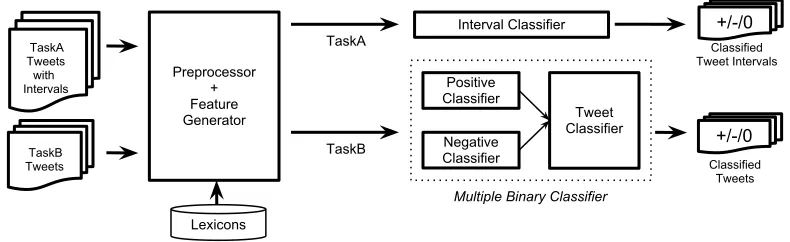
Figure 1: The Overview of BOUNCE System
tweets into positive, negative, or neutral sets. Fig-ure 1 gives the overview of our approach. The Pre-processor module tokenizes the tweets that are used by the Feature Generator. At this stage, the tweets are represented as feature vectors. For TaskA, the feature vectors are used by the Interval Classifier that predicts the labels of the tweet intervals. For TaskB, the feature vectors are used by the Positive Classifier and the Negative Classifier which report on the positivity and negativity of the tweets. The Tweet Classifier determines the tweet labels using a rule-based method. Each step is described in detail in the following subsections.
2.1 Lexicons
The core of our approach to sentiment analysis relies on word lists that are used to determine the positive and negative words or phrases. Several acquired lists are used in addition to one that we curated. AFINN (Nielsen, 2011) is the main sentiment word list in-cluding 2477 words rated between -5 to 5 for va-lence. SentiWordNet (Baccianella et al., 2010), de-rived from the Princeton English WordNet (Miller, 1995), assigns positive, negative, or objective scores to each synset in WordNet. We considered the av-erage of a word’s synsets as its SentiWordNet score. Thus, synsets are disregarded and no disambiguation of the sense of a word in a given context is done. The SentiWordNet score of a word is not used if it has objective synsets, since it indicates that the word might have been used in an objective sense. We use a list of emotion words and categories that is created by DeRose1. Furthermore, a slang dictionary
down-1
http://derose.net/steve/resources/emotionwords/ewords.html
loaded from the Urban Dictionary2containing over 16,000 phrases (with no sentiment) is used. Finally, we curated a sentiment word list initiated with a list of positive and negative words obtained from Gen-eral Inquirer (Stone et al., 1966), and refined by sen-timent emitting words from a frequency-based or-dered word list generated from the training data set of SemEval-2013 Task A. Naturally, this list is more specialized to the Twitter domain.
2.2 Preprocessing
Prior to feature generation, tweets were prepro-cessed to yield text with more common wording. For this, CMU’s Ark Tokenizer and Part-of-Speech (POS) Tagger (Gimpel et al., 2011), which has been specifically trained for tweets, was used. Tweets are tokenized and POS tagged.
2.3 Feature Sets
In addition to the lexical or syntactic characteristics, the manner in which tweets are written may reveal sentiment. Orthogonal shapes of words (esp. fully or partially capitalized words), expressions of a sin-gle word or a phrase in the form of a hashtag, posi-tions of certain tokens in a tweet are prominent char-acteristics of tweets. In addition to these, tweets may convey multiple sentiments. This leads to sequence-based features, where we append features for each sentiment emitted by a word or a phrase in a tweet. Moreover, since TaskA asks for sentiment of inter-vals in a tweet, we also engineer features to catch clues from the surrounding context of the interval,
2
such as the sentiments and lengths of the neighbor-ing intervals. For TaskB, the usage of hashtags and last words in tweets were occasionally sentimental, thus we considered them as features as well. We ex-plain all features in detail in Section 3.
2.4 Classification
Maximum entropy models (Berger et al., 1996) have been used in sentiment analysis (Fei et al., 2010). They model all given data and treat the remainder as uniform as possible making no assumptions about what is not provided. For this, TaskA system uses the MaxEnt tool (Zhang, 2011).
Naive Bayes is a simple probabilistic model based on Bayes’ Theoremthat assumes independence be-tween features. It has performed well in sentiment classification of Twitter data (Go et al., 2009; Bifet and Frank, 2010). TaskB data was not evenly dis-tributed. There were very few negative tweets com-pared to positive tweets. Using a single classifier to distinguish the classes from each other resulted in poor performance in identifying negative tweets. Therefore, TaskB system utilizes multiple binary classifiers that use the one-vs-all strategy. Maximum Entropy and Naive Bayes models were considered and the model that performed best on the develop-ment set was chosen for each classifier. As a result, the positive classifier (Bpos) is based on the
Max-imum Entropy model, whereas the negative classi-fier (Bneg) is based on Naive Bayes. TaskB system
uses the Natural Language Toolkit (Loper and Bird, 2002).
3 Systems
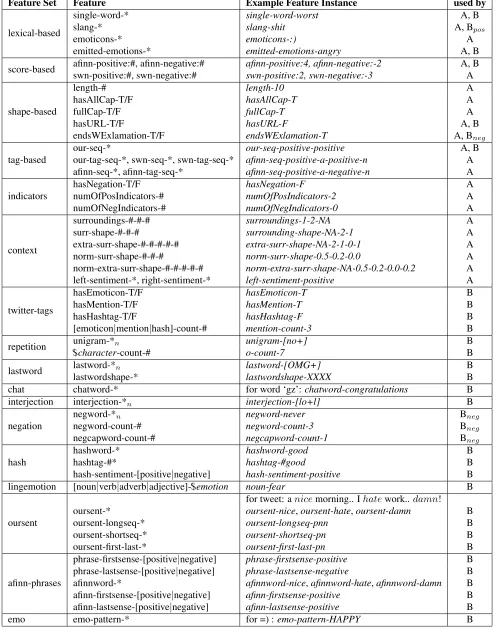
In this section, TaskA and TaskB systems are plained in detail. All features used in the final ex-periments for both tasks are shown in Table 1.
3.1 TaskA System
TaskA is a classification task where we classify a given interval as having positive, negative or neutral sentiment. TaskA feature sets are shown in Table 1.
lexical features: These features use directly words (or tokens) from tweets as features. single-wordfeature uses the word of the single-word inter-vals, whereas slangfeatures are created for match-ing uni-grams and bi-grams from our slang dictio-nary. We also use emoticons as features, as well as
the words or phrases that emit emotion according to the lexicons described in Section 2.1.
score-based features: These features use the scores obtained from the AFINN and SentiWordNet (SWN) lexicons. We use separate scores for the pos-itive and negative sentiments, since one interval may contain multiple words with opposite sentiment. In case of multiple positive or negative occurances, we take the arithmetic mean of those.
shape-based features:These features capture the length of an interval, whether it contains a capital-ized word or all words are capitalcapital-ized, whether it contains a URL, or ends with an exclamation mark.
tag-based features: In addition to numeric val-ues of sentiments, we use the tokens ‘positive’ and ‘negative’ to express the type of sentiment. When multiple words emit a sentiment in a given interval, their corresponding tokens are appended to create a single feature out of it, sequences. Moreover, we have another set of features which also contains the POS tags of these sentiment words.
indicator features:These features are used in or-der to expose how many sentiment emitting words from our currated large lexicon exist in a given inter-val. hasNegationindicates the presence of a nega-tion word likenot orcan’t in the interval, whereas
numOfPosIndicatorsandnumOfNegIndicatorsgives the number of tokens that convey positive and nega-tive sentiment, respecnega-tively.
context features:In addition to the features gen-erated from the given interval, these features capture the context information from the neighboring inter-vals. Featuresurroundingscombines the length of the interval along with the lengths of the intervals on both sides, whereas surrounding-shape and extra-surrounding-shapefeatures use number of positive and negative sentiment indicators for the intervals. We also use their normalized forms (those starting with norm-) where we divide the number of indi-cators by the length of the interval. Features with
-extra- use two adjacent intervals from both sides. Intervals that are not available are represented with
NA.
3.2 TaskB System
Feature Set Feature Example Feature Instance used by
lexical-based
single-word-* single-word-worst A, B
slang-* slang-shit A, Bpos
emoticons-* emoticons-:) A
emitted-emotions-* emitted-emotions-angry A, B
score-based afinn-positive:#, afinn-negative:# afinn-positive:4, afinn-negative:-2 A, B swn-positive:#, swn-negative:# swn-positive:2, swn-negative:-3 A
shape-based
length-# length-10 A
hasAllCap-T/F hasAllCap-T A
fullCap-T/F fullCap-T A
hasURL-T/F hasURL-F A, B
endsWExlamation-T/F endsWExlamation-T A, Bneg
tag-based
our-seq-* our-seq-positive-positive A, B
our-tag-seq-*, swn-seq-*, swn-tag-seq-* afinn-seq-positive-a-positive-n A afinn-seq-*, afinn-tag-seq-* afinn-seq-positive-a-negative-n A
indicators
hasNegation-T/F hasNegation-F A
numOfPosIndicators-# numOfPosIndicators-2 A numOfNegIndicators-# numOfNegIndicators-0 A
context
surroundings-#-#-# surroundings-1-2-NA A
surr-shape-#-#-# surrounding-shape-NA-2-1 A extra-surr-shape-#-#-#-#-# extra-surr-shape-NA-2-1-0-1 A norm-surr-shape-#-#-# norm-surr-shape-0.5-0.2-0.0 A norm-extra-surr-shape-#-#-#-#-# norm-extra-surr-shape-NA-0.5-0.2-0.0-0.2 A left-sentiment-*, right-sentiment-* left-sentiment-positive A
twitter-tags
hasEmoticon-T/F hasEmoticon-T B
hasMention-T/F hasMention-T B
hasHashtag-T/F hasHashtag-F B
[emoticon|mention|hash]-count-# mention-count-3 B
repetition unigram-*n unigram-[no+] B
$character-count-# o-count-7 B
lastword lastword-*n lastword-[OMG+] B
lastwordshape-* lastwordshape-XXXX B
chat chatword-* for word ‘gz’:chatword-congratulations B interjection interjection-*n interjection-[lo+l] B
negation
negword-*n negword-never Bneg
negword-count-# negword-count-3 Bneg
negcapword-count-# negcapword-count-1 Bneg
hash
hashword-* hashword-good B
hashtag-#* hashtag-#good B
hash-sentiment-[positive|negative] hash-sentiment-positive B lingemotion [noun|verb|adverb|adjective]-$emotion noun-fear B
oursent
for tweet: anicemorning.. Ihatework..damn! oursent-* oursent-nice,oursent-hate,oursent-damn B
oursent-longseq-* oursent-longseq-pnn B
oursent-shortseq-* oursent-shortseq-pn B
oursent-first-last-* oursent-first-last-pn B
afinn-phrases
phrase-firstsense-[positive|negative] phrase-firstsense-positive B phrase-lastsense-[positive|negative] phrase-lastsense-negative B afinnword-* afinnword-nice,afinnword-hate,afinnword-damn B afinn-firstsense-[positive|negative] afinn-firstsense-positive B afinn-lastsense-[positive|negative] afinn-lastsense-positive B
[image:4.612.70.568.67.696.2]emo emo-pattern-* for =) :emo-pattern-HAPPY B
Dataset Type Positive Negative Neutral+Objective Tot. No. of Instances
TaskA
Training 5290 (5865) 2771(3120) 16118 (17943) 24179 (26928) Development 589 (648) 392 (430) 1993 (2202) 2974 (3280)
Test 2734 1541 160 4435
TaskB
Training 3274 (3640) 1291 (1458) 4155 (4586) 8720 (9684) Development 523 (575) 309 (340) 674 (739) 1506 (1654)
[image:5.612.95.518.53.139.2]Test 1572 601 1640 3813
Table 2: Number of instances used in TaskA and TaskB
decide on the sentiment label of a tweet. For each tweet, the probabilities of belonging to the posi-tive class (P robpos) and negative class (P robneg)
are computed by the Bpos and Bneg classifiers,
re-spectively. IfP robpos is greater thanP robneg, and
greater than a predefined threshold, then the tweet is classified as ‘positive’, otherwise it is classified as ‘neutral’. On the other hand, if P robneg is
greater than P robpos, and greater than the
prede-fined threshold, then the tweet is classified as ‘neg-ative’, otherwise it is classified as ‘neutral’. The threshold is set to0.45, since it gives the optimal F-score on the development set. TaskB features along with examples are shown in Table 1.
twitter-tags: hasEmoticon, hasMention, ha-sURL, and hasHashtag indicate whether the corre-sponding term (e.g. mention) exists in the tweet.
repetition: Words with repeating letters are added as a feature∗n. ∗nrepresents the normalized version (i.e., no repeating letters) of a word. For ex-ample, ‘nooooooo’ is shortened to[no+]. We also keep the count of the repeated character.
wordshape: Shape of each word in a tweet is con-sidered. For example, the shape of ‘NOoOo!!’ is ‘XXxXx!!’.
lastword: The normalized form and the shape of the last word are used as features. For example, if the lastword is ‘OMGG’, thenlastword ‘[OMG+]’ andlastwordshape‘XXXX’ are used as features.
chat: A list of chat abbreviations that express sen-timent is manually created. Each abbreviation is re-placed by its corresponding word.
interjection: An interjection is a word that ex-presses an emotion or sentiment (e.g. hurraah, loool). Interjection wordnis used as a feature.
negation: We manually created a negation list ex-tended by word clusters from (Owoputi et al., 2013). A negation word is represented by spellings such
as not, n0t, and naht. Each negation wordn (e.g
neve[r+]) is considered. We keep the count of nega-tion words and all capitalized neganega-tion words.
hash: If the hashtag is ‘#good’ then #good and
goodbecome hash features. If the hashtag is a sen-timent expressing word according to our sensen-timent word list, then we keep the sentiment information.
lingemotion: Nodebox Linguistics3 package gives emotional values of words for expressions of emotions such as fear and sadness. POS augmented expression information is used as a feature.
oursent: Each word in a tweet that exists in our sentiment word list is considered. When multiple sentiment expressing words are found, a sentiment sequence feature is used. oursent-longseq keeps the long sequence, whereasoursent-shortseqkeeps same sequence without repetitive sentiments. We also consider the first and last sentiments emitted by a tweet.
afinn: We consider each word that exists in AFINN. If a negation exists before this word, the opposite sentiment is considered. For example, if a tweet contains the bigram ‘not good’, then the senti-ment of the bigram is set to ‘negative’. The AFINN scores of the positive and negative words, as well as the first and last sentiments emitted by the tweet are considered.
phrases: Each n-gram (n > 1) of a tweet that exists in our sentiment phrase list is considered.
afinn-phrases: Phrases are retrieved using the
phrases feature. Each sentiment that appears in a phrase is kept, hence we obtain a sentiment se-quence. The first and last sentiments of this se-quence are also considered. Then, the phrases are removed from the tweet text and theafinnfeature is applied.
emo: We manually created an emoticon list where
3
each term is associated with an emotion pattern such as HAPPY. These emotion patterns are used as a fea-ture.
others: Bposuses theslangfeature from the
lexi-cal feature set, and BnegusesendsWExlamation
fea-ture from the indicators feafea-ture set.
4 Experiments and Results
4.1 Data
[image:6.612.317.539.63.308.2]The data set provided by the task organizers was an-notated by using Amazon Mechanical Turk4. The annotations of the tweets in the training and devel-opment sets were provided to the task participants. However, the tweets had to be downloaded from Twitter by using the script made available by the or-ganizers. We were unable to download all the tweets in the training and development sets, since some tweets were deleted and others were not publicly accessible due to their updated authorization status. The number of actual tweets (numbers in parenthe-ses) and the number of collected tweets are shown in Table 2. Almost 10% of the data for both tasks are missing. For the test data, however, the tweets were directly provided to the participants.
4.2 Results on TaskA
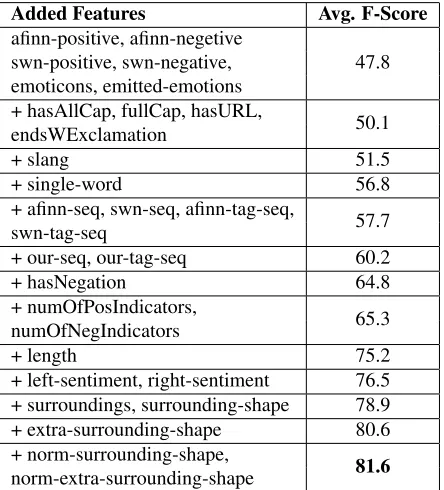
We start our experiments with features generated from lexicons and emoticons. Called our baseline, it achieved an f-score of 47.8 on the devset in Ta-ble 3. As we add other features at each step, we reach an average f-score of 81.6 on the devset at the end. Among those features, the most contribut-ing ones are lexical featuresingle-word, indicator featurehasN egation, and especially shape feature
length. The success of thelengthfeature is mostly
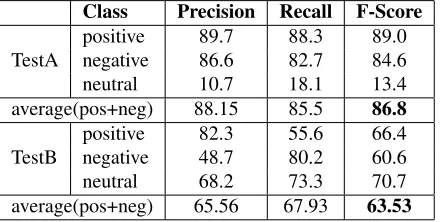
due to the nature of intervals, where the long ones tend to be neutral, and the rest are mostly positive or negative. Another noteworthy result is that our curated word list contributed more compared to the others. When the final model is used on the test set, we get the results in Table 5. Having low neutral f-score might be due to the fact that there were only a few neutral intervals in the test set, which might in-dicate that their characteristics may not be the same as the ones in the devset.
4
https://www.mturk.com/mturk/
Added Features Avg. F-Score
afinn-positive, afinn-negetive
47.8 swn-positive, swn-negative,
emoticons, emitted-emotions + hasAllCap, fullCap, hasURL,
50.1 endsWExclamation
+ slang 51.5
+ single-word 56.8
+ afinn-seq, swn-seq, afinn-tag-seq,
57.7 swn-tag-seq
+ our-seq, our-tag-seq 60.2
+ hasNegation 64.8
+ numOfPosIndicators,
65.3 numOfNegIndicators
+ length 75.2
+ left-sentiment, right-sentiment 76.5 + surroundings, surrounding-shape 78.9 + extra-surrounding-shape 80.6 + norm-surrounding-shape,
81.6 norm-extra-surrounding-shape
Table 3: Macro-averaged F-Score on the TaskA dev. set
Added Features Average
F-Score oursent (baseline) 58.59 + afinn-phrases 64.64 + tags + hash 65.43 + interjection + chat 65.53 + emo + lingemotion 65.92 + repetition + lastword 66.01 + negation + others 66.32
Table 4: Macro-averaged F-Score on the TaskB dev. set
4.3 Results on TaskB
The baseline model is considered to includeoursent
[image:6.612.351.503.363.476.2]Class Precision Recall F-Score
TestA
positive 89.7 88.3 89.0 negative 86.6 82.7 84.6 neutral 10.7 18.1 13.4 average(pos+neg) 88.15 85.5 86.8
TestB
[image:7.612.77.297.64.175.2]positive 82.3 55.6 66.4 negative 48.7 80.2 60.6 neutral 68.2 73.3 70.7 average(pos+neg) 65.56 67.93 63.53
Table 5: Results on the test sets for both tasks
5 Conclusion
We presented two systems one for TaskA (a Maxi-mum Entropy model) and one for TaskB (MaxiMaxi-mum Entropy + Naive Bayes models) based on using rich feature sets. For Task A, we started with a baseline system that just uses ordinary features like sentiment scores of words. As we added new features, we ob-served that lexical features and shape-based features are the ones that contribute most to the performance of the system. Including the context features and the indicator feature for negations led to considerable improvement in performance as well. For TaskB, we first created a baseline model that uses sentiment words and phrases from the AFINN lexicon as fea-tures. Each feature that we added to the system re-sulted in improvement in performance. The nega-tionandendsWExclamationfeatures only improved the performance of the negative classifier, whereas theslangfeature only improved the performance of the positive classifier.
Our results show that using rich feature sets with machine learning algorithms is a promising ap-proach for sentiment classification in Twitter. Our TaskA system ranked 3rd among 23 systems and TaskB system ranked 4th among 35 systems partici-pating in SemEval 2013 Task 2.
References
Stefano Baccianella, Andrea Esuli, and Fabrizio Sebas-tiani. 2010. SentiWordNet 3.0: An Enhanced Lex-ical Resource for Sentiment Analysis and Opinion Mining. In Proceedings of the Seventh Conference on International Language Resources and Evaluation
(LREC’10), Valletta, Malta, May. European Language
Resources Association (ELRA).
Luciano Barbosa and Junlan Feng. 2010. Robust senti-ment detection on twitter from biased and noisy data.
In Proceedings of the 23rd International Conference
on Computational Linguistics: Posters, COLING ’10,
pages 36–44, Stroudsburg, PA, USA. Association for Computational Linguistics.
Adam L. Berger, Stephen A. Della Pietra, and Vincent J. Della Pietra. 1996. A maximum entropy approach to natural language processing. Computational Lin-guistics, 22:39–71.
Albert Bifet and Eibe Frank. 2010. Sentiment knowl-edge discovery in twitter streaming data. In Proceed-ings of the 13th international conference on
Discov-ery science, DS’10, pages 1–15, Berlin, Heidelberg.
Springer-Verlag.
Dmitry Davidov, Oren Tsur, and Ari Rappoport. 2010. Enhanced sentiment learning using twitter hashtags and smileys. InProceedings of the 23rd International
Conference on Computational Linguistics: Posters,
COLING ’10, pages 241–249, Stroudsburg, PA, USA. Association for Computational Linguistics.
Xiaoxu Fei, Huizhen Wang, and Jingbo Zhu. 2010. Sen-timent word identification using the maximum entropy model. InInternational Conference on Natural Lan-guage Processing and Knowledge Engineering (NLP-KE), pages 1–4.
Kevin Gimpel, Nathan Schneider, Brendan O’Connor, Dipanjan Das, Daniel Mills, Jacob Eisenstein, Michael Heilman, Dani Yogatama, Jeffrey Flanigan, and Noah A. Smith. 2011. Part-of-speech tagging for twitter: annotation, features, and experiments. In
Proceedings of the 49th Annual Meeting of the Asso-ciation for Computational Linguistics: Human
Lan-guage Technologies: short papers - Volume 2, HLT
’11, pages 42–47. Association for Computational Lin-guistics.
Alec Go, Richa Bhayani, and Lei Huang. 2009. Twit-ter sentiment classification using distant supervision. Technical report, Stanford University.
Edward Loper and Steven Bird. 2002. Nltk: the natural language toolkit. InProceedings of the ACL-02 Work-shop on Effective tools and methodologies for teach-ing natural language processteach-ing and computational
linguistics - Volume 1, ETMTNLP ’02, pages 63–70,
Stroudsburg, PA, USA. Association for Computational Linguistics.
George A. Miller. 1995. Wordnet: A lexical database for english.Communications of the ACM, 38:39–41. Finn ˚A. Nielsen. 2011. A new ANEW: Evaluation of
a word list for sentiment analysis in microblogs. In
Brendan O’Connor, Ramnath Balasubramanyan, Bryan R. Routledge, and Noah A. Smith. 2010. From Tweets to Polls: Linking Text Sentiment to Public Opinion Time Series. In Proceedings of the International AAAI Conference on Weblogs and Social Media.
Olutobi Owoputi, Brendan O’Connor, Chris Dyer, Kevin Gimpel, Nathan Schneider, and Noah A. Smith. 2013. Improved part-of-speech tagging for online conver-sational text with word clusters. In Proceedings of
NAACL.
Philip J. Stone, Dexter C. Dunphy, Marshall S. Smith, and Daniel M. Ogilvie. 1966. The General Inquirer:
A Computer Approach to Content Analysis. MIT
Press.
Theresa Wilson, Zornitsa Kozareva, Preslav Nakov, Sara Rosenthal, Veselin Stoyanov, and Alan Ritter. 2013. SemEval-2013 task 2: Sentiment analysis in twitter.
In Proceedings of the International Workshop on
Se-mantic Evaluation, SemEval ’13, June.