Adversarial training for multi-context
joint entity and relation extraction
Giannis Bekoulis Johannes Deleu Thomas Demeester Chris Develder
Ghent University - imec, IDLab Department of Information Technology [email protected]
Abstract
Adversarial training (AT) is a regularization method that can be used to improve the ro-bustness of neural network methods by adding small perturbations in the training data. We show how to use AT for the tasks of entity
recognition and relation extraction. In
par-ticular, we demonstrate that applying AT to a general purpose baseline model for jointly ex-tracting entities and relations, allows improv-ing the state-of-the-art effectiveness on sev-eral datasets in different contexts (i.e., news, biomedical, and real estate data) and for dif-ferent languages (English and Dutch).
1 Introduction
Many neural network methods have recently been exploited in various natural language processing (NLP) tasks, such as parsing (Zhang et al.,2017), POS tagging (Lample et al.,2016), relation extrac-tion (dos Santos et al., 2015), translation ( Bah-danau et al., 2015), and joint tasks (Miwa and Bansal, 2016). However, Szegedy et al. (2014) observed that intentional small scale perturbations (i.e., adversarial examples) to the input of such models may lead to incorrect decisions (with high confidence). Goodfellow et al. (2015) proposed adversarial training (AT) (for image recognition) as a regularization method which uses a mixture of clean and adversarial examples to enhance the robustness of the model. Although AT has recently been applied in NLP tasks (e.g., text classifica-tion (Miyato et al.,2017)), this paper — to the best of our knowledge — is the first attempt investigat-ing regularization effects of AT in a joint settinvestigat-ing for two related tasks.
We start from a baseline joint model that per-forms the tasks of named entity recognition (NER) and relation extraction at once. Previously pro-posed models (summarized in Section 2) exhibit
several issues that the neural network-based base-line approach (detailed in Section3.1) overcomes: (i) our model uses automatically extracted features without the need of external parsers nor manually extracted features (seeGupta et al.(2016);Miwa and Bansal(2016); Li et al.(2017)), (ii) all enti-ties and the corresponding relations within the sen-tence are extracted at once, instead of examining one pair of entities at a time (seeAdel and Sch¨utze (2017)), and (iii) we model relation extraction in a multi-label setting, allowing multiple relations per entity (see Katiyar and Cardie (2017); Bekoulis et al.(2018a)). The core contribution of the paper is the use of AT as an extension in the training pro-cedure for the joint extraction task (Section3.2).
To evaluate the proposed AT method, we per-form a large scale experimental study in this joint task (see Section4), using datasets from different contexts (i.e., news, biomedical, real estate) and languages (i.e., English, Dutch). We use a strong baseline that outperforms all previous models that rely on automatically extracted features, achieving state-of-the-art performance (Section 5). Com-pared to the baseline model, applying AT during training leads to a consistent additional increase in joint extraction effectiveness.
2 Related work
Joint entity and relation extraction: Joint
2016; Zheng et al., 2017). Specifically, Miwa and Bansal(2016) as well asLi et al. (2017) ap-ply bidirectional tree-structured RNNs for differ-ent contexts (i.e., news, biomedical) to capture syntactic information (using external dependency parsers). Gupta et al. (2016) propose the use of various manually extracted features along with RNNs. Adel and Sch¨utze (2017) solve the sim-pler problem of entity classification (EC, assum-ing entity boundaries are given), instead of NER, and they replicate the context around the entities, feeding entity pairs to the relation extraction layer. Katiyar and Cardie(2017) investigate RNNs with attention without taking into account that relation labels are not mutually exclusive. Finally, Bek-oulis et al.(2018a) use LSTMs in a joint model for extracting just one relation at a time, but increase the complexity of the NER part. Our baseline model enables simultaneous extraction of multi-ple relations from the same input. Then, we fur-ther extend this strong baseline using adversarial training.
Adversarial training (AT)(Goodfellow et al.,
2015) has been proposed to make classifiers more robust to input perturbations in the context of im-age recognition. In the context of NLP, several variants have been proposed for different tasks such as text classification (Miyato et al.,2017), re-lation extraction (Wu et al., 2017) and POS tag-ging (Yasunaga et al., 2018). AT is considered as a regularization method. Unlike other regu-larization methods (i.e., dropout (Srivastava et al., 2014), word dropout (Iyyer et al.,2015)) that in-troduce random noise, AT generates perturbations that are variations of examples easily misclassified by the model.
3 Model
3.1 Joint learning as head selection
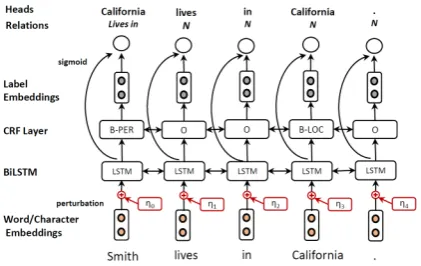
The baseline model, described in detail in Bek-oulis et al.(2018b), is illustrated in Fig.1. It aims to detect (i) the type and the boundaries of the en-tities and (ii) the relations between them. The in-put is a sequence of tokens (i.e., sentence) w =
[image:2.595.310.521.64.197.2]w1, ..., wn. We use character level embeddings to implicitly capture morphological features (e.g., prefixes and suffixes), representing each character by a vector (embedding). The character embed-dings are fed to a bidirectional LSTM (BiLSTM) to obtain the character-based representation of the word. We also use pre-trained word embeddings.
Figure 1: Our model for joint entity and relation ex-traction with adversarial training (AT) comprises (i) a word and character embedding layer, (ii) a BiLSTM layer, (iii) a CRF layer and (iv) a relation extraction layer. In AT, we compute the worst-case perturbationsηof the input embeddings.
Word and character embeddings are concatenated to form the final token representation, which is then fed to a BiLSTM layer to extract sequential information.
For the NER task, we adopt the BIO (Begin-ning, Inside, Outside) encoding scheme. In Fig.1, the B-PERtag is assigned to the beginning token of a ‘person’ (PER) entity. For the prediction of the entity tags, we use: (i) a softmax approach for the entity classification (EC) task (assuming entity boundaries given) or (ii) a CRF approach where we identify both thetype and the boundaries for each entity. During decoding, in the softmax set-ting, we greedily detect the entitytypesof the to-kens (i.e., independent prediction). Although in-dependent distribution of types is reasonable for EC tasks, this is not the case when there are strong correlations between neighboring tags. For in-stance, the BIO encoding scheme imposes several constraints in the NER task (e.g., the B-PERand
I-LOCtags cannot be sequential). Motivated by this intuition, we use a linear-chain CRF for the NER task (Lample et al., 2016). For decoding, in the CRF setting, we use the Viterbi algorithm. Dur-ing trainDur-ing, for both EC (softmax) and NER tasks (CRF), we minimize the cross-entropy lossLNER. The entity tags are later fed into the relation ex-traction layer as label embeddings (see Fig.1), as-suming that knowledge of the entitytypesis ben-eficial in predicting the relations between the in-volved entities.
et al., 2018b;Zhang et al.,2017). In our model, each wordwican be involved in multiple relations with other words. For instance, in the example il-lustrated in Fig.1, “Smith” could be involved not only in a Lives in relation with the token “Cali-fornia” (head) but also in other relations simulta-neously (e.g.,Works for, Born Inwith some corre-sponding tokens). The goal of the task is to predict for each wordwi, a vector of headsyiˆ and the vec-tor of corresponding relationsrˆi. We compute the scores(wj, wi, rk) of wordwj to be the head of wi given a relation label rk using a single layer neural network. The corresponding probability is defined as: P(wj, rk|wi;θ) = σ(s(wj, wi, rk)),
whereσ(.)is the sigmoid function. During train-ing, we minimize the cross-entropy lossLrelas:
n X
i=0 m X
j=0
−logP(yi,j, ri,j|wi;θ) (1)
where m is the number of associated heads (and thus relations) per wordwi. During decoding, the most probable heads and relations are selected us-ing threshold-based prediction. The final objective for the joint task is computed asLJOINT(w;θ) =
LNER+Lrelwhereθis a set of parameters. In the case of multi-token entities, only the last token of the entity can serve as head of another token, to eliminate redundant relations. If an entity is not involved in any relation, we predict the auxiliary “N” relation label and the token itself as head.
3.2 Adversarial training (AT)
We exploit the idea of AT (Goodfellow et al., 2015) as a regularization method to make our model robust to input perturbations. Specifically, we generate examples which are variations of the original ones by adding some noise at the level of the concatenated word representation (Miyato et al.,2017). This is similar to the concept intro-duced byGoodfellow et al.(2015) to improve the robustness of image recognition classifiers. We generate an adversarial example by adding the worst-case perturbation ηadv to the original em-beddingwthat maximizes the loss function:
ηadv = argmax
kηk≤
LJOINT(w+η; ˆθ) (2)
whereθˆis a copy of the current model parameters. Since Eq. (2) is intractable in neural networks, we use the approximation proposed inGoodfellow et al.(2015) defined as:ηadv =g/kgk, withg=
∇wLJOINT(w; ˆθ), whereis a small bounded norm treated as a hyperparameter. Similar toYasunaga et al. (2018), we set to be α√D (where D is the dimension of the embeddings). We train on the mixture of original and adversarial examples, so the final loss is computed as: LJOINT(w; ˆθ) +
LJOINT(w+ηadv; ˆθ).
4 Experimental setup
We evaluate our models on four datasets, us-ing the code as available from our github code-base.1 Specifically, we follow the 5-fold cross-validation defined byMiwa and Bansal(2016) for the ACE04 (Doddington et al.,2004) dataset. For the CoNLL04 (Roth and Yih, 2004) EC task (as-suming boundaries are given), we use the same splits as inGupta et al.(2016);Adel and Sch¨utze (2017). We also evaluate our models on the NER task similar to Miwa and Sasaki (2014) in the same dataset using 10-fold cross validation. For the Dutch Real Estate Classifieds, DREC ( Bek-oulis et al.,2017) dataset, we use train-test splits as in Bekoulis et al. (2018a). For the Adverse Drug Events, ADE (Gurulingappa et al., 2012), we perform 10-fold cross-validation similar toLi et al. (2017). To obtain comparable results that are not affected by the input embeddings, we use the embeddings of the previous works. We em-ploy early stopping in all of the experiments. We use the Adam optimizer (Kingma and Ba, 2015) and we fix the hyperparameters (i.e., α, dropout values, best epoch, learning rate) on the valida-tion sets. The scaling parameterαis selected from
{5e−2, 1e−2, 1e−3, 1e−4}. Larger values of α (i.e., larger perturbations) lead to consistent per-formance decrease in our early experiments. This can be explained from the fact that adding more noise can change the content of the sentence as also reported byWu et al.(2017).
We use three types of evaluation, namely: (i) S(trict): we score an entity as correct if both the entity boundaries and the entity type
are correct (ACE04, ADE, CoNLL04, DREC), (ii) B(oundaries): we score an entity as correct if only the entity boundaries are correct while the entitytype is not taken into account (DREC) and (iii)R(elaxed): a multi-token entity is considered correct if at least one correct type is assigned to the tokens comprising the entity, assuming that the
1https://github.com/bekou/multihead_
Settings Features Eval. Entity Relation Overall
A
CE 04
Miwa and Bansal(2016) 3 S 81.80 48.40 65.10
Katiyar and Cardie(2017) 7 S 79.60 45.70 62.65 baseline 7 S 81.16 47.14 64.15 baseline + AT 7 S 81.64 47.45 64.54
CoNLL 04
Gupta et al.(2016) 3 R 92.40 69.90 81.15
Gupta et al.(2016) 7 R 88.80 58.30 73.60
Adel and Sch¨utze(2017) 7 R 82.10 62.50 72.30 baseline EC 7 R 93.26 67.01 80.14 baseline EC + AT 7 R 93.04 67.99 80.51
Miwa and Sasaki(2014) 3 S 80.70 61.00 70.85 baseline 7 S 83.04 61.04 72.04 baseline + AT 7 S 83.61 61.95 72.78
DREC
Bekoulis et al.(2018a) 7 B 79.11 49.70 64.41 baseline 7 B 82.30 52.81 67.56 baseline + AT 7 B 82.96 53.87 68.42 baseline 7 S 81.39 52.26 66.83 baseline + AT 7 S 82.04 53.12 67.58
ADE
Li et al.(2016) 3 S 79.50 63.40 71.45
[image:4.595.71.290.62.246.2]Li et al.(2017) 3 S 84.60 71.40 78.00 baseline 7 S 86.40 74.58 80.49 baseline + AT 7 S 86.73 75.52 81.13
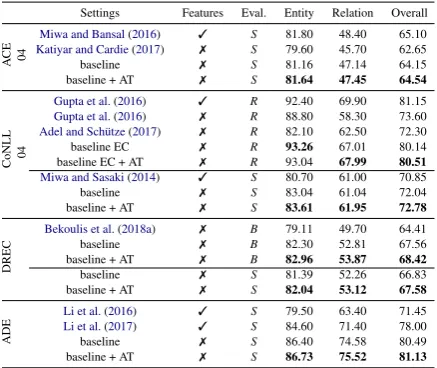
Table 1: Comparison of our method with the
state-of-the-art in terms of F1score. The proposed mod-els are: (i) baseline, (ii) baseline EC (predicts only entity classes) and (iii) baseline (EC) + AT (reg-ularized by AT). The 3and 7 symbols indicate whether the models rely on external NLP tools. We include different evaluation types (S,RandB).
boundaries are known (CoNLL04), to compare to previous works. In all cases, a relation is consid-ered as correct when both the relationtypeand the argument entities are correct.
5 Results
Table1shows our experimental results. The name of the dataset is presented in the first column while the models are listed in the second column. The proposed models are the following: (i) baseline: the baseline model shown in Fig.1with the CRF layer and the sigmoid loss, (ii) baseline EC: the proposed model with the softmax layer for EC, (iii) baseline (EC) + AT: the baseline regular-ized using AT. The final three columns present the F1 results for the two subtasks and their av-erage performance. Bold values indicate the best results among models that use only automatically extracted features.
For ACE04, the baseline outperforms Katiyar and Cardie (2017) by ∼2% in both tasks. This improvement can be explained by the use of: (i) multi-label head selection, (ii) CRF-layer and (iii) character level embeddings. Compared to Miwa and Bansal(2016), who rely on NLP tools, the baseline performs within a reasonable margin (less than 1%) on the joint task. On the other hand, Li et al. (2017) use the same model for
the ADE biomedical dataset, where we report a 2.5% overall improvement. This indicates that NLP tools are not always accurate for various con-texts. For the CoNLL04 dataset, we use two eval-uation settings. We use the relaxed evaluation similar to Gupta et al. (2016); Adel and Sch¨utze (2017) on the EC task. The baseline model outper-forms the state-of-the-art models that do not rely on manually extracted features (>4% improve-ment for both tasks), since we directly model the whole sentence, instead of just considering pairs of entities. Moreover, compared to the model ofGupta et al.(2016) that relies on complex fea-tures, the baseline model performs within a margin of 1% in terms of overall F1 score. We also re-port NER results on the same dataset and improve overall F1score with∼1% compared toMiwa and Sasaki (2014), indicating that our automatically extracted features are more informative than the hand-crafted ones. These automatically extracted features exhibit their performance improvement mainly due to the shared LSTM layer that learns to automatically generate feature representations of entities and their corresponding relations within a single model. For the DREC dataset, we use two evaluation methods. In theboundariesevaluation, the baseline has an improvement of∼3% on both tasks compared toBekoulis et al.(2018a), whose quadratic scoring layer complicates NER.
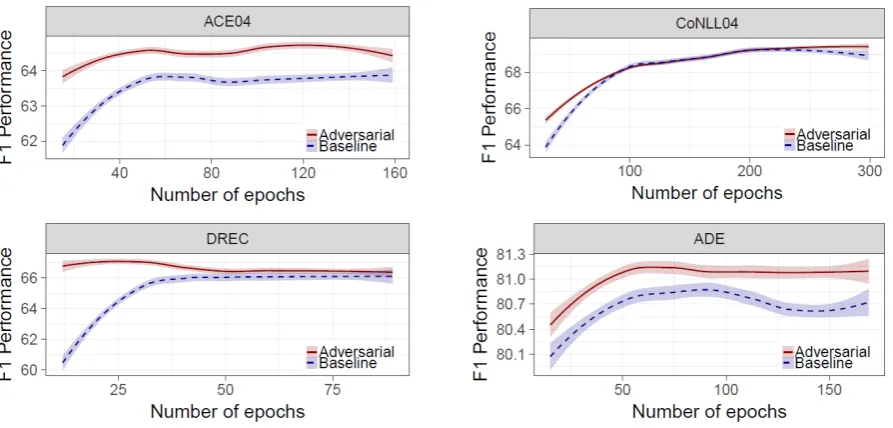
Table1and Fig.2show the effectiveness of the adversarial training on top of the baseline model. In all of the experiments, AT improves the pre-dictive performance of the baseline model in the joint setting. Moreover, as seen in Fig. 2, the performance of the models using AT is closer to maximum even from the early training epochs. Specifically, for ACE04, there is an improvement in both tasks as well as in the overall F1 perfor-mance (0.4%). For CoNLL04, we note an im-provement in the overall F1 of 0.4% for the EC and 0.8% for the NER tasks, respectively. For the DREC dataset, in both settings, there is an overall improvement of∼1%. Figure2 shows that from the first epochs, the model obtains its maximum performance on the DREC validation set. Finally, for ADE, our AT model beats the baseline F1 by 0.7%.
im-Figure 2: F1 performance of the baseline and the AT models on the validation sets from 10-30 epochs onwards depending on the dataset. The smoothed lines (obtained by LOWESS smoothing) model the trends and the 95% confidence intervals.
provement of AT over our baseline (depending on the dataset) ranges from∼0.4% to∼0.9% in terms of overall F1 score. This seemingly small perfor-mance increase is mainly due to the limited per-formance benefit for the NER component, which is in accordance with the recent advances in NER using neural networks that report similarly small gains (e.g., the performance improvement in Ma and Hovy(2016) andLample et al.(2016) on the CoNLL-2003 test set is 0.01% and 0.17% F1 per-centage points, while in the work of Yasunaga et al.(2018), a 0.07% F1improvement on CoNLL-2000 using AT for NER is reported). However, the relation extraction performance increases by∼1% F1 scoring points, except for the ACE04 dataset. Further, as seen in Fig. 2, the improvement for CoNLL04 is particularly small on the evaluation set. This may indicate a correlation between the dataset size and the benefit of adversarial training in the context of joint models, but this needs fur-ther investigation in future work.
6 Conclusion
We proposed to use adversarial training (AT) for the joint task of entity recognition and relation ex-traction. The contribution of this study is twofold: (i) investigation of the consistent effectiveness of AT as a regularization method over a multi-con-text baseline joint model, with (ii) a large scale experimental evaluation. Experiments show that
AT improves the results for each task separately, as well as the overall performance of the baseline joint model, while reaching high performance al-ready during the first epochs of the training proce-dure.
Acknowledgments
We would like to thank the anonymous reviewers for the time and effort they spent in reviewing our work, and for their valuable feedback.
References
Heike Adel and Hinrich Sch¨utze. 2017. Global nor-malization of convolutional neural networks for joint entity and relation classification. InProceedings of the 2017 Conference on Empirical Methods in
Nat-ural Language Processing, Copenhagen, Denmark.
Association for Computational Linguistics.
Dzmitry Bahdanau, Kyunghyun Cho, and Yoshua
Ben-gio. 2015. Neural machine translation by jointly
learning to align and translate. InProceedings of the International Conference for Learning Representa-tions, San Diego, USA.
Giannis Bekoulis, Johannes Deleu, Thomas Demeester, and Chris Develder. 2017. Reconstructing the house from the ad: Structured prediction on real estate
classifieds. InProceedings of the 15th Conference
of the European Chapter of the Association for
Com-putational Linguistics: (Volume 2, Short Papers),
[image:5.595.77.524.67.281.2]Giannis Bekoulis, Johannes Deleu, Thomas Demeester, and Chris Develder. 2018a. An attentive neural ar-chitecture for joint segmentation and parsing and its application to real estate ads. Expert Systems with Applications, 102:100–112.
Giannis Bekoulis, Johannes Deleu, Thomas Demeester,
and Chris Develder. 2018b. Joint entity
recogni-tion and relarecogni-tion extracrecogni-tion as a multi-head
selec-tion problem. Expert Systems with Applications,
114:34–45.
George Doddington, Alexis Mitchell, Mark Przybocki, Lance Ramshaw, Stephanie Strassel, and Ralph Weischedel. 2004. The automatic content extrac-tion (ace) program-tasks, data, and evaluaextrac-tion. In Proceedings of the Fourth International Conference
on Language Resources and Evaluation, volume 2,
page 1, Lisbon, Portugal.
Ian Goodfellow, Jonathon Shlens, and Christian Szegedy. 2015. Explaining and harnessing
adver-sarial examples. In Proceedings of the
Interna-tional Conference on Learning Representations, San Diego, USA.
Pankaj Gupta, Hinrich Sch¨utze, and Bernt Andrassy. 2016. Table filling multi-task recurrent neural net-work for joint entity and relation extraction. In Pro-ceedings of COLING 2016, the 26th International Conference on Computational Linguistics: Techni-cal Papers, pages 2537–2547.
Harsha Gurulingappa, Abdul Mateen Rajput, Angus Roberts, Juliane Fluck, Martin Hofmann-Apitius, and Luca Toldo. 2012. Development of a bench-mark corpus to support the automatic extrac-tion of drug-related adverse effects from medical
case reports. Journal of Biomedical Informatics,
45(5):885–892.
Mohit Iyyer, Varun Manjunatha, Jordan Boyd-Graber, and Hal Daum´e III. 2015. Deep unordered compo-sition rivals syntactic methods for text classification.
In Proceedings of the 53rd Annual Meeting of the
Association for Computational Linguistics and the 7th International Joint Conference on Natural
Lan-guage Processing (Volume 1: Long Papers), pages
1681–1691, Beijing, China. Association for Com-putational Linguistics.
Arzoo Katiyar and Claire Cardie. 2017. Going out
on a limb: Joint extraction of entity mentions and
relations without dependency trees. In
Proceed-ings of the 55th Annual Meeting of the Association for Computational Linguistics (Volume 1: Long Pa-pers), Vancouver, Canada.
Diederik Kingma and Jimmy Ba. 2015. Adam: A
method for stochastic optimization. InProceedings
of the International Conference on Learning Repre-sentations, San Diego, USA.
Guillaume Lample, Miguel Ballesteros, Sandeep Sub-ramanian, Kazuya Kawakami, and Chris Dyer. 2016.
Neural architectures for named entity recognition.
InProceedings of the 2016 Conference of the North
American Chapter of the Association for
Computa-tional Linguistics: Human Language Technologies,
pages 260–270, San Diego, California.
Fei Li, Meishan Zhang, Guohong Fu, and Donghong Ji. 2017. A neural joint model for entity and relation
extraction from biomedical text. BMC
Bioinformat-ics, 18(1):1–11.
Fei Li, Yue Zhang, Meishan Zhang, and Donghong Ji. 2016. Joint models for extracting adverse drug
events from biomedical text. InProceedings of the
Twenty-Fifth International Joint Conference on
Ar-tificial Intelligence, pages 2838–2844, New York,
USA. IJCAI/AAAI Press.
Qi Li and Heng Ji. 2014. Incremental joint
extrac-tion of entity menextrac-tions and relaextrac-tions. In
Proceed-ings of the 52nd Annual Meeting of the Association for Computational Linguistics (Volume 1: Long
Pa-pers), pages 402–412, Baltimore, USA.
Xuezhe Ma and Eduard Hovy. 2016. End-to-end
sequence labeling via bi-directional
LSTM-CNNs-CRF. InProceedings of the 54th Annual Meeting of
the Association for Computational Linguistics
(Vol-ume 1: Long Papers), pages 1064–1074, Berlin,
Germany.
Makoto Miwa and Mohit Bansal. 2016. End-to-end re-lation extraction using LSTMs on sequences and tree structures. InProceedings of the 54th Annual Meet-ing of the Association for Computational LMeet-inguistics
(Volume 1: Long Papers), pages 1105–1116, Berlin,
Germany.
Makoto Miwa and Yutaka Sasaki. 2014. Modeling
joint entity and relation extraction with table repre-sentation. InProceedings of the 2014 Conference on Empirical Methods in Natural Language Process-ing, pages 1858–1869, Doha, Qatar. Association for Computational Linguistics.
Takeru Miyato, Andrew M Dai, and Ian Goodfel-low. 2017. Adversarial training methods for semi-supervised text classification. InProceedings of the International Conference on Learning Representa-tions, Toulon, France.
Dan Roth and Wen-tau Yih. 2004. A linear program-ming formulation for global inference in natural
language tasks. In HLT-NAACL 2004 Workshop:
Eighth Conference on Computational Natural
Lan-guage Learning (CoNLL-2004), pages 1–8, Boston,
USA. Association for Computational Linguistics.
Cicero dos Santos, Bing Xiang, and Bowen Zhou. 2015. Classifying relations by ranking with
con-volutional neural networks. InProceedings of the
53rd Annual Meeting of the Association for Compu-tational Linguistics and the 7th International Joint Conference on Natural Language Processing
(Vol-ume 1: Long Papers), pages 626–634, Beijing,
Nitish Srivastava, Geoffrey Hinton, Alex Krizhevsky, Ilya Sutskever, and Ruslan Salakhutdinov. 2014. Dropout: A simple way to prevent neural networks
from overfitting. Journal of Machine Learning
Re-search, 15(1):1929–1958.
Christian Szegedy, Wojciech Zaremba, Ilya Sutskever, Joan Bruna, Dumitru Erhan, Ian Goodfellow, and
Rob Fergus. 2014. Intriguing properties of
neu-ral networks. In Proceedings of the International
Conference on Learning Representations, Banff,
Canada.
Yi Wu, David Bamman, and Stuart Russell. 2017. Ad-versarial training for relation extraction. In Proceed-ings of the 2017 Conference on Empirical Methods
in Natural Language Processing, pages 1778–1783,
Copenhagen, Denmark. Association for Computa-tional Linguistics.
Michihiro Yasunaga, Jungo Kasai, and Dragomir
Radev. 2018. Robust multilingual part-of-speech
tagging via adversarial training. In Proceedings of the 16th Annual Conference of the North American Chapter of the Association for Computational
Lin-guistics: Human Language Technologies, New
Or-leans, USA.
Xingxing Zhang, Jianpeng Cheng, and Mirella Lapata. 2017. Dependency parsing as head selection. In Proceedings of the 15th Conference of the European Chapter of the Association for Computational
Lin-guistics: (Volume 1, Long Papers), pages 665–676,
Valencia, Spain.
Suncong Zheng, Yuexing Hao, Dongyuan Lu,
Hongyun Bao, Jiaming Xu, Hongwei Hao, and Bo Xu. 2017. Joint entity and relation extraction
based on a hybrid neural network. Neurocomputing,