152
Tell Me More: A Dataset of Visual
Scene Description Sequences
Nikolai Ilinykh
Dialogue Systems Group Bielefeld University
Sina Zarrieß∗
Digital Humanities University of Jena
David Schlangen∗
Computational Linguistics University of Potsdam
Abstract
We present a dataset consisting of what we call
image description sequences. These multi-sentence descriptions of the contents of an im-age were collected in a pseudo-interactive set-ting, where the describer was told to describe the given image to a listener who needs to identify the image within a set of images, and who successively asks for more information. As we show, this setup produced nicely struc-tured data that, we think, will be useful for learning models capable of planning and real-ising such description discourses.
1 Introduction
Talking about what one sees brings together sev-eral core competences of situated agents: to un-derstand the world in terms of objects and their attributes and mutual relations, and to be able to
name these objects, attributes, and relations, and to compose linguistic expressions from that, for the given addressee and under the constraints of the given communicative intention.
Many of the decisions involved in this do not only require general visual and linguistic compe-tences, but are well-known to be affected by the task, the context and the intended addressee. Con-sequently, recent progress in the area of NLG, Language & Vision has been made by moving from generic settings like image captioning (Lin et al.,2014;Chen et al.,2015;Hodosh et al.,2013; Plummer et al., 2015) to task-oriented settings like referring expression generation (Kazemzadeh et al., 2014;Yu et al., 2016) or interactive visual question answering (Das et al., 2017; De Vries et al., 2017). As shown byIlinykh et al. (2018), task-based image descriptions substantially dif-fer in terms of their linguistic properties (e.g. oc-currence of referring expressions, attribute types) from their “neutral” counterparts.
∗
Work done while at Bielefeld University.
An orthogonal development has been to move towards longer units of text as the desired out-put. A few datasets exist that pair longer natural language texts (like full paragraphs) with single images that they are meant to describe (Krause et al.,2017;Lin et al., 2015). These constitute a challenging testbed for state-of-the-art models in NLG where common tasks from Language & Vi-sion need to be connected to core aspects of text generation such as content selection, text structur-ing, or aggregation.1 On the “interactivity” dimen-sion, however, these datasets constitute a step back to a monological setting. While the instructions to the annotators were to imagine that they describe an image for an imagined partner, they were al-lowed to edit the paragraph in the usual way, thus creating something that is more akin to a text than to a task-oriented contribution to an interaction.
We present a task and a dataset that is meant to combine aspects of those mentioned above. We have collected image description sequences, which are sequences of expressions that collec-tively are meant to single out one image from an (imagined) set of other similar images. These se-quences were produced in a monological setting, but with the instruction to imagine they were pro-vided to a partner who successively asked for more information (hence, “tell me more”).2 We believe that such setting at least partially resembles di-alogical interaction between humans, and, there-fore, we refer to a single expression in a sequence asa turn. In the user interface, this sequential / in-cremental aspect was stressed by offering separate text input fields, rather than one block.
1See (Gatt and Krahmer,2018) for a survey on this
tradi-tional area in NLG.
2
This setting is somewhat similar to that of Lin et al.
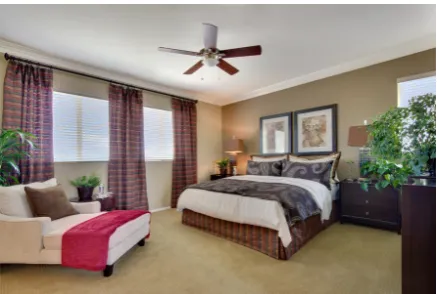
1: This is a large bedroom with two large windows, a bed,
and a two person chaise lounge.
2:The windows have striped curtains in front of them and a
curtain rod that goes over both windows.
3:There is a ceiling light and fan in the center of the room. 4:There are two large pictures above the bed and dark
col-ored nightstands on both sides.
[image:2.595.72.291.61.208.2]5:There are table lights on the nightstands and several plants throughout the room.
Figure 1: An image / description sequence pair
As the example in Figure 1 illustrates, the se-quences bring together higher level summarising descriptions (“a large bedroom”) with more de-tailed descriptions of individual objects in the scene and their relations (e.g., “a curtain rod that goes over both windows”), and they form
mini-discourses that are cohesive (co-references, e.g. “a bed” – “the bed”) and coherent (elaborations of descriptions of individual objects followed by descriptions of other objects). The sequence as a whole can be seen as providing a single fine-grained description which is delivered in install-ments(Clark,1996).3
The research questions to which we aim to con-tribute are: How is the selection made of ob-jects, attributes, and relations that are to be men-tioned? How is the selection serialised and priori-tized to form the sequence, and how are later turns in the sequence influenced by earlier ones? Ulti-mately, we want models derived from this dataset to also contribute to interactive description gen-eration where parts of the sequence may come from different participants. More immediately, however, the combination of visual grounding and successive discourse planning seems already chal-lenging.
3
But note that this is just an approximation, for the sake of allowing for a more controlled data collection. A truly in-teractive setting, such as inIlinykh et al.(2019), will turn up additional phenomena like clarification requests and correc-tions, from which we wanted to abstract away here.
2 The Dataset
2.1 Data Collection
Images As our material on the visual side, we used a part of the ADE20k corpus (Zhou et al., 2017), which consists of images of indoor and out-door environmental scenes that come with pixel-level object labels. We chose visual scenes as im-age subject matter, rather than the more event or single-object oriented settings that dominate other corpora, because scenes afford a natural high-level categorisation (e.g., “a bathroom”) that trig-gers expectations about objects that are present (e.g., “a sink”), while at the same time still al-lowing for a wide variety in how they are com-posed (e.g., what shape or colour the sink has, what material it is made of, where it is placed). This turns the task into a fine-grained classifica-tion task, where unlike in other such settings— e.g., the CUB corpus of images of bird species, (Wah et al., 2011)—there is no single label that fully categorises the instance. To further reinforce this, we used only such images which belong to one of the 35 house-related image categories spec-ified in the ‘indoor/home or hotel‘ section of the SUN image hierarchy (Xiao et al., 2016), which this corpus follows; the corpus as a whole contains also more esoteric scene categories where these expectations may not hold.
We have noticed that the first largest category (“bedroom”) is oversampled with nearly twice as many images as the second largest category in each scene set; we hence reduced this to the same size as the next largest categories (bathroom, liv-ing room, kitchen). In total, we selected 4,410 im-ages of house indoor and outdoor visual scenes, for which the corpus provides 165,088 annotated objects (for an average of 37 objects per image). The data has been divided into three disjoint sub-sets: 3528 images in the train set, 441 in the vali-dation and test sets (80/10/10).
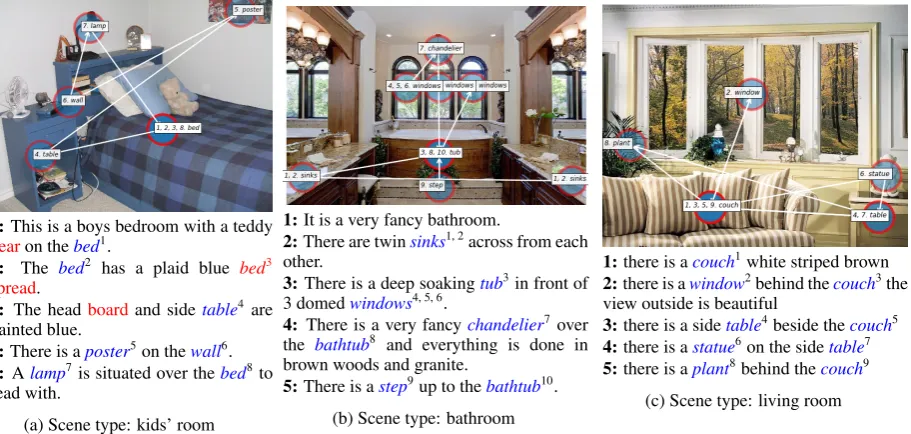
1:This is a boys bedroom with a teddy
bearon thebed1.
2: The bed2 has a plaid blue bed3
spread.
3: The headboardand sidetable4 are painted blue.
4:There is aposter5on thewall6. 5:Alamp7is situated over thebed8to
read with.
(a) Scene type: kids’ room
1:It is a very fancy bathroom.
2:There are twinsinks1, 2across from each other.
3:There is a deep soakingtub3in front of 3 domedwindows4, 5, 6.
4: There is a very fancychandelier7 over the bathtub8 and everything is done in brown woods and granite.
5:There is astep9up to thebathtub10.
(b) Scene type: bathroom
1:there is acouch1white striped brown 2:there is awindow2behind thecouch3the
view outside is beautiful
3:there is a sidetable4beside thecouch5 4:there is astatue6on the sidetable7 5:there is aplant8behind thecouch9
[image:3.595.77.533.63.280.2](c) Scene type: living room
Figure 2: Examples of visual scenes with corresponding IDS. The results of the linking are superimposed on the images, with the numbers indicating the position in the sequence and the nouns shown in italics. Nouns where a (correct) link could not be established are shown in red.
For each image, we collected a single descrip-tion sequence. Table 1in AppendixAgives the set of instructions that the workers were presented with when working on the HIT. We restricted the worker’s location to English-speaking countries only and only used workers who had previously successfully completed more than 3000 HITs. For each sequence, we payed $0.15. In total, 297 workers submitted HITs with the top five partici-pants completing over 80 tasks each. For compar-ison, in a separate task, we randomly chose almost 10% of the images in our subcorpus and collected traditional captions for them, using the COCO in-structions (Chen et al., 2015) (at least 8 words, don’t start with “there is”, don’t mention things that can’t be seen).
General statistics Overall, we collected a se-quence for each of the 4,410 images in our set, with a fixed number of 5 turns each and conse-quently resulting in 22,050 collected turns. A few turns contained more than one sentence, as in-dicated by using the nltk sentence splitter (Bird et al.,2009), yielding an average of 1.01 sentences per turn. There are 208,778 tokens altogether in the corpus, realising 5,124 token types. On aver-age, each turn contains 9 tokens.
Preprocessing While there are various methods for unsupervised learning to ground phrases in im-ages (e.g., Rohrbach et al., 2015; Wang et al., 2016), for now we went a simpler route and made
use of the object level annotations provided by the ADE corpus. More specifically, we tried to link nouns in the sequences with labels of objects in the corpus, going first by string matches and then by similarity in a vector space (where we used the GoogleNews vectors provided by Mikolov et al. (2013)). For plural nouns, we took their singu-lar form; if the image had a set of objects marked with the same label, a matching noun would be linked to all of them. If singular nouns matched more than one object, we selected the one with the biggest bounding box. Out of all noun can-didates for linking, 30,198 nouns were linked with 45,324 annotated objects (that is, on average each noun was linked to 1.5 objects). On a manually annotated small set (44 sequences), the best link-ing method (testlink-ing various weightlink-ings and simi-larity thresholds) reached a precision of 0.77, re-call 0.64, and 0.70 f-score; the numbers provided next are hence somewhat noisy. We note that our linking method ignores any adnominal dependents (determiners, adjectives, etc.), and, therefore, has no capability to resolve ambiguity between objects of the same type, but with different attributes (“red chair” vs. “blue chair”). We leave this for the future work. Some examples with the computed links are shown in Figure2.
3 Data Analysis
struc-ture to the sequences. Typically, the first turn pro-vides a classification of the scene using the ex-pected labels (“a bathroom”, “a boys bedroom”, as in Figure2), with subsequent turns providing addi-tional information about selected objects. Figure3 shows the frequency distribution of initial 3-grams for the first turn (left) and for the remaining turns together, confirming this impression.
Figure 3: Frequency distribution of the first 10 trigram prefixes of the first sentences in first turn (left) com-pared to those in other sequence positions (right).
Our elicitation method enforced a natural split into discourse segments, by providing 5 separate text fields. We expect that the intentional structure, in the sense of Grosz and Sidner (1986), is flat, i.e. the whole sequence only serves the purpose of describing the image. The attentional structure of which object is in the center of attention, however, can be expected to be richer, as we discuss next.
What gets mentioned? Using the linking method described above, we associate on average 10 objects in each scene to nouns in the descrip-tion sequence. The ADE annotadescrip-tion contains on average 37 objects per image. This indicates that the describers did not simply describe the images exhaustively.
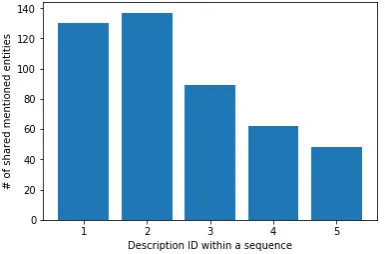
Figure 4: Position in the sequence of objects mentioned both in sequence and caption.
To investigate whether the sequences tend to
mention salient objects first, we compared them to the captions that we collected for a subset of the corpus. In the collected captions, on average 3.7 links to image objects were found.
65% of all objects mentioned in all captions were also mentioned in the sequences, but only 32% of the objects mentioned in the sequences were mentioned in the captions. Figure 4 shows that objects mentioned in both caption and se-quence tend to occur early in the sese-quence.
Co-reference We expected that this dataset would also provide interesting data for learning to co-refer, see e.g.Lin et al.(2015). The examples in Figure2illustrate the phenomenon. In each of the sequences, there is an object that is referred to repeatedly, and in all of them, it is the central or most salient one (the bed, the bathtub, the couch). As it should be, first mentions are indefinite NPs (“a deep soaking tub”) and repeated mentions defi-nite NPs (“the bathtub”). The exceptions are inter-esting as well: In Figure2a, the definite “the bed” can be resolved as given with a bridging inference (Clark, 1977) linking it to “bedroom”, and “the headboard” to “the bed”. Pronominal co-reference occurs as well, with at least one pronoun, as de-termined via their POS tag as assigned by SpaCy (Honnibal and Montani,2017), occurring in 42% of the sequences. We leave to future work an anal-ysis of a larger part of the corpus in terms of the
centeringprocess assumed by Grosz et al.(1995) to underly local coherence.
4 Conclusions
[image:4.595.85.278.583.710.2]References
Steven Bird, Ewan Klein, and Edward Loper. 2009.
Natural Language Processing with Python, 1st edi-tion. O’Reilly Media, Inc.
Xinlei Chen, Hao Fang, Tsung-Yi Lin, Ramakr-ishna Vedantam, Saurabh Gupta, Piotr Doll´ar, and C. Lawrence Zitnick. 2015. Microsoft COCO cap-tions: Data collection and evaluation server. CoRR, abs/1504.00325.
Herbert Clark. 1977. Bridging. In Phillip N. Johnson-Laird and P. C. Wason, editors,Thinking: Readings in Computer Science, pages 411–420. Cambridge University Press, Cambridge, UK.
Herbert H. Clark. 1996. Using Language. Cambridge University Press, Cambridge.
Abhishek Das, Satwik Kottur, Khushi Gupta, Avi Singh, Deshraj Yadav, Jos´e MF Moura, Devi Parikh, and Dhruv Batra. 2017. Visual dialog. In Proceed-ings of the IEEE Conference on Computer Vision and Pattern Recognition, volume 2.
Harm De Vries, Florian Strub, Sarath Chandar, Olivier Pietquin, Hugo Larochelle, and Aaron Courville. 2017. Guesswhat?! visual object discovery through multi-modal dialogue. InProc. of CVPR.
Rui Fang, Malcolm Doering, and Joyce Y Chai. 2014. Collaborative models for referring expression gen-eration in situated dialogue. InTwenty-Eighth AAAI Conference on Artificial Intelligence.
Albert Gatt and Emiel Krahmer. 2018. Survey of the state of the art in natural language generation: Core tasks, applications and evaluation. Journal of Artifi-cial Intelligence Research, 61:65–170.
Barbara Grosz, Aravind K. Joshi, and Scott Weinstein. 1995. Centering: A framework for modelling the local coherence of discourse. Computational Lin-guistics, 21(2):203–225.
Barbara J. Grosz and Candace L. Sidner. 1986. Atten-tion, intentions, and the structure of discourse. Com-put. Linguist., 12(3):175–204.
Micah Hodosh, Peter Young, and Julia Hockenmaier. 2013. Framing image description as a ranking task: Data, models and evaluation metrics. J. Artif. Int. Res., 47(1):853–899.
Matthew Honnibal and Ines Montani. 2017. spacy 2: Natural language understanding with bloom embed-dings, convolutional neural networks and incremen-tal parsing. To appear.
Nikolai Ilinykh, Sina Zarrieß, and David Schlangen. 2018. The task matters: Comparing image cap-tioning and task-based dialogical image description. InProceedings of the 11th International Conference on Natural Language Generation, pages 397–402, Tilburg University, The Netherlands. Association for Computational Linguistics.
Nikolai Ilinykh, Sina Zarrieß, and David Schlangen. 2019. Meetup! a corpus of joint activity dialogues in a visual environment. InProceedings of the 23rd Workshop on the Semantics and Pragmatics of Dia-logue (SemDial 2019 / LondonLogue), London, UK. Sahar Kazemzadeh, Vicente Ordonez, Mark Matten, and Tamara L Berg. 2014. ReferItGame: Referring to Objects in Photographs of Natural Scenes. In Pro-ceedings of the Conference on Empirical Methods in Natural Language Processing (EMNLP 2014), pages 787–798, Doha, Qatar.
Jonathan Krause, Justin Johnson, Ranjay Krishna, and Li Fei-Fei. 2017. A hierarchical approach for gen-erating descriptive image paragraphs. InComputer Vision and Patterm Recognition (CVPR).
Dahua Lin, Sanja Fidler, Chen Kong, and Raquel Ur-tasun. 2015. Generating multi-sentence natural lan-guage descriptions of indoor scenes. InProceedings of the British Machine Vision Conference (BMVC), pages 93.1–93.13. BMVA Press.
Tsung-Yi Lin, Michael Maire, Serge Belongie, James Hays, Pietro Perona, Deva Ramanan, Piotr Doll´ar, and C.Lawrence Zitnick. 2014. Microsoft coco: Common objects in context. InComputer Vision – ECCV 2014, volume 8693, pages 740–755. Springer International Publishing.
Tomas Mikolov, Kai Chen, Gregory S. Corrado, and Jeffrey Dean. 2013. Efficient estimation of word representations in vector space. CoRR, abs/1301.3781.
Bryan A. Plummer, Liwei Wang, Chris M. Cervantes, Juan C. Caicedo, Julia Hockenmaier, and Svetlana Lazebnik. 2015. Flickr30k entities: Collecting region-to-phrase correspondences for richer image-to-sentence models.CoRR, abs/1505.04870. Anna Rohrbach, Marcus Rohrbach, Ronghang Hu,
Trevor Darrell, and Bernt Schiele. 2015. Ground-ing of textual phrases in images by reconstruction.
CoRR, abs/1511.03745.
C. Wah, S. Branson, P. Welinder, P. Perona, and S. Be-longie. 2011. The Caltech-UCSD Birds-200-2011 Dataset. Technical Report CNS-TR-2011-001, Cal-ifornia Institute of Technology.
Mingzhe Wang, Mahmoud Azab, Noriyuki Kojima, Rada Mihalcea, and Jia Deng. 2016. Structured matching for phrase localization. InComputer Vi-sion – ECCV 2016, pages 696–711, Cham. Springer International Publishing.
Jianxiong Xiao, Krista A. Ehinger, James Hays, Anto-nio Torralba, and Aude Oliva. 2016. Sun database: Exploring a large collection of scene categories.Int. J. Comput. Vision, 119(1):3–22.
L. Yu, P. Poirson, S. Yang, A.C. Berg, and Berg T.L. 2016. Modeling context in referring expressions. InComputer Vision – ECCV 2016, volume 9906 of
Sina Zarrieß and David Schlangen. 2016. Easy things first: Installments improve referring expression gen-eration for objects in photographs. In Proceed-ings of the 54th Annual Meeting of the Association for Computational Linguistics (Volume 1: Long Pa-pers), pages 610–620, Berlin, Germany. Association for Computational Linguistics.
Bolei Zhou, Hang Zhao, Xavier Puig, Sanja Fidler, Adela Barriuso, and Antonio Torralba. 2017. Scene parsing through ade20k dataset. In Proceedings of the IEEE Conference on Computer Vision and Pat-tern Recognition.
A Instructions
Imagine that you are talking to someone over the phone, who sees a set of images of places. What you see is one image from this set. Your partner has to pick out the image that you see out of the set that they see.
What would you say?
Imagine that is a game and the both of you want to do this as quickly as possible. There are several text fields here. Imag-ine that your partner can’t immediately find the image, and you want to offer more information, or phrase what you’ve said differently, until they find the image.
We will pay you (and accept your results) only if you (a) fill our all the text fields with descriptions, (b) provide reasonable descriptions,
(c) properly follow the instructions.
You can get an image zoomed in by clicking on it.