Optimizing Statistical Machine Translation for Text Simplification
Wei Xu1, Courtney Napoles2, Ellie Pavlick1, Quanze Chen1 and Chris Callison-Burch1 1 Computer and Information Science Department
University of Pennsylvania
{xwe, epavlick, cquanze, ccb}@seas.upenn.edu
2Department of Computer Science
Johns Hopkins University [email protected]
Abstract
Most recent sentence simplification systems use basic machine translation models to learn lexical and syntactic paraphrases from a man-ually simplified parallel corpus. These meth-ods are limited by the quality and quantity of manually simplified corpora, which are expen-sive to build. In this paper, we conduct an in-depth adaptation of statistical machine trans-lation to perform text simplification, taking advantage of large-scale paraphrases learned from bilingual texts and a small amount of manual simplifications with multiple refer-ences. Our work is the first to design auto-matic metrics that are effective for tuning and evaluating simplification systems, which will facilitate iterative development for this task.
1 Introduction
The goal of text simplification is to rewrite an input text so that the output is more readable. Text sim-plification has applications for reducing input com-plexity for natural language processing (Siddharthan et al., 2004; Miwa et al., 2010; Chen et al., 2012b) and providing reading aids for people with lim-ited language skills (Petersen and Ostendorf, 2007; Watanabe et al., 2009; Allen, 2009; De Belder and Moens, 2010; Siddharthan and Katsos, 2010) or lan-guage impairments such as dyslexia (Rello et al., 2013), autism (Evans et al., 2014), and aphasia (Car-roll et al., 1999).
It is widely accepted that sentence simplification can be implemented by three major types of
oper-ations: splitting, deletionand paraphrasing(Feng, 2008). The splitting operation decomposes a long sentence into a sequence of shorter sentences. Dele-tion removes less important parts of a sentence. The paraphrasing operation includes reordering, lexical substitutions and syntactic transformations. While sentence splitting (Siddharthan, 2006; Petersen and Ostendorf, 2007; Narayan and Gardent, 2014; An-grosh et al., 2014) and deletion (Knight and Marcu 2002; Clarke and Lapata 2006; Filippova and Strube 2008; Filippova et al. 2015; Rush et al. 2015; and others) have been intensively studied, there has been considerablylessresearch on developing new para-phrasing models for text simplification — most pre-vious work has used off-the-shelf statistical machine translation (SMT) technology and achieved reason-able results (Coster and Kauchak, 2011a,b; Wubben et al., 2012; ˇStajner et al., 2015). However, they have either treated the judgment technology as a black (Coster and Kauchak, 2011a,b; Narayan and Gar-dent, 2014; Angrosh et al., 2014; ˇStajner et al., 2015) or they have been limited to modifying only one as-pect of it, such as the translation model (Zhu et al., 2010; Woodsend and Lapata, 2011) or the reranking component (Wubben et al., 2012).
In this paper, we present a complete adaptation of a syntax-based machine translation framework to perform simplification. Our methodology poses text simplification as a paraphrasing problem: given an input text, rewrite it subject to the constraints that the output should be simpler than the input, while preserving as much meaning of the input as pos-sible, and maintaining the well-formedness of the text. Going beyond previous work, we make
di-401
rect modifications to four key components in the SMT pipeline:1 1) two novel simplification-specific tunable metrics; 2) large-scale paraphrase rules au-tomatically derived from bilingual parallel corpora, which are more naturally and abundantly available than manually simplified texts; 3) rich rule-level simplification features; and 4) multiple reference simplifications collected via crowdsourcing for tun-ing and evaluation. In particular, we report the first study that shows promising correlations of au-tomatic metrics with human evaluation. Our work answers the call made in a recent TACL paper (Xu et al., 2015) to address problems in current simplifi-cation research — we amend human evaluation cri-teria, develop automatic metrics, and generate an improved multiple reference dataset.
Our work is primarily focused on lexical simplifi-cation (rewriting words or phrases with simpler ver-sions), and to a lesser extent on syntactic rewrite rules that simplify the input. It largely ignores the important subtasks of sentence splitting and dele-tion. Our focus on lexical simplification does not af-fect the generality of the presented work, since dele-tion or sentence splitting could be applied as pre- or post-processing steps.
2 Background
Xu et al. (2015) laid out a series of problems that are present in current text simplification research, and argued that we should deviate from the previous state-of-the-art benchmarking setup.
First, the Simple English Wikipedia data has dom-inated simplification research since 2010 (Zhu et al., 2010; Siddharthan, 2014), and is used together with Standard English Wikipedia to create parallel text to train MT-based simplification systems. How-ever, recent studies (Xu et al., 2015; Amancio and Specia, 2014; Hwang et al., 2015; ˇStajner et al., 2015) showed that the parallel Wikipedia simplifi-cation corpus contains a large proportion of inade-quate (not much simpler) or inaccurate (not aligned or only partially aligned) simplifications. It is one of the leading reasons that existing simplification sys-tems struggle to generate simplifying paraphrases and leave the input sentences unchanged (Wubben
1Our code and data are made available at: https:// github.com/cocoxu/simplification/
et al., 2012). Previously researchers attempted some quick fixes by adding phrasal deletion rules (Coster and Kauchak, 2011a) or reranking n-best outputs based on their dissimilarity to the input (Wubben et al., 2012). In contrast, we exploit data with im-proved quality and enlarged quantity, namely, large-scale paraphrase rules automatically derived from bilingual corpora and a small amount of manual simplification data with multiple references for tun-ing parameters. We then systematically design new tuning metrics and rich simplification-specific fea-tures into a syntactic machine translation model to enforce optimization towards simplicity. This ap-proach achieves better simplification performance without relying on a manually simplified corpus to learn paraphrase rules, which is important given the fact that Simple Wikipedia and the newly released Newsela simplification corpus (Xu et al., 2015) are only available for English.
Second, previous evaluation used in the simplifi-cation literature is uninformative and not compara-ble across models due to the complications between the three different operations of paraphrasing, dele-tion, and splitting. This, combined with the unreli-able quality of Simple Wikipedia as a gold reference for evaluation, has been the bottleneck for develop-ing automatic metrics. There exist only a few stud-ies (Wubben et al., 2012; ˇStajner et al., 2014) on au-tomatic simplification evaluation using existing MT metrics which show limited correlation with human assessments. In this paper, we restrict ourselves to lexical simplification, where we believe MT-derived evaluation metrics can best be deployed. Our newly proposed metric is the first automatic metric that shows reasonable correlation with human evalua-tion on the text simplificaevalua-tion task. We also intro-duce multiple references to make automatic evalua-tion feasible.
choice and grammar. Our work is also related to other tunable metrics designed to be very simple and light-weight to ensure fast repeated computation for tuning bilingual translation models (Liu et al., 2010; Chen et al., 2012a). To the best of our knowledge, no tunable metric has been attempted for simplifica-tion, except for BLEU. Nor do any evaluation met-rics exist for simplification, although there are sev-eral designed for other text-to-text generation tasks: grammatical error correction (Napoles et al., 2015; Felice and Briscoe, 2015; Dahlmeier and Ng, 2012), paraphrase generation (Chen and Dolan, 2011; Xu et al., 2012; Sun and Zhou, 2012), and conversation generation (Galley et al., 2015). Another line of re-lated work is lexical simplification that focuses on finding simpler synonyms of a given complex word (Yatskar et al., 2010; Biran et al., 2011; Specia et al., 2012; Horn et al., 2014).
3 Adapting Machine Translation for Simplification
We adapt the machinery of statistical machine trans-lation to the task of text simplification by making changes in the following four key components:
3.1 Simplification-specific Objective Functions
In the statistical machine translation framework, one crucial element is to design automatic evaluation metrics to be used as training objectives. Train-ing algorithms, such as MERT (Och, 2003) or PRO (Hopkins and May, 2011), then directly optimize the model parameters such that the end-to-end simplifi-cation quality is optimal. Unfortunately, previous work on text simplification has only used BLEU for tuning, which is insufficient as we show empirically in Section 4. We propose two new light-weight met-rics instead:FKBLEUthat explicitly measures read-ability andSARIthat implicitly measures it by com-paring against the input and references.
Unlike machine translation metrics which do not compare against the (foreign) input sentence, it is necessary to compare simplification system outputs against the inputs to assess readability changes. It is also important to keep tunable metrics as simple as possible, since they are repeatedly computed dur-ing the tundur-ing process for hundreds of thousands of candidate outputs.
FKBLEU
Our first metric combines a previously proposed metric for paraphrase generation,iBLEU (Sun and
Zhou, 2012), and the widely used readability metric, Flesch-Kincaid Index (Kincaid et al., 1975). iBLEU is an extension of the BLEU metric to measure di-versity as well as adequacy of the generated para-phrase output. Given a candidate sentenceO, human referencesRand input textI, iBLEU is defined as:
iBLEU = α×BLEU(O, R) (1)
−(1−α)×BLEU(O, I).
whereαis a parameter taking balance between
ade-quacy and dissimilarity, and set to0.9empirically as suggested by Sun and Zhou (2012).
Since the text simplification task aims at improv-ing readability, we include the Flesch-Kincaid Index (FK) which estimates the readability of text using cognitively motivated features (Kincaid et al., 1975):
FK = 0.39×
#words #sentences
(2)
+11.8×
#syllables #words
−15.59
with a lower value indicating higher readability.2 We adapt FK to score individual sentences and change it so that it counts punctuation tokens as well as word, and counts each punctuation token as one syllable. This prevents it from arbitrarily deleting punctua-tion.
FK measures readabilityassuming that the text is well-formed, and therefore is insufficient alone as a metric for generating or evaluating automatically generated sentences. Combining FK and iBLEU captures both a measure of readability and adequacy. The resulting objective function, FKBLEU, is de-fined as a geometric mean of the iBLEU and the FK difference between input and output sentences:
FKBLEU=iBLEU(I, R, O)×FKdiff(I, O) FKdiff=sigmoid(FK(O)−FK(I)) (3) Sentences with higher FKBLEU values are better simplifications with higher readability.
SARI
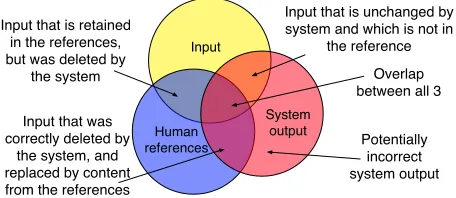
We design a second new metricSARI that
prin-cipally compares system output against references and against the input sentence. It explicitly mea-sures the goodness of words that are added, deleted and kept by the systems (Figure 1).
We reward addition operations, where system out-putOwas not in the inputI but occurred in any of
the referencesR, i.e. O∩I∩R. We definen-gram
precision p(n) and recall r(n) for addition opera-tions as follows:3
padd(n) =
P
g∈Omin
#g(O∩I),#g(R)
P
g∈O#g(O∩I)
radd(n) =
P
g∈Omin
#g(O∩I),#g(R)
P
g∈O#g(R∩I)
(4)
where#g(·)is a binary indicator of occurrence ofn -gramsgin a given set (and is a fractional indicator
in some later formulas) and
#g(O∩I) = max(#g(O)−#g(I),0)
#g(R∩I) = max(#g(R)−#g(I),0)
Therefore, in the example below, the addition of un-igramnowis rewarded in bothpadd(n)andradd(n), while the addition ofyouinOUTPUT-1 is penalized
inpadd(n):
INPUT: About 95 species are currently accepted .
REF-1: About 95 species are currently known .
REF-2: About 95 species are now accepted .
REF-3: 95 species are now accepted .
OUTPUT-1: About 95 you now get in .
OUTPUT-2: About 95 species are now agreed .
OUTPUT-3:About 95 species are currently agreed.
The corresponding SARI scores of these three toy outputs are 0.2683, 0.7594, 0.5890, which match with intuitions about their quality. To put it in perspective, the BLEU scores are 0.1562, 0.6435, 0.6435 respectively. BLEU fails to distinguish be-tween OUTPUT-2 and OUTPUT-3 because match-ing any one of references is credited the same. Not all the references are necessarily complete simpli-fications, e.g. REF-1 doesn’t simplify the word 3In the rare case when the denominator is 0 in calculating precisionpor recallr, we simply set the value ofpandrto 0.
Input
System output Human
references
Input that is unchanged by system and which is not in
the reference Input that is retained
in the references, but was deleted by
the system Overlap
between all 3
Input that was correctly deleted by
the system, and replaced by content from the references
[image:4.612.313.541.57.156.2]Potentially incorrect system output
Figure 1: Metrics that evaluate the output of monolingual text-to-text generation systems can compare system out-put against references and against the inout-put sentence, un-like in MT metrics which do not compare against the (for-eign) input sentence. The different regions of this Venn diagram are treated differently with our SARI metric.
currently, which gives BLEU too much latitude for matching the input.
Words that are retained in both the system out-put and references should be rewarded. When mul-tiple references are used, the number of references in which an n-gram was retained matters. It takes into account that some words/phrases are considered simple and are unnecessary (but still encouraged) to be simplified. We useR0to mark the n-gram counts
overRwith fractions, e.g. if a unigram (wordabout
in above example) occurs in 2 out of the totalr
ref-erences, then its count is weighted by2/rin
compu-tation of precision and recall:
pkeep(n) =
P
g∈Imin
#g(I∩O),#g(I∩R0)
P
g∈I#g(I∩O)
rkeep(n) =
P
g∈Imin
#g(I∩O),#g(I∩R0)
P
g∈I#g(I∩R0)
(5)
where
#g(I∩O) = min #g(I),#g(O)
#g(I∩R0) = min #g(I),#g(R)/r
For deletion, we only use precision because over-deleting hurts readability much more significantly than not deleting:
pdel(n) =
P
g∈Imin
#g(I∩O),#g(I∩R0)
P
g∈I#g(I∩O) (6) where
#g(I∩O) = max #g(I)−#g(O),0
[RB] solely → only
Lexical [NN] objective → goal
[JJ] undue → unnecessary
[VP] accomplished → carried out
Phrasal [VP/PP] make a significant contribution → contribute greatly
[VP/S] is generally acknowledged that → is widely accepted that [NP/VP] the manner in which NN → the way NN
Syntactic [NP] NNP ’s population → the people of NNP
[image:5.612.108.506.53.179.2][NP] NNP ’s JJ legislation → the JJ law of NNP
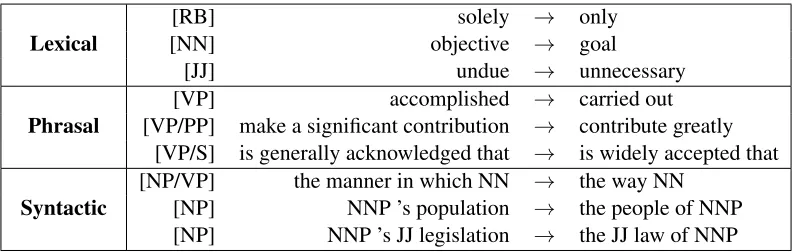
Table 1: Example paraphrase rules in the Paraphrase Database (PPDB) that result in simplifications of the input. The rules are synchronous context-free grammar (SCFG) rules where uppercase indicates non-terminal symbols. Non-terminals can be complex symbols like VP/S which indicates that the rule forms a verb phrase (VP) missing a sentence (S) to its right. The final syntactic rule both simplifies and reorders the input phrase.
The precision of what is kept also reflects the suf-ficiency of deletions. The n-gram counts are also weighted inR0 to compensate n-grams, such as the wordcurrently in the example, that are not consid-ered asrequired simplificationby human editors.
Together, in SARI, we use arithmetic average of n-gram precisionsPoperationand recallsRoperation:
SARI =d1Fadd+d2Fkeep+d3Pdel (7)
whered1 =d2 =d3 =1/3and
Poperation=
1 k
X
n=[1,...,k]
poperation(n)
Roperation=
1 k
X
n=[1,...,k]
roperation(n)
Foperation=
2×Poperation×Roperation
Poperation+Roperation
operation∈[del, keep, add]
wherekis the highest n-gram order and set to 4 in
our experiments.
3.2 Incorporating Large-Scale Paraphrase Rules
Another challenge for text simplification is generat-ing an ample set of rewrite rules that potentially sim-plify an input sentence. Most early work has relied on either hand-crafted rules (Chandrasekar et al., 1996; Carroll et al., 1999; Siddharthan, 2006; Vick-rey and Koller, 2008) or dictionaries like WordNet (Devlin et al., 1999; Kaji et al., 2002; Inui et al., 2003). Other more recent studies have relied on
the parallel Normal-Simple Wikipedia Corpus to au-tomatically extract rewrite rules (Zhu et al., 2010; Woodsend and Lapata, 2011; Coster and Kauchak, 2011b; Wubben et al., 2012; Narayan and Gar-dent, 2014; Siddharthan and Angrosh, 2014; An-grosh et al., 2014). This technique does manage to learn a small number of transformations that sim-plify. However, we argue that because the size of the Normal-Simple Wikipedia parallel corpus is quite small (108k sentence pairs with 2 million words), the diversity and coverage of patterns that can be learned is actually quite limited.
In this paper we will leverage the large-scale Para-phrase Database (PPDB)4(Ganitkevitch et al., 2013; Pavlick et al., 2015) as a rich source of lexical, phrasal and syntactic simplification operations. It is created by extracting English paraphrases from bilingual parallel corpora using a technique called “bilingual pivoting” (Bannard and Callison-Burch, 2005). The PPDB is represented as a synchronous context-free grammar (SCFG), which is commonly used as the formalism for syntax-based machine translation (Zollmann and Venugopal, 2006; Chiang, 2007; Weese et al., 2011). Table 1 shows some ex-ample paraphrase rules in the PPDB.
PPDB employs 1000 times more data (106 mil-lion sentence pairs with 2 bilmil-lion words) than the Normal-Simple Wikipedia parallel corpus. The En-glish portion of PPDB contains over 220 million paraphrase rules, consisting of 8 million lexical, 73 million phrasal and 140 million syntactic
phrase patterns. The key differences between the paraphrase rules from PPDB and the transforma-tions learned by the naive application of SMT to the Normal-Simple Wikipedia parallel corpus, are that the PPDB paraphrases are much more diverse. For example, PPDB contains 214 paraphrases for
ancient including antique, ancestral, old, age-old, archeological, former, antiquated, longstanding, ar-chaic, centuries-old, and so on. However, there is nothing inherent in the rule extraction process to say which of the PPDB paraphrases are simplifications.
In this paper, we model the task by incorporating rich features into each rule and let SMT advances in decoding and optimization determine how well a rule simplifies an input phrase. An alternative way of using PPDB for simplification would be to sim-ply discard any of its rules which did not result in a simplified output, possibly using a simple super-vised classifier (Pavlick and Callison-Burch, 2016).
3.3 Simplification-specific Features for Paraphrase Rules
Designing good features is an essential aspect of modeling. For each input sentenceiand its
candi-date output sentencej, a vector of feature functions
~
ϕ= {ϕ1...ϕN}are combined with a weight vector
~
win a linear model to obtain a single scorehw~:
hw~(i, j) =w~·ϕ~(i, j) (8)
In SMT, typical feature functions are phrase trans-lation probabilities, word-for-word lexical transla-tion probabilities, a rule applicatransla-tion penalty (which governs whether the system prefers fewer longer phrases or a greater number of shorter phrases), and a language model probability. Together these fea-tures are what the model uses to distinguish between good and bad translations. For monolingual transla-tion tasks, previous research suggests that features like paraphrase probability and distributional sim-ilarity are potentially helpful in picking out good paraphrases (Chan et al., 2011) and for text-to-text generation (Ganitkevitch et al., 2012b). While these two features quantify how good a paraphrase rule is
in general, they do not indicate how good the rule is for a specific task, like simplification.
For each paraphrase rule, we use all the 33 fea-tures that were distributed with PPDB 1.0 and add
9 new features for simplification purposes:5 length in characters, length in words, number of syllables, language model scores, and fraction of common En-glish words in each rule. These features are com-puted for both sides of a paraphrase pattern, the word with the maximum number of syllables on each side and the difference between the two sides, when it is applicable. We use language models built from the Gigaword corpus and the Simple Wikipedia corpus collected by Kauchak (2013). We also use a list of 3000 most common US English words compiled by Paul and Bernice Noll.6
3.4 Creating Multiple References
Like with machine translation, where there are many equally good translations, in simplification there may be several ways of simplifying a sentence. Most previous work on text simplification only uses a sin-gle reference simplification, often from the Simple Wikipedia. This is undesirable since the Simple Wikipedia contains a large proportion of inadequate or inaccurate simplifications (Xu et al., 2015) .
In this study, we collect multiple human reference simplifications that focus on simplification by para-phrasing rather than deletion or splitting. We first selected the Simple-Normal sentence pairs of simi-lar length (≤20% differences in number of tokens) from the Parallel Wikipedia Simplification (PWKP) corpus (Zhu et al., 2010) that are more likely to be paraphrase-only simplifications. We then asked 8 workers on Amazon Mechanical Turk to rewrite a selected sentence from Normal Wikipedia (a subset of PWKP) into a simpler version while preserving its meaning, without losing any information or split-ting sentence. We removed bad workers by man-ual inspection on the worker’s first several submis-sions on the basis of a recent study (Gao et al., 2015) on crowdsourcing translation that suggests Turkers’ performance stays consistent over time and can be reliably predicted by their first few translations.
In total, we collected 8 reference simplifications for 2350 sentences, and randomly split them into 2000 sentences for tuning, 350 for evaluation. Many crowdsourcing workers were able to provide simpli-fications of good quality and diversity (see Table 2
for an example and Table 4 for the manual quality evaluation). Having multiple references allows us to develop automatic metrics similar to BLEU to take advantage of the variation across many people’s sim-plifications. We leave more in-depth investigations on crowdsourcing simplification (Pellow and Eske-nazi, 2014a,b) for future work.
3.5 Tuning Parameters
Like in statistical machine translation, we set the weights of the linear model w~ in the Equation (8)
so that the system’s output is optimized with re-spect to the automatic evaluation metric on the 2000 sentence development set. We use the pairwise ranking optimization (PRO) algorithm (Hopkins and May, 2011) implemented in the open-source Joshua toolkit (Ganitkevitch et al., 2012a; Post et al., 2013) for tuning.
Specifically, we train the system to distinguish a good candidate output j from a bad candidate j0,
measured by an objective functiono (Section 3.1), for an input sentencei:
o(i, j)>o(i, j0) ⇐⇒ hw~(i, j)> hw~(i, j0) ⇐⇒ hw~(i, j)−hw~(i, j0)>0 ⇐⇒ w~·ϕ~(i, j)−w~ ·ϕ~(i, j0)>0 ⇐⇒ w~·(ϕ~(i, j)−ϕ~(i, j0))>0
(9)
Thus, the optimization reduces to a binary classifi-cation problem. Each training instance is the dif-ference vector ϕ~(i, j) −ϕ~(i, j0)) of a pair of can-didates, and its training label is positive or negative depending on whether the value ofo(i, j)−o(i, j0) is positive or negative. The candidates are generated according tohw~ at each iteration, and sampled for making the training tractable. We use different met-rics: BLEU, FKBLEU and SARI as objectives.
4 Experiments and Analyses
We implemented all the proposed adaptations into the open source syntactic machine translation de-coder Joshua (Post et al., 2013),7 and conducted the experiments with PPDB and the dataset of 2350 sentences collected in Section 3.4. Most recent 7http://joshua-decoder.org/We augment its lat-est version to include the text-to-text generation functionality described in this paper.
Paraphrase Rule Trans. Model Score
principal→key 4.515
principal→main 4.514
principal→major 4.358
principal→chief 3.205
principal→core 3.025
principal→principal 2.885
principal→top 2.600
principal→senior 2.480
principal→lead 2.377
principal→primary 2.171
principal→prime 1.432
principal→keynote -0.795 able-bodied→valid 6.435
able-bodied→sound 5.838
[image:7.612.319.536.52.307.2]able-bodied→healthy 4.446 able-bodied→able-bodied 3.372 able-bodied→job-ready 1.611 able-bodied→employable -0.363 able-bodied→non-disabled -2.207
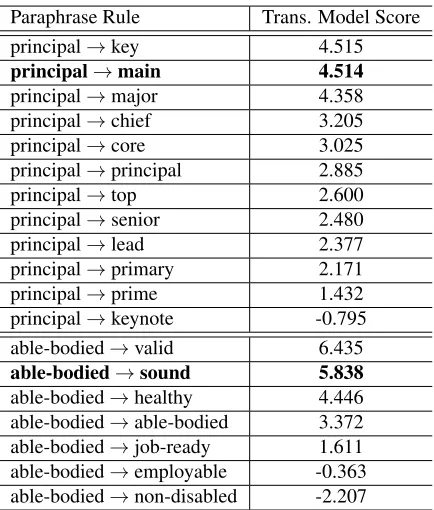
Table 3: Qualitative analysis of candidate paraphrases ranked by the translation model in SBMT (PPDB + SARI), showing that the model is optimized towards sim-plicity in addition to the correctness of paraphrases. The final simplifications (in bold) are chosen in conjunction with the language model to fit the context and further bias towards more common n-grams.
end-to-end sentence simplification systems use a basic phrase-based MT model trained on parallel Wikipedia data using the Moses decoder (ˇStajner et al., 2015, and others). One of the best systems is PBMT-R by Wubben et al. (2012), which reranks Moses’ n-best outputs based on their dissimilarity to the input to promote simplification. We also build a baseline by using BLEU as the tuning metric in our adapted MT framework. We conduct both human and automatic evaluation to demonstrate the advan-tage of the proposed simplification systems. We also show the effectiveness of the two new metrics in tun-ing and automatic evaluation.
[image:7.612.317.535.54.309.2]4.1 Qualitative Analysis
para-Sentence
Normal Wikipedia Jeddah is the principal gateway to Mecca, Islam’s holiest city, which able-bodied Muslims are required to visit at least once in their lifetime.
Simple Wikipedia Jeddah is themaingateway to Mecca,theholiest cityofIslam, where able-bodied Muslims must goto at least once inalifetime.
Mechanical Turk #1 Jeddah is themain entranceto Mecca,theholiest cityinIslam, whichall healthyMuslims needto visit at least once in theirlife.
Mechanical Turk #2 Jeddah is themain entranceto Mecca, Islam’s holiest city, whichpureMuslims are re-quired to visit at least once in their lifetime.
PBMT-R(Wubben et al., 2012) Jeddah is themaingateway to Mecca, Islam’s holiest city, which able-bodied Muslims are requiredof Muslimsat least once in their lifetime.
SBMT(PPDB + BLEU) Jeddah is themain doorto Mecca, Islam’s holiest city, whichsoundMuslims areto go to at least once in theirlife.
SBMT(PPDB + FKBLEU) Jeddah is themaingateway to Mecca, Islam’s holiest city, whichsoundMuslimsmust visit at least once in theirlife.
SBMT(PPDB + SARI) Jeddah is themaingateway to Mecca, Islam’s holiest city, whichsoundMuslimshave to visit at least once in their life.
Table 2: Example human reference simplifications and automatic simplification system outputs. The bold font high-lights the parts of the sentence that are different from the original version in the Normal Wikipedia, and strikethrough denotes deletions.
phrases learned from the more abundant bilingual texts. It improves method applicability to languages other than English, for which no simpler version of Wikipedia is available.
Our proposed approach also provides an intu-itive way to inspect the ranking of candidate para-phrases in the translation model. This is done by scoring each rule in PPDB by Equation 8 using the weights optimized in the tuning process, as in Ta-ble 3. It shows that our proposed method is capaTa-ble of capturing the notion of simplicity using a small amount of parallel tuning data. It correctly rankskey
andmainas good simplifications for principal. Its choices are not always perfect as it prefers sound
over healthy for able-bodied. The final simplifi-cation outputs are generated according to both the translation model and the language model trained on the Gigaword corpus to take into account context and further bias towards more common n-grams.
4.2 Quantitative Evaluation of Simplification Systems
For the human evaluation, participants were shown the original English Wikipedia sentence as a ref-erence and asked to judge a set of simplifications that were displayed in random order. They eval-uated a simplification from each system, the Sim-ple Wikipedia version, and a Turker simplification. Judges rated each simplification on two 5-point
scales of meaning retention and grammaticality (0 is the worst and 4 is the best). We also ask partici-pants to rate Simplicity Gain (Simplicity+) by count-ing how many successful lexical or syntactic para-phrases occurred in the simplification. We found this makes the judgment easier and that it is more infor-mative than rating the simplicity directly on 5-point scale, since the original sentences have very differ-ent readability levels to start with. More importantly, using simplicity gain avoids ovpunishment of er-rors, which are already penalized for poor meaning retention and grammaticality, and thus reduces the bias towards very conservative models. We collect judgments on these three criteria from five different annotators and report the average scores.
Grammar Meaning Simplicity+ #tokens #chars Edit Dist.
Normal Wikipedia 4.00 4.00 0.00 23 125 0.00
Simple Wikipedia 3.72 3.24 1.03 22 116 6.69
Mechanical Turk 3.70 3.36 1.35 19 104 8.25
PBMT-R(Wubben et al., 2012) 3.18 2.83 0.47 20 108 5.96
SBMT(PPDB + BLEU) 4.00 4.00 0.00 23 125 0.00
SBMT(PPDB + FKBLEU) 3.30 3.05 0.48 21 107 4.03
[image:9.612.84.526.54.159.2]SBMT(PPDB + SARI) 3.50 3.16 0.65 23 118 3.98
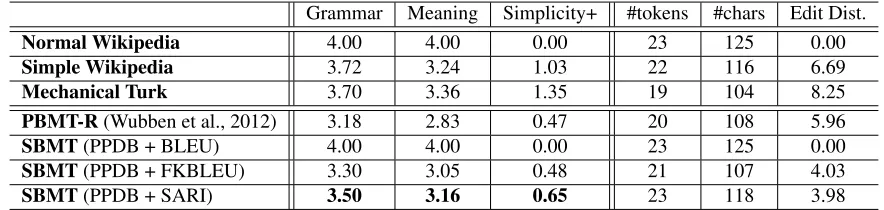
Table 4: Human evaluation (Grammar, Meaning, Simplicity+) and basic statistics of our proposed systems (SBMTs) and baselines. PBMT-R is an reimplementation of the state-of-the-art system by Wubben et al. (2012). Newly proposed metrics FKBLEU and SARI show advantages for tuning.
FK BLEU iBLEU FKBLEU SARI
Normal Wikipedia 12.88 99.05 78.41 62.48 26.05
Simple Wikipedia 11.25 66.75 53.53 61.75 38.42
Mechanical Turk 10.80 100.0 74.31 73.60 43.71
PBMT-R(Wubben et al., 2012) 11.10 63.12 48.91 59.00 33.77
SBMT(PPDB + BLEU) 12.88 99.05 78.41 62.48 26.05
SBMT(PPDB + FKBLEU) 10.75 74.48 58.10 66.68 34.18
SBMT(PPDB + SARI) 10.90 72.36 58.15 66.57 37.91
Table 5: Automatic evaluation of different simplification systems. Most systems achieve similar FK readability scores as human. The SARI metric ranks all 5 different systems and 3 human references in the same order as human assess-ment. Tuning towards BLEU with all 8 references results in identical transformation (same asNormal Wikipedia), as this can get a near-perfect BLEU score of 99.05 (out of 100).
outputs that are dissimilar to the input. Our best sys-tem is able to make more effective paraphrases (bet-ter Simplicity+) while introducing less errors (bet(bet-ter Grammar and Meaning).
Table 5 shows the automatic evaluation. An en-couraging fact is that SARI metric ranks all 5 dif-ferent systems and 3 human references in the same order as human assessment. Most systems achieve similar FK readability as human editors, using fewer words or words with fewer syllables. Tuning to-wards BLEU with all 8 references results in no trans-formation (same as input), as this can get a near-perfect BLEU score of 99.05 (out of 100).
Table 6 shows the computation time for different metrics. SARI is only slightly slower than BLEU but achieves much better simplification quality.
Time (milliseconds)
BLEU 0.12540908
FKBLEU 1.2527733
[image:9.612.114.257.620.673.2]SARI 0.15506646
Table 6: Average computation time of different metrics per candidate sentence.
4.3 Correlation of Automatic Metrics with Human Judgments
Table 7 shows the correlation of automatic metrics with human judgment. There are several interesting observations.
Spearman’sρ ref. Grammar Meaning Simplicity+ FK none - 0.002 (≈.976) 0.136 (<.010) 0.147 (<.010) BLEU single 0.366 (<.001) 0.459 (<.001) 0.151(<.005)
BLEU multiple 0.589(<.001) 0.701(<.001) 0.111 (<.050)
iBLEU single 0.313 (<.001) 0.397 (<.001) 0.149 (<.005) iBLEU multiple 0.492 (<.001) 0.609 (<.001) 0.141 (<.010)
FKBLEU multiple 0.349 (<.001) 0.410 (<.001) 0.235 (<.001)
[image:10.612.140.473.53.154.2]SARI multiple 0.342(<.001) 0.397(<.001) 0.343(<.001)
Table 7: Correlations (and two-tailed p-values) of metrics against the human ratings at sentence-level (also see Figure 3). In this work, we propose to use multiple (eight) references and two new metrics: FKBLEU and SARI. For all three criteria of simplification quality, SARI correlates reasonably with human judgments. In contrast, previous works use only a single reference. Existing metrics BLEU and iBLEU show higher correlations on grammaticality and meaning preservation using multiple references, but fail to measure the most important aspect of simplification – simplicity.
human evaluation every time a new model is built or parameters are adjusted.
Second, the correlation of automatic metrics with human judgment of grammaticality and meaning preservation is higher than any reported before (Wubben et al., 2012; ˇStajner et al., 2014). It val-idates our argument that constraining simplification to only paraphrasing reduces the complication from deletion and splitting, and thus makes automatic evaluation more feasible. Using multiple references further improves the correlations.
4.4 Why Does BLEU Correlate Strongly with Meaning/Grammar, and SARI with Simplicity?
Here we look more deeply at the correlations of BLEU and SARI with human judgments. Our SARI metric has highest correlation with human judg-ments of simplicity, but BLEU exhibits higher corre-lations on grammaticality and meaning preservation. BLEU was designed to evaluate bilingual transla-tion systems. It measures the n-gram precision of a system’s output against one or more references. BLEU ignores recall (and compensates for this with its brevity penalty). BLEU prefers an output that is not too short and contains only n-grams that appear in any reference. The role of multiple references in BLEU is to capture allowable variations in trans-lation quality. When applied to monolingual tasks like simplification, BLEU does not take into account anything about the differences between the input and the references. In contrast, SARI takes into account both precision and recall, by looking at the differ-ence between the referdiffer-ences and the input sentdiffer-ence.
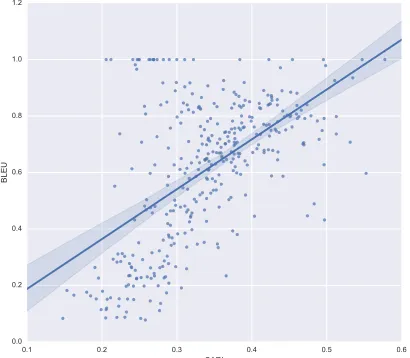
Figure 2: A scatter plot of BLEU scores vs. SARI scores for the individual sentences in our test set. The metrics’ scores for many sentences substantially diverge. Few of the sentences that scored perfectly in BLEU receive a high score from SARI.
In this work, we use multiple references to capture many different ways of simplifying the input.
Unlike bilingual translation, the more references created for the monolingual simplification task the more n-grams of the original input will be included in the references. That means, with more references, outputs that are close or identical to the input will get high BLEU. Outputs with few changes also receive high Grammar/Meaning scores from human judges; but these do not necessarily get high SARI scorenor
[image:10.612.325.530.243.422.2]0.1 0.2 0.3 0.4 0.5 0.6 0.7 0
1 2 3 4
Human Score
SARI vs. Grammar
0.1 0.2 0.3 0.4 0.5 0.6 0.7
SARI vs. Meaning
0.1 0.2 0.3 0.4 0.5 0.6 0.7
SARI vs. Simplicity
0.0 0.2 0.4 0.6 0.8 1.0 1.2
Automatic Score
0 1 2 3 4
Human Score
BLEU vs. Grammar
0.0 0.2 0.4 0.6 0.8 1.0 1.2
Automatic Score BLEU vs. Meaning
0.0 0.2 0.4 0.6 0.8 1.0 1.2
Automatic Score
Human Rating
[image:11.612.75.536.57.336.2]BLEU vs. Simplicity
Figure 3: Scatter plots of automatic metrics against human scores for individual sentences.
seen in Figure 2 where sentences with a BLEU score of 1.0 receive a range of scores from SARI.
The scatter plots in Figure 3 further illustrate the above analysis. These plots emphasize the correla-tion of high human scores on meaning/grammar for systems that make few changes (which BLEU re-wards, but SARI does not). The tradeoff is that con-servative outputs with few or no changes do not re-sult in increased simplicity. SARI correctly rewards systems that make changes that simplify the input.
5 Conclusions and Future Work
In this paper, we presented an effective adaptation of statistical machine translation techniques. We find the approach promising in suggesting two new directions: designing tunable metrics that corre-late with human judgements and using simplicity-enriched paraphrase rules derived from larger data than the Normal-Simple Wikipedia dataset. For fu-ture work, we think it might be possible to design a universal metric that works for multiple text-to-text generation tasks (including sentence simplifica-tion, compression and error correction), at the same
time using the same idea of comparing system out-put against multiple references and against the inout-put. The metric could possibly include tunable parame-ters or weighted human judgments on references to accommodate different tasks. Finally, we are also interested in designing neural translation models for the simplification task.
Acknowledgments
References
Allen, D. (2009). A study of the role of relative clauses in the simplification of news texts for learners of English. System, 37(4):585–599. Amancio, M. A. and Specia, L. (2014). An analysis
of crowdsourced text simplifications. In Proceed-ings of the 3rd Workshop on Predicting and Im-proving Text Readability for Target Reader Popu-lations (PITR).
Angrosh, M., Nomoto, T., and Siddharthan, A. (2014). Lexico-syntactic text simplification and compression with typed dependencies. In Pro-ceedings of the 14th Conference of the Euro-pean Chapter of the Association for Computa-tional Linguistics (EACL).
Bannard, C. and Callison-Burch, C. (2005). Para-phrasing with bilingual parallel corpora. In Pro-ceedings of the 43rd Annual Meeting of the Asso-ciation for Computational Linguistics (ACL). Biran, O., Brody, S., and Elhadad, N. (2011).
Putting it simply: A context-aware approach to lexical simplification. InProceedings of the 49th Annual Meeting of the Association for Computa-tional Linguistics: Human Language Technolo-gies (ACL-HLT).
Carroll, J., Minnen, G., Pearce, D., Canning, Y., De-vlin, S., and Tait, J. (1999). Simplifying text for language-impaired readers. InProceedings of the 14th Conference of the 9th European Conference for Computational Linguistics (EACL).
Chan, T. P., Callison-Burch, C., and Van Durme, B. (2011). Reranking bilingually extracted para-phrases using monolingual distributional similar-ity. In Proceedings of the Workshop on Geo-metrical Models of Natural Language Semantics (MTTG).
Chandrasekar, R., Doran, C., and Srinivas, B. (1996). Motivations and methods for text simpli-fication. In Proceedings of the 16th Conference on Computational linguistics (COLING).
Chen, B., Kuhn, R., and Larkin, S. (2012a). PORT: A precision-order-recall MT evaluation metric for tuning. InProceedings of the 50th Annual Meet-ing of the Association for Computational LMeet-inguis- Linguis-tics (ACL).
Chen, D. L. and Dolan, W. B. (2011). Collecting highly parallel data for paraphrase evaluation. In
Proceedings of the 49th Annual Meeting of the As-sociation for Computational Linguistics (ACL). Chen, H.-B., Huang, H.-H., Chen, H.-H., and
Tan, C.-T. (2012b). A simplification-translation-restoration framework for cross-domain SMT ap-plications. In Proceedings of the 24th Interna-tional Conference on ComputaInterna-tional Linguistics (COLING).
Chiang, D. (2007). Hierarchical phrase-based trans-lation. Computational Linguistics, 33(2):201– 228.
Clarke, J. and Lapata, M. (2006). Models for sentence compression: A comparison across do-mains, training requirements and evaluation mea-sures. In Proceedings of the 21st International Conference on Computational Linguistics and 44th Annual Meeting of the Association for Com-putational Linguistics (ACL-COLING).
Coster, W. and Kauchak, D. (2011a). Learning to simplify sentences using Wikipedia. In Proceed-ings of the Workshop on Monolingual Text-To-Text Generation.
Coster, W. and Kauchak, D. (2011b). Simple En-glish Wikipedia: A new text simplification task. InProceedings of the 49th Annual Meeting of the Association for Computational Linguistics: Hu-man Language Technologies (ACL-HLT).
Dahlmeier, D. and Ng, H. T. (2012). Better eval-uation for grammatical error correction. In Pro-ceedings of the 2012 Conference of the North American Chapter of the Association for Compu-tational Linguistics: Human Language Technolo-gies (NAACL-HLT).
De Belder, J. and Moens, M.-F. (2010). Text simpli-fication for children. InProceedings of the SIGIR Workshop on Accessible Search Systems.
Devlin, S., Tail, J., Canning, Y., Carroll, J., Min-nen, G., and Pearce, D. (1999). The application of assistive technology in facilitating the compre-hension of newspaper text by aphasic people. As-sistive Technology on the Threshold of the New Millennium, page 160.
for people with autism. In Proceedings of the 3rd Workshop on Predicting and Improving Text Readability for Target Reader Populations (PITR).
Felice, M. and Briscoe, T. (2015). Towards a stan-dard evaluation method for grammatical error de-tection and correction. In Proceedings of the 2015 Conference of the North American Chapter of the Association for Computational Linguistics (NAACL).
Feng, L. (2008). Text simplification: A survey. The City University of New York, Technical Report. Filippova, K., Alfonseca, E., Colmenares, C. A.,
Kaiser, L., and Vinyals, O. (2015). Sentence com-pression by deletion with LSTMs. InProceedings of the 2015 Conference on Empirical Methods in Natural Language Processing (EMNLP).
Filippova, K. and Strube, M. (2008). Dependency tree based sentence compression. InProceedings of the Fifth International Natural Language Gen-eration Conference (INLG).
Galley, M., Brockett, C., Sordoni, A., Ji, Y., Auli, M., Quirk, C., Mitchell, M., Gao, J., and Dolan, B. (2015). deltaBLEU: A discriminative metric for generation tasks with intrinsically diverse tar-gets. InProceedings of the 53rd Annual Meeting of the Association for Computational Linguistics (ACL).
Ganitkevitch, J., Cao, Y., Weese, J., Post, M., and Callison-Burch, C. (2012a). Joshua 4.0: Packing, PRO, and paraphrases. InProceedings of the Sev-enth Workshop on Statistical Machine Translation (WMT).
Ganitkevitch, J., Van Durme, B., and Callison-Burch, C. (2012b). Monolingual distributional similarity for text-to-text generation. In Proceed-ings of the First Joint Conference on Lexical and Computational Semantics (*SEM).
Ganitkevitch, J., Van Durme, B., and Callison-Burch, C. (2013). PPDB: The paraphrase database. InProceedings of the 2013 Conference of the North American Chapter of the Association for Computational Linguistics (NAACL).
Gao, M., Xu, W., and Callison-Burch, C. (2015). Cost optimization in crowdsourcing translation.
In Proceedings of the 2015 Conference of the North American Chapter of the Association for Computational Linguistics (NAACL).
Hopkins, M. and May, J. (2011). Tuning as rank-ing. In Proceedings of the Conference on Em-pirical Methods in Natural Language Processing (EMNLP).
Horn, C., Manduca, C., and Kauchak, D. (2014). Learning a lexical simplifier using Wikipedia. In
Proceedings of the 52th Annual Meeting of the As-sociatioin for Computational Linguistics (ACL). Hwang, W., Hajishirzi, H., Ostendorf, M., and Wu,
W. (2015). Aligning sentences from Standard Wikipedia to Simple Wikipedia. In Proceed-ings of the 2015 Conference of the North Ameri-can Chapter of the Association for Computational Linguistics (NAACL).
Inui, K., Fujita, A., Takahashi, T., Iida, R., and Iwakura, T. (2003). Text simplification for read-ing assistance: A project note. InProceedings of the 2nd International Workshop on Paraphrasing (IWP).
Kaji, N., Kawahara, D., Kurohash, S., and Sato, S. (2002). Verb paraphrase based on case frame alignment. In Proceedings of the 40th Annual Meeting on Association for Computational Lin-guistics (ACL).
Kauchak, D. (2013). Improving text simplification language modeling using unsimplified text data. InProceedings of the 2013 Conference of the As-sociation for Computational Linguistics (ACL). Kincaid, J. P., Fishburne Jr, R. P., Rogers, R. L., and
Chissom, B. S. (1975). Derivation of new read-ability formulas (automated readread-ability index, fog count and Flesch reading ease formula) for Navy enlisted personnel. Technical report, Defence Technical Information Center (DTIC) Document. Knight, K. and Marcu, D. (2002). Summarization beyond sentence extraction: A probabilistic ap-proach to sentence compression. Artificial Intelli-gence.
Miwa, M., Saetre, R., Miyao, Y., and Tsujii, J. (2010). Entity-focused sentence simplification for relation extraction. In Proceedings of the 23rd International Conference on Computational Lin-guistics (COLING).
Napoles, C., Sakaguchi, K., Post, M., and Tetreault, J. (2015). Ground truth for grammatical error correction metrics. In Proceedings of the 53rd Annual Meeting of the Association for Computa-tional Linguistics (ACL).
Narayan, S. and Gardent, C. (2014). Hybrid simpli-fication using deep semantics and machine trans-lation. InProceedings of the 52nd Annual Meet-ing of the Association for Computational LMeet-inguis- Linguis-tics (ACL).
Och, F. J. (2003). Minimum error rate training in statistical machine translation. InProceedings of the 41st Annual Meeting on Association for Com-putational Linguistics (ACL).
Pavlick, E., Bos, J., Nissim, M., Beller, C., Durme, B. V., and Callison-Burch, C. (2015). Adding se-mantics to data-driven paraphrasing. In Proceed-ings of the 53rd Annual Meeting of the Associa-tion for ComputaAssocia-tional Linguistics (ACL). Pavlick, E. and Callison-Burch, C. (2016). Simple
PPDB: A paraphrase database for simplification. InThe 54th Annual Meeting of the Association for Computational Linguistics (ACL).
Pellow, D. and Eskenazi, M. (2014a). An open corpus of everyday documents for simplification tasks. InProceedings of the 3rd Workshop on Pre-dicting and Improving Text Readability for Target Reader Populations (PITR).
Pellow, D. and Eskenazi, M. (2014b). Tracking hu-man process using crowd collaboration to enrich data. In Proceedings of Second AAAI Confer-ence on Human Computation and Crowdsourcing (HCOMP).
Petersen, S. E. and Ostendorf, M. (2007). Text sim-plification for language learners: A corpus anal-ysis. InProceedings of Workshop on Speech and Language Technology for (SLaTE).
Post, M., Ganitkevitch, J., Orland, L., Weese, J., Cao, Y., and Callison-Burch, C. (2013). Joshua 5.0: Sparser, better, faster, server. In
Proceed-ings of the Eighth Workshop on Statistical Ma-chine Translation (WMT).
Rello, L., Baeza-Yates, R. A., and Saggion, H. (2013). The impact of lexical simplification by verbal paraphrases for people with and without dyslexia. In Proceedings of the 14th Interna-tional Conference on Intelligent Text Processing and Computational Linguistics (CICLing). Rush, A. M., Chopra, S., and Weston, J. (2015).
A neural attention model for abstractive sentence summarization. InProceedings of the 2015 Con-ference on Empirical Methods in Natural Lan-guage Processing (EMNLP).
Siddharthan, A. (2006). Syntactic simplification and text cohesion. Research on Language and Com-putation, 4(1):77–109.
Siddharthan, A. (2014). A survey of research on text simplification. Special issue of International Journal of Applied Linguistics, 165(2).
Siddharthan, A. and Angrosh, M. (2014). Hybrid text simplification using synchronous dependency grammars with hand-written and automatically harvested rules. InProceedings of the 25th Inter-national Conference on Computational Linguis-tics (COLING).
Siddharthan, A. and Katsos, N. (2010). Reformulat-ing discourse connectives for non-expert readers. InProceedings of the 2010 Annual Conference of the North American Chapter of the Association for Computational Linguistics: Human Language Technologies (NAACL-HLT).
Siddharthan, A., Nenkova, A., and McKeown, K. (2004). Syntactic simplification for improving content selection in multi-document summariza-tion. In Proceedings of the 20th International Conference on Computational Linguistics (COL-ING).
Specia, L., Jauhar, S. K., and Mihalcea, R. (2012). SemEval-2012 task 1: English lexical simplifica-tion. In Proceedings of the Sixth International Workshop on Semantic Evaluation (SemEval). ˇStajner, S., B´echara, H., and Saggion, H. (2015). A
deeper exploration of the standard PB-SMT ap-proach to text simplification and its evaluation. In
ˇStajner, S., Mitkov, R., and Saggion, H. (2014). One step closer to automatic evaluation of text simpli-fication systems. InProceedings of the 3rd Work-shop on Predicting and Improving Text Readabil-ity for Target Reader Populations (PITR).
Sun, H. and Zhou, M. (2012). Joint learning of a dual SMT system for paraphrase generation. In
Proceedings of the 50th Annual Meeting of the As-sociation for Computational Linguistics (ACL). Vickrey, D. and Koller, D. (2008). Sentence
sim-plication for semantic role labeling. In Proceed-ings of the 46th Annual Meeting of the Associa-tion for ComputaAssocia-tional Linguistics: Human Lan-guage Technologies (ACL-HLT).
Watanabe, W. M., Junior, A. C., Uzˆeda, V. R., Fortes, R. P. d. M., Pardo, T. A. S., and Alu´ısio, S. M. (2009). Facilita: Reading assistance for low-literacy readers. In Proceedings of the 27th ACM International Conference on Design of Communication (SIGDOC).
Weese, J., Ganitkevitch, J., Callison-Burch, C., Post, M., and Lopez, A. (2011). Joshua 3.0: Syntax-based machine translation with the thrax grammar extractor. In Proceedings of the Sixth Workshop on Statistical Machine Translation (WMT). Woodsend, K. and Lapata, M. (2011). Learning to
simplify sentences with quasi-synchronous gram-mar and integer programming. InProceedings of the Conference on Empirical Methods in Natural Language Processing (EMNLP).
Wubben, S., van den Bosch, A., and Krahmer, E. (2012). Sentence simplification by monolingual machine translation. InProceedings of the 50th Annual Meeting of the Association for Computa-tional Linguistics (ACL).
Xu, W., Callison-Burch, C., and Napoles, C. (2015). Problems in current text simplification research: New data can help. Transactions of the As-sociation for Computational Linguistics (TACL), 3:283–297.
Xu, W., Ritter, A., Dolan, B., Grishman, R., and Cherry, C. (2012). Paraphrasing for style. In Pro-ceedings of the 24th International Conference on Computational Linguistics (COLING).
Yatskar, M., Pang, B., Danescu-Niculescu-Mizil, C., and Lee, L. (2010). For the sake of simplicity:
Unsupervised extraction of lexical simplifications from Wikipedia. InProceedings of the 2010 An-nual Conference of the North American Chapter of the Association for Computational Linguistics: Human Language Technologies (ACL-HLT). Zhu, Z., Bernhard, D., and Gurevych, I. (2010). A
monolingual tree-based translation model for sen-tence simplification. In Proceedings of the 23rd International Conference on Computational Lin-guistics (COLING).