Morphological Paradigms: Computational Structure and Unsupervised
Learning
Jackson L. Lee
University of Chicago
Abstract
This thesis explores the computational struc-ture of morphological paradigms from the per-spective of unsupervised learning. Three top-ics are studied: (i) stem identification, (ii) paradigmatic similarity, and (iii) paradigm induction. All the three topics progress in terms of the scope of data in ques-tion. The first and second topics explore structure when morphological paradigms are given, first within a paradigm and then across paradigms. The third topic asks where mor-phological paradigms come from in the first place, and explores strategies of paradigm in-duction from child-directed speech. This re-search is of interest to linguists and natural language processing researchers, for both the-oretical questions and applied areas.
1 Introduction
Morphological paradigms (e.g., walk-walks-walked-walking) are of central interest to both linguists and natural language processing researchers for the con-nectedness (e.g., jumps, jumping sharing the lex-eme JUMP) and predictability across words (e.g., inducing googles for google based on jump-jumps
etc). This thesis explores the computational struc-ture of morphological paradigms, particularly from the perspective of unsupervised learning for model-ing how such structure can be induced from unstruc-tured data. Three topics under study are as follows:
• Stem identification: The first part of the the-sis concerns the structure within a morpho-logical paradigm, focusing on stem identifi-cation. The goal is to devise general and
language-independent strategies for stem ex-traction applicable for different types of mor-phology across languages, and goes beyond the common substring-based approaches.
• Paradigmatic similarity: The second part of the thesis asks what structure there is across
morphological paradigms. Paradigms often do not inflect in the exact same pattern, which leads to inflection classes, e.g., Spanish verbs in distinct conjugation groups. At the same time, paradigms inflect in remarkably similar ways, e.g., Spanish verbs in the second plural all end with-mosregardless the inflection classes. This part of the thesis develops a string-based hierarchical clustering algorithm that computa-tionally characterizes the similarity and differ-ences across morphological paradigms.
• Induction of morphological paradigms from unstructured data: The third part of the thesis seeks to induce paradigms from unstructured data. The kind of unstructured data of interest here is child-directed speech. Building on pre-vious work on unsupervised learning of mor-phological paradigms from raw text, this the-sis develops an approach of paradigm induc-tion that incorporates results from the previous two parts of this thesis and has a version taking child-directed speech data incrementally.
These three topics on morphological paradigms progress in terms of the scope of data in question. The first and second parts explore structure when paradigms are given – one paradigm at a time, and
then a list of paradigms together. The third part asks where morphological paradigms come from in the first place. This research will be of interest to both linguistics (the nature of strings, morphemes, and paradigms) and natural language processing (infor-mation retrieval, machine translation).
2 Stem identification
Given a morphological paradigm with inflected word forms, what is the stem of the paradigm? This question on stem identification is part of the mor-pheme segmentation problem, important for both theoretical linguistics (Spencer 2012) and compu-tational linguistics (Goldsmith 2010, Hammarstr¨om and Borin 2011); once the stem is identified, what is not the stem in each word form can be subject to further segmentation and morphological analy-sis for potential affixes. Stem identification is far from being a trivial problem. Strictly concatenative morphology, as exemplified by English jump-jumps-jumped-jumping with “jump” as the stem, appears intuitively simple. In contrast, non-concatenative morphology, a well-known case being Arabic root-and-pattern morphology (e.g., kataba ‘he wrote’,
yaktubu ‘he writes/will write’ with “k-t-b” as the stem) has been treated as something fundamen-tally different. The first part of this thesis seeks to develop language-independent, algorithmic ap-proaches to stem identification which are sufficiently general to work with both concatenative and non-concatenative morphology.
2.1 Linearity and contiguity
The problem of stem identification begins with the definition of “stem” in a morphological paradigm. A common and language-independent assumption is that the stem (broadly construed, encompassing “root” and “base”) is the maximal common material across all word forms in the paradigm. This thesis explores different definitions of “maximal common material” in search of general algorithms of stem identification for languages of different morphologi-cal types. In particular, we examine ways of charac-terizing strings in terms of linearity and contiguity.
As a point of departure, we take the maximal common material to mean the maximal common
substring, a very intuitive and common assumption
in morpheme segmentation. To illustrate the idea of a substring with respect to linearity and contiguity, consider the string “abcde”. “a”, “bc”, and “cde” are its substrings. “ac” is not a possible substring, be-cause “a” and “c” are not contiguous. “ba” is not a substring either, because “a” does not linearly come after “b” in the string “abcde”. Because substrings embody both linearity and contiguity, if a stem in a morphological paradigm is the longest common sub-string across the word forms, then this approach of stem identification works well only for strictly con-catenative morphology but not for anything that de-viates from it. To solve this problem, this thesis ex-plores various ways of defining the maximal com-mon material with regard to linearity and contiguity.
2.2 Substrings, multisets, and subsequences
The definition of maximal common material may depend on whether linearity and contiguity are re-spected. Three major definitions along these two pa-rameters are of interest; see Table 1:
Substring Multiset Subsequence
Linearity ✓ ✗ ✓
[image:2.612.313.543.349.391.2]Contiguity ✓ ✗ ✗
Table 1: Three definitions of maximal common material for stem identification in terms of linearity and contiguity
(The possibility of maintaining contiguity but aban-doning linearity results in pairs of symbols which appear to be less informative for stem identification.) As noted above, defining the stem as the max-imal common substring is suboptimal for non-concatenative morphology. The two other strategies consider the stem as the maximal commonmultiset
if the stem is the maximal common subsequence, then there are two competing stems for the PODER paradigm: p-d and p-e (using ‘-’ to denote linear or-der without committing to contiguity). These two stems are tied because they each contain two sym-bols and are the longest possible common subse-quences in the paradigms.
Multiset Subsequence
{p,d,e} p-d p-e
puedo puedo puedo puedo puedes ppuueeddeess puedes ppuuededeses
[image:3.612.353.500.538.636.2]puede ppuueeddee puede ppuuededee podemos podemos podemos podemos pod´eis podeis podeis podeis pueden ppuueeddeenn pueden ppuuededenen
Table 2: Stem as maximal common multiset or subse-quence for the SpanishPODER paradigm conjugated for
present indicative
The subsequence approach has clear merits. Re-cent work—both directly and indirectly on stem identification—appears to converge on the use of the subsequence approach (Fullwood and O’Donnell 2013, Ahlberg et al. 2014). This is because it can handle Arabic-type non-concatenative morphol-ogy, infixation, circumfixation (as in Germange
-X-t), and (trivially) the jump-type strictly concatena-tive morphology. In general, linearity appears to be more important than contiguity in stem identifica-tion. It must be noted, however, that probably for the more familiar properties of substrings, linguists are accustomed to using multi-tier substrings to han-dle surface non-contiguity, e.g., McCarthy (1985) on templatic morphology and Heinz and Lai (2013) on vowel harmony.
This part of the thesis serves as the foundational work for the later parts. For this first part, languages of interest include those with morphology diverging from simple concatenation, e.g., English with weak suppletion, Spanish with stem allomorphy, Arabic with templatic morphology, and German with cir-cumfixation. Datasets come from standard sources such as Wiktionary (cf. Durrett and DeNero 2013). In terms of evaluation, a particular stem
identifi-cation algorithm can be tested for whether it pro-vides the correct stems for paradigm generation, an evaluation method connected to the clustering of paradigms in section 3.
Apart from stems, stem identification necessar-ily identifies the residual, non-stem material in each word form in the paradigm. The non-stem material is analogous to the affixes and stem allomorphs (e.g., theo∼ue alternation inPODER). It plays an impor-tant role in terms of structure across morphological paradigms, the subject of the next section.
3 Paradigmatic similarity
The second part of the thesis asks what structure there is across morphological paradigms. Word forms across paradigms do not alternate in the same pattern. Linguists discuss this in terms of inflection classes, which introduce differences across morpho-logical paradigms. At the same time, however, mor-phological patterns are also systematically similar. This part of the thesis focuses on the modeling of
paradigm similarityand develops a string-based hi-erarchical clustering algorithm that computationally characterizes the similarity and differences across morphological paradigms, with both theoretical and practical values.
3.1 Inflection classes
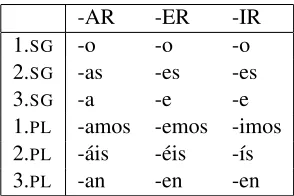
Morphological paradigms often do not inflect in the same way, which leads to inflection classes. For ex-ample, Spanish verbs are classified into three conju-gation groups (commonly referred to as -AR, -ER, and -IR verbs), illustrated in Table 3 for the inflec-tional suffixes (all person and number combinations) in present indicative.
-AR -ER -IR
1.SG -o -o -o
2.SG -as -es -es
3.SG -a -e -e
1.PL -amos -emos -imos 2.PL -´ais -´eis -´ıs
3.PL -an -en -en
Table 3: Suffixes for the three Spanish conjugation groups in present indicative
the-sis models: partial similarity across morphologi-cal paradigms. Spanish is described as having three conjugation classes for the three distinct overall suf-fixing patterns. For example, they are completely different for first-person plurals (-amos, -emos, and
-imos). At the same time, they share a great deal in common. Across all three classes, the first-person singular suffixes are-o, the second-person singular suffixes end with -s, and so forth. Some classes share properties to the exclusion of others: the sec-ond and third conjugation groups share-es, -e, -en
for 2.SG, 3.SG, 3.PLrespectively, but the first con-jugation group have-as, -a, -aninstead.
The similarities and differences which morpho-logical paradigms exhibit as inflection classes are of interest to both linguistics and natural language processing. In linguistics, the partial similarities across inflection classes prompt theoretical ques-tions on the extent to which paradigms can differ from one another (Carstairs 1987, M¨uller 2007). Computationally, inflection classes introduce non-uniformity across paradigms and must be handled in one way or another in an automatic morphology learning system. Previous work has opted to explic-itly learn inflection classes (Goldsmith and O’Brien 2006) or collapse them in some way (Chan 2006, Hammarstr¨om 2009, Monson 2009, Zeman 2009).
3.2 Clustering for paradigm similarity
This thesis aims to characterize paradigm similar-ity in a way that is amenable to a linguistic analy-sis and a formal model of paradigm similarity use-ful for computational tasks related to paradigms. As discussed above, similarities and differences criss-cross one another in morphological paradigms and result in inflection classes. It is therefore rea-sonable to think of morphological paradigms as having a string-based hierarchical structure, where paradigms more similar to one another by the in-flectional patterns cluster together. Haspelmath and Sims (2010) explore just this idea using data from Greek nouns and demonstrate how inflection classes can be modeled as a problem of clustering, though their work appears to be based purely on the hu-man linguist’s intuition and is not computationally implemented. This thesis proposes a string-based hierarchical clustering algorithm (with morpholog-ical paradigms as the objects of interest to cluster)
for modeling paradigm similarity, which is (i) built on results of stem identification from section 2 and (ii) useful for further computational tasks such as paradigm generation.
There are multiple advantages of proposing a clustering algorithm for morphological paradigms. To the linguist, results of clustering paradigms can be visualized, which will be helpful for the study of inflectional structure of the morphology of less fa-miliar languages (such as those based on fieldwork data). For computational linguistics and natural lan-guage processing, clustering provides a similarity measure that is useful for inducing unobserved word forms of incomplete morphological paradigms.
The proposed algorithm performs agglomerative hierarchical clustering on a given list of morpholog-ical paradigms. It involves stem identification (sec-tion 2) that determines the non-stem material in the word forms of each paradigm. The distance metric measures similarity among the paradigms by com-paring non-stem material, which forms the basis of the distance matrix for hierarchical clustering.
Preliminary work (Lee 2014) suggests that clus-tering morphological paradigms gives desirable sults. To illustrate, Figure 1 shows the clustering re-sults of our algorithm under development for several English verbal paradigms (by orthography). For rea-sons of space, the results of only ten English verbs are discussed here; see Lee (2014) for details.
jump walk
move love push touch
[image:4.612.325.537.460.537.2]try cry buy seek
Figure 1: Simplified clustering results for a few English verbal paradigms, each represented by the infinitive form
addi-tional ‘e’) and the verb-final ‘e’ (MOVE, LOVEwith ‘e’ dropped for the-ingform). This example shows that clustering morphological paradigms provides a much more fine-grained characterization of inflec-tion classes, which are usually described in non-hierarchical terms in linguistics.
An open question here is how to evaluate the re-sults of clustering morphological paradigms. The major issue is that morphological paradigms are usu-ally not hierarchicusu-ally represented in standard de-scriptions, thereby making it unclear what the gold standard could be. One possibility is that the learned inflection classes (based on clusters of paradigms) be compared to those in standard grammatical de-scriptions of the language in question. Alternatively, the results can be evaluated indirectly by what the in-duced structure should facilitate, namely paradigm generation; this also evaluates stem identification in section 2. Datasets of paradigm tables for languages with inflection classes (English, Greek, Spanish, etc) come from standard sources such as Wiktionary. Paradigm generation takes a paradigm table with held-out words for some paradigms, and the goal is to recover the missing words using (i) stems com-puted based on the available words in the respective paradigms (section 2) and (ii) non-stem material as predicted based on the cross-paradigmatic cluster in-formation (this section).
4 Induction of morphological paradigms from unstructured data
The discussion so far has assumed that a list of mor-phological paradigms are available for the study of structure within (section 2) and across (section 3) paradigms. While this is a common practice in the cognitive and computational modeling of morpho-logical paradigms (Albright and Hayes 2002, Dur-rett and DeNero 2013), it is legitimate to ask where a list of morphological paradigms come from in the first place. This part of the thesis attempts to provide an answer to this question. Building on previous work on unsupervised paradigm induction, this the-sis will propose a language-independent, incremen-tal paradigm learning system that induces paradigms with child-directed speech data as the input.
4.1 Incremental paradigm induction
The unsupervised learning of morphological paradigms has attracted a lot of interest in compu-tational linguistics and natural language processing (Goldsmith 2001, Schone and Jurafsky 2001, Chan 2006, Creutz and Lagus 2005, Monson 2009, Dreyer and Eisner 2011, Ahlberg et al. 2014). Vir-tually all previous work proposes a batch algorithm of paradigm induction, rather than an online and incremental learner, that takes some raw text as the input data. This is probably cognitively implausible, because a human child does not have access to all input data at once. This thesis proposes an incre-mental paradigm induction system to fill this gap of the relative lack of work on the incremental and unsupervised learning of morphological paradigms. As a starting point, the proposed paradigm induc-tion system will use one akin to Linguistica (Gold-smith 2001) and adapt it as an incremental version. The choice of a system like Linguistica as the point of departure is justified, because the goal here is to induce morphological paradigms from unstruc-tured data but not necessarily morpheme segmenta-tion (accomplished by other systems such as Mor-fessor (Creutz and Lagus 2005) that focus strongly on morphologically rich languages such as Finnish and Turkish). Linguistica induces paradigms by finding the optimal cut between a stem and an affix across words that could enter into paradigmatic rela-tions, and does not perform further morpheme seg-mentation. A characteristic of Linguistica that will be modified in this thesis is that of stem identifica-tion: as it currently stands, it assumes (i) strictly con-catenative morphology (i.e., stem as maximal com-monsubstring), and (ii) knowledge of whether the language under investigation is suffixing or prefix-ing. In line with the general goal of coming up with language-independent algorithms to handle natural language morphology, we will make use of the re-sults from section 2 on stem identification for lan-guages of diverse morphological types.
make use of the temporal information of the child-directed speech and read the data in small and chronologically ordered chunks. As such, this incre-mental version of Linguistica models child language acquisition, and the results will be of much interest to linguists. For evaluation, research on the child acquisition of English morphology (Cazden 1968, Brown 1973) provides the gold standard informa-tion on the order of acquisiinforma-tion of major morpho-logical patterns (plurals acquired before possessives, present progressives acquired before pasts, etc).
4.2 Collapsing paradigms of different inflection classes
A recurrent problem in unsupervised learning of morphological paradigms is that certain induced morphological paradigmatic patterns may appear in-complete (due to unobserved word forms) or dis-tinct on the surface (due to inflection classes), but should intuitively be collapsed in some way (Gold-smith 2009). For inflection classes, for instance, En-glish verbs display a regular morphological pattern as in Ø-s-ed-ing (e.g., for JUMP), but there is also a very similar—but distinct—pattern, with e-es-ed-ing(e.g., forMOVEwith the silent ‘e’); this English example is by orthography, but is analogous to Span-ish verbs with inflection classes discussed above. Ideally, it would be desirable to collapse morpho-logical patterns, e.g., the two English morphologi-cal patterns just mentioned as belonging to the ver-bal category and with the correct morphosyntactic alignment for the suffixes across the two patterns. Previous work either ignores this issue and treats the distinct surface patterns as is (e.g., Goldsmith 2001) or attempts to collapse morphological patterns (e.g., Chan 2006, with the assumption of part-of-speech tags being available).
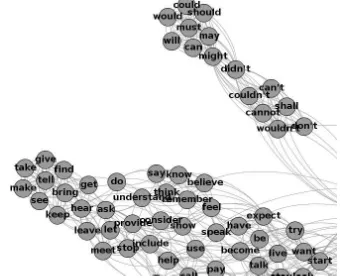
This thesis will explore the possibility of collaps-ing paradigms of different inflection classes with no annotations (e.g., part-of-speech tags) in the in-put data. Some sort of syntactic information will have to be induced and combined with the induced morphological knowledge, in the spirit of previous work such as Higgins (2002) and Clark (2003). We are currently using graph-theoretical approaches to the unsupervised learning of syntactic categories. Based on Goldsmith and Wang’s (2012) proposal of the word manifold, a given corpus is modeled as a
[image:6.612.340.510.178.317.2]graph, where the nodes are the words and the edges connect words that are distributionally similar based on n-grams from the corpus. The resulting graph has distributionally (and therefore syntactically) similar words densely connected together, e.g., modal verbs and infinitives in Figure 2. Various graph cluster-ing algorithms are becluster-ing explored for the purposes of word category induction.
Figure 2: A zoomed-in image of clusters of modal verbs and infinitives in a 1,000-word graph
5 Contributions
This thesis will contribute to both the unsupervised learning of natural language morphology as well as bringing theoretical linguistics and computational linguistics closer together.
On the unsupervised learning of natural language morphology, this thesis explores structure within and across morphological paradigms and proposes algorithms for adducing such structure given a list of morphological paradigms. Furthermore, we also ask how an unsupervised learning system can in-duce morphological paradigms from child-directed speech, an area much less researched than previous work on non-incremental and batch algorithms for paradigm induction.
References
Malin Ahlberg, Markus Forsberg, and Mans Hulden. 2014. Semi-supervised learning of morphological paradigms and lexicons. InProceedings of the 14th Conference of the European Chapter of the Association for Computational Linguistics, 569-578. Gothenburg, Sweden.
Adam Albright and Bruce Hayes. 2002. Modeling En-glish past tense intuitions with minimal generalization. InProceedings of the 6th meeting of the ACL Special Interest Group in Computational Phonology.
Roger Brown. 1973. A First Language: The Early Stages. Cambridge, MA: Harvard University Press. Andrew Carstairs. 1987. Allomorphy in Inflexion.
Lon-don: Croom Helm.
Courtney Cazden. 1968. The acquisition of noun and verb inflections.Child Development39: 433-448. Erwin Chan. 2006. Learning probabilistic paradigms
for morphology in a latent class model. In Proceed-ings of the Eighth Meeting of the ACL Special Interest Group on Computational Phonology at HLT-NAACL 2006, 69-78. New York City.
Alexander Clark. 2003. Combining distributional and morphological information for part of speech induc-tion. InProceedings of the Tenth Conference on Eu-ropean Chapter of the Association for Computational Linguistics(volume 1), 59-66.
Mathias Creutz and Krista Lagus. 2005. Inducing the morphological lexicon of a natural language from unannotated text. InProceedings of AKRR’05, Inter-national and Interdisciplinary Conference on Adaptive Knowledge Representation and Reasoning, 106-113. Markus Dreyer and Jason Eisner. 2011.
Discover-ing morphological paradigms from palin text usDiscover-ing a dirichlet process mixture model. In Proceedings of Empirical Methods in Natural Language Processing, 616-627.
Greg Durrett and John DeNero. 2013. Supervised learn-ing of complete morphological paradigms. In Proceed-ings of the North American Chapter of the Association for Computational Linguistics.
Michelle A. Fullwood and Timothy J. O’Donnell. 2013. Learning Non-concatenative Morphology. In Proceed-ings of the Fourth Annual Workshop on Cognitive Mod-eling and Computational Linguistics(CMCL). John A. Goldsmith. 2001. Unsupervised learning of the
morphology of a natural language.Computational Lin-guistics27(2): 153-198.
John A. Goldsmith. 2009. Morphological analogy: Only a beginning. In James P. Blevins and Juliette Blevins (eds.), Analogy in Grammar: Form and Acquisition, 138-164. Oxford: Oxford University Press.
John A. Goldsmith. 2010. Segmentation and
morphol-ogy. In Alexander Clark, Chris Fox, and Shalom Lappin (eds.),Handbook of Computational Linguistics and Natural Language Processing, 364-393. Oxford: Wiley-Blackwell.
John A. Goldsmith and Jeremy O’Brien. 2006. Learning inflectional classes.Language Learning and Develop-ment2(4): 219-250.
John A. Goldsmith and Xiuli Wang. 2012. Word mani-folds. University of Chicago, ms.
Harald Hammarstr¨om. 2009. Unsupervised Learning of Morphology and the Languages of the World. Ph.D. thesis, Chalmers University of Technology and Uni-versity of Gothenburg.
Harald Hammarstr¨om and Lars Borin. 2011. Unsuper-vised learning of morphology.Computational Linguis-tics37(2): 309-350.
Jeffrey Heinz and Regine Lai. 2013. Vowel Harmony and Subsequentiality. In Andras Kornai and Marco Kuhlmann (eds.) Proceedings of the 13th Meeting on the Mathematics of Language (MoL 13), 52-63. Jackson L. Lee. 2014. Automatic morphological
alignment and clustering. Technical report TR-2014-07, Department of Computer Science, University of Chicago.
Martin Haspelmath and Andrea D. Sims. 2010. Un-derstanding Morphology. London: Hodder Education, 2nd ed.
Derrick Higgins. 2002. A Multi-modular Approach to Model Selection in Statistical NLP. University of Chicago Ph.D. thesis.
Brian MacWhinney. 2000. The CHILDES Project. New Jersey: Lawrence Erlbaum Associates.
John J. McCarthy. 1985. Formal Problems in Semitic Phonology and Morphology. New York: Garland. Christian Monson. 2009. ParaMor: From Paradigm
Structure to Natural Language Morphology Induction. Ph.D. thesis, Carnegie Mellon University.
Gereon M¨uller. 2007. Notes on paradigm economy. Mor-phology17: 1-38.
Patrick Schone and Daniel Jurafsky. 2001. Knowledge-free induction of inflectional morphologies. In Pro-ceedings of the second meeting of the North American Chapter of the Association for Computational Linguis-tics on Language Technologies, 1-9. Association for Computational Linguistics.
Andrew Spencer. 2012. Identifying stems. Word Struc-ture5(1): 88-108.