Embeddings into Crossed Cubes
Emad Abuelrub
*,
Member, IAENG
Abstract- The hypercube parallel architecture is one of the most popular interconnection networks due to many of its attractive properties and its suitability for general purpose parallel processing. An attractive version of the hypercube is the crossed cube. It preserves the important properties of the hypercube and most importantly reduces the diameter by a factor of two. In this paper, we show the ability of the crossed cube as a versatile architecture to simulate other interconnection networks efficiently. We present new schemes to embed complete binary trees, complete quad trees, and cycles into crossed cubes.
Index Terms- binary trees, cycles, dilation, embedding, expansion, hypercubes, crossed cubes.
I. NTRODUCTION
Hypercube architectures are loosely coupled parallel processors based on the binary cube network. Parallel computers based on the hypercube topology have gained widespread acceptance in parallel computing. Recently, many machines based on the hypercube have been designed and made commercially available. The hypercube offers a rich interconnection topology with large bandwidth, logarithmic diameter, simple routing and broadcasting of data, recursive structure that is naturally suited to divide and conquer applications, and the ability to simulate other interconnection networks with minimum overhead [2, 11, 14, 15, 20, 21]. Due to the popularity of the hypercube, many variations of the hypercube topology have been proposed to improve on its properties and computational power. El-Amaway and Latifi [7] proposed the folded hypercube to reduce the diameter and the traffic congestion with little hardware overhead. Preparata and Vuillemin [18] introduced the cube-connected cycles in which the degree of the diameter was reduced to 3. Efe [6] proposed an attractive version of the hypercube called the crossed cube, where preliminary studies proved that the crossed cube preserves many of the attractive properties of the hypercube and more importantly reduces the diameter by a factor of two [1, 4, 6, 8, 9, 22]. This implies that the crossed cube has an advantage over the hypercube when data communication is of major concern. It is well known that for parallel architectures, data communication cost dominates computation cost. Therefore, it is worthwhile to make comparative studies on crossed cubes and other interconnection networks, and explore the advantages provided by them. The problem of embedding one interconnection network into another is very important in the area of parallel computing for portability of algorithms across various architectures, layout of circuits in VLSI, and mapping logical data structures into computer memories.
_____________________________________________
*Department of Computer Science, Zarqa Private University, Jordan, email:
The importance of binary trees comes from the fact that this class of structures is useful in the solution of banded and sparse systems, by direct elimination, and captures the essence of divide and conquers algorithms. Embedding binary trees into other interconnection networks attracted the attention of many researchers. Barasch et al. have considered embedding complete binary trees into generalized hypercubes [2], while Dingle and Sudborough considered simulation of binary trees and X-trees on pyramid networks [5].
Quad trees are becoming an important technique in the domain of image processing, computer graphics, robotics, computational geometry, and geographic information systems [3, 17, 19]. This hierarchical structure is based on the principle of recursive decomposition, which is similar to divide and conquer methods. Mapping quad trees into other interconnection networks attracted the attention of many researchers [14].
The problem of embedding rings or cycles into other interconnection networks has been studied by many researchers. It is well known that rings can be embedded into hypercubes using cyclic Gray codes [20]. Latifi and Zheng [12] generalized the cyclic Gray code method to embed rings into twisted cubes. On the other hand, other researchers addressed the problem of embedding rings into fault-free and faulty topologies [9, 12, 13, 14, 16, 20] or the Hamiltonicity of such structures in fault-free and faulty environments [1, 8, 10, 11].
The remainder of this paper is organized as follows. In section 2, we establish a few preliminary definitions and notations. Section 3 explains a scheme to embed complete binary trees into crossed cubes. Section 4 presents a recursive technique to embed complete quad trees. In section 5, we extend the Gray code scheme to embed cycles into crossed cubes. Finally, section 6 concludes the paper and discusses some future possible work.
II. DIFINITIONS AND NOTATIONS
In this paper, we use undirected graphs to model interconnection networks. Each vertex represents a processor and each edge a communication link between processors. The embedding of a guest graph G = (VG, EG) into a host graph H = (VH, EH) is an injective mapping f from VG to VH, where VG, EG and VH, EH are the vertex and edge sets of G and H, respectively, and where
adjacent vertices of G, D = max {d(f(u), f(v)), where u−v
∈ EG}. The expansion E is the ratio of the cardinality of the host vertex set to the cardinality of the guest vertex set, E = VH / VG. Minimizing each of these measurements has a direct implication on the quality of the simulation of the guest network by the corresponding host network. The dilation of an embedding measures how far apart neighboring guest processors are placed in the host network. Clearly, if adjacent guest processors are placed far apart in the host network, then there will be a significant degradation in simulation due to the long length of the communication path between them. The expansion of an embedding measures how much larger is the host network than the guest network during the simulation. We want to minimize expansion, as we want to use the smallest possible host network that has at least as many processors as in the guest network. In reality, we usually have a fixed size host network and we may have to consider many-to-one embedding for larger guest networks. When the size of the guest network is not equal to the size of the host network in terms of the number of processors, then we try to find the smallest host network that has at least as many processors as the guest network. Such a host network is referred to as the optimal host network.
A hypercube of dimension n, denoted by Qn, is an undirected graph consisting of 2n vertices labeled from 0 to 2n-1 and such that there is an edge between any two vertices if and only if the binary representation of their labels differs in exactly one bit position. A complete binary tree of height n-1, denoted by CBn, is an undirected graph consisting of 2n-1 vertices and such that every vertex of depth less than n-1 has exactly two sons and every vertex of depth n-1 is a leaf. A complete quad tree of height n-1, denoted by CQn, is an undirected graph consisting of (4n-1)/3 vertices and such that every vertex of depth less than n-1 has exactly four sons and every vertex of depth n-1 is a leaf. A cycle of size n, denoted Cn, is an undirected graph consisting of n vertices labeled from v1 to vn, such that node vi is a neighbor with node v(i+1)mod n, 1 ≤ i ≤ n. A path (vo, v1, v2, …, vn-1) is a sequence of nodes such that each two consecutive nodes are adjacent. A cycle or a circuit is called a Hamiltonian circuit if it traverses every node of G exactly once.
The crossed cube is defined recursively as follows. Let G be any undirected labeled graph, then Gb is obtained from G by prefixing every vertex label with b. Two binary strings x = x1x0 and y = y1y0, each of length two, are pair-related if and only if (x, y) ∈ {(00, 00), (10, 10), (01, 11), (11, 01)}. Now, we define a crossed cube of dimension n, denoted XQn, as an undirected graph consisting of 2n vertices labeled from 0 to 2n-1 and defined recursively as following:
1. XQ1 is the complete graph on two vertices with labels 0 and 1.
2. For n > 1, XQn consists of two copies of XQn-1 one prefixed by 0, XQ0n-1, and the other by 1, XQ1n-1. Two vertices u = 0un-2...u0 ∈XQ0n-1 and v = 1vn-2...v0
∈XQ1
n-1 are adjacent, if and only if:
a. un-2 = vn-2, if n is even, and
b. For 0 ≤ i ≤(n-1)/2, u2i+1 u2i and v2i+1 v2i are pair-related.
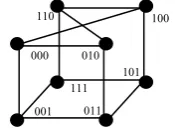
Figure 1 shows crossed cubes of dimension 3. XQn is constructed recursively based on the construction of XQn-1 by pasting together a copy of XQ0n-1 and the mirror image of XQ1n-1, then adding the appropriate links between the two copies according to the pair-related relationship. For clarity, we view the crossed cube XQn as a [2x 2n-1] grid. If the grid is partitioned horizontally into two equal parts, then all nodes above the horizontal line have a 0 as a prefix, while all nodes below the horizontal line have a 1 as a prefix.
Figure 1: The crossed cube XQ3.
III. EMBEDDING COMPLETE BINARY TREES This section describes our scheme to embed a complete binary tree CBn into a crossed cube XQn with dilation two and unit expansion. Our scheme is based on the inorder labeling to embed CBn into XQn in a straight forward way. The inorder embedding is constructed by Algorithm Embedding Complete Binary Tree (ECBT).
Algorithm ECBT Begin
Label the nodes of the complete binary tree based on the inorder traversal using binary representation. Map each node of the complete binary tree to the node in the crossed cube with the corresponding binary representation.
End
Theorem 1: For all n, the inorder labeling of the complete binary tree embeds CBn within the crossed cube XQn with dilation two.
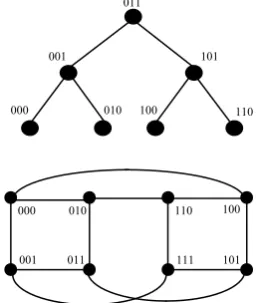
Proof: Let βk be the binary string of length k with 1 in all positions. For n 3, the inorder embedding is shown in Figure 2. For n > 3, we prove the theorem by induction on the height of the binary tree. Our induction basis is CB3, a dilation two embedding of CB3 into XQ3 is shown in Figure 2. Assume the theorem is true for an embedding of CBn-1 into XQn-1. We now prove that the theorem is true for the embedding of CBn into XQn. In XQn, consider the two subcubes XQ0n-1 and XQ1n-1. By induction hypothesis, we can embed CBn-1 into XQ
0
n-1 and XQ 1
n-1, with dilation two. Since the number of nodes in CBn-1 is less than the number of nodes in XQn-1 by one, then XQ0n-1 and XQ1n-1 contain two extra-unused nodes located at addresses 01βn-2 and 11βn-2, respectively. We can use the extra-unused node in XQ0n-1, the CBn-1 of XQ0n-1, and the CBn-1 of XQ1n-1 to construct the complete binary tree CBn with 2n-1 nodes. Next, we prove that the dilation of this embedding is two. We again use the routing algorithm of [12] to show that the length of the shortest path from the root of CBn to any of its children is of length two. Let r∼lr be the shortest path from the root r of CBn to the root lr of the left complete
100 110
101 111 000
010
[image:2.595.378.466.192.258.2]binary subtree LCBn-1 and r∼rr be the shortest path from the root r of CBn to the root rr of the right complete binary subtree RCBn-1. r will appear at address 01βn-2, lr at address 00βn-2, and rr at address 10βn-2. Notice that r, lr, and rr are identical except for the left most two bits. By using the routing algorithm, the shortest paths from 01βn-2 to 00βn-2 and from 01βn-2 to 10βn-2 are of length two. So, the dilation of this embedding is two.
[image:3.595.105.235.302.454.2]As an illustration to the resulted embedding, in the lowest level, each edge from a left child to its parent is mapped to the corresponding crossed cube edge between the images of the two nodes, while the edge between a right child to its parent is mapped to a path of length two, from the right child to the left child and from the left child to the parent. In the higher level, each edge from a left child, or a right child, to its parent is mapped to the corresponding crossed cube edge between the images of the two nodes. In all higher levels, each edge from a left child, or a right child, to its parent is mapped to a path of length two. Notice that the inorder embedding is very simple and straight forward.
Figure 2: The inorder embedding of CB3 into XQ3.
IV. EMBEDDING QUAD TREES
This section describes our recursive scheme to embed a complete quad tree CQ
n into its optimal crossed cube XQ
2n-1 with dilation two and unit expansion. We proceed in four steps. In the first step, CQn is decomposed into a four complete quad sub trees; a left complete quad sub tree ACQn-1with root a, a left middle complete quad sub tree BCQ
n-1with root b, a right middle complete quad sub tree CCQ
n-1with root c, a right complete quad sub tree DCQn-1 with root d, and a root r. In the second step, XQ2n-1 is
decomposed into four sub cubes XQ00 2n-3, XQ
01
2n-3, XQ 11
2n-3, and XQ 10
2n-3. In the third step, ACQn-1is embedded into XQ002n-3, BCQn-1 is embedded into XQ012n-3, CCQn-1 is
embedded into XQ112n-3, DCQn-1is embedded into XQ102n-3, and the root r is embedded into one of the unused nodes in XO00
2n-3. In the last step, we construct CQn by finding the paths r∼a, r∼b, r∼c, and r∼d, each of at most length two. The embedding process is continued recursively by decomposing the complete quad sub trees and the crossed sub cubes, repeating the above steps, until we reach the
leaves of the complete quad tree. At the bottom level of the complete quad tree, each complete quad sub tree with 5 nodes is mapped into a crossed sub cube of dimension 3. Next, we present Algorithm Embed Complete Quad Tree (ECQT) that uses a recursive divide and conquers technique to embed a complete quad tree CQn into its optimal crossed cube XQ2n-1.
Algorithm ECQT
Let δi be the binary string of length n with a 1 in position i
and 0 in all other positions, θk be the binary string of
length k with 0 in all positions, and ⊕ be the xor operator. Begin
Decompose CQn to ACQn-1, BCQn-1, CCQn-1, DCQn-1, and r.
Decompose XQ
2n-1to XQ 00
2n-3, XQ 01
2n-3,
XQ112n-3, and XQ102n-3.
Map the quad sub trees into the crossed sub cubes as follows:
a. Embed ACQ
n-1into XQ 00
2n-3, BCQn-1into
XQ012n-3, CCQn-1into XQ112n-3, and DCQn-1into
XQ102n-3. a, b, c, and d will appear at addresses 000θ
2n-4, 010θ2n-4, 110θ2n-4, and 100θ2n-4,,
respectively.
b. Translate the embeddings in XQ00
2n-3and
XQ10
2n-3by complementing the (2n-3) th
bit of each node. Formally, if a tree node was mapped to address x then after the translation it will appear at address x ⊕ δ
2n-3. After the
translation, the left root a and the right root d will appear at addresses 001θ
2n-3 and 101θ2n-4,
respectively. Therefore, the final position of a, b, c, and d are 001θ
2n-4, 010θ2n-4, 110θ2n-4, and
101θ
2n-4,, respectively.
c. Map the root r into the node with label 0 in XQ00
2n-3.
Construct CQn from ACQn-1, BCQn-1, CQn-1, DCQn-1, and r by finding the four paths r~a, r~b, r~c, and r~d. The edges r-a and r-b of CQn are mapped to paths of length one in XO2n-1, while the edges r-c and r-d are mapped to paths of length two. The shortest paths from r to c and from r to d are 000θ
2n-4 - 010θ2n-4 -
110θ
2n-4 and 000θ2n-4- 100θ2n-4 -101θ2n-4 ,respectively.
End
Theorem 2: For all n, Algorithm ECQT maps the complete
quad tree CQ
n within the crossed cube XQ2n-1with dilation two and unit expansion.
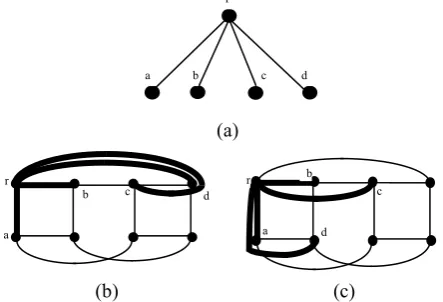
Proof: For n = 1, CQ1 can be easily embedded into XQ1. For n = 2, the existence of a mapping with dilation two is shown in Figure 4. Since the crossed cube is vertex symmetric, then we can relabel the crossed cube and any of the corner nodes of the sub cube XQ3 can be the root.
000 010 110 100
001 011 111 101 011
010 001
000 110
01 1
Figures 4-b and 4-c show two different kinds of possible embeddings that might be used during the embedding process. For n > 2, we prove this by induction on the height of the complete quad tree CQ
n. Our induction basis is CQ
3, a dilation two mapping of CQ3 into XQ5 is shown in Figure 5. Note that the figure shows only the positions of the roots, as the rest of the embedding follows directly from Figure 4. Assume the theorem is true for a mapping of CQn-1in XQ2n-3. Now, we prove that the theorem is true for the embedding of CQ
n in XQ2n-1. In XQ2n-1, consider the four sub cubes XQ002n-3, XQ012n-3, XQ112n-3, and XQ10
2n-3. By induction hypothesis, there exist a dilation two mapping from CQn-1 to XQ002n-3, XQ012n-3, XQ112n-3, and
XQ10
2n-3. Since the number of nodes in CQn-1is less than the number of nodes in XQ
2n-3, then XQ 00
2n-3, XQ 01
2n-3, XQ11
2n-3, and XQ 10
2n-3contain extra unused nodes. Now, we can use the unused node with label 0 in XQ002n-3, the
CQn-1 of XQ002n-3, the CQn-1 of XQ012n-3, the CQn-1 of
XQ11
2n-3, and the CQn-1 of XQ 10
2n-3 to construct the complete quad tree CQ
n. To prove that the dilation of this mapping is two, we need to show that the length of the shortest path from the root r to any of its four children is at most two. Clearly, the length of the paths r~a and r~b is one since they are mapped directly to edges in the crossed cube. Let r~c be the shortest path from the root r of CQn to the root c of the right middle complete quad sub tree CCQn-1and r~d be the shortest path from the root r of CQn to the root d of the right complete quad sub tree DCQ
n-1. r will appear at address 000θ
2n-4, c will appear at address 110θ
2n-4, and d will appear at address 101θ2n-4. Notice, that if we group the addresses of r, c, and d into pairs of bits, from right to left, then they are pair-related except for the left most three bits. By using the routing algorithm of [6], the shortest path from 000θ2n-4 to 110θ2n-4 is 000θ2n-4 - 010θ2n-4 -110θ2n-4 and from 000θ2n-4 to 101θ2n-4 is 000θ2n-4 -100θ
2n-4 -101θ2n-4. So, the length of the paths r~c and r~d are two. Therefore, the dilation of this embedding is two.
(a)
[image:4.595.53.275.580.731.2](b) (c)
Figure 4: Embedding CQ1 into the sub cube XQ3.
Figure 5: Embedding CQ3 into XQ5.
V. EMBEDDING CYCLES Given a cycle C2n with 2
n
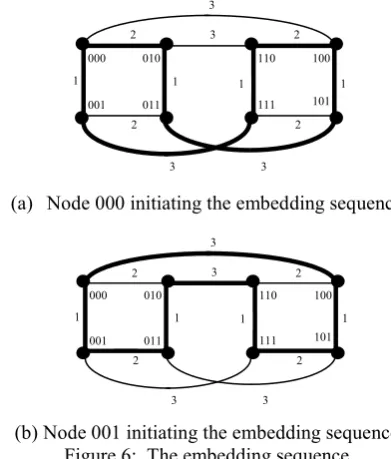
nodes, consider the problem of assigning the cycle nodes to the nodes of the crossed cube XQn such that adjacency is preserved. Now, given any two adjacent nodes in the cycle, their images by this embedding should be neighbors in the crossed cube through some dimension i, where 1 ≤ i ≤ n. We can view such an embedding as a sequence of dimensions crossed by adjacent nodes. We call such a sequence the embedding sequence, denoted by ES = (d1, d2, ..., d2n), where di∈ {1, ..., n} for all 1 ≤ i ≤ 2n. Figure 6 shows two different embeddings of the cycle C23 into the crossed cube XQ3. It is more convenient to view the embedded cycle as will as the crossed cube in the way shown in Figure 6. The embedding sequence of C23 is ES = (1, 3, 1, 2, 1, 3, 1, 2). For example, in Figure 6-a, notice that nodes 000 and 001 are connected by a link through dimension 1, 001 and 111 are connected by a link through dimension 3, 111 and 110 are connected by a link through dimension 1, 110 and 100 are connected by a link through dimension 2, and so on. The embedding sequence ES can be generated using Algorithm ES.
Algorithm ES
Let n be the dimension of the crossed cube and the vertical bar be the concatenation operator.
Begin ES ← 1
For i ← 3 to n do ES ← ESiES ES ← ES2ES2 End
The embedding sequence is generated by applying Algorithm ES on n, where n is the dimension of the crossed cube. The number of nodes in the crossed cube is equal to the number of nodes in the embedded cycle, which is 2n nodes. Thus, the embedding sequence of the cycle C24 is ES = (1, 3, 1, 4, 1, 3, 1, 2, 1, 3, 1, 4, 1, 3, 1, 2) and
the embedding sequence of the cycle C25 is ES = (1, 3, 1, 4,
1, 3, 1, 5, 1, 3, 1, 4, 1, 3, 1, 2, 1, 3, 1, 4, 1, 3, 1, 5, 1, 3, 1, 4, 1, 3, 1, 2). The embedding sequence corresponds to the extended binary-reflected Gray code embedding of a cycle into a crossed cube. The binary-reflected Gray code is the
00000 00100 01000
10100 11000
r a b
d c
r
a
b c d r
a b
c
d
a b c d
most common technique to embed a cycle into a fault-free hypercube. Notice that the same embedding sequence may result in different embeddings of C2n into XQn depending on the crossed cube node that initiates the cycle construction. Among all different embeddings, we are interested in one kind. The embedding when the node that initiates the cycle construction in the crossed cube is the upper leftmost node, node with label 0. This will not violate the generalization of the technique since the crossed cube is node and vertex symmetric, which means that we can relabel the nodes, where any node can be labeled as node 0, and hence initiates the construction of the cycle. In Figure 6-a, the cycle is initiated by node 000, while in Figure 6-b the cycle is initiated by node 001.
(a) Node 000 initiating the embedding sequence.
[image:5.595.61.257.219.449.2](b) Node 001 initiating the embedding sequence. Figure 6: The embedding sequence.
Theorem 3: For every n, Algorithm ES will generate the embedding sequence to construct a cycle of size 2n in a crossed cube of dimension n.
Proof: We prove this by induction on the dimension of the crossed cube. Our induction basis is XQ2, it is trivial that a cycle of size 4 can be easily constructed in XQ2 using the embedding sequence ES = (1, 2, 1, 2). Assume the theorem is true for the construction of a cycle of size 2n-1 in a crossed cube of dimension n-1. We now prove that the theorem is true for the construction of C2n in XQn. Let G be any undirected labeled graph, then Gb is obtained from G by prefixing every vertex label with b. Consider the two crossed sub cubes XQ0n-1 and XQ1n-1. By induction hypothesis, we can construct a cycle of size 2n-1 in both XQ0n-1 and XQ1n-1. Let their embedding sequence be ES = Sn-12Sn-12, where, Sn is a sequence of dimensions recursively defined as follows: S2 = 1 and Sn-1 = Sn-2nS n-2. Now, we combine two cycles, each of size 2n-1, to come up with a cycle of size 2n. This is done by replacing the first link that goes through dimension 2 of the first cycle and the second link that goes through dimension 2 of the second cycle by two links that go through dimension n. The embedding sequence of the new cycle C2n is ES = S
n-1nSn-12Sn-1nSn-12 = Sn2Sn2, which is the same embedding sequence generated by Algorithm ES.
Next, we present Algorithm Hamiltonian Circuit (HC) that uses a recursive divide and conquers technique to embed a cycle C2n into a crossed cube XQn.
Algorithm HC Begin
Partition XQn into 2n-3 disjoint crossed cubes, each of
dimension 3.
Embed the cycle C23 into each sub cube using the
embedding sequence ES = (1, 3, 1, 2, 1, 3, 1, 2). Connect the 2n-3 cycles, each of size 8, through the
upper, or lower, links to come up with a cycle of size C2n.
End
Theorem 4: For every n, Algorithm HC will embed a Hamiltonian cycle of size 2n in a crossed cube of dimension n.
Proof: We prove this by induction on the dimension of the crossed cube. Our induction basis is XQ3, the embedding of a cycle of size 23 into a crossed cube of dimension 3 is shown in Figure 6. Assume the theorem is true for the construction of a cycle of size 2n-1 in a crossed cube of dimension n-1. We now prove that the theorem is true for the construction of C2n in XQn. Consider the two crossed sub cubes XQ0n-1 and XQ1n-1. By induction hypothesis, we can construct a cycle of size 2n-1 in both XQ0n-1 and XQ1n-1. Now, we combine two cycles, each of size 2n-1, to come up with a cycle of size 2n. This is done by replacing the first link that goes through dimension 2 of the first cycle constructed in XQ0n-1 and the first link that goes through dimension 2 in of the second cycle constructed in XQ1n-1 by links that go through dimension n. Note the use of the upper links of dimension n when the embedding sequence is generated by node 0, while the lower crossed links of dimension n are used when the embedding sequence is generated by node 1, as shown in Figure 7.
VI. CONCLUSIONS
The problem of embedding one interconnection network into another is very important in the area of parallel computing for portability of algorithms across various architectures, layout of circuits in VLSI, and mapping logical data structures into computer memories. The importance of trees comes from the fact that this class of structures is useful in the solution of banded and sparse systems, by direct elimination, and captures the essence of divide and conquers algorithms. The important of cycles and rings comes from the fact that it is the task graph of many basic operations in parallel computing. The hypercube is one of the most popular interconnection networks due to many of its attractive properties and its suitability for general purpose parallel processing. An attractive version of the hypercube is the crossed cube. It preserves many properties of the hypercube and most importantly reduces the diameter by a factor of two. This paper has presented different schemes to show the ability of the crossed cube as a versatile architecture to simulate other interconnection networks efficiently. We present new schemes to embed complete binary trees, complete quad trees, and cycles into crossed cubes. A good problem will be to improve the dilation on embedding trees into crossed
000 010 110 100
001 011 111 101
1 1 1 1
2 2
2 2
3
3
3 3
000 010 110 100
001 011 111 101
1 1 1 1
2 2
2 2
3
3
cubes. Another interesting problem is to generalize the schemes to embed trees and cycles in the presence of faults.
(a) Using upper links when ES initiated by 000.
(b) Using lower links when ES initiated by 001. Figure 7: The recursive construction of the cycle C2n in a
fault-free environment.
REFERENCES
[1] E. Abuelrub, "The Hamiltonicity of Crossed Cubes in the Presence of Faults," Engineering Letters, vol. 16, no. 3, pp. 453-459, 2008.
[2] L. Barasch, S. Lakshmivarahan, and S. Dhall, "Embedding Arbitrary Meshes and Complete Binary Trees in Generalized Hypercubes," Proceedings of
the 1st IEEE Symposium on Parallel and Distributed
Processing, pp. 202-209, 1989.
[3] A. Bardera, M. Feixas, I. Boada, J. Rigau, and M. Sbert, "Medical Image Registration Based on BSP and Quad-Tree Partitioning", Proceedings of WBIR'2006, pp. 1-8, 2006.
[4] C. Chang, T. Sung, and L. Hsu, "Edge Congestion and Topological Properties of Crossed Cubes," IEEE Transactions on Parallel and Distributed Systems, vol. 11, no. 1, pp. 64-80, 2006.
[5] A. Dingle and I. Sudborough, "Simulating Binary Trees and X-Trees on Pyramid Networks," Proceedings of the 1st IEEE Symposium on Parallel and DistributedProcessing, pp. 210-219, 1989. [6] K. Efe, "The Crossed Cube Architecture for Parallel
Computation," IEEE Transactions on Parallel and Distributed Systems, vol. 3, no. 5, pp. 513-524, 1992. [7] A. El-Amaway and S. Latifi, "Properties and
Performance of Folded Hypercubes," IEEE Transactions on Parallel and Distributed Systems, vol. 2, no. 1, pp. 31-42, 1991.
[8] J. Fan, X. Lin, and X. Jia, "Non-Pancylicity and Edge-Pancyclicity of Crossed Cubes," Information Processing Letters, vol. 93, no. 3, pp. 133-138, 2005.
[9] J. Fan, X. Lin, and X. Jia, "Optimal Path Embedding in Crossed Cubes," IEEE Transactions on Parallel and Distributed Systems, vol. 16, no. 12, pp. 1190-1200, 2005.
[10] J. Fu and G. Chen, "Hamiltonicity of the Hierarchical Cubic Network," Theory of Computer Systems, vol. 35, pp. 59-79, 2008.
[11] H. Keh and J. Lin, "On Fault-Tolerance Embedding of Hamiltonian Cycles, Linear Arrays, and Rings in a Flexible Hypercube," Parallel Computing, vol. 26, no. 6, pp. 769-781, 2000.
[12] S. Latifi and S. Zheng, "Optimal Simulation of Linear Array and Ring Architectures on Multiply-Twisted Hypercube," Proceedings of the 11th International
IEEE Conference on Computers and
Communications, 1992.
[13] S. Lee and H. Ho, "A 1.5 Approximation Algorithm for Embedding Hyperedges in a Cycle," IEEE Transactions on Parallel and Distributed Systems, vol. 16, no. 6, pp. 481-487, June 2005.
[14] T. Leighton, Introduction to Parallel Algorithms and Architecture: Arrays, Trees, Hypercubes, Morgan
Kaufmann, 1992.
[15] J. Lin, "Embedding Hamiltonian Cycles, Linear Arrays, and Rings in a Faulty Supercube," International Journal of High Speed Computing, vol. 11, no. 3, pp. 189-201, 2000.
[16] M. Ma and J. Xu, "Panconnectivity of Locally Twisted Cubes," Applied Mathematical Letters, vol. 17, no. 7, pp. 674-677, 2006.
[17] T. Markas and J. Reif, "Quad Tree Structures for Image Compression Applications", Information Processing Letters, vol. 28, no. 6, pp. 707-722, 1992. [18] F. Preparata and J. Vuillemin, "The Cube-Connected
Cycles: A Versatile Network for Parallel Computation," Communications of the ACM, vol. 24, no. 5, pp. 3000-309, 1981.
[19] L. Topi, R. Parisi, and A. Uncini, "Spline Recurrent Neural Network for Quad-Tree Video Coding,"
Proceedings of WIRN'2002, pp. 90-98, 2002.
[20] Y. Saad and M. Schultz, "Topological Properties of the Hypercube," IEEE Transactions on Computers, vol. 37, no. 7, pp. 867-872, July 1988,
[21] L. Youyao, "A Hypercube-based Scalable Interconnection Network for Massively Parallel Computing," Journal of Computers, vol. 3, no. 10, October 2008.
[22] Q. Zhu, J. Hou, and M. Xu, "On Reliability of the Folded Hypercubes," Information Science, vol. 177, no. 8, pp. 1782-1788, 2008.
001 2
2
001 2
2
4 4
2 2 4 2 2
4