An Iterative Link-based Method for Parallel Web Page Mining
Le Liu
1, Yu Hong
1, Jun Lu
2, Jun Lang
2, Heng Ji
3, Jianmin Yao
1 1School of Computer Science & Technology, Soochow University, Suzhou, 215006, China
2Institute for Infocomm Research, Singapore, 138632
3Computer Science Department, Rensselaer Polytechnic Institute, Troy, NY 12180, USA
[email protected],{tianxianer,lujun59,billlangjun}@gmail.com
[email protected],[email protected]
Abstracts
Identifying parallel web pages from lingual web sites is a crucial step of bi-lingual resource construction for cross-lingual information processing. In this paper, we propose a link-based approach to distinguish parallel web pages from bi-lingual web sites. Compared with the ex-isting methods, which only employ the internal translation similarity (such as content-based similarity and page struc-tural similarity), we hypothesize that the external translation similarity is an effec-tive feature to identify parallel web pages. Within a bilingual web site, web pages are interconnected by hyperlinks. The basic idea of our method is that the trans-lation similarity of two pages can be in-ferred from their neighbor pages, which can be adopted as an important source of external similarity. Thus, the translation similarity of page pairs will influence each other. An iterative algorithm is de-veloped to estimate the external transla-tion similarity and the final translatransla-tion similarity. Both internal and external similarity measures are combined in the iterative algorithm. Experiments on six bilingual websites demonstrate that our method is effective and obtains signifi-cant improvement (6.2% F-Score) over the baseline which only utilizes internal translation similarity.
1
Introduction
Parallel corpora have played an important role in multilingual Natural Language Processing, espe-cially in Machine Translation (MT) and Cross-lingual Information Retrieval(CLIR). However, it’s time-consuming to build parallel corpora
manually. Some existing parallel corpora are subject to subscription or license fee and thus not freely available, while others are domain-specific. Therefore, a lot of previous research has focused on automatically mining parallel corpora from the web.
In the past decade, there have been extensive studies on parallel resource extraction from the web (e.g., Chen and Nie, 2000; Resnik 2003; Jiang et al., 2009) and many effective Web min-ing systems have been developed such as STRAND, PTMiner, BITS and WPDE. For most of these mining systems, there is a typical paral-lel resource mining strategy which involves three steps: (1) locate the bilingual websites (2) identi-fy parallel web pages from these bilingual web-sites and (3) extract bilingual resources from the parallel web pages.
In this paper, we focus on the step (2) which is regarded as the core of the mining system (Chunyu, 2007). Estimating the translation simi-larity of two pages is the most basic and key problem in this step. Previous approaches have tried to tackle this problem by using the infor-mation within the pages. For example, in the STRAND and PTMiner system, a structural fil-tering process that relies on the analysis of the underlying HTML structure of pages is used to determine a set of pair-specific structural values, and then the values are used to decide whether the pages are translations of one another. The BITS system filters out bad pairs by using a large bilingual dictionary to compute a content-based similarity score and comparing the score with a threshold. The WPDE system combines URL similarity, structure similarity with content-based similarity to discover and verify candidate paral-lel page pairs. Some other features or rules such as page size ratio, predefined hypertexts which link to different language versions of a web page are also used in most of these systems. Here, all of the mining systems are simply using the in-formation within the page in the process of
ing parallel web pages. In this paper, we attempt to explore other information to identify parallel web pages.
On the Internet, most web pages are linked by hyperlinks. We argue that the translation similar-ity of two pages depends on not only their inter-nal information but also their neighbors. The neighbors of a web page are a set of pages, which link to the page. We find that the similari-ty of neighbors can provide more reliable evi-dence in estimating the translation similarity of two pages.
The main issues are discussed in this paper as follows:
Can the neighbors of candidate page pairs really contribute to estimating the translation similarity?
How to estimate the translation similarity of candidate page pairs by using their neighbors?
Our method has the following advantages: High performance
The external and internal information is com-bined to verify parallel page pairs in our method, while in previous mining systems, only internal information was used. Experimental results show that compared with existing parallel page pair identification technologies, our method obtains both higher precision and recall (6.2% and 6.3% improvement than the baseline, respectively). In addition, the external information used in our method is a more effective feature than internal features alone such as structural similarity and content-based similarity.
Language independent
In principle, our method is language inde-pendent and can be easily ported to new lan-guage pairs, except for the lanlan-guage-specific bi-lingual lexicons. Our method takes full ad-vantage of the link information that is language-independent. For the bilingual lexicons in our experiments, compared to previous methods, our method does not need a big bilingual lexicon, which is good news to less-resource language pairs.
Unsupervised and fewer parameters
In previous work, some parameters need to be optimized. Due to the diversity of web page styles, it is not trivial to obtain the best parame-ters. Some previous researches(Resnik, 2003; Zhang et al., 2006) attempt to optimize parame-ters by employing machine learning method. In contrast, in our method, only two parameters
need to be estimated. One parameter remains stable for different style websites. Another pa-rameter can be easily adjusted to achieve the best performance. Therefore, our method can be used in other websites with different styles, without much effort to optimize these parameters.
2
Related Work
A large amount of literature has been published on parallel resource mining from the web. Ac-cording to the existing form of the parallel re-source on the Internet, related work can be cate-gorized as follows:
Mining from bilingual websites
Most existing web mining systems aimed at mining bilingual resource from the bilingual websites, such as PTMiner (Nie et al., 1999), STRAND (Resnik and Smith, 2003), BITS (Ma and Liberman, 1999), PTI (Chen et al., 2004). PTMiner uses search engines to pinpoint the candidate sites that are likely to contain parallel pages, and then uses the collected URLs as seeds to further crawl each web site for more URLs. Web page pairs are extracted based on manually defined URL pattern matching, and further fil-tered according to several criteria. STRAND us-es a search engine to search for multilingual websites and generated candidate page pairs based on manually created substitution rules. Then, it filters some candidate pairs by analyzing the HTML pages. PTI crawls the web to fetch (potentially parallel) candidate multilingual web documents by using a web spider. To determine the parallelism between potential document pairs, a filename comparison module is used to check filename resemblance, and a content analysis module is used to measure the semantic similari-ty. BITS was the first to obtain bilingual web-sites by employing a language identification module, and then for each bilingual website, it extracts parallel pages based on their content.
Mining from bilingual web pages
to automatically acquire bilingual web pages from the result pages of a search engine.
Mining from comparable corpus
Several attempts have been made to extract parallel resources from comparable corpora. Zhao et al. (2002) proposed a robust, adaptive approach for mining parallel sentences from a bilingual comparable news collection. In their method, sentence length models and lexicon-based models were combined under a maximum likelihood criterion. Smith et al. (2010) found that Wikipedia contains a lot of comparable doc-uments, and adopted a ranking model to select parallel sentence pairs from comparable docu-ments. Bharadwaj et al. (2011) used a SVM clas-sifier with some new features to identify parallel sentences from Wikipedia.
3
Iterative Link-based Parallel Web
Pages Mining
As mentioned, the basic idea of our method is that the similarity of two pages can be inferred from their neighbors. This idea is illustrated in Figure 1.
A D
E C
B
A’ D’
E’ C’
B’ ?
Figure 1 Illustration of the link-based method
In Figure 1, A, B, C, D and E are some pages in the same language; while A’, B’, C’, D’ and E’ are some pages in another language. The solid black arrows indicate the links between these pages. For example, page A points to C, page B’ points to C’ and so on. Then the page set {A, B, D, E} is called the neighbors of page C. Similar-ly, the page set {A’, B’, D’, E’} contains the neighbors of page C’. If the page pairs : <A, A’>, <B, B’>, <D, D’> and <E, E’> have high transla-tion similarities, then it can be inferred that page C and C’ have a high probability to be a pair of parallel pages. Every page has its own neighbors. For each web page, our method views link-in and link-out hyperlinks as the same. Thus, the linked pages will influence each other in estimating the translation similarity. For example, the similari-ties of two pairs <A, A’> and <C, C’> will influ-ence each other. It is an iterative process. We
will elaborate the process in the following sec-tions.
Since our goal is to find parallel pages in a specific website, the key task is to evaluate the translation similarity of two pages (which are in different languages) as accurately as possible. The final similarity of two pages should depend both on their internal similarity and external sim-ilarity. The internal similarity means the similari-ty estimated by using the information in the page itself, such as the structure similarity and the content-based similarity of the two pages. On the other hand, the external similarity of two pages is the similarity depending on their neighbors. The final translation similarity is called the En-hanced Translation Similarity (ETS). The ETS of two pages can be calculated as follows:
( ) ( ) ( ) ( ) [ ] (1)
Where, ( ) is the internal translation simi-larity of two pages: e and c; ( ) represents the external translation similarity of pages e and c. ( ) indicates the final similarity of two pages, which combines the internal with external translation similarity.
In this paper, we conduct the experiments on English-Chinese parallel page pair mining. How-ever, our method is language-independent. Thus, it can be applied to other language pairs by only replacing a bilingual lexicon. The symbol e and c always indicate an English page and a Chinese page respectively in this paper. In the following sections, we will describe how to calculate the
( ) and ( ) step by step.
3.1 Preprocessing
The input of our method is a bilingual website. This paper aims to find English/Chinese parallel pages. So a 3-gram language model is used to identify (or classify) the language of a certain document. The performance of the language identification module achieves 99.5% accuracy through in-house testing. As a result, a set of English pages and a set of Chinese pages are ob-tained. In order to get the neighbors of a page, for each bilingual website, two networks are con-structed based on the hyperlinks, one for English pages and another for Chinese pages.
3.2 The Internal Translation Similarity
The size ratio of two pages
The length ratio of two documents is the sim-plest criterion for determining whether two doc-uments are parallel or not. Parallel docdoc-uments tend to be similar in length. And it is reasonable to assume that for text E in one language and text F in another language, length(E) ≈ C•length(F), where C is a constant that depends on the lan-guage pair. Here, the content length of a web page is regarded as its length.
The structure similarity of two pages
The HTML tags describe and control a web page’s structure. Therefore, the structure similar-ity of two pages can be calculated by their HTML tags. Here, the HTML tags of each page are extracted (except the visual tags such as “B”, “FONT”.) as a linear sequence. Then the struc-ture similarity of two pages is computed by com-paring their linearized sequences. In this paper, the LCS algorithm (Dan, 1997) is adopted to find the longest common sequences of the two HTML tag sequences. The ratio of LCS length and the average length of two HTML tag sequences are used as the structure similarity of the two pages.
The content-based translation similarity of two pages
The basic idea is that if two documents are parallel, they will contain word pairs that are mu-tual translations (Ma, 1999). So the percentage of translation word pairs in the two pages can be considered as the content-based similarity. The translation words of two documents can be ex-tracted by using a bilingual lexicon. Here, for each word in English document, we will try to find a corresponding word in Chinese document. Finally, the internal translation similarity of two pages is calculated as follows:
( ) ( ) ( ) ( ) [ ] (2)
Where, ( ) and ( ) are the con-tent-based and structural similarity of page and
respectively. In addition, the size ratio of two pages is used to filter invalid page pairs.
3.3 The External and Enhanced Transla-tion Similarity
As described above, the external translation similarity of two pages depends on their neigh-bors:
( ) ( ( ) ( )) (3)
Where, PG(x), a set of pages, is the neighbors of page x. Obviously, the similarity of two sets re-lies on the similarity of the elements in the two sets. Here, the elements are namely web pages. So, ( ) equals to ( ( ) ( )), and ( ( ) ( )) depends on ( ) ( belongs to ( ) ( ), respectively) and ( ) . According to Equation (1), ( ) depends on ( ) and ( ). Therefore, it is a process of iteration. ( ) will converge after a certain number of iterations. Thus, ( ) is defined as the enhanced similarity of page and after the i-th iteration, and the same is for ( ) and ( ( ) ( )). ( ( ) ( )) is computed by the following algorithm:
Algorithm 1: Estimating the external transla-tion similarity
Input: ( ) ( ) Output: ( ) Procedure: 0 ( ) ( )
While and are both not empty:
( ( )) + ( )
Remove from Remove from ( ) ( ( ) ( ))
( ( ) ( ) )
Algorithm 2 Estimating the enhanced transla-tion similarity
Input: , (the English and Chinese page set) Output: ( )
Initialization: Set ETS(e, c) random value or small value
Procedure: LOOP:
For each in : For each in :
( ) ( ) ( ) ( )
Parameters normalization UNTIL ( ) is stable
values of these pairs. Finally, ( ) is calcu-lated by the following algorithm 2.
In Algorithm 2, the input and are English and Chinese page sets in a certain bilingual web-site. We use algorithm 2 to estimate the en-hanced translation similarity.
3.4 Find the Parallel Page Pairs
At last, the enhanced translation similarity of every pair is obtained, and the parallel page pairs can be extracted in terms of these similarities:
Algorithm 3 Finding parallel page pairs Input:
( ) (or ) Output: Parallel Page Pairs List : Procedure:
LOOP:
( ( )) Add to
Remove from Remove from
UNTIL size of > (or ( ) < )
This algorithm is similar to Algorithm 1 in each bilingual website. The input is an integer threshold which means that only top page pairs will be extracted in a certain website. It needs to be noted that is al-ways less than and . While the input is another kind of threshold that is used for extracting page pairs with high transla-tion similarity.
4
Experiments and Analysis
4.1 Experimental setup
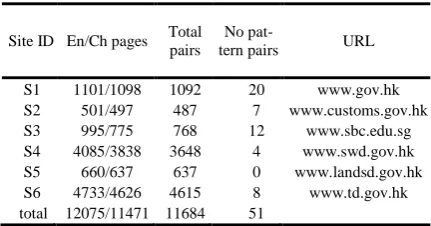
Our experiments focus on six bilingual websites. Most of them are selected from HK government websites. All the web pages were retrieved by using a web site download tool: HTTrack1. We notice that a small amount of pages doesn’t al-ways contain valuable contents. So, we put a threshold (100 bytes in our experiment) on the web pages' content to filter meaningless pages. In order to evaluate our method, the bilingual page pairs of each website are annotated by a human annotator. Finally, we got 23109 pages and 11684 bilingual page pairs in total for testing.
1
http://www.httrack.com/
The basic information of these websites is listed in Table 1.
It’s time-consuming to annotate whether two pages is parallel or not. Note that if a website contains N English pages and M Chinese pages, an annotator has to label N*M page pairs. To the best of our knowledge, there is no large scale and public parallel page pair dataset with human an-notation. So we try to build a reliable and large-scale dataset.
In our experiments, URL similarity is used to reduce the workload for annotation. For a certain website, firstly, we obtain its URL pattern be-tween English and Chinese pages manually. For example, in the website “www.gov.hk”, the URL pairs like:
http://www.gov.hk/en/about/govdirectory/ (English)
http://www.gov.hk/sc/about/govdirectory/ (Chinese)
[image:5.595.307.523.441.554.2]The URL pairs always point to a pair of paral-lel pages. So <”/en/”,”/sc/”> is considered as a URL pattern that was used to find parallel pages. For the other URLs that can’t match the pattern, we have to label them by hand. The column “No pattern pairs” in Table 1 shows that the number of parallel page pairs which mismatch any pat-terns.
Table 1 Number of pages and bilingual page pairs of each websites
Site ID En/Ch pages Total pairs
No
pat-tern pairs URL
S1 1101/1098 1092 20 www.gov.hk S2 501/497 487 7 www.customs.gov.hk S3 995/775 768 12 www.sbc.edu.sg S4 4085/3838 3648 4 www.swd.gov.hk S5 660/637 637 0 www.landsd.gov.hk S6 4733/4626 4615 8 www.td.gov.hk total 12075/11471 11684 51
Each website listed in Table 1 has a URL pat-tern for most parallel web pages. Some previous researches used the URL similarity or patterns to find parallel page pairs. However, due to the di-versity of web page styles and website mainte-nance mechanisms, bilingual websites adopt var-ied naming schemes for parallel documents (Shi, et al, 2006). The effect of URL pattern-based mining always depends on the style of website. In order to build a large dataset, the URL pattern is not used in our method. Our method is able to handle bilingual websites without URL pattern rules.
. It is very hard to tune the because it varies a lot in different websites and language pairs. However, Table 1 shows that the number of parallel pages is smaller than that of English and Chinese pages. Here, for each web-site, the is set to the number of Chinese pages (which is always smaller than that of Eng-lish pages). In this way, the precision will never reach 100%, but it is more practical in a real ap-plication. As a result, in some experiments, we only report the F-score, and the precision and recall can be calculated as follows:
( )
(4)
( )
(5)
Where, for each website is listed in the “Total pairs” column of Table 1.
4.2 Results and Analysis
Performance of the Baseline
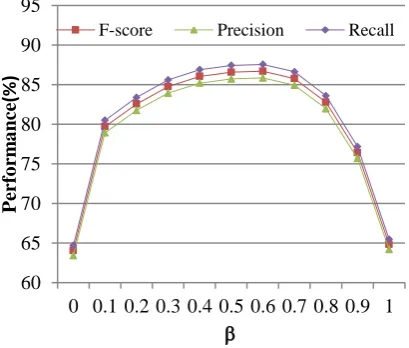
[image:6.595.85.290.554.728.2]Let’s start by presenting the performance of a baseline method as follows. The baseline only employs the internal translation similarity for parallel web pages mining. Algorithm 3 is also used to get the page pairs in baseline system. Here, the input ( ) is replaced by ( ). The parameter in Equation 2 is a discount factor. For different values, the per-formance of baseline system on six websites is shown in Figure 2. In the Figure 2, it shows that when is set to 0.6, the baseline system achieves the best performance. The precision, recall and F-score are 85.84%, 87.55% and 86.69% respec-tively. So in the following experiments, we al-ways set to 0.6.
Figure 2 Performances of baseline system with differ-ent value
Performance of Our Method
As described in Section 3, our method com-bines the internal with external translation simi-larity in estimating the final translation simisimi-larity (i.e., ETS) of two pages. So, the discount factor in Equation (1) is important in our method. Besides, as shown in Algorithm 2, the iterative algorithm is used to calculate the similarity. Then, one question is that how many iterations are re-quired in our algorithm. Figure 3 shows the per-formance of our method on each website. Its hor-izontal axis represents the number of iterations and the vertical axis represents the F-score. And for each website, the F-scores with different (range from 0.2 to 0.8) are also reported in this figure. From Figure 3, it is very easy to find that the best iteration number is 3. For almost all the websites, the performance of our method achieves the maximal values and converges after the third iteration. In addition, Figure 3 also indi-cates that our method is robust for different web-sites. In the following experiments, the iteration number is set to 3.
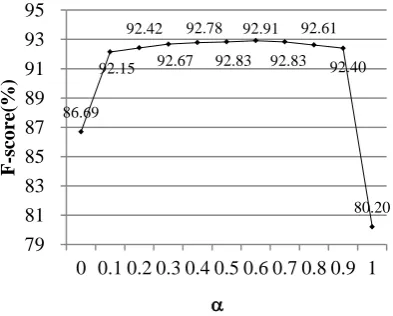
Next, let’s turn to the discount factor . Figure 4 reports the experimental results on the whole dataset. Here, the horizontal axis represents the discount factor and the vertical axis represents the F-score. means that only the internal similarity is used in the algorithm, so the F-score equals to that in Figure 2 when . On the contrary, means that only the external similarity is used in the method, and the F-score is 80.20%. The performance is lower than the baseline system when only the external link in-formation is used, but it is much better than the performance of the content-based method and structure-based method whose F-scores are 64.82% and 64.0% respectively. Besides, it is shown from Figure 4, the performance is improved sig-nificantly when the internal and external similari-ty measures are combined together. Furthermore, it is somewhat surprising that the discount factor is not important as we previously expected. In fact, if we discard the cases that equals to 0 or 1, the difference between the maximum and min-imum F-score will be 0.76% which is very small. This finding indicates that the internal and exter-nal similarity can easily be combined and we don’t need to make many efforts to tune this pa-rameter when our method is applied to other websites. The reason of this phenomenon is that, no matter how much weight (i.e., 1- ) was as-signed to the internal similarity, the internal sim-ilarity always provides a relatively good initial
60 65 70 75 80 85 90 95
0 0.1 0.2 0.3 0.4 0.5 0.6 0.7 0.8 0.9 1
P
er
for
m
a
nce
(%
)
Figure 3 Experiment results of our method on each website
[image:7.595.83.280.365.523.2]iterative direction. In the following experiments, the parameter is set to 0.6.
Figure 4 The F-scores of our method with different the value of
The weight of pages
The weight of the neighbor pages should also be considered. For example, in the most websites, it is very common that most of the web pages contain a hyperlink which points to the homep-age of the website. While in most of the Eng-lish/Chinese websites, almost every English page will link to the English homepage and each Chi-nese page will point to ChiChi-nese homepage. The English and Chinese homepages are probably parallel, but they will be helpless to find parallel web pages, because they are neighbors of almost every page in the site. On the contrary, some-times the parallel homepages have negative ef-fects on finding parallel pages They will increase the translation similarity of two pages which are
not indeed mutual translations. So it is necessary to amend the Algorithm 1.
The weight of each page is calculated accord-ing to its popularity:
( ) ( ) (6)
where ( ) indicates the weight of page , is the number of all pages, ( ) is the number of pages pointing to page and is a constant for smoothing.
In this paper, the weights of pages are used in two ways:
Weight 1: The 9th line of Algorithm 1 is amended by the page weight as follows:
( ) ( ( ) ( )) Weight 2: The pages with low weight are re-moved from the input of Algorithm 1.
The experiment results are shown in Table 2.
Table 2 The effect of page weight
Type No Weight Weight 1 Weight 2
F-score (%) 92.91 92.78 92.75
Surprisingly, no big differences are found after the introduction of the page weight. The side ef-fect of popular pages is not so large in our meth-od. In the neighbor pages of a certain page, the popular pages are the minority. Besides, the iter-ative process makes our method more stable and robust.
The impact of the size of bilingual lexicon The baseline system mainly combines the con-tent-based similarity with structure similarity.
86.69 92.15
92.42
92.67 92.78
92.83 92.91
92.83 92.61
92.40
80.20
79 81 83 85 87 89 91 93 95
0 0.1 0.2 0.3 0.4 0.5 0.6 0.7 0.8 0.9 1
F
-s
co
re(
%)
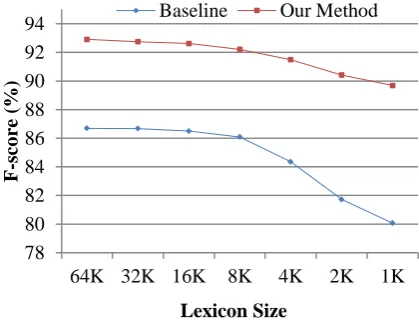
[image:7.595.306.523.582.619.2]And two kinds of similarity measures are also used in our method. As Ma and Liberman (1999) pointed out, not all translators create translated pages that look like the original page which means that the structure similarity does not al-ways work well. Compared to the structure simi-larity, the content-based is more reliable and has wider applicability. Furthermore, the bilingual lexicon is the only information that relates to the language pairs, and other features (such as struc-ture and link information) are all language inde-pendent. So, it’s important to investigate the ef-fect of lexicon size in our method. We test the performance of our method with different size of the bilingual dictionary. The experiment results are shown in Figure 5. In this figure, the horizon-tal axis represents the bilingual lexicon size and the vertical axis represents the F-score. With the decline of the lexicon size, the performances of both the baseline method and our method are decreased. However, we can find that the descent rate of our method is smaller than that of the baseline. It indicates that our method does not need a big bilingual lexicon which is good news for the low-resource language pairs.
Figure 5 The impact of the size of bilingual lexicon
Error analysis
Errors occur when the two pages are similar in terms of structure, content and their neighbors. For example, Figure 6 illustrates a typical web page structure. There are 5 parts in the web page: , , , and . Part always contains the main content of this page. While part , , and always contain some hyperlinks such as “home” in part and “About us” in part . Links in and sometimes relate to the content of the page. For such a kind of non-parallel page pairs, let’s assume that the two pages have the same struc-ture (as shown in Figure 6). In addition, their content part is very short and contains the
same or related topics. As a result, the links in other 4 parts are likely to be similar. In this case, our method is likely to regard the two pages as parallel.
M U
B
L R
Figure 6 A typical web page structure
There are about 920 errors when our system obtains its best performance. By carefully inves-tigating the error page pairs, we find that more than 90% errors fall into the category discussed above. The websites used in our experiments mainly come from Hong Kong government web-sites. Some government departments regularly publish quarterly or monthly work reports on one issue through their websites. These reports look very similar except the publish date and some data in them. The other 10% errors happen be-cause of the particularity of the web pages, e.g. very short pages, broken pages and so on.
5
Conclusions and Future Work
Parallel corpora are valuable resources for a lot of NLP research problems and applications, such as MT and CLIR. This paper introduces an effi-cient and effective solution to bilingual language processing. We first explore how to extract paral-lel page pairs in bilingual websites with link in-formation between web pages. Firstly, we hy-pothesize that the translation similarity of pages should be based on both internal and external translation similarity. Secondly, a novel iterative method is proposed to verify parallel page pairs. Experimental results show that our method is much more effective than the baseline system with 6.2% improvement on F-Score. Further-more, our method has some significant contribu-tions. For example, compared to previous work, our method does not depend on bilingual lexi-cons, and the parameters in our method have lit-tle effect on the final performance. These fea-tures improve the applicability of our method.
In the future work, we will study some method on extracting parallel resource from existing par-allel page pairs, which are challenging tasks due to the diversity of page structures and styles. Be-sides, we will evaluate the effectiveness of our mined data on MT or other applications.
78 80 82 84 86 88 90 92 94
64K 32K 16K 8K 4K 2K 1K
F
-s
co
re
(
%)
Lexicon Size
Acknowledgments
This research work has been sponsored by Na-tional Natural Science Foundation of China (Grants No.61373097 and No.61272259), one National Natural Science Foundation of Jiangsu Province (Grants No.BK2011282), one Major Project of College Natural Science Foundation of Jiangsu Province (Grants No.11KJA520003) and one National Science Foundation of Suzhou City (Grants No.SH201212).
The corresponding author of this paper, ac-cording to the meaning given to this role by School of computer science and technology at Soochow University, is Yu Hong
Reference
Chen, Jiang and Jianyun Nie. 2000. Automatic con-struction of parallel English-Chinese corpus for cross-language information retrieval. Proceedings of the sixth conference on Applied Natural Lan-guage Processing, 21–28.
Resnik, Philip and Noah A. Smith. 2003. The Web as a Parallel Corpus. Meeting of the Association for Computational Linguistics 29(3). 349–380.
Kit, Chunyu and Jessica Yee Ha Ng. 2007. An Intelli-gent Web AIntelli-gent to Mine Bilingual Parallel Pages via Automatic Discovery of URL Pairing Patterns. Web Intelligence and Intelligent Agent Technology Workshops, 526–529.
Zhang, Ying, Ke Wu, Jianfeng Gao and Phil Vines. 2006. Automatic Acquisition of Chinese-English Parallel Corpus from the Web. Joint Proceedings of the Association for Computational Linguistics and the International Conference on Computational Linguistics, 420–431.
Nie, Jianyun, Michel Simard, Pierre Isabelle and Richard Durand. 1999. Cross-language information retrieval based on parallel texts and automatic min-ing of parallel texts from the Web. Proceedmin-ings of the 22nd annual international ACM SIGIR confer-ence on Research and development in information retrieval, 74–81.
Ma, Xiaoyi and Mark Y. Liberman. 1999. BITS: A Method for Bilingual Text Search over the Web. Machine Translation Summit VII.
Chen, Jisong, Rowena Chau and Chung-Hsing Yeh. 2004. Discovering Parallel Text from the World Wide Web. The Australasian Workshop on Data Mining and Web Intelligence, vol. 32, 157–161. Dunedin, New Zealand.
Jiang, Long, Shiquan Yang, Ming Zhou, Xiaohua Liu and Qingsheng Zhu. 2009. Mining Bilingual Data from the Web with Adaptively Learnt Patterns. Proceedings of the Joint Conference of the 47th
Annual Meeting of the ACL and the 4th Interna-tional Joint Conference on Natural Language Pro-cessing of the AFNLP, vol. 2, 870–878.
Yanhui Feng, Yu Hong, Zhenxiang Yan, Jianmin Yao and Qiaoming Zhu. 2010. A novel method for bilingual web page acquisition from search engine web records. Proceedings of the 23rd International Conference on Computational Linguistics: Posters, 294–302.
Zhao, Bing and Stephan Vogel. 2002. Adaptive Paral-lel Sentences Mining from Web Bilingual News Collection. IEEE International Conference on Data Mining, 745–748.
Smith, Jason R., Chris Quirk and Kristina Toutanova. 2010. Extracting parallel sentences from compara-ble corpora using document level alignment. Hu-man Language Technologies: The 2010 Annual Conference of the North American Chapter of the Association for Computational Linguistics, 403– 411.
Bharadwaj, Rohit G. and Vasudeva Varma. 2011. Language independent identification of parallel sentences using wikipedia. Proceedings of the 20th International Conference Companion on World Wide Web, 11–12. Hyderabad, India.
Gusfield, Dan. 1997. Algorithms on Strings, Trees and Sequences: Computerss Science and Computa-tional Biology. Cambridge University Press