An Embedding Model for Predicting Roll-Call Votes
Peter E. Kraft Hirsh Jain Alexander M. Rush
School of Engineering and Applied Science, Harvard University
{pkraft, hirshjain}@college.harvard.edu, [email protected]
Abstract
We develop a novel embedding-based model for predicting legislative roll-call votes from bill text. The model introduces multidimen-sionalideal vectorsfor legislators as an alter-native to single dimensional ideal point mod-els for quantitatively analyzing roll-call data. These vectors are learned to correspond with pre-trained word embeddings which allows us to analyze which features in a bill text are most predictive of political support. Our model is quite simple, while at the same time allowing us to successfully predict legislator votes on specific bills with higher accuracy than past methods.
1 Introduction
Quantitative analysis of political data can contribute to our understanding of governments. One impor-tant source of such data is roll-call votes, records of how legislators vote on bills. Analysis of roll-call data can reveal interesting information about legisla-tors (such as political leanings and ideological clus-ters) and can also allow prediction of future votes (Clinton, 2012).
Previous work on analyzing roll-call votes has chiefly involved positioning congresspeople on ideal point models. Ideal point models assume all legisla-tors and bills can be plotted as single points in one-dimensional “political space.” The closer a particu-lar bill’s position is to a particuparticu-lar congressperson’s, the more utility the congressperson is expected to derive from the bill. Initial work on ideal point models focused on using them to test theories about legislative behavior, such as predicting that the rel-ative differences between ideal points of
congress-people of different parties, and thus party polar-ization, would increase over time (McCarty, 2001). Ideal point models are often created using Bayesian techniques over large amounts of roll-call data (Clin-ton et al., 2004; Jackman, 2001). However, these models are not used to make predictions. They are trained using the complete vote matrix for the bill, which indicates how each congressperson voted on each bill. Therefore, they cannot say anything about how congresspeople will vote on a new bill, as until some congresspeople have voted on the bill its ideal point is not known.
We target this vote prediction problem: given the text of a bill and a congressperson, can we indepen-dently predict how each congressperson will vote on the bill? The first prior attempt at this task was made by Gerrish and Blei (2011) who create anideal point topic modelwhich integrates a topic model similar to LDA for the bill text with an ideal point model for the congresspeople. They use variational inference to approximate the posterior distribution of the top-ics and ideal points, predicting with a linear model. Gerrish and Blei (2012) further extend this work with an issue-adjusted model, a similar model that modifies congressperson ideal points based on top-ics identified with labeled LDA, but which cannot be used for predictions. Further work in a similar vein includes Wang et al. (2013), who introduced temporal information to a graphical model for pre-dicting Congressional votes, and Kim et al. (2014), who used sparse factor analysis to estimate Senato-rial ideal points from bill text and the votes of party leadership.
In this work we revisit this task with a simple bilinear model that learns multidimensional embed-dings for both legislators and bills, combining them
to make vote predictions. We represent a bill as the average of its word embeddings. We represent legislators as ideal vectors, trained end-to-end for vote prediction. These ideal vectors serve as a use-ful, easy-to-train, multidimensional representation of legislator ideology that does not rely on elaborate statistical models or any further assumptions about legislator behavior. Finally, we train our model by optimizing a cross-entropy objective instead of the posterior of a topic model. The final model achieves high accuracy at predicting roll-call votes.
2 Model
Our goal is to predict roll-call votes by learning from the texts of bills and from past votes. Our input con-sists of a congresspersoncand the setB of unique words in a bill. Our outputyis whether that the
con-gressperson votedyeaornayon the bill. We train on the full set of congressional votes on a number of bills. At test time, we supply entirely new bills and predict how each congressperson will vote on each new bill.
We propose a simple bilinear model that uses low-dimensional embeddings to model each word in our dictionary and each congressperson. We rep-resent each bill using its word embeddings in or-der to capture the multivariate relationships between words and their meanings (Collobert et al., 2011; Mikolov et al., 2013). The model is trained to synthesize information about each congressperson’s voting record into a multidimensional ideal vector. At test time, the model combines the embedding rep-resentation of a new bill with the trained ideal vector of a congressperson and generates a prediction for how the congressperson will vote on the bill.
Letew ∈Rdwordbe the pretrained embedding for a wordw. We initialize to the GloVe embeddings
with dword = 50 (Pennington et al., 2014), then jointly train them with the model. To represent a bill, we average over the embeddings of the setBof words in the bill.
To represent a congressperson, we introduce an-other set of embeddings vc ∈ Rdemb for each con-gresspersonc. The embeddings act as the ideal
vec-tor for each legislavec-tor. Unlike the word embeddings, we initialize these randomly.
The full model takes in a bill and a
congressper-Congress # Bills House Senate Pres 106 557 R R Clinton
107 505 R D2 Bush
108 607 R R Bush
109 579 R R Bush
110 854 D D Bush
111 965 D D Obama
Table 1: Dataset details for 106-111th Congress.
son. It applies an affine transformation, represented by a matrixW ∈Rdemb×dword and biasb∈Rdemb, to map the bill representation into the space of the ideal vectors, and then uses a dot-product to provide ayea/nayscore.
p(y =yea|B, c) =σ((W X w∈B
ew/|B|
!
+b)·vc)
The full model is simply trained to minimize the negative log-likelihood of the training set, and re-quires no additional meta-information (such as party affiliation) or additional preprocessing of the bills during training- or test-time.
3 Experimental Setup
Data Following past work, our dataset is derived from the Govtrack database.1 Specifically, our dataset consists of all votes on the full-text (not amendments) of bills or resolutions from the 106th-111th Congress, six of the most recent Congresses for which bill texts are readily available. Details of each these congresses are shown in Table 1.
To create our dataset, we first find a list of all votes on the full text of bills, and create a matrix of how each congressperson voted on each bill, which will be used in training and in testing. In accordance with previous work, we only consider yes-or-no votes and omit abstentions and “present” votes (Gerrish and Blei, 2011). We then simply collect the set of words used in each bill. Overall, our dataset consists of 4067 bills and over a million unique yes-or-no votes.
1https://www.govtrack.us/
Congress YEA GB IDP EMB 106 83.0 - 79.5 84.9 107 85.9 - 85.8 89.7 108 87.1 - 85.0 91.9 109 83.5 - 81.5 88.4 110 82.7 - 80.8 92.1 111 86.0 - 85.7 93.4 Avg 84.5 89.0 83.1 90.6 Table 2: Main results comparing predictive accu-racy of our model EMBwith a several baselines (de-scribed in the text) on the 106th-111th Congress.
Model We tested prediction accuracy of the
average-of-embeddings model, EMB, by running it for ten epochs at a learning rate ofη= 0.1anddemb set to 10. Hyperparameters were tuned on a held-out section of the 107th Congress. We ran on each of the 106th to 111th Congresses individually using five-fold cross-validation.
Baselines We compare our results to three
differ-ent baselines. The first, YEA, is a majority class baseline which assumes all legislators vote yea. The second, IDP, is our model with demb set to 1 to simulate a simple ideal point model. The third, GB, is Gerrish and Blei’s reported predictive accu-racy of 89 % on average from the 106th to 111th Congresses, which is to the extent of our knowledge the best predictive accuracy on roll-call votes yet achieved in the literature. Gerrish and Blei report on the same data set using cross-validation and like us train and test on each congress individually, but do not split out results into individual congresses.
4 Experiments and Analysis
Predictive Results The main predictive
experi-mental results are shown in Table 2. We see that EMB performs substantially better than YEAon all six Congresses. It has a weighted average of 90.6% on an 84.5% baseline, compared to Gerrish and Blei’s 89% on an identical dataset. IDP, however, actually does worse than the baseline, demonstrat-ing that the bulk of our gain in prediction accu-racy comes from using ideal vectors instead of ideal points. To further test this hypothesis, we experi-mented with replacing word embeddings with LDA
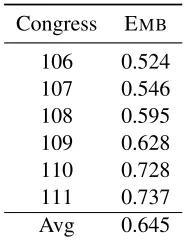
[image:3.612.92.278.59.179.2]Congress EMB 106 0.524 107 0.546 108 0.595 109 0.628 110 0.728 111 0.737 Avg 0.645
Table 3: Minority class F1 Scores of our model EMB on the 106th-111th Congress.
and obtained an accuracy of 89.5%, in between GB and EMB. This indicates that the word embeddings are also responsible for part, but not all, of the accu-racy improvement. We also report minority class F1 scores for EMBin Table 3, finding an overall average F1 score of 0.645.
Ideal Vectors Beyond predictive accuracy, one of
the most interesting features of the model is that it produces ideal vectors as its complete representa-tion of congresspeople. These vectors are much eas-ier to compute than standard ideal points, which re-quire relatively complex and computationally inten-sive statistical models (Jackman, 2001). Addition-ally unlike ideal point models, which tend to contain many assumptions about legislative behavior, ideal vectors arise naturally from raw data and bill text (Clinton et al., 2004).
Figure 1: PCA projection of the ideal vectors for 111th Congress, both House and Senate. Republi-cans shown in red, Democrats who voted for Afford-able Care Act (ACA) in blue, Democrats who voted against ACA in yellow, and independents in green.
voted against the Affordable Care Act (ACA, bet-ter known as Obamacare) are shown in yellow. The ACA was a major Democratic priority and point of difference between the two parties. The Democrats who voted against it tended to be relatively conser-vative and closer to the Republicans. The model picks up on this distinction.
Furthermore, since our model maps individual words and congresspeople to the same vector space, we can use it to determine how words (and by proxy issues) unite or divide congresspeople and parties. In Figure 2, we show the scaled probabilities that congresspeople will vote for a bill containing only the word “enterprise” versus one containing only the word “science” in the 110th Congress. The word “enterprise,” denoting pro-business legislation, neatly divides the parties. Both are for it, but Repub-licans favor it more. More interestingly, the word “science” creates divisionwithinthe parties, as nei-ther was at the time more for science funding than the other but both contained congresspeople with varying levels of support for it. An ideal point model would likely capture the “enterprise” dimension, but not the “science” one, and would not be able to dis-tinguish between libertarians like Ron Paul (R-TX) who are against both “corporate welfare” and gov-ernment science funding, conservative budget hawks like Jeff Flake (R-AZ) who favor business but are skeptical of government funding of science, and
es-Figure 2: Relative likelihood of congresspeople in the 110th Congress voting for a bill containing only the word “Enterprise” versus only the word “Sci-ence.” Coordinates are sigmoids of dot products of congressperson vectors with normalized word vec-tors.
tablishment Republicans like Kevin McCarthy (R-CA) who support both. Indeed, ideal point models are known to perform poorly at describing ideolog-ically idiosyncratic figures like Ron Paul (Gerrish and Blei, 2011). Providing the ability to explore multiple dimensions of difference between legisla-tors will be extremely helpful for political scientists analyzing the dynamics of legislatures.
Lexical Properties Finally, as with topic
[image:4.612.317.540.58.216.2]Democrats Republicans economic veterans exchange head
state opportunities carrying provided government promote higher service congress identified consumer information educational record
[image:5.612.119.253.57.219.2]special executive
Table 4: Top ten words by cosine similarity for each party in the 110th Congress with stop words re-moved.
5 Conclusion
We have developed a novel model for predicting Congressional roll-call votes. This new model provides a new and interesting way of analyz-ing the behavior of parties and legislatures. It achieves predictive accuracies around 90.6% on av-erage and outperforms any prior model of roll-call voting. We also introduce the idea of ideal vec-tors as a fast, simple, and multidimensional al-ternative to ideal point models for analyzing the actions of individual legislators and testing theo-ries about their behavior. Our code and datasets are available online at https://github.com/ kraftp/roll_call_predictor.
References
Clifford J Carrubba, Matthew Gabel, Lacey Murrah, Ryan Clough, Elizabeth Montgomery, and Rebecca Schambach. 2006. Off the record: Unrecorded leg-islative votes, selection bias and roll-call vote analysis. British Journal of Political Science, 36(04):691–704. Clifford Carrubba, Matthew Gabel, and Simon Hug.
2008. Legislative voting behavior, seen and unseen: A theory of roll-call vote selection. Legislative Stud-ies Quarterly, 33(4):543–572.
Joshua Clinton, Simon Jackman, and Douglas Rivers. 2004. The statistical analysis of roll call data. Ameri-can Political Science Review, 98(02):355–370. Joshua D Clinton. 2012. Using roll call estimates to test
models of politics. Annual Review of Political Science, 15:79–99.
Ronan Collobert, Jason Weston, L´eon Bottou, Michael Karlen, Koray Kavukcuoglu, and Pavel Kuksa. 2011. Natural language processing (almost) from scratch. The Journal of Machine Learning Research, 12:2493– 2537.
Sean Gerrish and David M Blei. 2011. Predicting leg-islative roll calls from text. InProceedings of the 28th international conference on machine learning (icml-11), pages 489–496.
Sean Gerrish and David M Blei. 2012. How they vote: Issue-adjusted models of legislative behavior. In Advances in Neural Information Processing Systems, pages 2753–2761.
Simon Jackman. 2001. Multidimensional analysis of roll call data via bayesian simulation: Identification, estimation, inference, and model checking. Political Analysis, 9(3):227–241.
In Song Kim, John Londregan, and Marc Ratkovic. 2014. Voting, speechmaking, and the dimensions of conflict in the us senate. In Annual Meeting of the Midwest Political Science Association.
Nolan McCarty. 2001. The hunt for party discipline in congress. InAmerican Political Science Association, volume 95, pages 673–687. Cambridge Univ Press. Tomas Mikolov, Wen-tau Yih, and Geoffrey Zweig.
2013. Linguistic regularities in continuous space word representations. InHLT-NAACL, pages 746–751. Jeffrey Pennington, Richard Socher, and Christopher D