Syntactic Sca
ff
olds for Semantic Structures
Swabha Swayamdipta♠ Sam Thomson♠
Kenton Lee♦ Luke Zettlemoyerr Chris Dyer♥ Noah A. Smithr♣
♠Language Technologies Institute, Carnegie Mellon University ♦Google AI Language
rPaul G. Allen School of Computer Science & Engineering, University of Washington ♥
Google DeepMind ♣
Allen Institute for Artificial Intelligence
{swabha,sammthomson}@cs.cmu.edu {kentonl,cdyer}@google.com
{lsz,nasmith}@cs.washington.edu
Abstract
We introduce the syntactic scaffold, an ap-proach to incorporating syntactic informa-tion into semantic tasks. Syntactic scaffolds avoid expensive syntactic processing at run-time, only making use of a treebank during training, through a multitask objective. We im-prove over strong baselines on PropBank se-mantics, frame sese-mantics, and coreference res-olution, achieving competitive performance on all three tasks.
1 Introduction
As algorithms for the semantic analysis of natu-ral language sentences have developed, the role ofsyntaxhas been repeatedly revisited. Linguis-tic theories have argued for a very tight integra-tion of syntactic and semantic processing ( Steed-man,2000;Copestake and Flickinger,2000), and many systems have used syntactic dependency or phrabased parsers as preprocessing for se-mantic analysis (Gildea and Palmer, 2002; Pun-yakanok et al., 2008; Das et al., 2014). Mean-while, some recent methods forgo explicit syntac-tic processing altogether (Zhou and Xu,2015;He et al.,2017;Lee et al.,2017;Peng et al.,2017).
Because annotated training datasets for se-mantics will always be limited, we expect that syntax—which offers an incomplete but poten-tially useful view of semantic structure—will con-tinue to offer useful inductive bias, encouraging semantic models toward better generalization. We address the central question: is there a way for se-mantic analyzers to benefit from syntax without the computational cost of syntactic parsing?
We propose a multitask learning approach to incorporating syntactic information into learned
representations of neural semantics models (§2). Our approach, the syntactic scaffold, minimizes an auxiliary supervised loss function, derived from a syntactic treebank. The goal is to steer the dis-tributed, contextualized representations of words and spans toward accurate semanticandsyntactic labeling. We avoid the cost of training or execut-ing a full syntactic parser, and at test time (i.e., runtime in applications) the semantic analyzer has no additional cost over a syntax-free baseline. Fur-ther, the method does not assume that the syntactic treebank overlaps the dataset for the primary task. Many semantic tasks involve labeling spans, in-cluding semantic role labeling (SRL;Gildea and Jurafsky, 2002) and coreference resolution (Ng,
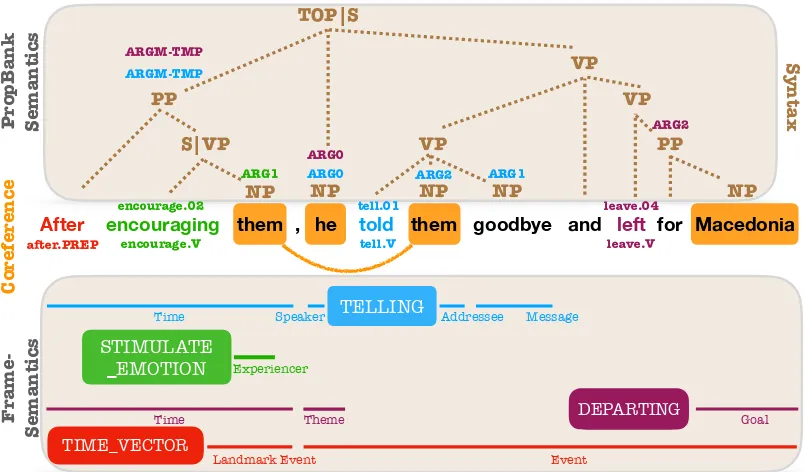
2010) (tasks we consider in this paper), as well as named entity recognition and some reading comprehension and question answering tasks ( Ra-jpurkar et al., 2016). These spans are usu-ally syntactic constituents (cf. PropBank;Palmer et al.,2005), making phrase-based syntax a natu-ral choice for a scaffold. See Figure1 for an ex-ample sentence with syntactic and semantic anno-tations. Since the scaffold task is not an end in itself, we relax the syntactic parsing problem to a collection of independent span-level predictions, with no constraint that they form a valid parse tree. This means we never need to run a syntactic pars-ing algorithm.
base-them he
After encouraging them , told goodbye and left for
STIMULATE
_EMOTION Experiencer
TELLING
Time Speaker Addressee Message
DEPARTING Goal
Time Theme
TIME_VECTOR
Event Landmark Event
Macedonia
NP
NP NP
NP NP
S|VP VP PP
VP PP
VP TOP|S
ARGM-TMP
ARGM-TMP
ARG1
ARG0
ARG0 ARG1
ARG2
Syntax
Coref
erence
Frame-
Semantics
encourage.02 tell.01 leave.04
ARG2 PropBank Semantics
[image:2.595.98.501.62.298.2]after.PREP encourage.V tell.V leave.V
Figure 1: An example sentence with syntactic, PropBank and coreference annotations from OntoNotes,
and author-annotated frame-semantic structures. PropBank SRL arguments and coreference mentions are annotated on top of syntactic constituents. All but one frame-semantic argument (Event) is a syntactic
constituent. Targets evoke frames shown in the color-coded layers.
line itself is a novel globally normalized structured conditional random field, which outperforms the previous state of the art.1 Syntactic scaffolds re-sult in further improvements over prior work— 3.6 absolute F1 in FrameNet SRL, 1.1 absolute
F1 in PropBank SRL, and 0.6 F1 in coreference resolution (averaged across three standard scores). Our code is open source and available athttps: //github.com/swabhs/scaffolding.
2 Syntactic Scaffolds
Multitask learning (Caruana, 1997) is a collec-tion of techniques in which two or more tasks are learned from data with at least some parameters shared. We assume there is only one task about whose performance we are concerned, denotedT1 (in this paper,T1is either SRL or coreference res-olution). We use the term “scaffold” to refer to a second task, T2, that can be combined withT1 during multitask learning. A scaffold task isonly
used during training; it holds no intrinsic interest beyond biasing the learning ofT1, and after learn-ing is completed, the scaffold is discarded.
Asyntactic scaffoldis a task designed to steer the (shared) model toward awareness of syntactic
1This excludes models initialized with deep,
contextual-ized embeddings (Peters et al.,2018), an approach orthogonal to ours.
structure. It could be defined through a syntac-tic parser that shares some parameters with T1’s model. Since syntactic parsing is costly, we use simpler syntactic prediction problems (discussed below) that do not produce whole trees.
As with multitask learning in general, we do not assume that the same data are annotated with out-puts for T1 and T2. In this work, T2 is defined using phrase-structure syntactic annotations from OntoNotes 5.0 (Weischedel et al., 2013;Pradhan et al., 2013). We experiment with three settings: one where the corpus forT2does not overlap with the training datasets for T1 (frame-SRL) and two where there is a complete overlap (PropBank SRL and coreference). Compared to approaches which require multiple output labels over the same data, we offer the major advantage of not requiring any assumptions about, or specification of, the rela-tionship betweenT1andT2output.
3 Related Work
We briefly contrast the syntactic scaffold with ex-isting alternatives.
common approach for semantic structure predic-tion (Toutanova et al.,2008;Yang and Mitchell,
2017;Wiseman et al.,2016).2 However, pipelines introduce the problem of cascading errors (T2’s mistakes affect the performance, and perhaps the training, of T1; He et al., 2013). To date, reme-dies to cascading errors are so computationally ex-pensive as to be impractical (e.g., Finkel et al.,
2006). A syntactic scaffold is quite different from a pipeline since the output ofT2is never explicitly used.
Latent variables. Another solution is to treat the output of T2 as a (perhaps structured) la-tent variable. This approach obviates the need of supervision forT2and requires marginalization (or some approximation to it) in order to reason about the outputs of T1. Syntax as a latent vari-able for semantics was explored by Zettlemoyer and Collins(2005) andNaradowsky et al.(2012). Apart from avoiding marginalization, the syntactic scaffold offers a way to use auxiliary syntactically-annotated data as direct supervision forT2, and it need not overlap theT1training data.
Joint learning of syntax and semantics. The motivation behind joint learning of syntactic and semantic representations is that any one task is helpful in predicting the other (Llu´ıs and M`arquez,
2008;Llu´ıs et al., 2013; Henderson et al., 2013;
Swayamdipta et al., 2016). This typically re-quires joint prediction of the outputs of T1 and
T2, which tends to be computationally expensive at both training and test time.
Part of speech scaffolds. Similar to our work, there have been multitask models that use part-of-speech tagging asT2, with transition-based de-pendency parsing (Zhang and Weiss, 2016) and CCG supertagging (Søgaard and Goldberg,2016) asT1. Both of the above approaches assumed par-allel input data and used both tasks as supervision. Notably, we simplify our T2, throwing away the structured aspects of syntactic parsing, whereas part-of-speech tagging has very little structure to begin with. While their approach results in improved token-level representations learned via supervision from POS tags, these must still be composed to obtain span representations.
In-2There has been some recent work on SRL which
com-pletely forgoes syntactic processing (Zhou and Xu, 2015), however it has been shown that incorporating syntactic in-formation still remains useful (He et al.,2017).
stead, our approach learns span-level representa-tions from phratype supervision directly, for se-mantic tasks. Additionally, these methods explore architectural variations in RNN layers for includ-ing supervision, whereas we focus on incorporat-ing supervision with minimal changes to the base-line architecture. To the best of our knowledge, such simplified syntactic scaffolds have not been tried before.
Word embeddings. Our definition of a scaffold task almostincludes stand-alone methods for es-timating word embeddings (Mikolov et al.,2013;
Pennington et al., 2014;Peters et al.,2018). Af-ter training word embeddings, the tasks implied by models like the skip-gram or ELMo’s language model become irrelevant to the downstream use of the embeddings. A noteworthy difference is that, rather than pre-training, a scaffold is integrated di-rectly into the training ofT1 through a multitask objective.
Multitask learning. Neural architectures have often yielded performance gains when trained for multiple tasks together (Collobert et al.,2011; Lu-ong et al., 2015; Chen et al., 2017; Hashimoto et al.,2017). In particular, performance of seman-tic role labeling tasks improves when done jointly with other semantic tasks (FitzGerald et al.,2015;
Peng et al.,2017,2018). Contemporaneously with this work, Hershcovich et al. (2018) proposed a multitask learning setting for universal syntactic dependencies and UCCA semantics (Abend and Rappoport,2013). Syntactic scaffolds focus on a primary semantic task, treating syntax as an auxil-lary, eventually forgettable prediction task.
4 Syntactic Scaffold Model
We assume two sources of supervision: a cor-pusD1with instancesxannotated for the primary task’s outputsy(semantic role labeling or corefer-ence resolution), and a treebankD2with sentences x, each with a phrase-structure treez.
4.1 Loss
Each task has an associated loss, and we seek to minimize the combination of task losses,
X
(x,y)∈D1
L1(x,y)+δ X (x,z)∈D2
L2(x,z) (1)
the rest of this section, we describe the scaffold task. We define the primary tasks in Sections5–6. Each input is a sequence of tokens, x = hx1,x2, . . . ,xni, for some n. We refer to a span of contiguous tokens in the sentence as xi:j =
hxi,xi+1, . . . ,xji, for any 1 6 i 6 j 6 n. In our experiments we consider only spans up to a maxi-mum lengthD, resulting inO(nD) spans.
Supervision comes from a phrase-syntactic tree zfor the sentence, comprising a syntactic category
zi:j ∈ Cfor every span xi:j in x(many spans are given anulllabel). We experiment with different
sets of labelsC(§4.2).
In our model, every span xi:j is represented by an embedding vector vi:j (see details in §5.3). A distribution over the category assigned tozi:jis de-rived fromvi:j:
p(zi:j=c|xi:j)=softmax
c wc·vi:j (2)
where wc is a parameter vector associated with categoryc. We sum the log loss terms for all the spans in a sentence to give its loss:
L2(x,z)=− X
16i6j6n j−i6D
logp(zi:j |xi:j). (3)
4.2 Labels for the Syntactic Scaffold Task
Different kinds of syntactic labels can be used for learning syntactically-aware span representations:
• Constituent identity:C= {0,1}; is a span a constituent, or not?
• Non-terminal: c is the category of a span, including anullfor non-constituents.
• Non-terminal and parent:cis the category of a span, concatenated with the category of its immediate ancestor. nullis used for
non-constituents, and for empty ancestors.
• Common non-terminals: Since a majority of semantic arguments and entity mentions are labeled with a small number of syntac-tic categories,3 we experiment with a three-way classification among (i) noun phrase (or prepositional phrase, for frame SRL); (ii) any other category; and (iii)null.
In Figure 1, for the span “encouraging them”, the constituent identity scaffold label is 1, the non-terminal label is S|VP, the non-terminal and par-ent label is S|VP+par=PP, and the common non-terminals label is set toOTHER.
3In the OntoNotes corpus, which includes both
syntac-tic and semansyntac-tic annotations, 44% of semansyntac-tic arguments are noun phrases and 13% are prepositional phrases.
5 Semantic Role Labeling
We contribute a new SRL model which contributes a strong baseline for experiments with syntactic scaffolds. The performance of this baseline itself is competitive with state-of-the-art methods (§7).
FrameNet. In the FrameNet lexicon (Baker et al., 1998), a frame represents a type of event, situation, or relationship, and is associated with a set of semantic roles, called frame elements. A frame can be evoked by a word or phrase in a sen-tence, called a target. Each frame element of an evoked frame can then be realized in the sentence as a sentential span, called anargument(or it can be unrealized). Arguments for a given frame do not overlap.
PropBank. PropBank similarly disambiguates predicates and identifies argument spans. Tar-gets are disambiguated to lexically specificsenses
rather than shared frames, and a set of generic roles is used for all targets, reducing the argument label space by a factor of 17. Most importantly, the arguments were annotated on top of syntactic constituents, directly coupling syntax and seman-tics. A detailed example for both formalisms is provided in Figure1.
Semantic structure prediction is the task of iden-tifying targets, labeling their frames or senses, and labeling all their argument spans in a sentence. Here we assume gold targets and frames, and con-sider only the SRL task.
Formally, a single input instance for argument identification consists of: ann-word sentencex = hx1,x2, . . . ,xni, a single target spant=htstart,tendi, and its evoked frame, or sense, f. The argu-ment labeling task is to produce a segmentation of the sentence: s = hs1,s2, . . . ,smi for each in-put x. A segment s = hi,j,yi:ji corresponds to a labeled span of the sentence, where the label
yi:j ∈ Yf ∪ {null} is either a role that the span
fills, ornullif the span does not fill any role. In
5.1 Semi-Markov CRF
In order to model the non-overlapping arguments of a given target, we use a semi-Markov condi-tional random field (semi-CRF;Sarawagi et al.,
2004). Semi-CRFs define a conditional distribu-tion over labeled segmentadistribu-tions of an input se-quence, and are globally normalized. A single tar-get’s arguments can be neatly encoded as a labeled segmentation by giving the spans in between argu-ments a reservednull label. Semi-Markov
mod-els are more powerful than BIO tagging schemes, which have been used successfully for PropBank SRL (Collobert et al.,2011;Zhou and Xu, 2015,
inter alia), because the semi-Markov assumption allows scoring variable-length segments, rather than fixed-length label n-grams as under an (n−
1)-order Markov assumption. Computing the marginal likelihood with a semi-CRF can be done using dynamic programming inO(n2) time (§5.2). By filtering out segments longer than D tokens, this is reduced toO(nD).
Given an input x, a semi-CRF defines a condi-tional distribution p(s | x). Every segment s = hi, j,yi:jiis given a real-valued score,ψ(hi,j,yi:j =
ri,xi:j) = wr · vi:j, where vi:j is an embedding of the span (§5.3) and wr is a parameter vector corresponding to its label. The score of the en-tire segmentation s is the sum of the scores of its segments: Ψ(x,s) = Pm
k=1ψ(sk,xik:jk). These
scores are exponentiated and normalized to define the probability distribution. The sum-product vari-ant of the semi-Markov dynamic programming al-gorithm is used to calculate the normalization term (required during learning). At test time, the max-product variant returns the most probable segmen-tation, ˆs=arg maxsΨ(s,x).
The parameters of the semi-CRF are learned to maximize a criterion related to the conditional log-likelihood of the gold-standard segments in the training corpus (§5.2). The learner evaluates and adjusts segment scores ψ(sk,x) for every span in the sentence, which in turn involves learning em-bedded representations for all spans (§5.3).
5.2 Softmax-Margin Objective
Typically CRF and semi-CRF models are trained to maximize a conditional log-likelihood objec-tive. In early experiments, we found that incor-porating a structured cost was beneficial; we do so by using a softmax-margin training objective (Gimpel and Smith,2010), a “cost-aware” variant
of log-likelihood:
L1=−
X
(x,s∗)∈D 1
logexpΨ(s
∗,x)
Z(x,s∗) , (4)
Z(x,s∗)=X s
exp{Ψ(s,x)+cost(s,s∗)}. (5)
We design the cost function so that it factors by predicted span, in the same wayΨdoes:
cost(s,s∗)=X s∈s
cost(s,s∗)=X s∈s
I(s<s∗). (6)
The softmax-margin criterion, like log-likelihood, is globally normalized over all of the exponentially many possible labeled segmentations. The follow-ing zeroth-order semi-Markov dynamic program (Sarawagi et al., 2004) efficiently computes the new partition function:
αj = X
s=hi,j,yi:ji
j−i6D
αi−1exp{Ψ(s,x)+cost(s,s∗)}, (7)
whereZ=αn, under the base caseα0=1. The prediction under the model can be calcu-lated using a similar dynamic program with the following recurrence whereγ0=1:
γj = max
s=hi,j,yi:ji
j−i6D
γi−1expΨ(s,x). (8)
Our model formulation enforces that arguments do not overlap. We do not enforce any other SRL constraints, such as non-repetition of core frame elements (Das et al.,2012).
5.3 Input Span Representation
This section describes the neural architecture used to obtain the span embedding, vi:j, correspond-ing to a spanxi:j and the target in consideration,
t = htstart,tendi. For the scaffold task, since the
syntactic treebank does not contain annotations for semantic targets, we use the last verb in the sen-tence as a placeholder target, wherever target fea-tures are used. If there are no verbs, we use the first token in the sentence as a placeholder target. The parameters used to learnvare shared between the tasks.
We construct an embedding for the span using
• hiandhj: contextualized embeddings for the words at the span boundary (§5.3.1),
• ai:j: and a hand-engineered feature vector for the span (§5.3.3).
This embedding is then passed to a feedforward layer to compute the span representation,vi:j.
5.3.1 Contextualized Token Embeddings
To obtain contextualized embeddings of each to-ken in the input sequence, we run a bidirectional LSTM (Graves, 2012) with` layers over the full input sequence. To indicate which token is a pred-icate, a linearly transformed one-hot embeddingv is used, following Zhou and Xu (2015) and He et al. (2017). The input vector representing the token at positionqin the sentence is the concate-nation of a fixed pretrained embeddingxqandvq. When given as input to the bidirectional LSTM, this yields a hidden state vector hq representing theqth token in the context of the sentence.
5.3.2 Span Summary
Tokens within a span might convey different amounts of information necessary to label the span as a semantic argument. Following Lee et al.
(2017), we use an attention mechanism (Bahdanau et al., 2014) to summarize each span. Each con-textualized token in the span is passed through a feed-forward network to obtain a weight, normal-ized to giveσk = softmax
i6k6j w
head·h
k,wherewhead
is a learned parameter. The weights σ are then used to obtain a vector that summarizes the span, ui:j=Pi6k6j;j−i<Dσk·hk.
5.3.3 Span Features
We use the following three features for each span:
• width of the span in tokens (Das et al.,2014)
• distance (in tokens) of the span from the tar-get (T¨ackstr¨om et al.,2015)
• position of the span with respect to the tar-get (before,after,overlap) (T¨ackstr¨om et al.,
2015)
Each of these features is encoded as a one-hot-embedding and then linearly transformed to yield a feature vector,ai:j.
6 Coreference Resolution
Coreference resolution is the task of determin-ing clusters of mentions that refer to the same entity. Formally, the input is a document x =
x1,x2, . . . ,xn consisting of n words. The goal is to predict a set of clustersc = {c1,c2, . . .}, where each clusterc = {s1,s2, . . .} is a set of spans and
each span s = hi,jiis a pair of indices such that 16i6 j6n.
As a baseline, we use the model of Lee et al.
(2017), which we describe briefly in this section. This model decomposes the prediction of coref-erence clusters into a series of span classification decisions. Every span s predicts an antecedent
ws ∈ Y(s) = {null,s1,s2, . . . ,sm}. Labels s1 to
sm indicate a coreference link betweens and one of themspans that precede it, andnullindicates
that sdoes not link to anything, either because it is not a mention or it is in a singleton cluster. The predicted clustering of the spans can be recovered by aggregating the predicted links.
Analogous to the SRL model (§5), every span
s is represented by an embedding vs, which is central to the model. For each span s and a po-tential antecedenta ∈ Y(s), pairwise coreference scoresΨ(vs,va, φ(s,a)) are computed via feedfor-ward networks with the span embeddings as input.
φ(s,a) are pairwise discrete features encoding the distance between spansand spanaand metadata, such as the genre and speaker information. We re-fer the reader toLee et al.(2017) for the details of the scoring function.
The scores fromΨare normalized over the pos-sible antecedents Y(s) of each span to induce a probability distribution for every span:
p(ws=a)=softmax
a∈Y(s) Ψ(vs,va, φ(s,a)) (9)
In learning, we minimize the negative log-likelihood marginalized over the possibly correct antecedents:
L1 =−X
s∈D
log X
a∗∈G(s)∩Y(s)
p(ws=a∗) (10)
whereDis the set of spans in the training dataset, andG(s) indicates the gold cluster ofsif it belongs to one and{null}otherwise.
To operate under reasonable computational re-quirements, inference under this model requires a two-stage beam search, which reduces the number of span pairs considered. We refer the reader to
Lee et al.(2017) for details.
2012), we reuse thevfor the scaffold task. Addi-tionally, instead of the entire document, each sen-tence in it is independently given as input to the bidirectional LSTMs.
7 Results
We evaluate our models on the test set of FrameNet 1.5 for frame SRL and on the test set of OntoNotes for both PropBank SRL and coref-erence. For the syntactic scaffold in each case, we use syntactic annotations from OntoNotes 5.0 (Weischedel et al., 2013; Pradhan et al.,
2013).4 Further details on experimental settings and datasets have been elaborated in the supple-mental material.
Frame SRL. Table1shows the performance of all the scaffold models on frame SRL with respect to prior work and a semi-CRF baseline (§5.1) without a syntactic scaffold. We follow the offi -cial evaluation from the SemEval shared task for frame-semantic parsing (Baker et al.,2007).
Prior work for frame SRL has relied on pre-dicted syntactic trees, in two different ways: by using syntax-based rules to prune out spans of text that are unlikely to contain any frame’s argument; and by using syntactic features in their statistical model (Das et al., 2014; T¨ackstr¨om et al., 2015;
FitzGerald et al.,2015;Kshirsagar et al.,2015). The best published results on FrameNet 1.5 are due toYang and Mitchell(2017). In their sequen-tial model (seq), they treat argument identification
as a sequence-labeling problem using a deep bidi-rectional LSTM with a CRF layer. In their rela-tional model (Rel), they treat the same problem as
a span classification problem. Finally, they intro-duce an ensemble to integerate both models, and use an integer linear program for inference satis-fying SRL constraints. Though their model does not do any syntactic pruning, it does use syntactic features for argument identification and labeling.5 Notably, all prior systems for frame SRL listed in Table 1 use a pipeline of syntax and seman-tics. Our semi-CRF baseline outperforms all prior work, without any syntax. This highlights the
ben-4http://cemantix.org/data/ontonotes.html
5Yang and Mitchell (2017) also evaluated on the full
frame-semantic parsing task, which includes frame-SRL as well as identifying frames. Since our frame SRL performance improves over theirs, we expect that incorporation into a full system (e.g., using their frame identification module) would lead to overall benefits as well; this experiment is left to fu-ture work.
efits of modeling spans and of global normaliza-tion.
Turning to scaffolds, even the most coarse-grained constituent identity scaffold improves the performance of our syntax-agnostic baseline. The nonterminal and nonterminal and parent scaffolds, which use more detailed syntactic representations, improve over this. The greatest improvements come from the scaffold model predicting com-mon nonterminal labels (NPandPP, which are the most common syntactic categories of semantic ar-guments, vs. others): 3.6% absolute improvement inF1measure over prior work.
Contemporaneously with this work,Peng et al.
(2018) proposed a system for joint frame-semantic and semantic dependency parsing. They report re-sults for joint frame and argument identification, and hence cannot be directly compared in Table1. We evaluated their output for argument identifica-tion only; our semi-CRF baseline model exceeds their performance by 1F1, and our common non-terminal scaffold by 3.1F1.6
Model Prec. Rec. F1
Kshirsagar et al.(2015) 66.0 60.4 63.1
Yang and Mitchell(2017) (Rel) 71.8 57.7 64.0
Yang and Mitchell(2017) (Seq) 63.4 66.4 64.9
†Yang and Mitchell(2017) (All) 70.2 60.2 65.5
Semi-CRF baseline 67.8 66.2 67.0
+constituent identity 68.1 67.4 67.7
+nonterminal and parent 68.8 68.2 68.5
+nonterminal 69.4 68.0 68.7
[image:7.595.322.513.566.659.2]+common nonterminals 69.2 69.0 69.1
Table 1: Frame SRL results on the test set of
FrameNet 1.5., using gold frames. Ensembles are denoted by†.
Model Prec. Rec. F1
Zhou and Xu(2015) - - 81.3
He et al.(2017) 81.7 81.6 81.7
He et al.(2018a) 83.9 73.7 82.1
Tan et al.(2018) 81.9 83.6 82.7
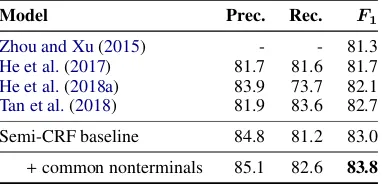
Semi-CRF baseline 84.8 81.2 83.0
+common nonterminals 85.1 82.6 83.8
Table 2: PropBank sSRL results, using gold
pred-icates, on CoNLL 2012 test. For fair comparison, we show only non-ensembled models.
6This result is not reported in Table1sincePeng et al.
Model MUC B3 CEAFφ4 Avg.F1
Prec. Rec. F1 Prec. Rec. F1 Prec. Rec. F1
Wiseman et al.(2016) 77.5 69.8 73.4 66.8 57.0 61.5 62.1 53.9 57.7 64.2
Clark and Manning(2016b) 79.9 69.3 74.2 71.0 56.5 63.0 63.8 54.3 58.7 65.3
Clark and Manning(2016a) 79.2 70.4 74.6 69.9 58.0 63.4 63.5 55.5 59.2 65.7
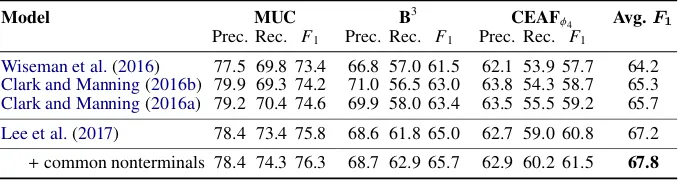
Lee et al.(2017) 78.4 73.4 75.8 68.6 61.8 65.0 62.7 59.0 60.8 67.2
[image:8.595.130.469.63.153.2]+common nonterminals 78.4 74.3 76.3 68.7 62.9 65.7 62.9 60.2 61.5 67.8
Table 3: Coreference resolution results on the test set on the English CoNLL-2012 shared task. The
averageF1of MUC, B3, and CEAFφ4 is the main evaluation metric. For fair comparison, we show only
non-ensembled models.
PropBank SRL. We use the OntoNotes data from the CoNLL shared task in 2012 (Pradhan et al., 2013) for Propbank SRL. Table 2 reports results using gold predicates.
Recent competitive systems for PropBank SRL follow the approach ofZhou and Xu(2015), em-ploying deep architectures, and forgoing the use of any syntax. He et al.(2017) improve on those re-sults, and in analysis experiments, show that con-straints derived using syntax may further improve performance. Tan et al. (2018) employ a similar approach but use feed-forward networks with self-attention. He et al.(2018a) use a span-based clas-sification to jointly identify and label argument spans.
Our syntax-agnostic semi-CRF baseline model improves on prior work (excludingELMo), show-ing again the value of global normalization in se-mantic structure prediction. We obtain further im-provement of 0.8 absolute F1 with the best syn-tactic scaffold from the frame SRL task. This in-dicates that a syntactic inductive bias is benefi-cial even when using sophisticated neural archi-tectures.
He et al.(2018a) also provide a setup where ini-tialization was done with deep contextualized em-beddings, ELMo (Peters et al.,2018), resulting in 85.5F1on the OntoNotes test set. The improve-ments fromELMoare methodologically orthogonal to syntactic scaffolds.
Since the datasets for learning PropBank se-mantics and syntactic scaffolds completely over-lap, the performance improvement cannot be at-tributed to a larger training corpus (or, by exten-sion, a larger vocabulary), though that might be a factor for frame SRL.
A syntactic scaffold can match the performance of a pipeline containing carefully extracted syntac-tic features for semansyntac-tic prediction (Swayamdipta et al., 2017). This, along with other recent
ap-proaches (He et al.,2017,2018b) show that syntax remains useful, even with strong neural models for SRL.
Coreference. We report the results on four stan-dard scores from the CoNLL evaluation: MUC, B3 and CEAFφ4, and their averageF1in Table3. Prior
competitive coreference resolution systems ( Wise-man et al.,2016;Clark and Manning,2016b,a) all incorporate synctactic information in a pipeline, using features and rules for mention proposals from predicted syntax.
Our baseline is the model from Lee et al.
(2017), described in §6. Similar to the baseline model for frame SRL, and in contrast with prior work, this model does not use any syntax.
We experiment with the best syntactic scaffold from the frame SRL task. We usedNP,OTHER, and
null as the labels for the common nonterminals
scaffold here, since coreferring mentions are rarely prepositional phrases. The syntactic scaffold out-performs the baseline by 0.6 absoluteF1. Contem-poraneously, Lee et al.(2018) proposed a model which takes in account higher order inference and more aggressive pruning, as well as initialization withELMo embeddings, resulting in 73.0 average
F1. All the above are orthogonal to our approach, and could be incorporated to yield higher gains.
8 Discussion
To investigate the performance of the syntactic scaffold, we focus on the frame SRL results, where we observed the greatest improvement with re-spect to a non-syntactic baseline.
We consider a breakdown of the performance by the syntactic phrase types of the arguments, provided in FrameNet7 in Figure 2. Not
surpris-7We used FrameNet syntactic phrase annotations for
NP
PP
N
Sfin
AJP
VPto
AVP
A
Poss
VPbrst
Phrase Types
0.4 0.5 0.6 0.7 0.8 0.9
FrameNet Test F1
Baseline
Common NT Scaffold
Figure 2: Performance breakdown by
argu-ment’s phrase category, sorted left to right by frequency, for top ten phrase categories.
Entity Time Locale Theme Agent Ground Event Goal Figure Unit
0.5 0.6 0.7 0.8 0.9 1.0
FrameNet Test F1
Baseline
[image:9.595.314.516.67.215.2]Common NT Scaffold
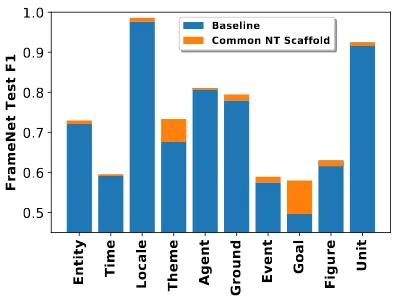
Figure 3: Performance breakdown by top ten
frame element types, sorted left to right by fre-quency.
ingly, we observe large improvements in the com-mon nonterminals used (NP and PP). However, the phrase type annotations in FrameNet do not correspond exactly to the OntoNotes phrase cat-egories. For instance, FrameNet annotates non-maximal (A) and standard adjective phrases (AJP), while OntoNotes annotations for noun-phrases are flat, ignore the underlying adjective phrases. This explains why the syntax-agnostic baseline is able to recover the former while the scaffold is not.
Similarly, for frequent frame elements, scaff old-ing improves performance across the board, as shown in Fig.3. The largest improvements come forThemeandGoal, which are predominantly re-alized as noun phrases and prepositional phrases.
9 Conclusion
We introduced syntactic scaffolds, a multitask learning approach to incorporate syntactic bias into semantic processing tasks. Unlike pipelines and approaches which jointly model syntax and semantics, no explicit syntactic processing is re-quired at runtime. Our method improves the per-formance of competitive baselines for semantic role labeling on both FrameNet and PropBank, and for coreference resolution. While our focus was on span-based tasks, syntactic scaffolds could be applied in other settings (e.g., dependency and graph representations). Moreover, scaffolds need not be syntactic; we can imagine, for example, se-manticscaffolds being used to improve NLP appli-cations with limited annotated data. It remains an open empirical question to determine the relative merits of different kinds of scaffolds and multi-task learners, and how they can be most
produc-tively combined. Our code is publicly available at
https://github.com/swabhs/scaffolding.
Acknowledgments
We thank several members of UW-NLP, partic-ularly Luheng He, as well as David Weiss and Emily Pitler for thoughtful discussions on prior versions of this paper. We also thank the three anonymous reviewers for their valuable feedback. This work was supported in part by NSF grant IIS-1562364 and by the NVIDIA Corporation through the donation of a Tesla GPU.
References
Omri Abend and Ari Rappoport. 2013. Universal Con-ceptual Cognitive Annotation (UCCA). InACL.
Dzmitry Bahdanau, Kyunghyun Cho, and Yoshua Ben-gio. 2014. Neural machine translation by jointly learning to align and translate. ArXiv:1409.0473.
Collin Baker, Michael Ellsworth, and Katrin Erk. 2007. SemEval’07 Task 19: Frame semantic structure ex-traction. InProc. of SemEval.
Collin F. Baker, Charles J. Fillmore, and John B. Lowe. 1998. The Berkeley FrameNet project. InProc. of ACL.
Rich Caruana. 1997. Multitask learning. Machine
Learning, 28(1).
Xinchi Chen, Zhan Shi, Xipeng Qiu, and Xuanjing Huang. 2017. Adversarial multi-criteria learning for chinese word segmentation. ArXiv:1704.07556.
Kevin Clark and Christopher D. Manning. 2016b. Im-proving coreference resolution by learning entity-level distributed representations. InProc. of ACL.
Ronan Collobert, Jason Weston, L´eon Bottou, Michael Karlen, Koray Kavukcuoglu, and Pavel Kuksa. 2011. Natural language processing (almost) from scratch. Journal of Machine Learning Research, 12:2493–2537.
Ann Copestake and Dan Flickinger. 2000. An
open source grammar development environment and broad-coverage English grammar using HPSG. In
Proc. of LREC.
Dipanjan Das, Desai Chen, Andr´e FT Martins, Nathan
Schneider, and Noah A Smith. 2014.
Frame-semantic parsing. Computational linguistics,
40(1):9–56.
Dipanjan Das, Andr´e F. T. Martins, and Noah A. Smith. 2012. An exact dual decomposition algorithm for shallow semantic parsing with constraints. InProc. of *SEM.
Jenny Rose Finkel, Christopher D Manning, and An-drew Y Ng. 2006. Solving the problem of cascading errors: Approximate bayesian inference for linguis-tic annotation pipelines. InProc. of EMNLP.
Nicholas FitzGerald, Oscar T¨ackstr¨om, Kuzman
Ganchev, and Dipanjan Das. 2015. Semantic role labeling with neural network factors. In Proc. of EMNLP.
Daniel Gildea and Daniel Jurafsky. 2002. Automatic labeling of semantic roles. Computational Linguis-tics, 28(3):245–288.
Daniel Gildea and Martha Palmer. 2002. The necessity of parsing for predicate argument recognition. In
Proc. of ACL.
Kevin Gimpel and Noah A. Smith. 2010. Softmax-margin CRFs: Training log-linear models with cost functions. InProc. of NAACL.
Alex Graves. 2012. Supervised Sequence Labelling with Recurrent Neural Networks, volume 385 of
Studies in Computational Intelligence. Springer.
Alex Graves. 2013. Generating sequences with recur-rent neural networks. ArXiv:1308.0850.
Kazuma Hashimoto, Caiming Xiong, Yoshimasa Tsu-ruoka, and Richard Socher. 2017. A joint many-task model: Growing a neural network for multiple NLP tasks. InProc. of EMNLP.
He He, Hal Daum´e III, and Jason Eisner. 2013. Dy-namic feature selection for dependency parsing. In
Proc. of EMNLP.
Luheng He, Kenton Lee, Omer Levy, and Luke Zettle-moyer. 2018a. Jointly predicting predicates and ar-guments in neural semantic role labeling. InProc. of ACL.
Luheng He, Kenton Lee, Mike Lewis, and Luke Zettle-moyer. 2017. Deep semantic role labeling: What works and what’s next. InProc. of ACL.
Shexia He, Zuchao Li, Hai Zhao, and Hongxiao Bai. 2018b. Syntax for semantic role labeling, to be, or not to be. InProc. of ACL.
James Henderson, Paola Merlo, Ivan Titov, and Gabriele Musillo. 2013. Multi-lingual joint pars-ing of syntactic and semantic dependencies with a latent variable model. Computational Linguistics, 39(4):949–998.
Daniel Hershcovich, Omri Abend, and Ari Rappoport. 2018. Multitask parsing across semantic representa-tions. InProc. of ACL.
Diederik P. Kingma and Jimmy Ba. 2014.
ADAM: A method for stochastic optimization. ArXiV:1412.6980.
Lingpeng Kong, Chris Dyer, and Noah A. Smith. 2016. Segmental Recurrent Neural Networks. InProc. of ICLR.
Meghana Kshirsagar, Sam Thomson, Nathan Schnei-der, Jaime Carbonell, Noah A Smith, and Chris Dyer. 2015. Frame-semantic role labeling with het-erogeneous annotations. InProc. of NAACL.
Kenton Lee, Luheng He, Mike Lewis, and Luke Zettle-moyer. 2017. End-to-end neural coreference resolu-tion. InProc. of EMNLP.
Kenton Lee, Luheng He, and Luke Zettlemoyer. 2018. Higher-order coreference resolution with coarse-to-fine inference. InProc. of NAACL.
Xavier Llu´ıs, Xavier Carreras, and Llu´ıs M`arquez. 2013. Joint arc-factored parsing of syntactic and semantic dependencies. Transactions of the ACL, 1:219–230.
Xavier Llu´ıs and Llu´ıs M`arquez. 2008. A joint model for parsing syntactic and semantic dependencies. In
Proc. of CoNLL.
Minh-Thang Luong, Quoc V Le, Ilya Sutskever, Oriol Vinyals, and Lukasz Kaiser. 2015. Multi-task se-quence to sese-quence learning. ArXiv:1511.06114.
Tomas Mikolov, Kai Chen, Gregory S. Corrado, and Jeffrey Dean. 2013. Efficient estimation of word representations in vector space. ArXiv:1301.3781.
Vinod Nair and Geoffrey E. Hinton. 2010. Rectified linear units improve restricted Boltzmann machines. InProc. of ICML.
Jason Naradowsky, Sebastian Riedel, and David A.
Smith. 2012. Improving NLP through
marginal-ization of hidden syntactic structure. In Proc. of EMNLP.
Martha Palmer, Daniel Gildea, and Paul Kingsbury.
2005. The Proposition Bank: An annotated
cor-pus of semantic roles. Computational Linguistics, 31(1):71–106.
Hao Peng, Sam Thomson, and Noah A. Smith. 2017. Deep multitask learning for semantic dependency parsing. InProc. of ACL.
Hao Peng, Sam Thomson, Swabha Swayamdipta, and
Noah A. Smith. 2018. Learning joint semantic
parsers from disjoint data. InProc. of NAACL.
Jeffrey Pennington, Richard Socher, and Christo-pher D. Manning. 2014. GloVe: Global vectors for word representation. InProc. of EMNLP.
Matthew E Peters, Mark Neumann, Mohit Iyyer, Matt Gardner, Christopher Clark, Kenton Lee, and Luke Zettlemoyer. 2018. Deep contextualized word rep-resentations. ArXiv:1802.05365.
Sameer Pradhan, Alessandro Moschitti, Nianwen Xue, Hwee Tou Ng, Anders Bj¨orkelund, Olga Uryupina, Yuchen Zhang, and Zhi Zhong. 2013. Towards ro-bust linguistic analysis using OntoNotes. InProc. of CoNLL.
Sameer Pradhan, Alessandro Moschitti, Nianwen Xue, Olga Uryupina, and Yuchen Zhang. 2012.
CoNLL-2012 shared task: Modeling multilingual
unre-stricted coreference in OntoNotes. In Proc. of EMNLP.
Vasin Punyakanok, Dan Roth, and Wen-tau Yih. 2008. The importance of syntactic parsing and inference in semantic role labeling. Computational Linguistics, 34(2):257–287.
Pranav Rajpurkar, Jian Zhang, Konstantin
Lopy-rev, and Percy Liang. 2016. SQuAD: 100,000+
questions for machine comprehension of text. ArXiv:1606.05250.
Sunita Sarawagi, William W Cohen, et al. 2004. Semi-markov conditional random fields for information extraction. InProc. of NIPS, volume 17.
Anders Søgaard and Yoav Goldberg. 2016. Deep
multi-task learning with low level tasks supervised at lower layers. InProc. of ACL.
Rupesh Kumar Srivastava, Klaus Greff, and J¨urgen Schmidhuber. 2015. Training very deep networks. InProc. of NIPS.
Mark Steedman. 2000. Information structure and
the syntax-phonology interface. Linguistic Inquiry, 31(4):649–689.
Swabha Swayamdipta, Miguel Ballesteros, Chris Dyer, and Noah A. Smith. 2016. Greedy, joint syntactic-semantic parsing with Stack LSTMs. In Proc. of CoNLL.
Swabha Swayamdipta, Sam Thomson, Chris Dyer, and Noah A. Smith. 2017. Frame-semantic parsing with softmax-margin segmental rnns and a syntactic scaf-fold. Arxiv:1706.09528.
Oscar T¨ackstr¨om, Kuzman Ganchev, and Dipanjan Das. 2015. Efficient inference and structured learn-ing for semantic role labellearn-ing. Transactions of the ACL, 3:29–41.
Zhixing Tan, Mingxuan Wang, Jun Xie, Yidong Chen, and Xiaodong Shi. 2018. Deep semantic role label-ing with self-attention. InProc. of AAAI.
Kristina Toutanova, Aria Haghighi, and Christopher D.
Manning. 2008. A global joint model for
se-mantic role labeling. Computational Linguistics, 34(2):161–191.
Ralph Weischedel, Martha Palmer, Mitchell Marcus, Eduard Hovy, Sameer Pradhan, Lance Ramshaw, Nianwen Xue, Ann Taylor, JeffKaufman, Michelle Franchini, et al. 2013. OntoNotes release 5.0 ldc2013t19. Linguistic Data Consortium, Philadel-phia, PA.
Sam Wiseman, Alexander M Rush, and Stuart M Shieber. 2016. Learning global features for coref-erence resolution. InProc. of NAACL.
David H Wolpert. 1992. Stacked generalization. Neu-ral networks, 5(2):241–259.
Bishan Yang and Tom Mitchell. 2017. A joint sequen-tial and relational model for frame-semantic parsing. InProc. of EMNLP.
Luke S Zettlemoyer and Michael Collins. 2005. Learn-ing to map sentences to logical form: Structured classification with probabilistic categorial gram-mars. InProc. of UAI.
Yuan Zhang and David Weiss. 2016.
Stack-propagation: Improved representation learning for syntax. InProc. of ACL.