Proceedings of NAACL-HLT 2019, pages 970–977 970
Strong Baselines for Complex Word Identification
across Multiple Languages
Pierre Finnimore1, Elisabeth Fritzsch1, Daniel King1, Alison Sneyd1,
Aneeq Ur Rehman1,Fernando Alva-Manchego1 and Andreas Vlachos2
1Department of Computer Science, University of Sheffield
2Department of Computer Science and Technology, University of Cambridge
{pmfinnimore,fritzsch.elisabeth,danielking1903}@gmail.com, [email protected],[email protected],[email protected],
Abstract
Complex Word Identification (CWI) is the task of identifying which words or phrases in a sentence are difficult to understand by a tar-get audience. The latest CWI Shared Task re-leased data for two settings: monolingual (i.e. train and test in the same language) and cross-lingual (i.e. test in a language not seen dur-ing traindur-ing). The best monoldur-ingual models relied on language-dependent features, which do not generalise in the cross-lingual setting, while the best cross-lingual model used neural networks with multi-task learning. In this pa-per, we present monolingual and cross-lingual CWI models that perform as well as (or bet-ter than) most models submitted to the latest CWI Shared Task. We show that carefully se-lected features and simple learning models can achieve state-of-the-art performance, and re-sult in strong baselines for future development in this area. Finally, we discuss how incon-sistencies in the annotation of the data can ex-plain some of the results obtained.
1 Introduction
Complex Word Identification (CWI) consists of deciding which words (or phrases) in a text could be difficult to understand by a specific type of reader. In this work, we follow the CWI Shared Tasks (Paetzold and Specia, 2016;Yimam et al., 2018) and assume that a target word or multi-word expression (MWE1) in a sentence is given, and our goal is to determine if it is complex or not (an ex-ample is shown in Table 1). Under this setting, CWI is normally treated using supervised learn-ing and feature engineerlearn-ing to build monollearn-ingual models (Paetzold and Specia,2016;Yimam et al., 2018). Unfortunately, this approach is infeasible for languages with scarce resources of annotated
1We consider n-grams withn ≥2as MWEs, while
Yi-mam et al.(2018) usedn≥3.
Sentence Target word/MWE Complex?
Both China and the Philippines flexed their muscles on Wednesday.
flexed Yes
flexed their muscles Yes
muscles No
Table 1: An annotated sentence in the English dataset of the Second CWI Shared Task.
data. In this paper, we are interested in both mono-lingual and cross-mono-lingual CWI; in the latter, we build models to make predictions for languages not seen during training.
While monolingual CWI has been studied ex-tensively (see a survey in Paetzold and Specia (2017)), the cross-lingual setup of the task was in-troduced only recently byYimam et al. (2017b), who collected human annotations from native and non-native speakers of Spanish and German, and integrated them with similar data previously pro-duced for three English domains (Yimam et al., 2017a): News, WikiNews and Wikipedia.
For the Second CWI Shared Task (Yimam et al., 2018), participants built monolingual models us-ing the datasets previously described, and also tested their cross-lingual capabilities on newly col-lected French data. In the monolingual track, the best systems for English (Gooding and Kochmar, 2018) differed significantly in terms of feature set size and the model’s complexity, to the best sys-tems for German and Spanish (Kajiwara and Ko-machi, 2018). The latter used Random Forests with eight features, whilst the former used Ad-aBoost with 5000 estimators or ensemble voting combining AdaBoost and Random Forest classi-fiers, with about 20 features.
Bingel and Bjerva(2018) who implemented an en-semble of Random Forests and feed-forward neu-ral networks in a multi-task learning architecture.
Our approach to CWI differs from previous work in that we begin by building competitive monolingual models, but using the same set of features and learning algorithm across languages. This reduces the possibility of getting high scores due to modelling annotation artifacts present in the dataset of one language. Our monolingual models achieve better scores for Spanish and German than the best systems in the Second CWI Shared Task. After that, we focus on language-independent fea-tures, and keep those that achieve good perfor-mance in cross-lingual experiments across all pos-sible combinations of languages. This results in a small set of five language-independent features, which achieve a score as high as the top models in the French test set. Finally, we analyse the annota-tion of the datasets and find some inconsistencies that could explain some of our results.
Code for all our models can be found at:
https://github.com/sheffieldnlp/cwi
2 Problem Formulation
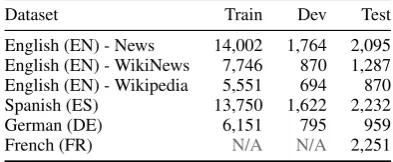
We tackle the binary classification task in the Sec-ond CWI Shared Task (Yimam et al., 2018), in which a model decides if a target word/MWE in a sentence is complex or not. Following com-mon practice, we extract features from the target word/MWE and its context, and then use a su-pervised learning algorithm to train a classifier. For training and testing our models, we use the annotated datasets provided for the Second CWI Shared Task (see Table2for some statistics).
Dataset Train Dev Test
English (EN) - News 14,002 1,764 2,095 English (EN) - WikiNews 7,746 870 1,287 English (EN) - Wikipedia 5,551 694 870
Spanish (ES) 13,750 1,622 2,232
German (DE) 6,151 795 959
[image:2.595.82.279.558.639.2]French (FR) N/A N/A 2,251
Table 2: Number of annotated samples in each dataset for each language.
3 Monolingual Models
3.1 Features Description
Our feature set consists of 25 features that can be extracted for all languages considered (English,
German, Spanish and French). They can be di-vided into three broad categories: features based on the target word/MWE, sub-word level features, and sentence-level features to capture information from the target’s context. As we intended that our features be applicable across languages, we drew on features found to be useful in previous work on CWI (Yimam et al.,2017b,2018). We made use of the python libraries spaCy2 (Honnibal and Mon-tani, 2017) and NLTK3 (Loper and Bird, 2002).
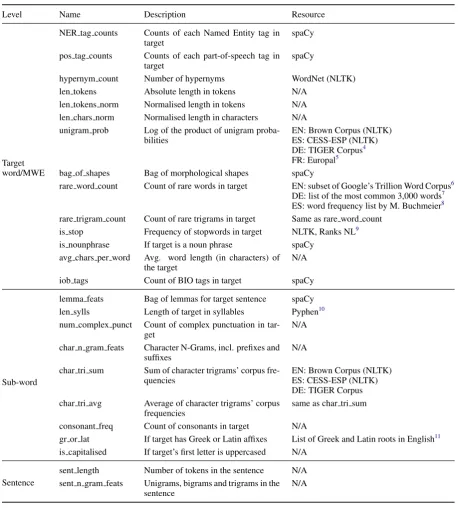
Details on the resources used for extracting each feature can be found in AppendixA.
At the target word/MWE level, we experi-mented with features such as Named Entity (NE) type, part-of-speech, hypernym counts, number of tokens in the target, language-normalised num-ber of characters in each word, and simple uni-gram probabilities. These features are linguisti-cally motivated. The perceived complexity of a MWE may be higher than that of a single word, as each component word can be complex, or sim-ple component words can be synthesised into a complex whole. Similarly, infrequent words are less familiar, so we would expect low-probability target words to be found more complex. Along these lines, proper nouns could be more complex, as there is a vast number of NEs, and the chance that a person has encountered any one of them is low. We would expect this trend to reverse for the NE type of organisations, in combination with the Enlgish-News dataset, as organisations mentioned in news articles are frequently global, and so the chance that a person has encountered a proper nounthat is an organisation is often higher than for proper nouns in general. In total, 14 features were used at the target word/MWE level.
Our sub-word level features include prefixes, suffixes, the number of syllables, and the num-ber of complex punctuation marks (i.e. punctu-ation within the target word/MWE, such as hy-phens, that could denote added complexity). We would expect certain affixes to be useful features, as language users use sub-word particles like these to identify unknown words: by breaking up a word like “granted” into “grant-” and “-ed”, readers can fall back on their knowledge of these component pieces to clarify the whole. A total of 9 sub-word features were used in the monolingual models.
Finally, sentence level features with linguistic
2
https://spacy.io/
motivations were also considered. Long sentences could be harder to understand, which makes it more difficult to figure out the meaning of un-known words contained within them. Also, long sentences are more likely to include more un-known words or ambiguous references. Therefore, we considered sentence length (i.e., number of to-kens in the sentence) as a feature. In addition, we extracted N-grams (unigrams, bigrams and tri-grams) from the whole sentence, since certain sen-tence constructions can help a reader understand the target word/MWE. For example, “A of the B” suggests a relation between A and B. We used 2 sentence-level features in total.
3.2 Experiments and Results
FollowingYimam et al. (2018), we used Macro-F1 score to evaluate performance and for compar-ison with previous work on the datasets. We used Logistic Regression for all our experiments, as it allowed for easy exploration of feature combina-tions, and in initial experiments we found that it performed better than Random Forests. We eval-uated both using the full feature set described be-fore, as well as a two-feature baseline using the number of tokens of the target and its language-normalised number of characters. Results of our monolingual experiments are shown in Table3.
Dataset Dev Test
BL MA BL MA SotA
EN - News 83.6 85.5 69.7 86.0 87.4
EN - WikiNews 80.4 82.8 65.8 81.6 84.0 EN - Wikipedia 74.2 76.6 70.1 76.1 81.2
ES 78.0 77.1 69.6 77.6 77.0
DE 79.5 74.6 72.4 74.8 75.5
Mean 79.1 79.3 69.5 79.2 N/A
Table 3: Macro-F1 for the baseline (BL), our monolin-gual approach (MA), and the state of the art (SotA) on the Dev and Test splits of each dataset.
In the test set, our baseline results (BL in Ta-ble 3) are strong, especially in German. Our full 25-features model improves on the baseline in all cases, with the biggest increase of over 16 percentage points seen for the EN-News dataset. Our system beats the best performing system from the Shared Task in Spanish (77.0) and German (74.5), both obtained by Kajiwara and Komachi (2018). However, the state of the art for German remains the Shared Task baseline (75.5) (Yimam et al.,2018). The best results for all three English
datasets were obtained byGooding and Kochmar (2018); ours is within two percentage points of their News dataset score. Furthermore, the mean score for our system (79.2) is close to the mean of the best performing models (81.0), which are dif-ferent systems, while using simpler features and learning algorithm. The best-performing model in English, for example, used Adaboost with 5000 estimators (Gooding and Kochmar,2018).
4 Cross-lingual Models
4.1 Features Description
Linguistically, the cross-lingual approach can be motivated by the relation between certain lan-guages (such as French and Spanish both being Romance languages). In addition, there may be features identifying complex words that are shared even across language families.
To be able to test a model on a language that was unseen during training, the features the model works with must be cross-lingual (or language-independent) themselves. For example, the words themselves are unlikely to transfer across lan-guages (apart from those that happen to be spelled identically), but the popularity of the words would transfer. This rules out some of the features we used for the monolingual approach (see Sec.3.1), as they were language-dependent. One such fea-ture is N-grams for the target word/MWE, which depend on the language, and so will only occur with extreme sparsity outside of their source lan-guage. For example, if applying a system trained on English to unseen French, the English phrases “`a la mode” or “film noir” might reoccur in the French, since they originate from that language, but these are rare exceptions. What is more, a French loan-phrase may have different complex-ity characteristics to the same N-grams occurring in their native language. Therefore, we did not use these features in the cross-lingual system.
4.2 Experiments and Results
To find out which features were best suited for the cross-lingual approach, we performed an it-erative ablation analysis (see AppendixBfor de-tails). Using this process, we arrived at our final cross-lingual feature set: number of syllables in the target, number of tokens in the target, number of complex punctuation marks (such as hyphens), sentence length, and unigram probabilities.
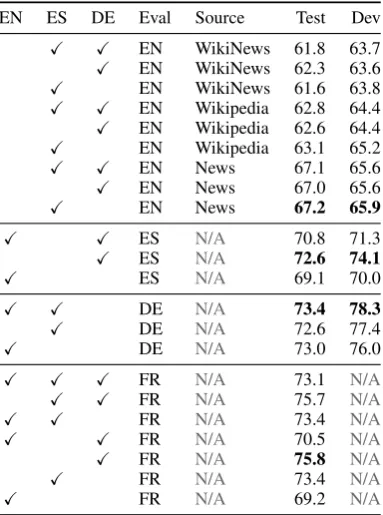
language combinations on the performance of the cross-lingual model in order to investigate how the relationship between the languages trained and tested on would influence model performance. Re-call that we only have training data for English, Spanish and German, but not French. We train models using all possible combinations (each lan-guage independently, each pairing, and all three) and evaluate on each of the four languages that have test data (i.e. the former three and French), excluding training combinations that include the test language. Results are shown in Table4.
EN ES DE Eval Source Test Dev
X X EN WikiNews 61.8 63.7
X EN WikiNews 62.3 63.6
X EN WikiNews 61.6 63.8
X X EN Wikipedia 62.8 64.4
X EN Wikipedia 62.6 64.4
X EN Wikipedia 63.1 65.2
X X EN News 67.1 65.6
X EN News 67.0 65.6
X EN News 67.2 65.9
X X ES N/A 70.8 71.3
X ES N/A 72.6 74.1
X ES N/A 69.1 70.0
X X DE N/A 73.4 78.3
X DE N/A 72.6 77.4
X DE N/A 73.0 76.0
X X X FR N/A 73.1 N/A
X X FR N/A 75.7 N/A
X X FR N/A 73.4 N/A
X X FR N/A 70.5 N/A
X FR N/A 75.8 N/A
X FR N/A 73.4 N/A
[image:4.595.86.278.239.497.2]X FR N/A 69.2 N/A
Table 4: Comparison of Test and Dev results for all permutations of training languages.
When testing on French, we achieved the high-est performance by training on German only (75.8), followed closely by training on a combina-tion of German and Spanish (75.7) and only Span-ish (75.5). The worst performance was achieved by training only on English (69.2), and the per-formance also noticeably decreased for all training combinations that included English.
When testing on German, language choice had a weaker effect. The highest score came from com-bining English and Spanish (73.4), but using only one of those languages gave comparable results (72.6 for Spanish, 73.0 for English).
For Spanish, the best results were achieved when training only on German (72.6). Adding English to the training languages decreased the
Spanish German French
Monolingual SotA 77.0 75.5 N/A
[image:4.595.85.277.239.498.2]Cross-lingual SotA N/A N/A 76.0 Our cross-lingual 72.6 73.4 75.8
Table 5: Comparison between the monolingual and lingual state of the art (SotA), and our cross-lingual system.
performance (70.8), which was even lower when training only on English (69.1).
It is noteworthy that adding English to the train-ing languages noticeably decreases performance for both Spanish and French, but not for Ger-man. One possible reason for Spanish and French not benefiting from English when German does is that both English and German are Germanic lan-guages, whereas Spanish and French are Romance languages. Another possible explanation for the decrease of performance caused by training with English is that there are inconsistencies in the way MWEs in the datasets were labelled across lan-guages, which we explore in Sec.5.
We finally compare our cross-lingual models against the state of the art: the best monolin-gual system for Spanish and German, and the best cross-lingual system for French, where no mono-lingual systems exist. As Table5shows, our cross-lingual models come close to the best monocross-lingual models for Spanish and especially for German. This is remarkable given how simple our model and features are, and that the approaches we com-pare against train complex models for each lan-guage. Furthermore, this points towards the possi-bility of extending CWI to more languages which lack training data.
Finally, Table 6 compares the coefficients for models trained on Romance and Germanic lan-guages. Notably, use of complex punctuation (such as the hyphenation in “laser-activated” or “drug-related”) and the number of tokens are in-versely correlated w.r.t. the word or MWE being complex. More words in the target was correlated with complexity for English and German, and in-versely correlated for Spanish.
5 Dataset Analysis
Feature Train Coefficient
number of complex punctuation marks
EN -0.693
DE -0.559
ES 1.111
number of tokens
EN -2.200
DE -0.534
ES 1.420
Table 6: Coefficients for cross-lingual models trained on Germanic and Romance languages.
The First CWI Shared Task (Paetzold and Spe-cia, 2016) used the annotations of a group (i.e. ten annotators on the training data) to predict the annotation of an individual (i.e. one annotator on the test data). The resulting inconsistencies in la-belling may have contributed to the low F-scores of systems in the task (Zampieri et al.,2017). Al-though the Second CWI Shared Task improved on the first by having multiple annotators for all splits of the data, it contains some labelling inconsisten-cies arising from annotators now being able to la-bel phrases, and words within them, separately.
More concretely, we found that across all datasets, 72% of MWEs contain at least one SW with the opposite label (see Table7). While this makes sense in some cases, every SW in 25% of MWE instances has the opposite label. For ex-ample, “numerous falsifications and ballot stuff-ing” is not annotated as complex, despite its SWs “numerous”, “numerous falsifications”, “falsifica-tions”, “ballot”, “ballot stuffing” and “stuffing” all being complex. Conversely, “crise des march´es du cr´edit” is complex, despite “crise”, “march´es” and “cr´edit” being labelled non-complex. It is diffi-cult to see how classifiers that extract features for MWEs from their individual SWs could predict the labels of both correctly.
Furthermore, every target MWE in the Spanish, German and French datasets is labelled complex. This may bias a classifier trained on the Span-ish or German datasets towards learning MWEs and long individual words (if length is a feature) are complex. In particular, this observation may help explain why adding English as a training lan-guage decreased the performance of our cross-lingual system when testing on French and Span-ish (where all MWEs are complex). An analysis in Bingel and Bjerva(2018) further found that their cross-lingual French model was effective at pre-dicting long complex words/MWEs but had diffi-culty predicting long non-complex words.
C NC ≥1 Irreg. All Irreg.
English 3,750 982 3,315 950
Spanish 2,309 0 1,747 760
German 502 0 374 178
French 242 0 192 82
[image:5.595.326.506.63.141.2]Total 6,803 982 5,628 1,970
Table 7: MWE annotation analysis: numbers of MWEs labelled complex (C) and non-complex (NC), numbers with at least one SW (≥ 1Irreg) and all SWs (All Ir-reg.) having the opposite label.
It is also worth noting that considering a word or MWE as complex is subjective and may differ from person to person, even within the same target audience.Bingel et al.(2018) investigated predict-ing complex words based on the gaze patterns of children with reading difficulties. They found a high degree of specificity in misreadings between children, that is, which words they found complex when reading aloud. This variety of complexity judgements even within one target group points to-wards the high degree of subjectivity in the task, which may also partly explain the inconsistencies in the dataset.
6 Conclusion and Future Work
The monolingual and cross-lingual models pre-sented achieve comparable results against more complex, language-specific state-of-the-art mod-els, and thus can serve as strong baselines for future research in CWI. In addition, our analy-sis of the dataset could help in the design of bet-ter guidelines when crowdsourcing annotations for the task. Dataset creators may wish to only al-low single words to be chosen as complex to avoid labelling inconsistencies. In case MWEs are be-ing permitted, we suggest instructbe-ing annotators to chose the smallest part of a phrase they find complex (French annotators for the Second CWI Shared Task sometimes grouped individual com-plex words into a comcom-plex MWE (Yimam et al., 2018)).
Acknowledgements
References
Joachim Bingel, Maria Barrett, and Sigrid Klerke. 2018. Predicting misreadings from gaze in chil-dren with reading difficulties. In Proceedings of the Thirteenth Workshop on Innovative Use of NLP for Building Educational Applications, pages 24–34, New Orleans, Louisiana. Association for Computa-tional Linguistics.
Joachim Bingel and Johannes Bjerva. 2018. Cross-lingual complex word identification with multitask learning. InProceedings of the Thirteenth Workshop on Innovative Use of NLP for Building Educational Applications, pages 166–174. Association for Com-putational Linguistics.
Sian Gooding and Ekaterina Kochmar. 2018. Camb at cwi shared task 2018: Complex word identification with ensemble-based voting. InProceedings of the Thirteenth Workshop on Innovative Use of NLP for Building Educational Applications, pages 184–194. Association for Computational Linguistics.
Matthew Honnibal and Ines Montani. 2017. spaCy2: Natural language understanding with bloom embed-dings, convolutional neural networks and incremen-tal parsing. To appear.
Tomoyuki Kajiwara and Mamoru Komachi. 2018.
Complex word identification based on frequency in a learner corpus. InProceedings of the Thirteenth Workshop on Innovative Use of NLP for Building Educational Applications, pages 195–199. Associ-ation for ComputAssoci-ational Linguistics.
Edward Loper and Steven Bird. 2002. Nltk: The natu-ral language toolkit. InProceedings of the ACL-02 Workshop on Effective Tools and Methodologies for Teaching Natural Language Processing and Com-putational Linguistics, pages 63–70, Philadelphia, Pennsylvania, USA. Association for Computational Linguistics.
Gustavo Paetzold and Lucia Specia. 2016. Semeval 2016 task 11: Complex word identification. In Pro-ceedings of the 10th International Workshop on Se-mantic Evaluation (SemEval-2016), pages 560–569. Association for Computational Linguistics.
Gustavo H. Paetzold and Lucia Specia. 2017. A sur-vey on lexical simplification. Journal of Artificial Intelligence Research, 60:549–593.
Seid Muhie Yimam, Chris Biemann, Shervin Mal-masi, Gustavo Paetzold, Lucia Specia, Sanja ˇStajner, Ana¨ıs Tack, and Marcos Zampieri. 2018. A report on the complex word identification shared task 2018. In Proceedings of the Thirteenth Workshop on In-novative Use of NLP for Building Educational Ap-plications, pages 66–78. Association for Computa-tional Linguistics.
Seid Muhie Yimam, Sanja ˇStajner, Martin Riedl, and Chris Biemann. 2017a. Cwig3g2 - complex word identification task across three text genres and two
user groups. InProceedings of the Eighth Interna-tional Joint Conference on Natural Language Pro-cessing (Volume 2: Short Papers), pages 401–407. Asian Federation of Natural Language Processing.
Seid Muhie Yimam, Sanja ˇStajner, Martin Riedl, and Chris Biemann. 2017b. Multilingual and cross-lingual complex word identification. InProceedings of the International Conference Recent Advances in Natural Language Processing, RANLP 2017, pages 813–822. INCOMA Ltd.
A Detailed Feature Set
Level Name Description Resource
Target word/MWE
NER tag counts Counts of each Named Entity tag in target
spaCy
pos tag counts Counts of each part-of-speech tag in target
spaCy
hypernym count Number of hypernyms WordNet (NLTK)
len tokens Absolute length in tokens N/A
len tokens norm Normalised length in tokens N/A len chars norm Normalised length in characters N/A unigram prob Log of the product of unigram
proba-bilities
EN: Brown Corpus (NLTK) ES: CESS-ESP (NLTK) DE: TIGER Corpus4 FR: Europal5 bag of shapes Bag of morphological shapes spaCy
rare word count Count of rare words in target EN: subset of Google’s Trillion Word Corpus6 DE: list of the most common 3,000 words7 ES: word frequency list by M. Buchmeier8 rare trigram count Count of rare trigrams in target Same as rare word count
is stop Frequency of stopwords in target NLTK, Ranks NL9 is nounphrase If target is a noun phrase spaCy
avg chars per word Avg. word length (in characters) of the target
N/A
iob tags Count of BIO tags in target spaCy
Sub-word
lemma feats Bag of lemmas for target sentence spaCy len sylls Length of target in syllables Pyphen10 num complex punct Count of complex punctuation in
tar-get
N/A
char n gram feats Character N-Grams, incl. prefixes and suffixes
N/A
char tri sum Sum of character trigrams’ corpus fre-quencies
EN: Brown Corpus (NLTK) ES: CESS-ESP (NLTK) DE: TIGER Corpus char tri avg Average of character trigrams’ corpus
frequencies
same as char tri sum
consonant freq Count of consonants in target N/A
gr or lat If target has Greek or Latin affixes List of Greek and Latin roots in English11 is capitalised If target’s first letter is uppercased N/A
Sentence
sent length Number of tokens in the sentence N/A sent n gram feats Unigrams, bigrams and trigrams in the
sentence
[image:7.595.70.529.89.598.2]N/A
Table 8: Monolingual and Cross-lingual Feature Set Summary
4https://www.ims.uni-stuttgart.de/forschung/ressourcen/korpora/tiger.html
5http://www.statmt.org/europarl/
6
https://github.com/first20hours/google-10000-english
7http://germanvocab.com/
8https://en.wiktionary.org/wiki/User:Matthias_Buchmeier/Spanish_frequency_
list-1-5000
9https://www.ranks.nl/stopwords
10
https://pyphen.org/
11https://www.oakton.edu/user/3/gherrera/Greek%20and%20Latin%20Roots%20in%
B Cross-lingual Features Ablation
Iteration Current features Features increasing performance Features decreasing performance
1
len tokens num complex punct
len sylls sent length
is nounphrase len tokens norm consonant freq is capitalised bag of shapes pos tag count
2
len tokens len sylls
num complex punct sent length
unigram prob gr or lat
3
len tokens len sylls
num complex punct sent length unigram prob
[image:8.595.90.506.96.285.2]char ngram feats iob tags lemma feats NER tag counts