Proceedings of the Thirteenth Workshop on Innovative Use of NLP for Building Educational Applications, pages 166–174
Cross-lingual complex word identification with multitask learning
Joachim Bingel
Department of Computer Science University of Copenhagen, Denmark
Johannes Bjerva
Department of Computer Science University of Copenhagen, Denmark
Abstract
We approach the 2018 Shared Task on Com-plex Word Identification by leveraging a cross-lingual multitask learning approach. Our method is highly language agnostic, as evi-denced by the ability of our system to general-ize across languages, including languages for which we have no training data. In the shared task, this is the case for French, for which our system achieves the best performance. We fur-ther provide a qualitative and quantitative anal-ysis of which words pose problems for our sys-tem.
1 Introduction
Complex word identification (CWI) is the task of predicting whether a certain word might be difficult for a reader to understand and is typi-cally used as a first step in (lexical) simplification pipelines (Shardlow, 2014; Paetzold and Specia, 2015, 2016a). This task has received significant attention from the community over the past few years, leading to two shared tasks and several other publications (Shardlow,2013a,b).
This paper presents our submission to the CWI 2018 shared task (Yimam et al.,2018), at the 13th Workshop on Innovative Use of NLP for Build-ing Educational Applications. This task includes tracks targeting four languages: English, Spanish, German and French. For each of these languages, the task involves prediction of binary labels of whether any of a range of annotators deemed some word or phrase complex, or prediction of the ratio of those who did. The task further differs from previous approaches to CWI in extending the def-inition of the target units from the word level to multi-word expressions, such that annotations in the training and test set spanned wider stretches of text than single tokens.
Another difference from previous approaches to CWI is that the data is annotated by a mixture of
native and non-native speakers, posing an interest-ing challenge to reconcile the potentially different complexity assessments of these groups.
One challenge in the CWI 2018 shared task is the fact that one of the languages under consid-eration (French) does not have any training data available. We approach this problem by explor-ing a combination of multitask learnexplor-ing and cross-lingual learning. In doing so, we aim to answer the following research questions:
RQ 1 How can multitask learning be applied to the task of cross-lingual CWI?
RQ 2 How can complex words be identified in languages which are not seen during training time?
Our contributions also include a thorough quali-tative and quantiquali-tative error analysis, which shows that long and infrequent words are very likely to be complex, but that non-complex words that display these properties pose a challenge to our system.
2 Related work
2.1 Multitask Learning
Multitask learning (MTL) is the combined learn-ing of several tasks in a slearn-ingle model (Caruana, 1997). This can be beneficial in a number of sce-narios. Previous work has shown benefits, e.g., in cases where one has tasks which are closely re-lated to one another (Bjerva,2017a,b), when one task can help another escape a local minimum (Bingel and Søgaard, 2017), and when one has access to some unsupervised signal which can be beneficial to the task at hand (Rei,2017). A com-mon approach to MTL is the application of hard parameter sharing, in which some set of param-eters in a model is shared between several tasks. We contribute to previous work in MTL by us-ing a hard parameter sharus-ing approach in which
we share intermediate layers between languages, and use one output-layer per language, thus in a sense seeing languages as tasks, similarly to Bjerva(2017a).
2.2 Cross-lingual learning
Cross-lingual learning is the problem of training a model on a given language, and applying it to an-other (unseen) language. One common approach is to apply cross-lingual word representations, al-though this has the disadvantage that it tends to place relatively high demands on availability of parallel text. Another frequently used approach in this context is to use machine translation (MT) so as to obtain a monolingual training set (Tiede-mann et al., 2014). However, this approach nec-essarily increases the complexity of a system, as a fully-fledged MT system needs to be incorpo-rated in the pipeline. Furthermore, this approach bypasses the problem of attempting to find meth-ods or feature sets which can be successful across languages. We therefore follow previous work by, e.g.Bjerva and ¨Ostling(2017) in that we use hard parameter sharing with language-agnostic input representations. We build upon this by leverag-ing language-specific resources which are widely available, such as Wikipedia dumps, and WordNet (see Section5.
2.3 CWI
Automatic complex word identification has a rel-atively short history as a research task, with first publications includingShardlow(2013a,b)
A noticeable commonality of the highest-scoring systems in the CWI 2016 shared task was the use of ensemble methods, most notably ran-dom forest classifiers, which drew on a range of morphologic, semantic and psycholinguistic fea-tures, among others (Paetzold and Specia,2016b; Ronzano et al.,2016).
Yimam et al. (2017) present first work on CWI that considers languages other than English. They release a German and a Spanish dataset and present first CWI results for these languages. No-tably, they also describe first cross-lingual experi-ments, in which they train on some language and test on another, i.e. without employing any of the common strategies for cross-lingual learning that we outline above.
Recently,Bingel et al.(2018) showed promising results in predicting complex words from gaze pat-terns of Danish children with reading difficulties,
Language Training Dev Test Complex
English 27,299 3,328 4,252 42.03% Spanish 13,750 1,622 2,233 40.61% German 6,151 795 959 39.21%
French – – 2,251 29.18%
Table 1: Data overview. The share of complex words is computed across all data splits.
which opens up possibilities for personalized com-plex word identification, but it is less certain how well their method generalizes to other languages or demographics.
3 Data
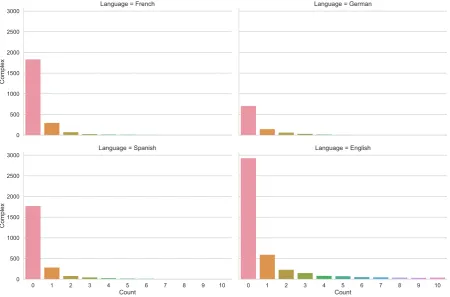
We use the data made available through the shared task (Yimam et al.,2018). Each training instance consists of a sentence, with a marked complex phrase annotation, including the numbers of na-tive and non-nana-tive annotators, and the fraction of these who found the phrase to be complex. An overview of the data is given in Table 1. The number of entries which are considered complex is quite skewed, and differs per language as French has substantially fewer complex phrases than En-glish. This is further illustrated in Figure1.
In addition to the shared task data, we also use external resources in our feature representations (see Section5).
4 Model
As outlined in Section2, earlier work has shown the aptitude of ensemble methods for CWI, espe-cially such ensembles that feature random forests. We further choose to address the problem in a cross-lingual fashion, for which we deem multi-task learning models particularly suitable.
0 500 1000 1500 2000 2500 3000
Complex
Language = French Language = German
0 1 2 3 4 5 6 7 8 9 10
Count 0
500 1000 1500 2000 2500 3000
Complex
Language = Spanish
0 1 2 3 4 5 6 7 8 9 10
[image:3.595.75.526.64.361.2]Count Language = English
Figure 1: Histogram of numbers sentences (y-axis) which N annotators (x-axis) found to be complex.
Note that our random forests are single-task mod-els, where we cannot define shared or language-specific subparts. Instead, these are always trained on data for the single test language.
The neural MTL models, in contrast, explic-itly define parts pertaining to specific languages. Concretely, for each languagel, we define a
func-tion from a language-specific input layer to a hid-den representationh0 that we share between lan-guages:
h0 = tanh(x(l)Win(l)+b (l)
in) (1)
Here and in the following equations,W(·)andb(·)
consistently denote weight matrices and bias vec-tors, respectively. Win(l) andb(inl) are the weights
and bias terms specific to input layerl, and the in-put x(l) is a vector representation of the features
introduced in Sec.5.
We then compute deeper hidden representa-tions, such that the hidden layer at depthdis
de-fined as follows:
hd= tanh(hd−1Wd+bd) (2)
Finally, each languageldefines its own outputy(l).
This output is defined slightly differently for the
regression and classification models.
y(regl) =hDWout(l) +b (l)
out (3)
For the former, this is simply a linear transforma-tion of the deepest hidden layerD. The
classifica-tion model adds a sigmoid activaclassifica-tion to this:
yclf(l) =σ(hDWout(l) +b(outl)) (4)
4.1 MTL training
Since our multitask model defines several outputs, but our data is only labeled with a single anno-tation layer (i.e. for a single language or “task”), we need a training strategy that does not require true labels for all tasks. The way this is normally approached is to iteratively optimize for tasks in isolation, e.g. by deciding at random which lan-guage we sample a batch of data from at every pass of the forward-backward algorithm we use to train the model.
4.2 Ensemble voting
The different neural and random-forest based model that we train as devised above finally make independent predictions for new examples. For the regression models, we use the median prediction across all systems for a given input to make the fi-nal ensemble prediction. For the classifiers, how-ever, we have an additional parameter t that we
optimize on a held-out development set. This is a threshold indicating the fraction of classifiers that need to cast a positive vote for us to finally accept an example as complex. All neural and random forest classifiers are weighted equally here, each casting a single binary vote.
4.3 Language identification for cross-lingual prediction
As we expect our system to be able to generate predictions for unseen languages (for which we have no explicit output layer), we implement a fur-ther component in our neural model that we opti-mize to predict the language of some input from the set of available languages with explicit output layers. This is an additional output layer of our model, defined as a dense projection from the first hidden layer followed by a sigmoid.
l=σ(h0Wlid+blid) (5)
During training, we then supply a ground truth lan-guage identifierˆl as a second target variable and perform optimization under a cross-entropy loss that we add to the CWI loss. At test time, for a language without an explicit output layer, we first predict the most similar language we saw during training using Eq.5and then use the output layer for that language to generate CWI predictions. An alternative to this could be to generate predictions from all CWI output layers and ensemble these, possibly weighted, with weights inferred in a sim-ilar fashion to language identification.
For the random forest models, which do not de-fine language-specific output functions, we simply concatenate training data from all available lan-guages, leveraging the fact that our feature space is language-independent.
5 Features
Our systems build on the same set of features for all input languages, although some of these are computed from language-specific resources. This means that the distributions of values attained
for certain features may differ between languages, which is the motivation for language-specific input layers in our model. We further reduce language idiosyncrasies by normalizing all features to the [0,1]range. The features are listed below.
Log-probability We compute unigram
fre-quencies for candidates as their log-probabilities in language-specific Wikipedia dumps. For multi-word targets, we use the sum of the log-probabilities of the individual items. Log-probabilities are computed using KenLM (Heafield,2011).
Character perplexity Based on the same
Wikipedia dumps as above, we compute charac-ter perplexities over the candidate strings using a smoothed 5-gram character-based language model (again using KenLM).
Number of synsets As a measure of a
tar-get’s semantic ambiguity, we count the number of synsets that include it. For this, we rely on the language-specific WordNet resources for En-glish (Fellbaum,1998), Spanish (Gonzalez-Agirre et al.,2012) and French (Sagot and Fiˇser,2008). For German, access to GermaNet (Hamp and Feldweg, 1997) was harder to obtain, and we in-stead automatically translate words from German to English and use the English WordNet.1 In case of a multi-word target, we take the mean number of synsets across the individual words.
Hypernym chain As a measure of semantic
specificity, we further consider the length of the hypernym chain of an item, i.e. the number of hypernyms that can recursively be obtained for a word. These are also obtained using WordNet, and again we average over individual words in a target. Inflectional complexity As a proxy for inflec-tional complexity (i.e. the number of suffixes ap-pended to a word stem), we measure the differ-ence in length (character count) between the sur-face form and the stem of a word. For this, we use language-specific instances of the Snowball stem-mer (Porter,2001) as implemented in NLTK (Bird and Loper,2004).
Surface features As basic surface features, we include the length of an item (in characters) and whether it is all-lowercase.
1For the translations, we used a bilingual dictionary
Language MAE Rank ∆(system) F1 Rank ∆(system)
French 0.066 1 0.012 (TMU) 0.7595 1 0.013 (TMU)
German 0.075 2 -0.013 (TMU) 0.6621 5 -0.083 (TMU)
[image:5.595.118.479.64.129.2]Spanish 0.079 3 -0.007 (TMU) 0.7458 5 -0.024 (TMU)
Table 2: Official performance figures of our method for all non-English tracks. The∆(system) column indicates the difference in performance between our system and the best system in each track except for ours. In accordance with the shared task report, classification performance is measured by macro F1 between the complex and non-complex class in the official results.
Bag-of-POS For each tag defined in the Univer-sal Part-of-Speech project (Petrov et al.,2011), we count the number of words in a candidate that be-long to the respective class. We obtain POS tags from spacy.2
Target-sentence similarity Motivated by the
conjecture that words or phrases are easier to understand if they display higher semantic simi-larity with their context, we compute the cosine distances between averaged word embeddings for the target word or phrase and the rest of the containing sentence. To mitigate out-of-vocabulary problems, we use pretrained subword embeddings that we retrieve from the BPEemb project (Heinzerling and Strube,2017).
The data provided for the shared task further includes information on how many of the annota-tors are native and non-native speakers. While this information is potentially helpful (assuming that non-native speakers would have a stronger bias for annotating as complex), we do not make use of it, considering that access to such information cannot be assumed in a real-world scenario.
6 Results
We present an overview of the results that our method (as well as our best contender) achieved in Table 2 and discuss results for the individual languages below.3
6.1 French
Due to the lack of training data for this track, it poses a challenging test for the ability of our mod-els to generalize across languages. While the exact performance figures are at least partly subject to idiosyncrasies in the text samples and annotators,
2https://spacy.io/
3We did not submit solutions for the English track.
the results obtained here are a good benchmark of of what we can achieve for languages for which we do not even have validation data to monitor de-velopment loss for early stopping.
As Table 2 shows, we achieve the best results of all participating teams for French, both for the classification and for the regression track. We view this as evidence that our cross-lingual MTL approach is an effective means to share knowledge between different data sources and even different languages.
6.2 German/Spanish
Our results for Spanish and German show that, while we did not achieve the best results com-pared to other participants, our method still per-forms competitively. Especially for the regression track, while not ranking first, the absolute perfor-mance figures place us very close to the winning systems. We see this as a validation of our ap-proach, in particular under the consideration that a gradual assessment of complexity is perhaps more meaningful than a binary one, especially when the definition of the latter makes no distinction be-tween one or all out of 20 annotators judging an item as difficult.
6.3 Analysis
True positives
Ilmarque n´eanmoins sa d´esapprobationen voyant des Juifs prier devant le mur des Lamentations; Einstein commente qu’il s’agit de personnes coll´ees au pass´e et faisant abstraction du pr´esent. Rimbaud a donn´e ses lettres de noblesse `a un type de po`eme en prose distinct d’exp´eriences plus prosa¨ıquesdu type du “Spleen de Paris” de Baudelaire.
False negatives
Le pays des vall´ees d’Andorre entre la France et l’Espagne, sur le versant sud des Pyr´en´ees, est constitu´e par deux vall´ees principales: celle du Valira del Orient et celle du Valira del Nord dont les eaux r´eunies forment le Valira.
Autres cultures permanentes, la lavande et le lavandin occupent plusieurs milliers d’hectareset four-nissent plusieurs milliers d’emplois directs.
True negatives
Beaucoup d’ˆıles des Cara¨ıbes (les Antilles) – par exemple, les Grandes Antilles et les Petites Antilles – sontsitu´eesau-dessus de la plaque cara¨ıbe, une plaque tectonique avec une topographie diffuse. Avec un fort penchant `a l’herm´etisme qu’il partage avec d’autres de ses quasi contemporains (G´erard de Nerval, St´ephane Mallarm´e, sinon Paul Verlaine parfois), Rimbaud a leg´enie des visions saisis-santes qui semblent d´efier tout ordre de description du r´eel.
False positives
[image:6.595.90.281.517.652.2]Laconstructionde l’Atomium fut une prouesse technique. Laproportiondes musulmans, tous sunnites, est inf´erieure `a 1%.
Table 3: Example wins and losses of our model for French. Target words or phrases are marked in bold.
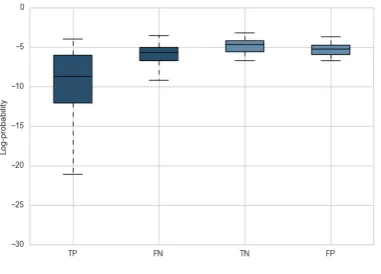
(a) Length in characters per error type (b) Log-probability per error type
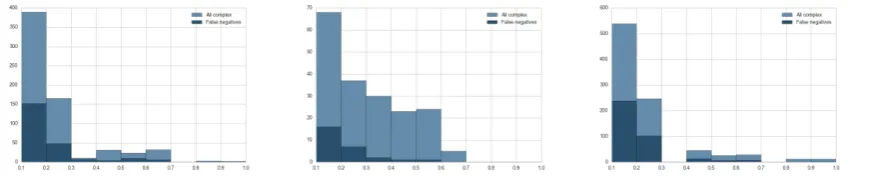
[image:6.595.313.504.518.655.2]Figure 3: Distributions of false negative predictions per complexity degree as measured by the fraction of annotators that labeled items as complex in the French, German and Spanish test sets (left to right).
system as non-complex, possibly because of their shortness.
Quantitative error analysis Investigating the observations from the previous section in a more quantitative fashion, Figure 2 presents distribu-tions of two basic features across complex vs. non-complex words, and correctly vs. wrongly pre-dicted test set items for French. For item length, we observe a clear pattern that complex words tend to be significantly longer than non-complex ones. Further, the longer they are, the easier it is for our model to detect them as complex. Non-complex words that are relatively long, however, lead to incorrect predictions from our model.
A very similar pattern can be observed for the log-probability of complex and non-complex items. The former are assigned a much lower probability by our language model, and particu-larly unlikely words are very easy to detect as complex. In turn, non-complex words with rel-atively low probability pose a challenge for our model.
False negatives per complexity degree We fur-ther analyze the influence of the degree of com-plexity on our model’s ability to detect complex words. As stated in the Introduction, an item is labeled as complex in the classification setting if any of the annotators deemed it to be complex. Effectively, no distinction is made in the classifi-cation task between a “slightly complex” item that was marked as such by just one out of ten anno-tators, and one that was unanimously considered complex.
A natural assumption is that our models would more easily pick up on highly complex words and predict false negatives mostly for items with low complex annotation ratios. To verify this assump-tion, we plot the total number of complex words
in the three non-English test sets against the false negative predictions of our model, grouped by the ratio of annotators who marked an item as com-plex (Figure 3). The French and Spanish test sets are somewhat inconclusive for our question as they generally contain very few items with a com-plexity ratio higher than0.2. The German test set, however, is more balanced, and in fact we observe that items with a complexity ratio above 0.2 are very reliably detected by our model, confirming our hypothesis.
7 Discussion
We approached RQ 1by using one output layer per language, and sharing intermediate parame-ters. This approach was successful, at least in part due to our language-agnostic input represen-tations, which allowed the model to learn similar internal representations for each language. Sepa-rate output-layers per language, in turn, allow for the model to make language-specific accommoda-tions. We approached RQ 2by using agnostic feature representations, and language-specific output layers which were chosen during test time for unseen languages. This approach al-lowed our model to perform well on the unseen language French, and in fact outperformed our re-sults on other languages. This is, however, not strictly a fair comparison as it is possible that the French test set was somehow easier than the oth-ers.
8 Conclusion
cross-linguistic predictors of complexity. However, the concrete relationships between these features and complexity may differ between languages, which is captured by our multitask learning approach. Our approach is especially promising for the ap-plication of CWI to unseen languages, as we do not assume access to any target language training data. Furthermore, this could even substantially facilitate the creation of new CWI datasets, using a bootstrapping or active learning approach.
Acknowledgments
James Thorne wrote much of the Pytorch code that we used in this work. We are grateful to the anony-mous reviewer for helpful suggestions. The first author acknowledges the support by Trygfonden.
References
Joachim Bingel, Maria Barrett, and Sigrid Klerke. 2018. Predicting misreadings from gaze in chil-dren with reading difficulties. InProceedings of the 13th Workshop on Innovative Use of NLP for Build-ing Educational Applications, New Orleans, United States. Association for Computational Linguistics. Joachim Bingel and Anders Søgaard. 2017.
Identify-ing beneficial task relations for multi-task learnIdentify-ing in deep neural networks. 15th Conference of the European Chapter of the Association for Computa-tional Linguistics.
Steven Bird and Edward Loper. 2004. Nltk: the nat-ural language toolkit. In Proceedings of the ACL 2004 on Interactive poster and demonstration ses-sions, page 31. Association for Computational Lin-guistics.
Johannes Bjerva. 2017a. One Model to Rule them all: Multitask and Multilingual Modelling for Lexical Analysis. Ph.D. thesis, University of Groningen. Johannes Bjerva. 2017b. Will my auxiliary tagging
task help? Estimating Auxiliary Tasks Effectivity in Multi-Task Learning. InProceedings of the 21st Nordic Conference on Computational Linguistics, NoDaLiDa, 22-24 May 2017, Gothenburg, Sweden, 131, pages 216–220. Link¨oping University Elec-tronic Press, Link¨opings universitet.
Johannes Bjerva and Robert ¨Ostling. 2017. Cross-lingual Learning of Semantic Textual Similar-ity with Multilingual Word Representations. In
Proceedings of the 21st Nordic Conference on Computational Linguistics, NoDaLiDa, 22-24 May 2017, Gothenburg, Sweden, 131, pages 211–215. Link¨oping University Electronic Press, Link¨opings universitet.
Leo Breiman. 2001. Random forests. Machine learn-ing, 45(1):5–32.
Rich Caruana. 1997. Multitask learning. Machine Learning, 28 (1):41–75.
Christiane Fellbaum. 1998. A semantic network of english verbs. WordNet: An electronic lexical database, 3:153–178.
Aitor Gonzalez-Agirre, Egoitz Laparra, and German Rigau. 2012. Multilingual central repository version 3.0. InLREC, pages 2525–2529.
Birgit Hamp and Helmut Feldweg. 1997. Germanet-a lexical-semantic net for German. Automatic Infor-mation Extraction and Building of Lexical Semantic Resources for NLP Applications.
Kenneth Heafield. 2011. Kenlm: Faster and smaller language model queries. InProceedings of the Sixth Workshop on Statistical Machine Translation, pages 187–197. Association for Computational Linguis-tics.
Benjamin Heinzerling and Michael Strube. 2017. Bpemb: Tokenization-free pre-trained subword embeddings in 275 languages. arXiv preprint arXiv:1710.02187.
Gustavo Paetzold and Lucia Specia. 2015. Lexenstein: A framework for lexical simplification. Proceed-ings of ACL-IJCNLP 2015 System Demonstrations, pages 85–90.
Gustavo Paetzold and Lucia Specia. 2016a. Semeval 2016 task 11: Complex word identification. In Pro-ceedings of the 10th International Workshop on Se-mantic Evaluation (SemEval-2016), pages 560–569. Gustavo Paetzold and Lucia Specia. 2016b. Sv000gg at semeval-2016 task 11: Heavy gauge complex word identification with system voting. InProceedings of the 10th International Workshop on Semantic Eval-uation (SemEval-2016), pages 969–974.
Slav Petrov, Dipanjan Das, and Ryan McDonald. 2011. A universal part-of-speech tagset. arXiv preprint arXiv:1104.2086.
Martin F Porter. 2001. Snowball: A language for stem-ming algorithms.
Marek Rei. 2017. Semi-supervised multitask learn-ing for sequence labellearn-ing. In Proceedings of the 55th Annual Meeting of the Association for Compu-tational Linguistics (Volume 1: Long Papers), pages 2121–2130. Association for Computational Linguis-tics.
Francesco Ronzano, Luis Espinosa Anke, Horacio Saggion, et al. 2016. Taln at semeval-2016 task 11: Modelling complex words by contextual, lex-ical and semantic features. In Proceedings of the 10th International Workshop on Semantic Evalua-tion (SemEval-2016), pages 1011–1016.
Matthew Shardlow. 2013a. A comparison of tech-niques to automatically identify complex words. In
51st Annual Meeting of the Association for Compu-tational Linguistics Proceedings of the Student Re-search Workshop, pages 103–109.
Matthew Shardlow. 2013b. The cw corpus: A new re-source for evaluating the identification of complex words. InProceedings of the Second Workshop on Predicting and Improving Text Readability for Tar-get Reader Populations, pages 69–77.
Matthew Shardlow. 2014. Out in the open: Finding and categorising errors in the lexical simplification pipeline. InLREC, pages 1583–1590.
J¨org Tiedemann, ˇZeljko Agi´c, and Joakim Nivre. 2014. Treebank translation for cross-lingual parser induc-tion. In Proceedings of the Eighteenth Confer-ence on Computational Natural Language Learning, pages 130–140. Association for Computational Lin-guistics.
Seid Muhie Yimam, Chris Biemann, Shervin Mal-masi, Gustavo Paetzold, Lucia Specia, Sanja ˇStajner, Ana¨ıs Tack, and Marcos Zampieri. 2018. A Report on the Complex Word Identification Shared Task 2018. InProceedings of the 13th Workshop on In-novative Use of NLP for Building Educational Ap-plications, New Orleans, United States. Association for Computational Linguistics.