Experiments on Lithuanian Term Extraction
Gintar˙e Grigonyt˙e, Erika Rimkut˙e, Andrius Utka and Loic Boizou Centre of Computational Linguistics (http://donelaitis.vdu.lt)
Vytautas Magnus University Kaunas, Lithuania
{g.grigonyte, e.rimkute, a.utka, l.boizou}@hmf.vdu.lt
Abstract
This paper explores the problem of ex-tracting domain specific terminology in the field of science and education from Lithuanian texts. Four different term ex-traction approaches have been applied and evaluated.
1 Introduction
Term extraction nowadays is becoming automated and a well defined process that contains phases of NLP in the levels of morphology, syntax, and sometimes semantics (Sager, 1990; Cabre, 1992). Even though NLP tools have never reached very high reliability, there is a wide choice of term extraction applications for widely spread Indo-European languages like English (Pantel and Lin, 2001), French (Daille, 1994), Polish (Piskorski et al., 2004), and Russian (Mitrofanova and Za-kharov, 2009).
The research strategies of term extraction can be divided into statistically-based and linguistically-based1(Cabre et al., 2001). Rarer languages
of-ten do not have the luxury of linguistic tools for automatic text processing. One can argue that a possible solution could be statistically-based tools, which are claimed to be language independent. However, there is a lack of evaluation of such tools for rare languages.
Even though there are some rapid advances in Lithuania’s HLT2, automatic term extraction is
still quite a new and unexplored field. First at-tempts of using commercial term extraction tools for Lithuanian were described by Zeller (2005).
The present paper deals with the automatic ex-traction of Lithuanian domain specific terminol-ogy in the field of education and science. In the 1Hybrid approaches combine both strategies: usually lin-guistic analysis followed by statistical filtering.
2More about Lithuanian HLT in Marcinkeviˇcien˙e and Vitkut˙e-Adžgauskien˙e (2010).
following subsections we will describe the termi-nology situation in Lithuania and several Lithua-nian language specific pitfalls that are relevant for linguistically or statistically based term extraction systems.
1.1 Terminology Situation in Lithuania The main volume of Lithuanian terminology is available at the Lithuanian Terminology bank3.
The Terminology bank is being run and con-stantly updated by the Commission of the Lithua-nian Language4together with the Office of
Lithua-nian Seimas5. Presently, the bank keeps records
of 150 thousand terms and their definitions of var-ious domains, e.g. machinery, computer science, medicine, etc. Naturally, there is a large number of domain specific databases and dictionaries in various institutions that do not always include of-ficially accepted terms.
In Lithuania until now terms have been com-posed, chosen and approbated on the basis of in-considerable amount of texts, intuition, and the norms of the Lithuanian language. This is a tradi-tional prescriptive way of term definition that does not satisfy contemporary needs of the language.
However, there is a great urge for changes in the Lithuanian terminology, as now there is a con-stant lack of terms and a large number of incor-rectly translated terms. Furthermore, new variants of terms occur much faster than the definition of a term. Quite often the standardized terms are not willingly accepted by the society.
Obviously this paper takes the descriptive path, as it is an attempt to find an efficient and robust way to extract a domain specific terminology with-out any prescriptive judgment.
3http://terminai.vlkk.lt:10001/pls/tb/tb.search 4http://vlkk.lt/
1.2 The Language Related Problem
Lithuanian is a highly inflective language. For ex-ample, Lithuanian nouns, adjectives and particles typically have 7 cases in singular and 7 in plural, which makes 14 different wordforms of a single-word. Additionally some Lithuanian nouns, adjec-tives, participles, pronouns, and numerals can be used in three different genders (feminine, mascu-line, and neuter), which again adds to a variety of forms. This proliferation of inflections makes the statistical automatic identification of terms more complicated, as distinct wordforms of terms ap-pear very infrequently.
The solution for this is the morphological tag-ging, which again is complicated due to many morphological categories and morphological am-biguity, which exists in Lithuanian in spite of rich variety of wordforms. Unlike in other languages like for instance Malay morphological categories do not necessarily resolve ambiguity as ambigu-ity is present within lemmas, e.g., "laiko" (noun "time" and verb "hold"), and within wordforms, e.g. "prek˙es" (sing. noun gen. and pl. noun nom.). Besides, the linguistic approach needs an an-swer to the question, which of grammatical cat-egories are necessary for the successful extraction of term candidates and which can be ignored. One thing is obvious that the part-of-speech category is not enough for Lithuanian.
The categories of gender and number are not very helpful in distinguishing between terms and non-terms. For example, if we consider the most productive two-word term combination N + N in Lithuanian, then in the terms like d˙estytoju˛ kompetencija(competence of teachers), studentu˛ atstovyb˙e (students’ organization) the first noun should have plural Genitive form, while in the terms likefakulteto taryba(faculty board), univer-siteto autonomija(autonomy of the university) the first noun should have singular Genitive form.
In other cases the second noun needs to be either in plural (akademiniai i˛g¯udžiai(academic skills), auditorin˙es darbo valandos (class hours)) or in singular (bendrasis pri˙emimas (common enroll-ment),mokslinis leidinys(scientific publication)). The category of gender may not be a distinguish-ing feature either, as each constituent of a term can potentially be in feminine or masculine gender.
It seems that the only useful additional feature in the N + N combination is the Genitive case of the first constituent, as it remains stable across
many variants.
Additional complications arise with three-word or longer terms. For example, if we take the termmoksliniu˛ tyrimu˛ i˛staigos atestacija (certifi-cation of institution of scientific researches), then its structure is
A pl. Gen + N pl. Gen + N sg. Gen + N sg. Nom
Such long terms often consist of several combi-nations of words, where their syntactic relations might differ. For example, in the term nefor-maliojo suaugusiu˛ju˛ švietimo i˛statymas(law of in-formal education of adults) with a structure of A sg. G. + N pl. G. + N sg. G. + N sg. N syntactic relations are spread as follows: (figures indicate the elements of word combinations):
1←−3 2←−3 [123]←−4
Beside language related problems, there are some universal terminology identification lems typical to all languages. One of such prob-lems is determining term boundaries. For exam-ple, the word combinationd˙estytoju˛ ir mokslininku˛ kvalifikacijos bei kompetencijos atitiktis (corre-spondence of qualification and competence of teachers and scientists) may give birth to one term or several terms: 1) d˙estytoju˛ kvalifikaci-jos bei kompetencikvalifikaci-jos atitiktis (correspondence of qualification and competence of teachers), 2) mokslininku˛ kvalifikacijos bei kompetencijos ati-tiktis (correspondence of qualification and com-petence of scientists), 3)d˙estytoju˛ ir mokslininku˛ kvalifikacijos atitiktis (correspondence of quali-fication of teachers and scientists), 4) d˙estytoju˛ ir mokslininku˛ kompetencijos atitiktis (correspon-dence of competence of teachers and scientists) (more combinations of possible terms (concerning their boundaries) are possible).
Finally, the question, whether a particular stable word combination is a term or not, is faced by both human experts and computer programs. However, even if a word combination is a term, yet another judgment on its specificity, i.e. domain term vs. general term, is required. The solution of such problem is possible only with the help of an ex-pert.
&'(#)%
*#+($"),-)$#./*01$),-)(#+#.'2)$#./1*01$),-)#34#.$5'44.,6#7)$#./1 *#+($"),-)$#./*01$),-)(#+#.'2)$#./1
% 8%9 9: % %;<;
: %=>? >;9 : >;<9
? 8:; ?:> ? :@<?
> :%@ %:A > 8<A
= 8: ?> = :
8 :; :% 8 @<;
9 9 ? 9 @<:
A : % A @<%
; 8 = ; @<:
%@ % @ %@ @
% : ? > = 8 9 A ; %@ @
:@@ >@@ 8@@ A@@ %@@@ %:@@ %>@@ %8@@ %A@@
*01$),-) (#+#.'2) $#./1 *01$),-) #34#.$5 '44.,6#7) $#./1
*#+($"),-)$#./1
B#
./
)C
,
D
+$
% : ? > = 8 9 A ; %@
@ %@ :@ ?@ >@ =@ 8@
%;<;
>;<9 :@<?
8<A : @<; @<: @<% @<: @
8<8
>=<A :;<; %%<A
?<% %<; @<? @<% @<= @
*01$),-) (#+#.'2) $#./1 *01$),-) #34#.$5 '44.,6#7) $#./1
B#./)701$.0ED$0,+F)G
*
#
+(
$"
),
-)$
#
./
[image:3.612.111.520.69.251.2]1
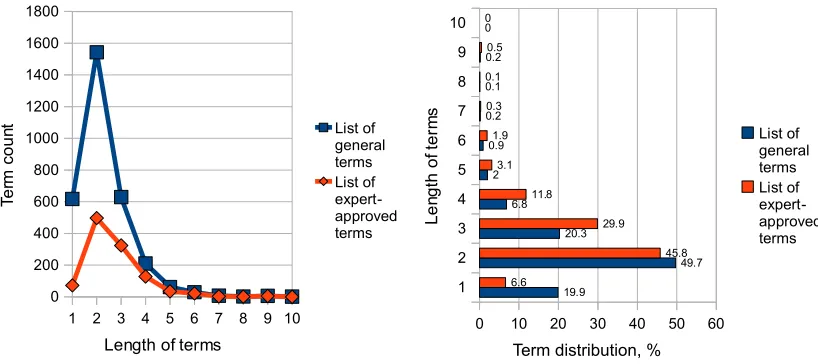
Figure 1: Absolute frequency distribution (1st part) and relative frequency distribution (2nd part) of term lengths.
2 Experimental Settings
2.1 The Corpus
An experimental 103,893 token corpus of educa-tion and science has been compiled specifically for term extraction experiments. This corpus consists of laws, orders, regulations, resolutions, mem-oranda, descriptions, overviews, notes, reports, newsletters, programmes, summaries, and stan-dards. The texts mainly encompass the follow-ing topics: high education policy, research policy, continuous education, and professional education policy. Two reference lists have been manually created for the analysis of terms and evaluation purposes: the first one is a larger list of all gen-eral terms, and the second one is the special list of terms in the field of education and science.
Firstly, 5 linguists have identified a list of gen-eral terms (in total 3,106 lemmas). Problem cases and disagreements have been solved by consulta-tion between the linguists. Then this provisional list has been further reviewed by the education ex-pert, who has identified the terms of science and education. As a result of this review, the list has shrank to 1,085 terms. The expert mostly removed general administrative terms and terms that are not related to the previously mentioned topics.
The analysis of distribution of term lengths in the reference lists has been performed, as term length is very important characteristic to many term extraction methods. The analysis of term types has shown that the term length can vary from one to ten words (see Figure 1). Although
two-word terms are by far most frequent (49.7 % of the total number of terms), they cover only a half of all terminology.
In the expert list, the part of single and two-word terms has significantly decreased, while the part of three and four-word terms has significantly increased. The distribution of term lengths shows that terms with lengths from 1 to 4 words make up 96.7% of all terms in the general list and 94.1% in the expert list. Many extraction methods typi-cally leave out single-word and four-word terms, although it is evident from this analysis that they are quite important in the overall coverage of ter-minology.
2.2 Statistical Approaches
Statistically-based term extraction aims at detect-ing syntagmatic collocations or keywords, which are relevant for the domain6. Many statistic
measures can be applied for term extraction task starting with frequency rank, Mutual Informa-tion (Church and Hanks, 1989), Dice coefficient (Smadja et al., 1996), T-score (Church et al., 1991), Log-likelihood (Dunning, 1993), C-value (Frantzi and Ananiadou, 1996), and others.
A major advantage of statistical TE systems is that they do not require huge databases with term patterns constructed by humans and also do not re-quire running through language analysis pipelines. The assumption in using statistical models in TE is that words which tend to co-occur together are re-lated and therefore they are likely term candidates.
6These features are referred as unithood and termhood.
In this section, we will deal with three statisti-cal approaches, namely keyword cluster identifi-cation, keyword extraction with machine learning, and collocation extraction.
2.2.1 Keyword Clusters
When analysing abilities of extracting terms by the linguistic programWordSmith Tools(Scott, 2008), the idea of extractingkeyword clusters as termi-nology candidates has emerged. The idea is based on the assumption that the most frequent clusters of keywords in a given text may also point to ter-minology.
Keywords are identified by comparing a given text’s frequency list to the frequency list of a large reference corpus by using Ted Dunning’s (Dunning, 1993) log likelihood test. The final step is calculating keyword clusters that are two or more words, which are found repeatedly near each other (1-3 intervening words may be present). Below is the list of 10 most frequent keyword clusters and their frequencies:
mokslo [.] studiju˛ (studies of science) 524 švietimo [.] mokslo (education science) 522 aukštojo mokslo (higher education) 474 moksliniu˛ tyrimu˛ (scientific research) 390 suagusiu˛ju˛ švietimo (adult education) 292 lietuvos respublikos (lithuanian republic) 284 protu˛ nutek˙ejimo (brain drain) 228 švietimo ministerija (ministery of education) 220 profesinio mokymo (professional teaching) 184 neformaliojo [.] švietimo (non-formal education) 164
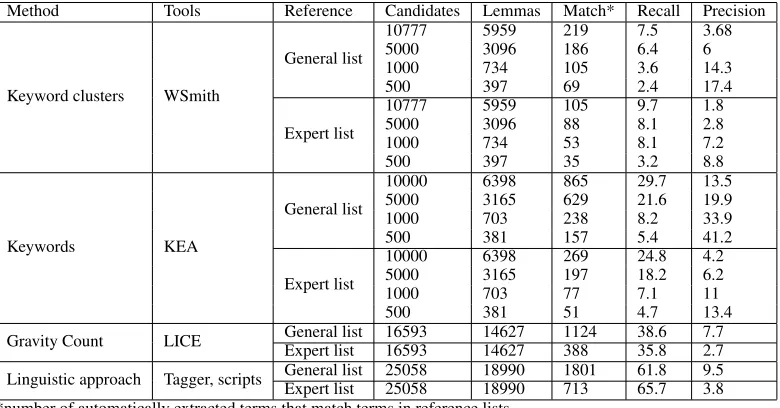
Even though the resulting list seems very promising, the comparison in terms of precision and recall with the reference lists has not shown good results. The best result with the whole key-word list has produced 9.7% of recall and 1.8% of precision when compared to the expert’s list and 7.5% of recall and 3.7% of precision when com-pared to the list of general terms (see Table 2 for all results).
2.2.2 Machine Learning: KEA
Many NLP tools require a process of machine learning, which allows the system to improve the quality of results by its own experience or the su-pervision of a human.
The keyword extractor KEA7implements such
methods. The core of the KEA system is a statistically-based algorithm with a machine learn-ing system generatlearn-ing an extraction model. The
7http://www.nzdl.org/Kea/
multi-featured algorithm rates keywords taking in account four components:
• degree of specificity;
• position in the text; • length of the phrase;
• node degree.
The learning process, which is based on Naive Baysian Method using the software WEKA8,
re-quires a manual extraction of keywords from a training corpus. A clear overview of the whole system may be found in Medelyan (2005). Be-sides, the core may be extended by language spe-cific Java components as a stop-words list and a stemmer.
From a terminological perspective, it must be noticed that a keyword is not the same as a term. However, in a corpus made of specialized texts, we may expect a significant matching between the set of keywords and the set of terms.
The task of machine learning has been based on a subset of the test corpus consisting of four texts, representing approximately 22,000 words, about 1/5 of the whole experimental corpus. The man-ually selected keywords have been the terms ap-pearing in the sub-corpus. Given the highly in-flected nature of the Lithuanian language, two at-tempts of machine learning have been carried out. In the first case, the list of manually extracted key-words has included only the main nominal forms (Nominative, Accusative and Genitive, if relevant singular and plural). In the second case, the list has been restricted to the base forms (lemma). The ex-traction results have been identical for both meth-ods.
Once the extraction model has been built, three different approaches have been tested : 1) with no extension, 2) with a stop-words list and 3) with both a stop-words list and a stemmer. The first ap-proach has produced results of insufficient qual-ity with such terms as mokslo ir (science and). This has led to the conclusion that a stop-word list would enhance the quality. On the basis of the results given by the rough extraction, a list of more than one hundred stop-words has been com-piled. In order to avoid an artificialad hoc cor-rection of the results, only words of some specific groups have been included in the stop-words list:
• grammatical words such as prepositions,
con-8http://www.cs.waikato.ac.nz/ml/weka/
junctions, particles, some adverbs and fre-quent forms of pronouns;
• some expressions of quantity; • main abbreviations;
• some general verb forms (to be, to show, modal verbs).
The use of this restricted stop-word list obvi-ously has improved the results, avoiding some common mistakes of highly improbable termino-logical combinations.
Besides, the third variant adding a stemmer has also been tested, but the quality of the results has been the worst of all three. The Lithuanian re-sults have appeared as a confirmation of a state-ment in the docustate-mentation of KEA’s source code - "We have obtained better results for Spanish and French with NoStemmer".
Given the preliminary results of the different methods, the term candidates have been extracted on the basis of the second variant, that is, with a stop-words list only. Subsets of different sizes have been extracted (10,000, 5,000, 1000, 500 forms of term candidates).
2.2.3 Collocation Extraction Methods
Collocations and terminology are related con-cepts, but this relationship is not a synonymic or a simple one. It is a well known fact that the term of collocation is very broadly understood, and there-fore it is important at the very start to define which notion of collocation is used in the current pa-per. In this paper we will deal only with statisti-cal collocations, that is with sequences of words that co-occur more often than would be expected by chance.
Automatically extracted collocations have been used for terminology extraction process many times (e.g., Daille, 1996, Azé et al., 2005 etc.). As a rule, collocation extraction methods are used as the first step in creating a terminology candidate list, which is then further processed by ranking and extracting the relevant items. However, there are at least two problems associated with these meth-ods. The first problem is that there is quite a large number of statistical collocation extraction meth-ods (e.g. Azé et al., 2005 deal with 13 methmeth-ods), and it is not a trivial task to choose the best one for the terminology extraction task. The second problem is that the majority of collocation extrac-tion methods are limited to extracting two to three word collocations, while the range of term lengths,
as our analysis has shown, is rather more broad. The latter statement can be supported by the analysis of term lengths in 103,893 word experi-mental corpus (see Figure 1).
Due to these reasons, it has been decided to try only the tools and methods that extract col-locations of variant length, i.e. LICE (Gravity Counts)9, and leave out other tools that extract
fixed length collocations.
Gravity counts (Daudaraviˇcius and Marcinke-viˇcien˙e, 2004) is a method for determining bor-ders or collocations. It is based on the idea that all words in a text are more or less tied, that is, the de-gree of attraction between them may be stronger or weaker. Gravity count G for two words x and y in this order is calculated according to the formula:
G(x, y) =log
f(x, y)·r(x)
f(x)
+log
f(x, y)·l(y)
f(y)
(1) where f(x) is the frequency of x, f(y) the fre-quency of y, f(x,y) the frefre-quency of the two word co-occurring in this order, r(x) the number of dif-ferent words to the right of x and l(y) the number of different words to the left of y.
The software LICE, which is designed to imple-ment the gravity counts, has been used to collect collocations with the aim of comparing them with the set of terms manually extracted. It must be emphasized that LICE does not extract only multi-word expressions, since the program is designed to indicate the limits of collocations. Thus, if a group of consecutive words shows a significant degree of attraction, they appear as a collocation, but words which are loosely tied to others appears separately in the results given by LICE.
The result given by LICE has been processed in order to extract the multiword expressions. Then, in order to improve the result in the same way it has been done for KEA, a stop-words list (the same as prepared for KEA) has been used as a second filter. It must be emphasized that even af-ter the filtration the number of expressions remains very high (more than 16,000 terms).
2.3 Linguistically-based Approach
N Gen N Nom 638
A Nom N Nom 610
N Nom 484
A Gen N Gen N Nom 168
N Gen N Gen N Nom 145
A Nom N Gen N Nom 73
PART Nom N Nom 66
A Nom A Nom N Nom 42
A Gen N Gen N Gen N Nom 37
[image:6.612.110.286.57.153.2]V inf 31
Table 1: Morphological patterns in the general list of terms (where N - noun, A - adj, PART - participle, Nom - Nomina-tive, Gen - Genitive).
The approach is language dependent as terms in different languages have different morphological patterns. Morphological patterns may include part-of-speech categories for analytic languages (e.g. English), or additional grammatical cate-gories such as cases for synthetic languages (e.g. Lithuanian), or syntactic categories (e.g. noun phrases).
Typically this approach requires an annotated corpus, which needs to have an appropriate anno-tation scheme (e.g. POS, POS+case, or syntax). The term extraction tools simply extract all occur-rences of required patterns from the annotated cor-pus and produce a list of term candidates that can be manually reviewed, statistically processed, or filtered with the help of stop-word lists.
Linguistic rules can be coded as regular ex-pressions and directly used for identifying term candidates. An example of such a rule for a singleword term is [noun], for twoword terms -[noun]+[noun] and [adjective]+[noun]. Morpho-logical patterns that have not been coded into a term extractor will produce low recall, while non-terms that coincide with the programmed patterns will reduce precision. Lopes et al. (2010) have shown that linguistic approaches produce better results than statistical ones, besides they also em-phasize the fact that linguistic approaches are more complicated in comparison to easy adaptable statistical methods.
For the present study, the manually extracted terminological list has been morphologically tagged10 and a frequency list of morphological
patterns has been built. In order to avoid unnec-essary diversity of the patterns, only categories
10The tagging has been performed using the morphologi-cal analyzer developed at CCL VMU. Rimkut˙e and Daudar-aviˇcius (2007) have established that the precision of the tag-ger is 94% for establishing grammatical categories and 99% for lemmatisation.
of part-of-speech and case have been considered. The list of top ten grammatical patterns with fre-quencies of occurrence in the lemmatized list of general terms is given in Table 1.
A set of 27 morphological patterns has been se-lected for the extraction of term candidates from the annotated experimental corpus. The list of pat-terns includes mostly combinations of nouns and adjectives, sometimes with the intervening con-junctionir’and’. In order to limit the noise, only multiword patterns have been considered. The maximal length of morphological patterns is five words. A Haskell function has been specially de-veloped for this goal. Some deficiencies of this ap-proach result from the tagging process which can give inaccurate analysis or fail to analyse an un-known word.
2.4 Evaluation
The evaluation of a term extraction system can be addressed with measuring against the gold stan-dard. Two term reference lists have been set (see section 2.1) for the purpose of evaluating the four different term extraction approaches.
The quality performance of the term extraction system can be evaluated in terms ofprecisionand recall. Which are the equivalent of inverted mea-sures ofsilenceand noiseproposed by (Cabre et al., 2001).
2.5 Results
All the test results of the above tested methods and tools are summarized in the Table 2.
Concerning the recall, there are several objec-tive reasons, which have negaobjec-tively influenced the results. In case of KEA and the linguistic ap-proach, candidate terms longer than 5 words have not been extracted, while these patterns represent between 1.4% and 2.8% of the manually extracted terms. Similarly, the linguistic, keyword clusters approach and LICE, have not taken into account single word terms, which represent between 6.6% and 19.9%.
Method Tools Reference Candidates Lemmas Match* Recall Precision
Keyword clusters WSmith
General list
10777 5959 219 7.5 3.68
5000 3096 186 6.4 6
1000 734 105 3.6 14.3
500 397 69 2.4 17.4
Expert list
10777 5959 105 9.7 1.8
5000 3096 88 8.1 2.8
1000 734 53 8.1 7.2
500 397 35 3.2 8.8
Keywords KEA
General list
10000 6398 865 29.7 13.5
5000 3165 629 21.6 19.9
1000 703 238 8.2 33.9
500 381 157 5.4 41.2
Expert list
10000 6398 269 24.8 4.2
5000 3165 197 18.2 6.2
1000 703 77 7.1 11
500 381 51 4.7 13.4
Gravity Count LICE General listExpert list 1659316593 1462714627 1124388 38.635.8 7.72.7
[image:7.612.96.486.58.262.2]Linguistic approach Tagger, scripts General listExpert list 2505825058 1899018990 1801713 61.865.7 9.53.8 *number of automatically extracted terms that match terms in reference lists.
Table 2: Evaluation of Terminology Extraction Tools.
’academician’, it is mainly due to a significant pro-cess of normalization of terms occurring in the corpus by operations on the syntactic structure by the expert. For example, the terms docento pedagoginis vardas’pedagogical title of docent’, vakariniai kursai’evening courses’ andpri˙emimas i˛ universitet ˛a’enrollment in university’ appear re-spectively in the expressionsdocento ir profesori-aus pedagoginiai vardai’pedagogical titles of do-cent and Professor’,kursai (dieniniai, vakariniai, t˛estiniai, trumpalaikiai ir kt.) ’courses (full-time, evening, continuing, short)’ and pri˙emimo i˛ VU ’enrollment in UV’ (or pri˙emimo i˛ valstybines aukšt ˛asias mokyklas ’enrollment in public high schools’). None of these examples could be found by any of the tested extraction methods.
The number of extracted candidate terms has a strong influence on the level of precision. For example, with LICE and the linguistic approach, the number of extracted patterns is very high, with more than 15,000 lemmatized expressions, which has generated mechanically much noise in com-parison with the manually extracted reference lists consisting of 1,085 and 3,106 terms. Besides, term candidates have not been rated by both of the methods, which does not allow to extract a mean-ingful subset of comparable number.
We are aware that results could be further eval-uated, taking into account measures for partial matches, however the lack of necessary tools has not allowed us to include in the present paper.
The overall analysis of the results shows that
the linguistic approach that extracts term candi-dates on the basis of morphological patterns has appeared to be quite reliable and most promis-ing accordpromis-ing to the measure of recall (61.8% and 65.7%). While in terms of precision, the keyword approach with machine learning has produced bet-ter results. Both these methods may be considered as the most perspective, as the linguistic approach could identify a thousand more correct terms than the keyword approach, and the keyword approach has picked up the smallest number of non-terms.
3 Conclusions
We have looked at the term extraction task for Lithuanian from the perspective of existing term extraction tools. Four different methods, i.e., three statistical and one linguistic, have been applied and evaluated against manually constructed refer-ence lists.
The evaluation of term extraction methodology has lead to the following conclusions:
- Most of Lithuanian domain specific terms are two-word or three-word noun phrases.
- The majority of the Lithuanian terms are very rare.
- The best performing methods in terms of recall pick up low precision.
method.
- The analysis has shown that all the methods have problems in extracting both multiword and single-word terms, as well as determining which terms are domain specific and which ones are gen-eral. The possible solution would be the combina-tion of several methods for each of these tasks.
- Domain specificity of a term has not been anal-ysed is this paper. A possible approach would be a statistical measure of specificity that expresses the difference of usage of a term between a general corpus and a domain specific corpus.
- An increased quality, i.e. increased precision, may be obtained by improving the linguistic filter-ing of noisy candidate term lists in order to extract only expressions matching the usual structure of Lithuanian terms.
- A significant improvement of the results may be expected for the machine learning method (KEA) with a more extensive learning process and a processing of each file of the corpus separately.
- Hybrid approaches have not been analysed in this paper, however they may turn out to be very useful in reducing the noise produced by the lin-guistic approach.
Acknowledgments
The presented research is funded by a grant (No. LIT-2-44) from the Research Council of Lithuania in the framework of the project “Švietimo ir mok-slo terminu˛ automatinis identifikavimas – ŠIMTAI 2” (Automatic Identification of Education and Sci-ence Terms). The authors would like to thank anonymous reviewers for their comments.
References
Azé J., Roche M, Kodratoff M., and Sebag M. 2005. Preference Learning in Terminology Extraction:
a ROC-based Approach, Proceedings of Applied
Stochastic Models and Data Analysis. p. 209-219. Cabre T., Estopa R., and Vivaldi J. 2001. Automatic
term detection. Recent advances in computational terminology. p. 53-88.
Cabre T. 1992.Terminology: theory, methods and ap-plications. John Benjamins.
Church K.W., and Hanks P. 1989. Word Association
Norms, Mutual Information and Lexicography. In
Proc: ACL’89, p. 76-83.
Daille B. 1994. Towards Automatic Extraction of Monolingual and Bilingual Terminology. In Proc: COLING’94, p. 515-524.
Daille B., Habert B., Jacquemin C., and Royaut J. 1996. Empirical observation of term variations and principles for their description. Terminology, 3(2):197-258.
Daudaraviˇcius V., and Marcinkeviˇcien˙e R. 2005. Gravity counts for the boundaries of collocations. Corpus Linguistics, 9(2):321-348.
Dunning T. 1993. Accurate Methods for the Statistics of Surprise and Coincidence. Computational Lin-guistics, 19(1): 61-74.
Frantzi K., and Ananiadou S. 1996.Extracting Nested Collocations. In Proc: COLING’96, p. 41-46. Lopes L., de Oliveira L. H. M., and Vieira R. 2010.
Portuguese Term Extraction Methods: Comparing Linguistic and Statistical Approaches. In Proc: 9th Int. Conf. on Computational Processing of the Por-tuguese Language.
Marcinkeviˇcien˙e R., and Vitkut˙e-Adžgauskien˙e D. 2010. Developing the Human Language Technol-ogy Infrastructure in Lithuania. In Proc: 4th Int. Conf. Human Language Technologies - The Baltic Perspective. IOS Press.
Medelyan O. 2005. Automatic Keyphrase Indexing with a Domain-Specific Thesaurus. Master Thesis. University of Freiburg, Germany.
Mitrofanova O., and Zakharov V. 2009. Automatic Analysis of Terminology in the Russian Corpus on Corpus Linguistics. In Proc: 5th Int. Conf. NLP, Corpus Linguistics, Corpus Based Grammar Re-search.
Pantel P., and Lin D. 2001. A Statistical Corpus-Based Term Extractor. In Proc: 14th conf. Advances in Artificial Intelligence, E. Stroulia and S. Matwin (Eds.). Springer-Verlag, London, p. 36-46.
Piskorski J., Homola P., Marciniak M., Mykowiecka A., Przepiorkowski A., and Wolin-ski M. 2004. Information Extraction for Polish Using the SProUT Platform. In Proc. of Intelligent Information Systems 2004. Springer Verlag. Rimkut˙e E, and Daudaraviˇcius V. 2007. Morfologinis
dabartin˙es lietuviu˛ kalbos tekstyno anotavimas. In Kalbu˛ studijos, 11:30-35.
Sager J. 1990.A Practical Course in Terminology Pro-cessing. John Benjamins.
Scott M. 2008.WordSmith Tools version 5. Liverpool: Lexical Analysis Software.
Smadja F., McKeown K., and Hatzivassiloglou V. 1996. Translating collocations for bilingual lexi-cons: a statistical approach. Computational Lin-guistics, 22(1):1-38.
Zeller I. 2005. Automatinis terminu˛ atpažinimas ir apdorojimas. PhD thesis, VMU, Lithuania.