R E S E A R C H
Open Access
Spoken term detection ALBAYZIN 2014
evaluation: overview, systems, results, and
discussion
Javier Tejedor
1*, Doroteo T. Toledano
2, Paula Lopez-Otero
3, Laura Docio-Fernandez
3, Carmen Garcia-Mateo
3,
Antonio Cardenal
3, Julian David Echeverry-Correa
4, Alejandro Coucheiro-Limeres
4, Julia Olcoz
5and Antonio Miguel
5Abstract
Spoken term detection (STD) aims at retrieving data from a speech repository given a textual representation of the search term. Nowadays, it is receiving much interest due to the large volume of multimedia information. STD differs from automatic speech recognition (ASR) in that ASR is interested in all the terms/words that appear in the speech data, whereas STD focuses on a selected list of search terms that must be detected within the speech data. This paper presents the systems submitted to the STD ALBAYZIN 2014 evaluation, held as a part of the ALBAYZIN 2014 evaluation campaign within the context of the IberSPEECH 2014 conference. This is the first STD evaluation that deals with Spanish language. The evaluation consists of retrieving the speech files that contain the search terms, indicating their start and end times within the appropriate speech file, along with a score value that reflects the confidence given to the detection of the search term. The evaluation is conducted on a Spanish spontaneous speech database, which comprises a set of talks from workshops and amounts to about 7 h of speech. We present the database, the evaluation metrics, the systems submitted to the evaluation, the results, and a detailed discussion. Four different research groups took part in the evaluation. Evaluation results show reasonable performance for moderate out-of-vocabulary term rate. This paper compares the systems submitted to the evaluation and makes a deep analysis based on some search term properties (term length, in-vocabulary/out-of-vocabulary terms, single-word/multi-word terms, and
in-language/foreign terms).
Keywords: Spoken term detection; Spanish; International evaluation; Search on spontaneous speech
Introduction
The enormous amount of information stored in audio and audiovisual repositories promotes the development of efficient methods that aim at retrieving the stored infor-mation. For audio content search, significant research has been conducted in spoken document retrieval (SDR), key-word spotting, spoken term detection (STD), and query-by-example. Spoken term detection aims at finding a list of terms (composed of individual words or multiple words) within audio archives, and has been receiving much inter-est for years from the likes of IBM [1–3], BBN [4], SRI
*Correspondence: [email protected]
1GEINTRA, Universidad de Alcalá, Campus Universitario. Ctra. Madrid-Barcelona, km.33,600, Alcalá de Henares, Madrid, Spain Full list of author information is available at the end of the article
and OGI [5–7], BUT [8–10], Microsoft [11], QUT [12, 13], JHU [14–16], Fraunhofer IAIS/NTNU/TUD [17], NTU [18, 19], IDIAP [20], etc. In addition, several evaluations including SDR, STD, and query-by-example STD have been recently proposed [21–31].
Given the increasing interest in STD evaluations around the world, we organized an international evaluation of STD in the context of the ALBAYZIN 2014 evaluation campaign. This campaign is an internationally open set of evaluations supported by the Spanish Network of Speech Technologies (RTTH [32]) and the ISCA Special Interest Group on Iberian Languages (SIG-IL [33]), which have been held every 2 years since 2006. The evaluation cam-paigns provide an objective mechanism to compare differ-ent systems and are a powerful way to promote research
on different speech technologies (e.g., speech segmenta-tion [34], speaker diarizasegmenta-tion [35], language recognisegmenta-tion [36], query-by-example spoken term detection [37], and speech synthesis [38] in the ALBAYZIN 2010 and 2012 evaluation campaigns). This year, this campaign has been held during the IberSPEECH 2014 conference [39].
Introduction to spoken term detection technology
Spoken term detection relies on a text-based input, com-monly the orthographic transcription of the search term. Spoken term detection systems are typically composed of two main stages: indexing by an automatic speech recog-nition (ASR) subsystem, and then search by a detection subsystem, as depicted in Fig. 1. The ASR subsystem decodes the input speech signal in terms of word/subword lattices. The detection subsystem integrates aterm
detec-tor and a decision maker. The term detector searches
for putative detections of the terms in the word/subword lattices. The decision maker decides whether each detec-tion is reliable enough to be considered as a hit or should be rejected as a false alarm (FA). Finally, a tool provided by the National Institute of Standards and Technology (NIST) is commonly used for performance evaluation [40].
There are two main approaches to STD: the word-based approach [6, 41–45] that searches for terms in the output of a large vocabulary continuous speech recogni-tion (LVCSR) system, and the subword-based approach which searches for subword representations of search terms within the output of a subword speech recognition system. The word-based STD approach typically obtains better performance than the subword-based approach thanks to the lexical information it employs. However, the subword-based approach has the unique advantage that it can detect terms that consist of words that are not in the recognizer’s vocabulary — out-of-vocabulary (OOV) terms — whereas the word-based approach can only detect in-vocabulary (INV) terms. Several
subword unit types have been employed in the subword-based approach, including word fragments [46], particles [47, 48], acoustic words [49], graphones [6, 7], multi-grams [9, 50], syllables [51–53], and graphemes [54], although phonemes are the most commonly used due to their simplicity and natural relationship with spoken languages [41, 55–59]. In order to exploit the relative advantages of the word and phoneme-based approaches, it has been proposed to combine these two approaches by using the word-based approach to detect INV terms and the subword-based approach to detect OOV terms, e.g., [41, 56, 60–64]. A hybrid approach that fuses word and subword lattices and then searches for both INV terms and OOV terms in the hybrid lattices has also been proposed [11, 65]. Another hybrid approach uses word/subword mixed lexica and language models to gen-erate hybrid lattices [7, 10, 66]. A recent hybrid approach employs word confusion networks (WCNs) during ASR decoding and next incorporates a probabilistic phonetic retrieval (PPR) framework to deal with OOV terms [67]. Kaldi STD system [68–70] employs a word-based approach for term detection and a method based on proxy words (i.e., replacing the OOV term by the most similar in-vocabulary term/terms) to detect OOV terms [71].
Spoken term detection under the IARPA BABEL program and Open KWS
Significant research has been conducted on STD under the IARPA BABEL program [72]. This program was born in 2011 and aims at developing fully automatic and noise-robust speech recognition systems in limited time (e.g., 1 week) and with limited amount of transcribed training data, so that they can be applied to any lan-guage in order to process massive amounts of speech data recorded in challenging real-world situations. Spo-ken term detection perfectly fits within the scope of this program, which includes keyword search algorithms and low resource languages within its research areas. This
program supports research in the following languages, corresponding to base period, option period 1, and option period 2 releases: Cantonese, Pashto, Tagalog, Turkish, Vietnamese, Assamese, Bengali, Haitian Creole, Lao, Zulu, Tamil, Kurmanji Kurdish, Tok Pisin, Cebuano, Kazakh, Telugu, Lithuanian, and Swahili. Since 2013, NIST has been organizing an annual open STD evaluation called NIST Open Keyword Search (KWS), which is closely related to the BABEL program but open to other research groups besides BABEL participants (more information in “Comparison to other evaluations” section). In this section, we will review some relevant results arisen from research in this framework, which focuses on OOV term detection, score normalization, and system combination.
The work presented in [73] focused on OOV term detection from different recognition units (word, syllable, and word fragment) and two search strategies (whole unit fuzzy search and phone fuzzy search) from the lattices obtained during the ASR process. For the phone fuzzy search, each recognition unit is first split into phones. Experimental results showed that (1) phone-based search outperformed the whole unit-based search for OOV terms, and whole-word search performed the best for INV terms; (2) the syllable models outperformed the word fragment models for the phone search; and (3) system combination from different recognition units and search strategies performed better than each individual system.
Wang and Metze [74] focused on score normalization and proposed a term-specific threshold that uses the con-fidence scores assigned to all the detections of the given term to compute the final score for each detection.
Karakos et al. [75] presented a new score normalization approach based on the combination of an unsupervised linear fit method and a supervised linear model method (Powell’s method [76]) from several input features such as posterior probability, keyword length, false alarm proba-bility, etc.
Chiu and Rudnicky [77] proposed a score normalization based onword burst(i.e., words of interest that occur near each other in the speech content) by penalizing the term detections that do not occur near other detections of the same term.
Deep neural networks (DNNs) as input for a Hidden Markov Model (HMM)-Gaussian Mixture Model (GMM) classifier have also shown their potential [78–81].
Language-independent and unsupervised training-based approaches have also been considered within this program aiming at building a system for an unknown language [82]. The limited data corresponding to some languages covered in the program (Cantonese, Pashto, Turkish, Tagalog, Vietnamese, Assamese, Bengali, Haitian Creole, Lao, and Zulu) were used for system training. The system is based on multi-lingual bottle-neck DNNs and Hidden Markov Model Toolkit (HTK) [83] for training
and decoding and the IBM keyword search system for term detection [84]. Results showed that INV term performance is good for languages (e.g., Haitian Creole) whose phonetic structure is similar to that of the languages used for system training.
Various subword unit types (syllable, phone, grapheme, and automatically discovered) were investigated in [85] in the framework of lattice- and consensus network-based exact match term detection. Experimental results showed that (1) the automatically discovered units performed the best in isolation, (2) the combination of all the subword unit types for detection fusion significantly outperformed each subword unit type, and (3) fusion of the phone-and grapheme-based systems performed better than each individual system.
Lee et al. [86] investigated graph-based re-ranking tech-niques for scoring detection in STD systems for low-resource languages (Assamese, Bengali, and Lao). A node in the graph represents a hypothesized region of the given term, and connections are created from acoustically sim-ilar hypothesized regions. The STD system is based on fuzzy matching and different word/subword units (word, syllable, morpheme, and phoneme).
Ma et al. [87] proposed a combined approach for detection re-scoring from linear interpolation of a rule-based detection re-scoring system, a logistic regression-based detection re-scoring system, and a rank learning-based detection re-scoring system. The detection re-scoring system based on word-burst fea-tures (e.g., number, strength, and proximity of neighbor hypothesis, etc.), consensus network features (e.g., pos-terior probability, number of hit arcs, number of average arcs per bin, etc.), and acoustic features (e.g., pitch, number of unvoiced frames, jitter, etc.).
Chiu et al. [88] proposed combining finite state transducer- and confusion network-based STD systems from DNN, bottle-neck, and perceptual linear prediction (PLP) acoustic features.
Wegmann et al. [90] presented a system where detec-tions of several ASR systems were combined. ASR sys-tems were built from HTK [83] and Kaldi [68] tools and employed PLP and bottle-neck acoustic features. More interestingly, this work also made an analysis of the ATWV performance from different approaches. The first approach consisted on setting the optimal threshold for each term from the ground-truth information. This anal-ysis showed that there are important performance gaps in ATWV due to the thresholding algorithm employed, suggesting that a better threshold selection will produce significant performance gains. The second approach is based on bootstrapping techniques to show the ATWV results of randomly selected groups of terms. The differ-ent distribution of the ATWV performance across the dif-ferent term groups showed that ATWV heavily depends on the selected terms, and even that small changes in the ASR system accuracy can cause large changes in the STD performance.
Several score normalization and system combination approaches were presented in [91]. Score normalization based on term-dependent thresholding, rank normaliza-tion and mapping back to posteriors, sum-to-one nor-malization, and machine learning. The term-dependent thresholding simply re-scores the detection by consider-ing the confidence scores of all the detections of the given term in the ATWV formulation. The rank normalization is based on the false alarm rate for the given term as score normalization value for each term detection. The mapping back to posteriors approach relies on the aver-age posteriors of the detections of all the terms except that being detected that are ranked in the same position within the detection list for the given term. The sum-to-one approach normalizes the score of the detection by the sum of all the scores of the detections of the given term. The machine learning approach is based on a linear model by applying the Powell’s method [76] to maximize ATWV performance from several input features (e.g., rank nor-malization, mapping back to posteriors, term length, etc.). System combination merged the detections from differ-ent STD systems that rely on differdiffer-ent approaches (e.g., GMM-based and DNN-based HMMs) and combined the detection scores from Powell’s method.
Su et al. [53] proposed syllable-weighted finite state transducer (WFST) for speech indexing and direct search on syllable- and word-WFST for term detection. The word-WFST is obtained by syllable-to-word mapping from the original syllable-WFST. Experiments showed that the system combination from word- and syllable-WFST at detection level significantly outperforms each individual system.
Chen et al. [92] presented a novel subword unit-based approach that focused on pronunciation prediction. To get the optimal set of subword units, the pronunciation
prediction is first based on syllables, which are then con-verted to a more specific subword units (similar to mor-phemes), according to a certain lexicon segmentation that obtains the highest language model score for each pro-nunciation in the lexicon. For OOV term detection, the phoneme transcription of the terms is obtained with the sequitur grapheme-to-phoneme tool [93], which is next mapped to subword units. The novel subword approach outperformed the system performance of word-, syllable-, and phoneme-based units. In addition, system combina-tion from word, novel subword, syllable, and phoneme units showed significant performance gains over each individual system.
Trmal et al. [94] proposed system combination from dif-ferent ASR systems that employ difdif-ferent configurations in terms of acoustic features and acoustic models (e.g., subspace GMMs (SGMMs), DNNs, and bottle-neck fea-tures). Kaldi STD system [68–70] was used for term detec-tion in all the systems. A syllable-based lexicon expansion was proposed for OOV keyword search. Point process models (PPMs) were also employed for keyword search. These are based on whole-word, event-based acoustic modeling and phone-based search [95, 96]. Since they are phone based, OOV term detection is not an issue for the PPM-based STD systems. Experimental results showed that (1) the combination of PPM-based STD and Kaldi-based STD effectively improved the STD performance, and (2) the lexicon expansion generally outperforms the system performance.
Keyword spotting under the DARPA RATS program
The DARPA Robust Automatic Transcription of Speech (RATS) program also includes keyword spotting within its research areas. Different to the BABEL program, DARPA RATS program mainly focuses on speech recog-nition under highly noisy communication channels, where typically speech signals of less than 10 dB are speci-fied. Two main languages have been employed in this program: Levantine Arabic and Farsi. For these lan-guages, significant research has also been carried out in keyword spotting. In this section, we will try to sum-marize the most significant research in this program, which mainly focuses on score normalization and system combination.
The system presented in [98] used also the white list approach presented in [97] and focused on system com-bination from word lattices and phone confusion net-works. Both word lattices and phone confusion networks were generated from different ASR systems that employed different configurations (Mel-frequency cepstral coeffi-cient (MFCC), PLP, GMM, SGMM, etc.). Detections of the different ASR systems were combined using logistic regression.
Deep neural networks have also been employed for developing keyword spotting systems under the DARPA RATS program [99]. In this work, several word- and subword-based systems were combined with the system combination approach presented in [91]. A similar work based on DNNs, GMMs, and convolutional neural net-works (CNNs) for acoustic modeling and various signal processing features (standard cepstral and filter-bank fea-tures, noise-robust feafea-tures, and MLP features) was pre-sented in [100]. This employs word- and phone-based ASR systems to produce a set of term detections that are next fused with the logistic regression-based approach presented in [98].
Mangu et al. [101] employed CNNs, DNNs, and GMMs as acoustic modeling, audio segmentation based on GMMs and DNNs, word lattices as ASR output, phone-WFST for keyword search, and system combination. Sys-tem combination took the output of the different ASR systems and merged the detections of all the systems. Detection scores are normalized by the sum of all the scores of the detections of the given term. Experimental results showed that (1) CNNs perform very well for key-word search, (2) audio segmentation plays a very impor-tant role in keyword search, and (3) system combination yields significant performance gains.
Seigel et al. [102] employed a system combination approach based on word and grapheme ASR. Word- and grapheme-based lattices are first produced and then used for term search. Conditional random field (CRF) models are used for detection scoring in a discriminative confi-dence scoring framework. The input features to the CRF are related to the lattice information, contextual posterior features, and unigram prior features.
Mitra et al. [103] focused on system combination from word lattices. The word lattices are obtained from different GMM-HMM speech recognition systems that employ different sets of acoustic features (e.g., PLP, normalized modulation cepstral coefficients, and mod-ulation of medium duration speech amplitude), along with various feature combination and dimensionality reduction techniques (principal component analysis, het-eroscedastic linear discriminant analysis, and nonlin-ear autoencoder network). Experiments showed that the feature combination (prior combination) and the detection combination from individual ASR systems
(posterior combination) yield significant performance gains.
The rest of the paper is organized as follows: the next section presents the STD evaluation and includes an evaluation description, the metric used, the database released for experimentation, a comparison with previous evaluations, and the participants involved in the evalu-ation. Next, we present the different systems submitted to the evaluation. Results along with discussion are pre-sented in a separate section, and finally conclusions are presented.
Spoken term detection evaluation STD evaluation overview
This evaluation involves searching a list of terms within speech content. Therefore, the evaluation is designed for research groups working on speech indexing and retrieval and speech recognition as well. In other words, the STD evaluation focuses on retrieving the appropriate audio files, with the occurrences and timestamps, which contain any of those terms.
The evaluation consists of searching a
train-ing/development term list within traintrain-ing/development speech data and searching a test term list within test speech data. The evaluation result ranking is based on the system performance when searching the test terms within test speech data. Participants can use the train-ing/development data for system training and tuning, but any additional data can also be employed.
Participants could submit a primary system and up to 4 contrastive systems. No manual intervention is allowed for each system developed to generate the final output file, and hence all the developed systems must be fully automatic. Listening to the test data or any other human interaction with the test data is forbidden before all the evaluation results in terms of the performance of the sys-tems in test data (i.e., evaluation result ranking) have been sent back to the participants. The standard XML-based format corresponding to the NIST STD 2006 evaluation [22] has been used for building the system output file.
Evaluation metric
In STD, a hypothesized occurrence is called adetection; if the detection corresponds to an actual occurrence, it is called ahit, otherwise it is afalse alarm. If an actual occur-rence is not detected, this is called a miss. The ATWV proposed by NIST [22] has been used as the main metric for the evaluation. This metric integrates the hit rate and false alarm rate of each term into a single metric and then averages over all the terms:
ATWV= 1
||
K∈
NhitK NtrueK −β
NFAK T−NtrueK
wheredenotes the set of terms and||is the number of terms in this set.NhitK andNFAK represent the numbers of hits and false alarms of termK, respectively, andNtrueK
is the number of actual occurrences ofKin the audio.T
denotes the audio length in seconds, andβis a weight fac-tor set to 999.9, as in the ATWV proposed by NIST [4]. This weight factor causes an emphasis placed on recall compared to precision in the ratio 10:1.
ATWV represents the TWV for the threshold set by the STD system (usually tuned on development data). An additional metric, called maximum term weighted value (MTWV) [22] can also be used to evaluate the perfor-mance of an STD system. This MTWV is the maximum TWV achieved by the STD system for all possible thresh-olds and hence does not depend on the tuned threshold. Therefore, this MTWV represents an upper-bound of the performance obtained by the STD system. Results based on this metric are also presented to evaluate the system performance with respect to threshold selection.
In addition to ATWV and MTWV, NIST also proposed a detection error tradeoff (DET) curve [104] to evaluate the performance of an STD system working at various miss/FA ratios. Although DET curves were not used for the evaluation itself, they are also presented in this paper for system comparison.
The NIST STD evaluation tool [40] was employed to compute MTWV, ATWV, and DET curves.
Additionally, precision, recall, andF-measure values are also presented in this paper to evaluate system perfor-mance. Whereas the original ATWV metric proposed by NIST gives more emphasis to recall than to preci-sion (in other words, it is more important a miss than a false alarm), F-measure assigns the same cost to preci-sion and recall values. Therefore,F-measure allows us to compare the system performance in a different way. How-ever, it must be noted that the systems submitted to the evaluation were tuned and optimized towards ATWV.
Database
The database used for the evaluation consists of a set of talks extracted from the MAVIR workshops [105] held in 2006, 2007, and 2008 (corpus MAVIR 2006, 2007, and 2008) that contain speakers from Spain and Latin Amer-ica (henceforth MAVIR corpus or database). The MAVIR corpus contains 3 recordings in English and 10 recordings in Spanish, but only the recordings in Spanish were used for the evaluation.
The MAVIR Spanish data consist of spontaneous speech files, each containing different speakers, which amount to about 7 h of speech and are further divided for the purpose of this evaluation into training/development and test sets. There are 20 male and 3 female speakers in the MAVIR Spanish database. The data were also manually annotated in an orthographic form, but timestamps were
only set for phrase boundaries. To prepare the data for the evaluation, we manually added the timestamps for the roughly 6000 occurrences of spoken terms used in the training/development and test evaluation sets.
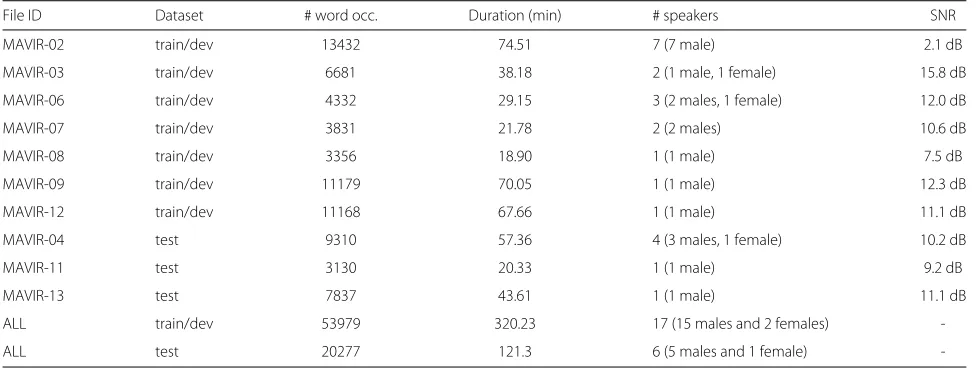
The speech data were originally recorded in several audio formats (PCM mono and stereo, MP3, 22.05 KHz., 48 KHz., etc.). All data were converted to PCM, 16 KHz., single channel, 16 bits per sample using SoX tool [106]. Recordings were made with the same equipment, a Digital TASCAM DAT model DA-P1, except for one recording. Different microphones were used for the different record-ings. They mainly consisted of tabletop or floor standing microphones, but in one case a lavalier microphone was used. The distance from the mouth of the speaker to the microphone varies and was not particularly controlled, but in most cases the distance was smaller than 50 cm. All the speech contain real and spontaneous speech of MAVIR workshops in a real setting. Thus, the record-ings were made in large conference rooms with capacity for over a hundred people and a large amount of people in the conference room. This poses additional challenges including background noise (particularly babble noise) and reverberation. The realistic settings and the differ-ent nature of the spontaneous speech in this database make it appealing and challenging enough for our eval-uation. Table 1 includes some database features such as the number of word occurrences, duration, and signal-to-noise ratio (SNR) [107] of each speech file in the MAVIR Spanish database.
Training/development data amount to about 5 h of speech extracted from 7 out of the 10 speech files of the MAVIR Spanish database and contain 15 male and 2 female speakers. This material was made avail-able to the participants including the orthographic tran-scription and the timestamps for phrase boundaries [108]. However, there is no constraint in the amount of training/development data beyond the MAVIR corpus that can be employed to build the systems. The train-ing/development term list consists of 346 terms. Each term can be composed of a single word or multiple words and its length varies between 5 and 25 phonemes. Ground truth labels and evaluation tools were provided to the participants by the date of the release. There are 4192 occurrences of those terms in the training/development data. Table 2 includes information related to the train-ing/development term list, and Fig. 2 shows the histogram with the number of terms that contain a certain number of phonemes.
Table 1MAVIR database characteristics. “train/dev” stands for training/development, “occ.” stands for occurrences, “min” stands for minutes, “SNR” for signal-to-noise ratio, and “dB” for decibels
File ID Dataset # word occ. Duration (min) # speakers SNR
MAVIR-02 train/dev 13432 74.51 7 (7 male) 2.1 dB
MAVIR-03 train/dev 6681 38.18 2 (1 male, 1 female) 15.8 dB
MAVIR-06 train/dev 4332 29.15 3 (2 males, 1 female) 12.0 dB
MAVIR-07 train/dev 3831 21.78 2 (2 males) 10.6 dB
MAVIR-08 train/dev 3356 18.90 1 (1 male) 7.5 dB
MAVIR-09 train/dev 11179 70.05 1 (1 male) 12.3 dB
MAVIR-12 train/dev 11168 67.66 1 (1 male) 11.1 dB
MAVIR-04 test 9310 57.36 4 (3 males, 1 female) 10.2 dB
MAVIR-11 test 3130 20.33 1 (1 male) 9.2 dB
MAVIR-13 test 7837 43.61 1 (1 male) 11.1 dB
ALL train/dev 53979 320.23 17 (15 males and 2 females)
-ALL test 20277 121.3 6 (5 males and 1 female)
-and 23 phonemes. No ground truth labels correspond-ing to the test data were given to the participants until the organizers have sent them back the evaluation results. There are 2054 occurrences of the test terms in the test data. Table 3 includes information related to the
Table 2Twenty most and less occurrence terms of the training/development term list along with the number of phonemes (# phonemes) and the number of occurrences in the training/development data
Term # occurrences Term # occurrences
(# phonemes) (# phonemes)
Información (11) 153 mercurio (8) 1
También (7) 113 música pop (9) 1
Mercado (7) 111 mystic (6) 1
Internet (8) 74 nostradamus (11) 1
Empresas (8) 71 pacífico (8) 1
Importante (10) 69 patagonia (9) 1
Ustedes (7) 66 real alcázar (11) 1
Investigación (13) 52 reino unido (10) 1
Momento (7) 50 repsol (6) 1
Imágenes (8) 46 salamanca (9) 1
Simplemente (11) 46 sudamérica (10) 1
General (7) 43 suecia (6) 1
Motores (7) 43 taiwán (6) 1
Noventa (7) 39 torres quevedo (11) 1
Primero (7) 39 valencia (8) 1
Después (7) 38 venezuela (9) 1
Utilizar (8) 38 verity (6) 1
Siempre (7) 36 windows mobile (13) 1
Trabajo (7) 36 zaragoza (8) 1
Proyectos (9) 34 zurich (5) 1
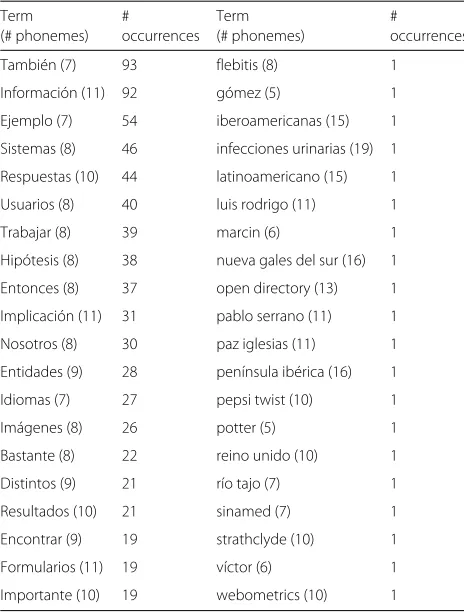
test term list, and Fig. 3 shows the histogram with the number of terms that contain a certain number of phonemes.
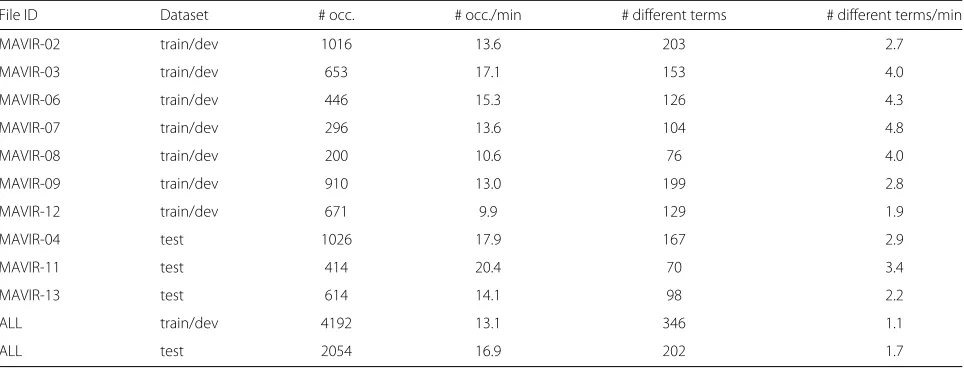
Table 4 includes some information related to the train-ing/development and test data files used in the evaluation such as the number of term occurrences and the aver-age number of term occurrences per minute, the number of different terms, and the average number of different terms and their occurrences per minute. It must be noted that, although the length of the speech data used for train-ing/development is greater than that of the test data, the average number of occurrences per minute in both sets is similar.
0 5 10 15 20 25 30 0
10 20 30 40 50 60 70 80
Term length
Number of terms
Fig. 2Histogram of the training/development term list. Histogram of the number of terms in the training/development term list with respect to the term length (in phonemes)
Comparison to other evaluations
In the last years, several evaluations in the field of spo-ken term detection have taspo-ken place. In this section, we review the former evaluations mainly to highlight the differences with the evaluation presented in this paper. The National Institute of Standards and Technology of the USA organized in 2006 the NIST STD evaluation
Table 3Twenty most and less occurrence terms of the test term list along with the number of phonemes (# phonemes) and the number of occurrences in the test data
Term # Term #
(# phonemes) occurrences (# phonemes) occurrences
También (7) 93 flebitis (8) 1
Información (11) 92 gómez (5) 1
Ejemplo (7) 54 iberoamericanas (15) 1
Sistemas (8) 46 infecciones urinarias (19) 1
Respuestas (10) 44 latinoamericano (15) 1
Usuarios (8) 40 luis rodrigo (11) 1
Trabajar (8) 39 marcin (6) 1
Hipótesis (8) 38 nueva gales del sur (16) 1
Entonces (8) 37 open directory (13) 1
Implicación (11) 31 pablo serrano (11) 1
Nosotros (8) 30 paz iglesias (11) 1
Entidades (9) 28 península ibérica (16) 1
Idiomas (7) 27 pepsi twist (10) 1
Imágenes (8) 26 potter (5) 1
Bastante (8) 22 reino unido (10) 1
Distintos (9) 21 río tajo (7) 1
Resultados (10) 21 sinamed (7) 1
Encontrar (9) 19 strathclyde (10) 1
Formularios (11) 19 víctor (6) 1
Importante (10) 19 webometrics (10) 1
[22]. The data contained speech in English, Mandarin Chinese, and Modern Standard and Levantine Arabic. In this evaluation, the nature of the speech included conversational telephone speech (CTS), broadcast news (BNews) speech, and speech recorded in roundtable meet-ing rooms (RTMeet) with distantly placed microphones (this last type is used only for English). Of the three dif-ferent types of speech, the last one is the most similar to the nature of the speech in our evaluation, although there are some differences in terms of the size of the room, larger in our case, which has a negative impact on the system performance due to the reverberation; also, the use of amplification of the audio in the conference rooms is not present in the case of a roundtable meet-ing. The NIST STD 2006 evaluation results are publicly available [109], and are a very interesting result to ana-lyze the influence of the language and the nature of speech on STD results. Table 6 presents the best results obtained by the evaluation participants for each condition. With respect to the type of speech, it is clear from Table 6 that results using microphone speech, particularly distant microphones in less controlled settings than in audiovi-sual studios (such as in broadcast news) or close-talking conversational telephone data, are definitely much more limited. With respect to the language, English is the lan-guage with more resources and for which more research has been done so far. When applying similar technology to languages for which less specific research has been conducted, performance decreases are observed.
0 5 10 15 20 25 0
10 20 30 40 50 60 70 80
Term length
Number of terms
Fig. 3Histogram of the test term list. Histogram of the number of terms in the test term list with respect to the term length (in phonemes)
surprise language that was announced only a few (4 or less) weeks before the evaluation. Best performance in
the NIST Open KWS 2013 evaluation is ATWV=0.6248
[110] under the Full Language Pack (FullLP) condition, for which 20 h of word-transcribed scripted speech, 80 h of word-transcribed CTS, and a pronunciation lexicon were given to participants. In the works describing systems on the surprise language (i.e., Tamil) of the Open KWS 2014 evaluation [53, 92, 94, 111–117], ATWV=0.5802 is the best performance obtained under the FullLP condition, for which 60 h of transcribed speech and a pronunciation lexicon were given to participants.
In our evaluation, the audio contains microphone recordings of real talks in real workshops, in large con-ference rooms with public. Microphones, concon-ference rooms, and even recording conditions change from one recording to another. Microphones are not close-talking microphones but mainly tabletop and ground standing microphones. This difference in the evaluation conditions
makes our evaluation pose different challenges and makes it difficult to compare the results obtained in our evalua-tion to those of the previous NIST STD evaluaevalua-tions.
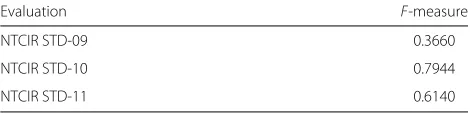
Additionally, a new round of STD evaluations has been organized within NTCIR conferences [23, 28, 29]. Data used in these evaluations contained spontaneous speech in Japanese provided by the National Institute for Japanese language and spontaneous speech recorded during seven editions of the Spoken Document Processing Workshop. These evaluations also provide the manual transcription of the speech data and the output of an LVCSR system to the participants. Table 7 presents the best result obtained in each individual evaluation, where theF-measure was used as the evaluation metric. Although our evaluation could be similar in terms of speech nature to these NTCIR STD evaluations (speech recorded in real work-shops), we do not provide any kind of information apart from the speech content, the list of terms, and the train-ing/development ground-truth files to the participants.
Table 4MAVIR training/development and test data file characteristics. “train/dev” stands for training/development, “occ.” stands for occurrences, and “min” stands for minutes
File ID Dataset # occ. # occ./min # different terms # different terms/min
MAVIR-02 train/dev 1016 13.6 203 2.7
MAVIR-03 train/dev 653 17.1 153 4.0
MAVIR-06 train/dev 446 15.3 126 4.3
MAVIR-07 train/dev 296 13.6 104 4.8
MAVIR-08 train/dev 200 10.6 76 4.0
MAVIR-09 train/dev 910 13.0 199 2.8
MAVIR-12 train/dev 671 9.9 129 1.9
MAVIR-04 test 1026 17.9 167 2.9
MAVIR-11 test 414 20.4 70 3.4
MAVIR-13 test 614 14.1 98 2.2
ALL train/dev 4192 13.1 346 1.1
Table 5Training/development and test term list characteristics. “train/dev” stands for training/development, “IN-LANG” refers to in-language terms, “OUT-LANG” to foreign terms, “SINGLE” to single-word terms, “MULTI” to multi-word terms, “INV” to in-vocabulary terms, “OOV” to out-of-vocabulary terms, and “occ.” stands for occurrences
Term list # IN-LANG/OUT-LANG # SINGLE/MULTI # INV/OOV terms (occ.) terms (occ.) terms (occ.)
Train/dev 330 (4061)/16 325 (4166)/21 346 (4192)/0
(131) (26) (0)
Test 189 (2020)/13 185 (2032)/17 150 (1840)/52
(34) (22) (214)
In addition, our evaluation makes use of other lan-guage, employs a larger list of terms, and defines disjoint training/development and test term lists to measure the generalization capability of the systems. The evaluation presented here is, to the best of our knowledge, the first STD evaluation that deals with the Spanish language.
Participants
Six different systems were submitted from four dif-ferent research groups to the spoken term detection ALBAYZIN 2014 evaluation. Participants are listed in Table 8. About 3 months were given to the participants for system development, and hence the STD evaluation focuses on building STD systems in limited time. The training/development and test data were released to the participants in different periods. Training/development data (i.e., training/development speech data, train-ing/development term list, traintrain-ing/development ground-truth labels, orthographic transcription and timestamps for phrase boundaries in the training/development speech data, and evaluation tools) were released at the end of June 2014. The test data (i.e., test speech data and test term list) were released at the beginning of September 2014. The final system submission was due at the end of September 2014. Final results were discussed at IberSPEECH 2014 conference at the end of November 2014.
Additional considerations for the STD evaluation design
The first STD evaluation, which was born in 2006 and was held by NIST [22], aimed at finding a set of terms within
Table 6Best performance (in terms of actual term weighted value, ATWV) obtained by the different participants of the NIST STD 2006 evaluation in the different conditions: “CTS” stands for conversational telephone speech, “BNews” for broadcast news, and “RTMeet” for speech recorded in roundtable meeting rooms
Language CTS BNews RTMeet
English 0.8335 0.8485 0.2553
Arabic 0.3467 -0.0924 N/A
Mandarin 0.3809 N/A N/A
Table 7Best performance (in terms ofF-measure) obtained by the different participants in the NTCIR STD evaluations
Evaluation F-measure
NTCIR STD-09 0.3660
NTCIR STD-10 0.7944
NTCIR STD-11 0.6140
huge audio archives. In 2000, Garofolo claimed that the information extraction in large audio repositories was a solved problem by means of the LVCSR systems [118]. In this way, a search of the terms of interest within their out-put would be enough for practical applications. However, these LVCSR systems suffer from the OOV problem, since OOV terms are impossible to retrieve by standard LVCSR systems. In addition, Logan showed that about 10 % of the user queries to a spoken information retrieval system contain OOV terms [119]. Therefore, it is reasonable that STD evaluations focus on OOV term detection. Our eval-uation also considers the OOV term detection in a great extent, by incorporating some terms that do not appear in the training/development speech data to the test term list. The systems need to deal with these OOV terms so that the final performance is not degraded. On the one hand, they can incorporate these OOV terms to their LVCSR system vocabulary, in case significant amount of training/development material is obtained from external sources (e.g., web, newspapers, broadcast news, etc.). Oth-erwise, systems must rely on some other approach (e.g., subword-unit ASR) to retrieve them. Moreover, by incor-porating INV and OOV terms in the test term list, orga-nizers greatly encouraged the participants to build hybrid systems from the combination of word- and subword unit-based STD systems. Since both phone and syllable sets in Spanish language are well defined [120], these two types of subword units can effectively deal with the OOV terms. The MAVIR database chosen for the evaluation con-sists of highly spontaneous speech from real workshops. Given this database condition, there is an inherent diffi-culty for term detection. In addition, STD and, in gen-eral, ASR systems significantly degrade their performance when training/development data belong to a different
Table 8Participants in the spoken term detection ALBAYZIN 2014 evaluation along with the systems submitted
Team ID Research institution Systems
GTM AtlantTIC Research Center, Fusion, WL-Kaldi University of Vigo, Spain
GTH University Politécnica W1B-HTK
of Madrid, Spain
ATVS-GEINTRA University Autónoma of WL-ATWV-Kaldi, Madrid - University of Alcalá, Spain WL-WER-Kaldi
domain or pose different acoustic conditions to those of the test data. To alleviate this problem in the STD evaluation, organizers paid special attention in preparing limited training/development data from the same domain and withsimilaracoustic conditions (microphone speech from workshops) to that of the test data. This mate-rial could be used by the participants to train and tune their systems (see “Database” section). However, it must be noted that different microphones were used for each recorded file in the MAVIR database, and hence the acoustic conditions slightly vary from one file to another. Moreover, the limited training/development data, which amount to 5 h of speech, adds another challenge to the evaluation, aiming at building STD systems with limited data that match the test data conditions.
Systems
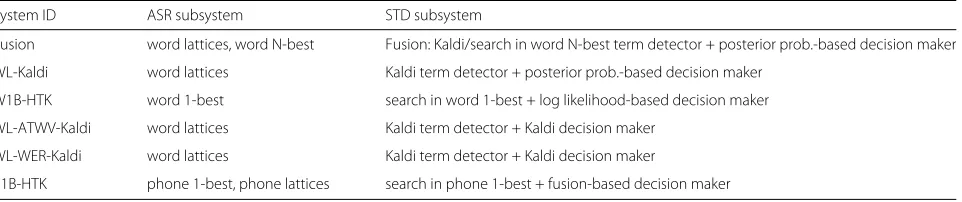
In this section, we describe the systems submitted to the STD evaluation. The systems appear in the same order that they are ranked in Tables 9–17. A summary of the systems is presented in Table 9.
Fusion-based STD system (fusion)
This system consists of the fusion of two different LVCSR-based STD systems, as depicted in Fig. 4; specifically, Kaldi-based and UVigo LVCSR-based STD systems were developed, which are described next.
Kaldi-based STD system
The Kaldi-based STD system comprises two different sub-systems, as depicted in Fig. 5: An ASR subsystem is used to decode the speech utterances into word lattices; an STD subsystem integrates a term detector that searches for the input terms within the word lattices and a decision maker that ascertains reliable detections.
The ASR subsystem employs the Kaldi speech recog-nizer [68] to obtain word lattices from the input wave-forms. Thirteen-dimensional PLP coefficients were used as acoustic features, and a state-of-the-art maximum likelihood (ML) acoustic model training strategy was employed. This training starts with a flat-start initializa-tion of context-independent phonetic HMMs and ends with a speaker adaptive training (SAT) of state-clustered
triphone HMMs with GMM output densities. After the ML-based acoustic model training stage, a universal back-ground model (UBM) is built from speaker-transformed training data, which is next used to train an SGMM employed in the decoding stage to generate the word lattices.
The aforementioned acoustic models were trained using the Spanish data from 2006 TC-STAR automatic speech recognition evaluation campaign [121]. Specifically, the training data from the European Parliamentary Plenary Sessions (EPPS) and the Spanish Parliament Sessions, which were manually transcribed, were used for acoustic model training [122]. All the non-speech parts, the speech parts corresponding to transcriptions with pronunciation errors, incomplete sentences, and short speech utterances from the speech data were discarded. The training data amount to about 79 h of speech.
The language model (LM) was trained using a text database of 160 million words extracted from several sources: transcriptions of the European and Spanish Parliaments of the TC-STAR database, subtitles, books, newspapers, online courses, and the transcriptions of the MAVIR sessions included in the training/development data provided by the organizers [123]. For development experiments, a different LM was created for each MAVIR session, using the transcription of the session to obtain the optimum mixture of the partial LMs. The LM and the corresponding vocabulary created from all the train-ing/development data files except one were then used to compute the detections of that file in a leave-one-out strategy. For the test data, the LM was generated using a normalized average of the weights obtained from the development sessions. It must be noted that the vocabu-lary was selected at the last stage of the LM training, once the partial LMs and their weights were computed. A tri-gram word LM trained with a vocabulary of 60k words and a Kneser-Ney discount strategy was used for the ASR subsystem.
The STD subsystem integrates the Kaldi term detector [68–70], which searches for the input terms within the word lattices obtained in the previous step. The lattice indexing technique, described in [124], first converts the word lattices of all the utterances in the speech data from
Table 9System summary in terms of the ASR subsystem and STD subsystem employed. “prob.” stands for probability
System ID ASR subsystem STD subsystem
Fusion word lattices, word N-best Fusion: Kaldi/search in word N-best term detector + posterior prob.-based decision maker
WL-Kaldi word lattices Kaldi term detector + posterior prob.-based decision maker
W1B-HTK word 1-best search in word 1-best + log likelihood-based decision maker
WL-ATWV-Kaldi word lattices Kaldi term detector + Kaldi decision maker
WL-WER-Kaldi word lattices Kaldi term detector + Kaldi decision maker
Fig. 4Architecture of the fusion system
individual WFSTs to a single generalized factor trans-ducer structure that stores the start-time, end-time, and the lattice posterior probability of each word token as a three-dimensional cost. This factor transducer represents an inverted index of all the word sequences contained in the lattices. Thus, given a search term, a simple finite state machine that accepts the term is created and com-posed with the factor transducer in order to obtain all the occurrences of the term in the speech data. The posterior probabilities of the lattice corresponding to all the words of the search term are accumulated, assigning a confi-dence score to each detection. The decision maker simply removes those detections with a confidence score below a predefined threshold.
The Kaldi spoken term detection system [68–70] han-dles OOV term search by means of a method calledproxy
words[71]. This method essentially consists of
substitut-ing each OOV word of the search term with acoustically similar INV proxy words, getting rid of the need of a subword-based system for OOV term search. However, this method was not used within this system, causing those terms containing any OOV words not to be detected at all.
The entire Kaldi-based STD system (both ASR and STD subsystems) was run on training/development data for parameter tuning, with the leave-one-out strategy explained before for LM building in the ASR subsystem. Next, the optimal parameters were used to hypothesize the detections corresponding to the test data.
UVigo LVCSR-based STD system
The UVigo LVCSR-based STD system is composed of two different subsystems, as depicted in Fig. 6: the ASR subsystem, which employs the UVigo LVCSR system [122], is used to decode the speech utterances in terms
of word N-best hypotheses; the STD subsystem integrates a term detector that first obtains word meshes from the N-best hypotheses and then searches for the term within these word meshes, and a decision maker that ascertains reliable detections.
The UVigo LVCSR system comprises three different stages: audio segmentation, acoustic model selection, and ASR decoding. Thirteen MFCCs augmented with their delta and acceleration coefficients were used as acoustic features.
On the first stage, the audio is segmented (i.e., the input speech files are divided into more manageable speech seg-ments). This segmentation is carried out by combining the output of the speaker segmentation strategy described in [125] with an energy-based voice activity detector (VAD). The speaker segmentation strategy divides the input audio signal into speech and non-speech segments, and speech segments are also divided into shorter segments according to their speaker. The energy-based VAD is then applied on these speaker-homogeneous segments in order to detect silence intervals, dividing each speaker turn into shorter chunks.
On the second stage, acoustic model selection is per-formed. Given a speech segment, the UVigo decoder [126] is used to conduct phone recognition using different sets of acoustic models to obtain a likelihood for each set. The set of acoustic models that obtained the highest like-lihood was chosen, as it was considered to be the most suitable for decoding the corresponding speech segment. The set of acoustic models consists of 24 two-state demi-phone acoustic models. Fourteen of the acoustic models were trained using the TC-STAR data described before, and they consist of independent and gender-dependent acoustic models obtained from different par-titions of the data. The remaining acoustic models were
Fig. 6Architecture of the UVigo LVCSR-based STD system of the fusion system. “utt.” stands for utterance
obtained by adapting the TC-STAR models from differ-ent combinations of MAVIR training/developmdiffer-ent speech data.
The third stage employs the UVigo decoder to extract N-Best hypotheses for each speech segment; this decoder uses the token-passing algorithm with language model look-ahead and an A* stack strategy-based N-Best re-scoring [126]. It must be noted that the acoustic model used for decoding is that selected in the acoustic model selection stage. As language model, the system employs the same as the Kaldi-based STD system.
The STD subsystem takes the word N-Best hypotheses produced by the LVCSR system as input for the lattice tool of the SRI-LM toolkit [127] and converts them to word meshes with posterior probabilities. Next, a search of the given term within the word mesh produces the term detections and outputs a posterior probability as score for each detection. The decision maker simply removes those detections whose posterior probability remains below a predefined threshold.
It must be noted that terms that do not appear in the LVCSR system vocabulary cannot be detected with this system.
As in the Kaldi-based STD system, the entire system was run on training/development data for parameter tuning. The optimal parameter set is next applied on test data.
System fusion
System fusion combines the output of the two systems described above to produce a more discriminative and better-calibrated score for each detection, aiming at taking advantage of the strengths of the individual approaches [128]. First, the optimal operating point was calculated on training/development data and applied to each individual system. After this, a global minimum zero-mean and unit-variance normalization was applied to prevent the scores of the individual systems to be in different ranges and to obtain term-independent scores. Finally, Bosaris toolkit
[129] was used to construct a fusion scheme based on logistic regression; this procedure results in a new score for each detection, which is used by the decision maker of this system to output the final detections. The overlapping detections, i.e., detections of different terms on the same time interval, were removed by keeping the search term with the highest score.
Word lattice-based Kaldi STD system (WL-Kaldi)
This system is the Kaldi-based STD system described in the fusion system.
Word 1-best-based HTK STD system (W1B-HTK)
This system comprises two different subsystems, as depicted in Fig. 7: The ASR subsystem consists of an LVCSR system that produces a 1-best word sequence for each speech file. The STD subsystem consists of a word-based term detector and a decision maker that outputs reliable detections.
The ASR subsystem is built from the HTK tool [83]. First, the VAD of the Voicebox [130] tool is applied to segment the speech signal into speech segments. These speech segments are next decoded by the HTK tool to produce a 1-best word sequence as output. The ASR subsystem employs 39-dimensional PLP coefficients as acoustic features and three-state cross-word triphone models as acoustic models. The acoustic models have been trained from the Spanish partition of the EPPS cor-pus, which amounts to about 99 h of speech [131], and all the training/development data provided by the organizers except the MAVIR-02, MAVIR-07, and MAVIR-09 speech files. MAVIR-07 speech file was used as development file for parameter tuning, and the two other speech files were removed from the acoustic model training material since the STD performance on that development file degrades when both were used for acoustic model training. In total, about 101.5 h of speech were employed for acoustic model training. As a language model, a word trigram LM has
been employed. The LM was trained with the SRI-LM toolkit [127] from different text sources: (1) the Span-ish Parliament partition (PARL) of the EPPS corpus used to train the acoustic models, which amounts to 17.5k words, (2) the training/development data provided by the organizers which amount to 5k words, and (3) data cor-responding to different web pages whose topic relates to that of the MAVIR corpus (sentiment analysis, data crawl-ing, etc.), and through web pages related to companies mentioned in the training/development data (daedalus, bitext, isoco, etc.), which amount to 7.2k words. In total, a vocabulary of 30k words has been used for LM training.
The STD subsystem comprises an edit distance-based term detector, which treats the term search in one way or another depending on the number of words the term consists of, and a decision maker that ascertains reliable detections. For term detection, an exact match in the 1-best word sequence is conducted in case the term is composed of a single or two words. For a term composed of three or more words, this is detected in case two of its words appear in the 1-best word sequence. For single-word and double-single-word terms, the start and end times of each detection are assigned the initial time of the first word and the end time of the last word, respectively. For terms with more than two words, the start and end times of the detection consider all the words, even those that are wrongly recognized. The confidence score for each detection is the sum of the scores given by the HTK tool to all the words of the term that are correctly recog-nized, divided by the number of words that are correctly recognized.
This system does not integrate a method to handle OOV terms, and hence terms absent from the HTK-based speech recognizer vocabulary cannot be detected.
For parameter tuning, this system employed the MAVIR-07 speech file from the training/development dataset. To do so, the entire STD system was first built and next applied on this file to obtain the optimal parame-ter set of the ASR and STD subsystems. Next, the optimal parameter set is applied on the test data to hypothesize the detections of the test term list.
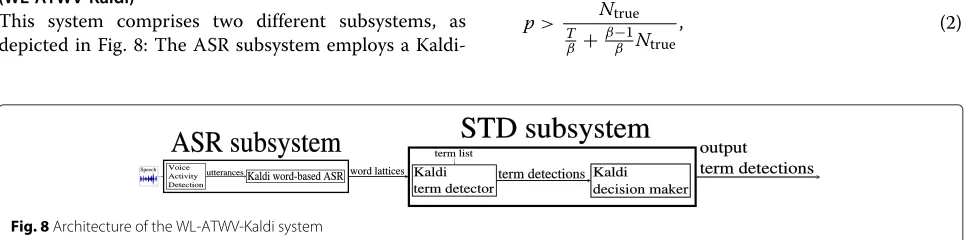
Word lattice-based Kaldi ATWV-based STD system (WL-ATWV-Kaldi)
This system comprises two different subsystems, as depicted in Fig. 8: The ASR subsystem employs a
Kaldi-based speech recognizer [68] to decode speech utterances and produce word lattices. The STD subsystem consists of the Kaldi term detector [68–70] to search for the input terms within the word lattices and the Kaldi decision maker [42] to output reliable detections.
For the ASR subsystem, a word-based speech rec-ognizer using Kaldi toolkit [68] has been constructed. First, an energy-based VAD implemented in SoX has been employed to remove non-speech segments. For word-based speech recognition, 13-dimensional MFCCs with cepstral mean and variance normalization (CMVN) applied were used as acoustic features. The normalized MFCC features then pass a splicer which augments each frame by its left and right four neighboring frames. A linear discriminant analysis is then employed to reduce the feature dimension to 40, and a maximum likeli-hood linear transform (MLLT) is applied to match the diagonal assumption in GMM. These acoustic modeling training stages were chosen to maximize ATWV perfor-mance on training/development data. As acoustic mod-els, context-dependent phone GMM/HMMs were trained with the training part of the Fisher Spanish corpus (about 268 h of conversational telephone speech) and the train-ing/development data provided by the organizers (about 5 h of speech). For English words that appear in the Fisher Spanish corpus, a letter-to-sound module has been used to build the phone transcription of these words using Spanish phones. In total, about 273 h of speech have been used for acoustic model training. These acoustic models were augmented with some non-speech events present in the Fisher Spanish corpus-like background noise, laugh, breath, cough, sneeze, and lip-smack events, which were modeled as context-independent acoustic models. As a language modeling, a word trigram trained with a vocab-ulary of 30k words has been employed. This language model has been trained from the same data used to train the acoustic models.
The STD subsystem integrates the Kaldi term detector [68–70], as described in the fusion system, and the Kaldi decision maker [42]. This decision maker conducts the YES/NO decision for each detection based on the confi-dence score computed according to Eq. 2:
p> T Ntrue
β +β−β1Ntrue
, (2)
wherepis the confidence score of the detection,Ntrueis
the sum of the confidence score of all the detections of the given term,β is set to 999.9, and T is the length of the audio in seconds.
This system does not incorporate any mechanism to deal with the OOV terms.
This system employed all the training/development data for ASR subsystem training. Therefore, the parameter tuning was carried out as follows: First, the ASR subsys-tem was trained (acoustic and language models) with the Fisher Spanish corpus and five training/development files of the training/development data (all except MAVIR-02 and 03). These two files (02 and MAVIR-03) were used for parameter tuning. Therefore, the entire STD system was run on MAVIR-02 and MAVIR-03 speech files and the optimal parameter set was obtained, including the type of acoustic models to use, which was chosen to maximize ATWV performance. This param-eter set, along with the acoustic models, were finally used to hypothesize detections of the test term list. It must be noted that, as explained before, all the train-ing/development data were used for acoustic and language model training in the ASR subsystem of the final system submitted. This aimed at building a more robust set of models for the evaluation.
Word lattice-based Kaldi WER-based STD system (WL-WER-Kaldi)
This system is the same as the WL-ATWV-Kaldi, with the only difference that acoustic models were optimized for word error rate (WER) performance on Fisher Spanish data. Acoustic modeling also includes maximum like-lihood linear regression (MLLR) and speaker adaptive training (SAT) to improve model robustness. In addition, a discriminative training approach based on the maxi-mum mutual information (MMI) criterion was employed to produce the final acoustic models used in the ASR subsystem.
Phone 1-best-based HTK STD system (P1B-HTK)
This system comprises two different subsystems, as depicted in Fig. 9: The ASR subsystem consists of a phone-based speech recognizer that decodes the speech utterances to generate phone lattices and 1-best phone
sequences. The STD subsystem consists of a phone 1-best-based term detector and a fusion-based decision maker to output reliable detections.
The ASR subsystem is an HTK-based phone recogni-tion system [83] (and therefore, not a word-based ASR system as the rest of the systems described before), which produces a phone lattice and a 1-best phone sequence for each speech file. The ASR subsystem employs 39-dimensional MFCCs as acoustic features with cepstral mean compensation and histogram equalization applied. Three-state context-dependent phone models have been trained from different speech sources: (1) the noise-free phonetically-balanced data of the ALBAYZIN database [132], which amount to 12.8 h of speech, (2) the close-talk microphone speech data from Speech-Dat-Car database [133], which amount to 18.85 h of speech, (3) data recorded with the close talk microphone and one of the lapel microphones of the Domolab database [134], which amount to 9.33 h of speech, and (4) data corresponding to the Spanish parliament sessions of the TC-STAR database [135], which amount to 111.89 h of speech. In total, about 153 h of speech have been used for acoustic model train-ing. The text transcriptions of these speech sources have been used to train the phone trigram LM with the SRI-LM toolkit [127]. In total, there are about 500k words in the text material and about 3 million phones that are finally used to train the phone trigram.
The STD subsystem employs a term detector to out-put out-putative detections from the 1-best phone sequence and a fusion-based decision maker to ascertain reliable detections. For term detection, the 1-best phone sequence is used as source text for an edit distance search. In the search, each detection could be any substring which has a phone edit distance with the search term of less than 50 % of its length. Start and end times of each detection are assigned the start time of the first phone that is cor-rectly recognized in the phone substring and the end time of the last phone that is correctly recognized in the phone substring. Detections that overlap in time are removed by keeping the best one (i.e., the one with the minimum edit distance). Once all the detections have been obtained, two different scores are assigned to each: one derived from the edit distance computed during term search, and an acous-tic confidence measure obtained from the latacous-tice. The former is computed from standard substitution, insertion,
and deletion errors in the 1-best phone sequence and nor-malized by the length of the term. To obtain the acoustic confidence measure, the following steps are conducted: (1) the lattice is determinized with HTK tool [83], (2) an acoustic mesh graph of the phone lattice is obtained using the lattice tool of the SRI-LM toolkit [127], and (3) the confidence calculated in the acoustic mesh graph is used in a modified edit distance algorithm where, instead of all costs equal to 1, the confidence of the matching phones (those that are correctly recognized in the phone lattice) with the search term are accumulated. Then, the score of a detection is the sum of the confidences of the matching phones through the acoustic mesh of the search term between the time limits where the detection resides. This score is also normalized by the length of the term. The decision maker fuses these two scores with the Bosaris toolkit, produces the final confidence score for each detection, and ascertains reliable detections.
The entire set of training/development data was employed for parameter tuning. Therefore, the whole STD system was first built, and next this was run on train-ing/development data to obtain the optimal parameter set. This optimal parameter set was next applied to hypothe-size the detections corresponding to the test data.
It must be noted that this system is based on phone ASR and hence allowing for fast search and OOV term detection.
Results and discussion
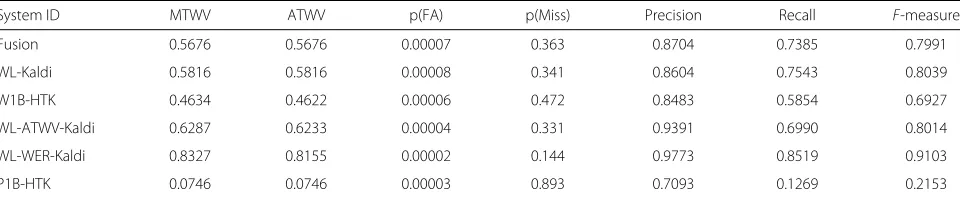
System results are presented in Tables 10 and 11 for training/development and test data respectively. They show a different behavior, in terms of result ranking. The best performance on training/development data is obtained by the WL-WER-Kaldi system, whereas the best performance on test data is obtained by the WL-Kaldi system. Paired t-tests show that the best performance of the WL-WER-Kaldi system on training/development data is statistically significant compared to the rest of the systems (p<10−10) for ATWV. This better performance is due to the use of the training/development data for acoustic and language model training, which causes this system to be clearly biased towards these data. This is con-firmed by the STD performance on training/development
data obtained by the WL-ATWV-Kaldi system, which just differs from the WL-WER-Kaldi system in a few acoustic model training techniques. However, the WL-Kaldi system does not employ the training/development data for acoustic model training, and the language model does not include the decoded sentence, hence resulting in an unbiased system towards the training/development data. On the other hand, the P1B-HTK system, which employs a phone recognition-based STD system, obtains the worst performance on both sets of data, due to the absence of lexical information in the ASR subsystem. The rest of the systems significantly outperform the perfor-mance of this P1B-HTK system for training/development data (p<10−14) and test data (p<10−4) for ATWV.
WL-ATWV-Kaldi and WL-WER-Kaldi systems obtain different result ranking on both sets of data. The lat-ter outperforms the former on training/development
data and the contrary occurs on test data. Paired t
-tests show that the better performance of the WL-WER-Kaldi system over the WL-ATWV-Kaldi system on training/development data is statistically significant (p<10−12) for ATWV, and the better performance of the WL-ATWV-Kaldi system over the WL-WER-Kaldi sys-tem is also statistically significant (p<10−5) for test data for ATWV. This is again, partially, due to the bias intro-duced in these systems with the use of the training/ development data for acoustic and language model train-ing. Although the WL-WER-Kaldi system employs more robust ASR techniques than the WL-ATWV-Kaldi sys-tem, these techniques only improved the WER of the ASR subsystem and obtained a worse STD performance on a subset of the training/development data provided by the organizers used for STD parameter tuning. This is also causing the worse performance on test data compared with the WL-ATWV-Kaldi system.
This difference in result ranking is also observed for W1B-HTK and WL-ATWV-Kaldi systems. On train-ing/development data, the WL-ATWV-Kaldi system is biased towards these data (in terms of acoustic model and language model training), and hence better performance is obtained. This improvement on training/development data is statistically significant (p< 10−9) for ATWV for
a paired t-test. However, the W1B-HTK system, which
Table 10Results of the STD ALBAYZIN 2014 evaluation on training/development data
System ID MTWV ATWV p(FA) p(Miss) Precision Recall F-measure
Fusion 0.5676 0.5676 0.00007 0.363 0.8704 0.7385 0.7991
WL-Kaldi 0.5816 0.5816 0.00008 0.341 0.8604 0.7543 0.8039
W1B-HTK 0.4634 0.4622 0.00006 0.472 0.8483 0.5854 0.6927
WL-ATWV-Kaldi 0.6287 0.6233 0.00004 0.331 0.9391 0.6990 0.8014
WL-WER-Kaldi 0.8327 0.8155 0.00002 0.144 0.9773 0.8519 0.9103
Table 11Results of the STD ALBAYZIN 2014 evaluation on test data
System ID MTWV ATWV p(FA) p(Miss) Precision Recall F-measure
Fusion 0.4872 0.4868 0.00003 0.483 0.9666 0.6207 0.7560
WL-Kaldi 0.5451 0.5350 0.00008 0.374 0.9104 0.7473 0.8209
W1B-HTK 0.2026 0.1980 0.00016 0.642 0.7981 0.4927 0.6093
WL-ATWV-Kaldi 0.2018 0.1972 0.00007 0.731 0.8829 0.3194 0.4691
WL-WER-Kaldi 0.1389 0.1316 0.00003 0.828 0.8498 0.2561 0.3936
P1B-HTK 0.0391 0.0297 0.00004 0.917 0.7275 0.1222 0.2093
employs more sources that augment the variability in lan-guage model training and less training/development data for acoustic model training, results in a less biased system towards the training/development data. This causes sim-ilar performance for W1B-HTK and WL-ATWV-Kaldi systems on test data at the ATWV operating point. More-over, for test data, the performance gap between both systems is not statistically significant (p≈0.9) for ATWV. WL-Kaldi system performs the best on test data. This is due to two reasons: (1) it has the most robust ASR sub-system of those presented by the participants in terms of ASR techniques (SGMM for acoustic modeling), the type of the speech data (spontaneous speech) used for acoustic model training is very similar to that of the eval-uation files, and the text material used for language model training comes from a large variety of text sources. (2) All the test terms were included within the ASR subsys-tem vocabulary, hence getting rid of the OOV term issue. Table 12 shows the OOV rate of the systems (i.e., the number of test terms that do not appear in the ASR sub-system vocabulary), which shows that the OOV rate plays an important role in system performance. Pairedt-tests show that the best performance of the WL-Kaldi system is statistically significant compared to the rest of the systems (p<10−9) except the fusion system for ATWV. The fusion of this WL-Kaldi system with the other system presented in the fusion system yields the worse STD performance than the best system in isolation (WL-Kaldi system). This performance gap is statistically significant for a pairedt -test (p<10−2) for ATWV. This suggests that a better fusion strategy is necessary.
Table 12OOV rate of the word-based systems on test data. The P1B-HTK system is not presented in this table since it employs phone-based ASR
System ID OOV rate (%)
Fusion 0 %
WL-Kaldi 0 %
W1B-HTK 12.87 %
WL-ATWV-Kaldi 13.86 %
WL-WER-Kaldi 13.86 %
It can also be observed in Table 10 that some systems show a slight degradation on training/development data when MTWV and ATWV are compared. This is because of the optimal threshold in the decision maker that was calculated from a subset of the training/development data and next applied to the whole set.
In terms of theF-measure values presented in Tables 10 and 11, similar trends are observed. The systems that obtained the best performance for ATWV metric are also the best for F-measure metric, with similar signifi-cance levels. The only difference in terms of result ranking relates to WL-Kaldi and WL-ATWV-Kaldi systems on training/development data. Whereas for ATWV the WL-ATWV-Kaldi system outperforms the WL-Kaldi system,
the contrary occurs for F-measure. The improvement
obtained by the WL-ATWV-Kaldi system for ATWV is statistically significant (p< 10−2), and the improvement
obtained by the WL-Kaldi system for F-measure is not
statistically significant (p≈ 0.7). This difference in terms of system ranking is due to the different weight given to precision and recall in the ATWV andF-measure metrics. In addition, the improvement obtained by the W1B-HTK system over the WL-ATWV-Kaldi system on test data is statistically significant (p < 10−4) for F-measure. Again, the different behavior of both metrics (ATWV and
F-measure) is causing this discrepancy.