Workshop on Semantic Interpretation in an Actionable Context, NAACL-HLT 2012, pages 1–6,
Learning to Interpret Natural Language Instructions
Monica Babes¸-Vroman+, James MacGlashan∗, Ruoyuan Gao+, Kevin Winner∗ Richard Adjogah∗,Marie desJardins∗,Michael Littman+ andSmaranda Muresan++
∗ Department of Computer Science and Electrical Engineering
University of Maryland, Baltimore County +Computer Science Department, Rutgers University ++School of Communication and Information, Rutgers University
Abstract
This paper addresses the problem of training an artificial agent to follow verbal instructions representing high-level tasks using a set of in-structions paired with demonstration traces of appropriate behavior. From this data, a map-ping from instructions to tasks is learned, en-abling the agent to carry out new instructions in novel environments.
1 Introduction
Learning to interpret language from a situated con-text has become a topic of much interest in recent years (Branavan et al., 2009; Branavan et al., 2010; Branavan et al., 2011; Clarke et al., 2010; Chen and Mooney, 2011; Vogel and Jurafsky, 2010; Gold-wasser and Roth, 2011; Liang et al., 2011; Atrzi and Zettlemoyer, 2011; Tellex et al., 2011). Instead of using annotated training data consisting of sentences and their corresponding logical forms (Zettlemoyer and Collins, 2005; Kate and Mooney, 2006; Wong and Mooney, 2007; Zettlemoyer and Collins, 2009; Lu et al., 2008), most of these approaches leverage non-linguistic information from a situated context as their primary source of supervision. These ap-proaches have been applied to various tasks such as following navigational instructions (Vogel and Ju-rafsky, 2010; Chen and Mooney, 2011; Tellex et al., 2011), software control (Branavan et al., 2009; Branavan et al., 2010), semantic parsing (Clarke et al., 2010; Liang et al., 2011) and learning to play games based on text (Branavan et al., 2011; Gold-wasser and Roth, 2011).
In this paper, we present an approach to inter-preting language instructions that describecomplex multipart tasks by learning from pairs of instruc-tions and behavioral traces containing a sequence of primitive actions that result in these instructions being properly followed. We do not assume a one-to-one mapping between instructions and primitive actions. Our approach uses three main subcom-ponents: (1) recognizing intentions from observed behavior using variations of Inverse Reinforcement Learning (IRL) methods; (2) translating instructions to task specifications using Semantic Parsing (SP) techniques; and (3) creating generalized task speci-fications to match user intentions using probabilis-tic Task Abstraction (TA) methods. We describe our system architecture and a learning scenario. We present preliminary results for a simplified version of our system that uses a unigram language model, minimal abstraction, and simple inverse reinforce-ment learning.
Early work on grounded language learning used features based on n-grams to represent the natural language input (Branavan et al., 2009; Vogel and Jurafsky, 2010). More recent methods have relied on a richer representation of linguistic data, such as syntactic dependency trees (Branavan et al., 2011; Goldwasser and Roth, 2011) and semantic templates (Tellex et al., 2011) to address the complexity of the natural language input. Our approach uses a flexi-ble framework that allows us to incorporate various degrees of linguistic knowledge available at differ-ent stages in the learning process (e.g., from depen-dency relations to a full-fledged semantic model of the domain learned during training).
2 System Architecture
We represent tasks using the Object-oriented Markov Decision Process (OO-MDP) formal-ism (Diuk et al., 2008), an extension of Markov De-cision Processes (MDPs) to explicitly capture rela-tionships between objects. Specifically, OO-MDPs add a set of classesC, each with a set of attributes
TC. Each OO-MDP state is defined by an unordered set of instantiated objects. In addition to these ob-ject definitions, an OO-MDP also defines a set of propositional functions that operate on objects. For instance, we might have a propositional function
toyIn(toy, room) that operates on an object belonging to class “toy” and an object belonging to class “room,” returning true if the specified “toy” object is in the specific “room” object. We extend OO-MDPs to include a set ofpropositional function classes(F) associating propositional functions that describe similar properties. In the context of defin-ing a task corresponddefin-ing to a particular goal, an OO-MDP defines a subset of states β ⊂ S called ter-mination statesthat end an action sequence and that need to be favored by the task’s reward function.
Example Domain.To illustrate our approach, we present a simple domain calledCleanup World, a 2D grid world defined by various rooms that are con-nected by open doorways and can contain various objects (toys) that the agent can push around to dif-ferent positions in the world. The Cleanup World domain can be represented as an OO-MDP with four object classes: agent, room, doorway, and toy, and a set of propositional functions that specify whether a toy is a specific shape (such asisStar(toy)), the color of a room (such as isGreen(room)), whether a toy is in a specific room (toyIn(toy, room)), and whether an agent is in a specific room (agentIn(room)). These functions belong to shape,color,toy positionoragent positionclasses.
2.1 Interaction among IRL, SP and TA
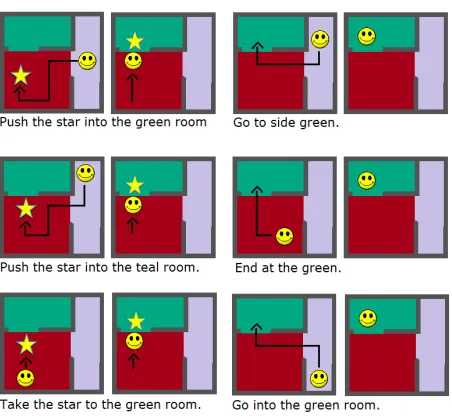
The training data for the overall system is a set of pairs of verbal instructions and behavior. For exam-ple, one of these pairs could be the instructionPush the star to the green room with a demonstration of the task being accomplished in a specific environ-ment containing various toys and rooms of different colors. We assume the availability of a set of
fea-tures for each state represented using the OO-MDP propositional functions descibed previously. These features play an important role in defining the tasks to be learned. For example, a robot being taught to move furniture around would have information about whether or not it is currently carrying a piece of furniture, what piece of furniture it needs to be moving, which room it is currently in, which room contains each piece of furniture, etc. We present briefly the three components of our system (IRL, SP and TA) and how they interact with each other dur-ing learndur-ing.
Inverse Reinforcement Learning. Inverse Re-inforcement Learning (Abbeel and Ng, 2004) ad-dresses the task of learning a reward function from demonstrations of expert behavior and information about the state-transition function. Recently, more data-efficient IRL methods have been proposed, including the Maximum Likelihood Inverse Rein-forcement Learning (Babes¸-Vroman et al., 2011) or MLIRL approach, which our system builds on. Given even a small number of trajectories, MLIRL finds a weighting of the state features that (locally) maximizes the probability of these trajectories. In our system, these state features consist of one of the sets of propositional functions provided by the TA component. For a given task and a set of sets of state features, MLIRL evaluates the feature sets and returns to the TA component its assessment of the probabilities of the various sets.
repre-sented as a conjunction of atomic predicates. For ex-ample, the representation of the phrase green room is hX1.is=green, X.P1 = X1, X.isa=roomi. The semantic representation specifies two concepts—
green and room—connected through a property that can be uninstantiated in the absence of a seman-tic model, or instantiated via the Φi constraints to the property name (e.g, color) if such a model is present.
During the learning phase, the SP component, us-ing an LWFG grammar that is learned offline, pro-vides to TA the logical forms (i.e., the semantic parses, or the unlabeled dependency parses if no se-mantic model is given) for each verbal instruction. For example, for the instructionMove the chair into the green room, the semantic parser knows initially thatmoveis a verb, chairandroomare nouns, and greenis an adjective. It also has grammar rules of the form S → Verb NP PP: Φc1,Φi1,1 but it has no knowledge of what these words mean (that is, to which concepts they map in the domain model). For this instruction, the LWFG parser returns the logical form:
h(X1.isa=move, X1.Arg1=X2)move, (X2.det=the)the,(X2.isa=chair)chair,
(X1.P1 =X3, P2.isa=into)into,(X3.det=the)the, (X4.isa=green, X3.P2=X2)green,
(X3.isa=room)roomi.
The subscripts for each atomic predicate in-dicate the word to which that prein-dicate corre-sponds. This logical form corresponds to the simplified logical formmove(chair1,room1), P1(room1,green), where predicate P1 is unin-stantiated. A key advantage of this framework is that the LWFG parser has access to the domain (seman-tic) model viaΦi constraints. As a result, when TA provides feedback about domain-specific meanings (i.e., groundings), the parser can incorporate those mappings via the Φi constraints (e.g., move might map to the predicateblockToRoomwith a certain probability).
Task Abstraction. The termination conditions for an OO-MDP task can be defined in terms of the propositional functions. For example, the Cleanup
1For readability, we show here just the context-free back-bone, without the augmented nonterminals or constraints.
World domain might include a task that requires the agent to put a specific toy (t1) in a specific room (r1). In this case, the termination states would be defined by states that satisfytoyIn(t1, r1) and the reward function would be defined as Ra(s, s0) =
{1 : toyIn(ts10, r1s0);−1 : otherwise}. However, such a task definition is overly specific and cannot be evaluated in a new environment that contains dif-ferent objects. To remove this limitation, we define abstract task descriptions usingparametric lifted re-ward and termination functions. A parametric lifted reward function is a first-order logic expression in which the propositional functions defining the re-ward can be selected as parameters. This repre-sentation allows much more general tasks to be de-fined; these tasks can be evaluated in any environ-ment that contains the necessary object classes. For instance, the reward function for an abstract task that encourages an agent to take a toy of a certain shape to a room of a certain color (resulting in a re-ward of1) would be represented asRa(s, s0) ={1 :
∃ts0∈toy∃rs0∈roomP1(t)∧P2(r)∧toyIn(t, r);−1 :
otherwise}, whereP1is a propositional function
A Learning from Scratch Scenario. Our sys-tem is trained using a set of sentence–trajectory pairs ((S1, T1), ...,(SN, TN)). Initially, the sys-tem does not know what any of the words mean and there are no pre-existing abstract tasks. Let’s assume that S1 is Push the star into the green room.This sentence is first processed by the SP com-ponent, yielding the following logical forms: L1 is push(star1, room1), amod(room1, green) and
L2ispush(star1), amod(room1, green),
into(star1, room1). These logical forms and their likelihoods are passed to the TA compo-nent, and TA induces incomplete abstract tasks, which define only the number and kinds of ob-jects that are relevant to the corresponding re-ward function. TA can send to IRL a set of features involving these objects, together with T1, the demonstration attached to S1. This set of features might include: agentTouchToy(t1),
toyIn(t1, r1),toyIn(t1, r2),agentIn(r1). IRL sends back a weighting of the features, and TA can select the subset of features that have the highest weights (e.g, (1.91, toyIn(t1, r1)), (1.12,
agentTouchToy(t1)), (0.80,agentIn(r1)). Us-ing information from SP and IRL, TA can now create a new abstract task, perhaps calledblockToRoom, adjust the probabilities of the logical forms based on the relevant features obtained from IRL, and send these probabilities back to SP, enabling it to adjust its semantic model.
The entire system proceeds iteratively. While it is designed, not all features are fully implemented to be able to report experimental results. In the next section, we present a simplified version of our sys-tem and show preliminary results.
3 A Simplified Model and Experiments
In this section, we present a simplified version of our system with a unigram language model, inverse rein-forcement learning and minimal abstraction. We call this version Model0. The input to Model0is a set of verbal instructions paired with demonstrations of appropriate behavior. It uses an EM-style algorithm (Dempster et al., 1977) to estimate the probability distribution of words conditioned on reward func-tions (the parameters). With this information, when the system receives a new command, it can behave
in a way that maximizes its reward given the pos-terior probabilities of the possible reward functions given the words.
Algorithm 1 shows our EM-style Model 0. For all possible reward–demonstration pairs, the E-step of EM estimates zji = Pr(Rj|(Si, Ti)), the prob-ability that reward functionRj produced sentence-trajectory pair(Si, Ti), This estimate is given by the equation below:
zji= Pr(Rj|(Si, Ti)) =
Pr(Rj) Pr(Si, Ti)
Pr((Si, Ti)|Rj)
= Pr(Rj) Pr(Si, Ti)
Pr(Ti|Rj)
Y
wk∈Si
Pr(wk|Rj)
where Si is the ith sentence, Ti is the trajectory demonstrated for verbal commandSi, andwk is an element in the set of all possible words (vocabulary). If the reward functionsRjare known ahead of time, Pr(Ti|Rj) can be obtained directly by solving the MDP and estimating the probability of trajectoryTi under a Boltzmann policy with respect toRj. If the
Rjs are not known, EM can estimate them by run-ning IRL during the M-step (Babes¸-Vroman et al., 2011).
The M-step in Algorithm 1 uses the current esti-mates ofzjito further refine the probabilitiesxkj = Pr(wk|Rj):
xkj = Pr(wk|Rj) = 1
X
Σwk∈SiPr(Rj|Si) +
ΣiN(Si)zji+
whereis a smoothing parameter, X is a normalizing factor andN(Si)is the number of words in sentence
Si.
Algorithm 1EM-style Model0
Input:Demonstrations{(S1, T1), ...,(SN, TN)}, number of reward functionsJ, size of vocabulary
K.
Initialize: x11, . . . , xJ K,randomly.
repeat
E Step: Compute
zji = Pr(SPr(Ri,Tj)i)Pr(Ti|Rj)Qwk∈Sixkj.
M step: Compute
xkj = X1
Σwk∈SiPr(Rj|Si)+
ΣiN(Si)zji+ .
untiltarget number of iterations completed.
Pr(SN|R1) = Qwk∈SNPr(wk|R1) = 8.6×10
−7,
Pr(SN|R2) = Qwk∈SNPr(wk|R2) = 4.1×10
−4,
and choose the optimal policy corresponding to re-ward R2, thus successfully carrying out the task. Note that R1 andR2 corresponded to the two tar-get tasks, but this mapping was determined by EM. We illustrate the limitation of the unigram model by telling the trained agent toGo with the star to green, (we label this sentence SN0 ). Using the learned parameters, the agent computes the following esti-mates:
Pr(SN0 |R1) =Q
wk∈S0NPr(wk|R1) = 8.25×10
−7,
Pr(SN0 |R2) =Qwk∈S0NPr(wk|R2) = 2.10×10
−5.
The agent wrongly chooses rewardR2 and goes to the green room instead of taking the star to the green room. The problem with the unigram model in this case is that it gives too much weight to word fre-quencies (in this case go) without taking into ac-count what the words mean or how they are used in the context of the sentence. Using the system de-scribed in Section 2, we can address these problems and also move towards more complex scenarios.
4 Conclusions and Future Work
[image:5.612.314.540.67.275.2]We have presented a three-component architecture for interpreting natural language instructions, where the learner has access to natural language input and demonstrations of appropriate behavior. Our future work includes fully implementing the system to be able to build abstract tasks from language informa-tion and feature relevance.
Figure 1: Training data for 2 tasks: Taking the star to the green room (left) and Going to the green room (right).
Acknowledgments
The authors acknowledge the support of the Na-tional Science Foundation (collaborative grant IIS-00006577 and IIS-1065195). The authors thank the anonymous reviewers for their feedback. Any opin-ions, findings, conclusopin-ions, or recommendations ex-pressed in this paper are those of the authors, and do not necessarily reflect the views of the funding organization.
References
Pieter Abbeel and Andrew Ng. 2004. Apprenticeship learning via inverse reinforcement learning. In Pro-ceedings of the Twenty-First International Conference in Machine Learning (ICML 2004).
Yoav Atrzi and Luke Zettlemoyer. 2011. Bootstrapping semantic parsers for conversations. InProceedings of the 2011 Conference on Empirical Methods in Natural Language Processing.
Monica Babes¸-Vroman, Vukosi Marivate, Kaushik Sub-ramanian, and Michael Littman. 2011. Apprentice-ship learning about multiple intentions. In Proceed-ings of the Twenty Eighth International Conference on Machine Learning (ICML 2011).
Natural Language Processing of the AFNLP: Volume 1 - Volume 1, ACL ’09.
S. R. K. Branavan, Luke S. Zettlemoyer, and Regina Barzilay. 2010. Reading between the lines: Learning to map high-level instructions to commands. In Asso-ciation for Computational Linguistics (ACL 2010). S.R.K. Branavan, David Silver, and Regina Barzilay.
2011. Learning to win by reading manuals in a monte-carlo framework. In Association for Computational Linguistics (ACL 2011).
David L. Chen and Raymond J. Mooney. 2011. Learning to interpret natural language navigation instructions from observations. In Proceedings of the 25th AAAI Conference on Artificial Intelligence (AAAI-2011)., pages 859–865.
James Clarke, Dan Goldwasser, Ming-Wei Chang, and Dan Roth. 2010. Driving semantic parsing from the world’s response. In Proceedings of the Association for Computational Linguistics (ACL 2010).
A. P. Dempster, N. M. Laird, and D. B. Rubin. 1977. Maximum likelihood from incomplete data via the EM algorithm. Journal of the Royal Statistical Society, 39(1):1–38.
Carlos Diuk, Andre Cohen, and Michael Littman. 2008. An object-oriented representation for efficient rein-forcement learning. In Proceedings of the Twenty-Fifth International Conference on Machine Learning (ICML-08).
Dan Goldwasser and Dan Roth. 2011. Learning from natural instructions. In Proceedings of the Twenty-Second International Joint Conference on Artificial In-telligence.
Rohit J. Kate and Raymond J. Mooney. 2006. Using string-kernels for learning semantic parsers. In Pro-ceedings of the 21st International Conference on Com-putational Linguistics and the 44th annual meeting of the Association for Computational Linguistics, ACL-44.
Percy Liang, Michael Jordan, and Dan Klein. 2011. Learning dependency-based compositional semantics. In Association for Computational Linguistics (ACL 2011).
Wei Lu, Hwee Tou Ng, Wee Sun Lee, and Luke S. Zettle-moyer. 2008. A generative model for parsing natural language to meaning representations. InProceedings of the Conference on Empirical Methods in Natural Language Processing, EMNLP ’08.
Smaranda Muresan and Owen Rambow. 2007. Grammar approximation by representative sublanguage: A new model for language learning. InProceedings of ACL. Smaranda Muresan. 2011. Learning for deep language
understanding. InProceedings of IJCAI-11.
Stefanie Tellex, Thomas Kollar, Steven Dickerson, Matthew Walter, Ashis Gopal Banerjee, Seth Teller, and Nicholas Roy. 2011. Understanding natural language commands for robotic navigation and
mo-bile manipulation. InProceedings of the Twenty-Fifth AAAI Conference on Articifical Intelligence.
Adam Vogel and Dan Jurafsky. 2010. Learning to follow navigational directions. InAssociation for Computa-tional Linguistics (ACL 2010).
Yuk Wah Wong and Raymond Mooney. 2007. Learn-ing synchronous grammars for semantic parsLearn-ing with lambda calculus. In Proceedings of the 45th Annual Meeting of the Association for Computational Linguis-tics (ACL-2007).
Luke S. Zettlemoyer and Michael Collins. 2005. Learn-ing to map sentences to logical form: Structured clas-sification with probabilistic categorial grammars. In Proceedings of UAI-05.