Alkaloids, Limonoids and Phenols from Meliaceae Species
Decrease Survival and Performance of Hypsipyla grandella
Larvae
Julián Pérez-Flores1*, Sanford D. Eigenbrode2, Luko Hilje-Quiroz3
1Colegio de Postgraduados-Campus Tabasco, H. Cárdenas Tabasco, México; 2PSES Department, University of Idaho, Moscow, USA; 3Centro Agronómico Tropical de Investigación y Enseñanza (CATIE), Turrialba, Costa Rica.
Email: *[email protected]
Received May 2nd, 2012; revised May 30th, 2012; accepted June 9th, 2012
ABSTRACT
Meliaceae plants are distinguished by the attack of the shootborer Hypsipyla grandella and also for the occurrence of
limonoids, alkaloids and phenolic compounds. Such compounds extracted from leaves of Meliaceae species Cedrela odorata L., Swietenia macrophylla King, Khaya senegalensis, Toona ciliata, and C. odorata grafted onto T. ciliata
plants, were tested on C. odorata leaf disks to determine their effects on survival and performance of H. grandella lar-
vae. Larval survival was assessed 2, 10 and 25 days after starting the bioassays. Leaf consumption and weight gain per larva, days to pupa and to adult stages, pupal weight and length, and moth wing appearance were assessed for larval performance. The three compounds from the four Meliaceae species and the grafted combination affected (P ≤ 0.02) lar- val leaf consumption, weight gain, time to pupa and to adult stages, wing development and larval survival of H. gran- della. Pupa weight (P = 0.78, F = 0.72, d.f. = 18,160) and length (P = 0.48, F = 0.98, d.f. = 18,160) were similar re-
gardless of the coumpound used. Limonoid reduced larval survival on the three dates of evaluation. Alkaloids decreased leaf consumption, weight gain of larvae and time needed to reach pupa and adult stages. Alkaloids from T. ciliata and
phenols from C. odorata were the best coumpounds to reduce leaf consumption and weight gain. Alkaloids from the
grafted plants caused 20% of H. grandella adults to form abnormal wings.
Keywords: Leaf Extracts; Cedrela; Swietenia; Khaya; Toona; Shootborer
1. Introduction
High-quality timber from Spanish cedar (Cedrela odo- rata L.) and mahogany (Swietenia macrophylla King) is
of major significance for economies in many neotropical countries [1]. Unfortunately, natural populations of these species are being reduced quickly due to selective har- vest [2]. In addition, the mahogany shootborer, Hyp- sipyla grandella (Zeller) (Lepidoptera: Pyralidae), has
limited their establishment in commercial plantations in Latin America, as its larva mainly feeds on apical shoots, inducing branching on the trees and rendering the timber unmarketable [3]. Larvae also can feed on fruits, leaves, bark, and root tissues.
In tree tissues internal chemicals may exert their effect in the volatile state causing an insect to avoid the tree completely, or they may deter the insect after it contacts the tree or ingests tissue [4]. Research on the biochemical basis for resistance to H. grandella in Meliaceae has
been completed on limonoids [5,6], while Gripjma [7]
indicated that the biochemical basis for resistance of
Toona ciliata (Meliaceae) may be due to alkaloids. Fur-
ther, Newton et al. [8] suggested that proantocianydins
(i.e. phenolic compounds) may reduce susceptibility of C. odorata to attack by H. grandella larvae.
The family Meliaceae stands out because of the com- mon occurrence of limonoids [9], which possess an- tifeedant, toxic, or growth-reducing properties to differ- ent species of insects [10]. Azadirachtin, the most well- known limonoid [11] was toxic to the Meliaceae´s shootborer H.grandella larvae when incorporated in diet
mixtures [7]. Such toxic effect plus growth-disruptant activity were reported by Mancebo et al. [12] for
azadirachtin. Limonoids, however, seemed unrelated to the induced resistance of C. odorata grafted onto T. ciliata against H. grandella larvae [6]; instead, these au-
thors stated that phenols (cycloartanes, catechin and proanthocyanidins) were likely responsible for such re- sistance, as all of them were absent from C. odorata sci-
ons or intact (non-grafted) plants but present in T. ciliata.
Phenols such as methylcoumarins and the furanocou-
marin bergapten have been found in T. ciliata [13],
proanthocyanidins in C. odorata [8], and the flavonoids
quercitin and kaenferol in C. odorata and T. ciliata [14].
Furanocoumarins are potent feeding deterrents to certain insect species [15], and bergapten might promote the resistance of T. ciliata against H. grandella larvae. Other
chemicals found in Meliaceae species which provide resistance against H. grandella are alkaloids. Alkaloids
are nitrogen compounds that function as plant defenses against herbivores [16] and were detected in ethanolic extracts from T. ciliata [17]. These extracts were toxic to
and reduced growth on H. grandella larvae [18]. For this
reason, alkaloid compounds could be responsible for the resistance of T. ciliata against H. grandella larvae.
Therefore, the objective of the research was to detect the effects of alkaloid, limonoid, and phenolic extracts from foliage of susceptible and resistant Meliaceae spe- cies, as well as from C. odorata grafted onto T. ciliata
plants, on H. grandella larval survival and performance.
The hypothesis to test was that the three different com- pounds from the susceptible and resistant Meliaceae spe- cies as well as from the grafted plants affect larval sur- vival and performance of the Meliaceaes shootborer.
2. Materials and Methods
2.1. Plant Material and Extract Preparation
The extracts were prepared in the Animal Nutrition Laboratory at the Tropical Agricultural Research and Higher Education Center (CATIE), in Turrialba, Costa Rica, from the susceptible Meliaceae species C. odorata
and S. macrophylla, the resistant species Khaya sene- galensis and T. ciliata as well as from C. odorata grafted
onto T. ciliata plants. Plants were grown from seeds in a
nursery at the Cabiria Experiment Station, within the premises of CATIE.
Fresh leaves and shoots (500 g) from 1-year-old plants were cut into 2 to 5 cm pieces, and then ground in liquid nitrogen to 0.05 mm in a mill (Model 3 Wiley Mill®, Thomas Co., Philadelphia). Later, the ground material was extracted with 2 L 70/30 methanol/water by volume. Extraction was completed at room temperature (20˚C) for 8 d. Each extract was filtered through Whatman paper No. 4, and the extract was concentrated to a small vol- ume (200 mL) by a rotary evaporator (40˚C) (so all methanol was removed). Each concentrate was parti- tioned among ether and dichloromethane to produce ex- tracts likely to contain predominantly alkaloids, phenols and limonoids, respectively.
Alkaloid and phenolic fractions. These compounds
were isolated by the acid-base separation method [19]. Back extraction of the ether extract with 0.5 M HCl re-moved amine bases such as alkaloids. A second
extrac-tion of the remaining ether extract with 0.5 M NaOH removed phenols, which are ionizable at high pH. The basic and phenolic compounds were recovered by ad- justing the pH of each extract to the point where the compounds were present in their uncharged forms (alka- loids, pH 11; phenols, pH 7).
Limonoid fractions. For the isolation of limonoids25
mL of crude extract were separated on a silica gel col- umn (400 mm × 8 mm, Silica Gel grade 60, 254 g gravity flow), and then eluted with dichloromethane [20]. This dichloromethane fraction was then concentrated to a small volume (50 mL) by a rotary evaporator and then used in the bioassays.
2.2. Test Insects
Hypsipyla grandella larvae for bioassays were taken
from a colony kept at the Entomology Laboratory at CATIE. The colony was established in 1998, and re- newed yearly, from field-collected larvae feeding on C. odorata. Larvae in the colony are normally fed with ten-
der C. odorata leaves from instars I-III, and then placed
onto an artificial diet [21] until pupation. Combining leaves and artificial diet ease the management of the colony. Eggs hatch hardly on diet but easily on leaves. Feeding larvae only with leaves is hard since they are so voracious that if they do not have anything to eat they eat each other. On another hand, tender leaves are scarce on dry season. Pupae are moved to a metal-framed cage covered with fine mesh, kept at a greenhouse, where adults emerge, mate, and oviposit. Eggs are collected and taken to the laboratory to sustain the colony.
Instar II larvae (4 - 8 mm length) were selected for bioassay because they are less sensitive to handling than instar I and approximate what would occur in nature re- garding initial plant attack by H. grandella larvae. Instar
II bores into the apical bud only after feeding on tender petioles and foliage [3].
2.3. Bioassays
The bioassay was completed in an environmental cham- ber Percival I35-L (Boone, Iowa) at 25 C, 80% to 90% RH, and 12:12 L:D, at the Entomology Laboratory at CATIE, from October 15 through December 6, 2005.
Cedrela odorata leaf disks were taken from plants as the
food source for rearing the H. grandella colony. Leaf
DOA-P104-AA, GAST Manufacturing Corp. Benton Harbor, Michigan), with 0.7 kg·cm−2 constant pressure. Sprayed leaf disks were allowed to dry and were placed individually, with the abaxial side up, inside a 30-mL glass vial. Then, an instar II H. grandella larva was
placed onto the leaf disk. Larvae had been deprived of food for 3 h [12]. A wet piece of paper towel was fas- tened to the lid of each vial to avoid excessive desicca- tion of leaf disks. The vial was then turned over so the larva was below the leaf disk.
2.4. Assessments
All of the larvae were weighed before and 2 d after start- ing the bioassay and then an average weight gain per larva per treatment was calculated by subtracting initial from final weight. Also after 2 d, larval survival was as- sessed and leaf consumption estimated. To estimate leaf consumption, the disk was glued to a transparent film and then overlayed onto graph paper (1 mm2 grid size) to count the leaf area eaten. Living larvae were individually transferred by means of a thin paintbrush into a vial con-taining ca. 6 mL of artificial diet [21], and then reared until adult emergence. Larval survival at 2, 10 and 25 d after starting bioassay, time (days) to achieve the pupa and adult stages, pupal weight (mg) and length (mm), and wing shape were all determined for these larvae.
Larval and pupal mortality were recorded as 0 and 1 for dead and live larvae, respectively, since just one larva was used per leaf disk. Larvae were classified as dead if they were immobile or blackened. Pupae were classified as dead if they failed to emerge after 45 days or if they appeared blackened or shriveled [12]. Data for pupa were determined 1 day after pupation. On the day of adult emergence, wing shape was recorded after wing expan- sion and drying were completed. Normal and abnormal wings were recorded as 0 and 1, respectively. Wings were considered normal when both forewings were simi- lar in length and covered the whole abdomen longitude- nally [22]. Abnormalities included absence or rudiment- tary forewings or shortened forewings exposing the ab- domen. To exclude possible effects of the artificial diet alone on these characteristics, 100 pupas were selected at random from the colony and reared to adults. None of these insects had abnormal wings.
2.5. Experimental Procedure and Statistical Analysis
The bioassay was replicated three times. Each bioassay consisted of 19 treatments: five limonoid, alkaloid and phenolic extracts with each one from the four Meliaceae species and the grafted plants, dichloromethane and ether solvents as well as larvae without leaf disk as relative
controls, and distilled water as absolute control. The ex- perimental unit was a leaf disk with one instar II H. grandella larva in a capped vial. The vials were arranged
in a completely randomized design with a factorial ar- rangement of treatments. The factors were the extract (limonoids, alkaloids and phenols) and the source of ex- tract (C. odorata, S. macrophylla, K. senegalensis, T. ciliata, and the grafted combination C. odorata onto T. ciliata). Each treatment was replicated 10 times.
Data were examined for compliance of assumptions required for analysis of variance (ANOVA). If necessary, data were transformed by Y = sqrt (Y + 0.5) to meet these assumptions. ANOVA was completed using the general lineal model (GLM) procedure [23]. Orthogonal con- trasts were used to test the effect of alkaloids, limonoids and phenols on larval survival and performance. The con-trasts were as follows: 1) alkaloids versus limonoids, 2) alkaloids versus phenols, and 3) limonoids versus phenols.
3. Results and Discussion
The three kind of compounds from leaves of the four Meliaceae species and the grafted combination affected (P ≤ 0.02) larval leaf consumption, weight gain, time to pupa and to adult stages, wing development and larval survival of H. grandella (Table 1). Pupa weight (P =
0.78, F = 0.72, d.f. = 18,160) and length (P = 0.48, F = 0.98, d.f. = 18,160) were similar regardless of the extract used.
3.1. Larval Survival
Alkaloids, limonoids and phenols affected larval survival differently (Table 1) at 2, 10 and 25 days after starting
bioassay. Fewer larvae reared on disks sprayed with li- monoids survived compared to larvae reared on disks sprayed with alkaloids or phenols similar to the neem- derived Azadirachtin [16]. These authors reported that small amounts of ingested C. odorata leaf disks dipped
in Azadirachtin 10% were enough to kill 100% of larvae in a 24 h period of exposure.
Reduction of larval survival at 2 d after starting bioas- say was most notable for limonoid extracts from K. sene- galensis, compared to alkaloids from C. odorata or from
the grafted plants and phenols from K. senegalensis or
from T. ciliata. A similar trend on larval survival was
observed at 10 and 25 d after starting bioassay; larval survival was reduced by limonoids from S. macrophylla
and K. senegalensis compared to alkaloids from S. macrophylla or from the grafted plants and also com-
pared to phenols from K. segalensis or from T. ciliata;
such reduction on larval survival by limonods was only comparable to this of larvae without leaf disk (Figure 1).
Table 1. Probability values for orthogonal contrasts and ANOVA for several variables assessed in a bioassay with Hypsipyla grandella larvae on Cedrela odorata foliar disks treated with alkaloids, limonoids and phenols extracts from Meliaceae species and a graft combination.
Days to Larval survival
Contrast
Leaf consumption
(mm2)
Weight gain
(mg) Pupa Adult
Normal
wings 2 DAS 10 DAS 25 DAS
Probabilities
Alkaloids vs limonoids 0.71 <0.0001 0.59 0.34 0.02 0.39 0.09 0.84
Alkaloids vs phenols 0.90 <0.0001 0.44 0.46 0.06 0.13 0.41 0.07
Limonoids vs phenols 0.80 0.91 0.19 0.84 0.67 0.02 0.01 0.05
ANOVA
P <0.0001 <0.0001 0.007 0.001 0.0003 <0.0001 0.0008 0.02
F 3.15 97.94 2.12 2.51 2.81 4.94 2.58 1.86
d.f. 17,162 18,171 18,161 18,154 18,153 18,171 18,170 18,170
[image:4.595.57.288.323.450.2]Abbreviations: DAS, days after starting the bioassay. Data are from three bioassays combined into one data set analysis.
Figure 1. Survival of instar II H. grandella larvae exposed for 2 d to C. odorata leaf disks treated with alkaloids, limon- oids, and phenols from four Meliaceae species and a graft combination. Data were taken 2, 10 and 25 d after starting bioassay. C = C. odorata, S = S. macrophylla, K = K. sene-galensis, T = T. ciliata, C/T = C. odorata grafted onto T. ciliata, E = Ether, D = Dichloromethane, W = Water. Data are means (n = 30) from three bioassays.
K. senegalensis or S. Macrophylla against H. grandella
larvae. Chronic toxicity on Spodopthera littoralis (Lepi-
doptera: Pyralidae) larvae was caused by extracts from
Reynoutria sp. (Polygonaceae) plants containing phenol-
lic compounds [20]. Althought S. littoralis and H. gran- della belong to the same family, they are different genera.
Also, the difference between our results and those of Pavela et al. [24] can be attributed to the kind of phenols
contained on Reynoutria and Meliaceae species.
The lowest larval survival scored (30%) was caused for limonoids from S. macrophylla (Figure 1), but this
results differed from those of Pérez et al. [25] who found
that besides causing deterrence, crude extracts from Meliaceae species, specifically the extracts from T. ciliata species, decreased up to 0% H. grandella larval
survival. Such difference seems consistent with a prob-
able sinergestic effect of multiple defenses [26]. Anyway, limonoids and phenols differed only for larval survival but not for larval performance variables (Table 1).
3.2. Larval Performance
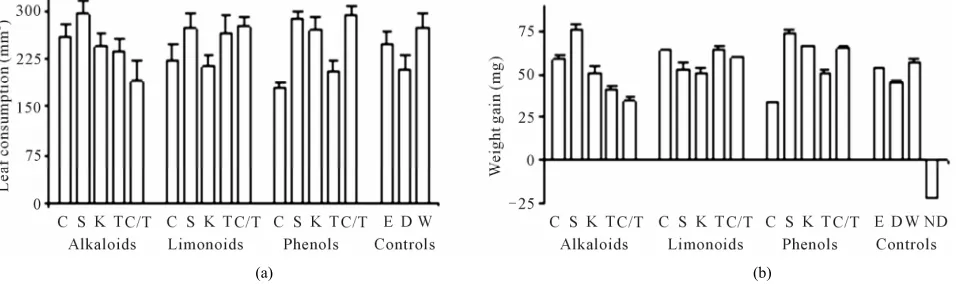
Consumed leaf area and weight gain. These variables had a direct relation when leaf disks were sprayed with li- monoid extracts (Figure 2). Although limonoids seemed
to have a phagoestimulatory effect on H. grandella larvae,
larvae weight gain was lower than the expected, or larvae died after leaf consumption. Limonoids may be found in all tissues on plants, but different plant organs may pro- duce different kinds of limonoids [10] with different ac- tion on plant protection.
The alkaloid and phenol effects depended on the plant source for leaf consumption. The alkaloids from grafted plants reduced H. grandella leaf consumption compared
to alkaloids from C. odorata or limonoids and phenols
from S. macrophylla and also compared to the control
water. In contrast, limonoid from K. senegalensis and C. odorata differed to limonoids from S. macrophylla, T. ciliata and the graft combination in their effect on leaf
consumption. Phenols from C. odorata and T. ciliata
reduced leaf consumption compared to those of the other two species and the grafted plants (Figure 2(a)).
Larval weight gain differed among larvae fed with al- kaloids. The alkaloid fraction effect on weight gain was more notable between S. macrophylla and grafted plants.
From grafted plants alkaloid fractions reduced weight gain more than phenols or limonoids (Figure 2(b)). Ex-
cept for phenols from C. odorata or T. ciliata which re-
Cedrela spp. mixed in an artificial diet showed a postdi-
gestive toxicity for Spodoptera frugiperda neonates, re-
ducing growth and causing significant mortality after rearing [20].
Although phenols differed from alkaloids on weight gain (Table 1), phenols from C. odorata and alkaloids
from the grafted plants reduced the leaf consumption by
H. grandella to the same level (Figure 2(a)). Such re-
sults caused by alkaloids from the grafted plants agree with the hypothesis suggested by Grijpma [7] about the transfer of alkaloids from T. ciliata to C. odorata to con-
fer resistance in this susceptible scion.
Time to pupa and to adult stages. All of the tested
compounds from S. macrophylla, as well as limonoids
from the grafted plants or phenols from T. ciliata, re-
duced the time to pupation by 2 and 4 d compared to water and no-disk controls, respectively; but their effect was similar to the other controls (Figure 3(a)). All of the
compounds that reduced the time to pupation, also re-
duced the time to the adult stage by a difference of 5 d compared to the no-disk control, but their effect was again similar to all the other controls and extracts from the various species (Figure 3(b)).
Alkaloids from grafted plants and limonoid from C. odorata or from K. senegalensis seemed to delay pupa-
tion compared to the other fractions (Figure 3(a)). Such
treatments and the phenols from C.odorata also seemed
to delay adulthood compared to the controls ether and dichloromethane (Figure 3(b)). However, H. grandella
larval development last about 30 d and pupation about 10 to 12 d [27], therefore the three evaluated compounds reduced time to pupa and to adult stage. Pérez et al. [25]
cited that H. grandella larvae fed leaf disks from K. senegalensis grafted onto S. macrophylla extended by 10
d both time to reach pupa and to adult stages (34.3 ± 3.8 d vs. 24.3 ± 0.5 d; and 45.2 ± 2.8 vs. 35.2 ± 1.3 d, res- pectively) compared to larvae fed C. odorata leaf disks.
Also, these authors cited that crude extracs from grafted
[image:5.595.61.539.339.481.2](a) (b)
Figure 2. Leaf consumption (a) and weight gain (b) for instar II Hypsipyla grandella larva reared on Cedrela odorata leaf disks treated with alkaloids, limonoids and phenols from four Meliaceae species and a graft combination. C = C. odorata, S = S. macrophylla, K = K. senegalensis, T = T. ciliata, C/T = C. odorata grafted onto T. ciliata, E = Ether, D = Dichloromethane, W = Water, ND = Larva without leaf disk. Data were taken 2 d after starting bioassay. Data are means (±SE, n = 30) from three bioassays.
(a) (b)
Figure 3. Time to pupa (a) and to adult (b) stages of Hypsipyla grandella larvae reared on C. odorata leaf disks treated with alkaloids, limonoids, and phenols from four Meliaceae species and a graft combination. C = C. odorata, S = S. macrophylla, K = K. senegalensis, T = T. ciliata, C/T = C. odorata grafted onto T. ciliata, E = Ether, D = Dichloromethane, W = Water, ND =
[image:5.595.60.539.553.687.2]and intact Meliaceae plants affected (P ≤ 0.05) both variables. Pavela et al. [24] observed a larval period in-
creased on neonate larvae of Spodoptera littoralis by
feeding them with diet containing different concentra- tions of crude extracts of Reynoutria sp. (Polygonaceae)
which contained phenolic compounds.
Moth wing appearance. Development of wings was
affected (P = 0.0003, F = 2.81, d.f. = 18,153) by the tested compounds. Alkaloids from grafted plants and phenols from T. ciliata caused 20% and 4% of adults
with abnormal wing shape, respectively. All larvae fed leaf disks treated with any other compound got from any other plant or the controls formed normal wings when they developed into adult moths. These results are con- sistent with those of Pérez et al. [25] who reported ab-
normal wings formed on H. grandella larvae fed leaf
disks from K. senegalensis, K. senegalensis grafted onto S. macrophylla, C. odorata grafted onto K. senegalensis,
or from S. macrophylla grafted onto K. senegalensis. The
same authors reported abnormal wings developed on one adult fed on C. odorata leaf sprayed with crude foliar
extract from C. odorata grafted onto T. ciliata. Devel-
opment disruption was reported for Locusta migratoria
due to limonoid Azadirachtin at 1 - 10 ppm in artificial diets [28].
Meliaceae plants stands out by the occurrence of li- monoids [9], but other secondary compounds such as flavonoids, alkaloids, terpenes and antraquinones have been isolated from Toona sinensis leaves [29] and re-
cently 12 phenolic compounds have been identified in this species [30]. The primary selective advantage of the production of secondary compounds on plants is protec- tion against insect herbivory. In this way, limonoids Cedrelone and Anthotecol from Toona and Khaya spp.
showed potent growth reducing activity to Spodopthera frugiperda, Heliothis zea, Pectinophora gossypiela and Ostrinia nubilalis larvae [10]. Also from the same spe-
cies, limonoids Bussein and Anthotecol inhibited ecdysis on O. nubilalis.
Taking into account that an efficient control for H. grandella is currently lacking due to the low damage
threshold of one larva per plant [31], the extracts repre- sent potentially useful raw material for developing microinjections or implants into tree stems as slow-re- lease formulas, increasing their persistence. A further step would be to identify the specific alkaloid, limonoid, and phenol that act against H. grandella in order to syn-
thesize, combine, and incorporate them in commercial products. Such products could be deployed to protect
Cedrela spp. and Swietenia spp. trees for 5 to 8 years
(critical period to H. grandella), which is the time re-
quired to achieve a commercial trunk for these species, depending on the site where they grow [32].
4. Conclusion
This study demonstrates that survival of Hypsipyla grandella larvae is affected by limonoids, specifically
those extracted from S. macrophylla and K. senegalensis.
Alkaloids reduced leaf consumption and weight gain per larva compared to limonoids and phenols and those ex- tracted from S. macrophylla were the best to reduce time
to pupa and to adult stages compared to the starved con- trol. Alkaloids from C. odorata grafted onto T. ciliata
and phenols from T. ciliata caused abnormal wing shape
on H. grandella moths. Therefore, our hypothesis that
alkaloids, limonoids and phenols from the susceptible and resistant Meliaceae species, as well as from the grafted plants, affect larval survival and performance of the Meliaceae’s shootborer was accepted.
5. Acknowledgements
J. P. F. thanks to CONACYT and the Colegio de Post- graduados (México), and the Department of Plant, Soil and Entomological Sciences at the University of Idaho (USA) for providing founds for this research.
REFERENCES
[1] A. C. Newton, P. Baker, S. Ramnarine, J. F. Mesén and R. R. B. Leakey, “The Mahogany Shoot Borer: Prospects for Control,” Forest Ecology Management, Vol. 57, No. 1-4, 1993, pp. 301-328. doi:10.1016/0378-1127(93)90179-Q [2] P. D. Albert, A. A. López, T. M. Rodríguez and R. M.
Duarte, “Recursos Fitogenéticos Forestales, I. Familia Meliaceae,” Fontqueria, Vol. 42, 1995, pp. 329-351. [3] P. Grijpma, “Studies on the Shoot-borer Hypsipyla
grandella (Zeller) (Lepidoptera, Pyralidae). V. Observa- tion on Rearing Technique and on Host Selection Behav-ior of Adults in Captivity,” Turrialba, Vol. 21, 1971, pp. 202-213.
[4] S. A. Cunningham and R. B. Floyd, “Leaf Compositional Differences Predict Variation in Hypsipyla robusta Da- mage to Toona ciliata in Field Trials,” Canadian Journal of Forest Research, Vol. 34, No. 3, 2004, pp. 642-648. doi:10.1139/x03-228
[5] M. F. Das G. F. Da Silva, S. M. M. Agostinho, J. R. De Paula, J. O. Neto, I. Castro-Gamboa, R. E. Filho, J. B. Fernandes and P. C. Vieira, “Chemistry of Toona ciliata and Cedrela odorata Graft (Meliaceae): Chemosystema- tic and Ecological Significance,” Pure and Applied Chemistry, Vol. 71, No. 6, 1999, pp. 1083-1087.
doi:10.1351/pac199971061083
[7] P. Grijpma, “Resistance of Meliaceae against the Shoot Borer Hypsipyla grandella with Particular Reference to Toona ciliata M.J. Roem. var. australis (F. & M.) C.D.C.,” In: J. Burley and B. T. Styles, Eds., Tropical Trees: Variation, Breeding and Conservation, Academic Press, London, England, 1976, pp. 69-78.
[8] A. C. Newton, A. D. Watt, F. López, J. F. Cornelius, J. F. Mesén and E. A. Corea, “Genetic Variation in Host Sus-ceptibility to Attack by the Mahogany Shoot Borer, Hyp-sipyla grandella (Zeller),” Agricultural and Forest En-tomology, Vol. 1, 1999, pp. 11-18.
doi:10.1046/j.1461-9563.1999.00002.x
[9] D. H. A. Taylor, “Chemotaxonomy: the Occurrence of Limonoids in the Meliaceae,” In: T. D. Pennington, Ed., Flora Neotropica, The New York Botanical Garden, 1981, pp. 450-458.
[10] D. E. Champagne, O. Koul, M. B. Isman, G. G. E. Scuder, and G. H. N. Towers, “Biological Activity of Limonoids from the Rutales,” Phytochemistry, Vol. 31, No. 2, 1992, pp. 377-394. doi:10.1016/0031-9422(92)90003-9
[11] R. C. Saxena, “Insecticides from Neem,” In: J. T. Arna-son, B. J. R. Philogéne and P. Morand, Eds., Insecticides of Plant Origin, American Chemical Society, Washington DC, 1989, pp. 110-135.
doi:10.1021/bk-1989-0387.ch009
[12] F. Mancebo, L. Hilje, G. A. Mora and R. Salazar, “Bio-logical Activity of Two Neem (Azadirachta indica A. Juss., Meliaceae) Products on Hypsipyla grandella (Lepidoptera: Pyralidae) Larvae,” Crop Protection, Vol. 21, No. 2, 2002, pp. 107-112.
doi:10.1016/S0261-2194(01)00069-2
[13] R. Chowdhury, “5-Methylcoumarins from Toona ciliata Stem Bark and Their Chemotaxonomic Significance,” Biochemical Systematics and Ecology, Vol. 32, 2004, pp. 103-105. doi:10.1016/S0305-1978(03)00182-0
[14] A. T. Chatterjee, T. Chakraborthy and S. Chandrasekha- ran, “Chemical Investigation of Cedrela toona,” Phyto- chemistry, Vol. 10, 1971, pp. 2533-2535.
doi:10.1016/S0031-9422(00)89902-1
[15] L. M. Schoonhoven, “Secondary Plant Substances and Insects,” Recent Advances in Phytochemistry, Vol. 4, 1972, pp. 197-242.
[16] L. H. Caporale, “Chemical Ecology: A View from the Pharmaceutical Industry,” Proceedings of the National Academy of Sciences USA, Vol. 92, 1995, pp. 75-82. doi:10.1073/pnas.92.1.75
[17] S. Smolenski, H. Silinis and M. Farnworth, “Alkaloid Screening IV,” Lloydia, Vol. 37, No. 1, 1974, pp. 30-61. [18] P. Grijpma and S. C. Roberts, “Biological and Chemical
Screening for the Basis of Resistance of Toona ciliata M.J. Roem. var. australis (F. & M.) C.D.C.,” Turrialba, Vol. 25, No. 2, 1975, pp. 152-159.
[19] J. G. Millar and J. J. Sims, “Preparation, Cleanup, and Preliminary Fractionation of Extracts,” In: J. G. Millar and K. F. Haynes, Eds., Methods in Chemical Ecology, Chemical Methods, Vol. 1, Kluwer Academic Publishers, Boston, 1998, pp. 1-31.
[20] C. L. Céspedes, J. S. Calderón, L. Lina and E. Aranda, “Growth Inhibitory Effects on Fall Armyworm Spodo- ptera frugiperda of Some Limonoids Isolated from Cedrela spp. (Meliaceae),” Journal of Agricultural and Food Chemistry, Vol. 48, No. 5, 2000, pp. 1903-1908. doi:10.1021/jf990443q
[21] C. Vargas, P. J. Shannon, R. Taveras, F. Soto and L. Hilje, “Un Nuevo Método Para la Cría Masiva de Hypsipyla grandella,” Hoja Técnica No. 39, Manejo Integrado de Plagas (Costa Rica), Vol. 62, 2001, pp. I-IV.
[22] D. Sliwa and V. O. Becker, “Studies on the Shootborer Hypsipyla grandella (Zeller) (Lep., Pyralidae). XXI. Ob-servations on Emergence and Mating of Adults in Captiv-ity,” Turrialba, Vol. 23, 1973, pp. 351-356.
[23] SAS Institute, “SAS User’s Guide: Statistical Analysis System,” Version 8.2, SAS Institute Inc., Cary, 2001. [24] R. Pavela, N. Vrchová and B. Šerá, “Growth Inhibitory
Effect of Extracts from Reynoutria sp. Plants Against Spodoptera littoralis Larvae,” Agrociencia, Vol. 42, No. 5, 2008, pp. 573-584.
[25] J. Pérez, S. Eigenbrode, L. Hilje, R. Tripepi, M. E. Agui- lar and F. Mesén, “Leaves from Grafted Meliaceae Spe- cies Affect Survival and Performance of Hypsipyla gran- della (Zeller) (Lepidoptera: Pyralidae) Larvae,” Journal of Pest Sciences, Vol. 83, No. 2, 2010, pp. 95-104. doi:10.1007/s10340-009-0275-8
[26] W. T. Warthen, “Insect Feeding Deterrents (1976-1980),” In: E. Morgan and N. Mandava, Eds., CRC Handbook of Natural Pesticides, CRC Press, Boca Raton, 1990, pp. 23-24.
[27] R. Taveras, L. Hilje and M. Carballo, “Development of Hypsipyla grandella (Zeller) (Lepidoptera: Pyralidae) in Response to Constant Temperatures,” Neotropical Ento- mology, Vol. 33, No. 1, 2004, pp. 1-6.
doi:10.1590/S1519-566X2004000100002
[28] H. Rembole and K. P. Suber, “Inhibition of Oogenesis and Ovarian Ecdysteroid Synthesis by Azadirachtin in Locusta migratoria,” Zeitschrift für Naturforschung, Vol. 36, 1981, pp. 466-469.
[29] X. D. Luo, S. H. Wu, Y. B. Ma and D. G. Wu, “Studies on Chemical Constituents of Toona sinensis,” Chinese Traditional and Herbal Drugs, Vol. 32, No. 5, 2001, pp. 390-391.
[30] K. J. Wang, Ch. R. Yang and Y. Zhang, “Phenolic Anti- oxidants from Chinese Toon (Fresh Young Leaves and Shoots of Toona sinensis),” Food Chemistry, Vol. 101, No. 1, 2007, pp. 365-371.
doi:10.1016/j.foodchem.2006.01.044
[31] L. Hilje and J. Cornelius, “Es Inmanejable Hypsipyla grandella Como Plaga Forestal? Hoja Técnica No. 38,” Manejo Integrado de Plagas (Costa Rica), Vol. 61, 2001, pp. I-IV.