An Output Stabilization Problem of Distributed Linear
Systems Approaches and Simulations
El Hassan Zerrik, Yassine Benslimane
Department of Mathematics and Computer Science, Faculty of Science, University of Moulay Ismaïl, Meknès, Morocco
Email: {zerrik3, bensyassine}@yahoo.fr
Received February 13, 2012; revised March 20, 2012; accepted March 28, 2012
ABSTRACT
The goal of this paper is to study an output stabilization problem: the gradient stabilization for linear distributed systems. Firstly, we give definitions and properties of the gradient stability. Then we characterize controls which stabilize the gradient of the state. We also give the stabilizing control which minimizes a performance given cost. The obtained re-sults are illustrated by simulations in the case of one-dimensional distributed systems.
Keywords: Distributed System; Gradient Stability; Gradient Stabilization; Stabilizing Control
1. Introduction
One of the most important notions in systems theory is the concept of stability. An equilibrium state is said to be stable if the system remains close to this state for small disturbances; and for an unstable system the question is how to stabilize it by a feedback control.
For finite dimensional systems, the problem of stabili-zation was considered in many works and various results have been developed [1]. In the infinite dimensional case, the problem has been treated in Balakrishnan [2], Curtain and Zwart [3], Pritchard and Zabczyk [4], Kato [5], Trig- giani [6]. Many approaches have been considered to char- acterize different kinds of stabilization for linear distrib- uted systems: Lyapunov and Riccati equation for expo- nential stabilization, and dissipative type criterion for the case of strong stabilization [3-5,7]. The problem has been also treated by means of specific state space decomposi-tion [6]. The above results concern the state, but in many real problem the stabilization is considered for the state gradient of the considered system, which means to find a feedback control such that the gradient 0, when
. t
For example the problem of thermal insulation where the purpose is to keep a constant temperature of the sys-tem with regards to the outside environment assumed to be with fluctuating temperature. Thus one has to regulate the system temperature in order to vanish the exchange thermal flux. This is the case inside a car where one has to change the level of the internal air conditioning with respect to the external temperature.
As we cannot always have external measurements, we
use a sensor to measure the flux, which is a transducer producing a signal that is proportional to the local heat flux.
The purpose of this paper is the study of gradient sta-bilization. It is organized as follows: In the second sec-tion we define and characterize gradient stability. In the third section, we characterize gradient stabilizability, by finding a control that stabilizes the gradient of a linear distributed system and we give characterizations of such a control. In the fourth section we search the minimal cost control that stabilizes the system gradient. In the last section we give an algorithmic approach for control im-plementation and simulation examples.
2. Gradient Stability
This section is devoted to some preliminaries concerning definition and characterization of gradient stability for linear distributed systems.
2.1. Notations and Definitions
m
I
Let be an open regular subset of R and let us
consider the state-space system
0 0z Az t
z z H
(1)
: A
where D A HH
S t t0
is a linear operator gener-ating a strongly continuous semigroup , , on the state space H which is continuously embedded in
1H is endowed with its a complex inner product , .
and the corresponding norm .
. We define the operator by:
2
1 2
, , ,
m
m
z z z
:H L
z
x x x
L2
m
(2)
is endowed with its usual complex inner pro- duct , m and the corresponding norm .m where:
2 2 1 .,. , d m m i m i i iL L C
f g f x g x x
I
1 2 (3)With f
f, , ,f fm
and g
g g1, 2, , gm
*
G
0,1, , .
i m
0S t z
where The mild solution of (1) is
given by
.
z t
2
,
i i
f g L
*
Let denote the adjoint operator of , and we define the operator which a bounded operator applying H into itself.
Definition 2.1
The system (1) is said to be
Gradient weakly stable (g.w.s) if z0 H, the
cor-responding solution z t
of (1) satisfies
,
2
my L
, 0 as
m
z t y t
Gradient strongly stable (g.s.s) if for any initial con-dition z0H the corresponding solution z t
of(1) satisfies:
0 as t
m
z t
Gradient exponentially stable (g.e.s) if there exist M,
0
such that:
0 , 0,z0H
t m
z t Me z t
Remark 2.2
From the above definitions we have: 1) g.e.s g.s.s g.w.s.
2) If the system (1) is stable then it also gradient sta-ble.
3) We can find systems gradient stable but not stable. This is illustrated in the following example.
Exemple 2.3
Let
0,1 , on we consider the followingsystem
1 H
1 0 1, 0t Az t
z z
t t
t t
z z H
0, .,0 z t (4)Where Az z z and
2 2
d dx
s the Laplace op-erator.
i
The eigenpairs i, i
,iIN
of A are given by:
22
1 π 0
2 cos π 0
1 π
i
i
i i
x i x i
i
A generates a strongly continuous semigroup S t
given by
0 00
eit ,
i i
i
S t z z
0 0
then (4) isn’t stable but
1
1
2 2 2 2
0 0 0 2 2 0 e , e t
i i m
m i t
S t z z
z
Therefore the system (4) is g.e.s. 2.2. Characterizations
The following result links gradient stability of the system (1) to the spectrum properties of the operator A.
Let us consider the sets
1 , Re 0,
A A N A I N G
and
2 A A , Re 0,N A I N G
A
where and N A
1 .
A
are the points spectrum and the kernel of the operator A.
Proposition 2.4
1) If the system (1) is g.w.s then
2) Assume that the state space H has an orthonormal
basis
n n
1
A
of eigenfunctions of A, if 0
and,
for some Re
2
,A
,
for all
then the system (1) is g.e.s.
Proof
A
1) Assume that there exists such that
Re 0 and there exists H such that A .
etS t
0
z
For , the solution of (1) is
, eRe t 2 2 0, som m
m
S t
0
z H
hence the system (1) is not g.w.s. we have 2) For
0 0 , ,0 1
en n ,
r t
n k n k
n k
S t z z
n
r n.
where is the multiplicity of the eigenvalue
1 ,
A
gives:
0 e 0t m
S t z M z
for some M 0.
So we have the g.e.s of the system (1).
As example we consider (4). We have: 1
A
and 2
A
, Re , then the system (4)
is g.e.s.
1
2 0, ;
2
π
For the gradient exponential stability, we need the fol-lowing lemma.
Lemma 2.5
Assume that there exists a function
M t L IR such that:
s t s, 0
S t
t0S t s M t S
(5)
Then the operators are uniformly bounded. Proof
Let us show that
0 sup t S t
. Otherwise there exists a sequence t1k , t10 and k such
that S t
1k
is increasing without bound.Now we have:
2
0 k
k m
S s z s
2d d
m
S s z s
k
and the right-hand side goes to zero when . By Fatou’s lemma liminf S s k 0
m z
k 0 s
when , almost everywhere
0 1
.
Hence for some s t we can find a subsequence
n k
such that lim
0
n S s kn zm 0.
But with (5) we have
1 kn
m
1 0
S t z M t s S s
0 kn 0
m z
, n
when which is a contradiction.
The conclusion follows from the uniform boundedness principle.
Proposition 2.6
Assume that (5) is satisfied and
n 0, n IN*S nt S t t
(6)
Then the system (1) is g.e.s if and only if
20 m
S t z
dt ,z HProof
2 2 0 2 0 2 0 2( ) d
d ( ) from lemm = a (3 t m m t m t
t S t z S t z s
S s t s z
M s S t s
N z
2d from (5)
.2)
m
s
z s
0
N ln S t
0where , then t t0
0 0,
t
, for some
hence 0 0 ln inf 0 t S t w t
0 ln lim t S t w t
Now we show that .
1
0,
sup ,
t t
N S t
n IN
Let t1 > 0, and there exists
1 1 1
nt t n t for each tt1, then
such that
1
1
ln S t ln S nt ln S t nt
t t t
With (4) we have
1
1 1ln S t nt ln S t lnN
t t t t
Therefore
0 ln llimsup inf n liminfln
t t
t
S t S t S t
t t t
0 ln lim t S t w t then .
0, 0
,Hence for all there exists M' such that
e t ,m
S t z M z
z H, t0.
0 t
So the system (1) is g.e.s.
The converse is immediate. Example 2.7
The system (2) satisfies the conditions (5) and (6). In-deed:
1z H
Let , and .
We have0
eit ,
i i
i
S t z z
, which implies
11
2 2 2 2
0 2 2 e , e t
i i m
m i t
S t z z
z
e21t. mS t
we can show that2
0
d m
S t z t
We have
.Therefore the system (4) is g.e.s. Corollaire 2.8
Under conditions (5) and (6) and assume, in addition, that there exists a self-adjoint positive operator PL H
such that:
, , , 0,
Az Pz Pz Az Rz z zD A (7)
RL H is a self-adjoint operator satisfying
where
2
, m, for some 0
D A in H, and the continuity of
then (1) is g.e.s. Proof
We define the function V z
Pz,z , z H.
z t S t and
For z0D A
, we have z0
0, 0,
V z t z S t 0 z AS 0
0 0
d d
,
t PAS z PS t t z
t
RS t z S t z
Thus
0,
0 dsV z
0 By (8), we ob- 0RS s z S s z
tain
0 2 0d m
S t z s
Sin
.
ce
D A is dense H we can extended this
ine-z H
in
quality to all 0 , and the proposition 3.3 gives the
conclusion.
For the gradient strong stability we have the following result.
Proposition 2.9 Assume that the equation
, 0,
, ,
Az Pz Pz Az Rz z zD A
has a self-adjoint positive PL H
, where
ing (8).solution
RL H is a self-adjoint operator satisfy More-
over if the following condition holds
Re GAz z, 0,zD A (9)
then (1) is g.s.s.
r the function: Proof
Let us conside
, ,V z Pz z z H
0
z D
For
A , we have z t
S t
z0 and
0, 0,
V z S t z S 0 z AS 0
0 0
d d
,
t PA t z PS t t z
t
RS t z S t z
we obtain
0,
0 dsV z
0 By (8),0
RS s z S s z
2 0 0d
m
S t z s
and from (9), we have
2 0 m 0.S t z t
Then
2
2
0 0
0 0
t t
m m
2 0
d d
m t z
S t z s
S t z sWe deduce
t S
2 00 for so
m S t z
z D A
0 , 0,
me
z t t
z
(10)
From the density of
. , (10) is satisfied for all z0H. T
the gradient of (1) is strongly stable.
lizab
his means that
3. Gradient Stabi
ility
Let us consider the system
0
z t
.,0 Az tt
Bv t
H
(11)
with the same assumptions on A, and B is a bounded
lin-ear operator mapping U, the space of c
to be Hilbert space), into H.
Definition 3.1
z z
ontrols (assumed
The system (11) is said to be gradient weakly (respec-tively strongly, exponentially) stabilizable if there exists a bounded operator KL H
,U
such that the system
z t
.,0 0A BK z t
t z
(12)
z H
is g.w.s (respectively g.s.s, g.e.s). Remark 3.2
1) If a system is stabilizable, then it is also gradient stabilizable.
eaper than state stabi-liz if we consider the cost functional
2) Gradient stabilizability is ch ability. Indeed2
0
and the spaces
d
v t t
q v
2
0, ;
; stabiliz the gradient
ad
U vL U v
and
es
2
0, ;
; stabilizes the state .
ad U v
Then we have 1
ad ad
U U and therefore
1
U vL
1
min min
ad ad
v U v U
q v q v
s a special
ca r
3) The gradient stabilization may be seen a se of output stabilization with output operato .
In the following we give the feedb k control which stabilizes the gradient of the system (11), by two ap-pr
position [6
3.
ac oaches.
The first is an extension of state space decom ] and the second one is based on algebraic Riccati equ-ation.
1. Decomposition Method
Let 0 be a fixed real and consider the subsets
s
u A
de-fined by
:
, Re
u A A
and
:
, Re
s A A
that u
Assume A is bounded and is separated
s
from the set A in such a way that a rectifiable
curve can be drawn so as to enclose an g s
sim op
ple closed
en set containin A
in its interior and u
A inits exterior. This i e case, for example, where A is self-
adjoint with compact resolvent, there are at most finitely many nonnegative eigen ues of A and each with finite
dimensional eigenspace.
Then the state space H can be decomposed [5]
ac-cording to:
s th val
u s
HH H (13)
with Hu PH, Hs
IP H
, and PL H
is the projection operator given by
1d2π c
P I A
i
1
where C is a cl ed cuos rve surrounding s
A .The system (11) may be decomposed into the two subsystems
u u
0u 0
u u z t
A z t PBv t
t
z Pz
z Pz
(14)
and
0 0
s
s s
s
s z t
A z t t
z I P z
z I P z
IP Bv t
(15)
where As and Au are the restrictions of A to Hs and u
H , and are such thats
A
As , u
A
Au ,and Au is a bounded op
olu (
erator on Hu.
The s tions of 14) and (15) are given by
0 0u u u u
z t S t z tS
t
PBv
d (16
d P Bv
)And
0 0
t
s s s s
z t S t z S t I
w
t and Ss
t denote th ion of (17)
here Su e restrict S t
to Hu and Hs, which are strongl inuous
rate u
y cont semi-groups gene d by A and As.
y r
For t stem state, it is known (see [6]) that if the operato
he s
s
A satisfies the spectrum growth assumption
p s
ln
lim S ts su Re
t t A
then stabilizing (11) comes back to stabilize (14). (18)
The following proposition gives an extension of this result to the gradient case.
Proposition 3.3
3) and
Let the state space satisfy the decomposition (1
s
A satisfy the following inequality
ln
lim S ts
sup Re s
t t A
1) If the system (14) is gradient ex
(19)
ponentially (respec-tively strongly) stabilizable by a feedback control
u u
u K Gz
,
u
K
, with
L H U , then the sys
gradient exponentially (respectively strongly) stabilizable us
tem (11) is ing the control v
u, 0 .2) If the system (14) is gradient exponentially (resp strongly) stabilizab byle the feedback control: vK zu u,
with KuL H U
,
then the system (11) is gradientexponentially (res gly) stabilizable using th
pectively stron e feedback operator K
Ku;0
.Proof
We ve for the exponential case. In view of the above decomposition, we have:
gi the proof
sup Re As .
Hence if As satisfies (19) then for some M1 and
0,
, we have: S ts M1e t
, t0.
It follows that the system (15) is gradient exponen-tially stabilizable taking v(t) = 0.
Let Ku be uch that
eu 0t
u u
z t z , with
s F
u
u u u
F A PBK GL Z and there exists 0 2
su
, M > 0
ch that
2e 0t
u m u
z t M z
Then with the feedback control vK Gzu u we have
3 e 0t
u u
t K z 0
v M , with M
From (17) and (18) we have 3
1e 0 3 0 e d0
4 0
1 0
?
e e
t t s
u e
z
with M40.
Thus the system (11) excited by
e ts
M z M
t s
s m s u
t t
z t M z M z s
v t Kz t
satis-fies
1 4 2 0e e
e e
t t
t t
z t M M M z
h shows that the system (11) is gradient exponen-tially stabilizable.
2) The case of strong stabilizability follows from si i- lar above techniques.
m
whic
m Corollary 3.4
(13) and suppose that (19) is satisfied. If in addition 1) Hu is a finite dimensional space
2) The system (14) is controllable on Hu then the
sy dient exp tially stabilizable. trol-stem (11) is gra onen
Proof
The system (14) is of finite dimension and is con lable on the space Hu then it is stabilizable on the same
sp on
3.
ace, hence it is gradient stabilizable, the c clusion is obtained with the proposition 3.3.
2. Riccati Method
Let us consider the system (11) with the same assump-tions on A and B. We denote by K
ed
S t , t0 the
strongly continuous semigroup generat by ABK ,
,
where K is the feedback operator K L Hrato
U .
r such that (8)
nt ope Let RL H
be a self-adjoiis satisfied and suppose that the steady state Riccati equ-ation
* *
, , , ,
Az Pz Pz Az B Pz B Pz Rz z 0, D A
(20)
*
z
has a self-adjoint positive solution PL H
, and letK B P.
Proposition 3.5
1) If SK
t satisfies the conditions (5) and (6) e system (11) is gradient exponentially stabilizable by
, then th
the control *
.u t Kz t
2) If BK z z
, 0,zD A
then the system(1 ngly stabilizable.
G A
1) is gradient stro
3) Suppose that the system (11) is gradient exponen-tially stabilizable. If in addition the feedback operator K
satisfies z c
A K z z
, ,zD A
,for somec the state of the system (12) re
e th z D A
, we have, Re
Gz B
> 0 then mains bounded.
Proof
The first and second points are deduced from the sec-ond section.
For th irst point: Let 0
1
2Re ,
2
ABK z t z t z t (21)
we obtain
t
and from (21)
2
2 2
t
0 0
d 2
m c
z s s z t z
Since the system (11) is gradient exponentially stabi-
lizable then 2
0
d
m
z t t
, so there exists M 0
such that z t M, for all t0 and by the density
t Stabilization Control Problem Here we explore the control that stabilizes the gradient of
(11) as a s f the
(22)
of D A
in H we have the conclusion.3.3. Gradien
the system olution o minimization prob-lem
minq v
ad vU
where q v
Rz t
,z t dt v t
2dt
with0 0
2 0, ; ;q v
ad
U vL U
and R is a linear bounded operator mapping H into itself
sfying (8).
classical result known for sta a-tion if Uad
and sati
We recall the te stabiliz
for each initial state z0, then there
exists a unique control v that minimizes (22 nd giv-) a
en by v
t B Pz t
where P is a positive solutionof the steady state Riccati Equation (20).
gr
If in addition the operator R is coercive then the state
of system (11) is exponentially stabilizable (see [7]). In the following we give an extension of the above re-sult to the adient case.
We suppose that Uad for each initial state z H, and R satisfies (8).
Proposition 3.6
0
The control given by v t B Pz t minimizes
q v where P assumed to be a self-adjoint, positive
operator, and satisfies the y state Riccati equation ), if in addition the sem oup S
t satisfies theen th stead
(20 igr K
co e same control stabilizes the
gr P
t an algorithm which allows the ca n of the solution of problem (22) stabilizing the
gr is
control may be obtained by solving the algebraic Riccati nditions (5) and (6) th
adient of system (11) roof
The proof follows from [7], and the proposition 3.5.
4. Numerical Algorithm and Simulations
In this section we presen lculatio
adient of the system (11). By the previous result th Equation (20). Let Hn span e i
i, 1, 2, , n
where
e ii, 1
is a hilbertian basis of H. Hn is a subspaceof H endowed with the restriction of the inner product of H. The projection operator n:H Hn is defined by
1
,
n
n i
z e z e z H
i i
The projection of (20) on space Hn, is given formally
by:
0
n n n n n n n n n
P A A P P B B P R (23)
where An, Pn and Rn are respectively the projections
of A, P and R on Hn, and Bn the pr jection of B which
is mapping U the space of control in
o to Hn.
We have lim n n 0
verges to P strongly in H, (see [8]).
ojectio
We can write the pr n of (11) like
n
n n n n n
z t
0 0n
n n
A z t B B P z t
t
z
z
(24)
xplicitly by:
0n zn (25)
To calculate the matrix exponential we approximation with scaling and squaring (see [9]).
the solution of this system is given e
z t e
An B B P tn n n
use the Padé If we denote
z t ,e , we have
1
n n i
i
z t z t e
(26)i
zn t n i
n i
Let consider a time sequence tii , iN where 0
small enough.
tion co
With these no nt stabiliza
e obtained s (Table 1
tations, the gradie ntrol
may b the algorithm step ).
Remark 4.1
The dimension of the projection space
be nsider
appro t.
n is choosing to
good approximation of the co ed system and priate for numerical constrain
Example 4.2 Let [0,1], on
1 such that 0 1 0
d d
H z H
x x
which is an Hilbert space we consider the following sys-te
dz dz
m
20, 1,
1 1 ,0
2 3
D z t
Az t v t
t
z t z t
[0, ]
0 t 0
z x x x
(27)
0.
x x
where Az 02 z 0.5z , v t
H t 0, D is. ]
the restriction operator on D[02,0.9 , and w
e
con-sider the problem (22) with R
igroup .
inuous
A generates a strongly cont sem S t
given by:
0
, it
i i
e z
i
S t z , where
01 i
2
π 0.5 and 0.i
i
x icos
i xπ with
22
i
.
1 iπ
The state and the m (27) are unsta since 0, 1 0
gradient of syste ble
. Let consider the su
i n x,
Applying the algorithm taking the truncation at n = 5,
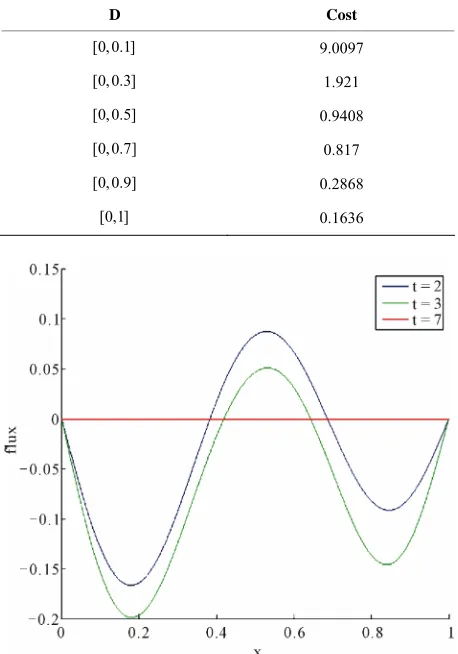
we obtain Figures 1 which illustrates the evolution of the system gradient and shows how the gradient evolves close to
gradient ilized with error equals 9.9836 ×
10 –4. This shows the
effi-ciency of the developed algorithm.
In Table 2 we give the cost of gradient stabilizati of sy
bspace
1cos 1 π , 1
n i
H Span i x
zero when the time t increases.
The is stab
–7 and cost equals 2.6982 × 10
on stem (27) for different supports control “D”.
The Table 2 shows that there is relation between area of control support and the cost of gradient stabilization, more precisely more this area decreases more cost in-
Table 1. Algorithm.
1) Let 0 the threshold, n the dimension of the projection space, and zn 0 z0n.
2) Solve (23) using Schur-type methods (see [10,11]) 3) Solve system (24) using formula (25) gives z tn i
4) Calculate z tn i by the formula (26).
[image:7.595.54.291.85.348.2]5) If z tn i stop, else 6) i = i + 1 and go to 3.
Table 2. Support control-cost stabilization.
D Cost
[0,0.1] 9.0097
[0,0.3] 1.921
0.9408
[0,0.7] 0.817
[ 0.1636
[0,0.5]
[0,0.9] 0.2868
[image:7.595.308.537.375.707.2]0,1]
[image:7.595.309.538.377.704.2]creases.
Example 4.3
Let [0,1] on 1
0
H H we consider the
(2 let boundary conditions: tem 7) with Dirich
,0 1
2 2D z t
Az t v t
t
z x x x
[0, ]
x
(28)
where Az0.01 z 0.5z, v t
H t 0, D[0, 0.3],*
. and we consi
The eige
der the problem npairs of A are
(22) with R
given by
i, isin
i xπ
, 01 iπgradie (28) are unstable since 1 0
of system (28) for different zone control support “D”.
Also in this example, we remark that more the area of control support increases more the cost of gradient stabi-lization decreases.
4. Conclusions
In this paper the question of gradient stabilization is ex-plored. According to the conditions, satisfied by the dy-namic of system, and those satisfied by the state space, two methods are applied to characterize the controls of gradient stabilization namely, decomposition approach and Riccati method.
The obtained results are successfully illustrated by numerical simulations. Questions are still open, this is the case of regional gradient stabilization. It is under consid-eration and will be appear in separate paper.
he work presented here was carried out within the
sup-port of
Tech-nology.
REFERENCES
[1] W. M. Wonham, “Linear Multivariab rol: A Geo-metric Approach,” Springer-Verlag, Be
[2] A. V. Balakrishnan, “Strong Stabil e Steady State Riccati Equation,” Applied Mathematics and Opti- mization, Vol. 7, No. 1, 1981, pp. 3
doi:10.1007/BF01442125
1
i , with i 0.
The state and the
2
0.5 . nt of system .
We consider the subspace
sin π , 1, ,
n i
H i x i n with
21 iπ
Applying the al
2
.
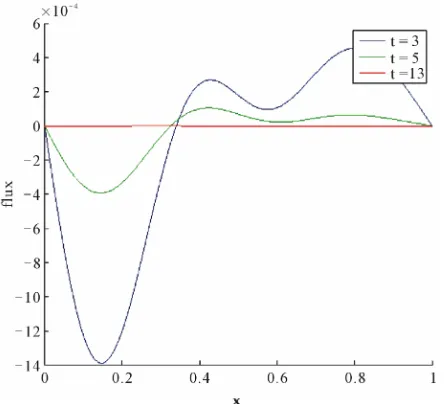
gorithm with truncation (n = 5), the
evolution at times t = 3, 5,
an
[image:8.595.63.286.363.565.2]i
Figure 2 shows the gradient d 13.
In Table 3 we present the cost of gradient stabilization
gure 2. The gradient evolution for the Direchlet boundary F
co i
ndition case.
Table 3. Support control-cost stabilization.
D Cost
[0,0.1] 0.0247
5. Acknowledgements
T
the Academy Hassan II of Sciences and
le Cont rlin, 1974. izabity and th 35-345.
nd J. Zabczyk, “Stability and Stabilizabil- ity of Infinite Dimensional Systems,” SIAM Review, Vol.
pp. 25-51. doi:10.1137/1023003
[3] R. F. Curtain and H. J. Zwart, “An Introduction to Infi- nite Dimensional Linear Systems Theory,” Springer- Verlag, Berlin, 1995.
[4] A. J. Pritchard a 23, No.1, 1981,
[5] T. Kato, “Perturbation Theory for Linear Operators,” Springer-Verlag, Berlin, 1980.
[6] R. Triggiani, “On the Stabilizability Problem in Banach Space,” Journal of Mathematical Analysis and Applica- tions, Vol. 52, No. 3, 1979, pp. 383-403.
doi:10.1016/0022-247X(75)90067-0
[7] R. F. Curtain, and A. J. Pritchard, “Infinite Dimensional Linear Systems Theory,” Springer-Verlag, Berlin, 1978. [8] H. T. Banks and K. Kunisch, “The Linear Regulator
Problem for Parabolic Systems,” SIAM Journal on Con- trol and Optimization, No. 22, Vol. 5, 1984, pp. 684-696.
doi:10.1137/0322043
[0,0.3] 0.0039
[0,0.5] 0.0016
[0,0.7] 4.7255 × 10⁻⁴
[0,0.9] 2.6982 × 10⁻⁴
[0,1] 2.6081 × 10⁻⁴
g and Squaring Method for the [9] N. J, Higham, “The Scalin
Matrix Exponential,” SIAM Journal on Matrix Analysis and Applications, Vol. 26, No. 4, 2005, pp. 1179-1193.
doi:10.1137/04061101X
[image:8.595.59.286.620.732.2]Vol. 24, No. 6, 1979, pp. 913-921.
doi:10.1109/TAC.1979.1102178
[11] W. F Arnold and A. J. Laub, “Generalized Eigenproblem