Physics Potentials with the Second Hyper-Kamiokande Detector
in Korea
(Hyper-Kamiokande Proto-Collaboration)
K. Abe,57, 59 Ke. Abe,24 H. Aihara,59, 60 A. Aimi,18 R. Akutsu,58 C. Andreopoulos,28, 43
I. Anghel,21 L.H.V. Anthony,28 M. Antonova,20 Y. Ashida,25 M. Barbi,44 G.J. Barker,66
G. Barr,40 P. Beltrame,11 V. Berardi,16 M. Bergevin,3 S. Berkman,2 T. Berry,45
S. Bhadra,73 F.d.M. Blaszczyk,1 A. Blondel,12 S. Bolognesi,6 S.B. Boyd,66 A. Bravar,12
C. Bronner,59 M. Buizza Avanzini,10 F.S. Cafagna,16 A. Cole,50 R. Calland,59 S. Cao,25
S.L. Cartwright,50 M.G. Catanesi,16 C. Checchia,18 Z. Chen-Wishart,45 J.H. Choi,8
K. Choi,14 J. Coleman,28 G. Collazuol,18 G. Cowan,11 L. Cremonesi,48 T. Dealtry,27 G. De Rosa,17 C. Densham,43 D. Dewhurst,40 E.L. Drakopoulou,11 F. Di Lodovico,48
O. Drapier,10 P. Dunne,15 M. Dziewiecki,65 S. Emery,6 A. Esmaili,46 P. Fern´andez,31
E. Fern´andez-Martinez,31 T. Feusels,2 A. Finch,27 A. Fiorentini,73 M. Fitton,43
K. Frankiewicz,37 M. Friend,22 Y. Fujii,22 Y. Fukuda,33 D. Fukuda,38 K. Ganezer,5
M. Gonin,10 N. Grant,66 P. Gumplinger,62 D.R. Hadley,66 L. Haegel,12 D. Hamabe,61
B. Hartfiel,5 M. Hartz,59, 62 Y. Hayato,57, 59 K. Hayrapetyan,48 J. Hill,5 S. Hirota,25
S. Horiuchi,69 A.K. Ichikawa,25 T. Iijima,34, 35 M. Ikeda,57 J. Imber,10 K. Inoue,55, 59
J. Insler,30 R.A. Intonti,16 A. Ioannisian,72 T. Ishida,22 H. Ishino,38 M. Ishitsuka,61 Y. Itow,35, 36 K. Iwamoto,47 A. Izmaylov,20 B. Jamieson,68 H.I. Jang,52 J.S. Jang,13
S.H. Jeon,54 M. Jiang,25 P. Jonsson,15 K.K. Joo,7 A. Kaboth,43, 45 C. Kachulis,1
T. Kajita,58, 59 J. Kameda,57, 59 Y. Karadhzov,12 T. Katori,48 K. Kayrapetyan,48
E. Kearns,1, 59 M. Khabibullin,20 A. Khotjantsev,20 J.H. Kim,54 J.Y. Kim,7 S.B. Kim,51
S.Y. Kim,51 S. King,48 Y. Kishimoto,57, 59 P. Ko∗,23 T. Kobayashi,22 M. Koga,55, 59
A. Konaka,62 L.L. Kormos,27 Y. Koshio,38, 59 K.L. Kowalik,37 W.R. Kropp,4 Y. Kudenko,20
R. Kurjata,65 T. Kutter,30 M. Kuze,61 L. Labarga,31 J. Lagoda,37 P.J.J. Lasorak,48
M. Laveder,18 M. Lawe,27 J.G. Learned,14 I.T. Lim,7 T. Lindner,62 R. P. Litchfield,15 A. Longhin,18 P. Loverre,19 T. Lou,60 L. Ludovici,19 W. Ma,15 L. Magaletti,16 K. Mahn,32
M. Malek,50L. Maret,12 C. Mariani,69 K. Martens,59 Ll. Marti,57J.F. Martin,63J. Marzec,65
∗ Author as part of the T2HKK interest group.
S. Matsuno,14 E. Mazzucato,6 M. McCarthy,73 N. McCauley,28 K.S. McFarland,47
C. McGrew,53 A. Mefodiev,20 C. Metelko,28 M. Mezzetto,18 J. Migenda,50 P. Mijakowski,37
H. Minakata,71 A. Minamino,25 S. Mine,4 O. Mineev,20 M. Miura,57, 59 J. Monroe,45
D.H. Moon,7 S. Moriyama,57, 59 T. Mueller,10 F. Muheim,11 K. Murase,41 F. Muto,34
M. Nakahata,57, 59 Y. Nakajima,57 K. Nakamura,22, 59 T. Nakaya,25, 59 S. Nakayama,57, 59
C. Nantais,63 M. Needham,11 T. Nicholls,43 Y. Nishimura,58 E. Noah,12 F. Nova,43
J. Nowak,27 H. Nunokawa,46 Y. Obayashi,59 H.M. O’Keeffe,27 Y. Okajima,61
K. Okumura,58, 59 E. O’Sullivan,9 T. Ovsiannikova,20 R.A. Owen,48 Y. Oyama,22 J. P´erez,31
M.Y. Pac,8 V. Palladino,17 J.L. Palomino,53 V. Paolone,42 W. Parker,45 S. Parsa,12 D. Payne,28 J.D. Perkin,50 E. Pinzon Guerra,73 S. Playfer,11 M. Posiadala-Zezula,64
J.-M. Poutissou,62 A. Pritchard,28 N.W. Prouse,48 P. Przewlocki,37 B. Quilain,25
M. Quinto,16 E. Radicioni,16 P.N. Ratoff,27 M.A. Rayner,12 F. Retiere,62 C. Riccio,17
B. Richards,48 E. Rondio,37 H.J. Rose,28 C. Rott,54 S.D. Rountree,69 A.C. Ruggeri,17
A. Rychter,65 R. Sacco,48 M. Sakuda,38 M.C. Sanchez,21 E. Scantamburlo,12
K. Scholberg,9, 59 M. Scott,62 Y. Seiya,39 T. Sekiguchi,22 H. Sekiya,57, 59 S.H. Seo,51
D. Sgalaberna,12 R. Shah,40 A. Shaikhiev,20 I. Shimizu,55 M. Shiozawa,57, 59 Y. Shitov,15, 45
S. Short,48 C. Simpson,40, 59 G. Sinnis,29 M.B. Smy,4, 59 S. Snow,66 J. Sobczyk,70 H.W. Sobel,4, 59 Y. Sonoda,57 T. Stewart,43 J.L. Stone,1, 59 Y. Suda,60 Y. Suwa,74
Y. Suzuki,59 A.T. Suzuki,24 R. Svoboda,3 R. Tacik,44 A. Takeda,57 A. Takenaka,57
A. Taketa,56 Y. Takeuchi,24, 59 V. Takhistov,4 H.A. Tanaka,63 H.K.M. Tanaka,56
H. Tanaka,57, 59 R. Terri,48 L.F. Thompson,50 M. Thorpe,43 S. Tobayama,2 T. Tomura,57, 59
C. Touramanis,28 T. Towstego,63 T. Tsukamoto,22 K.M. Tsui,58 M. Tzanov,30
Y. Uchida,15 M.R. Vagins,4, 59 G. Vasseur,6 C. Vilela,53 R.B. Vogelaar,69 J. Walding,45
C.W. Walter,9, 59 D. Wark,40, 43 M.O. Wascko,15 A. Weber,43 R. Wendell,25, 59 R.J. Wilkes,67
M.J. Wilking,53 J.R. Wilson,48 T. Xin,21 K. Yamamoto,39 C. Yanagisawa,53 T. Yano,24 S. Yen,62 N. Yershov,20 D.N. Yeum,51 M. Yokoyama,59, 60 T. Yoshida,61 I. Yu,54
M. Yu,73 J. Zalipska,37 K. Zaremba,65 M. Ziembicki,65 M. Zito,6 and S. Zsoldos48
(Hyper-Kamiokande proto-collaboration)
1Boston University, Department of Physics, Boston, Massachusetts, U.S.A.
and Astronomy, Vancouver, British Columbia, Canada
3University of California, Davis, Department of Physics, Davis, California, U.S.A.
4University of California, Irvine, Department of
Physics and Astronomy, Irvine, California, U.S.A.
5California State University, Department of Physics, Carson, California, U.S.A.
6IRFU, CEA Saclay, Gif-sur-Yvette, France
7Chonnam National University, Department of Physics, Gwangju, Korea
8Dongshin University, Basic Science Research Institute, Naju, Korea
9Duke University, Department of Physics, Durham, North Carolina, U.S.A.
10Ecole Polytechnique, IN2P3-CNRS, Laboratoire Leprince-Ringuet, Palaiseau, France
11University of Edinburgh, School of Physics and Astronomy, Edinburgh, United Kingdom
12University of Geneva, Section de Physique, DPNC, Geneva, Switzerland
13GIST College, Gwangju Institute of Science and Technology, Gwangju 500-712, Korea
14University of Hawaii, Department of Physics and Astronomy, Honolulu, Hawaii, U.S.A.
15Imperial College London, Department of Physics, London, United Kingdom
16INFN Sezione di Bari and Universit`a e Politecnico di
Bari, Dipartimento Interuniversitario di Fisica, Bari, Italy
17INFN Sezione di Napoli and Universit`a di Napoli, Dipartimento di Fisica, Napoli, Italy
18INFN Sezione di Padova and Universit`a di Padova, Dipartimento di Fisica, Padova, Italy
19INFN Sezione di Roma, Roma, Italy
20Institute for Nuclear Research of the Russian Academy of Sciences, Moscow, Russia
21Iowa State University, Department of Physics and Astronomy, Ames, Iowa, U.S.A.
22High Energy Accelerator Research Organization (KEK), Tsukuba, Ibaraki, Japan
23Korean Institute for Advanced Studies, Seoul, Korea
24Kobe University, Department of Physics, Kobe, Japan
25Kyoto University, Department of Physics, Kyoto, Japan
26Laboratori Nazionali di Frascati, Frascati, Italy
27Lancaster University, Physics Department, Lancaster, United Kingdom
28University of Liverpool, Department of Physics, Liverpool, United Kingdom
29Los Alamos National Laboratory, New Mexico, U.S.A.
30Louisiana State University, Department of Physics
31University Autonoma Madrid, Department of Theoretical Physics, Madrid, Spain
32Michigan State University, Department of Physics
and Astronomy, East Lansing, Michigan, U.S.A.
33Miyagi University of Education, Department of Physics, Sendai, Japan
34Nagoya University, Graduate School of Science, Nagoya, Japan
35Nagoya University, Kobayashi-Maskawa Institute for
the Origin of Particles and the Universe, Nagoya, Japan
36Nagoya University, Institute for Space-Earth Environmental Research, Nagoya, Japan
37National Centre for Nuclear Research, Warsaw, Poland
38Okayama University, Department of Physics, Okayama, Japan
39Osaka City University, Department of Physics, Osaka, Japan
40Oxford University, Department of Physics, Oxford, United Kingdom
41Pennsylvania State University, Department of Physics, University Park, PA 16802, U.S.A.
42University of Pittsburgh, Department of Physics
and Astronomy, Pittsburgh, Pennsylvania, U.S.A.
43STFC, Rutherford Appleton Laboratory, Harwell Oxford,
and Daresbury Laboratory, Warrington, United Kingdom
44University of Regina, Department of Physics, Regina, Saskatchewan, Canada
45Royal Holloway University of London, Department
of Physics, Egham, Surrey, United Kingdom
46Pontif´ıcia Universidade Cat´olica do Rio de Janeiro,
Departamento de F´ısica, Rio de Janeiro, Brazil
47University of Rochester, Department of Physics
and Astronomy, Rochester, New York, U.S.A.
48Queen Mary University of London, School of
Physics and Astronomy, London, United Kingdom
49Universidade de S˜ao Paulo, Instituto de F´ısica, S˜ao Paulo, Brazil
50University of Sheffield, Department of Physics and Astronomy, Sheffield, United Kingdom
51Seoul National University, Department of Physics, Seoul, Korea
52Seoyeong University, Department of Fire Safety, Gwangju, Korea
53State University of New York at Stony Brook, Department
54Sungkyunkwan University, Department of Physics, Suwon, Korea
55Research Center for Neutrino Science, Tohoku University, Sendai, Japan
56University of Tokyo, Earthquake Research Institute, Tokyo, Japan
57University of Tokyo, Institute for Cosmic Ray
Research, Kamioka Observatory, Kamioka, Japan
58University of Tokyo, Institute for Cosmic Ray Research,
Research Center for Cosmic Neutrinos, Kashiwa, Japan
59University of Tokyo, Kavli Institute for the Physics and Mathematics of the
Universe (WPI), Todai Institutes for Advanced Study, Kashiwa, Chiba, Japan
60University of Tokyo, Department of Physics, Tokyo, Japan
61Tokyo Institute of Technology, Department of Physics, Tokyo, Japan
62TRIUMF, Vancouver, British Columbia, Canada
63University of Toronto, Department of Physics, Toronto, Ontario, Canada
64University of Warsaw, Faculty of Physics, Warsaw, Poland
65Warsaw University of Technology, Institute of
Radioelectronics and Multimedia Technology, Warsaw, Poland
66University of Warwick, Department of Physics, Coventry, United Kingdom
67University of Washington, Department of Physics, Seattle, Washington, U.S.A.
68University of Winnipeg, Department of Physics, Winnipeg, Manitoba, Canada
69Virginia Tech, Center for Neutrino Physics, Blacksburg, Virginia, U.S.A.
70Wroclaw University, Faculty of Physics and Astronomy, Wroclaw, Poland
71Yachay Tech, Department of Physics, San Miguel de Urcuqu´ı, Ecuador
72Yerevan Institute for Theoretical Physics and
Modeling, Halabian Str. 34; Yerevan 0036, Armenia
73York University, Department of Physics and Astronomy, Toronto, Ontario, Canada
Abstract
We have conducted sensitivity studies on an alternative configuration of the Hyper-Kamiokande
experiment by locating the 2nd Hyper-Kamiokande detector in Korea at∼1100−1300 km baseline.
Having two detectors at different baselines improves sensitivity to leptonic CP violation, neutrino
mass ordering as well as nonstandard neutrino interactions. There are several candidate sites in
Korea with greater than 1 km high mountains ranged at an 1−3 degree off-axis angle. Thanks to
larger overburden of the candidate sites in Korea, low energy physics, such as solar and supernova
neutrino physics as well as dark matter search, is expected to be improved. In this paper sensitivity
studies on the CP violation phase and neutrino mass ordering are performed using current T2K
systematic uncertainties in most cases. We plan to improve our sensitivity studies in the near
I. MOTIVATION
The Hyper-Kamiokande (Hyper-K or HK) proposal [1] builds upon the highly successful Super-Kamiokande (Super-K or SK) detector [2] by constructing water Cherenkov detectors with nearly twenty times the fiducial volume of SK to pursue a rich program of neutrino (astro)physics and proton decay. The current Hyper-K design calls for the staged construc-tion of two 187 kt (fiducial volume mass) modules near the current Super-K site, 295 km away and 2.5◦ off-axis (OA) from the J-PARC neutrino beam used by the T2K experiment. The long baseline neutrino program at Hyper-K with the J-PARC neutrino beam aims for a definitive observation of CP violation (CPV) in neutrino oscillations that may result from an irreducible phase δCP in the neutrino mixing matrix. Hyper-K will make precise
mea-surements of other oscillation parameters, such as the mixing angleθ23 and ∆m232, and thus
will provide highly sensitive tests of the three-flavor mixing paradigm. These measurements are valuable towards elucidating the new physics responsible for neutrino mass and mixing and its potential connections to the mystery of the matter/antimatter asymmetry of the universe.
In this document, we will explore the possibility of placing one of the two Hyper-K mod-ules in Korea at a baseline of 1000−1300 km; we will refer to this as “T2HKK” in contrast to the current default configuration with both detectors in Kamioka with 295 km baseline (“T2HK”) . The T2HKK configuration, which provides measurements at two significantly different baselines, will break degeneracies related to the unknown mass ordering, θ23, and
the CP-violating phase δCP. It will provide the opportunity to fully probe the oscillation
physics at the first and second oscillation maxima. The measurements at multiple baselines, including near detectors at J-PARC, can serve to mutually reduce systematic uncertain-ties across all the measurements. The study of non-standard neutrino interactions is also expected to be significantly enhanced by the two-baseline configuration.
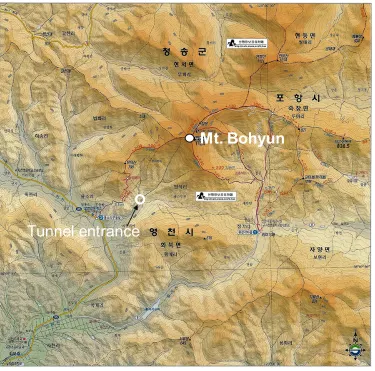
FIG. 1: Contour map of the J-PARC off-axis beam to Korea [8, 9].
water-based liquid scintillators raise the possibility of a program based on reactor neutrinos at a later stage.
There were earlier efforts on a large water Cherenkov detector in Korea using a J-PARC-based neutrino beam [3, 4]. Originally an idea for a two baseline experiment with a 2nd detector in Korea has been discussed by several authors pointing out possible improvements for measurements on CP violation and mass hierarchy [5–9]. Three international workshops were held in Korea and Japan in 2005, 2006 and 2007 [10]. The mixing angle of θ13 was not
known yet, and therefore the detector size and mass could not be determined at the time. Now more realistic studies and a detector design are possible due to the precisely measured θ13 [11–18].
II. SECOND HYPER-KAMIOKANDE DETECTOR IN KOREA
In this chapter we present an experimental setup and physics sensitivities of the second Hyper-K detector in Korea using the J-PARC neutrino beam.
A. J-PARC neutrino beam and Hyper-K detector
The J-PARC neutrino beam and the Hyper-K detector with the near and intermediate detectors will be described in the next subsections.
1. J-PARC neutrino beam
The neutrino beam for Hyper-K is produced at J-PARC (Japan Proton Accelerator Re-search Complex) located in Tokai Village, Ibaraki prefecture, on the east coast of Japan, 295 km from the Kamioka detector sites. The 30-GeV (kinetic energy) proton beam is ex-tracted from the J-PARC Main Ring (MR) by single-turn fast extraction and transported to the production target after being deflected about 90◦ by 28 superconducting combined func-tion magnets to direct the beam towards Kamioka. The beam pulse consists of 8 bunches spaced 581 ns apart to give a 4.2 µs total pulse length. The repetition period of the pulse is 2.48 s as of 2016. The production target is a 26 mm diameter and 90 cm long graphite rod (corresponding to 2 interaction lengths). About 80% of incoming protons interact in the target. The secondary pions (and kaons) from the target are focused by three consecutive electromagnetic horns operated by a 250 kA pulsed current. The focused pions and kaons enter a 110 m length decay volume (DV) filled with helium gas and decay in flight into neutrinos. The beam dump, which consists of graphite blocks of about 3.15 m thickness followed by iron plates of 2.5 m total thickness, is placed at the end of the DV to absorb remnant hadrons. Muon monitors (MUMONs) are placed just behind the beam dump to monitor on a spill-by-spill basis the intensity and the profile of muons > 5 GeV which pass through the beam dump.
off-axis angle at the current Super-Kamiokande and proposed Hyper-Kamiokande sites. As of summer 2016, stable operation of the MR at 425 kW beam power has been achieved. In 2018, the design power of 750 kW will be realized by increasing the repetition rate from 1/2.48 s to 1/1.3 s by upgrading magnet power supplies, RF core and other components. Further beam power increases will require upgrades to secondary beamline components such as the beam window, target, and horns. Upgrades primarily to the RF power supply will gradually increase the number of protons/pulse (ppp) and repetition rate further to 330 Tp and 1/1.16 s, respectively, to reach > 1.3 MW by around 2025 before Hyper-K becomes operational.
2. Hyper-Kamiokande tank configuration
The Hyper-K experiment employs a ring-imaging water Cherenkov detector technique to detect rare interactions of neutrinos and the possible spontaneous decay of protons and bound neutrons. The baseline detector configuration consists of two cylindrical tanks with the second tank commencing operation later than the first tank. The first priority is to perform a CP violation measurement at the earliest opportunity with the first tank.
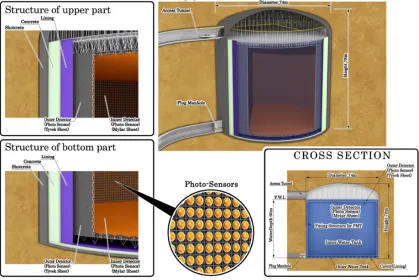
A full overview of the cavern and detector design R&D, upgraded beam and near detector suite, and expected physics sensitivities can be found in the Hyper-Kamiokande Design Report [19]. The schematic view of each tank is shown in Fig. 2. It is a standing cylindrical tank with a diameter of 74 m and height of 60 m. The total (fiducial) mass of the detector is 258 (187) kilo-tons. Two tanks in total will provide the fiducial volume which is about 20 times larger than that of Super-K. The Hyper-K detector candidate site, located 8 km south of Super-K and 295 km away from J-PARC, is in the Tochibora mine which is used by the Kamioka Mining and Smelting Company near Kamioka town in Gifu Prefecture, Japan. The J-PARC neutrino beamline is designed so that the existing Super-Kamiokande detector in the Mozumi mine and the Hyper-K candidate site in the Tochibora mine have the same off-axis angle. The detector will lie under the peak of Nijuugo-yama, with an overburden of 650 meters of rock or 1,750 meters-water-equivalent (m.w.e.), at geographic coordinates Lat. 36◦21’20.105”N, Long.137◦18’49.137”E (world geographical coordinate system), and an altitude of 514 m above sea level (a.s.l.).
high-FIG. 2: Schematic view for the first tank.
resolution PMTs (Hamamatsu R12860) which will amplify faint signatures such as those of neutrons associated with neutrino interactions, nuclear de-excitation gammas and π+ in
proton decays into kaons, and so on. This increased sensitivity contributes significantly to the major goals of the Hyper-K experiment such as clean proton decay searches via p → e+ +π0 and p → ν¯ +K+ decay modes and the observation of supernova electron
[image:11.612.96.515.72.352.2]3. Near and intermediate detector complex
The neutrino flux and cross-section models can be constrained by data collected at near detectors, situated close enough to the neutrino production point so that oscillation effects are negligible. Their data addresses important uncertainties in the neutrino flux or cross-section modeling.
The T2K ND280 detector suite comprises two detectors [20]: INGRID, which consists of 16 iron-scintillator modules in a cross pattern centered on the neutrino beam axis, and ND280, a multi-component detector at an angle of 2.5 degree from the beam direction. The primary purpose of the INGRID detector is to constrain the neutrino beam direction, whilst the off-axis detector is used to characterize the neutrino beam before oscillation. T2K has successfully applied a method of fitting to ND280 data with parameterized models of the neutrino flux and interaction cross-sections. Using the ND280 measurements, the systematic uncertainties on the parts of the models constrained by ND280 have been reduced to 3% on the Super-K (SK) predicted event rates. An upgrade of the current ND280 detector is planned before the starting of Hyper-K.
Moreover, a water Cherenkov detector at about 1-2 km is proposed to be built possibly before Hyper-K becomes operational [21]. A water Cherenkov near detector can be used to measure the cross section on H2O directly, with the same solid angle acceptance as the far
detector with no need for a subtraction analysis. Additionally, water Cherenkov detectors have shown excellent particle identification capabilities, allowing for the detection of pureνµ
-CC,νe-CC and NCπ0 samples. The CCπ0rate and kaon production in neutrino interactions,
which are backgrounds to nucleon decay searches, can also be measured.
B. T2HKK Experimental Setup and HKK Candidate Site
The axis of the J-PARC neutrino beam emerges upwards out of the sea between Japan and Korea. The southern part of the Korean peninsula is exposed to the 1−3 degree off-axis neutrino beams with baselines of 1000−1300 km as shown in Fig. 1. As mentioned earlier, the T2HKK experiment consists of the first Hyper-K detector in Kamioka at 295 km baseline and the second one in Korea at ∼1100 km. In this document, we assume that HKK will be a 258 kt water Cherenkov detector identical to the Hyper-K in Kamioka.
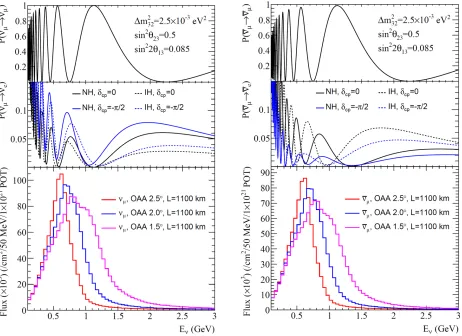
The second oscillation maximum takes place nearEν = 0.6 GeV at the∼1100 km baseline.
The clear separation of different CP phases and mass orderings is observed at the second oscillation maximum. The HKK can be the most sensitive to the CP phase determination if it is placed at 2.5 degrees of off-axis angle, the same as Hyper-K in Kamioka. In that case, the J-PARC neutrino beam spectrum peaks at Eν = 0.6 GeV with a narrow energy
band as shown in Fig. 3. Having identical off-axis angles of the J-PARC beam for HK and HKK, a ratio measurement between HK and HKK would greatly reduce the uncertainties of the neutrino beam flux and spectrum. On the other hand, the maximum sensitivity for determining the neutrino mass ordering is possible by a neutrino beam of Eν > 1 GeV
where the first oscillation maximum takes place. The J-PARC neutrino beam spectrum peaks above 1 GeV with a wider energy band when its off-axis angle is less than 1.5 degrees. In this case, the neutrino flux becomes less in the energy region of the second-oscillation maximum, but still remains enough for the satisfactory CP-phase sensitivity.
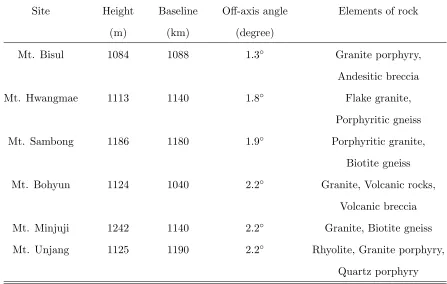
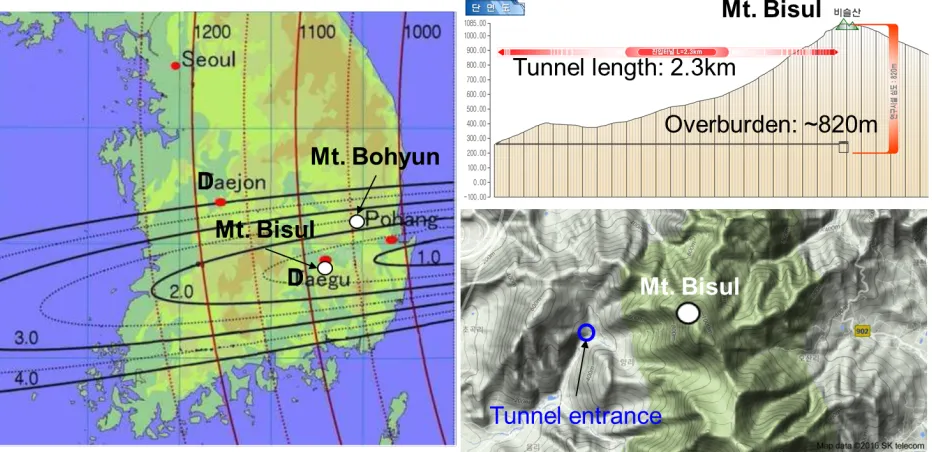
The Korean rocks are in general made of granite, hard enough to build a large cavern. A search for mountains higher than 1000 m has been made to find several candidates for HKK as listed in Table I. Mountains in the national or provincial parks are not considered in the search. Two candidate sites are selected among those as shown in Fig. 4: Mt. Bisul at 1.3 degrees of off-axis angle and Mt. Bohyun at 2.2 degrees.
FIG. 3: Expected J-PARC neutrino (left) and antineutrino (right) spectra and oscillation
prob-abilities at HKK assuming the baseline of 1100 km. Several off-axis angles are considered for
comparison. The second oscillation maximum takes place at∼0.6 GeV at HKK while the first one
is at∼2 GeV.
1088 km. Based on nearby ponds and rivers, sufficient underground water could be available in the site. Above all there is a traffic road including six tunnels near the Mt. Bisul that was built in October, 2014. We can take several advantages from the existing tunnels such as no hurdle in obtaining a permission for excavation, available geological-survey results, easy access of electricity lines, and easy accessibility of experimental underground facility. We find excellent access roads up to the candidate location of tunnel entrance. The HKK in the Mt. Bisul would provide a high sensitivity for the neutrino mass-ordering determination as well as an improved sensitivity for the CP phase measurement because of both first and second oscillation maxima.
TABLE I: Candidate sites with the off-axis angles between 1 and 2.5 degrees for the second Hyper-K
detector in Korea. The baseline is the distance from the production point of the J-PARC neutrino
beam.
Site Height Baseline Off-axis angle Elements of rock
(m) (km) (degree)
Mt. Bisul 1084 1088 1.3◦ Granite porphyry,
Andesitic breccia
Mt. Hwangmae 1113 1140 1.8◦ Flake granite,
Porphyritic gneiss
Mt. Sambong 1186 1180 1.9◦ Porphyritic granite,
Biotite gneiss
Mt. Bohyun 1124 1040 2.2◦ Granite, Volcanic rocks,
Volcanic breccia
Mt. Minjuji 1242 1140 2.2◦ Granite, Biotite gneiss
Mt. Unjang 1125 1190 2.2◦ Rhyolite, Granite porphyry,
Quartz porphyry
Observatory as shown in Fig. 5. The mountain is 1124 m high and made of fairly hard rocks, granite, volcanic rocks and volcanic breccia. It is an excellent candidate site for a large cavern. HKK is expected to have at least ∼820 m overburden and to be exposed to a 2.2 degree off-axis neutrino beam. Its coordinates are N36◦ 09’ 47” in latitude and E128◦ 58’ 26” in longitude. The baseline from J-PARC is 1040 km. Based on nearby rivers, sufficient underground water is expected in the site. Its accessibility is reasonably good. The HKK in the Mt. Bohyun would make it possible to do a ratio measurement with Hyper-K and provide significant improvement for the CP-phase measurement because of the second oscillation maximum location.
FIG. 4: Two candidate sites for the second Hyper-K detector in Korea. Mt. Bisul is located near
the city of Daegu and at 1.3 degrees of off-axis angle, and Mt. Bohyun at Youngcheon and at 2.2
degrees of off-axis angle. Mt. Bisul is 1084 m high and provides excellent accessibility with an
existing highway nearby. Mt. Bohyun is 1124 m high and accommodates an optical telescope on
the top.
Korea.
C. Improved sensitivity from HKK
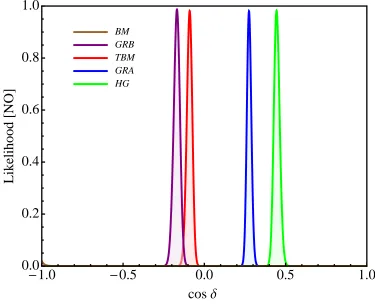
The tiny neutrino mass and the large neutrino mixing compared to quarks indicate that the origin of neutrino mass is from physics beyond the standard model, e.g. the see-saw mechanism. Tests of the unitarity of three generation neutrino mixing paradigm would pro-vide an effective tool as demonstrated in quark mixing. Precise determination of the mixing parameters also constraints physics beyond the standard model, such as Grand Unifica-tion Theory (GUT). For example, precision measurement of CP violaUnifica-tion phase δCP could
distinguish different types of flavor symmetries in GUT as shown in Fig. 6.
FIG. 5: Mt. Bohyun as a candidate site for the second Hyper-K detector in Korea. It is 1124 m
high and provides ∼820 m overburden for the HKK.
both HK and HKK, the J-PARC neutrino beam will provide a compelling measurement to establish CP violation measurement and improve its study of physics beyond the PMNS paradigm. Due to a factor of three enhancement of CP violation effect at the second oscil-lation maximum, the impact of systematic uncertainties is reduced accordingly in T2HKK. Systematic uncertainty already has significant impact on the CP sensitivity of T2K-II and it is the main limitation at T2HK. The reduction of impact from systematic uncertainty would be very important in establishing the CP violation in the neutrino oscillation. The T2HKK configuration would cover first and second oscillation maxima without serious pion production backgrounds atEν <1 GeV. The two different baseline oscillation measurement
-
1.0
-
0.5
0.0
0.5
1.0
0.0
0.2
0.4
0.6
0.8
1.0
cos
∆
Likelihood
@
NO
D
[image:18.612.116.491.73.379.2]BM GRB TBM GRA HG
FIG. 6: The likelihood function versus cosδCP for normal ordering neutrino mass spectrum for
different types of flavor symmetries assuming the prospective 1σuncertainties in the determination
of the neutrino mixing angles [22].
PMNS paradigm. Matter effect creates a fake CP violation effect causing difference inν and ¯
ν oscillations. The higher energy spectrum of HKK near the first oscillation maximum, is in particular sensitive to the matter effect and expected to resolve the mass hierarchy better than 5σ level. Other degeneracies of δCP and θ23 octant or ∆m231 can also be constrained.
Non-standard neutrino interaction can cause additional matter effect and a new physics be-yond PMNS may cause distortion in oscillation pattern. Both of these effects can be tested by the two baseline T2HKK data.
III. IMPROVED NEUTRINO MASS ORDERING AND CP SENSITIVITIES
This chapter describes the sensitivity to measure the neutrino mass ordering and discover CP violation using a configuration of Hyper-K with one tank in Japan and the second tank in Korea. First, the sensitivities to CP violation and the mass ordering are discussed by presenting the neutrino oscillation probability formulas and their energy dependence at a baseline to Korea, ∼1100 km. Then expected reconstructed event spectra for the Korean detector are presented and the effect of the oscillation parameters on these spectra are considered. The impact of systematic errors on the expected spectra are also presented. Finally, sensitivity studies for the mass ordering measurement, CP violation discovery, and precision of the CP phase measurement are presented.
A. Neutrino Oscillation Probabilities
The sensitivity enhancement of a second detector in Korea can be understood by first examining the P(νµ → νe) and P(¯νµ → ν¯e) probabilities in vacuum and then examining
the probabilities with the matter effect included. The approximate oscillation probability in vacuum is:
P(νµ(¯νµ)→νe(¯νe))≈sin2θ23 sin22θ13 sin2(
∆m231L
4E )
+ sin 2θ23sin 2θ13sin 2θ12cosθ13sin(∆m
2 31L
4E )sin(
∆m221L
4E )cos(
∆m231L
4E )cosδ
−(+) sin 2θ23sin 2θ13sin 2θ12 cosθ13sin2(
∆m231L
4E )sin(
∆m221L
4E )sinδ
+ cos2θ13 cos2θ23 sin22θ12 sin2(
∆m221L
4E ). (1)
(GeV)
ν
E
0.5
1
1.5
2
2.5
3
)
eν
→
µν
)-P(
eν
→
µν
P(
-0.02
0
0.02
0.04
0.06
0.08
L=300 km L=900 km L=1100 km
=0.085
13θ
2
2sin
=0.5
23θ
2
sin
2
eV
-310
×
=2.5
32 2m
∆
/2
π
=3
[image:20.612.125.477.92.321.2]δ
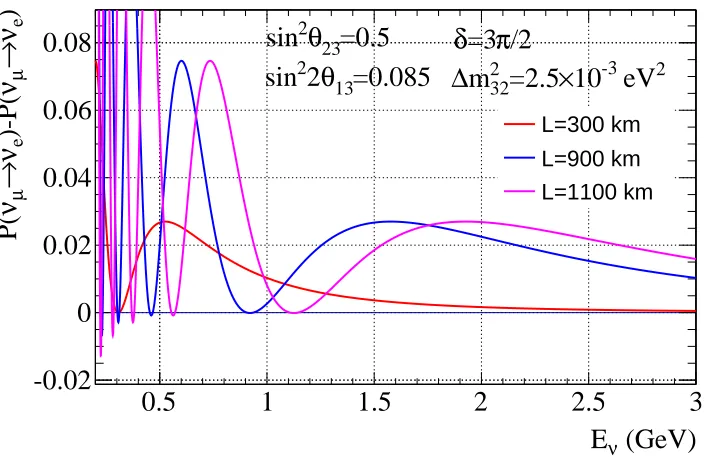
FIG. 7: The CP probability difference forδ = 3π/2 at 300 km and 900 km baselines for oscillations
in vacuum. The CP probability difference for 1100 km baseline is also shown since it is the typical
baseline for candidate sites in Korea.
term depends on sin(∆m221L
4E ). Since the argument is small for the L/E values of interest,
this can be expanded up to the linear term, introducing a dependence on ∆m221L
4E . For a fixed
energy, a larger CP effect will be observed at longer baselines. The oscillation maxima are observed when ∆m231L
4E = nπ/2 and n is an odd integer. For a fixed baseline, the second
When neutrinos propagate in matter, the matter potential is added to the Hamiltonian of the system, modifying the neutrino oscillation probabilities. The approximate oscillation probability in matter can be written as [23]:
P(νµ(¯νµ)→νe(¯νe))≈sin2θ23 sin22θ13
sin2(∆31−(+)aL)
(∆31−(+)aL)2 ∆
2 31
+ sin 2θ23sin 2θ13sin 2θ12cosθ13
sin(∆31−(+)aL)
(∆31−(+)aL)
∆31sin(aL)
aL ∆21cos(∆32)cosδ
−(+) sin 2θ23sin 2θ13sin 2θ12cosθ13
sin(∆31−(+)aL)
(∆31−(+)aL) ∆31
sin(aL)
aL ∆21sin(∆32)sinδ
+ cos2θ13 cos2θ23 sin22θ12
sin2(aL)
(aL)2 ∆
2
21. (2)
Here, ∆21 = ∆m2
21L
4E and ∆31=
∆m2 31L
4E . The matter effect depends on a =GFNe/
√
2, where GF is Fermi’s constant and Ne is the number density of electrons in the matter. The sign
of the aL terms flip for antineutrinos, introducing an effect that can mimic CP violation for some experimental configurations. It is clear from this formula that the introduction of matter effects introduces a linear dependence on ∆31, allowing for the measurement of the
sign of ∆31,i.e. the mass ordering. The matter effect increases with baseline, so experiments
with longer baselines will have more sensitivity to determine the mass ordering.
(GeV)
ν
E
0.5
1
1.5
2
2.5
3
Osc. Prob
0
0.05
0.1
0.15
0.2
0.25
0.3
flux
µν
°
1.5
, NH
°
=0
cpδ
, NH
°
=90
cpδ
, NH
°
=180
cpδ
, NH
°
=270
cpδ
, IH
°
=0
cpδ
, IH
°
=90
cpδ
, IH
°
=180
cpδ
, IH
°
=270
cpδ
at 1100 km
eν
→
µν
(GeV)
νE
0.5
1
1.5
2
2.5
3
Osc. Prob
0
0.05
0.1
0.15
0.2
0.25
0.3
flux
µν
°
1.5
, NH
°
=0
cpδ
, NH
°
=90
cpδ
, NH
°
=180
cpδ
, NH
°
=270
cpδ
, IH
°
=0
cpδ
, IH
°
=90
cpδ
, IH
°
=180
cpδ
, IH
°
=270
cpδ
at 1100 km
e
ν
→
µ
[image:22.612.119.478.71.665.2]ν
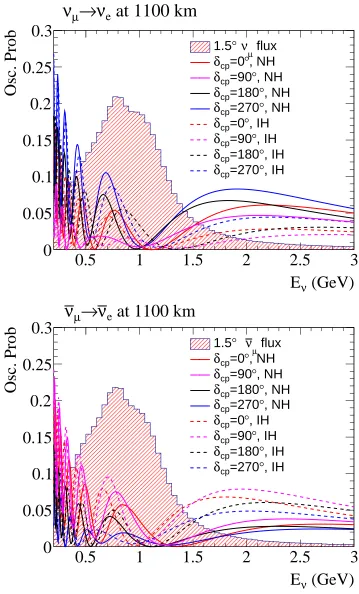
FIG. 8: The oscillation probabilities forδ= 0, π/2, π,3π/2 and normal and inverted mass ordering
B. Event Rates at Korean Detectors
For the purpose of the sensitivity studies presented here, we consider generic detector locations in South Korea at a baseline of 1100 km and an off-axis angle of 1.5◦, 2.0◦ or 2.5◦. The expected event rates are estimated using a NEUT [24] 5.3.2-based simulation of the Super-K detector, where the fiducial mass has been scaled from 22.5 kton to 187 kton. The simulated events are scaled to give good agreement with NEUT 5.1.4.2, which has been tuned against T2K near detector data. Following the running plan of Hyper-K, an exposure of (1.3 MW)×(10×107 sec) is assumed with a 3:1 ratio of antineutrino mode to neutrino
mode operation. Oscillation probabilities are calculated using Prob3++ [25], and a constant matter density of 3.0 g/cm3 is assumed for the 1100 km baseline [26]. For each detector
configuration, reconstructed events are classified in 4 categories:
• Neutrino mode, 1Re: Single electron-like ring candidates collected in the neutrino mode operation of the beam.
• Antineutrino mode, 1Re: Single electron-like ring candidates collected in the antineu-trino mode operation of the beam.
• Neutrino mode, 1Rµ: Single muon-like ring candidates collected in the neutrino mode
operation of the beam.
• Antineutrino mode, 1Rµ: Single muon-like ring candidates collected in the antineu-trino mode operation of the beam.
The selection cuts for these candidate samples are identical to the selection cuts used in re-cent T2K oscillation measurements [27], except for the reconstructed energy,Erec <1.25 GeV
cut on the 1Resamples. This cut has been removed since the matter effect which constrains the mass ordering is most strongly manifested in events with reconstructed energy greater than 1.25 GeV.
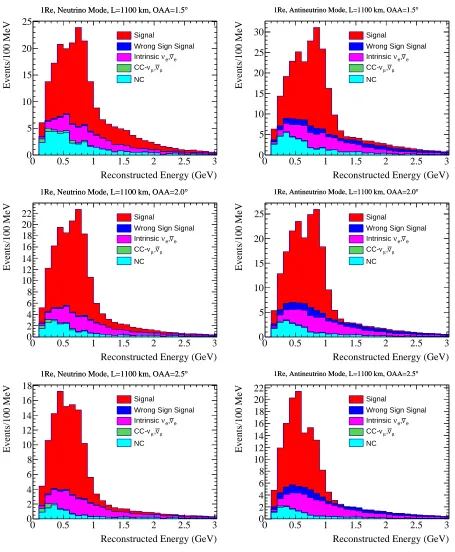
Predicted event rates for normal mass ordering and δcp=0 are shown for 1Re and 1Rµ
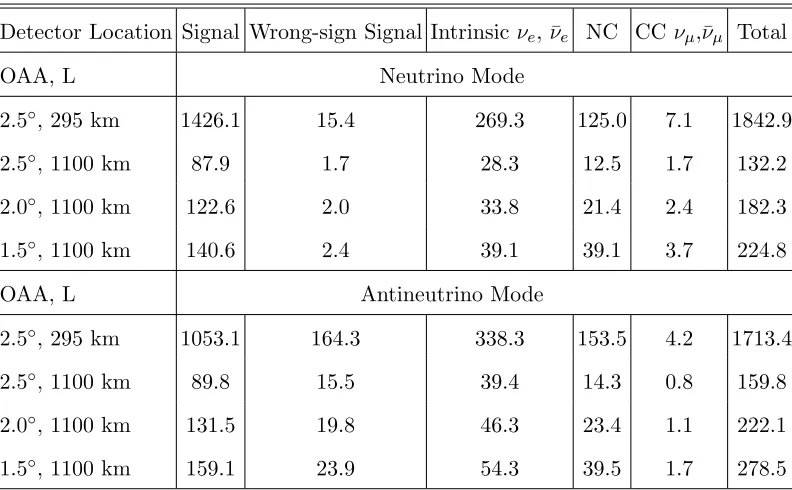
samples in Fig. 9/Table II and Fig. 10/Table III respectively. In Tables II, III, the predicted event rates for the nominal Hyper-K tank location are shown for comparison. These differ from those presented in the Hyper-K Design Report since the value for sin2θ13 has been
TABLE II: The expected number of νe and ¯νe 1Re candidate events. Normal mass ordering
with sin22θ13 = 0.085 and δcp = 0 are assumed. Background is categorized by the flavor before
oscillation.
Detector Location Signal Wrong-sign Signal Intrinsic νe, ¯νe NC CC νµ,¯νµ Total
OAA, L Neutrino Mode
2.5◦, 295 km 1426.1 15.4 269.3 125.0 7.1 1842.9
2.5◦, 1100 km 87.9 1.7 28.3 12.5 1.7 132.2
2.0◦, 1100 km 122.6 2.0 33.8 21.4 2.4 182.3
1.5◦, 1100 km 140.6 2.4 39.1 39.1 3.7 224.8
OAA, L Antineutrino Mode
2.5◦, 295 km 1053.1 164.3 338.3 153.5 4.2 1713.4
2.5◦, 1100 km 89.8 15.5 39.4 14.3 0.8 159.8
2.0◦, 1100 km 131.5 19.8 46.3 23.4 1.1 222.1
1.5◦, 1100 km 159.1 23.9 54.3 39.5 1.7 278.5
generation, and a 10 year exposure with one tank is presented here, while the Design Report assumes a 10 year exposure with one tank for the first 6 years and a second tank for the remaining 4 years. The 1Re candidate rates in Korea are ∼ 1/10 the rates at the 295 km baseline due to the 1/L2 dependence of the flux. In the 1Rµ samples, the first and second
oscillation maxima can be observed at 2 GeV and 0.7 GeV respectively.
The variations of the 1Re spectra in neutrino mode and antineutrino mode for different δcp values at different detector locations are shown in Fig. 11. Similarly, the asymmetries
of predicted 1Re spectra between neutrino mode and antineutrino mode as a function of δcp are shown in Fig. 12. For the detectors in Korea, the magnitude of the potential
Reconstructed Energy (GeV)
0 0.5 1 1.5 2 2.5 3
Events/100 MeV 0 5 10 15 20 25 °
1Re, Neutrino Mode, L=1100 km, OAA=1.5
Signal
Wrong Sign Signal
e ν , e ν Intrinsic µ ν , µ ν CC-NC °
1Re, Neutrino Mode, L=1100 km, OAA=1.5
Reconstructed Energy (GeV)
0 0.5 1 1.5 2 2.5 3
Events/100 MeV 0 5 10 15 20 25 30 °
1Re, Antineutrino Mode, L=1100 km, OAA=1.5
Signal
Wrong Sign Signal
e ν , e ν Intrinsic µ ν , µ ν CC-NC °
1Re, Antineutrino Mode, L=1100 km, OAA=1.5
Reconstructed Energy (GeV)
0 0.5 1 1.5 2 2.5 3
Events/100 MeV 0 2 4 6 8 10 12 14 16 18 20 22 °
1Re, Neutrino Mode, L=1100 km, OAA=2.0
Signal
Wrong Sign Signal
e ν , e ν Intrinsic µ ν , µ ν CC-NC °
1Re, Neutrino Mode, L=1100 km, OAA=2.0
Reconstructed Energy (GeV)
0 0.5 1 1.5 2 2.5 3
Events/100 MeV 0 5 10 15 20 25 °
1Re, Antineutrino Mode, L=1100 km, OAA=2.0
Signal
Wrong Sign Signal
e ν , e ν Intrinsic µ ν , µ ν CC-NC °
1Re, Antineutrino Mode, L=1100 km, OAA=2.0
Reconstructed Energy (GeV)
0 0.5 1 1.5 2 2.5 3
Events/100 MeV 0 2 4 6 8 10 12 14 16 18 °
1Re, Neutrino Mode, L=1100 km, OAA=2.5
Signal
Wrong Sign Signal
e ν , e ν Intrinsic µ ν , µ ν CC-NC °
1Re, Neutrino Mode, L=1100 km, OAA=2.5
Reconstructed Energy (GeV)
0 0.5 1 1.5 2 2.5 3
Events/100 MeV 0 2 4 6 8 10 12 14 16 18 20 22 °
1Re, Antineutrino Mode, L=1100 km, OAA=2.5
Signal
Wrong Sign Signal
e ν , e ν Intrinsic µ ν , µ ν CC-NC °
[image:25.612.75.530.69.621.2]1Re, Antineutrino Mode, L=1100 km, OAA=2.5
FIG. 9: Predicted 1Recandidate rates for neutrino mode (left) and antineutrino mode (right) with
the detector at a 1.5◦(top), 2.0◦(middle) or 2.5◦(bottom) off-axis angle. The oscillation parameters
Reconstructed Energy (GeV) 0 0.5 1 1.5 2 2.5 3 3.5 4
Events/100 MeV 0 100 200 300 400 500 600 700 °
, Neutrino Mode, L=1100 km, OAA=1.5
µ
1R
Without Oscillations
Signal
Wrong Sign Signal
NC
Other °
, Neutrino Mode, L=1100 km, OAA=1.5
µ
1R
Reconstructed Energy (GeV) 0 0.5 1 1.5 2 2.5 3 3.5 4
Events/100 MeV 0 100 200 300 400 500 600 700 °
, Antineutrino Mode, L=1100 km, OAA=1.5
µ
1R
Without Oscillations
Signal
Wrong Sign Signal
NC
Other
°
, Antineutrino Mode, L=1100 km, OAA=1.5
µ
1R
Reconstructed Energy (GeV) 0 0.5 1 1.5 2 2.5 3 3.5 4
Events/100 MeV 0 100 200 300 400 500 600 °
, Neutrino Mode, L=1100 km, OAA=2.0
µ
1R
Without Oscillations
Signal
Wrong Sign Signal
NC
Other °
, Neutrino Mode, L=1100 km, OAA=2.0
µ
1R
Reconstructed Energy (GeV) 0 0.5 1 1.5 2 2.5 3 3.5 4
Events/100 MeV 0 100 200 300 400 500 600 °
, Antineutrino Mode, L=1100 km, OAA=2.0
µ
1R
Without Oscillations
Signal
Wrong Sign Signal
NC
Other
°
, Antineutrino Mode, L=1100 km, OAA=2.0
µ
1R
Reconstructed Energy (GeV) 0 0.5 1 1.5 2 2.5 3 3.5 4
Events/100 MeV 0 100 200 300 400 500 °
, Neutrino Mode, L=1100 km, OAA=2.5
µ
1R
Without Oscillations
Signal
Wrong Sign Signal
NC
Other °
, Neutrino Mode, L=1100 km, OAA=2.5
µ
1R
Reconstructed Energy (GeV) 0 0.5 1 1.5 2 2.5 3 3.5 4
Events/100 MeV 0 100 200 300 400 500 °
, Antineutrino Mode, L=1100 km, OAA=2.5
µ
1R
Without Oscillations
Signal
Wrong Sign Signal
NC
Other
°
, Antineutrino Mode, L=1100 km, OAA=2.5
µ
[image:26.612.78.523.82.613.2]1R
FIG. 10: Predicted 1Rµcandidate rates for neutrino mode (left) and antineutrino mode (right) with
the detector at a 1.5◦(top), 2.0◦(middle) or 2.5◦(bottom) off-axis angle. The oscillation parameters
Reconstructed Energy (GeV)
0 0.5 1 1.5 2
Events/100 MeV 0 50 100 150 200 250 300 350 400 450 =0 cp δ /2 π = cp δ π = cp δ /2 π =3 cp δ
, L=295 km, Normal Ordering
°
Mode, OAA=2.5
ν
Reconstructed Energy (GeV)
0 0.5 1 1.5 2
Events/100 MeV 0 50 100 150 200 250 300 350 400 450 =0 cp δ /2 π = cp δ π = cp δ /2 π =3 cp δ
, L=295 km, Normal Ordering
°
Mode, OAA=2.5
ν
Reconstructed Energy (GeV)
0 0.5 1 1.5 2
Events/200 MeV 0 10 20 30 40 50 60 70 80 =0 cp δ /2 π = cp δ π = cp δ /2 π =3 cp δ
, L=1100 km, Normal Ordering
°
Mode, OAA=2.5
ν
Reconstructed Energy (GeV)
0 0.5 1 1.5 2
Events/200 MeV 0 10 20 30 40 50 60 70 80 =0 cp δ /2 π = cp δ π = cp δ /2 π =3 cp δ
, L=1100 km, Normal Ordering
°
Mode, OAA=2.5
ν
Reconstructed Energy (GeV)
0 0.5 1 1.5 2
Events/200 MeV 0 10 20 30 40 50 60 70 80 90 =0 cp δ /2 π = cp δ π = cp δ /2 π =3 cp δ
, L=1100 km, Normal Ordering
°
Mode, OAA=2.0
ν
Reconstructed Energy (GeV)
0 0.5 1 1.5 2
Events/200 MeV 0 10 20 30 40 50 60 70 80 90 =0 cp δ /2 π = cp δ π = cp δ /2 π =3 cp δ
, L=1100 km, Normal Ordering
°
Mode, OAA=2.0
ν
Reconstructed Energy (GeV)
0 0.5 1 1.5 2
Events/200 MeV 0 10 20 30 40 50 60 70 80 90 =0 cp δ /2 π = cp δ π = cp δ /2 π =3 cp δ
, L=1100 km, Normal Ordering
°
Mode, OAA=1.5
ν
Reconstructed Energy (GeV)
0 0.5 1 1.5 2
Events/200 MeV 0 10 20 30 40 50 60 70 80 90 =0 cp δ /2 π = cp δ π = cp δ /2 π =3 cp δ
, L=1100 km, Normal Ordering
°
Mode, OAA=1.5
[image:27.612.105.498.65.697.2]ν
FIG. 11: The predicted 1Re spectra in neutrino mode (left) and antineutrino mode (right) for
TABLE III: The expected number ofνµand ¯νµ1Rµcandidate events. Normal mass ordering with
sin2θ23= 0.5 and ∆m232= 2.5×10⁻³ eV2 are assumed
Detector Location Signal Wrong-sign Signal NC CC-νe,¯νe Total
OAA, L Neutrino Mode
2.5◦, 295 km 9062.5 571.2 813.6 29.5 10476.9
2.5◦, 1100 km 1275.0 32.7 58.5 1.9 1368.1
2.0◦, 1100 km 2047.2 42.8 107.7 2.5 2200.2
1.5◦, 1100 km 3652.0 55.4 210.4 2.9 3920.7
OAA, L Antineutrino Mode
2.5◦, 295 km 8636.1 4905.9 860.8 23.6 14426.5
2.5◦, 1100 km 1119.5 300.6 61.9 2.0 1484.0
2.0◦, 1100 km 1888.5 390.0 102.6 2.4 2384.4
1.5◦, 1100 km 3579.2 490.8 185.1 2.8 4257.9
TABLE IV: The statistical separation of the predicted maximally CP violating spectra from the
predicted CP conserving spectrum. Here the significance is calculated for both CP conserving
hypotheses and the smallest significance is shown. The mass ordering is assumed to be known.
Detector Location Significance (σ)
NH IH
OAA, L δcp=π/2 δcp= 3π/2 δcp =π/2 δcp = 3π/2
2.5◦, 295 km 11.6 11.0 11.8 10.9
2.5◦, 1100 km 6.1 4.9 6.5 4.9
2.0◦, 1100 km 7.9 5.9 7.1 6.3
1.5◦, 1100 km 6.9 5.3 5.9 5.7
Reconstructed Energy (GeV)
0 0.5 1 1.5 2
) ν +N ν )/(N ν -N ν (N -0.8 -0.6 -0.4 -0.2 0 0.2 0.4 0.6 0.8 =0 cp δ /2 π = cp δ π = cp δ /2 π =3 cp δ
, L=295 km, Normal Ordering
°
OAA=2.5
Reconstructed Energy (GeV)
0 0.5 1 1.5 2
) ν +N ν )/(N ν -N ν (N -0.8 -0.6 -0.4 -0.2 0 0.2 0.4 0.6 0.8 =0 cp δ /2 π = cp δ π = cp δ /2 π =3 cp δ
, L=1100 km, Normal Ordering
°
OAA=2.5
Reconstructed Energy (GeV)
0 0.5 1 1.5 2
) ν +N ν )/(N ν -N ν (N -0.8 -0.6 -0.4 -0.2 0 0.2 0.4 0.6 0.8 =0 cp δ /2 π = cp δ π = cp δ /2 π =3 cp δ
, L=1100 km, Normal Ordering
°
OAA=2.0
Reconstructed Energy (GeV)
0 0.5 1 1.5 2
) ν +N ν )/(N ν -N ν (N -0.8 -0.6 -0.4 -0.2 0 0.2 0.4 0.6 0.8 =0 cp δ /2 π = cp δ π = cp δ /2 π =3 cp δ
, L=1100 km, Normal Ordering
°
[image:29.612.76.528.74.439.2]OAA=1.5
FIG. 12: The event rate asymmetry between neutrino mode and antineutrino mode for variations
of δcp at different detector site locations.
difference is calculated for both the normal and inverted hierarchies and the difference be-tween hierarchies is taken. It can be seen that the neutrino-antineutrino difference varies differently with reconstructed energy for normal and inverted hierarchies. For the normal mass ordering, the neutrinos are enhanced in the < 0.8 GeV and > 1.1 GeV regions and diminished in the 0.8-1.0 GeV region relative to the inverted mass ordering. This relative difference is nearly independent of the true value of δcp, as illustrated in Fig. 13. The 1.5◦
Reconstructed Energy (GeV) 0 0.2 0.4 0.6 0.8 1 1.2 1.4 1.6 1.8 2
IH ] ν -N ν -[N NH ] ν -N ν [N -25 -20 -15 -10 -5 0 5 10 15 20 25 =0 cp δ /2 π = cp δ π = cp δ /2 π =3 cp δ
, L=1100 km
°
OAA=1.5
Reconstructed Energy (GeV) 0 0.2 0.4 0.6 0.8 1 1.2 1.4 1.6 1.8 2
IH ] ν -N ν -[N NH ] ν -N ν [N -25 -20 -15 -10 -5 0 5 10 15 20 25 =0 cp δ /2 π = cp δ π = cp δ /2 π =3 cp δ
, L=1100 km
°
OAA=2.0
Reconstructed Energy (GeV) 0 0.2 0.4 0.6 0.8 1 1.2 1.4 1.6 1.8 2
IH ] ν -N ν -[N NH ] ν -N ν [N -25 -20 -15 -10 -5 0 5 10 15 20 25 =0 cp δ /2 π = cp δ π = cp δ /2 π =3 cp δ
, L=1100 km
°
[image:30.612.77.528.63.438.2]OAA=2.5
FIG. 13: The difference of the observed neutrino-antineutrino difference in the 1Re samples for
normal mass ordering relative to the expected differences for inverted mass ordering. Error bars
are the propagated statistical errors for the neutrino mode and antineutrino mode 1Resamples.
While the CP-even and CP-odd interference terms in the electron (anti)neutrino appear-ance probability are enhappear-anced at the 1100 km baseline due to the ∆21 dependence, no such
enhancement is present in the muon (anti)neutrino survival probability. Hence, the statisti-cal constraint from the 1Rµsamples on ∆m232and sin22θ23 will be stronger for the detector
in Hyper-K provides higher statistics, only one period of oscillations can be observed.
Reconstructed Energy (GeV)
-1
10
×
2 1 2 3 4 5
Oscillated/Unoscillated Spectrum 0
0.2 0.4 0.6 0.8 1 1.2 °
, L=1100 km, OAA=2.5
µ
Modes, 1R
ν
+
ν
Reconstructed Energy (GeV)
-1
10
×
2 1 2 3 4 5
Oscillated/Unoscillated Spectrum 0
0.2 0.4 0.6 0.8 1 °
, L=1100 km, OAA=2.0
µ
Modes, 1R
ν
+
ν
Reconstructed Energy (GeV)
-1
10
×
2 1 2 3 4 5
Oscillated/Unoscillated Spectrum 0
0.2 0.4 0.6 0.8 1 °
, L=1100 km, OAA=1.5
µ
Modes, 1R
ν
+
ν
Reconstructed Energy (GeV)
-1
10
×
2 1 2 3 4 5
Oscillated/Unoscillated Spectrum 0
0.2 0.4 0.6 0.8 1 °
, L=295 km, OAA=2.5
µ
Modes, 1R
ν
+
[image:31.612.76.527.97.465.2]ν
FIG. 14: The ratio of the predicted 1Rµspectrum with oscillations to the predicted 1Rµspectrum
without oscillations. Here, the neutrino mode and antineutrino mode data have been summed.
The bin width varies from 25 MeV at low energy to 100 MeV at high energy, and the errors on
each bin represent the statistical error for that bin.
C. Systematic Errors
Due to the statistically large samples available in the Hyper-K experiment, systematic errors are likely to represent the ultimate limit on oscillation parameter measurement preci-sion. An advantage of a Korean detector is to enhance the contribution of theδcpdependent
limited measurement. To evaluate the impact of the Korean detector on the Hyper-K sensi-tivities, it is necessary to implement a systematic error model that takes into account what are expected to be the dominant systematic errors for Hyper-K. The systematic error model should also account for any new systematic errors introduced by having a detector in Korea. The systematic errors considered for the sensitivity studies presented in this paper are:
• σνe/σνµ and σ¯νe/σ¯νµ - The interaction cross sections for νe and ¯νe are not currently
precisely measured with near detector data, although they may be more precisely measured in the Hyper-K era. When extrapolating the measuredνµand ¯νµ rates from
the near detectors, it is necessary to assign and uncertainty on the interaction cross section ratios σνe/σνµ andσν¯e/σν¯µ. Here the T2K approach based on the work of Day
& McFarland [28] is taken. Separate normalization parameters are assigned to vary σνe and σ¯νe. The correlation between these parameters is assigned assuming there
is a 2% systematic effect that is uncorrelated between neutrinos and antineutrinos and an additional 2% systematic effect with anticorrelation between neutrinos and antineutrinos.
• Energy scale at the far detectors - The energy scale at Super-K is calibrated using samples of Michel electrons,π0s and stopping cosmic muons. In T2K oscillation analyses, the energy scale error is found to be 2.4% [27]. Here a 2.4% energy scale uncertainty is applied to the reconstructed energy for events in Hyper-K and the Korean detector. Independent parameters with no correlation are used for Hyper-K and the Hyper-Korean detector. 100% correlation between the 1Rµ and 1Re samples is assumed.
• Matter density- For results presented here, a constant matter density of 3.0 g/cm3
is assumed for the path to the Korean detector. An uncertainty of 6% is assigned based on previous estimates [26].
• The NCπ+ background - NCπ+ interactions are a significant background in the
1Rµsamples. Based on the approach taken by T2K [27], a 30% error is applied here.
• The intrinsic νe(¯νe) and NCπ0 backgrounds - The backgrounds for the 1Re
elec-Cherenkov detector with similarνe(¯νe) and total fluxes to the far detector fluxes.
Stud-ies of this measurement with the NuPRISM detector show an expected statistical error of 3%. A total error of 5% is considered to account for uncertainties in the different efficiency and fluxes between the near and far detectors. 100% correlation is assumed between Hyper-K and the Korean detector, but no correlation is assumed between the neutrino and antineutrino beam modes.
• The CC non-quasielastic fraction- The fraction of non-quasielastic interactions in the candidates samples affects the predicted normalization and reconstructed energy distribution. In T2K near detector fits, the normalization of the non-quasielastic 2p-2h component of the cross section is fitted with a 20% error. Here a 20% error is applied to the normalization of the non-quasielastic interactions. An anticorrelated parameter is applied to the quasielastic interactions, and its error is chosen such that the normalization of the unoscillated event rate is conserved for variations of these parameters. This approach models the effect of the near detector constraint.
• Near to far extrapolation - The T2K oscillation analysis [27] includes an uncer-tainty from the flux and cross section model parameters that are constrained by near detector data. This error includes the near detector measurement error and extrap-olation uncertainties in the flux and cross section models that arise due to different neutrino spectra at the near and far detectors. In principle, the extrapolation er-ror includes the effect of the previously described uncertainty on the non-quasielastic fraction. To model this uncertainty, the T2K errors are applied as an overall uncer-tainty on the charged current event rate. To avoid double counting the error on the non-quasielastic fraction, the T2K errors are corrected by subtracting in quadrature the normalization uncertainty that is explicitly calculated from the non-quasielastic uncertainty.
reduced by a factor of 1/√8.3, where 8.3 is the fiducial mass ratio between Hyper-K and Super-K. The remaining 50% of the error remains unchanged under the assump-tion the perfect agreement between the detector model and control samples may not be achieved and systematic errors may be applied to cover any disagreement. For this error source, there are no correlations between Hyper-K and the Korean detector.
For the purpose of this document, the above systematic error model is used in place of the model adopted for the Hyper-K Design Report. This is done because the systematic errors used in the Hyper-K design report are based on the T2K systematic error estimate for a 2.5◦ off-axis angle flux and a 1Re sample with a Erec < 1.25 GeV cut applied. The T2K
systematic error model has not yet been applied to the other off-axis angle positions and 1Re samples with the reconstructed energy cut removed.
The effect of systematic errors propagated to the normalization uncertainties on the 1Rµ and 1Resamples are summarized in Table V. The normalization uncertainties for individual samples are in the 4-5% range. These uncertainties are slightly more conservative than those presented in the Hyper-K design report, which included a total systematic error between 3% and 4% depending on the sample. The uncertainties for the more on-axis detector locations appear marginally smaller because the broader spectrum tends to average over shape uncertainties more. The fractional uncertainties as a function of reconstructed energy are shown in Fig. 15. Here, the most prominent feature is the large uncertainty in the 1-3 GeV region of the 1Rµsamples for the detector at L= 1100 km. This energy range is the location of the first oscillation maximum and the large uncertainty arises from energy scale and non-quasielastic fraction uncertainties that can cause feed-down or feed-up (in the case of energy scale) into the region of the oscillation maximum.
The relationship between systematic uncertainties and the physics sensitivity with a Ko-rean detector can be better understood by investigating a specific measurement, the precision measurement of δcp when δcp is near a maximally CP violating value of π/2 or 3π/2. Near
these values, the derivative of sin(δcp) approaches zero, degrading the sensitivity to the CP
odd term in the oscillation probability. Here, the CP even term, which depends on cos(δcp)
may contribute to the precision measurement of the phase. Fig. 16 shows the changes to the spectra for a change in a δcp by +13◦ from an initial value of π/2 for the Hyper-K
after a 10 year×1.3 MW exposure with 2 tanks. It can be seen that the change to δcp
by 13◦ largely effects the spectrum through the cos(δcp) term, causing a downward shift in
energy with little change to the overall normalization. Fig. 16 also shows the effect of an energy scale shift by −0.5% for comparison. The energy scale shift has a similar effect on the spectrum, indicating that even a 0.5% uncertainty on the energy scale can degrade the δcp precision near maximally CP violating values. The Korean detector is constraining δcp
(GeV) rec E -1 10 ×
2 1 2 3 4 5
Fractional Error 0 0.05 0.1 0.15 0.2 0.25 0.3 0.35 °
L=295 km, OAA=2.5
°
L=1100 km, OAA=2.5
°
L=1100 km, OAA=2.0
°
L=1100 km, OAA=1.5
Mode, 1Re ν (GeV) rec E -1 10 ×
2 1 2 3 4 5
Fractional Error 0 0.05 0.1 0.15 0.2 0.25 0.3 0.35 °
L=295 km, OAA=2.5
°
L=1100 km, OAA=2.5
°
L=1100 km, OAA=2.0
°
L=1100 km, OAA=1.5
Mode, 1Re ν (GeV) rec E -1 10 ×
2 1 2 3 4 5
Fractional Error 0 0.05 0.1 0.15 0.2 0.25 0.3 0.35 °
L=295 km, OAA=2.5
°
L=1100 km, OAA=2.5
°
L=1100 km, OAA=2.0
°
L=1100 km, OAA=1.5
µ Mode, 1R ν (GeV) rec E -1 10 ×
2 1 2 3 4 5
Fractional Error 0 0.05 0.1 0.15 0.2 0.25 0.3 0.35 °
L=295 km, OAA=2.5
°
L=1100 km, OAA=2.5
°
L=1100 km, OAA=2.0
°
L=1100 km, OAA=1.5
µ
Mode, 1R
[image:35.612.80.528.206.567.2]ν
FIG. 15: The fractional systematic errors per bin on the predicted spectra binned in reconstructed
energy.
with a significant number of events at the second and third oscillation maximum. Here, the effect of the interference terms in the oscillation probability is 3 times larger, and for the same shift in δcp, the CP-odd effect may be observable. Fig 17 shows the spectrum ratios
TABLE V: Percent error on the normalization of the predicted 1Rµand 1Resamples in neutrino
and antineutrino mode for each systematic error source. The error on the ratio of neutrino mode
to antineutrino mode is also shown for 1Resince this uncertainty is relevant for the detection of a
CP asymmetry.
Percent Error (%)
Error Source ν1Rµν¯1Rµ ν1Reν¯1Re (ν1Re)/(¯ν 1Re) OAA=2.5◦,L= 1100 km
σνe/σνµ,σν¯e/σ¯νµ 0.00 0.00 2.10 1.68 3.12
Energy Scale 0.02 0.02 0.01 0.01 0.01 Matter Density 0.04 0.08 0.43 0.09 0.53 NCπ+ Bgnd. 1.28 1.25 0.00 0.00 0.00 νe& NCπ0Bgnd. 0.00 0.00 1.32 1.41 1.88
CC non-QE Fraction 2.76 1.88 1.98 1.29 2.35 Extrapolation 2.70 2.60 2.44 3.06 1.95 Far Detector Model 2.64 2.64 2.08 2.08 0.00 Total 4.69 4.16 4.54 4.47 4.86
OAA=2.0◦,L= 1100 km
σνe/σνµ,σν¯e/σ¯νµ 0.00 0.00 2.01 1.67 3.07
Energy Scale 0.02 0.01 0.01 0.01 0.01 Matter Density 0.02 0.06 0.55 0.12 0.67 NCπ+ Bgnd. 1.47 1.29 0.00 0.00 0.00
νe& NCπ0Bgnd. 0.00 0.00 1.26 1.29 1.76
CC non-QE Fraction 0.87 0.82 1.24 0.76 1.51 Extrapolation 2.68 2.68 2.38 3.00 1.92 Far Detector Model 2.64 2.64 2.08 2.08 0.00 Total 3.89 3.83 4.18 4.27 4.39
OAA=1.5◦,L= 1100 km
σνe/σνµ,σν¯e/σ¯νµ 0.00 0.00 1.72 1.41 2.67
Energy Scale 0.01 0.01 0.01 0.01 0.01 Matter Density 0.01 0.06 0.24 0.28 0.53 NCπ+ Bgnd. 1.61 1.30 0.00 0.00 0.00
νe& NCπ0Bgnd. 0.00 0.00 1.42 1.37 1.93
CC non-QE Fraction 0.44 0.30 0.52 0.37 0.75 Extrapolation 2.67 2.60 2.23 2.88 1.84 Far Detector Model 2.64 2.64 2.08 2.08 0.00 Total 3.83 3.81 3.84 4.11 3.91
OAA=2.5◦,L= 295 km
σνe/σνµ,σν¯e/σ¯νµ 0.01 0.00 2.44 1.82 3.53
Energy Scale 0.04 0.03 0.42 0.63 0.21 Matter Density – – – – – NCπ+ Bgnd. 2.33 1.79 0.00 0.00 0.00
νe& NCπ0Bgnd. 0.00 0.00 0.94 1.22 1.51
(GeV)
rec
E
0.2
0.4
0.6
0.8
1
1.2
1.4
Ratio
0.94
0.96
0.98
1
1.02
1.04
1.06
)
°
=90
cp
δ
)/N(
°
=103
cp
δ
N(
=1.0)
escale
=0.995)/N(P
escale
N(P
Neutrino Mode: 1Re Candidates
(GeV)
rec
E
0.2
0.4
0.6
0.8
1
1.2
1.4
Ratio
0.94
0.96
0.98
1
1.02
1.04
1.06
)
°
=90
cp
δ
)/N(
°
=103
cp
δ
N(
=1.0)
escale
=0.995)/N(P
escale
N(P
[image:37.612.121.479.72.666.2]Antineutrino Mode: 1Re Candidates
FIG. 16: The ratios to nominal predicted spectra (δcp = π/2) for a δcp shift of +13◦ and an
energy scale shift of−0.5%. The ratios are shown for the 1Resamples in neutrino mode (top) and
CP-even term can be seen in the increased rate from 1.3 GeV and above for both neutrino and antineutrino mode. The CP-odd term causes an asymmetry in the normalization of the neutrino mode and antineutrino mode samples below 1 GeV. These effects can not be reproduced with a small variation of the energy scale parameter, as is the case for Hyper-K. This study shows that the constraint on δcp near δcp = π/2,3π/2 is sensitive to different
systematic errors for Hyper-K and the Korean detector. It also shows that the fractional change to spectrum from the δcp variation is larger for the detector at a longer baseline,
suggesting that the measurement is less likely to be systematics limited. The full impact of the Korean detector on the δcp precision will be shown in the following section where the
physics sensitivities are presented.
D. Impact of the Korean detector on physics results
For the physics sensitivity studies presented here, it is assumed that two 187 kton tanks will be operated for 10 years×1.3 MW. For the initial studies, four configurations are con-sidered:
• JD×2 - Both tanks are located in Japan at the Tochibora site with a baseline of 295 km and an off-axis angle of 2.5◦.
• JD+KD at 2.5◦ - One tank is located in Japan at a baseline of 295 km and an off-axis angle of 2.5◦, while the second is located in Korea at a baseline of 1100 km and an off-axis angle of 2.5◦.
• JD+KD at 2.0◦ - One tank is located in Japan at a baseline of 295 km and an off-axis angle of 2.5◦, while the second is located in Korea at a baseline of 1100 km and an off-axis angle of 2.0◦.
• JD+KD at 1.5◦ - One tank is located in Japan at a baseline of 295 km and an off-axis angle of 2.5◦, while the second is located in Korea at a baseline of 1100 km and an off-axis angle of 1.5◦.
(GeV)
rec
E
0.5
1
1.5
2
2.5
Ratio
0.9
0.95
1
1.05
1.1
)
°
=90
cp
δ
)/N(
°
=103
cp
δ
N(
=1.0)
escale
=0.995)/N(P
escale
N(P
Neutrino Mode: 1Re Candidates
(GeV)
rec
E
0.5
1
1.5
2
2.5
Ratio
0.9
0.95
1
1.05
1.1
)
°
=90
cp
δ
)/N(
°
=103
cp
δ
N(
=1.0)
escale
=0.995)/N(P
escale
N(P
[image:39.612.121.483.71.659.2]Antineutrino Mode: 1Re Candidates
FIG. 17: The ratios to nominal predicted spectra (δcp = π/2) for a δcp shift of +13◦ and an
energy scale shift of−0.5%. The ratios are shown for the 1Resamples in neutrino mode (top) and
The initial physics sensitivity studies focus on 3 measurements: the determination of the mass ordering, the discovery of CP violation through the exclusion of the sin(δcp) = 0
hypothesis, and the precision measurement ofδcp. In all cases, the sensitivities are evaluated
on pseudo-data generated with the following true oscillation parameter values:
• |∆m2
32|= 2.5×10 −3 eV2
• sin2θ23= 0.5
• sin2θ13= 0.0219
• ∆m2
21= 7.53×10 −5 eV2
• sin2θ12= 0.304
The pseudo-data are also generated for multiple values of δcp and both mass orderings, and
the sensitivities are presented as a function of the true value of δcp and the mass ordering.
In the fits to the pseudo-data, ∆m2 32, sin
2θ
23 and δcp are free parameters with no prior
constraints. sin2θ13, sin2θ12 and ∆m221 also vary in the fits, but they have prior Gaussian
constraints with 1σ uncertainties of 0.0012, 0.041 and 0.18×10⁻⁵ eV2 respectively. The
prior uncertainties on these parameters are taken from the 2015 edition of the PDG Review of Particle Physics. The systematic parameters described in the previous section are also allowed to vary as nuisance parameters in the fit within their prior constraints. In all cases, the sensitivities are evaluated on the fit to the so-called Asimov set, i.e. the prediction for the nominal values of the oscillation parameter and systematic parameters. All four samples (neutrino mode 1Re, 1Rµand antineutrino mode 1Re, 1Rµ) are used to construct a binned likelihood and the product of the pseudo-data likelihood is taken with the Gaussian priors for constrained oscillation parameters and systematic parameters to construct the full likelihood, L. To simplify the notation, we write −2log(L) as ∆χ2.
The test statistic used for the mass ordering determination is:
TM H = q
∆χ2
W H−∆χ2CH (3)