
© 2019, IRJET | Impact Factor value: 7.211 | ISO 9001:2008 Certified Journal
| Page 3223
Intelligent Lighting System for Classrooms and Mall using IoT
Nilesh A. Lakade
1, Rajat Patel
2, Pinak Panchal
31
Assistant Professor, Dept. of Electronics Engineering, K.J. Somaiya College of Engineering, Mumbai, India
2Student, Dept. of Electronics Engineering, K.J. Somaiya College of Engineering, Mumbai, India
3Student, Dept. of Electronics Engineering, K.J. Somaiya College of Engineering, Mumbai, India
---***---Abstract
- In recent era of automation, human interactionwith smart technologies have increased drastically. This is mainly due to the increase in use of smart applications which has reduced human effort in various fields. Due to discovery of Internet of Things (IOT) there has been a vast increase in applications which do not require human to human or human to computer interactions. In this paper, a smart lighting system with the help of IOT is used for energy efficient usage of resources which in this case would be electricity. Smart Lighting means automated controls that make adjustments based on occupancy and daylight availability. The proposed intelligent lighting system can control ON and OFF controlling of the light, intensity of light automatically as well as can change it using smart phone from anywhere. This system can be used to analyze electrical energy consumption and energy saving. In this paper efforts are made to solve problems which are faced in normal lighting systems by conserving energy by saving light energy, minimize human effort and increase accessibility via shared network.
Key Words: IoT, smart light, electric energy, automatic
1. INTRODUCTION
In today’s era, energy efficient devices and systems are a need of a time. Human beings are wasting too much of electrical energy by not turning off the lights, fans and many other electrical appliances when they are not using it. To overcome this problem a device is developed that can be fitted anywhere in schools, offices or homes. This device will detect the presence of Human and automatically turn on and off the device [1]. This paper also presented the use of Internet of Things to control intensity of light as well as to turn on and turn off light from anywhere as per the need. This concept not only saves the electrical energy but also increases the life of light and optimizes the cost of electrical home appliances.
Internet of things is a technology which can be used to control devices, systems from anywhere using Internet. IoT is a platform to transfer data between computing devices, objects or mechanical and digital machines. The vision of the Internet of Things (IoT) is to build smart environment by utilizing smart things/objects/devices that have sensory and communication capability to autonomously generate data and transmit it via the internet for decision making [3].
The smart street light system which can be implemented on streets to save electrical energy is presented in [1]. This
paper has used Raspberry Pi as controller. In this system light turns ON and OFF takes place depending on the presence and absence of the vehicle. As well as this system works according to the presence or absence of sunlight. In [2] author has presented automatic switching system using PIR sensor. This system can detect presence and absence of human being in predefined area and turn ON and OFF the lights. The author has used Arduino PRO as a controller. In this paper author has presented home automation of light and fan using IoT. In [4] paper author has presented concept using IR sensors and LDR for home automation. The system is connected to the internet using local area network (LAN). The smart home lighting control system using Android app, PIC microcontroller, Bluetooth and dimmer is presented in [5]. The smart LED lighting system is presented for Industrial and domestic purpose has been implemented, taking into account visual comfort and energy saving of interior lighting. LED lighting is suggested to save electrical energy. This system is implemented using embedded board, light sensor, motion sensor and temperature sensor [6]. In [7] street light automation system using Arduino UNO, PIR sensor, LDR sensor, Wi-fi module is presented. This system is implemented for street light application. The future scope of this system can be implemented in school, colleges, home automation, malls, hospitals, Industries.
In our system, Intelligent light system using IoT is designed and demonstrated for school/college classrooms as well as it can be implemented for malls, offices, and laboratories, parking garages, toilets, staircases, subways and many more places which is the future scope of the work presented in [7] by the author. Our system also used to count number of persons entering and leaving the room. This Intelligent Lighting system with IOT helps the householder or user to save energy and also provide better level of comfort and convenience. The lighting time period, intensity and duration can be controlled and manipulated via smart devices such as mobile phones or laptops.
© 2019, IRJET | Impact Factor value: 7.211 | ISO 9001:2008 Certified Journal
| Page 3224
be used to configure the smart light controlling unit. Basicknowledge of PIR sensors, IR sensor, Relay module and LDR would be required to understand this project.
2. HARDWARE DESCRIPTION
2.1 Arduino UNO
The Arduino UNO is an open-source micro-controller board based on the Microchip ATmega328P micro-controller. The board is equipped with sets of digital and analog input/output (I/O) pins that may be interfaced to various expansion boards (shields) and other circuits. The board has 14 Digital pins, 6 Analog pins, and programmable with the Arduino IDE (Integrated Development Environment) via a type B USB cable. It can be powered by a USB cable or by an external 9 volt battery, though it accepts voltages between 7 and 20 volts.
Fig. 1: Arduino UNO board
2.2 Relay
A Relay Module is a very useful component as it allows Arduino, Raspberry Pi or other Microcontrollers to control big electrical loads. We have used a 2-channel Relay Module in this project but used only one relay in it.
Input: Vcc, connected to the 5V current on the Arduino Board, GND, connected to the ground and 2 digital inputs. (In1 & In2)
[image:2.595.48.271.326.509.2]Output: The 2 channel relay module could be considered like a series switches: 2 normally Open (NO), 2 normally closed (NC) and 2 common Pins (COM)
Fig. 2: Relay
2.3 PIR Sensor
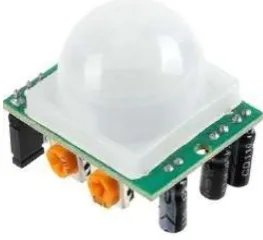
A PIR Sensor or a Passive Infrared Sensor is an electronic device that measures the infrared (IR) light emitted by the objects in its observable area. The term ‘Passive’ in the PIR
Sensor indicates that the sensor actually doesn’t emit any infrared light but rather passively detects it that is
emitted by its surrounding objects.
Fig. 3: PIR Sensor
2.4
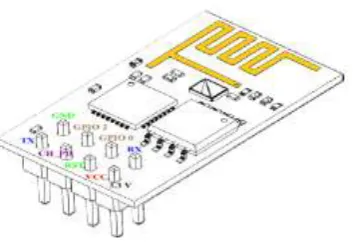
ESP 8266 Wi-Fi moduleThe ESP8266 is a low-cost Wi-Fi microchip with full TCP/IP stack. This small module allows microcontrollers to connect to a Wi-Fi network and make simple TCP/IP connections using Hayes-style commands. The pin connection is as follows for the common ESP-01 module:
1. VCC, Voltage (+3.3 V; can handle up to 3.6 V) 2. GND, Ground (0 V)
3. RX, Receive data bit X 4. TX, Transmit data bit X 5. CH_PD, Chip power-down 6. RST, Reset
[image:2.595.366.498.369.489.2]© 2019, IRJET | Impact Factor value: 7.211 | ISO 9001:2008 Certified Journal
| Page 3225
Fig. 3: PIR Sensors2.5 IR sensor
An infrared sensor is an electronic device that emits in order to sense some aspects of the surroundings. An IR sensor can measure the heat of an object as well as detects the motion.
2.6 LDR
A Light dependent resistor or photo resistor is a light-controlled variable resistor. The resistance of a photo resistor decreases with increasing incident light intensity. An LDR is a component that has a (variable) resistance that changes with the light intensity that falls upon it. This allows them to be used in light sensing circuits.
2.7 LED
A light-emitting diode (LED) is a semiconductor light source
that emits light when current flows through it. Electrons in the semiconductor recombine with electron
holes, releasing energy in the form of photons.
3. SYSTEM DESIGN
The involvement of smart and efficient system helps in improving the overall service reliability and functioning of the system. The development of smart lighting will help to achieve energy saving goals and also lead to reduction of operational costs. This also serves as a platform for IOT applications. Although these smart lighting systems provide many useful advantages over normal lighting but these also have few drawbacks. Some of which are mentioned below.
1. They can be difficult to control.
2. Users end up micro-managing the systems.
3. Users require basic knowledge about the smart system.
4. Installments require skilled personnel. 5. Bug in software application.
These problems can be minimized by acquiring proper knowledge about the system from manufacturers to users
and also installers. Updating the applications in regular interval of time can reduce the bugs and make it malware free. Proper maintenance of the circuit and regular checks by a skilled person can diminish the chances of faults occurring as well.
Most importantly, updating the circuit with new technology whenever some new part is manufactured or brought up in the market.
3.1 Block diagram
Fig. 4: Block diagram
[image:3.595.319.556.240.423.2]© 2019, IRJET | Impact Factor value: 7.211 | ISO 9001:2008 Certified Journal
| Page 3226
Second part of the project involves the major half whichis Intelligent lighting system itself. Here PIR sensors come into picture, these sensors detect the heat emitted by humans, initially when there is no human present OUT pin stays LOW. As the person enters the room, the change in infrared radiation in the room is detected by the PIR Sensor. As a result, the output of the PIR Sensor becomes HIGH. Since the Data OUT of the PIR Sensor is connected to Digital Pin 8 of Arduino, whenever it becomes HIGH, Arduino will activate the relay by making the relay pin LOW (as the relay module is an active LOW module). This will turn the Light ON. The light stays turned ON as long as there is movement in front of the sensor. If the person takes a nap or leaves the room, the IR Radiation will become stable (there will be no change) and hence, the Data OUT of the PIR Sensor will become LOW. This in turn will make the Arduino to turn OFF the relay (make the relay pin HIGH) and the room light will be turned OFF. We have such three PIR sensors connected to three bulbs working with same mechanism. The use of LDR helps in making this project more energy efficient, as the LDR detects light present in the surrounding and if the LDR gives reading below threshold then only the Light will turn ON. The arduino shares this data to Blynk application via ESP8266 which creates a Wi-Fi network for the system. The application shows the status of all the bulbs whether a bulb is ON or OFF.
3.1 Circuit diagram and features
[image:4.595.370.497.159.349.2]The circuit shown below is a basic connection of this project [8]. This project uses similar connections but improvisation has been made to make this a smart automated lighting system. This circuit is extended and implemented using Wi-fi module and mobile app. This is the basic structure of the project which shows glowing of bulb whenever there is any movement in front of the PIR sensor.
Fig. 5: Circuit diagram [8]
Blynk is a smartphone application that allows you to easily create "apps" that interact with Internet-connected hardware [7]. It works with a wide variety of hardware platforms, including the Photon, Raspberry Pi,
[image:4.595.320.576.416.547.2]Arduino/Ethernet Shield, and, of course, the ESP8266. The picture below shows the first page of application. This application is built for smart lighting which shows user all the data.
Fig. 6: Blynk app
[image:4.595.42.283.545.684.2]The actual interfacing of project, series of PIR sensors are connected to relays and ESP8266 module is shown in figure 7.
Fig. 7: circuit implementation
4. RESULTS
© 2019, IRJET | Impact Factor value: 7.211 | ISO 9001:2008 Certified Journal
| Page 3227
5. FUTURE SCOPE
The good part about IOT is that upgrades can be made easily on the project, further advancements that can be done on this project are large in number, few of them are
1. Controlling the intensity of light.
2. Controlling the usage period or timer based lighting. 3. Create application which generates graphs of
energy conserved.
4. Showing ratio of energy used per energy saved to users.
5. Same application can be used to control other devices such as heaters, fans, etc.
6. CONCLUSION
The Intelligent lighting system project discussed above shows prominent advantages and can be implied in day to day life usage at small scale as well as large scale purposes. This system provides us with extra cushion of user friendly and technology updated service to the user. With smart lighting users can change color or brightness in every room and even control them from a smart phone from anywhere in the world. This system also can be used to count number of persons entering and leaving the classrooms and mall. Thanks to smart lighting units and intelligent management systems to control them, cities benefit from lowered energy consumption, this brings economic and environmental benefits.
REFERENCES
[1] Ms. M. Kokilavani, Dr. A. Malathi, “Smart street light
system using IoT,” Inter national Journal of Advanced Research in Applied Science and Technology,” vol. 3, No.11 pp. 8–11, November 2017.
[2] Abhishek N Vaghela, Bhavin D Gajjar, Subhash J Patel,
“Automatic Switch using PIR Sensor,” IJEDR Volume 5, Issue 1 ISSN: 2321-9939 Clarendon, 2017, pp.696–698.
[3] Maxim Chernyshev, Zubair Baig , Oladayo Bello, Sherali
Zeadally, “Internet of Things (IoT): Research, Simulators, and Testbeds,” IEEE Internet Of Things Journal, vol. 5,
no. 3, pp. 1637–1647, June 2018.
[4] T. Indeevar Reddy, Akhila Nalluri, Kishore Bhamidipati, M.Sri Lakshmi, “Home automation of lights & fans using
IoT,”International Journal of Pure and
AppliedMathematics, vol. 116, No.5, 2017, pp. 127–131.
[5] Mohamed Abd El-Latif Mowad, Ahmed Fathy, Ahmed
Hafez, “Smart home automated control system using android application and microcontroller,” International Journal of Scientific & Engineering Research, vol. 5, Issue 5, May 2014, pp. 935–939.
[6] Lucio Ciabattoni, Alessandro Freddi, Gianluca Ippoliti,
Maurizio Marcantonio, Davide Marchei, Andrea Monteriu and Matteo Pirro, “A smart lighting system
for industrial and domestic use,” IEEE International Conference on Mechatronics , 2013, pp. 126–131
[7] Anusha Rao, Akash Konnur, “Street Light Automation
System using Arduino UNO,” International Journal of Innovative Research in Computer and
Communication Engineering,vol.5, Issue 11, November 2017, pp. 16499–16507.
[8] Karthikeyan.R.A, Saran Sriram.K, Piyush. D, “Automatic Lighting Using Arduino and PIR Sensor,” International Journal of Computer Science Trends and Technology, vol.6, Issue 5, Sep-Oct 2018, pp. 58–60.
![Fig. 5: Circuit diagram [8]](https://thumb-us.123doks.com/thumbv2/123dok_us/9324935.434435/4.595.370.497.159.349/fig-circuit-diagram.webp)
