© 2016, IRJET | Impact Factor value: 4.45 | ISO 9001:2008 Certified Journal
| Page 2920
Design and Development of Modified Air Cooler
and Storage System
J.Sabari priyan
a, S.Sakthivel
a, K.Sowndar Rajan
a, S.Rajavel
b*a
(UG Scholar, Gnanamani College of Technology, Namakkal, Tamilnadu, India)
b*(Assistant professor, Gnanamani College of Technology, Namakkal, Tamilnadu, India)
---Abstract- The “modified air cooler and storage system” is a type of conventional air cooler which is used for providing room cooling as well refrigeration systems. The system consists of a lower tank which is a mud pot whose outer periphery is filled by sand slurry. The lower tank and the slurry are held by a larger mud pot, i.e., a pot-in-pot system. The lower tank is filled with water and it is connected to the upper tray through a pump. The water in the upper tray is passed through a cooling pad which is used for absorbing the water. A fan is fixed next to the cooling pad and is followed by a vent system. The tray also has another port which is connected to the cold storage box. Hence providing the right temperature for storage of perishable items.
Keywords - Evaporative Cooling, Heat Transfer, Air Cooler, Pot System.
I. INTRODUCTION
India is a tropical country in which most of the regions experience very low temperatures during the winter and very high temperatures during the summer seasons. That is, the temperature range between summer and winter seasons is very large. Hence, it is not a very pleasant experience and highly uncomfortable. Though cheaper methods of heating are available during the winterseason, methods of cooling down the hot temperatures during the summer do not have wide variety of options. Air conditioners have high initial and running costs, which cannot be afforded by all the people in a developing country like India. Air coolers are relatively cheap, but provide unsatisfactory results; there is a need for developing a cheaper room cooling system. Conventional air conditioning is one of the major contributors of CFCs into the atmosphere. An alternative type of cooling, which does not expel CFCs is highly desirable as one important step in the correction of this problem. 1So, this is why adiabatic cooling is environmentally friendly because it is a passive cooling method that does not expel CFCs. It is 100% fresh air-cooling which even helps to clean the air it cools. With the help of Evaporative Technology swamp coolers provide cooling at cheaper than central air or larger air conditioners.
A Regenerative type evaporative cooler cools air [1] using a heat exchanger in addition to the direct evaporative method of cooling. It is observed that the overall efficiency of the system and the COP increase by about 20-25% than the normal air cooler system but the initial and maintenance costs of the system are increased due to the addition of a heat exchanger and a pump. The size of the system also increases due to the addition of more components.
A multi- utility desert cooler [2,3] is one in which water cooling as well as cold storage systems are attached in addition to the air cooling system. The average effectiveness was found to be 65.42% and a temperature range of 22-27o C was achieved. It can be used only in areas with high temperature and low relative humidity hence reducing its scope.
© 2016, IRJET | Impact Factor value: 4.45 | ISO 9001:2008 Certified Journal
| Page 2921
hence can be used as a vital element in the air coolingsystem.
Hence, it is proposed to build an air cooler which provides better room cooling in addition to providing a cold storage box for refrigeration purpose at a cheap initial, running and maintenance
costs which will meet the demands of a large section of the society who find it difficult to bear the hot temperatures
II. DESIGN MODEL AND COMPONENTS OF THE SYSTEM
The size and capacity of an air cooler and storage system is mostly determined by:
The size of the room to be cooled by the system. The volume of items to be stored in the cold
storage box.
The temperature preferred inside the room to be cooled.
A) Parameters affecting the rate of cooling
As the cooling process occurs by evaporative cooling, the rate of cooling is dependent on a number of factors which are stated below.
Porosity of the mud pot. Atmospheric temperature. Atmospheric humidity.
Temperature of the water supplied. Velocity of air.
In the above stated factors, though certain factors such as velocity of air, porosity of the mod pot can be controlled by the user, the rest are entirely dependent on the environment. These parameters affect the rate of cooling of the room and the cold storage box but they are independent of any internal factors and cannot be controlled.
The designs model in fig. 1shows the various components of the modified air cooler cum storage system.
Figure: 1 Components of Modified Air Cooler cum Storage System
B) Components of the System
The main components of modified air cooler cum storage system are Lower tank ( Pot-in-pot system), Pump, Cooling pad, Electrical fan, Vent system, Dehumidifier, Cold storage box and Connecting pipes.
C) Lower tank (Pot-in-pot system)
© 2016, IRJET | Impact Factor value: 4.45 | ISO 9001:2008 Certified Journal
| Page 2922
D) Cold storage box
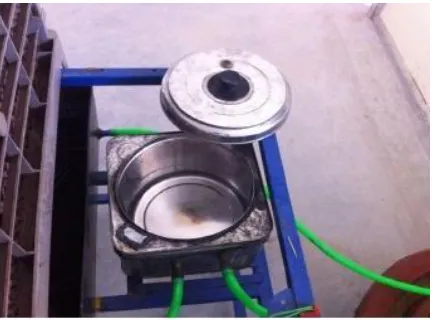
[image:3.612.326.540.157.299.2]A cold storage box is provided for getting cooling effects. It is used for storing perishable items. It is made of steel material as it has good thermal conductivity. It is a hollow box and the cold water is made to flow in the hollow space. One face of the box has a door from where the box can be filled. The capacity of the box is 15-20 liters. The cold storage box is converted by a thermocollyor to avoid a heat losses
Figure: 2 Cold Storage Box
III. WORKING METHODOLOGY
The modified air cooler cum storage system consists of two tanks, i.e. an upper tank and a lower tank. The upper tank is made up of plastic material and the lower tank is a pot-in-pot system. The lower tank is made of mud pots because the porosity of the mud absorbs the water and helps in evaporative cooling process. The mud pot has its outer periphery is filled by sand slurry. The lower tank and the slurry are held by a larger mud pot. The lower tank is filled with water and it is connected to the upper tank through a pump. As the system is small, a pump of 0.5 HP is enough to run the system. The water in the upper tank is passed through an cooling pad which is used for absorbing the water. Aspen material has high saturation efficiency and cooling capacity and hence can be used in the air cooler system. A fan is fixed next to the cooling pad and is followed by a dehumidifier layer and a vent system. The vent system is used for directing the air flow into the room and the dehumidifier is used for absorbing the moisture from the cool air. The dehumidifier is usually calcium tube or silica gel. The upper tank is also has another port which leads to the cold storage box. The cold storage box is made up of steel as it has high thermal conductivity. The box is hollow in nature and the water circulates throughout the layers of the box and returns
[image:3.612.37.254.225.385.2]back to the lower tank. The components are connected to each other by the help of connecting pipes which are made of polymers to avoid heat losses. Fig. 4 shows the fabricated working model of the proposed system.
Figure 3: Fabrication model
Figure 4: Working of Modified Air Cooler cum Storage System
When the system is switched on, the pump and the
electrical fan start running as they are the only components utilizing power in the system. The water in the lower tank is pumped to the upper tank by the positive displacement pump. The water then reaches upper tank and it then flows into the cooling pad. The cooling pad absorbs the water particles coming from the upper tank. The surrounding air particles absorb the chillness of the water particles. The fan which is
[image:3.612.327.535.333.529.2]© 2016, IRJET | Impact Factor value: 4.45 | ISO 9001:2008 Certified Journal
| Page 2923
low temperature and not moisture. The air is then flown inthe required direction by the vent system. The vent system is used for passing the air in the required direction and not blindly into the room. On the other side, water also flows towards the cold storage box and flows around the hollow box. As the box is made of steel, the box gets chilled and it can be used for storing perishable items. The water then returns back to the lower tank and the cycle is repeated. By using this system, room cooling can be done effectively than a normal air cooler and cheaper than an air
conditioner with addition to providing a storage system
IV. RESULTS AND DISCUSSION
The experimentation is carried out to record
observations in a 960 cubic feet room for five hours in Coimbatore, India on 20th and 21st March 2014. Properties and dimensions of the room considered for experimentation is
The flooring is concrete.
Two sides of the room are covered by concrete walls.
Two sides of the room are covered with glass insulation.
The ceiling is covered by thermocole layer.
S.NO CONDITIONS TEMPERATURE
1 Room
Temperature
37
2 Temperature of
water in earthen pot
33
3 Temperature
inside storage box
[image:4.612.318.558.132.305.2]35
Table 1:Initial conditions
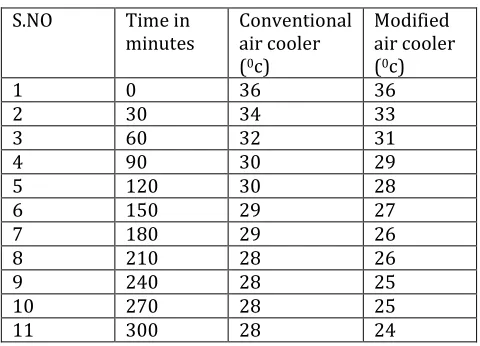
S.NO Time in
minutes Conventional air cooler (0c)
Modified air cooler (0c)
1 0 36 36
2 30 34 33
3 60 32 31
4 90 30 29
5 120 30 28
6 150 29 27
7 180 29 26
8 210 28 26
9 240 28 25
10 270 28 25
11 300 28 24
Table 2: Comparison of Room Temperature using Conventional Air Cooler and Modified Air Cooler
It is observed from table 2 that in five hours the room temperature decreases from 36°C to 28°C by using conventional air cooler, in last two hours the temperature of room remains constant at 28°C. While using modified air cooler the room temperature decreases up to 24° C, which is 4°C less than conventional desert cooler.
S.N
O Time in minut es
Conventio nal pot (°C)
Pot-in-pot system(°
C)
1. 0 33 33
2. 30 30 29
3. 60 28 27
4. 90 27 26
5. 120 26 25
6. 150 26 24
7. 180 25 23
8. 210 24 22
9. 240 24 22
10 270 23 21
11 300 23 21
© 2016, IRJET | Impact Factor value: 4.45 | ISO 9001:2008 Certified Journal
| Page 2924
From table 3, it is observed that in five hours the watertemperature decreases from 330c to 230c by using conventional pot. While using pot in pot system, the water temperature decreases up to 210c , which is 20c. less than conventional desert cooler
S.No Time in
minutes
Temperature in storage box (°C )
1. 0 35
2. 30 32
3. 60 30
4. 90 28
5. 120 27
6. 150 26
7. 180 25
8. 210 25
9. 240 24
10. 270 24
11. 300 24
Table 4: Change in Temperature inside the Storage Box with Respect to Time
From table 4, it is observed that the temperature inside the storage box decreases from 35°C to 24°C within five hours. This temperature is suitable for storing perishable food items
V. CONCLUSION AND SCOPE FOR FUTURE WORK
\ A. Conclusion
The “Modified air cooler cum storage system” provides both air cooling as well as cold storage systems. It provides better cooling effects than a normal air cooler and consumes lesser energy than air conditioners. That is, the temperature of 4o-5o C less than the conventional coolers is obtained where as a temperature range of 6o-80 C more than the air conditioners is obtained. It is very energy efficient as only the fan and pump require electricity. On running for 5 hours, 0.8 kWh of energy is consumed. It also has a very low initial, running and maintenance costs which is very appreciable. It can be very useful in tropical countries like India which have high temperatures and humidity during the summer.
B.Scope for Future Work
In this project, parameters such as room cooling and provision of cold storage box for storing perishable items were done. Optimization of the working parameters can be done in order to produce an effective and efficient system.
REFERENCES
[1] J.K..Jain and Hindoliya D.A, “Development and Testing of Regenerative Evaporative Cooler”,International Journal of Engineering Trends and Technology, Vol.3, No. 6, Pp 694-697,2012.
[2] M.P.Poonia, A.Bhardwaj, Upender Pandel and A.S.Jethoo A.S, “Design and Development of Energy Efficient Multi-Utility Desert Cooler”, Universal Journal of Environmental Research and Technology, Vol. 1 Pp 39-44, 2011.
[3]B.Chandrakant, Kothare and NitinB.Borkar, “Modified Desert Cooler”, International Journal of Engineering and Technology, Vol.3, No.2, Pp 166-172, 2011.
[4] Ndukwu Macmanus Chinenye, “Development of Clay
Evaporative Cooler for Fruits and
VegetablesPreservation”,AgriculturalEngineering
International: CIGR Journal Manuscript No.1781. Vol. 13, No.1, Pp 1-8, 2011.
[5] Farhan A. Khmamas, “Improving the environmental cooling for air-coolers by using the indirect-cooling method”, ARPN Journal of Engineering and Applied Sciences, Vol. 5, No. 2, Pp 66-73, 2010.
[6] R.K.Kulkarni and S.P.S.Rajput, “Comparative performance of evaporative cooling pads of alternative materials”, International Journal of Advanced Engineering Sciences and Technologies, Vol.10, No. 2, Pp 239–244, 2011.
[7] Sirelkhatim K. Abbouda and Emad A. Almuhanna, “Improvement of Evaporative Cooling System Efficiency in Greenhouses” International Journal of Latest Trends in Agriculture & Food Sciences, Vol. 2, No. 2, Pp 83-89, 2012.