Volume 7 | Issue 3
Article 3
1916
Grading Intelligence by Years and by Points
Warren W. Coxe
Follow this and additional works at:
https://scholarlycommons.law.northwestern.edu/jclc
Part of the
Criminal Law Commons
,
Criminology Commons
, and the
Criminology and Criminal
Justice Commons
This Article is brought to you for free and open access by Northwestern University School of Law Scholarly Commons. It has been accepted for inclusion in Journal of Criminal Law and Criminology by an authorized editor of Northwestern University School of Law Scholarly Commons.
Recommended Citation
WARREN W. CoxE.
The Binet-Simon Scale for the measurement of intelligence has
become the subject of much professional, as well as popular,
criti-cism. While the scale is being used more and more widely, yet the
results are more often discredited than ever before. This paper has
been written to review the published results of giving the scale, to
examine criticisms which have been made of it and to compare it
with the Yerkes Point Scale.
The incident which was originally responsible for the
formula-tion of the Binet-Simon Scale was the order from the Minister of
Public Instruction of Paris to the effect that all entrants into the
schools for subnormals must be given an examination to test their
deficiency.
Professors Binet and Simon had been carrying on
ex-tensive experiments with tests for children, and upon them devolved
the task of constructing the scale.
The first scale
s, 1905, consisted of thirty tests, arranged in order
of difficulty. By its use, the examiner was enabled to classify
defec-tives, but could not determine the age levels. After using these tests
for three years, Binet and Simon constructed the Scale of 1908.4 All
we know about the methods used in constructing the scale is that the
authors drew from their experience, putting tests at the different ages
which the majority of children could answer.
Systematic
experi-mentation for the purpose of constructing a scale seems to have been
lacking.
The Scale of 1908 increased the number of tests and grouped
them by ages, differing from the scales we are using in that the
num-ber of tests for each age was not always the same-year thirteen had
three tests and year seven had eight. Each test in year seven would
thus have a value of one-eighth of a year, while each test in year
'Contributed
by Dr. H. C. Stevens, Director of the PsychopathicLabora-tory, the University of Chicago.
2
The University of Chicago.
3A. Binet and Th. Simon, "Mdthodes nouvelles pour diagnostic du niveau
intellectual des anormaux. L'An nee psychologique. 1905, 11:191-244.
Translation by G. M. Whipple in Manual of Mental and Physical Tests. Warwick & York. 1910.
4Alfred Binet and Th. Simon, "Le development de r'intelligence chez
thirteen would have a value of one-third of a year; yet in calculating
age every test was supposed to have a value of one-fifth of a year.
The subject was considered past an age when he answered correctly
all but one of the tests for that age, and was given one year additional
credit for every five tests answered correctly above this level. Some
examples will show what inaccuracies this led to. A child answering
all the tests through twelve years and two tests in year thirteen would
be called thirteen, but had he passed all but one in year twelve, and
all but one in year thirteen, he would be considered only twelve and
two-fifths years of age. The failure in this case to respond to one test
made a difference of more than half a year. Another child, answering
all the tests in year six; and five in year seven, would, by one method
of counting, be seven years old, and by another method it would be
necessary for him to answer two more tests to be called seven.
The 1911 Scale
5improved the manner of counting by putting five
tests in each year, and most revisions have followed that plan. A
notable exception is the new Stanford Revision," in which there are
six tests for each year, thus making it possible to figure mental age in
months rather than in fifths of years, and consequently easier to
com-pare with chronological age. The inaccuracies pointed out in the
previous paragraph are also avoided.
But the 1911 Scale does not seem to have been the result of any
systematic investigati6n, the authors making the scale more difficult
in the-lower part and easier in the upper part, in order, apparently,
to meet rising objections. Their replacement of the tests has not
proven in accord with experimentation.
Because of this careless
revising, Wallin prefers to use the 1908 Scale until we have more facts
upon which to base a change.
7The actual changes which were made
are not in accord with the data obtained by Goddard from giving the
tests to two thousand children.
8This is the most extensive
applica-tion of the scale which has ever been made, and involved the
examina-tion of children of an entire school system. The Scale of 1908 was
used. The six-year test, in which the child is asked to show the right
hand and left ear, is placed in year seven in the 1911 Scale. Goddard
5Alfred Binet, "'La mesure developpement de 1'intelligence chez les Jeunes enfants". Bull. de la Societe libre pour l'Etude psychologique de l'Enfant. 1911,
10and 11; 187-248. -.
6A complete guide is soon to be published. Record blanks can be obtained from the Stanford University Press, Stanford University, California.
7J. E. W. Wallin, "Re-averments Respecting Psycho-clinical Norms and
Scales of Development". Psychological Clinic, 1913, 7:89-96.
8H. H. Goddard, "Two Thousand Children Measured by the Binet-Simon
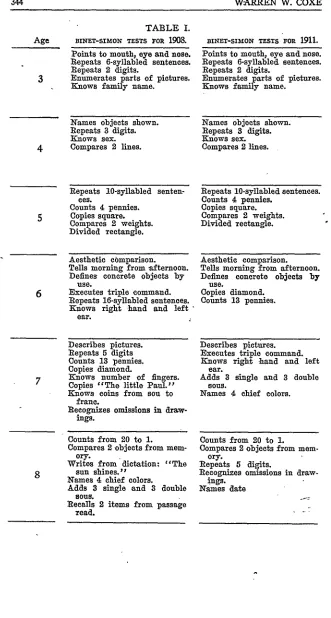
found that it was not too hard for the pupils of year six, eighty-one per cent passing the test. Binet changed the tests of weight discrimi-nation from the ninth year to the tenth, while Goddard found that eighty per cent passed the test in the ninth year, thus making the change needless. Another case is that of changing the test in which the child must recognize the various pieces of money, from the tenth year to the ninth. Goddard foundc that ninety-five per cent of the ten-year-olds and sixty-eight per. cent of the nine-year olds passed the test. If we accept Goddard's standard that a test is correctly placed if passed by seventy-five per cent of the subjects, then this test should not have been changed.
Furthermore, the 1911 Scale is very much inferior to its pre-decessor, in that tests are altogether lacking for certain ages, namely, eleven, thirteen and fourteen. This seriously affects the scoring. A subject answering all the tests for year ten and three for year twelve would be ten and three-fifths years of age. It would never be possible for him to be between eleven and twelve years old. Were there some-means provided to weight the tests for twelve and also for fifteen, the trouble would be partly obviated, but, as designed, one feels very uncertain of results in the upper part of the scale.
Age
TABLE I.
BINET-SIMON TESTS FOR 1908
Points to mouth, eye and nose. Repeats 6-syllabled sentences. Repeats 2 digits.
Enumerates parts of pictures. Knows family name.
Names objects shown. Repeats 3 digits.
Knows sex. 4 Compares 2 lines.
Repeats 10-syllabled senten-ces.
Counts 4 pennies.
5
Copies square. Compares 2 weights. Divided rectangle.Aesthetic comparison. Tells morning from afternoon. Defines concrete objects by
use.
6
Executes triple command. Repeats 16-syllabled sentences. Knows right hand and leftear.
Describes pictures. Repeats 5 digits
Counts 13 pennies. Copies diamond.
Knows number of fingers. Copies "The little Paul." Knows coins from son to
franc.
Recognizes omissions in ngs.
draw-Counts from 20 to 1.
Compares 2 objects from mem-ory.
Writes from dictation: "The
8
sun shines." Names 4 chief colors.Adds 3 single and 3 double sous.
Recalls 2 items from passage read.
BINET-SIMON TESTs FOR 1911. Points to mouth, eye and nose. Repeats 6-syllabled sentences. Repeats 2 digits.
Enumerates parts of pictures. Knows family name.
Names objects shown. Repeats 3 digits. Knows sex. Compares 2 lines.
Repeats 10-syllabled sentences. Counts 4 pennies.
Copies square. Compares 2 weights. Divided rectangle.
Aesthetic comparison. Tells morning from afternoon. Defines concrete objects by
use.
Copies diamond. Counts 13 pennies.
Describes pictures. Executes triple command.
Knows right hand and left ear.
Adds 3 single and 3 double
SoUS.
Names 4 chief colors.
Counts from 20 to 1.
Compares 2 objects from mem-ory.
Repeats 5 digits.
Recognizes omissions in draw-ings.
[image:5.612.66.397.59.677.2]WALMLN'S RMISION.
Points to eye, nose, mouth, hair.
Repeats 6-syllabled sentences. Repeats 2 digits.
Enumerates parts of pictures Knows family name.
Knows objects shown. Repeats 3 digits. Knows sex.
Compares two lines.
Repeats 10-syllabled sentences. Counts 4 pennies.
Copies square. Compares 2 weights Divided rectangle
Aesthetic comparison. Knows age
Tells morning from afternoon. Defines objects by use.
Executes triple command. Repeats 16-syllabled sentences.
Knows right hand and left ear.
Describes pictures. Repeats 5 digits. Counts 13 pennies. "
Copies diamond
Knows number of fingers. Copies "See little Paul." Knows coins from penny to
quarter.
Recognizes omissions in draw-ings.
Counts from 20 to 1.
Compares 2 objects from mem-ory.
Writes from dictation. Gives value of 3 lc and 3 2c
stamps. Knows colors.
Remembers 2 ideas from pas-sage.
GODDARDS REVISION.
Points to eyes, hair, nose, ears. Repeats 6-syllabled sentences. Repeats 2 digits.
Enumerates parts of pictures. Knows family name.
Knows objects shown. Repeats 3 digits. Knows sex.
Compares two lines.
Compares 2 weights. Copies square. Divided rectangle. Counts 4 pennies.
Knows right and left. Repeats 16-syllabled
senten-ces.
Aesthetic comparison. Defines by use. Triple command. Knows age
Knows morning from after-noon
Notes omissions in pictures. Knows number of fingers. Copies sentence.
Copies diamond. Repeats 5 digits. Describes pictures. Counts 13 pennies. Names 4 coins.
2 memories from reading. Adds small coins. Xnows colors.
Counts 20 to 1. Writes from dictation.
Age INET-SIMON TESTS FOR 1908. Definitions superior to use.
Makes change, 80 centimes from 1 frank.
Names date.
9
Recalls 6 items from passageread.
Recites days of the week. Arranges 5 weights
3 words in 2 sentences.
Solves 5 hard problem-ques-tions.
Recites months.
10 Knows all coins.
Solves 3 easy
problem-ques-,tions.
3 words in 1 sentence.
Defines abstract terms. Rearranges sentences.
11 Names 60 words in 3 minutes. Criticizes ' absurdities.'
Explains pictures. Repeats 7 digits.
Repeats 26-syllabled sentences.
3 rhymes in 1 minute.
12
Completion test.BINET-SIMON TESTS FOR 1911. Definitions superior to use.
Makes change, 80 centimes from 1 frank.
Recites months. Knows all coins.
Solves 3 easy problen-ques-tions.
0 words in 2 sentences.
Solves 5 hard problem-ques-tions.
Arranges 5 weights. Criticizes 'absurdities.' Copies drawings from memory.
3 words in one sentence.
Defines abstract terms. Rearranges sentences.
60 words in 3 minutes.
Resists line suggestion.
Cut and folded paper test. Juxtaposed triangles. Distinguishes abstract terms.
Explains pictures. Repeats 7 digits.
WALLIN'S REVISION.
Definitions better than use. Makes change 4c from 25c. Remembers 6 ideas from
pas-sage.
Knows days of week. Arranges 5 weights. Gives date.
3- words in 2 sentences.
Solves 5 hard problem-ques-tions.
Solves 3 hard problem-ques-tions
Gives months. Knows all coins. Repeats 6 digits.
3 words in one sentence.
Defines abstract terms. Rearrranges sentences.
Criticizes absurdities.
60 words in 3 minutes.
Repeats 26-syllabled sentence. Problem of diverse facts.
3 rhymes in 1 minute.
Repeats 7 digits.
Cut and folded paper. Juxtaposed triangles. Differences between abstract
terms.
WHIPPLE'S REVISION.
Knows date.
Gives days of week. Makes change 4e from 25c. Definitions superior to use.
6 memories from reading.
Names months. Knows all coins.
3 words in 2 sentences.
Hard problem-questions. Easy problem-questions.
SCriticises absurdities.
3 words in 1 sentence.
Gives 60 words in 3 minutes. Defines abstract terms. Rearranges sentences.
Repeats 7 digits. Gives 3 rhymes.
Repeats 26-syllabled sentence. Problem of diverse facts.
Cut and folded paper. Juxtaposed triangles.
Age BINET-SIMON TESTS FOR 1908.
Adult
Age GODDARD'S REVISION.
Points to nose, eyes and mouth. Repeats 6-syllabled sentences. Repeats 2 digits.
3 Enumerates objects in pictures Knows family name.
Knows sex.
Names objects shown. Repeats 3 digits. 4 Compares 2 lines.
Counts 4 pennies. Copies square. Compares 2 weights.
5
Divided rectangle.Repeats 10-syllabled sentences.
Aesthetic comparison. Tells morning from aftenoon. Defines objects by use. Executes triple command. Knows right hand and left
ear.
BIN-ET-SIMON TESTS FOR 1911. Cut and folded paper test. Juxtaposed triangles. Distinguishes abstract terms.
Distinguishes king and presi-dent.
Gives sense of selection read.
HUEY'S REVISION.
Points to eyes, nose and mouth or pictures of these. Repeats 2 digits.
Repeats 6-syllabled sentences. Enumerates objects in pictures. Knows family name.
Knows sex.
Names objects shown. Repeats 3 digits. Compares 2 lines.
Counts 4 pennies. Copies square. Compares 2 weights. Divded rectangle.
Repeats 10-syllabled sentences.
Aesthetic comparison.
Tells morning from afternoon. Defines objects by use. Executes triple command. Knows right hand and left
WALLIN'S REVISION.
PROPOSED SYSTEM OF TERMAN
AND CHILDS.
Names key, knife and coin. Enumerates parts of pictures. Repeats 3 digits.
Knows sex.
Compares 2 weights.. Problem questions.
Counts 4 pennies. Divided rectangle. Copies square. Aesthetic comparison. Defines by use.
Tells morning from afternoon. Names 4 chief colors. Executes triple command. Repeats 13-syllabled sentences. Vocabulary index.
Knows right hand and left ear.
Knows number of fingers. Counts 13 pennies. Repeats 4 digits.
Solves 3 easy problem-ques-tions.
Vocabulary index.
WHIPPLE'S REVISION.
KUHLMANN'S REVISION.
Enumerates objects in picture. Points to ears, eyes, mouth,
hair.
Knows family name. Repeats 6-syllabled sentence. Repeats 2 digits.
Knows sex.
Names objects shown. Repeats 3 digits. Compares lines.
Discrimination of forms.
Counts 4 pennies. Copies square. Compares 2 -weights. Divided rectangle.
Repeats 10-syllabled sentence.
Knows right hand, left ear,
right eye.
-Aesthetic comparison.
Tells morning from afternoon. Defines by use.
Age
7
GODDARD'S REVISION.
Describes pictures. Names 4 chief colors. Counts 13 pennies.
Notes omissions in drawings. Copies diamond.
Counts from 20 to 1. Compares 2 objects from
mem-ory.
Repeats 5 digits. Gives days of the week.
S
Adds 3 le stamps and 3 2c stamps.Definitions superior to use. Makes change.
Gives date. Repeats months. Arranges 5 weights.
3 words in 2 sentences.
Comprehends easy questions. Draws design from memory. Knows money.
10 Repeats 6 digits.
Criticizes 'absurdities.' Gives 60 words in 3-minutes.
3 words in 1 sentence.
Rearranges sentences. Gives 3 rhymes.
Repeats 7 digits. Defines abstract terms. Repeats 26-syllabled- sentences. Completion test.
12
Resists line suggestion.HUEY'S REVISION.
Describes pictures. Names 4 chief colors. Counts 13 pennies.
Notes omissions in drawings. Copies diamond.
Counts from 20 to 1.
Compares 2 objects from mem-ory.
Repeats 5 digits. Names days of week.
Adds 3 lc stamps and 3 2e stamps.
Definitions superior to use. Makes change 4c from 25c.
Gives date. Repeats months. Arranges 5 weights.
3 words ,in 2 sentences.
Solves 5 hard problem-ques-tions.
Solves 3 hard problem-ques-tions.
Copies design. Knows all coins.
3 words in 1 sentence.
Rearranges sentences. Gives 60 words in 3 minutes. Criticizes 'absurdities.'
3 rhymes in I minute.
AND CHILDS.
Describes pictures. Copies diamond. Names 4 coins.
Recognizes omissions in draw-ings.
Repeats 14 to 16-syllabled
sen-tences.
Vocabulary index 149o.
Counts from 20 to 1. Compares 2 objects from
mem-ory.
Writes from dictation, "The pretty little girl."
Repeats 5 digits. Vocabulary index 18%. Ball and field score 2
Names date. Arranges 5 weights.
Recalls 4 items from reading.
Adds 3 lc and 3 2c stamps. 50 words in 2 minutes. Vocabulary index 23%.
3 hard problem-questions.
Completion test. 3 words in 1 sentence. Repeats 6 digits.
Makes change 4e from 25c. Vocabulary index 26%. Completion test Score 20. Ball and field Score 3.
Interprets fables.
Copies design.
Solves 5 arithmetic problems. Solves 4 hard
problem-ques-tions
Completion test Score 25. Vocabulary index 30%. Interprets- fables;.
Sees points to five jokes. Rearranges sentences. Notes 4 of 5 absurdities. Recalls 7 items in passage
read.
Repeats 26-syllabled sentences. Resists line suggestion. Vocabulary index 36%.
IUHLMANN'S REVISION.
Describes pictures. Names 4 pieces of money. Knows number of fingers. Recognizes omissions in
draw-ings.
Repeats 5 digits.
Counts from 20 to 1.
Compares 2 objects from mem-ory.
Names months.
Adds 3 lc and 3 2c stamps. Copies diamond.
Definitions superior to use. Makes change.
Gives date Knows coins. Arranges weights.
3 words in 2 sentences.
Comprehends easy sentences. Draws design from memory. Counts dots.
Form board puzzle.
Criticizes 'absurdities.' Names 60 words in 3 minutes. Defines abstract words Rearranges sentences. Gives numbers to parts of
form."
Repeats 7 digits. Gives 3 rhymeg.
Repeats 24-syllabled sentences. Completion test.
Age G oDDARD'S REVISION.
Interprets pictures.
Interchanges hands of clock.
15 Code test.
Writes opposites of simple words.
Cut and folded paper. Juxtaposed triangles.
Adult Distinguishes abstract terms. Distinguishes president, and
king.
.Gives sense of selection.
HUEY'S REVISION.
Interprets pictures.
Interchanges hands of clock. Code test.
Writes opposites of simple words.
Cut and folded paper. Juxtaposed triangles.
Distinguishes abstract terms. Distinguishes president and
king.
PROPOSED SYSTEM OF TERMAN
AND CHILDS.
Repeats 7 digits. Interprets fables. Vocabulary index 42%. Arithmetic reasoning.
Completion test 36%. Problems of fact.
Reverses clock hands. Interprets fables. Interprets pictures. Vocabulary index Completion test Code test.
Reversed triangle.
Distinguishes president and king.
Ball and field Score 4. Completion test. Gives sense of selection.
KUHLMANN'S REVISION.
Reverses clock hands. Juxtaposed triangles. Distinguishes between
ab-stract terms.
Summarizes passage from memory.
Age BOBERTAG'S ARRANGEMENT.
Repeats 10-syllable sentences. Counts 4 pennies.
Copies square. Defines by use. Repeats 4 digits.
Aesthetic comparison. Executes triple command. Repeats 16-syllabled sentences. Divided rectangle.
Describes pictures.
Repeats 5 digits. Copies diamond.
Knows coins from 1 Pf. to
1 Mk.
Recognizes omissions in
draw-ings.
Knows right hand and left ear.
Counts 20 to 1.
Compares 2 objects from mem-ory.
Names 4 chief colors
Solves 3 easy problem-ques-tions.
Gives 1 point from newspaper reading.
STANFORD REVISION.
Points to parts of head. Repeats 6-syllabled' sentence. Repeats 3 digits.
Enumerates parts of pictures. Knows name.
Knows sex.
Names familiar objects.
Compares lines. Discriminates forms. Counts 4 pennies. Copies square. Problem-questions. Repeats 4 digits.
Repeats 12-syllabled sentence.
Compares 2 weights. Knows colors. Aesthetic comparison. Defines better than use. Divided rectangle. Triple command. Gives age.
Knows right and, left. Repeats 16-syllabled sentences.
Notes omissions in faces.
Counts 13 pennies. Easy problem-questions. Knows 4 coins.
Knows morning from after-noon.
Knows number of fingers. Describes pictures. Repeats 5 digits. Ties bow knot. Compares 2 objects. Copies diamond. Names days.
Repeats 3 digits backwards.
Ball and field Score 2. Counts 20 to 1. Problem-questions. Gives similarities. Defines superior to use.. Writes from dictation. Vocabulary index.
"Age BOBERTAG S ARRANGEMENT.
Defines by superordinates. Makes change 80 Pf. from
I Ik.
Explains pictures with help.
9 Names date. Arranges 5 weights.
3 words in 2-.sentences.
Knows all German coins. Reports 6 points in newspaper
reading.
10 Repeats 26-syllabled sentences. Repeats 6 digits.
Makes 1 sentence for 3 words. Defines abstract terms. Rearranges sentences. Criticizes ' absurdities.'
Explains pictures.
Give 3 rhymes in 1 minute. Completion test.
Solves hard problem-questions.
(3 successes count 1 year. 6 successes count 2 years).
12
STANFORD REVISION. Knows date.
Arranges 5 weights. Makes change.
Repeats 4 digits backwards. Adds 3 lc and 3 2c stamps.
3 words in 1 sentence.
3 rhymes.
Names months. Vocabulary index. Absurdities. Draws designs.
8 memories from reading. Problem-questions.
60 words in 3 minutes.
Repeats 6 digits. Repeats 22-syllables. Form-board. I
Repeats 5 digits backwards. Gives similarities of 3 things. Vocabulary index.
Defines abstract words. Ball and fileld.
Interprets fables. Rearranges sentences. Interprets pictures.
Vocabulary index. Induction test. Diverse facts.
Distinguishes president and
king.
Arithmetic reasoning. Reversed clock hands.
Age BOBE9TAG'S ARRANGEMENT. STANFORD REVISION.
Adult
Vocabulary index. Interpretation of fables, Distinctions between abstract
words.
Problem of enclosed boxes.
16
R~epeats 6 digits backwards.Code test.
Repeats 28-syllabled sentences. Comprehension of physical
relations. Vocabulary index. Cut and folded paper. Repeats 8 digits.
18
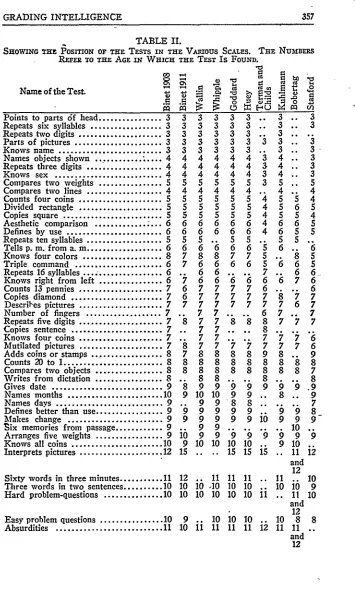
Gives sense of selection.SHOWING THE PosiTioN OF THE TESTS IN THE VAIZIOUS SCALES. THE NumBERS
REFEP TO THE AGE in WHICH T E TEST Is FOUND.
Name of the Test. .. .
o
.Points to parts df head ... 3 3 3 3 3
.2 . 2 -2
U
...
at.1 . . . .s .x. 0 0 .. .
Repeats two digits ... 3 3 3 3 3 3 3
Parts of pictures ... 3 3 3 3 3 3 3 3 .. 3
Knows name ... 3 3 3 3 3 3 3 .. 3
Names objects shown ... * ... 4 4 4 4 4 4 3 4.. 3 Repeats three digits ... 4 4 4 4 4 4 3 4.. 3 Knows sex ... 4 4 4 4 4 4 3 4 3
Compares two weights ... 5 5 5 5 5 5 3 5.. 5
Compares two lines ... 4 4 4 4 4 4 .. 4 4 Counts four coins ... 5 5 5 5 5 5 4 5 5 4 Divided rectangle ... 5 5 5 5 5 5 4 5 6 5
Copies square ... 5 5 5 5 5 5 4 5 5 4 Aesthetic comparison ... 6 6 6 6 6 6 4 6 6 5
Defines by use ... 6 6 6 6 6 6 4 6 5 5
Repeats ten syllables ... 5 5 5 .. 5 5 .. 5 5
Tellsp. m. froma. m ... 6 6 6 6 6 6 5 6 .
6
Knows four colors ... 8 7 8 8 7 7 5 "8 5
Triple command ... 6 7 6 6 6 6 5 6 6 5
Repeats 16 syllables... 6 .. 6 6 .. .. 7 6 6
Knows right from left ... 6 7 6 6 6 6 6 6 7 6 Counts 13 pennies ... 7 6 7 7 7 7 6 .. 6
Copies diamond ... 7 6 7 7 7 7 7 8 7 7 Descril-es pictures ... 7 7 7 7 7 7 7 7 6 7 Number of fingers ... 7.. 7 7 .. . 6 7.. 7 Repeats fivedigits ... 7 8 7 7 8 8 8 7 7 7
Copies sentence ... 7 .. 7 7 .. .. 8.
Knows four coins ... 7 7 7 7 7 7 6
Mutilated pictures ... 7 8 7 7 7 7 7 7 7 6
Adds coins or stamps ... 8 7 8 8 8 8 9 8 .. 9
Counts 20 to I ... 8 8 8 8 8 8 8 8 8 8
Compares two objects ... 8 8 8 8 8 8 8 8 8 7
Writes from dictation ... 8 .. 8 8 .. .. 8 .. 8
Gives date ... 9 8 9 9 9 9 9 9 9 .9
Names months ... 10 9 10 10 9 9.. 8.. 9
Names days ... 9 .. 9 9 8 8 77.. Defines better than use ... 9 9 9 9 9 9 9 9 8
Makes change ... 9 9 9 9 9 9 10 9 9 9 Six memories from passage ... 9 .. 9 9 .... .. .. .10
Arranges five weights ... 9 10 9 9 9 9 9 9 9 9
Knows all coins ... 10 9 10 10 10 10 .. 9 10
Interprets pictures ... 12 15 .... 15 15 15 11 12
and 12
Sixty words in three minutes ... 11 12 11 11 11 .. 11 .. 10
Three words in two sentences ... 1 0 10 10 -10 10 10 10 10 9 Hard problem-questions ... 10 10 10 10 10 10 11 .. 11 10
and 12
Easy problem questions ... 10 9 .. 10 10 10 .. 10 8 8
[image:18.612.42.397.30.619.2]TABLE II.
SHOWING THE POSITION 6F THE TESTS IN THE VARIOUS SCALES. THE NUMBERS
REFER TO THE AGE Ibi WHICH 'THE TEST IS FOUND.
00U
~Cd
-z - . U
Name of theTest. c. Cd 0
o
PA U o E Copies designed ...
10
0 10
1. ..10
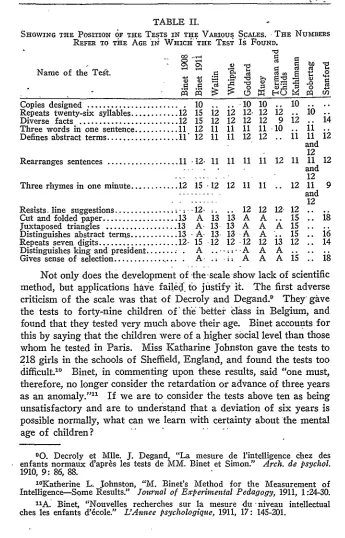
Repeats twenty-six syllables ... 12 15 12 12 12. 12 12 .. 10 Diverse facts ... 12 15 12 12 12 12 9 12 .. 14 Three words in one sentence ... 11 12 11 11 11 11 10 11 Defines abstract terms ... 11" 12 11 11 12 12 .. 11 11 12
and
12 Rearranges sentences ... 11 -12. 11 11 11 11 12 11 11 12
and 12
Three rhymes in one minute... 12 15 -12 12 11 11 .. 12 11 9 and
... 12
Resists, line suggestions ...
12
. .. 12 12 12, 12Cut and folded paper ... 13 A 13 13 A A .. 15 ..
18
juxtaposed triangles ... 13 A- 13 13 A A A 15
Distinguishes abstract terms ... 13 - A- 13- 13 A A -.. 15 ..
16
Repeats seven digits ... 12- 15 12 12 -12 12 13 12 .. 14Distinguishes king and president ... . A ...--.. A A A. ..
Gives sense of selection ... . A A A 15 ..
18
Not only does the development of -the-scale-show lack of scientific method, but applications have failed. t'o justify it. The first adverse criticism of the scale was that of Decroly and Degand.9 They gave the tests to forty-nine children of the" better class in Belgium, and found that they tested very much above their age. Binet accounts for this by saying that the children were of a higher social level than those whom he tested in Paris. Miss Katharine Johnston gave the tests to 218 girls in the -schools of Sheffield, England, and found the tests too difficult.'0 Binet, in commenting upon these results, said "one must, therefore, no longer consider the retardation or advance of three years as an anomaly."'" If we are to consider the tests above ten as being unsatisfactory and are to understand that a deviation of six years is possible normally, what can we learn with certainty about the mental age of children? .
90. Decroly et Mlle.
J.
Degand, "La mesure de l'intelligence chez des enfants normaux d'apr~s les tests de MM. Binet et Simon." Arch. de psychol. 1910, 9: 86, 88.'0Katherine L. Johnston, "M. Binet's Method for the Measurement of Intelligence-Some Results." Tournal of Experimental Pedagogy, 1911, 1:24-30.
"A.
Binet, "Nouvelles recherches surIa
mesure du -niveau intellectual [image:19.615.57.402.55.593.2]GRAPH I.-SHOVING THE DISTRIBUTION OF ALL AGES-TAKEN" TOGETHER.
-6 -5 -4 -3 -2 -1 0 1 2 3 4
GRAPH
II.-SHOWING THE DISTRIBUTION BY AGES.-3 -2
-1
0
1
Z
3
-3
-2
-1
Age 7.
23
-4
-3
-1
0
21
3
Age. 8
-4
-Zi
--3.
U 3
;~
,~Age 10.
-4
-3
-2
-I
0
1
2
3
-5
-4
-3
-2
-1
0
.1
2
&
13.
-5
-4
-3
-2, -i
0
-6
-5
-4
-3
-
-1
0
-A
I
-
-r-=
-6
-5
-4
-3
-2
-1
0
1
P
3
V----L___
V--The trained psychologists doii~f give the tests and interpret the
results with any degree of uniformity.- -They not only differ with regard to what tests should be included in the scale, but in the manner of giving. A number of examples might be cited, but the following show what is meant: The problem-question, "What's the thing to do if you have missed a train ?" is worded by American revisers in five different ways, and only one of these 12 makes explicit whether one is going away or coming home. There is even greater variation in stand-ards of correct response, especially in the following tests: Copying diamond, copying square, comparing two objects, definition's tests, tests asking for enumeration, description or interpretation of pictures, rearrangements of sentences, three rhymes in one minute, differences in abstract terms and differences between king and president.
It will always be impossible entirely to eliminate the "personal equation" in giving tests, but it is very desirable that it be as small a factor as possible. Because of a lack of a standardized method of giving the tests and because of the wide latitude possible in interpret-ing the responses, the "personal equation" becomes altogether too large a factor. The tests need to be made more objective.
Thus it will be seen that we are far from having a standardized scale-we are not agreed as to the tests which should be given in each year, nor are we agreed as to the method of giving them. After eight years of use, the results cannot be said to be gratifying. A rightly constructed scale ought to become more reliable and more accurate as the scale is administered to greater and greater numbers of chil-dren. Revisers have urged the use of a uniform system of giving and of scoring the tests, and the Informal Conference on the Binet-Simon Scale, meeting at Buffalo, urged the use of a standard scale, but we do not have such a standard today and we cannot with accuracy com-pare the results of different psychologists.
Some have expressed doubts as to the value of a statement of the mental age of the child, saying that it is of more use to know the stage of development of each of the mental capacities, or, as Pyle states: "It is more important, it seems to me, to know specifically the condition of the child with reference to the development of the separate mental traits than to know his average performance with respect to them all." 13 In none of our present scales do we have at -SF. Kuhlman, "A Revision of the Binet-Simon System for Measuring the Intelligence of Children," Journal of Psycho-Asthenics. No. v. Monograph
Supplement, 1912.
each age tests which represent the mental capacities of the child at that
age. Pyle'
14would have tests which would determine "the degree of
development of logical memory, rote memory, attention, imagination,
association and two aspects of mind more complex, learning capacity
and reasoning."
Where the scale has been applied, the results are not such as
would warrant the statement that the scale is satisfactory. The most
serious attempt to standardize the tests for each year has been made
by Goddard.
15He publishes the results for each test and for each
year. His conclusions as to the reliability of the tests are based upon
combined results of the whole experiment. Considering-the data thus,
he is able to present a distribution which approaches the normal curve,
as shown in Graph I. But the interest of the examiner is not in the
combined results, but in the results of each year. Plotting the curves
for the individual years, we have the distributions as given in Graph
II. It is noticeable that in the lower ages, the curve is skewed towards
the upper end, while in the upper ages the skewing is very markedly
in the other direction. Thus a lumping together of the results of all
t'he years results in a balancing which covers up the deviations from
the normal curve.
From what has thus far been said, it seems to the writer that
revisions based upon the plan of the Binet-Simon Scales are not going
to give us what we want-we need a scale based upon an entirely new
plan. The following is an attempted summary of what appears to be
the most important characteristics of such a scale:
1. It should be possible to make the scale more refined and
accurate with use.
2. It should furnish an accurate diagnosis of the intellectual level
of a child. In order to do this it will be necessary to establish norms
for each of the more important mental traits.
3.
It should make possible a grading by half-years, at least in
the lower years.
4. It should make more complete and more accurate the tests in
the years above ten.
5.
It should be based upori natural ability, not upon school
sub-jects or recent experiences.
6. It should 'be as little- affected as possible by the "personal
equation" of the examiner, and to this end should 'be made objective.
14W. H. Pyle, "A Suggestion for the Improvement and Extension of Mfental Tests." Journal of Educational Psychology, 1912, 3: 95-96.
,, '5H. H. Goddard, "Two Thousand Normil Children Measured by the
7. It must not be cumbersome to use.
8. It should be easily applied to different social classes and to
different nationalities as well as to both sexes.
The first man who attempted-to rectify-the fundamental weakness
of the Binet Scale was E. B. Huey. Before his death he constructed
a point scale, in which a selected number of tests were'used and a system of partial credits devised for the scoring. The tests, which
were selected, were not grouped by years, as in the Binet Scales, but
arranged in order of difficulty. Each
subject
was given all the tests
and the age level was determined by the number of points made.
Where confusion arose in the Binet tests because of the desire on the
part of the examiner to give credit for a partial response, here the
partial credit is granted. Where information gained from the child
in giving the Binet tests could not be used to the child's credit, here it
can be.
Since the death of Huey, the work has been taken up by Robert
M. Yerkes, James W. Bridges and Rose S. Hardwick; "A Point Scale
for Measuring M~ntal Ability"'
6is the result of their labors. This
scale attempts to test the following mental functions: Motor
Co-ordi-nation, perception (visual), discrimination (visual and kinaesthetic),
association, suggestibility, memory, imagination, judgment, analysis
and comparison and ideation. Twenty tests taken from the Binet
tests, are included in their scale, the answers being scored by points,
the highest total possible being one hundred. The authors summarize
the advantages of a point scale as follows:
"1. It is committed to no hypothesis as to the correlation
exist-ing between chronological and mental age, or between the different
mental functions at different stages of development.
"2.
It is capable of giving results of ever-increasing reliability
and precision as data accumulate and norms are established.
"3. The method of scoring-by subdivisions and partial
credits-affords a basis for fuller and more exact comparisons between
differ-ent individuals and between differdiffer-ent examinations of the same
in-dividual.
"4. It minimizes the influence of the personal equation of
the
examiner, reduces the number of doubtful cases and the time spent on
such-cases, and thus -favors the- standardization of the procedure and
makes for uniformity of results.
16Robert M. Yerkes, James W. Bridges and Rose S. Hardwick, A Point