ScholarWorks @ Georgia State University
ScholarWorks @ Georgia State University
Art and Design Theses Ernest G. Welch School of Art and Design
Summer 8-11-2011
A Journey towards Healing through Art
A Journey towards Healing through Art
Melanie J. Sgrignoli
Georgia State University
Follow this and additional works at: https://scholarworks.gsu.edu/art_design_theses
Recommended Citation Recommended Citation
Sgrignoli, Melanie J., "A Journey towards Healing through Art." Thesis, Georgia State University, 2011. https://scholarworks.gsu.edu/art_design_theses/90
A JOURNEY TOWARDS HEALING THROUGH ART
by
MELANIE SGRIGNOLI
Under the Direction of Melody Milbrandt
ABSTRACT
This qualitative study sought to answer: How may I, as an artist, use art for my own
transformation and healing? I am an artist and teacher living with chronic pain and fatigue and
wanted to find healing through art and inspire others to do the same. During the three month
study, I made artwork, reflected in my journal, and practiced guided imagery. The journal was
used to reflect on my health, the creative process, and to record ideas generated through guided
imagery. Findings showed that short term relief was provided during the act of creation, but no
long-term relief was achieved. The primary conclusion was that I was able to use art for healing
and transformation, but only after experimentation and reflection. By adapting the creative
process to accommodate for my illness, I was able to include art making as part of a healthy life.
A JOURNEY TOWARDS HEALING THROUGH ART
by
MELANIE SGRIGNOLI
A Thesis Submitted in Partial Fulfillment for the Degree of
Master of Art Education
In the College of Arts and Sciences
Georgia State University
Copyright by
Melanie Sgrignoli
A JOURNEY TOWARDS HEALING THROUGH ART
by
MELANIE SGRIGNOLI
Committee Chair: Dr. Melody Milbrandt
Committee: Dr. Kevin Hsieh
Dr. Melanie Davenport
Mark Burleson
Electronic Version Approved:
Office of Graduate Studies
College of Arts and Sciences
Georgia State University
Table of Contents
List of Figures ... vi
Chapter I. Introduction ...1
Purpose of Study ...2
Review of Literature ...2
Chapter II. Methodology……….…...8
Method of Study……….…………...……….8
Definition of Key Terms….………..……...………..……….8
Art Therapy Techniques……….9
Journal Reflection……….…………10
Art Production as Research Methodology………12
Limitations of Study……….13
Chapter III. Development, Interpretation, and Reflection of Works…………...15
Description of Works………15
Masks……….15
Gifts……….………..….18
Meditative Drawing Scroll……….22
Milagros……….24
Mixed Media Painting………..………....…..27
Photographic Drawings………..30
Reflections on the Artistic Process………33
Meditation and Guided Imagery………34
Creativity and Imagination………37
Technology………..………..38
Mental Health……….44
Raising Awareness……….45
Chapter IV. Implementation and Educational Practice………..………49
Visual Verbal Journal………...………49
Guided Imagery and Imagination……….52
Art as Therapy in the Classroom………..54
Classroom Environment and Working Adaptations……….55
Chapter V. Conclusion and Recommendation………..59
Summary………59
Conclusions………..59
Recommendations………61
References………63
List of Figures
Figure 2.1 Daily Journal Entry Example………...11
Figure 2.2 Meditative Drawing Example from Journal………….………..….….13
Figure 3.1 Initial Mask Installation Layout………...…16
Figure 3.2 Untitled (Masks)……….……….17
Figure 3.3 Untitled (Masks) Detail………..…….18
Figure 3.4 Detail of Small Press-Mold Face Offerings……….……20
Figure 3.5 Needle and Thread Offering Sketch……….21
Figure 3.6 "Gifts"………...22
Figure 3.7 Untitled (Meditative Drawing Scroll)………..23
Figure 3.8 Detail of Drawing Scroll………..24
Figure 3.9 Detail of Nerve Receptor, Back, and Mantra Drawing………25
Figure 3.10 Detail of Punched Tin and Sewn Thread………26
Figure 3.11 "Milagros"………..………26
Figure 3.12 Detail of Mixed Media Painting……….………28
Figure 3.13 Untitled (Healing Painting))………..………….…29
Figure 3.15 Sewn Photo Strip Example……….31
Figure 3.16 Untitled (Body Drawings)………..………32
Figure 3.17 Journal Reflections……….34
Figure 3.18 Idea Map on Awareness from Journal………...……….47
CHAPTER I.
INTRODUCTION
Introduction
I have been living with pain, fatigue and discomfort as part of my daily life for fourteen
years now. After going from doctor to doctor, searching for clues and explanations, I was finally
diagnosed with fibromyalgia three years ago. Although having a diagnosis to validate my
complaints gave some small relief, every day is a battle to push through the pain and fatigue in
order to live a normal life that includes work, relationships, and leisure.
I have also been a highly creative person my entire life, always searching to create
something from what’s around me and seeking the satisfaction of problem solving through a
process to get to the final product. Since I began living with pain and fatigue, I have found that
every year it becomes more difficult to find the time, energy, and creativity necessary to create.
As of recently, it has been extremely difficult to balance my career as a middle school art
teacher, which would probably exhaust any healthy individual, my graduate coursework, and my
creative life, not to mention all other aspects of my life. I am typically so exhausted that even
the thought of drawing or sculpting makes me more tired!
When I began contemplating my area of thesis research, I knew that I wanted to push
myself to create again, to have the satisfaction of working through a process from beginning to
end and observing the final product, but I also knew I had to find a way to muster up the time
and energy to do so. I decided that my thesis research would be an introspective study,
Purpose of the Study
The purpose of the study was twofold. The first purpose was self-serving, I wanted to feel
better in general, in order to live a more fruitful and satisfying life, with art-making being a large
part of my life again. Second, I wanted my research to inspire others to strive for health and
healing through art, in hopes that art-making will serve as therapy for the artist, whether
professional or student.
My review of relevant literature uncovered very little prior documentation of an artist
using art for self-transformation and healing. For this reason, I felt that I was embarking on a
journey never before taken, or never before documented, and charting new waters to find the
possibilities and limitations of self- art therapy, done on and by a trained artist, but untrained as
an art therapist. The study investigates art therapy as self-therapy in order to answer the question:
How may I, as an artist, use art for my own transformation and healing?
Review of Literature
As I began my research on art therapy, most case studies I came across focused on the
benefits of art therapy for psychotherapy patients dealing with issues such as depression, trauma,
and loss. Art therapy has proven to be helpful in psychotherapy, but I wondered if it could be
useful in medical therapy? In this study my intent was to research the benefits of art in dealing
with chronic pain, defined by Pavlek (2007) as a “complex mind-body phenomenon that
simultaneously affects a person’s physical, mental, social, and emotional functioning” (p.1). I
hoped to also find documentation on the benefits of art therapy in medical situations to deal with
anxiety, pain, fatigue, and stress.
Medical art therapy is defined as “the use of art expression and imagery with individuals
medical treatment such as surgery or chemotherapy” (Malchiodi, 1993, p.3). Malchiodi defines
the first documented use of medical art therapy to have taken place in 1945 when Adrian Hill
conducted art therapy with hospitalized tuberculosis patients and documented improvements in
their conditions. Since then, due to increased interest in mind and body connections, medical art
therapy has continued to emerge as a tool for diagnosing and treating sick individuals. Medical
art therapy does not use art for explicit healing, but explores the mind body connection to
determine that if a patient feels better mentally, he will show improvements in physical health
and quality of life. According to Graham (1993) in Malchiodi, healing does not mean curing the
body, but instead refers to “becoming whole physically and psychologically” (p. 8). As this
definition of healing becomes more widely accepted, more medical art therapy programs are
being implemented in order to test the benefits of using art therapy, typically considered
psychological healing, to promote physical healing.
DeTommaso’s (2008) study on the effects of art on pain in a hospital setting, showed that
patients who were asked to contemplate a beautiful painting, as opposed to an ugly painting, or a
blank panel, while being administered short pain-inducing laser pulses described their pain levels
to be a third lower while viewing the beautiful artwork rather than the ugly one or the blank
panel.
Another study involving a clinical trial of art therapy with chemotherapy cancer patients,
sought to lower the patients’ anxiety, depression, and fatigue, in order to have a better quality of
life during treatment. The program used water-based media with trained art therapists guiding the
creative process and asking questions throughout, and patients showed a reduction in depression
and fatigue, although not necessarily anxiety (Atid, Bar-Sela, Danos, Epelbaum, and Gabay,
Barker (2006) quotes McNiff, past president of the American Art Therapy Association,
explaining that medical art therapy works because, “Expressing what you can’t or don’t want to
talk about through painting or sculpture opens new windows and helps you get to the core of
what’s going on.” (p. 98) She also cites a study done by Thomas Jefferson University in
Philadelphia that found that among female cancer patients, those who sculpted and sketched had
lower levels of pain, insomnia and stress, and another study by Northwestern Memorial Hospital
in Chicago that found that after four months of art therapy, a group of fifty cancer patients
experienced less drowsiness, pain, and lack of appetite.
Following the idea of learning to act in a conscious way and exploring the mind/body
connection, authors Birnie, Carlson, Hutchins, Labelle, and Marion (2009) researched
mindfulness-based interventions in a hospital oncology setting with cancer patients. They
provided guided group sessions of mindfulness meditation, which guides the patient towards
being more aware of internal and external experience, and also encouraged daily independent
mindfulness meditation. The results showed increased restful sleep, lower levels of fatigue and
lower levels of distress in patients after the intervention as compared with pre-trial results. More
importantly, patients who had participated in the study continued to show improvement in the
follow-up study done a year after intervention.
Rockwood Lane (2005) advocates for increased availability of art materials and art
therapy programs in hospitals. She believes that creativity leads to healing by changing a
person’s physiology and attitude from one of stress to one of relaxation, thus encouraging health.
She describes how some nurses keep art materials on their floor for patients to use, and that
although nurses are not trained art therapists, that they can learn more about the patient’s
also suggests having hospitals bring in artists to conduct workshops with patients, and to create
“views” within the hospital or areas of art where murals are created or patient work is displayed.
Florence Nightingale in Notes on Nursing is quoted by Rockwood Lane (2005) as being a nurse
advocate for creating healing environments by saying that “What nursing has to do is put the
patient in the best condition for nature to act upon him,” and according to research, that condition
is one of peace, relaxation, and beauty, which can be achieved through and with art (Lane, 2005,
p. 123).
Thus far all studies mentioned have focused on the use of art and art therapy for patients
who do not necessarily consider themselves artists nor have any formal art training, and the
therapy has been conducted by trained art therapists, or has been advocated by medical
professionals; therefore, someone outside the patient is providing the resources for the patient to
learn to heal him/herself. How does the process change when the artist is the patient seeking to
heal him/herself though art?
Kellman (2005), an art therapist herself, describes the story of an HIV patient whom she
had worked with in a hospital HIV/AIDS expressive arts group. The patient, although inspired to
make art due to the influence of the art therapist and the group, was also a trained artist, having
graduated from a well-known art school. This case study differs from others because although
the man became reengaged with art through the expressive arts group, he then began making
narrative artwork or “healing” artwork on his own that described the journey he had taken up to
this point, and his journey forth with HIV. Kellman believes that it was the narrative quality of
the work and the meaning-making inherent in the work that allowed the patient to overcome
Another author chronicled the journey of Dr. K, an art education professor and artist
battling chronic pain and fatigue due to CFIDS, Chronic Fatigue and Immune Deficiency
Syndrome, and his struggle to learn to adapt his creative life (Wiener, 2000). The author, an art
therapist, became interested in Dr. K’s case, as there had been little documentation of an artist
learning to heal with art. Through interviews, Dr. K described many of the changes that he had to
make in order to adapt to art-making with his illness, such as creating a handicap accessible
studio, accepting help through studio assistants with his work, and changing his routine to
accommodate for tired, foggy, and fuzzy- thinking mornings.
Most interestingly however, Dr. K completely altered his way of thinking about and
creating work in order to reap the most beneficial effects of the art-making process. His artistic
process before the illness was to conceptualize and intellectualize art pieces before, during, and
after creation. However, when creating art with CFIDs, he found it most beneficial to be
spontaneous, and create art for art’s sake. In fact, the author states that Dr. K thought that
spontaneous creativity was healing his spirit, therefore, contributing to health (Wiener, 2000, p.
276).
The artist didn’t want to paint his pain, preferring to use art as an escape, changing from
his old process of extremely detailed wood cuts, to painting bright, spontaneous floral
arrangements. Weiner (2000) references Sandblom (1996) to compare Dr. K’s situation to that
of the aging Matisse, who said “I can see that playing with color is something that I choose to do
because it takes me past the pain” (Wiener, 2000, p. 280). Matisse too, created more colorful and
more abstract works as he aged, changing his process from painting to cut paper collage. Dr. K’s
assuming he is willing to adapt his art just as he has had to adapt his life to accommodate for the
CHAPTER II.
METHODOLOGY
Method of Study
My goal in this thesis project was to create a body of work inspired by my journey
towards healing, and in the process, learn how to create work that is both uplifting in theme and
also beneficial to my mind and body in process. I hoped to answer my primary research question:
How can my art be used for transformation and healing of myself as an artist?
Definition of Key Terms
Chronic Pain- a “complex mind-body phenomenon that simultaneously affects a person’s
physical, mental, social, and emotional functioning” (Pavlek, 2007, p.1)
Fatigue- “Fatigue is extreme tiredness and an inability to perform everyday tasks with your usual
amount of energy”. (WebMd, Fatigue Directory)
Fibromyalgia- A complex chronic pain disorder and central nervous system illness that affects
people physically, mentally and socially, characterized by chronic widespread pain, multiple
tender points, abnormal pain processing, sleep disturbances, fatigue and often psychological
distress. (National Fibromyalgia and Chronic Pain Association, About Fibromyalgia)
Healing- “Becoming Whole physically and psychologically” (Graham in Malchiodi, 1993, p.8)
Guided Imagery- Refers to a wide variety of techniques where elements of the unconscious are
invited to appear as images that can communicate with the conscious mind (Academy for Guided
Imagery, What is guided imagery?)
Medical Art Therapy- “The use of art expression and imagery with individuals who are
physically ill, experiencing trauma to the body, or who are undergoing aggressive medical
Meditation- the practice of focusing your attention to help you feel calm and give you a clear
awareness about your life (Webmd, Meditation Overview)
Art Therapy Techniques
When I began planning my thesis research and studio work, I thought that my goal would
be to raise awareness about chronic pain through working with a group of people also living with
similar illnesses. However, as I continued to plan, I became increasingly more fatigued and ill
due to the stress of working full time, commuting, and balancing graduate coursework. My thesis
ideas started transforming as I began reading about guided imagery and meditation and became
excited about using these methods to create my own journey towards healing.
Guided imagery consists in some forms of envisioning your pain as a concrete object and
then envisioning the object or process that would eliminate the pain, in other forms as imagining
your healing or peaceful place and focusing on being in that place, and still in other forms, as
simply allowing the mind to wander and concentrating on the images produced in order to see
what they could reveal (Dachman, 1990; Davenport, 2009). I decided that guided imagery could
be a strong force in my own healing, and would lend itself entirely to creating artwork for
healing, by drawing, sculpting, or painting the imagery and ideas that arise.
I also desired to find a way of creating daily, even if I lacked the time and energy to
devote to working on an art piece. I recalled that as a child I would doodle, or create designs as I
called them, for hours on end, typically just drawing spontaneously and intuitively in black and
white with pencil or pen, enjoying and relaxing through the process and not allowing myself to
be concerned with the final product. I decided that if I made an effort to return to this way of
doodles as an artistic meditation, allowing myself at least a few minutes daily to create and find
peace in the creation.
Journal Reflection
The investigation was a qualitative self- study lasting three months, with daily journaling
and art-making; however, the actual body of work began before and continued after the three
month period. My process was documented through the body of work created, by daily
meditative drawings, and by daily journaling.
Throughout the three months of my thesis research, I began practicing visualization and
guided imagery meditations. Through the meditation sessions, I was able to achieve a more
peaceful state of mind, a reduction in pain and fatigue, and to uncover my personal healing
imagery.
I used my journal as a place to collect and preserve ideas and inspirations brought about
by the process of meditation, guided imagery, and daily creation. The daily meditative drawings
or doodles served as a working meditation, as I learned to draw for relaxation for at least a few
minutes daily. I tried to fill a page during each meditative drawing session with spontaneous
imagery and design. The journal was also used to narratively document my thoughts, feelings,
and symptoms. I planned to be spontaneous and flexible with my materials, processes, and
products, hoping to achieve the most healthful and therapeutic way of working possible, and
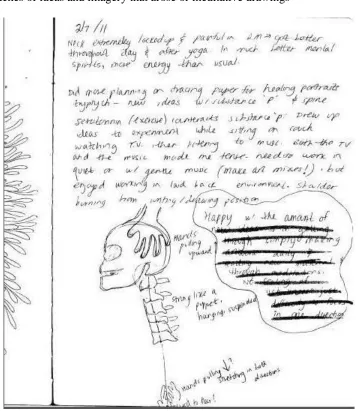
The consistent format that I used for my daily journal entry was as follows:
Date of entry
A few sentences or a paragraph on my health and well-being, both mental and physical,
along with a listing of any symptoms throughout the day
A few sentences or a paragraph reflecting upon visualization and guided imagery, artistic
concerns, products or processes, and artistic materials and techniques
[image:20.612.127.485.251.662.2] Sketches of ideas and imagery that arose or meditative drawings
After the three month research period of practicing visualization and guided imagery,
creating artwork daily, practicing meditative drawing, and recording and reflecting upon the
process in my journal, I reviewed the journal for patterns of thoughts and ideas that revealed
themselves to be beneficial for healing, as well as those that proved to exacerbate symptoms.
Art Production as Research Methodology
I first planned to sculpt exclusively in clay, as my artistic training and interest has been
mainly in ceramics; however, ceramic work can be very taxing on the body and in the past, I had
often found myself in more pain during and after sculpting than before. The same is true of
painting, at least on large canvasses and panels. As I embarked on this journey, one that could
possibly last my lifetime, but at least be documented for the length of my thesis study, I planned
to be spontaneous and flexible with my materials, processes, and products, hoping to achieve the
most healthful and therapeutic way of working possible. This could have meant that I continued
to work in a similar fashion to what I have always done, creating medium to large size sculptures
and paintings, as well as smaller doodle drawings, and adapting the process to make it less
harmful and more healthful. It could also have meant finding entirely new materials and
processes, and ways of thinking about my own work, allowing myself to be content with what I
am able to make, rather than always striving to achieve larger quantities, sizes, and more
masterful pieces.
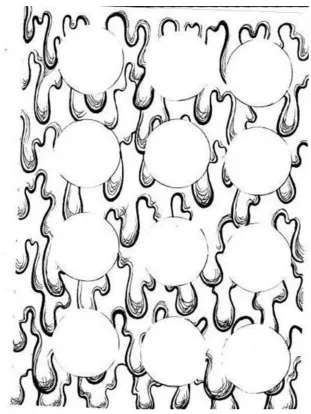
As I hoped that the doodle drawings would have a meditative effect, or at least knew that
they would cause little harm to my body, I planned to doodle or draw daily in order to achieve
my goal of daily creation (see figure 2.2). Depending on the day and restraints due to time and
energy, I wanted to allow the flexibility of drawing for only a few minutes or possibly for a more
Figure 2.2 Meditative Drawing Example from Journal
I wanted also, to leave open the opportunity to create based on what inspired me during
this journey towards healing, to allow my work to shift dramatically in style and content, and to
flow in whichever direction led more towards healing than harm.
Limitations of the Study
Because my journey was a self-study, with myself being the only active researcher as
well as participant, the findings are not generalizable to the general public or any special
creating, as well as increased enjoyment in the creative process, it proves only that the
techniques practiced were beneficial to me, not to any other persons. In order to generalize
findings, a more conclusive study would need to be conducted to incorporate a larger number of
participants as well as a control group. However, I hope that because the study resulted in a more
healthful life for me, others experiencing similar problems or symptoms may be inspired to
CHAPTER III.
DEVELOPMENT, INTERPRETATION, AND REFLECTION OF WORKS
Description of Works
I began my three month study of daily art-making with careful planning and sketching in
my journal, wanting to make sure that I had all my ideas in line before commencing. However,
my ideas began flowing more freely once I started art production, allowing for flexibility of idea
and material. Just as Dr. K had experienced when learning to make artwork while living with a
chronic pain and fatigue condition, I found it beneficial to work more spontaneously, allowing
for the artwork to be created and to find ideas and connections either mid-creation or
post-creation (Wiener, 2000). The result was a body of work created through the layering of images
and ideas related to body, mind, and health, using disparate art materials, yet finding aesthetic
connections between the various elements. I will explain the resulting works chronologically,
although there was a large amount of overlap while working on more than one piece at a time.
Masks.
My mask installation was the first of two ceramic installations that I planned and
executed. I sculpted about 50 masks from clay, varied in size from about three to six inches.
Each mask differs in emotion and symbolic colors were chosen to treat the surfaces in order to
portray the feeling of the faces more deeply.
My goal in creating the masks was to visually represent the various emotions that a
person living with chronic pain and fatigue goes through in a day. When living with pain and
fatigue, it is often necessary to feign that everything is fine, outwardly projecting a happy,
peaceful person, but inwardly feeling that you are being torn apart. The masks represented the
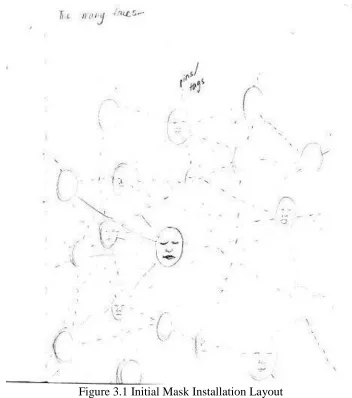
I began the piece by planning and sketching the installation arrangement of the masks. I
had desired to sculpt one mask that represented the utmost peace and happiness, having it stand
out from the rest by its facial expression as well as metallic glaze. This mask would have been
placed at the center of the installation, with all the others spiraled outward from it in a circular
arrangement. I then planned to connect the masks with either string or a dotted drawing on the
wall to create a spider web effect, showing that all the emotions are connected and ever-changing
[image:25.612.125.477.261.659.2](see Figure 3.1 below).
Figure 3.1 Initial Mask Installation Layout
After some experimentation with this installation idea, I felt that arrangement and connections
that the masks would better connect to my journey towards healing when displayed in a more
linear fashion depicting the various emotions one goes through when on a journey. I did not
however want the masks to be displayed in a straight line, as every person journeys through life
not in a straight line, but with ups, downs, and the occasional veering from the expected path.
Towards the end of the creation of the masks, I had also begun working on other pieces
involving body imagery such as blood vessels, nerves, and neurons. Many of these body images
include interesting lines of movement and paths throughout the body, and I wanted to use these
paths as a link to connect the art pieces of my journey. The result is that I plan to exhibit 44 of
the 50 masks in an organic line that splits off in different directions, referencing paths of
[image:26.612.78.537.346.591.2]movement within the body and through life.
Figure 3.3.Untitled (Masks) Detail
Gifts.
My “Gifts” was the second piece I began planning and sculpting during my journey, and
also the second of the ceramic installation works. Before planning this piece, I had been studying
and was able to view in person, Felix Gonzalez Torres’ Portrait of Ross, an interactive piece in
which the artist used 175 pounds of candy to represent the ideal weight of his deceased partner
when he was first diagnosed with AIDS. Viewers were able to take a piece of wrapped candy
from a large pile leaning against the wall and floor of the gallery. At the end of each day, the
remaining pile was weighed, and the lost weight was restored so that each day the installation
began anew with 175 pounds (The Art Institute of Chicago,
http://www.artic.edu/aic/collections/artwork/152961).
I was fascinated by Gonzalez’s ability to symbolize his partner through the profound idea
of his ideal body weight, but with a symbol as simple as a piece of candy. The use of the candy
made the piece seem more sweet and intimate, allowing the installation to become more
available and less intimidating to viewers,’ therefore, inviting them to participate. Through
sharing this candy with the world, Gonzalez was also sharing his love for his partner. I cannot
cathartic for Gonzalez, allowing for some small healing to take place through sharing Ross with
the public.
Gonzalez’s Portrait of Ross inspired me to create an interactive piece that would
stimulate healing in both the artist and the viewer and that installation became my “Gifts.” The
piece consisted of 10 ceramic arms, slightly smaller than life size, to be attached to a wall upon
exhibition. One set of five arms would contain offerings for the viewer to accept, as well as a
table below piled high with offerings. The other set of arms, to be displayed just next to the first,
would be empty, and the table below would be clear. Viewers would be asked to leave any
offering they choose.
Originally, I had planned only the offerings, hoping that I could find catharsis in making
others feel good, by offering those things that I find therapeutic in daily life. I struggled to find
symbols to represent those things that I could easily reproduce in multiples. Eventually, I settled
on the symbol of a face, which both tied in to the masks installation, but also represented the
need for human interaction and support in order to heal. I thought about how essential it is for me
to spend time with and to be understood and supported by those I love and those I am around.
The face symbol came to represent healing as well as the human interactive element of the piece.
I sculpted a small face from clay and then created a clay press mold from the original. The press
mold allowed me to produce the tiny ceramic faces very quickly, in order to have a few thousand
ready for the installation. Because the faces would not fit in the hands, I then created a table on
Figure 3.4 Detail of Small Press-Mold Face Offerings
In addition, I decided to hang red threads from the arms on the walls, providing a link
between this piece and others from my journey which incorporated red thread as a symbol of
body, blood, and vessels. At the bottom of each thread there is a needle tied on, and hundreds of
small drawings, cut out in circles from larger drawings, are threaded onto the string. The circles
were cut from my many meditative drawings, doodles done throughout my journey as a
meditative art practice. Viewers will be invited to not only take a small face from the table, but
also to carefully, without getting pricked on the needle, remove one of the drawings from the
thread. The needle represents physical pain, acupressure points used in the relief of fibromyalgia,
and also struggles in life. However, if the viewer participates and overcomes the obstacle of the
Figure 3.5 Needle and Thread Offering Sketch
I decided to include the receiving portion of the installation because I felt that people are
inherently creative and may offer mementos of healing that I would not have imagined. Also, the
act of giving can be just as cathartic for the artist as for the viewer. The receiving portion of the
installation was a replica of the offerings installation, except that upon exhibition, the table
below would be empty, and a bare thread and needle will hang from each arm. Viewers will be
invited to string something onto the thread or to leave an item on the table that they feel may
contribute to peace and healing.
I wanted this piece to have the look of a shrine, with meaningful colors and ritualistic
elements so that it would represent positive human interaction beyond the temporary installation.
The arms have been finished with rutile and black stain, and the small faces with black ink. Both
appear aged, or even burnt, as if recovered from antiquity. The wooden tables are stained almost
thread. I hope that during exhibition, the installation will appear both sacred but inviting, as the
[image:31.612.132.481.127.365.2]piece will only be successful in healing if viewers choose to participate.
Figure 3.6 "Gifts" by Melanie Sgrignoli, mixed media, installation 84" x 96"
Meditative drawing scroll.
Originally, I had planned to do some daily meditative drawing in my journal for the entire
three month study; however, I found it difficult to commit to drawing every day and especially at
a specific time of day, when I had so many projects going at once. I did draw in my journal
often, and especially before bed. I found the process calming, but had some physical struggles
with the process.
After a few weeks of the study, I decided that I might enjoy the drawings more in larger
format. I then began creating what I call a meditative drawing scroll, a continuous drawing done
in black ink on a ream of large white butcher paper. I worked by laying the paper out on the
Figure 3.7 Untitled (Meditative Drawing Scroll) by Melanie Sgrignoli, ink on paper, 36" x 120"
Due to the desired meditative quality of the drawing, I tried to work spontaneously and
avoided analysis of what I had drawn. I would begin with a certain motif, often circular or round,
and would allow the drawing to flow from the center out and then eventually across the page as I
rolled out more and more paper. Occasionally, I would get stuck and not know how to continue,
but rather than brainstorming and sketching as I usually would, I simply looked in my journal at
previous meditative drawings and borrowed elements in order to keep the drawing flowing.
Although technically, this drawing could go on until I had used the entire ream of butcher
paper, I had to find a stopping point in order to be able to display the work. I found that stopping
point about ten feet into the drawing. I then decided to cut around the edges of the motifs in order
to free the form from the confines of the rigid, rectangular paper. I also cut out small negative
spaces within the scroll to accentuate certain design elements and to create an overall, organic
appeal that reflected the natural process of creating the work.
As I finished the drawing scroll, I was also finishing my plans for the installation of the
“Gifts”, and had decided that I wanted to offer small drawings hung on threads. I then decided to
not only cut hundreds of small circles from my journal, but also from the meditative drawing
negative spaces left by the circles are geometric and contrast with the organic nature of the lines
used in the drawing. They provide peek holes though the scroll to the empty space behind,
suggesting the struggle between peace and unrest. In addition, if the installations are to be hung
as a body of work, viewers who are taking an offering from the hand may then figure that that
circle may have been cut from the displayed drawing scroll, and they may feel more a part of the
[image:33.612.168.447.235.423.2]healing ritual used to create it.
Figure 3.8 Detail of Drawing Scroll
Milagros.
My "Milagros" piece consists of five small framed, layered drawings, to be displayed
side by side together on a wall so that the five pieces make a whole, but can also be individually
investigated. The actual drawings to be displayed are reproductions of pencil and ink drawings
on tracing paper. I began this piece by doing some medical research about fibromyalgia, the
possible causes, shared symptoms, and healing therapies. I collected imagery pertaining to pain
signals, nerve cells, muscles, bones, and eastern medicine ideas such as acupuncture body maps.
At the same time, I had a series of photos taken of myself, many focused on the face, but others
I then simply started drawing images onto tracing paper, some using drawing pencils and
shading, and others using ink pens and nibs. I also filled pages with written mantras that I had
practiced in the past and present for healing, with the repetition of writing the mantras becoming
a meditation in itself. When I began to see idea links between the drawings, I experimented with
layering them on top of each other for visual effects as well as layered meanings. For example, a
drawing of my back may be layered with a drawing of the spine and nerve cells to represent the
pain experienced in that area. Some of the layered meanings are straightforward, and others are
[image:34.612.168.445.292.443.2]more abstract.
Figure 3.9 Detail of Nerve Receptor, Back, and Mantra Drawing
Although I enjoyed the visual aspects and the creation of meaning in the layered images,
I felt that they would be more powerful on a smaller scale in which the viewer could investigate
the details of each on a more intimate basis. After some experimentation and failure, I was able
to reproduce the images by scanning and shrinking them on the computer and printing. I would
have preferred that the finished pieces be original drawings, but would not have been able to
capture the same amount of detail working on such a small scale.
I had also been looking into the idea of framing the pieces in tin to look like Mexican
Milagros, small religious or spiritual images framed and decorated with sacred imagery. After
designs punched into the tin reflect the imagery in the drawings as well as other pieces from my
journey; nerve cell patterns, blood vessel lines, hints at bones, spines, and muscle fiber are all
included.
Because the tin was so disparate from the other materials in my body of work, I decided
to sew red thread through the punched designs in order to link it to the other installation pieces.
The result of the small layered drawings, framed in tin and stitched through with red thread is
reminiscent of the Mexican Milagros. Although the imagery reflects my journey and body
processes, the “Milagros” appear as spiritual relics that could be hung in a place of worship or
[image:35.612.199.413.319.400.2]healing.
Figure 3.10 Detail of Punched Tin and Sewn Thread
[image:35.612.103.512.436.679.2]Mixed media painting.
I created only one painting on canvas as part of my journey, almost as an afterthought. I
had needed a break from the various other pieces I was working on and decided to make use of a
large canvas I had lying around. Surprisingly, the painting allowed me to investigate completely
new processes and ideas and provided a link to some of the other pieces in the body of work.
I began by underpainting pastel yellows, violets, and pinks, using similar imagery to the
layered drawings, nerve cells and dendrites extremely magnified. Wanting to again experiment
with layering, but this time with paint rather than drawings, I then added layers hinting at a
person’s back and neck, spine, and muscle fibers in the shoulders. At this point, I decided to
allow the painting to be a complete experiment and to push the layering technique as far as I
could, including mixed media and three dimensional materials.
During a recent guided imagery session for pain relief, I had come up with the symbol of
sea urchins to represent my pain and sea stars as the relief symbol, as certain sea stars can digest
urchins. I pictured these giant sea stars roaming all over my body, engulfing my pain areas and
digesting them, their thousands of little tube feet providing a light relief as they wander. I
decided to use the sea star imagery in my painting by drawing large sea star arms with lots of
textural detail onto tracing paper with ink, and then adhering these translucent drawings to the
painting. I continued layering paint over the drawings to bring wholeness to the piece and began
incorporating darker shades of red and violet to create the effect of light shining from within the
Figure 3.12 Detail of Mixed Media Painting
I then experimented with sculpting small representations of human bones out of clay to
be sewn onto the canvas. I had little success with the clay due to its fragility and my tendency to
work large. I had the same fragility issues when working in paper clay. I finally found success
though sculpting paper pulp. The pulp allowed me to use tools to press the bones into shape
rather than sculpting them in the round. Once dried, I coated the paper pulp bones in gesso and
clear acrylic glaze to make them sturdy. I then stitched the miniature bones onto the canvas to
appear as found objects. Again, the red thread echoed body systems and linked to other pieces in
my body of work, but this time it also made the bones look like specimens on display.
To further incorporate the thread and the idea of blood vessels carrying life through the
body, I continued to stich organic lines and pathways across the canvas. Finally, I painted on
multiple layers of clear acrylic matte medium. The medium helped to adhere the various layers,
to embed certain areas of the thread and to allow other areas to hang freely; it also provided a
Photographic drawings.
My series of photographic drawings arose from a desire to somehow include actual
images of my body in my healing artwork documentation, both for the viewer to associate, and
for myself to feel that my actual physical self is becoming a part of the healing process. I had a
friend take numerous photos of my body as well as portraits of my face. I wanted most of the
images to be slightly ambiguous and abstract, so that the work would hint at the body but not
obviously be my own body. I then used digital photographic software to sepia tone the images so
they would appear more like relics than snapshots.
I sketched and planned for different uses for the photographs, having trouble figuring
how to tie them into my body of work. Eventually I settled on simply using them as meditative
drawing canvasses, drawing on each with permanent ink. I allowed the lines and shapes of the
photographs to guide the flow of the drawings, which assisted in the meditative quality of the
drawings as there was no anxiety about how to begin. Some of the drawings accentuated certain
parts of the photographs, leaving the photographic surface untouched in places, and other
[image:39.612.220.395.488.603.2]photographs can be seen only through the drawing that covers its entire surface.
Figure 3.14 Photographic Drawing Example
When I had completed drawings on all photographs, I removed the ones that I felt were
not aesthetically successful, and experimented with how to arrange the successful drawings into
thread. I sewed a series of 6 photos together at a time, and ended up with long narrow strips of
[image:40.612.236.377.126.313.2]photographic drawings.
Figure 3.15 Sewn Photo Strip Example
I then attempted to sew these strips together into a singular piece, but experienced major
warping of the photographs. Instead, I decided that the photographs could be pinned up as
singular pieces adjacent to each other to appear as a whole. The photo strips could be pinned up
one above the other to appear as if a painting on rectangular canvas, or could be displayed in
Reflections on the Artistic Process
As I began and planned for my three month study of journeying towards healing through
art, I hoped to find a more healthful way of including art as part of my daily life. I expected that
my findings would reveal possible changes in mental and physical health as well as insights into
which materials and techniques prove to be the most beneficial or the least harmful to my health.
Although I did uncover useful information pertaining to the above topics, I also discovered a
wealth of knowledge and insight into my creative process as I created a cohesive body of work
based loosely on a related subject, mind/body health and awareness.
I believe that journaling, both visually and verbally was an important aspect of
documentation and later reflection upon findings. As I wrote about my journey, my struggles,
symptoms, successes, and revelations, as compared with my meditative drawings, and my art
pieces, the journey uncovered certain truths about me and certain changes that needed to be made
in order to live a healthful life with art (see figure 3.17). The data was wholly qualitative, but
after daily journaling for three months, I was able to review my entries in order to come to
conclusions. The journal was essential for recording and remembering findings as well as ideas
and sketches generated throughout the creative process. It also helped me to connect my ideas
and artwork through a framework of images and understandings that may not have been as
obvious without the journal as a reference. As I reflect on the study, I will divide my journal
findings into sections based on theme in order to present miscellaneous information in an
Figure 3.17 Journal Reflections
Meditation and guided Imagery
I began my study by researching medical art therapy, “the use of art expression and
imagery with individuals who are physically ill [ …]” (Malchiodi, 1993, p.3) as well as reading
about the benefits of meditation and guided imagery for sick individuals (Birnie, Carlson,
Hutchins, Labelle and Marion, 2009). As I hypothesized that these methods may prove useful in
relief of my chronic pain, I decided to include them as part of my three month study. I also hoped
I began by attending a meditation workshop, reading various texts on meditation and
guided imagery, and listening to audio books and guided imagery relaxation CDs. Two of these
resources became the guiding manuals for my successful guided imagery sessions.
In the first, You Can Relieve Pain: How Guided Imagery Can Help You Reduce Pain or
Eliminate it Altogether authors Dachman and Lyons (1990) walked me through how to create
personalized pain control imagery. You first learn to create an image or images for your specific
pains. For example, I imagined the sharp pains in my upper and lower back as spiny sea urchins,
whose sharp points were poking me and creating sharp pains. You then create a prompt to
control the pain, something that will lessen the effectiveness of the pain-causing mechanism. I
imagined a large starfish crawling all over my body and wherever it encountered an urchin,
covering it and digesting, therefore, eliminating the pain.
The goal of this imagery technique is that the pain control prompt becomes autogenic,
meaning that eventually, just thinking of the control prompt will control and in some cases
eliminate the pain. Wiener (2000) explains this phenomenon by referring to Achterberg’s theory
that imagery reduces pain in two ways. First, imagery serves as a distraction for the sufferer,
therefore increasing pain tolerance, and second, pleasant imagery promotes feelings of control
over pain (p. 280). In my case, the starfish imagery was both a distraction and a pleasant image
that I could use to control the pain caused by the urchins.
In the second source, Self-Healing With Guided Imagery: How to Use the Power of Your
Mind to Heal Your Body by Dr. Andrew Weil and Dr. Martin L. Rossman (2003) explore guided
imagery in a slightly different way. With specific exercises, you learn to communicate through
your mind with your body, imagining a place of relaxation and healing, having a conversation
My struggle was to find the time and a quiet place in order to relax fully into the practice.
Without having a specific time or place to do my guided imagery, I would simply do a little bit
whenever possible, often times just before bed. Just after, I would record any imagery and ideas
that arose during the session, as well as how I felt physically and mentally. I found the sessions
to be very relaxing and I experienced a major reduction in pain during and just after the session.
If I began a session agitated and in pain, I would end it calm and relatively comfortable.
I discovered a few pain prompts that I used again and again, such as the starfish previously
mentioned, used to swallow the urchins causing my pain. Another was visualizing the tight
muscle fibers causing my pain, and them envisioning hands gently pulling the fibers apart in a
sort of massage in order to relax the muscle. These prompts were particularly useful because I
could use them whenever and wherever the need arose.
I also however, experienced different imagery and ideas during several different sessions,
based on my mood and the physical pain I was experiencing. Through guided imagery, I was
able to imagine a place of healing and to explore it with all five senses. One such place was the
top of a mountain I used to hike often. I imagined myself lying on the warm rocks in the sun,
feeling the heat of the surface relax my body. I could see the hawk flying overhead and the
shadows it cast on me as it passed, as well as the trees swaying in the breeze. I could hear the
birds calling and the leaves rustling, and could taste the fresh air. On one occasion in this place
of healing, I was able to imagine my inner healer and communicate with her about what my body
needed for healing.
Through the guided imagery sessions, I found not only a way to relax my mind and
control my pain, at least for a short period, but also a great way to unblock creativity. Because I
these new healing images in my artwork. Some sessions repeated the same images and others
brought new ones, but often times the images seemed to fit together not only through the theme
of healing, but also aesthetically. I felt that the sessions were a great jumping off point for my
body of work and prevented me from ever feeling artistically blocked.
Creativity and Imagination
In the recent past, I have struggled with creativity, feeling too stressed and busy to
develop new and interesting ideas, and especially to carry them through to visual fulfillment. I
feel that this study has taught me much about developing ideas, using my imagination, and
creating meaning. I felt much more creative during my three month study than I had probably
since I was an adolescent art student.
Part of the reason I felt creatively successful was due to the fact that I had decided to
create artwork daily, which put me in the mindset of an artist. In the past I have always been
pulled in different directions, thinking like a teacher primarily, and as an artist secondarily. My
journey allowed me to be primarily an artist, at least during the periods that I was working. The
simple fact that I was planning, creating, and journaling daily, allowed the ideas to flow much
more easily, not leaving time for a stumbling block. The guided imagery was a great starting
point for my study, allowing me to sketch out images and begin creating immediately.
I found that my ideas flowed quickly at the beginning of the study, sketching out and
planning multiple pieces at once, most of which I followed through to completion. Deciding on
the theme of mind/body imagery helped me to plan, as it created a path for my work that would
not have been as evident if I were making pieces more varied in theme. I also discovered that if I
set aside a portion of time for myself to think and act as an artist, that the creative process
session. When my time felt more divided or I felt rushed, I would not feel successful in my
creative efforts, instead feeling pressure to get something done, even if it were not my best work.
I struggled more towards the end of the study to bring all the pieces to completion, as it became
less exciting to simply complete them than it was to develop ideas and methods during the
beginning of the creative process.
I also decided early on to allow my ideas and work to flow, creating a large amount of
work without doing much initial analysis. I did a small amount of planning, but allowed myself
to be flexible and veer from the plan whenever I felt it creatively necessary. I wasn’t sure if any
or all of the work would be included in my final body of work, but I simply wanted to jump right
into the creation, just as Dr. K had desired to make art for art’s sake rather than intellectualizing
eth creation (Wiener, 2000). This flexible way of working allowed me to create a large amount
of work and later create groupings, layers, and meaning, as well as to be accepting of the fact
that some work should only be included as part of the process but not as the product. This was a
completely new way of working for me, as I am used to doing careful planning and sketching
and investigating a technique until I arrive at the desired result. I feel that both ways of working
can be beneficial depending on the goal of the work, but that working in a more spontaneous and
flexible way allowed me to create with a lower stress level, to be continually excited about the
outcomes, and to make meaning from the work produced rather than to force meaning onto the
work while planning it.
Technology
Use of technology in my journey towards healing through art was not something I
considered until I began analyzing my journal and realized how useful it had been in my creative
beginning guided imagery and meditative practices. This is something I had always been
interested in, but seemed somewhat daunting to try to study. In addition to books, I found that the
materials I utilized for home practice, which included podcasts, downloaded books on tape, and
audio CDs were especially useful for having guidance to begin my practice, but to be able to do
so on my own time and in my own space.
I also found the computer and internet to be incredibly useful in my studio practice and
creative process. As imagery began to arise through guided imagery sessions, I searched the
internet for images that related and may be useful in my work. I started a collection of these
saved images all loosely related in theme. At first, I simply saved images without knowing how I
planned to use them, but the images found their way into a number of my pieces. I used elements
of the found images in my layered drawings, my mixed media painting, and even certain textures
of the imagery throughout my meditative drawings. I am not an artist who can conjure any
desired image in my mind and then draw from the mental image; instead, I need to find an image
for reference and then draw from what I see. The ease of finding images on the internet allowed
me to create without the stumbling block of not being able to find desired reference materials.
The reference images made it easier to create meanings and to layer imagery as I had time to
focus on ideas and presentation because I was able to create the visuals more quickly.
Physical Health
As I stated in my proposal, in order for my journey towards healing through art to be
truly beneficial, I needed to be not only flexible with my creativity and ideas, but also with my
techniques and materials. I had worked in many mediums in the past, but considered myself
include some clay processes in my journey, but also experimented with new materials and new
ways of working with past materials.
When planning for my journey, but before beginning the studio aspects, I had planned to
create a number of ceramic sculptures. Soon after beginning my studio work however; as my
ideas developed and I began documenting the results of studio work on my physical and mental
health, I veered from my path of large work towards smaller pieces, multiples, and installation
work.
As an artist, I tend to feel most comfortable working in a large format. This has always
presented a problem however, due to my chronic pain and fatigue, which is aggravated when
working large, both because of the physical effects on the body and also the length of time
necessary to complete a piece. Working on installation pieces allowed me to feel the
accomplishment of completing a large piece, but also to work in a more healthful way with
smaller pieces and simpler processes.
Also, having a number of pieces in the works at once, allowed me flexibility for
arranging my time and energy to work on what I could when able.
When I had little energy or was experiencing physical pain, I would work on the more simple
aspects of my work, either creating small clay faces using a press mold, or doing meditative
drawings in my journal, on photographs, or on the scroll. I would reserve work on the larger or
more intensive pieces for either weekends or those evenings when I was feeling better than
normal. Most clay work was completed on weekends due to the energy and time required to set
up, work, and then clean up.
Also, for those pieces that required a large amount of experimentation and investigation,
weekend day in order to be able to investigate, take breaks, and then investigate further. Working
in this way allowed me to solve a problem without becoming frustrated and exhausted which in
the past, has caused me to fully give up.
I found it physically easier to work on drawings and paintings rather than ceramic
sculpture because of the ease of set up and clean up, the lack of weighty materials, and also the
relative ease of the process. When working in clay, timing is crucial in order to complete a piece
before the clay begins drying; whereas with drawings and paintings, you can begin the work and
then continue it whenever is convenient. For this reason, I did a lot of drawing during my
journey. The clay work that I included in my journey consisted of small pieces to be displayed
together in an installation as a whole, such as the masks, arms, and press-mold faces. In this way
I could sculpt pieces one at a time and complete a mask or an arm in a few hours or less or a
couple hundred mold faces in the same amount of time and not have to worry about finding the
time to finish the piece.
Something I struggled with regardless of material and technique, was finding a
comfortable place and position in which to work. As I stated earlier, I tend to work large, but
find it very trying on my body. When working on a large painting or sculpture, my shoulders
swell and burn from the necessity to lift my arms above chest level to work on the higher end of
the piece. It is more comfortable to work on pieces positioned below me so that I do not have to
lift my arms. However, I found that even when working on small pieces, and especially on
detailed areas, I tend to tense my body, which causes muscles pain and exhaustion. I think that I
tense more easily when working small because it does not feel like my natural way of working
muscles and try to loosen my body. I did find that I was able to work on small pieces longer than
larger pieces before the work exacerbated my pain.
I tried working in a number of different locations and positions in order to find the least
harmful position for my body. I found that the tables available in my home were either too high
or too low for the seating available, therefore causing me to either reach or stoop. Also, my easel
and the large canvas I was painting, forced me to reach up in order to paint the top of the canvas.
I did not however, want to lay the painting flat because I desired the result of paint running and
flowing vertically. Also, my only location to work in clay was my kitchen table, which proved
frustrating because I would have to fully set up and clean up from scratch for each work session,
which was physically exhausting on its own, without even considering the sculpting time. I hope
in the future, to be able to design a studio to accommodate the various physical struggles that
present themselves when working as an artist with an illness, just as Dr. K was able to make his
studio more accessible (Wiener, 2000).
Without that accessible studio, some solutions I discovered were to sit on the couch or a
comfortable seat with the drawing in my lap. This allowed me to draw without tensing as
quickly. On days that my shoulder and neck pain were severe, I would work with a heating pad
on these areas to prevent further injury. Also, I discovered by accidental necessity, that laying
work on the floor and sitting hovered above it allowed me to work for longer periods of time
without my shoulders swelling. This discovery came about simply because my meditative
drawing scroll was too large to fit anywhere but the floor. Therefore, I laid out the large scroll on
the floor, kneeled and sat on pillows and began working.
In all of my work, I found it beneficial to take a break at least every 45 minutes in order
with slightly less pain. The breaks prevented the tension from building to a breaking point which
has happened in the past when working on a piece for an extended period of time.
As soon as the weather made it possible, I also began doing a lot of my studio work
outside on my porch, especially when working in clay. I did not find it as crucial to clean up
thoroughly when working on the porch, so I was able to work in clay and clean up with relative
ease, as compared to working inside the house and needing to wipe and mop in order to prevent
harmful clay dust from permeating the home.
The best time to work, I found, was in the late morning to early or late afternoon. This of
course was not possible on teaching days, but on weekends when I had more flexibility, I would
start my day with a good breakfast and some exercise, and then would stay focused on my studio
work for the remainder of the day. I had the most energy and focus during these work sessions,
and was also able to take breaks as desired due to the flexibility of having the full day to work.
I found it very difficult to work in the late evenings, due not only to fatigue, but also to the fact
that my eyes become dry and irritated at night. When my eyes get dry, it becomes painful to
focus on reading, drawing, or any other activity that requires a large amount of visual focus. I
found this to me a major impediment to completing studio work, especially when teaching full
time and only having evenings available for studio work. Also, working on Fridays was almost
out of the question. Although I had planned to create daily, I found it impossible to stick to such
a rigid schedule. I did create almost every day, but skipped a number of Fridays due to absolute
exhaustion from the work week.
As far as pain and fatigue go, I did notice a significant reduction in symptoms while
highly engaged in studio creation, regardless of material. When my mind was focused on the task
receives. During a few sessions, especially when working on the meditative drawing scroll, I
would say there were moments even that I was completely unaware of my pain, which is ever
present. Eventually, the creation of the artwork would exacerbate the pain, as explained above,
but for periods of creation, I feel that the artwork allowed me to ignore my pain.
Mental Health
I decided to analyze my mental and physical health during my journey as separately as
possible because although they are inextricably related, there were so many factors to consider
that it became easier to organize the mental and physical aspects of the journey separately. My
findings about mental health can be grouped into discussions about the best time, place, and
methods for working.
As I discussed already in my physical health findings, I found it essential to try to work in
a comfortable setting during optimum times of day. The same was true of my mental state. When
I tried to create at times that I was already suffering from fatigue, I would become extremely
frustrated, and therefore, the artwork suffered. Occasionally, I would feel so fatigued that even
the thought of doing studio work was daunting and I feared the exhaustion that would follow
creation. When I was facing a deadline or felt overwhelmed by the amount of work to get done,
the same was true. At these times, the creation of artwork has little or no enjoyment, and felt just
as stressful as work. Even when I tried to relax into my meditative drawings, it would feel like a
chore if I was not in the proper mental state.
Working at those times of day when I was most alert, morning and afternoons was
helpful. I also found that often, once I overcame the fear of creating and became involved in the
task, I would find a calm mental state that allowed me to enjoy the act of creation. It was also
the same room as the television or loud music, I would grow agitated and frustrated with the
results of my artwork. I was able to relax into the work much more when working outdoors,
listening to calm music that I chose based on my mood, and in a space with comfortable lighting.
Rainy days became my favorite days for creating because the rain itself and the mood it creates
caused me to feel more relaxed and focused.
I tend to obsess over repetitive details in my work, which actually allowed me to find a
Zen-like state of creation when working on repetitive tasks; in this state I would be able to lose
focus and simply create. In fact, losing focus, or allowing myself to not analyze my work and
ideas became a goal. The same personality trait that causes me to obsess over the visual details of
my artwork also causes me to over-analyze the meanings in the artwork and to never be happy
with the results. In order to make the creation process more healing, I began to simply create
work quickly, not allowing myself the time to begin analyzing. Many of the pieces I created
hardly resemble the idea from which they originated, and in my opinion, were more successful
than past works due to this flexibility.
Raising Awareness
From the beginning of documenting my study and planning artworks based on mind/body
awareness, I struggled with deciding how ambiguous or how obvious to be with the artwork and
information. I did not want the artwork to be read as painful, or for the viewer to feel sorry for
the artist. I had discussed ideas with artists who suggested that my imagery seemed somewhat
trite and not befitting of the severity of the ideas behind it due to the illustrative quality of my
artwork. It was suggested that perhaps the artwork should reflect the suffering, either in product