Journal of Chemical and Pharmaceutical Research, 2016, 8(7):347-356
Research Article
ISSN : 0975-7384
CODEN(USA) : JCPRC5
Fe
3O
4nanoparticles stabilized on mmt: An efficient magnetically recoverable
heterogeneous Catalyst for the synthesis of Dihydropyrimidinones
Subrat Jyoti Borah and Diganta Kumar Das*
Department of Chemistry, Gauhati University, Gauhati-781 014, Assam, India
_____________________________________________________________________________________________
ABSTRACT
Fe3O4 magnetic nanoparticles supported on modified montmorillonite clay, were utilized for catalytic
performance for the synthesis of different 3,4-dihydropyrimidin-2(1H)-ones under green reaction condition.
The modification of Montmorillonite K10 clay was carried out with HCl under controlled conditions for
generating a high surface area porous matrix which acts as support for the in situ generation of Fe3O4
-nanoparticles. The synthesized nanocomposite material was characterized by powder XRD, TEM, N2
adsorption-desorption and XPS analysis. The catalysts can be recycled and reused several times without significant loss of their catalytic activity.
Keywords: Modified montmorillonite, Fe3O4@mmt, 3,4-dihydropyrimidin-2(1H)-ones, Heterogeneous catalyst. _____________________________________________________________________________________________
INTRODUCTION
Environmentally benign, efficient, economical and green synthesis of nanocatalysts as well as green conditions during catalysis has become more important to address industrial and environmental concerns [1-4]. In this connection, various multicomponent reactions have been designed for the synthesis of different complex molecules through a combination of three or more starting materials under one-pot conditions
[5-6]. Among them, one-pot three component condensation reactions of ethylacetoacetate, aldehydes and urea
known as Biginelli reaction is one of the best examples where Dihydropyrimidinones (DHPMs) are
obtained as main product. Pyrimidinones or Dihydropyrimidinones (DHPMs) are versatile intermediates in
various nitrogen containing organic compounds having pharmaceutical and therapeutic activities such as anticancer, anti-inflammatory, antibacterial, antifungal activities [7-16]. The clinically important antiretroviral agents like AZT, DDC and DDI possess the pyrimidine scaffold [7-9]. Some marine natural products such as the alkaloid Batzlladine B are found to be potent HIV gp-120-CD4 inhibitors which contain the dihydropyrimidine-5-carboxylate as a sole unit [11-13]. The Biginelli reaction involves one-pot three
component condensation of β-ketoester, aldehyde and urea to give dihydropyrimidinone derivative [16]. One
______________________________________________________________________________
Moreover, due to stringent and growing environmental regulations, the chemical industry needs the development of ecofriendly and sustainable synthetic methods [1, 6]. The strategy of magnetic separation of the catalysts attracted much attention over filtration or centrifugation as it prevents the loss of catalyst. Herein, we have reported a well-defined heterogeneous catalytic system by preparing Fe3O4 magnetic nanoparticles supported on modified montmorillonite clay and their catalytic activities for the one pot synthesis of Dihydropyrimidinones (DHPMs). Montmorillonite K10 clay is environmentally benign, cheap, which is purchased from M/S Sigma Aldrich, USA. The K10 clay was modified by treatment with mineral acid (HCl) under controlled conditions to generate a matrix having high surface area and contain micro-
and mesopores. The modified montmorillonite clay acts as a support for the in situ generation of Fe3O4
-nanoparticles (Fe3O4@mmt). Fe3O4@mmt catalyses the one pot three component condensation of aldehyde,
β-ketoester (or β-diketone) and urea (or substituted urea) to give the Dihydropyrimidinones (DHPMs) (85 -
98% yield) with 100% selectivity under mild reaction condition.
EXPERIMENTAL SECTION
Material: Montmorillonite K-10, FeCl3, FeCl2. 4H2O were purchased from M/S Sigma Aldrich, USA. NH3 solution was purchased from Merck Chemicals. All aldhydes, urea and active methylene compounds (ethyacetoacetate, acetylacetone) were purchased from M/S Sigma Aldrich. All the chemicals were used without further purification.
Support preparation: Montmorillonite K10 (10 g) was dispersed in 200 ml 2M HCl and refluxed for 2
hour. After cooling, the supernatant liquid was discarded and the activated montmorillonite was repeatedly
washed with deionised water until no Cl- ions could be detected by the AgNO3 test. The activated clay
was dried in air oven at 50oC over for 12 h and the solid product was designated as modified montmorillonite.
Catalyst preparation: 0.5 g of modified montmorillonite was dispersed in 50 ml double distilled water
and 0.5 mmol of FeCl2.4H2O and 1 mmol FeCl3 were added to this solution. The solution mixture was
vigorously stirred and degassed with nitrogen. After that 10 ml of aqueous NH3 solution was added drop
wise to the stirring solution. The solution became black immediately and stirring continued for another 1 h. The black reaction product was recovered and washed with deionised water several times and then dried
in a desiccators for 15 h. The composite was designated as Fe3O4@mmt.
General procedure for the one-pot synthesis of Dihydropyrimidinones (DHPMs):
Aldehyde (2 mmol), β-ketoester (or β-diketone) (2 mmol), urea (or substituted urea) (3 mmol), 20 mg
catalyst (Fe3O4@mmt) and 5 ml ethanol were taken in a 25 ml round bottom flask and reaction mixture
was refluxed at 78 oC for stipulated time period. The progress of the reactions was monitored by TLC.
After completion of the reaction, the solid catalyst was recovered magnetically with the help of a magnetic needle retriever. Then the soluble product was evaporated to dryness under reduced pressure to obtain a solid residue. It was finally recrystallized to give the pure product. The isolated pure product was
characterized by 1H and 13C NMR and CHNS analysis and all gave satisfactory results.
RESULTS AND DISCUSSION
Characterization of Support and Catalyst: The characterization of modified montmorillonite was thoroughly
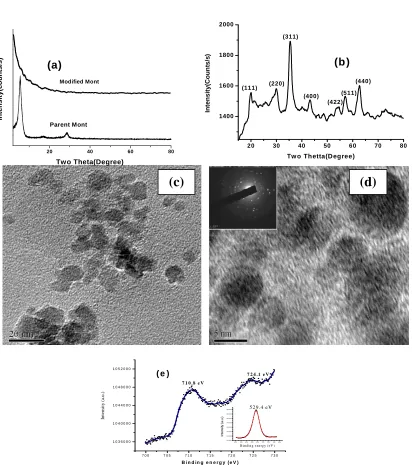
carried out with the help of different sophisticated analytical instruments like Powder-XRD, N2 adsorption-desorption etc. The parent montmorillonite K10 exhibited an intense basal reflection at 7.07o 2θ corresponding to a basal spacing of 12.6 Å (Fig. 1 a). During acid activation, the reflection intensity decreased with time and no basal reflection was seen after 2h acid activation. The modified montmorillonite
contained micro- (< 2 nm) and mesopores (> 2 nm), a high specific surface area of 416 m2/g and a large
Table 1: Surface properties of Fe3O4@mmt and modified montmorillonite
Specific Surface Specific Pore
Area ( m 2
/g) Volume (c m 3
/g) Modified montmorillonite 416 0.65 Fe3O4@mmt (fresh) 308 0.51
Fe3O4@mmt ( after 1st run) 265 0.42
Fe3O4@mmt ( after 2nd run) 225 0.36
Fe3O4@mmt ( after 3rd run) 204 0.32
7 0 0 7 0 5 7 1 0 7 1 5 7 2 0 7 2 5 7 3 0 1 0 3 6 0 0 0
1 0 4 0 0 0 0 1 0 4 4 0 0 0 1 0 4 8 0 0 0 1 0 5 2 0 0 0
5 225245 2652853 05325345365 38 32 5000
33 0000 33 5000 34 0000 34 5000 35 0000 35 5000 36 0000
In
te
n
si
ty
(
a
.u
.)
B ind in g e ne rg y (eV ) 5 2 9 .4 eV
In
te
n
si
ty
(
a.
u
.)
7 1 0 .8 e V
7 2 4 .1 e V ( e )
20 40 60 80
In
te
n
s
it
y
(c
o
u
n
ts
/s
)
Two Theta(Degree)
Parent Mont Modified Mont
(a)
20 30 40 50 60 70 80
1400 1600 1800 2000
In
te
n
s
it
y
(C
o
u
n
ts
/s
)
Tw o Th etta(D eg ree)
(111) (220)
(311)
(400) (511)
(440)
(422)
(b )
______________________________________________________________________________
The evidence for the formation of Fe3O4-nanoparticles was obtained from powder XRD analysis. The powder XRD suggests face centred cubic lattice (fcc) type arrangement of Fe3O4-nanoparticles. The seven reflections were assigned to the (111), (220), (311), (400), (422), (511) and (440) diffraction of a cubic
face-centered (fcc) lattice of Fe3O4 (Fig. 1 b) [30]. TEM image (Fig.1 c) shows the Fe3O4 nanoparticles form
a magnetic nanocluster with particle size below 20 nm. The HRTEM (Fig. 1 d) and SAED (Selected Area Electron Diffraction) pattern [Fig. 1d(inset)] of Fe3O4-nanoparticles corresponds to crystalline nature of the magnetic nanoparticles. XPS experiment was performed to determine the chemical state of iron in the
nanocomposite material. Figure 1(e) gives the broad and narrow scan XPS spectra of Fe3O4 nanoparticles.
For Fe3O4, the peaks at 710.8 eV and 724.1 eV are the characteristic doublets of Fe2p3/2 and Fe2p1/2 from
iron oxide. The peak at 529.4 is assigned to O1s [Fig. 1e (inset)]. No satellite peak at 719 eV is observed
indicating Fe3+ in γ-Fe2O3. This confirms that the peaks shift to high binding energy and broaden for Fe3O4
due to the appearance of Fe2p3/2 and Fe2p1/2 and it does not contain any impurity of γ-Fe2O3 [31-32].
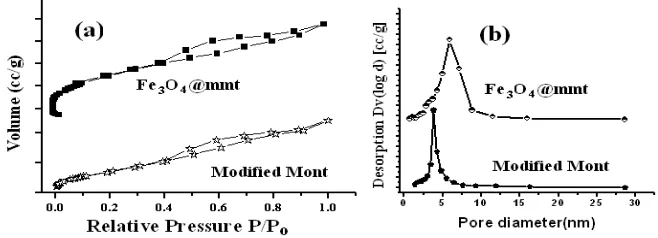
From surface area study, it is observed that there is an appreciable decrease of the specific surface area
and the specific pore volume after supporting Fe3O4-nanoparticles (Table1), but it exhibits a similar type of
isotherm and hysteresis loop to that of modified montmorillonite (Fig. 2). This might be due to clogging of some pores by Fe3O4-nanoparticles. The Fe contents in Fe3O4@mmt as analyzed by ICP-AES, reveals the
presence of 16.47 mg of Fe per 100 mg Fe3O4@mmt catalyst.
Fig. 2: (a) N2 adsorption/desorption isotherm and (b) BJH pore size distribution curve of Modified Mont. and Fe3O4@mmt
Catalytic activity: In order to introduce an efficient, robust and eco-friendly heterogeneous catalyst under
mild conditions, the synthesized Fe3O4@mmt was utilized as catalyst precursor for the well-known Biginelli
reaction. A series of three-component reactions were carried out using benzaldehyde, urea and
ethylacetoacetate (β-ketoester) as the model substrates to determine the best reaction condition (i.e. solvent,
reaction time etc.) which is required to afford excellent yields of DHPMs. The reaction without solvent was
the first choice, where about 60% of the DHPMs product was obtained in 3 h in presence of Fe3O4@mmt
catalyst. The use of water as a solvent increased the yield of the desired product to 68% in 3 h. When
ethanol was used as a solvent at 78oC, surprisingly, the yield of the product increased to 98% in 2 h. The
use of other solvents was also tested, but no encouraging results were obtained (Table 2). Therefore, ethanol is used as the solvent of for the synthesis of DHPMs by considering its high yield and selectivity.
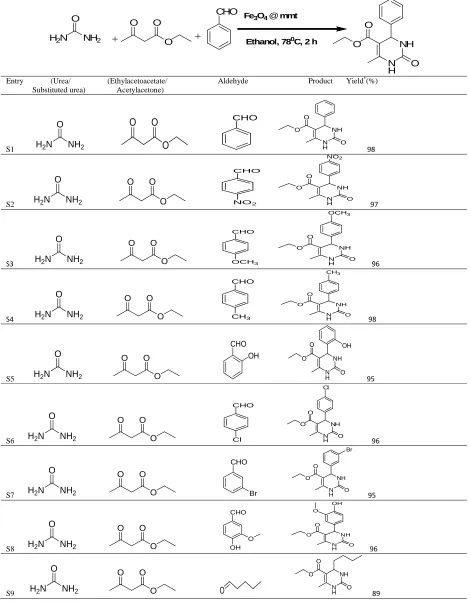
The results of the reactions are represented in Table 3. A control reaction was carried out to test the
requirement of a catalyst by stirring the model substrates in the absence of the catalyst. Only 6% yield of
the product was obtained in 5 h. The use of only modified clay as a catalyst gave only 55% yield in 2 h.
[image:4.595.135.464.311.430.2]Table 2: Effect of solvent and Fe3O4@mmt catalyst
Sl no Solvent Catalyst amount Temperature Time Isolated Yield (mg) (0C) (h) (%)
Effect of solvent:
1 Solvent free 20 90 3 60
2 Water 20 90 3 68
3 Methanol 20 65 3 66
4 Ethanol 20 78 2 98
5 DMF 20 110 3 28
6 Acetonitrile 20 80 3 35
Effect of catalyst amount 7 Ethanol 5 78 2 65
8 Ethanol 10 78 2 76
9 Ethanol 15 78 2 86
10 Ethanol 20 78 2 98
11 Ethanol 25 78 2 98
**Reaction conditions: Benzaldehyde (2 mmol), Ethylacetoacetate (2 mmol), Urea (3 mmol), and solvent (5 ml).
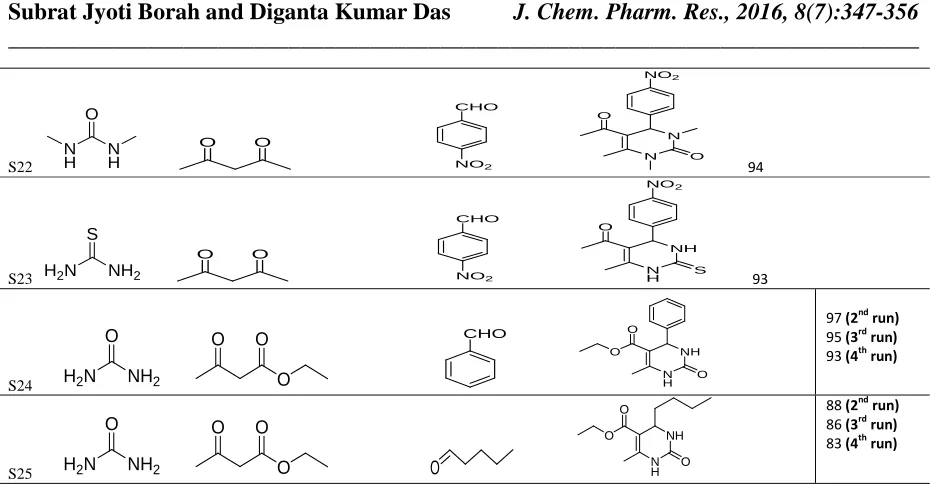
The presence of electron donating or withdrawing group on the aldehyde has no significant effect on the yield of the product (entry S1, S2 and S4) but aliphatic aldehyde (entry S9, S10) gives slightly lower yield than aromatic aldehyde (S1, S2 in Table 3). A variation in the reaction was done by using
substituted urea such as 1,3-dimethyl urea, thiourea and acetylacetone (β-diketone) instead of
ethylacetoacetate for the synthesis of different DHPMs (Table 3). The use of thiourea and 1,3-dimethyl urea as substrate also run the reaction smoothly but thiourea gives slightly lower yield of product compared to urea and 1,3-dimethyl urea (entry S1, S14 and S15). Both the active methylene compound i.e. ethylacetoacetate and acetylacetone run the reaction without any difficulty (entry S1 and S18). All the
reactions give a very good yield (85-98%) with 100% selectivity. One of the advantages of our catalytic
system is that the separation of the catalyst from the product is done simply by magnetic separation. The products were purified by recrystallization. The recyclability of our catalyst was investigated in the
synthesis of DHPMs (Table 3). The catalyst was recovered by magnetic separation technique after each
experiment. The recovered catalyst was washed with acetone, dried in a desiccator and reused directly with
fresh reaction mixture without further purification for the desired DHPMs synthesis upto the 4th run and
showed only a slight decrease in activity (Table 3).The recovered catalyst was further investigated through
N2 adsorption– desorption, HRTEM analysis. The specific surface areas of the recovered catalysts decrease
compared to the fresh catalyst with surface area of 308 m2g-1 (Table 1) which may be due to blockage of
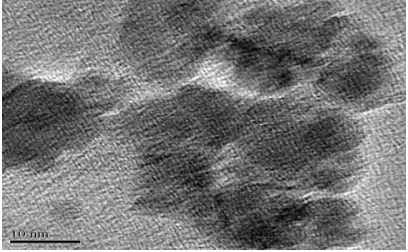
the pores by the reactant molecules after each reaction. In the HRTEM analysis of the recovered catalyst
(after 3rd run), it was found the sizes of Fe3O4 nanoparticles are still below 20 nm (Fig. 3).
[image:5.595.196.400.507.633.2]______________________________________________________________________________
Table 3: Fe3O4@mmt catalyzed three-component condensation reaction to synthesize DHPMs **
Fe3O4 @ mmt
Ethanol, 780C, 2 h
H2N NH2
O O O O CHO N H NH O O O
Entry (Urea/ (Ethylacetoacetate/ Aldehyde Product Yield*(%) Substituted urea) Acetylacetone)
S1 H2N NH2
O
O
O
O
CHO N H NH O O O 98S2 H2N NH2
O
O
O O
CHO
NO2 NH
NH O O O NO2 97
S3 H2N NH2
O
O
O O
CHO
OCH3 NH
NH O O O OCH3 96
S4 H2N NH2
O
O
O O
CHO
CH3 NH
NH O O O CH3 98
S5 H2N NH2
O O O O CHO OH N H NH O O O OH 95
S6 H2N NH2
O
O
O O
CHO
Cl NH
NH O O O Cl 96
S7 H2N NH2
O
O
O O
CHO
Br NH
NH O O O Br 95
S8 H2N NH2
O O O O CHO OH O NH NH O O O O OH 96
S9 H2N NH2
S10 H2N NH2 O O O O O 5 NH NH O O O 5 91
S11 H2N NH2
O O O O O HO HO N H NH O O O 92
S12 H2N NH2
O
O
O O
O NH NH O
O
O 85
S13 H2N NH2
O
O
O O
O NH
NH O
O
O
88
S14 H2N NH2
S O O O CHO NH NH O O S 94 S15 N H NH
O O O O CHO N N O O O 96 S16 N H NH
O
O
O O
CHO
OCH3 N
N O O O OCH3 95
S17 H2N NH2
S
O
O O
CHO
OCH3 NH
NH O O S OCH3 93
S18 H2N NH2
O O O CHO NH NH O O 97
S19 H2N NH2
O
O O
CHO
OCH3 NH NH O
O
OCH3
93
S20 H2N NH2
O
O O
CHO
NO2 NH
______________________________________________________________________________
S22
N H NH
O
O O
CHO
NO2 N
N O
O NO2
94
S23 H2N NH2 S O O CHO NO2 NH NH O S NO2 93
[image:8.595.66.531.72.314.2]S24 H2N NH2 O O O O CHO N H NH O O O 97 (2nd run) 95 (3rd run) 93 (4th run) S25 H2N NH2 O O O O O N H NH O O O 88 (2nd run) 86 (3rd run) 83 (4th run) *Yields are isolated products based on the aldehyde after recrystallization. **Reaction conditions: Aldehyde (2 mmol), Ethylacetoacetate (2 mmol), Urea (3 mmol), Catalyst (20 mg, contains 0.059 mmol Fe) and Ethanol (5 ml); Refluxing temp. 78oC, Time 2 h. A hot filtration test was carried out to investigate whether any leaching of Fe3O4 occurs during the course of the reaction. Here, the three component condensation reaction of benzaldehyde, ethylacetoacetate and urea was carried out in ethanol at 78oC for 1 h using our Fe3O4@mmt catalyst. At this stage, the yield of the product is 64%. The Fe3O4@mmt catalyst was the filtered off in hot conditions and with the filtrate the reaction was continued for another 1 h. But no further increase in the yield of the product was observed. Again, the Fe content in Fe3O4@mmt before the catalytic reaction was 16.47 mg Fe per 100 mg Fe3O4@mmt catalyst. After 3rd run, Fe content in the catalyst was found to be 16.43 mg Fe per 100 mg catalyst which was marginally decreased. Thus, the catalyst maintains its heterogeneous nature and no leaching of Fe3O4 occurs during the course of the reaction. For comparison, we have screened wide range of iron catalysts known in the literature for the reaction of urea, ethylacetoacetate and benzaldehyde (Table 4) and the result showed that our protocol is better than other previous protocols. Table 4: Screening of different iron catalyst for the reaction of urea, ethylacetoacetate and benzaldehyde Catalyst Solvent Temperature Time Isolated Yield Reference (0C) (h) (%) FeCl3 Ethanol 78 5 38
FeCl2.4H2O Ethanol 78 5 31
Nano-Fe3O4 Ethanol 78 5 48
ɣ-Fe2O3-SO3H Ethanol 60 5 91 [29]
Fe3O4@SBA15 Ethanol 100 6 85 [16]
Fe3O4@mmt Ethanol 78 2 98 Present work
The possible reaction pathway for the synthesis of DHPMs catalysed by Fe3O4@mmt is given in Scheme
1. The electrophilicity of the carbonyl carbon of the active methylene compound (ethylacetoacetate)
increases due to coordination with the highly porous Fe3O4@mmt catalyst. After that the aromatic aldehyde
O O
EtO O O
Ar H
O
EtO O O
Ar OH
H
EtO O O
H Ar H2N NH2
O EtO
OH O
N H Ar
NH2 O
EtO
EtO O O
N H Ar
NH2 O
EtO N H O
NH Ar
O O
H EtO
N H
O Ar
O NH
H
Ethylacetoacetate Product
Aldehyde
Urea
: Fe3O4 @ mmt
A B
H2O +
Scheme 1: Proposed mechanism for the synthesis of DHMPs
This leads to the aldol type intermediate (A) to generate ureides (B) that ultimately cyclize to give the desired product and the catalyst is regenerated. The theoretical byproduct obtained from the reaction is only water. The regenerated catalyst continues the catalytic cycles till the completion of the reaction.
CONCLUSION
In conclusion, we have developed an economical and practical protocol for the synthesis of DHPMs through an Fe3O4@mmt catalyzed three-component condensation reaction of Aldehyde, β-ketoester (or β
-diketone) and Urea (or substituted urea) using ethanol as solvent. The specific surface area and the pore
size of Montmorillonite K10 were tuned by controlled acid activation. Further, the catalysts retained its
magnetic property after several runs and were reused for new batch of reactions (upto 4th run) without
significant loss of their activity under the same conditions. The operational simplicity, mild reaction condition and robustness of the catalyst, make it attractive for the large scale synthesis of biologically active
dihydropyrimidinones.
1H and 13C NMR data along with C, H, N percentage of some of the products: S1. Ethyl-1,2,3,4-tetrahydro-6-methyl-2-oxo-4-phenylpyrimidine-5-carboxylate
1H NMR (300 MHz, DMSO-d6): δ 1.09 (t, 3H), δ 2.25 (s, 3H), δ 3.94-4.02 (q, 2H), δ 5.15 (d, 1H), δ
7.22-7.35 (m, 5H), δ 7.74 (s, 1H), δ 9.2 (s, 1H); 13C NMR (75 MHz, DMSO-d6) : δ 14.53, 18.24, 54.41,
59.66, 99.71, 126.70, 127.73, 128.86, 145.31, 148.82, 152.50, 165.80; C: 64.60%, H: 6.18%, N: 10.76%.
S2 . Ethyl-1,2,3,4-tetrahydro-6-methyl-4-(4-nitrophenyl)-2-oxopyrimidine-5-carboxylate 1
H NMR (300 MHz, DMSO-d6): δ 1.09 (t, 3H), δ 2.50 (s, 3H), δ 3.95-4.04 (q, 2H), δ 5.26 (d, 1H), δ
7.49-7.52 (m, 1H), δ 7.90 (s, 1H), δ 8.15-8.44 (m,3H), δ 9.37 (s, 1H) ; 13C NMR (75 MHz, DMSO-d6): δ
14.50, 18.33, 54.12, 98.62, 124.75, 128.12, 131.11, 147.16, 149.86, 152.45, 165.51, 192.83; C: 55.10%, H:
4.95%, N: 13.75%..
S3. Ethyl-1,2,3,4-tetrahydro-4-(4-methoxyphenyl)-6-methyl-2-oxopyrimidine-5-carboxylate
1H NMR (300 MHz, DMSO-d6): δ 1.12 (t, 3H), δ 2.23 (s, 3H), δ 3.71 (s, 3H) , δ 3.94-4.01 (q, 2H), δ
5.09 (d, 1H), δ 6.86-6.89 (m, 2H), δ 7.12-7.15 (m, 2H), δ 7.68 (s, 1H), δ 9.16 (s, 1H); 13C NMR (75
______________________________________________________________________________
DMSO-d6): δ 14.50, 18.18, 21.05, 54.07, 59.71, 99.96, 126.60, 129.36, 136.93, 142.29, 148.56, 152.74,
165.87; C: 65.70%, H: 6.61%, N: 10.19%.
S5. Ethyl 1,2,3,4-tetrahydro-4-(2-hydroxyphenyl)-6-methyl-2-oxopyrimidine-5-carboxylate
1H NMR (300 MHz, DMSO-d6): δ 1.19 (t, 3H), δ 1.69 (s, 3H), δ 4.15 (q, 2H), δ 4.43 (s, 1H), δ 5.38 (s,
1H), δ 6.72-7.12 (m, 4H), δ 7.14 (s, 1H), δ 7.57 (s, 1H); 13C NMR (75 MHz, DMSO-d6): δ 14.54, 24.48,
44.1, 48.1, 61.03, 83.61, 117.06, 121.0, 125.92, 129.13, 129.83, 151.15, 155.07, 168.92; C: 60.86%, H: 5.82%, N: 10.12%.
Acknowledgement
The authors gratefully acknowledge SAIF, NEHU for the TEM analysis.
REFERENCES
[1] R Narayanan, Green Chem. Lett. Rev., 2012, 5, 707.
[2] WW Chen; RV Nguyen; CJ Li, Tetrahedron Lett., 2009, 50, 2895.
[3] T Zeng; WW Chen; CM Cirtiu; A Moores; G Song; CJ Li, Green Chem., 2010, 12, 570. [4] X Zhou; Y Lu; LL Zhai; Y Zhao; Q Liu; WY Sun, RSC Adv., 2013, 3, 1732.
[5] B Karimi; M Gholinejad; M Khorasani, Chem. Commun., 2012, 48, 8961. [6] SJ Borah; DK Das, Catal. Lett., 2016, 146, 656-665.
[7] CO Kappe, J. Org. Chem., 1997, 62, 3109.
[8] RA Janis; PJ Silver; DJ Triggle, Adv. Drug Res., 1987, 16, 309. [9] F Bossert; W Vater, Med. Res. Rev., 1989, 9, 291.
[10] IT Phucho; A Nongpiur; S Tumtin; R Nongrum; RL Nongkhlaw, Rasayan J. Chem., 2009, 23, 662. [11] KI Sakata; M Someya; Y Matsumoto; H Tauchi; M Kai; M Toyota; M Takagi; M Hareyama; M Fukushima, Cancer Sci., 2011, 102, 1712.
[12] AD Patil; NV Kumar; WC Kokke; MF Bean; AJ Freyer; CD Brosse; S Mai; A Truneh; DJ Faulkner; B Carte; AL Breen; RP Hertzberg; RK Johnson; JW Westley; BCM Potts, J. Org. Chem., 1995, 60, 1182-1188.
[13] GKS Prakash; H Lau; C Panja; I Bychinskaya; SK Ganesh; B Zaro; T Mathew; GA Olah, Catal.
Lett., 2014, 144, 2012.
[14] B Ramesh; CM Bhalgat, Eur. J. Med. Chem., 2011, 46, 1882-1891. [15] GBD Rao; B Anjaneyulu; MP Kaushik, Tetrahedron Lett., 2014, 55, 19. [16] J. Mondal; T. Sen; A. Bhaumik, Dalton Trans., 2012, 41, 6173.
[17] K Folkers; HJ Harwood; TB Johnson, J. Am. Chem. Soc., 1932, 54, 3751. [18] E Dawood; S Ahmad, Chem. Eur. J., 2014, 20, 3212-3217.
[19] M Pramanik; A Bhaumik, Appl. Mater. Interfaces., 2014, 6, 933-941. [20] M Phukan; MK Kalita; R Borah, Green Chem. Lett. Rev., 2010, 3, 329-334. [21] BC Ranu; A Hajra; U Jana, J. Org. Chem., 2000, 65, 6270-6272.
[22] S Chitra; K Pandiarajan, Tetrahedron Lett., 2009, 50, 2222-2224. [23] ZL Shen; XP Xu; SJ Ji, J. Org. Chem., 2010, 75, 1162-1167.
[24] VR Choudhary; VH Tillu; VS Narkhede; HB Borate; RD Wakharkar, Catal. Commun., 2003, 4, 449-453.
[25] SE Hankari; B Motos-Pérez; P Hesemann; A Bouhaouss; JJE Moreau, Chem. Commun., 2011, 47, 6704-6706.
[26] KY Lee; KY Ko, Bull Korean Chem. Soc., 2004, 25, 1929.
[27] D An; YS Fan; Y Gao; ZQ Zhu; LY Zheng; SQ Zhang, Eur. J. Org. Chem., 2014, 301-306. [28] Y Qiua; H Suna; Z Mab; W Xia, J. Mol. Cat. A: Chem., 2014, 392, 76-82.
[29] E Kolvari; N Koukabi; O Armandpour, Tetrahedron., 2014, 70, 1384.
[30] Y Deng; D Qi; C Deng; X Zhang; D Zhao, J. Am. Chem. Soc., 2008, 130, 28-29. [31] X Teng; D Black; N Watkins; Y Gao; H Yang, Nano Lett., 2003, 3, 261.