CFD SIMULATION OF VORTEX-INDUCED
VIBRATION OF A BLUFF BODY STRUCTURE BY
ANSYS FLUENT
ABDUL HALIM BIN ABDUL RAHMAN
A project report submitted in partial
fulfillment of the requirement for the award of the
Degree of Master of Mechanical Engineering
Faculty of Mechanical and Manufacturing Engineering
Universiti Tun Hussein Onn Malaysia
Abstract
Vortex-induced vibration is a vibration phenomenon which occurred to the bluff body structure either on the ground or sea underneath. The investigations of
the effect of flow velocity on the transverse vibration of bluff body were done
to determine the vortex shedding frequency for each of the analyses. Besides it
was also to investigate the flow velocity and pressure loss in the time response.
Despite the investigation made by other researchers, a study on a very high
turbulence Reynolds number, were still blurred unknown. In response to this
problem, this study is purposely to investigate at a very high Reynolds number
and simulated through ANSYS Fluent software’s which started from a minimum
of 70 000 Reynolds number and increased to the maximum of 350 000 Reynolds number. A one meter in diameter of cylindrical aluminium was used for the
study where the velocity was in cross-flow direction. From the simulated results,
it could be seen the fluid flow after the boundary layer was an asymmetric flow.
The Strouhal number seems to be decreased by the increase of Reynolds number
while the frequencies were increased with the increased of Reynolds number.
Abstrak
Getaran disebabkan vorteks (VIV) adalah satu fenomena getaran yang berlaku kepada struktur badan tumpul samada di tanah atau di bawah laut. Kajian
ter-hadap kesan halaju aliran pada getaran melintang badan tumpul telah dilakukan
untuk menentukan frekuensi penumpahan vorteks bagi setiap analisis. Selain itu
tujuan penyelidikan ini juga dalah untuk menyiasat halaju aliran dan
kehilan-gan tekanan didalam tindak balas masa. Walaupun terdapat penyelidikan yang
dibuat oleh penyelidik lain, kajian mengenai pergolakan nombor Reynolds yang
sangat tinggi, masih kabur dan tidak diketahui. Untuk menjawab
permasala-han ini, kajian ini bertujuan untuk menyiasat dengan nombor Reynolds yang
sangat tinggi melalui simulasi perisian ANSYS Fluent yang bermula dari mini-mum 70 000 nombor Reynolds dan meningkat kepada maksimini-mum 350 000 nombor
Reynolds.. Satu selinder aluminium yang bergaris pusat satu meter telah
digu-nakan dalam kajian ini di mana halaju aliran adalah dalam arahan merentas
selin-der. Hasil dari keputusan simulasi, dapat dilihat cecair yang mengalir melepasi
lapisan sempadan adalah aliran tidak simetri. Nombor Strouhal kelihatan
menu-run apabila nombor Reynolds meningkat, manakala frekuensi pula meningkat
dengan peningkatan nombor Reynolds.
Contents
Declaration iii
Dedication iv
Acknowledgment v
Abstract vi
Abstrak vii
List of Figures xi
List of Tables xii
List of Appendices xiii
List of Symbols xv
1 Introduction 1
1.1 Background of Study 1
1.1.1 Vortex-Induced Vibration 2
1.1.2 Bluff Body 2
1.1.3 Computational Fluid Dynamics (CFD) 3
1.2 Problem Statement 3
1.3 Objective of the Study 3
1.4 Scopes of the Study 4
2 Literature Review 5
2.1 Reynolds Number 6
2.2 Strouhal Number 6
2.3 Effect of Flow Velocity 7
2.4 Vortex Shedding 7
ix
2.5 Previous Research 8
3 Methodology 11
3.1 Numerical Study 11
3.2 Physical Model 12
3.3 Numerical Methods 13
3.3.1 Finite Volume Method 14
3.3.2 Finite Element Method 14
3.3.3 Finite Difference Method 14
3.4 Governing Equations 15
3.5 Boundary Conditions 18
3.6 Computational Fluid Dynamics 18
3.6.1 Preprocessing 19
3.6.2 Solver 20
3.6.3 Post Processing 20
3.7 Methodology Summary 20
4 RESULTS AND DISCUSSION 22
4.1 Validation 22
4.2 Velocity Magnitude 23
4.3 Vorticity Magnitude 28
4.4 Pressure Coefficient 32
4.5 Strouhal Number 37
4.6 Frequency of Vortex Shedding 40
5 CONCLUSIONS AND RECOMMENDATIONS 42
List of Figures
2.1 Cylinder arrangement in the wind tunnel 9
3.1 Schematic diagram of the flow field around circular cylinder [7] 13
3.2 Steps Performed in CFD 19
3.3 Flowchart of Methodology 21
4.1 Trending line validation between present study and Simmons 23 4.2 Contours of Velocity Magnitude at Re=70000 24
4.3 Vectors of Velocity Magnitude at Re=70000 24
4.4 Contours of Velocity Magnitude at Re=150000 24
4.5 Vectors of Velocity Magnitude at Re=150000 25
4.6 Contours of Velocity Magnitude at Re=200000 25
4.7 Vectors of Velocity Magnitude at Re=200000 25
4.8 Contours of Velocity Magnitude at Re=250000 26
4.9 Vectors of Velocity Magnitude at Re=250000 26
4.10 Contours of Velocity Magnitude at Re=300000 26 4.11 Vectors of Velocity Magnitude at Re=300000 27
4.12 Contours of Velocity Magnitude at Re=350000 27
4.13 Vectors of Velocity Magnitude at Re=350000 27
4.14 Contours of Vorticity Magnitude at Re=70000 28
4.15 Vectors of Vorticity Magnitude at Re=70000 28
4.16 Contours of Vorticity Magnitude at Re=150000 29
4.17 Vectors of Vorticity Magnitude at Re=150000 29
4.18 Contours of Vorticity Magnitude at Re=200000 29
4.19 Vectors of Vorticity Magnitude at Re=200000 30 4.20 Contours of Vorticity Magnitude at Re=250000 30
4.21 Vectors of Vorticity Magnitude at Re=250000 30
4.22 Contours of Vorticity Magnitude at Re=300000 31
4.23 Vectors of Vorticity Magnitude at Re=300000 31
4.24 Contours of Vorticity Magnitude at Re=350000 31
xi
4.25 Vectors of Vorticity Magnitude at Re=350000 32
4.26 Vectors of Pressure Coefficient at Re=70000 33 4.27 Pressure Coefficient around cylinder at Re=70000 33
4.28 Vectors of Pressure Coefficient at Re=150000 33
4.29 Pressure Coefficient around cylinder at Re=150000 34
4.30 Vectors of Pressure Coefficient at Re=200000 34
4.31 Pressure Coefficient around cylinder at Re=200000 34
4.32 Vectors of Pressure Coefficient at Re=250000 35
4.33 Pressure Coefficient around cylinder at Re=250000 35
4.34 Vectors of Pressure Coefficient at Re=300000 35
4.35 Pressure Coefficient around cylinder at Re=300000 36 4.36 Vectors of Pressure Coefficient at Re=350000 36
4.37 Pressure Coefficient around cylinder at Re=350000 36
4.38 Strouhal Number vs Reynolds Number 38
4.39 Strouhal Number at Re=70000 38
4.40 Strouhal Number at Re=150000 38
4.41 Strouhal Number at Re=200000 39
4.42 Strouhal Number at Re=250000 39
4.43 Strouhal Number at Re=300000 39
4.44 Strouhal Number at Re=350000 40
4.45 Frequencies of Vortex Shedding vs Reynolds Number 41
4.46 Period vs Reynolds Number 41
B.1 Frequency at 70 000 Re, extracted directly from analysis figure 51
B.2 Frequency at 150 000 Re, extracted directly from analysis figure 52
B.3 Frequency at 200 000 Re, extracted directly from analysis figure 53
B.4 Frequency at 250 000 Re, extracted directly from analysis figure 54
B.5 Frequency at 300 000 Re, extracted directly from analysis figure 55
List of Tables
4.1 Pressure Coefficient for different Reynolds Number 37
4.2 Strouhal Number at different Reynolds Number 37
4.3 Calculated of Frequencies of Vortex Shedding and Period 40
A.1 Data of Analysis 47
List of Appendices
A Frequency of Vortex Shedding 47
B Figure of Frequency 49
List of Symbols
2D Two-dimensional
3D Three-dimensional
à Diffusion coefficient
Δt Time-step
ε Turbulence dissipation rate μ Dynamic viscosity (Ns/m2) ρ Fluid density (kg/m3) ω Specific dissipation rate
Cµ Empirical constant
Cd Drag coefficient
CFD Computational Fluid Dynamics
CWT Cooperative Wind Tunnel
D,d Diameter (m)
DNS Direct Numerical Simulation
xv
f Frequency
Fo Vortex shedding frequency
FDM Finite Difference Method
FEM Finite Element Method
FIV Flow-Induced Vibration
FVM Finite Volume Method
I Turbulence intensity
k Kinetic energy
LES Large Eddy Simulation
Re Reynolds number
SST Shear Stress Transport
St Strouhal number
U Fluid velocity (m/s)
U∞ Free stream velocity
Uavg Mean flow velocity
Chapter 1
Introduction
This chapter discussed about the CFD Simulation of Vortex-Induced Vibration of
the Bluff Bodies Structure by ANSYS Fluent. The chapter consists of the
back-ground study, the problem statement, the objectives and the scopes of study. In
the background study, the reader is then introduced to the CFD’s Simulation,
the vortex-induced vibration (VIV), the bluff bodies and the ANSYS Fluent
soft-ware’s.
1.1 Background of Study
In designing of a structure or structures, vibration of a structure is an important
issue to encounter with. A structure could lead to a fatigue damage which is
caused by vibrations. The environmental loading, either on the ground such as
wind, or sea underneath such as waves and currents, are the main cause of the
vibration.
In recent years, the study of flow around a bluff body becoming an
impor-tant study, to investigate the effect of the flow induced vibration [1]. Its effect is
relevant in designing, an on the ground structures such as taller buildings, bridges
and other similar structures. Its effect also relevant in designing sea underneath
structures such as pipelines and risers.
2
1.1.1 Vortex-Induced Vibration
Vibration phenomenon which occurs to the bluff body structure, either on the
ground or sea underneath could be regarded as vortex-induced vibration (VIV).
Previous researchers have been widely discussed in both detail and comprehensive
ways to understand the vortex-induced vibration mechanism from a bluff body [2,3].
As the flow passed a bluff body at a sufficiently large Reynolds number,
vortices would be shedding at the trailing edge of the body. A fluctuating lift
forced, was created due to the pressure difference on the side of the body surface
which eventually would create cross-flow vibrations.
The source of vibration was from the vortex formed that occurs after
the flow passed a bluff body structure. Large amplitude vibration phenomenon
would strike if the frequency of the vortex shedding and approaching the natural
frequency of the bluff body structure.
These large amplitudes vibration phenomena were also called lock-in [1].
This typed of fluid-structure interaction problem has been widely investigated
numerically and experimentally in the past.
1.1.2 Bluff Body
There were two types of shape’s structure which were that streamline shape and
non-streamline shape. The streamline shapes often called aerodynamic body
while the non-streamline shape often called bluff body.
As a result of its shape, a bluff body separated, flow over a substantial
part of its surface. An important feature of a bluff body flow is that there is a very
strong interaction between the viscous (significant to the frictional effect because
of the viscosity) and inviscid (ideal fluid that is assumed to have no viscosity)
regions [4,5]. Examples of bluff bodies include circular cylinders, square cylinders
3
1.1.3 Computational Fluid Dynamics (CFD)
CFD calculates numerical solutions to the equations governing fluid flow. As
opposed to flow around a streamlined body, bluff bodies were the structures with
shapes that significantly disturb the flow around them.
To model the fluid-structure interaction, the CFD software ANSYS
Flu-ent 14 was used to predict the results around cylindrical bluff body at each time
step. The cylindrical bluff body structured was tested at a difference Reynolds
number. The predicted results around the cylindrical bluff body are validated
through previous journals results.
1.2 Problem Statement
At low flow velocities, the fluid flow around the cylindrical bluff body acts as
a damper, limiting the amplitude of motion. The investigations of the effect of
flow velocity on the transverse vibration of bluff body were done to determine
the vortex shedding frequency for each of the analyses. Besides it was also done
to investigate the flow velocity and pressure loss in the time response.
However, as the flow velocity increased, the pressure and shear forces
also increased, which increased the net lift and drag forces on the cylindrical bar.
Eventually, at some critical velocity, the energy input from these external fluid
forces exceeds the structural damping and the amplitude of the cylindrical bluff
body vibration rises dramatically, particularly in the cross-flow direction. Despite
the investigation made by other researchers, a study on a very high turbulence
Reynolds number, were still blurred unknown.
In response to this problem, this study proposed to investigate several
options such as increasing the Reynolds number. The turbulence studied started
from a minimum of 70 000 Reynolds number and increased to the maximum of
350 000 Reynolds number.
1.3 Objective of the Study
4
1. To investigate the effect of flow velocity on the transverse vibration of bluff
body.
2. To determine the Strouhal number for each of the analyses.
3. To determine the vortex shedding frequency for each of the analyses.
1.4 Scopes of the Study
The scopes for this study were:
1. Aluminium cylindrical shape with one meter of diameter.
2. Shape is allow to move in cross-flow direction
3. Test at different Reynolds Number which were 70 000 Re, 150 000 Re, 200
000 Re, 250 000 Re, 300 000 Re and 350 000 Re.
Chapter 2
Literature Review
This chapter discussed about the work of past researchers. This chapter would
discuss about the Reynolds number, the Strouhal number, the effect of flow
ve-locity, the vortex shedding and the previous work of research. In the previous
research, several sub-topics will be discussed such as, the methodology, results
and discussion and finally the conclusion of previous research.
Fluid flowed behaviour could be analysed throughout the experiment and
empirical studies. To study the characteristics of the fluid flows, several tests had
been conducted. Differential equations and mathematical relations were used to
obtain new equations. Experimental and numerical method was always used as
the methods to investigate the fluid behaviour.
To solve the numerical equations, a program called Computational Fluid
Dynamics (CFD) was developed. Throughout the development of CFD, numbers of fluid problem were solved, although it was a complicated problem. Vortex
shedding was one example of the complicated problems, which need to be solved
computationally.
For many decades, vortex shedding from the bluff bodies has been always
a main subject that attracted many researchers to study and investigate. A high
tower building, for example, is the significance of the periodic unsteady fluid flows which passed from bluff bodies. Vibrations near the bluff body were produced
by the vortices which may be dangerous to the structure.
6
2.1 Reynolds Number
One of the very important non-dimensional numbers was the Reynolds Number
(Re) [3-9]. It is used in predicting flow patterns in different fluid flow situations.
The Reynolds numbers expresses the ratio of inertial (resistant to change or
mo-tion) forces to viscous (heavy and gluey) forces [2]. Reynolds numbers determines
dynamic similitude between two different cases of fluid flow.
Reynolds Number is given by the formula,
Re= ρUD
μ
(2.1)
whereρ is the fluid density (kg/m3), U is the velocity based on the actual across
area of the duct or pipe (m/s), D is the pipe diameter (m) and μ is the dynamic
viscosity (Ns/m2).
Besides that, Reynolds number also used to characterize different flow
regimes within a similar fluid, such as laminar flow or turbulent flow. Laminar
flow is characterized by smooth and constant fluid motion. Laminar flow occurs at
low Reynolds numbers, where viscous forces were the dominant. Turbulent flow
occurs at high Reynolds numbers and is dominated by inertial forces. Turbulent
flow produces chaotic eddies, vortices and other flow instabilities.
2.2 Strouhal Number
Another important non-dimensional number was the Strouhal number (St)
[4-9]. The Strouhal number is used to analyse the unsteady-state, oscillating flow
problems [10].
Strouhal number, defined as a ratio of inertial forces due to the
unsteadi-ness of the flow or local acceleration to the inertial forces due to changes in
velocity from one point to another in the flow field [10].
Strouhal Number is given by the formula,
St= f D
7
where f is the characteristic oscillation frequency, D is the characteristic
length and U is the velocity of the fluid.
2.3 Effect of Flow Velocity
Several factors such as force components, shedding frequency, Reynolds number,
material damping and structural stiffness of the cylinder, were the caused that
affected the vortices to generate [11].
As the Reynolds number increases, the amplitude as well as the frequency
of the velocity signals also increases. An increase in Reynolds number causes an
increase in the Strouhal frequency of a single bluff body and for a row of bluff
bodies [12].
2.4 Vortex Shedding
When shedding vortices (a Von Karman vortex street) exert oscillatory forces on
a cylinder in the direction perpendicular to both the flow and the structure, a
vortex-induced vibration (VIV) occurs [11].
When a solid and fluid interact, the instabilities appearing in flow fields
induce instabilities in the neighbouring solid structures [12]. Special emphasis is
required to analyse the VIV because vortex shedding and wake dynamics or flows passed bluff bodies were a complex flow problem [2, 12].
When cylinders with a bluff cross section, immersed in a free stream
with their axis perpendicular to the flow, they were susceptible to a range of
flow-induced vibration (FIV) phenomenon [13]. For circular cylinders, which do
not have a defined angle of attack, the phenomenon of VIV is more likely to
occur, which is due to periodic vortex shedding in the wake [13].
The periodic shedding was where a vortex was shedding from one side of
the body, and then a vortex of opposite sign was shedding from the other side of
the body and forms the Karman vortex street [13]. Large-amplitude oscillations
can occur in the resonance-type response when the vortex shedding frequency
8
also would change to match with the body oscillation frequency, which leading
to large, periodic oscillations.
2.5 Previous Research
Rahman et.al [14] investigates unsteady flow passed a circular cylinder using a
2D finite volume method with different Reynolds number.
Vijaya et.al [15] studied 2D unsteady flows of power-law fluids over a
cylinder. The study has been solved using a finite volume method based solver
FLUENT 6.3.
Mittal and Kumar [2] studied VIV on a pair of equal-size cylindrical
cylinders with two sets of arrangement, inline and staggered. The fixed cylinders
for the 2D simulation were simulated in a rectangular computational domain with a fixed Reynold number, Re = 1000.
Shao and Zhang [4] used the finite volume method to investigate two
side-by-side cylindrical cylinders. The cylinders were simulated in a 23 times of
the cylinder diameter computational domain with a constant inlet velocityU8 =
7m/s. Second orders implicit temporal discretization with a time step of Δt =
1x10⁻⁴ s was used.
Bourguet et.al [6] studied lock-in of the VIV on an in-line flow of a
flexible cylindrical cylinder using direct numerical simulation (DNS) of the 3D
incompressible Navier-Stokes equations.
Pratish and Tiwari [12] investigate unsteady wakes behind two inline
arrangement of square cylinders. 2D computational domain was used where the
length and width of the channel were 16 times and 6 times of the square width
cylinders.
Chandrakant and Swapnil [16] analyzed vortex shedding behind a
D-shaped cylinder. 2D computational domain with 2 m length and 1.6 m and quad meshing was used for the study.
Ali and Edris [17] analyzed the numerical simulation of unsteady flow
with vortex shedding around circular cylinder. Two-dimensional flow of an
9
stream flow and oscillated flows at Re=300. The computational domain with
length, 0.3m and width, 0.2m with water as the assumption liquid was used in the study.
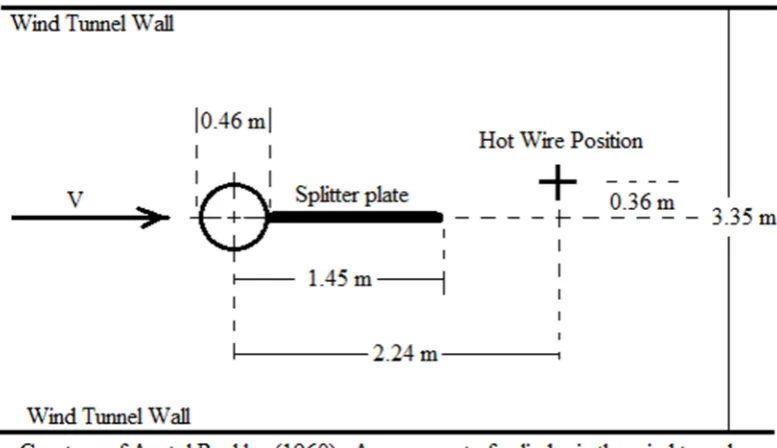
Roshko [18] conducted an experiment on the flow passed a circular
cylin-der at a very high Reynolds number. The experiments were conducted in the
Cooperative Wind Tunnel (CWT) in the subsonic test section of 2.591m height
and 3.353m width which could be pressurized to 4 atm, but to avoid
compress-ibility effects, the flow speed was limited to a Mach number of 0.25 or 85.07 m/s. The arrangement was shown in Figure 2.1.
Figure 2.1: Cylinder arrangement in the wind tunnel
Rahman et.al [14] found that, as Reynolds number becomes higher than 40 the flow reports a loss of symmetry in the wake. The studied also reported
the Strouhal number (St) is found to be 0.164 for Re=100.
Mittal and Kumar [2] reported the non-dimensional value of the vortex
shedding frequency is Fo = 0.234 for both cylinders while the non-dimensional
frequency corresponding to the cross-flow oscillations of both cylinders is 0.226.
Chandrakant and Swapnil [16] reported that the Strouhal number
in-creases with increase in Reynolds number and the number of vortices inin-creases
[image:20.595.119.508.259.483.2]10
Ali and Edris [18] reported the computed drag coefficient (Cd) and the
Strouhal number in four numbers of nodes. For the number of nodes 28 000, 57 500, 82 500 and 103 000, the Cds were 1.345, 1.353, 1.366 and 1.366 while the
Strouhal numbers were 0.202, 0.204, 0.207 and 0.207.
Roshko [13] found out that vortex shedding was not observed at Re <
3.5x10⁶. Below the value of Re < 3.5x10⁶, no peak frequency occurred, but
above this value there appeared a strong spectral peak, said to be well above the
turbulence level.
Rahman et.al [14] observed that standard k-epsilon model computes drag
coefficients accurately. The realizable k-epsilon turbulence model is more
effec-tive for visualization of vortex shedding, while for the SST k-omega model, it is
recommended for high Reynolds numbers.
Mittal et.al [2] concluded that the oscillations of the cylinders result in an
alternate mode of vortex shedding and where the vibration of cylinders is usually
accompanied by an increase in drag.
Shao et.al [4] concluded that LES is capable of reproducing complex
subcritical turbulent wake behind a circular cylinder, but fine meshes and longer
time were required for the flow around the circular cylinder.
Bourguet et.al [6] concluded that the structural vibrations are mixtures
of standing and traveling wave patterns. A frequency ratio of approximately 2
can be established between the excited frequencies in the in-line and cross-flow
directions.
Mittal et.al [2] concluded that for a circular cylinder, flow separation
Chapter 3
Methodology
This chapter discussed about the methodology of this present work. This chapter
started with an introduction followed by physical model. In the physical model,
previous model has been chosen as a present model with some modification. The
numerical methods would discuss on discretization methods such as FVM, FEM
and FDM. This chapter also consists of the governing equation and the boundary
conditions of the present study based on previous study. In the CFD, it would
discuss on the process involved, such as preprocessing, solver and post-processing.
3.1 Numerical Study
This numerical study was carried out to investigate the effect of flow velocity on
the transverse vibration of bluff body in the CFD, together with the effects of
variation of the Reynolds number.
Obviously, the Reynolds number was an important non-dimensional
num-ber to determine the types of flow, either laminar or turbulent flow. Most flows
were turbulent in nature and it was applied in engineering too. Turbulence was
the chaotic nature of flow in motion showing random variation in space and
time.
Turbulence, contains eddies with different scales and sizes. These eddies
were always rotational in motion. Large scale eddies were responsible for the
carrying of energy and transfer of momentum in the flow. The large eddies,
extract energy from the mean flow and transfer it to the smallest eddies, where
12
energy was taken out of the flow through viscosity.
The well-known equations of fluid motion were known as the
Navier-Stokes equations. These equations have been derived based on the fundamental
governing equations of fluid dynamics. These fundamental was the continuity,
the momentum and the energy equations, which represent the conservation laws
of physics.
Continuity equation was based on the law of conservation of mass. Once
the concept applied to the fluid flow, the change of mass in a control volume was
equal to the mass that enters through its faces minus the total of mass leaving
its faces.
Momentum equation was expressed in terms of the pressure and viscous
stresses. Both pressure and viscous, stresses acting on a particle in the fluid. This would ensure that the rate of change of momentum of the fluid particles was
equal to the total of the force. This was due to the surface stresses and body
forces.
The energy equation was based on the First Law of Thermodynamics.
The rate of change of energy of a fluid particle was to be equal to the net rate
of work has done on that particle. This was due to surface forces, heat and body forces such as gravitational force. The energy equation describes the transport of
heat energy through a fluid and its effects.
A Navier-Stokes equation was a set of partial differential equations, with
the combination of all those fundamental principles which was the continuity,
mo-mentum and energy equations. Pressure and velocity of the fluid can be predicted
throughout the flow by solving these equations.
3.2 Physical Model
The physical modelled that used in this study was similar to the physical studied
by Rahman et.al [7]. A circular cylinder with diameter, d, was modelled in the
centre with a square flow domain is created surrounding the cylinder as shown in
Figure 3.1.
The computational domain for an upstream was 23 times of the circular
13
cylinder. The width of the domain was 50 times the radius of the circular cylinder
which was shown in Figure 3.1 together with the important dimensions [7].
Figure 3.1: Schematic diagram of the flow field around circular cylinder [7]
3.3 Numerical Methods
To solve the engineering problems, besides analytical and experimental methods,
the ability of numerical methods in fluid mechanics has increased. The used of
the numerical methods was to find numerical approximations to the solutions
where most of the differential equations could not be solved exactly.
In the Computational Fluid Dynamics (CFD), Navier-Stokes equations
were the basic governing equations. The equations were obtained by applying
Newton’s Law of Motion to a fluid element. It was also called as the momentum
equation, and supplemented by the mass conservation equation which was also
called the continuity equation and energy equation.
CFD was used to construct and discretise the governing equations, through discretisation methods such as Finite Difference Methods (FDM), Finite Element
[image:24.595.122.459.128.327.2]14
3.3.1 Finite Volume Method
In a steady state solution the inlet and outlet mass flow rate would be obtained
equally. The change of momentum would equal the force exerted on solid
bound-aries. The solution of the steady state problems is performed by starting from
an arbitrary initial guess of the flow field and marching the equations forward in time until the flow becomes steady. If the flows entered and left every volume
were not equal, the conditions inside the volume must be changed and the flow
was not steady anymore.
Even the flow was at steady, the used in unsteady equations was found
to be very useful to solve the engineering problems. The FVM was based on
the discretisation of the Navier-Stokes equations. Every volume was contiguous with its adjacent volumes, and that the flow from recent volumes will enter the
adjacent volumes, and therefore, when a steady state reached, the flow was fully
utilized.
3.3.2 Finite Element Method
The Galerkin method was most commonly used formulation in FEM in fluid
me-chanics. The Galerkin method employs weighted residuals whereby their form
was usually assumed similar to the shape functions. The Galerkin method
ap-proximates the solution in terms of unknown nodal, and interpolated by the shape
functions.
3.3.3 Finite Difference Method
The conservation equations in differential form were approximated by replacing
the partial derivatives by approximations in terms of the nodal values of the
functions. Taylor series expansions or polynomial fitting were usually used to
obtain the derivatives of the functions with respect to the coordinates. This
yields an algebraic equation for each grid node in which values of neighbouring
nodes appear as unknowns. Although theoretically possible for unstructured
15
3.4 Governing Equations
The mathematical model of the finite volume method (FVM) that was used in
this study was similar to the model of numerical investigation of unsteady flow
passed a circular cylinder, studied by Rahman et.al [7]. The governing equations
for the unsteady flow of an incompressible viscous fluid passed a circular cylinder
were considered to the classical continuity and Navier-Stokes equations, which written in the following form:
div(~u) (3.1)
∂(u)
∂t +div(u~u) = 1
ρ
div(Γ∇u) (3.2)
On the left side of the equation (3.2) was the rate of change term and
the convective term and on the right side was the diffusion term, Ã= diffusion
coefficient which was used as the starting point in FVM.
ˆ
cv
∂(u) ∂t dv+
ˆ
cv
div(u~u)dv= 1
ρ
ˆ
cv
div(Γ∇u)dv (3.3)
In the second term of the left hand side of the equation (3.3) was the
convective term and on the right side was the diffusion term. By using the Gauss
divergence theorem, it could be rewritten as an integral over the entire boundary
surface of the control volume and the equation (3.3) became
∂ ∂t ˆ cv (u)dv + ˆ A
n.(u~u)dA = 1
ρ
ˆ
A
n.(Γ∇u)dA (3.4)
The rate of change term was equal to zero in the steady state case and
the equation (3.4) became
ˆ
A
n.(uU)dA= 1
ρ
ˆ
A
16
For the unsteady (time dependent) case it was necessary to integrate
with respect to time, t, over a small time interval, Δt i.e. from t to t + Δt,
Equation (3.5) became
ˆ ∆t ∂ ∂t ˆ cv (u)dv dt+
ˆ
∆t
ˆ
A
n.(u~u)dAdt= 1
ρ
ˆ
∆t
ˆ
A
n.(Γ∇u)dAdt (3.6)
In FVM, flow domain was divided into a number of control volumes or
cells which was called discretization. In order to solve the problem, equation (3.6)
needs to be discretized to be set up at a nodal point.
The resulting system of linear algebraic equations was then solved to
obtain the velocity and pressure distribution at each nodal point. Finally, the
drag and the lift coefficients were computed as follows:
CD =
D
0.5U∞2d, CDP =
ˆ 2π
0
Pwcos x dx, CDV =
2 Re
ˆ 2π
0
ωwsin x dx (3.7)
CL=
D
0.5U∞2d, CLP =
ˆ 2π
0
Pwsin x dx, CLV =
2 Re
ˆ 2π
0
ωwcos x dx (3.8)
Where, D and L represent the drag and lift force. The pressure coefficient
was defined as:
CP =
(P −P∞)
0.5ρU2d (3.9)
The subscripts P and V represent the pressure and viscous force. Pw is
the dimensionless wall pressure andωw is the dimensionless wall vorticity, defined
as
ωw =
ωR U∞
17
The dimensionless Reynolds number was given by:
Re= dU∞ρ
µ (3.11)
The Strouhal number was expressed as:
St= f D U∞
(3.12)
Where, the frequency of the vortex shedding, f (=1/T), the diameter of
the cylinder, d, and the free stream velocity, U∞.
The viscous forces of the turbulent flow were suggested to use standard
k-ε, realizable k-εand Shear-Stress Transport (SST) as suggested by Lakshmipathy
[7]. The standard k-ε model was based on model transport equations for the
turbulence kinetic energy (k) and its dissipation rate (ε) [7].
In the derivation of the k-ε model, it was assumed that the flow is fully
turbulent, and the effects of molecular viscosity are negligible. The standard k-ε
model is therefore valid only for fully turbulent flows [7]. The turbulent kinetic
energy, k, was given by:
k = 3
2(UavgI)
2 (3.13)
Where, Uavg was the mean flow velocity and I was the turbulence
inten-sity. The turbulence intensity, I, was defined by:
I = 0.16(Re)18 (3.14)
The turbulence length could be written as l=0.07d and the turbulence
dissipation rate, ε, as,
ε=U 3 4
µ
k32
l (3.15)
18
which was approximately 0.09.
SST k-ε was another turbulent model, but modified to use with shear
stress turbulent [7]. The specific dissipation rate, ω, in the modify SST k-εcould
be found by,
ω = k 1 2
C 1 4
µl
(3.16)
3.5 Boundary Conditions
The uniform flow condition was imposed at the inlet boundary while pressure was
treated at the outlet boundary. The standard no-slip condition was used on the
surface of the cylinder, which was Ux = 0 and Uy = 0. At the top and bottom wall boundaries, the slip-flow condition was imposed where,
∂Ux
∂y = 0andUy = 0 (3.17)
3.6 Computational Fluid Dynamics
The investigation performed on the wake properties of the two dimensional flow
and a cylindrical bluff body by using the finite volume method. By using a
com-puter, the CFD solves the Navier-Stokes equations numerically for fluid flow.
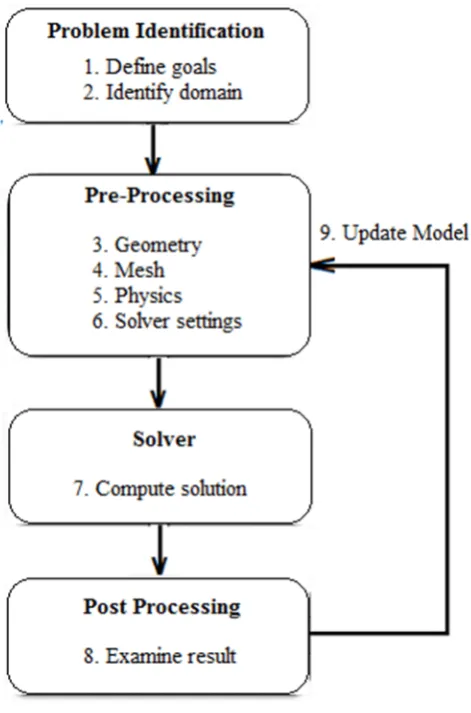
Graphs and charts in CFD were used to analyze the flow characteristics in
order to compare with the previous researchers’ results. This study was performed in three steps, which were pre-processing, solver and post-processing by ANSYS
19
Figure 3.2: Steps Performed in CFD
3.6.1 Preprocessing
After creating a solid model of the domain, the first step of the CFD simulation
process was the pre-processing which will describe the geometry in detailed. The
domain of interest is then further divided into smaller segments which were known
as meshed.
The properties of the fluid acting on the domain need to be defined first before begin the analysis. These include external constraints or boundary
[image:30.595.122.358.85.442.2]20
3.6.2 Solver
A solver calculates the solution of the CFD problem where the governing
equa-tions were solved. Identified physical problem such as fluid material properties,
flow physics model and boundary conditions were set to solve using a computer.
It was important to produce an accurate solution of the partial differential equa-tions by doing the convergence.
3.6.3 Post Processing
Flow phenomena would be presented in different methods, such as contour plots,
vector plot, streamlines, data curve and others related to the study. All those
methods would be used to analyze the results for appropriate graphical
repre-sentations to display the trends of velocity, pressure, kinetic energy and other
properties of the flow.
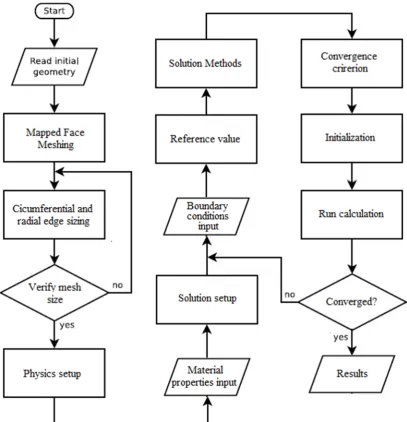
3.7 Methodology Summary
The methodology would be much better if it could be summarized. Therefore
a summarized methodology was clearly shown in a flowchart type as in Figure
21
[image:32.595.114.522.77.500.2]Chapter 4
RESULTS AND DISCUSSION
This chapter discussed the extracted results of the cylindrical simulation. The
simulation was done in the flow of turbulence. The turbulence flow was ranged
from 70 000 < Re < 350 000. The results were analysed through the contours
and vectors of velocity and pressure coefficient figures. The Strouhal Number was
determined throughout the use of Strouhal figures, extracted from the analysis.
4.1 Validation
In order to validate, data’s from Simmons which was used by Roshko [13] had
been chosen. From the trend pattern, the extracted simulated data’s was then
satisfied as we could see as shown in the Figure 4.1.
23
Figure 4.1: Trending line validation between present study and Simmons
4.2 Velocity Magnitude
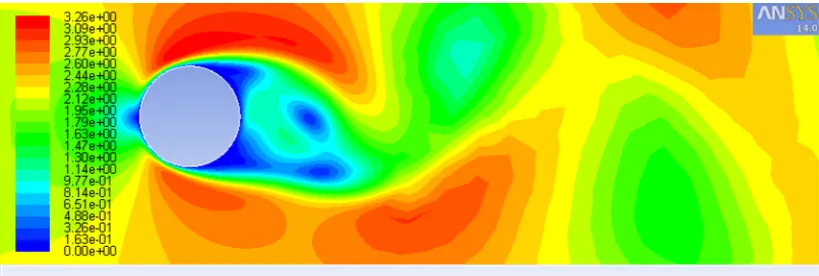
It could be seen as from Figure 4.2 to 4.13, the fluid flow after the boundary
layer at high Reynolds Number was an asymmetric flow. The vortex shedding is visualized throughout the contours and vectors of velocity magnitude.
As seen from the Figure 4.2 to 4.13, as the flow stream past the cylinder,
vortices were formed behind the cylinder. From all those figures, it could be seen,
as the flow speed increased, vortices were alternately shed on each side.
The vortex shedding clearly observed in all those figures and it could be
stated clearly that the vortex shedding proportional to the velocity magnitude
[image:34.595.118.478.65.290.2]24
Figure 4.2: Contours of Velocity Magnitude at Re=70000
Figure 4.3: Vectors of Velocity Magnitude at Re=70000
[image:35.595.113.527.68.211.2] [image:35.595.114.525.285.430.2] [image:35.595.114.524.501.639.2]Chapter 5
CONCLUSIONS AND RECOMMENDATIONS
From the research of simulation of Vortex Induced Vibration, the investigated
effect of flow velocity could be observed from the pressure coefficient and vorticity
magnitude.
It could be seen the increases of velocity which would also increase the
Reynolds number where the fluid flow past a bluff body creates vortices and were alternately shed on each side.
The vortex shedding frequencies were determined throughout the
ex-tracted results and data’s of the Strouhal number. It could be concluded, the
Strouhal numbers decreased with the increased of Reynolds number.
For the Reynolds number of 70 000 Re, 150 000 Re, 200 000 Re, 250 000
Re, 300 000 Re and 350 000 Re the Strouhal number were 0.017, 0.0194, 0.020,
0.0195, 0.0192 and 0.0184.
For the frequencies of vortex shedding, it could be concluded the
in-creased of Reynolds number would increase the frequencies while for the period
or duration of one cycle, decreased with the increased of Reynolds number.
For the Reynolds number of 70 000 Re, 150 000 Re, 200 000 Re, 250
000 Re, 300 000 Re and 350 000 Re the frequencies were 0.0174, 0.0425, 0.0584,
0.0712, 0.0841 and 0.094.
For the future work, there were still gaps that left behind in this research.
It could be recommended for the future research to study on different turbulence
model and different material.
References
[1] M. T. Asyikin, CFD Simulation of Vortex Induced Vibration of a Cylindri-cal Structure, Norwegian University of Science and Technology, Trondheim,
2012.
[2] S.Mittal and V.Kumar, Vortex Induced Vibrations of a Pair of Cylinders
at Reynolds Number 1000, International Journal of Computational Fluid
Dynamics, vol. 18(7), p. 601-614, 2004.
[3] X. Wang, B. Su and B. Su, Experimental study of vortex-induced vibrations
of a tethered cylinder, Journal of Fluids and Structures, vol. 34, pp. 51-57,
2012.
[4] J. Shao and C. Zhang, Large eddy simulations of the flow past two side-by-side circular cylinders, International Journal of Computational Fluid
Dy-namics, vol. 22(6), p. 393-404, 2008.
[5] H. Aref, M. Stremler and F. Ponta, Exotic vortex wakes—point vortex
solu-tions, Journal of Fluids and Structures, vol. 22, p. 929-940, 2006.
[6] R. Bourguet, G. E. Karniadakis and M. S. Triantafyllou, Lock-in of the
vortex-induced vibrations of a long tensioned beam in shear flow, Journal of
Fluids and Structures, vol. 27, pp. 838-847, 2011.
[7] Z. Pan, W. Cui and Q. Miao, Numerical simulation of vortex-induced
vibra-tion of a circular cylinder at low mass-damping using RANS code, Journal of Fluids and Structures, vol. 23, p. 23-37, 2007.
[8] S. Manzoor, J. Khawar and N. A. Sheikh, Vortex-Induced Vibrations of a
Square Cylinder with Damped Free-End Conditions, Advances in Mechanical
Engineering, vol. 5, 2013.
44
[9] F. Ponta and H. Aref, Numerical experiments on vortex shedding from an
oscillating cylinder, Journal of Fluids and Structures, vol. 22, p. 327-344, 2006.
[10] M. Dular and R. Bachert, The Issue of Strouhal Number Definition in
Cavi-tating Flow, Journal of Mechanical Engineering , vol. 55, pp. 666-674 , 2009.
[11] R. Gabbai and H. Benaroya, An overview of modeling and experiments of
vortex-induced vibration of circular cylinders, Journal of Sound and
Vibra-tion, vol. 282, p. 575-616, 2005.
[12] P. P. Patil and S. Tiwari, Numerical Investigation of Laminar Unsteady
Wakes Behind Two Inlinw Square Cylinders Confined in a Channel,
Engi-neering Applications of Computational Fluid Mechanics, vol. 3(3), p.
369-385, 2009.
[13] J. S. Leontini and M. C. Thompson, Active control of flow-induced
vibra-tion from bluff-body wakes: the response of an elastically-mounted
cylin-der to rotational forcing, in 18th Australasian Fluid Mechanics Conference,
Launceston, Australia, 2012.
[14] M. M. Rahman, M. M. Karim and M. A. Alim, Numerical Investigation of
Unsteady Flow Past a Circular Cylinder using 2-D Finite Volume Method,
Journal of Naval Architecture and Marine Engineering, vol. 4, p. 27-42, 2007.
[15] V. K. Patnana, R. P. Bharti and R. P. Chhabra, Two-dimensional unsteady
flow of power-law fluids over a cylinder, Chemical Engineering Science, vol. 64, pp. 2978-2999, 2009.
[16] C. D. Mhalungekar and Swapnil.P.Wadkar, CFD and Experimental
Analy-sis of Vortex Shedding behind D-shaped Cylinder, International Journal of
Innovative Research in Advanced Engineering, vol. 1(5), 2014.
[17] A. Kianifar and E. Y. Rad, Numerical Simulation of Unsteady Flow with
Vortex Shedding Around Circular Cylinder, in International Conference on
Theoretical and Applied Mechanics 2010; International Conference on Fluid
Mechanics and Heat & Mass Transfer 2010, Corfu Island, Greece, 2012.
45
[19] National Aeronautics and Space Administration (NASA), 12 Jun 2014.
[On-line]. Available: http://www.grc.nasa.gov/WWW/BGH/reynolds.html#.
[20] B. Sunden, “Thermopedia,” 16 March 2011. [Online]. Available:
http://www.thermopedia.com/content/1216/?tid=104&sn=1410. [Accessed
![Fig ur e 3 .1 : Sc he ma t ic dia g r a m o f t he flo wfie ld a r o und c ir c ula r c y linde r [7 ]](https://thumb-us.123doks.com/thumbv2/123dok_us/8762095.894499/24.595.122.459.128.327/fig-sc-dia-o-we-und-ula-linde.webp)