International Journal of Emerging Technology and Advanced Engineering
Website: www.ijetae.com (ISSN 2250-2459, Volume 2, Issue 7, July 2012)348
Multi Dimensional Hand Geometry Based
Biometric Verification and Recognition System
B.Mathivanan1, Dr.V.Palanisamy2, Dr.S.Selvarajan3
1
Associate Professor, Sri Ramakrishna Engineering College, Coimbatore, India
2
Principal, Info Institute of Engineering, Coimbatore, India
3Director, Muthayammal Technical Campus, Rasipuram, India
Abstract— Two-dimensional (2-D) hand-geometry features carry limited discriminatory information and therefore yield
moderate performance when utilized for personal
identification. This paper focuses on developing an efficient human identification and verification system using Multi Dimensional hand based biometrics for secured access control. This paper investigates a new approach to achieve performance improvement by simultaneously acquiring and combining three-dimensional (3-D) and 2-D Hand Geometry Features from the human hand. In our previous work (Mathivanan et al., 2007), we modeled a Hand based biometric recognition system using the palm side of the hand. In that system, the all the features were extracted from the palm side of the hand. In our previous work (Selvarajan et al., 2007) and some of the earlier works (Zhang et al., 2003; Ender et al., 2006), the palm side of the hand was used. The proposed approach utilizes a 3-D digital camera to simultaneously acquire intensity and range images of the presented hands of the users in a completely contact-free manner. Two new representations that effectively characterize the local finger surface features are extracted from the acquired range images and are matched using the proposed matching metrics. The experimental results suggest that the proposed 3-D hand-geometry features have significant discriminatory information to reliably authenticate individuals. Our experimental results demonstrate that consolidating 3-D and 2-D hand-geometry features results in significantly improved performance that cannot be achieved with the traditional 2-D hand-geometry features alone.
Keywords— Contact less hand biometrics, three-dimensional (3-D) hand geometry, three-three-dimensional (3-D), two-dimensional (2-D) hand geometry
I. INTRODUCTION
Hand-geometry-based biometric systems typically exploit shape features from the human hands to perform identity verification. Commonly used hand-geometry features include length, width, thickness and area of fingers and palm. Due to limited discriminatory power of these features, hand-geometry systems are rarely employed for applications that require performing identity recognition from large-scale databases.
Nevertheless, these systems have gained immense popularity and public acceptance as evident from their extensive deployment for applications in access control, attendance tracking and several other verification tasks.
History of hand-geometry biometric technology/systems dates back over three decades. It is generally believed that the hand-geometry system „Identimat‟ developed by the company named Identimation is one of the earliest reported implementations of any biometric system for commercial applications. Since then, the hand-geometry biometric systems have found applications in wide variety of fields ranging from airports to nuclear power plants. A number of techniques for the personal verification based on hand-geometry features have been proposed in the existing system.
Often, users are required to place their hand on flat surface fitted with pegs to minimize variations in the hand position. Although such constraints make the feature extraction task easier and consequently result in lower error rates, such systems are not user-friendly. For example, elderly or people with arthritis and other conditions that limit dexterity may have difficulty placing their hand on a surface guided by pegs.
In order to overcome this problem, a few researchers have proposed to do away with hand position restricting pegs. The feature extraction algorithm in their approaches takes care of possible rotation or translation of the hand images acquired without guiding pegs. However, users are still required to place their hand on a flat surface or a digital scanner. Such contact may give rise to hygienic as well as security concerns among users.
Security concern on the contact-based approaches arises from the possibility of picking up fingerprint or palm print impressions left on the surface by the user and thereby compromising the user‟s biometric traits.
International Journal of Emerging Technology and Advanced Engineering
Website: www.ijetae.com (ISSN 2250-2459, Volume 2, Issue 7, July 2012)349 Unique information in such binary images is very limited; Few researchers have also explored 3-D hand/finger information for identity verification and recognition. The objective of this study is to further explore 3-D hand/finger geometry features and to build a robust and reliable hand-geometry system, without sacrificing user friendliness and acceptability.
We investigate how much performance improvement can be achieved by combining 2-D and the 3-D hand-geometry information. In addition, we combine multiple 3-D and 2-D hand features, i.e., 3-D hand geometry, 2-D hand geometry and finger texture, that can be simultaneously extracted from the acquired data and ascertain the performance improvement that can be achieved by such unified framework for hand authentication.
II. RELATED WORKS
Most of the earlier works in the hand-geometry biometrics system employed guiding pegs on a flat surface to restrict the position and movement of the hand. Several patents have been issued for personal authentication devices based on hand-geometry features. Jain et al. (2007) developed a prototype hand-geometry system that measures features such as finger length and width along 16 different axes. Authors report encouraging results on a database of 50 individuals. Sanchez-Reillo et al. (2000) developed a system that extracts a set of features from the colour image of the hand. Authors experimented with various classifiers and achieved the best recognition rate of 96% on a rather small database of 20 people.
Instead of explicitly measuring geometry features on the hand, Jain and Duta (1999) in their study propose to align finger shapes (contours) from a pair of hand images. All of the above approaches solely rely on hand shape features (geometry or the silhouette) and, therefore, achieve limited performance on relatively smaller databases. In order to eliminate the use of pegs, several researchers have come up with algorithms to reliably locate key points (commonly finger tips and valleys) in the hand image. This information can be used to align hand images prior to feature extraction.
An alternate approach would be to extract features that are invariant to translation and rotation of the hand in the image plane (Oden et al., 2003). Kumar et al. (2003) investigated the fusion of palm print and hand-geometry features while Ying et al. (2007) achieved promising results by simultaneously integrating finger surface features with those from the palm surface. Oden et al. (2003) in
their system models finger contours using implicit polynomials and compute algebraic invariants from polynomial coefficients.
They achieve a verification rate of 99% when their proposed features are combined with conventional hand-geometry features. The deformable hand shape matching proposed in the system (Xiong et al., 2005) performs alignment of finger contours using several cross-sectional width measurements as its effectiveness. Authors achieved the best EER of 2.41% on a database of 108 users. Although the approaches described above do not use pegs to constrain hand placement, they require the user to place his/her hand on a flat surface.
Zheng et al. (2007) addressed this problem by proposing a hand-geometry approach using projective invariant hand features. The projection invariance property of the extracted features allows hand images to be captured under fewer constraints. Their approach employed a non contact, peg-free, imaging setup that allows users the freedom of presenting their hands at any orientation. Although promising, this approach needs to be evaluated on larger databases as the experimental result presented in their study is based on a database of 23 subjects. Despite the advances in hand-
Geometry research, very few researchers have explored the use of 3-D surface features on the hand or fingers.
Woodard and Flynn (2005) investigated 3-D finger surface as a potential biometric modality. Convex hull of the hand contour was used to locate finger valleys and to extract index, middle and ring fingers from the range image of the hand. Shape index, defined in terms of principal curvatures and computed at every pixel in the range images of fingers, is utilized as feature representation. Correlation coefficient is used to determine the matching distance between a pair of shape index images. Score level fusion of matching scores from individual fingers is then performed to obtain the final matching score.
International Journal of Emerging Technology and Advanced Engineering
Website: www.ijetae.com (ISSN 2250-2459, Volume 2, Issue 7, July 2012) [image:3.612.50.272.134.249.2]350
Fig. 1: Block Diagram of the proposed system
However, rank one recognition rates dropped significantly when gallery and probe images were col lected with a time lapse of one week. One of the limitations of this technique is the usage of large sized feature templates, as hand images of size 80×240, corresponding to each finger, are required to be stored. In addition, the data acquisition method adopted in the existing system (Woodard and Flynn, 2005) is not completely contact-free and raises hygienic concerns Malassiotis et al. (2006) Proposed a biometric system based on measurements extracted from a user‟s 3-D finger. A mixture of Gaussians is used to model and to subsequently segment the hand from other parts of the body appearing in the acquired range images. Three-dimensional width and mean curvature of cross-sectional segments are computed for four fingers (thumb excluded) and concatenated to form a feature vector. Finally, distance was employed for feature matching. The study detailed in (Malassiotis et al., 2006) is promising but was evaluated on a relatively smaller database and did not make any attempt to use the finger back surface features (2-D features) that can be simultaneously extracted from the presented hands. Another class of hand-shape-based authentication approaches does not explicitly acquire depth information from the hand (Lay, 2000).
These approaches project a pattern onto the back surface of the hand and employ a CCD camera to capture the pattern distorted by the shape (or curvature) of the hand. Features extracted from the acquired 2-D image are then used to perform identity verification. Although these approaches are easy for computation, they fail to explicitly characterize surface details and solely rely on the coarse-level hand-shape features. More importantly, since a projector and a camera are employed, the cost of such systems when used for real-world applications is identical
to a 3-D acquisition system based on structured light principle.
III. LIMITATIONS
Slow acquisition speed of 3-D imaging device, such as Vivid 910 3-D digitizer employed in existing system (Kanhangad et al., 2011), limits the online usage of the proposed system for the civilian applications. The 3-D digitizer employed in the existing system (Kanhangad et al., 2011) is quite expensive and large in size. Computational complexity is high in the existing system (Amayeh et al., 2006). The possibility of combining the proposed 3-D finger feature representations at the feature level is very low in (Kanhangad et al., 2011). Higher order Zernike moments in ZMI (Amayeh et al., 2006) are sensitive to noise. Zernike moments cannot tolerate very well situations where the hand is bent at the wrist.
The performance of the existing system (Kanhangad et al., 2009) can still be increased by adding more features. The limited feature processing limits the performance. The correct detection rate is only 90.33% and the precision is 83.03%. Zernike moments are complex and sensitive to noise in the existing system (Choras and Choras, 2006). Contact oriented feature extraction. More computational cost involved in (Zhang et al., 2009).
IV. PROPOSED SYSTEM
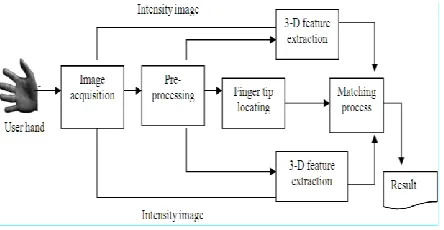
The overview of the proposed approach for biometric authentication that simultaneously employs multiple 2-D and 3-D hand features is shown in Fig.1.
Major computational modules of the proposed approach involve image normalization (in the pre-processing stage), feature extraction and feature matching. The intensity and range images of the user‟s hand, acquired by a 3-D digital camera, are processed to locate and extract individual fingers and palm print. Feature extraction modules further process the respective Regions Of Interest (ROIs) in order to extract the discriminatory features. Individual matching modules compute the matching distance by comparing the extracted features with the corresponding feature templates enrolled in the database. Multiple matching scores generated by the preceding stage are then combined at the fusion module, to obtain a consolidated match score. Finally, the decision module compares the consolidated match score with the preset threshold to determine whether the claimant is genuine or an impostor.
International Journal of Emerging Technology and Advanced Engineering
Website: www.ijetae.com (ISSN 2250-2459, Volume 2, Issue 7, July 2012)351 and gray-level images from the palm side of user‟s hand and thereby offers range of features (2-D and 3-D hand geometry and finger texture) that can be simultaneously extracted and combined to achieve reliable and secure multimodal biometric authentication.
The unified framework for hand identification described in this paper is evaluated on a relatively large database of intensity and range images to achieve more reliable estimates of performance for contact less hand imaging.
The objective of this study is to achieve performance improvement by simultaneously acquiring and combining three-dimensional and two dimensional features from the human hand. The proposed approach utilizes a 3-D digital camera to simultaneously acquire intensity and range images of the presented hands of the users in a contact-free manner.
A. Preprocessing
The acquired intensity image is pre-processed in order to improve the clarity of the picture by removing the noises present in the image, to adjust the resolution of the image according to the requirements and finally in order to improve the over all performance rate. First in order to remove noises present in the image, it is subjected to the filter called median filter. The median filter is nonlinear digital filtering technique, often used to remove noise.
Second we need to binarize the image to improve the performance rate. A binary image is a digital image that has only two possible values for each pixel. Typically the two colours used for a binary image are black and white though any two colours can be used. The gray level intensity images are first binarized using Otsu‟s thresholding algorithm.
Steps Involved in image binarization:
Compute histogram and probabilities of each intensity level
Set up initial qi (0) and μi (0)
Step through all possible thresholds
Maximum intensity
Update qi and μi Compute μ
Desired threshold corresponds to the maximum
The sample binarized image is shown in Fig. 2.
Fig. 2: Binarized image
B. Finger Edge Location
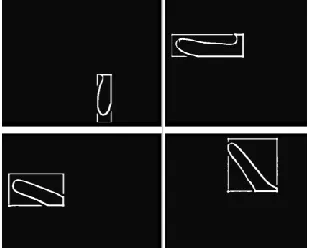
Traversing the extracted hand contour, local minima and local maxima points, which correspond to finger tips and finger valleys, are located. In order to estimate the orientation of each finger, four points on the finger contour (two points each on both sides of the fingertip) at fixed distances from the fingertip are identified. Two middle points are computed for corresponding points on either side and are joined to obtain the finger orientation. Points at the center and bottom part of the finger are not considered for the estimation of orientation, as some of the fingers are found to be no symmetric at these parts. Once the finger orientation and fingertip Valley points are determined; it is a straightforward task to extract a rectangular ROI from the fingers. Similarly, based on the two finger valley points (between little-ring and middle-index fingers), a fixed ROI can be extracted. Fig. 3 shows the extracted finger edge locations.
[image:4.612.333.513.157.317.2]
International Journal of Emerging Technology and Advanced Engineering
Website: www.ijetae.com (ISSN 2250-2459, Volume 2, Issue 7, July 2012)352 C. 2-D Hand Geometry and Texture Process
This system acquire low-resolution hand images and employ a 2-D Gabor filter-based competitive coding scheme to extract features from the 2-D hand images. The competitive coding scheme proposed in has been one of the best performing feature extraction methods. This approach uses a bank of 2-D Gabor filters to extract information. The three parameters of the Gabor filter are empirically determined to be (35, 2.6, 0.7), respectively.
In Image Processing, a Gabor filter, named after Dennis Gabor, is a linear filter used for edge detection. Frequency and orientation representations of Gabor filters are similar to those of the human visual system and they have been found to be particularly appropriate for texture representation and discrimination. In the spatial domain, a 2D Gabor filter is a Gaussian kernel function modulated by a sinusoidal plane wave.
The algorithm for Gabor filter is:
Function gb = gabor_fn (sigma, theta, lambda, psi, gamma)
sigma_x = sigma sigma_y = sigma/gamma
x_theta = x*cos (theta) +y*sin (theta) y_theta = -x*sin (theta) +y*cos (theta)
gb= 1/(2*pi*sigma_x*sigma_y)*exp (-0.5 (x_theta.^2/sigma_x^2+y_theta.^2/sigma_y^2)).*cos (2*pi/lambda*x_theta+psi);
Hand-geometry features are extracted from the binarized version of the acquired intensity images of the hand. Features considered in this work include finger lengths, finger widths at equally spaced distances along the finger area and finger perimeters. The Extracted 2-D features are shown in Fig. 4.
Fig. 4. 2-D features of the hand image
D. 3-D Hand Geometry and Texture Process
The finger localization algorithm developed in the previous section is employed to locate and extract individual fingers from the acquired range images. This system uses the terms 3-D hand geometry and 3-D finger geometry synonymously as they represent features extracted from the 3-D hand data. Each of the four finger range images is further processed for feature extraction. The 3-D feature extraction approach adopted in this work is inspired by the conventional finger width features in the hand-geometry verification. For each finger, a number of cross-sectional segments are extracted at uniformly spaced distances along the finger length. The Extracted 3-D curvature of the hand image are shown in Fig. 5.
E. Matching Module
In order to match hand and finger surface features, two simple but efficient matching distance metrics are introduced. The proposed metrics of using hamming distance can effectively deal with small changes resulting from hand pose variations during the imaging process. Features extracted from each of the four fingers are matched individually and then combined to obtain a consolidated match score.
The Hamming distance between two strings of equal length is the number of positions at which the corresponding symbols are different. Put another way, it measures the minimum number of substitutions required to change one string into the other, or the number of errors that transformed one string into the other.
[image:5.612.355.510.520.644.2]International Journal of Emerging Technology and Advanced Engineering
Website: www.ijetae.com (ISSN 2250-2459, Volume 2, Issue 7, July 2012)353 The Hamming distance between:
Toned and “roses” is 3
1011101 and 1001001 is 2
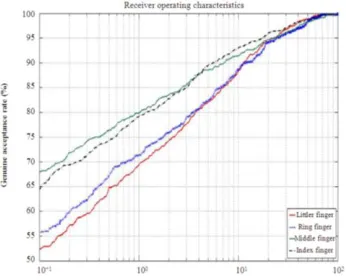
The output is also presented in Fig. 6, in form of graph against the 2-D and 3-D features of trained and compared hand images.
Fig. 6: ROC from the individual 3-D finger geometry representations
V. EXPERIMENTAL PROCESS
The performance of the proposed approach for hand authentication is evaluated on a database of 150 hand images acquired from 50 subjects. Since there is no publicly available database of 3-D and 2-D (palm-side) hand images.
It can be observed from Table-1 that the combination (3-D and 2-D hand geometry) features results in the best performance and is significantly better than the performance obtained from any of the individual hand features.
TABLEI
PERFORMANCE INDICES
Methodology Performance Rate
(%)
EER (%)
2D hand
geometry 96.55 6.3
3D hand
geometry 97.22 3.5
(2D + 3D) hand
geometry 99.44 2.3
VI. CONCLUSION
This project presented a new approach to achieve reliable personal authentication based on simultaneous extraction and combination of multiple biometric features extracted from 3-D and 2-D images of the human hand. The proposed approach acquires hand images in a contact-free manner to ensure high user friendliness and also to avoid the hygienic concerns. Simultaneously captured range and intensity images of the hand are processed for feature extraction and matching. In order to extract discriminatory information for 3-D hand-geometry-based biometric authentication, this system introduced two representations, namely, finger surface curvature and unit normal vector. The proposed 3-D hand-geometry features explicitly capture curvature variation on the cross-sectional finger segments. Simple and efficient metrics, capable of handling limited variations in the hand pose, are proposed for matching a pair of 3-D hands.
Our experimental results on a database of 150 images taken from 50 subjects demonstrate that the combining 2-D and 3-D hand-geometry features have high discriminatory information for biometric verification.
[image:6.612.82.255.252.392.2]Receiver Operating Curve (ROC): It can be observed from Figure.7, a simultaneous combination of 2-D hand-geometry features with the proposed 3-D features can significantly improve the performance (relative EER improvement of 34% over 3-D hand geometry), which cannot be achieved by either 2-D or 3-D hand-geometry features alone.
[image:6.612.324.537.500.690.2]International Journal of Emerging Technology and Advanced Engineering
Website: www.ijetae.com (ISSN 2250-2459, Volume 2, Issue 7, July 2012)354
REFERENCES
[1] Amayeh, G., G. Bebis, A. Erol and M. Nicolescu, 2006. Peg-free hand shape verification using high order Zernike moments. Proceedings of the 2006 Conference on Computer Vision and Pattern Recognition Workshop, (CVPRW‟ 06), IEEE Computer Society Washington, DC.., USA., DOI: 10.1109/CVPRW.2006.155
[2] Ying, H., T. Tieniu, S. Zhenan and H. Yufei, 2007. Identity verification by using handprint. Adv. Biometrics, 4642: 328-337. DOI: 10.1007/978-3-540-74549-5_35
[3] Jain, A.K., N. Duta, 1999. Deformable matching of hand shapes for
verification. Michigan StateUniversity.
http://www.cse.msu.edu/biometrics/Publications/HandGeometry/Jain Duta_DeformHandShape_ICIP99.pdf
[4] Jain, A.K., A. Ross and S. Pankanti, 1999. A prototype hand geometry based verification system. Proceedings of the 2nd International Conference on Audio-and Video-based Biometric Person Authentication, Mar. 22-24, Washington D.C.,pp:166-171.
[5] Kanhangad, V., A. Kumar and D. Zhang, 2009. Combining 2D and 3D hand geometry features for biometric verification. Proceedings of the IEEE Computer Society Conference on Computer Vision and Pattern Recognition Workshops, Jun. 20-25, IEEE Xplore Press, China, pp: 39-44. DOI: 10.1109/CVPRW.2009.5204306
[6] Kumar, A., D.C.M. Wong, H.C. Shen and A.K. Jain, 2003. Personal verification using palm print and hand geometry biometric. Proceedings of the 4th International Conference on Audio- and Video-Based Biometric Person Authentication, Springer-Verlag
Berlin, Heidelberg, U.K., pp: 668-675.
http://dl.acm.org/citation.cfm?id=1762309
[7] Kanhangad, V., A. Kumar and D. Zhang, 2011. A unified framework for contactless hand verification. IEEE Trans. Inform. Forensics Secu., 6: 1014-1027. DOI: 10.1109/TIFS.2011.2121062
Lay, Y.L., 2000. Hand shape recognition. Opt. Laser Technol., 32: 1-5.
[8] Malassiotis, S., N. Aifanti and M.G. Strintzis, 2006. Personal authentication using 3-D finger geometry. Proceeding of the IEEE Trans. Inf. Forensics Secu., 1: 12-21.
[9] Oden, C., A. Ercil and B. Buke, 2003. Hand recognition using implicit polynomials and geometric features. Pattern Recognit. Lett., 24: 2145-2152. DOI: 10.1016/S0167-8655(03)00087-4
[10] Choras, R.S.,M.Choras, 2006. Hand shape geometry and palm print features for the personal identification. Proceedings of the 6th International Conference on Intelligent Systems Design and Applications, Oct. 16-18, IEEE Xplore Press, Jinan, pp: 1085-1090. DOI: 10.1109/ISDA.2006.253763
[11] Sanchez-Reillo, R., C. Sanchez-Avila and A. Gonzalez-Macros, 2000. Biometric identification through hand geometry measurements. IEEE Trans. Patt. Anal. Machine Intel., 22: 1168-1171. DOI: 10.1109/34.879796
[12] Woodard, D.L and P.J. Flynn, 2005. Finger surface as a biometric identifier. Comput. Vision Image Understanding, 100: 357-384. DOI: 10.1016/j.cviu.2005.06.003
[13] Xiong, W., K.A. Toh, W.Y. Yau and X. Jiang, 2005. Model-guided deformable hand shape recognition without positioning aids. Patt. Recog., 38: 1651-1664. DOI: 10.1016/j.patcog.2004.07.008 [14] Zhang, D., G. Lu, W. Li, L. Zhang and N. Luo, 2009. Palm print
recognition using 3-D information. Proceedings of the IEEE Transactions on Systems, Man, and Cybernetics, (IEEE‟09), IEEE Xplore Press, pp: 505-519. DOI: 10.1109/TSMCC.2009.2020790 [15] Zheng, G., C.J. Wang and T.E. Boult, 2007. Application of projective
invariants in hand geometry biometrics. IEEE Trans. Inform. Forensics Secu., 2: 758-768. DOI: 10.1109/TIFS.2007.908239
[16] Selvarajan, S., V. Palanisamy and B. Mathivanan, 2007. Segmentation of hand images for hand geometry based human identification and recognition. GESTS Inter. Transactions Comp. Sci. Eng., 43: 152-162.
[17]Selvarajan, S., V. Palanisamy and B. Mathivanan, 2008. Hand geometry based human identification and recognition system using some selected hand attributes. Inter. J. Syst. Cybernetics Inform (ISSN 0973-4864) pp: 57-63.