
DEVELOPMENT OF COMPACT RECTANGULAR MICROSTRIP PATCH ANTENNA FOR WIMAX, FIXED SERVICE SATELLITE AND MICROWAVE C-BAND
APPLICATIONS
KHALID AHMED AWOL
A project report submitted in partial
Fulfillment of the requirement for the award of the Degree of Master Electrical Engineering
Fakulti Kejuruteraan Elektrik dan Elektronik Universiti Tun Hussein Onn Malaysia
CONTENTS
CHAPTER TITLE PAGE
DECLARATION I
DEDICATION v
ACKNOWLEDGEMENT vi
ABSTRACT vii
TABLE OF CONTENTS viii
LIST OF TABLE xii
LIST OF FIGURE xiii
LIST OF ABBREVIATIONS xiv
1 INTRODUCTION
1.1 Overview 1
1.2 Problem Statements 3
1.3 1.4
Project Objectives Motivation
4 4 1.5
1.5 1.6
Project Scopes Expected Result Thesis Outline
5 5 6
2 LITERATURE REVIEW
2.1 Introduction 7
2.2 2.3
Microstrip Antenna
Advantages and disadvantages of Microstrip
Antenna
2.3.1 Advatages 2.3.2 Disadvantages
9 10
2.4 Feeding Techniques
2.4.1 Microstrip Transmission line Feed 2.4.2 Aperture coupling feed
2.4.3 Coaxial probe feed 2.4.4 Proximity coupling feed
10 10 11 12 12 2.5 2.6
Transmission Line Model Analysis Technology Development 13 16 2.7 2.8 2.6.1 2.6.2 2.7.1 2.7.2 Application: WiMAX Application: Radar Previous Work
Antennas for mobile/WLAN applications
Broad band /Multiband antennas Chapter Summary 16 16 17 18 23 25
3 METHODOLOGY
3.1 Introduction 26
3.2 3.3
3.4
3.5
Procedures of Development of the Project Theoretical study and Design specification 3.3.1 Calculating Antenna Dimensions 3.3.2 Choosing for Feeding Technique 3.3.4 Choosing for Suitable Substrate
Design of Single Band Antenna Operating at 2.5 GHz for WIMAX Applications.
3.4.1 Antenna Design
Design of Triple Band Antenna using Semi Ellipse Shape at one Edge of the Patch.
27 27 29 31 31 32 32 34
x
3.5 3.6
3.7 3.8
3.6.1 Antenna Layout Printing
3.6.2 Lamination and UV Light Process 3.6.3 Developing Process
3.6.4 Etching Process 3.6.5 Stripping Process 3.6.6 Soldering Process
Measurement and Comparative Analysis Chapter Summery 37 37 37 37 37 38 38 39 4 5
RESULT AND ANALYSIS 4.1 Introduction 4.2 Simulation Results
4.2.1 Parametric Study 4.2.2 Return Loss, dB 4.2.3 Radiation Pattern Plots 4.2.4 Input Impedance
4.2.5 Gain versus frequency plot
4.2.6 Gain versus radiated efficiency plot 4.2.7 Electric Field and Magnetic Field
4.2.8 Gain versus Electric and Magnetic Field 4.2.9 Surface current
4.3 Measurement Results 4.3.1 Return Loss, dB
4.3.2 Smith Chart
4.4 Simulation and Measurement Result Analysis 4.5 Chapter Summary
CONCLUSION AND FUTURE WORK 5.1 Conclusion
LIST OF TABLE
TABLE NO. TITLE PAGE
2.1 Radar frequency bands. 6
3.1 Dimensions of single patch rectangular antenna.
30
3.2 Inset feed of single patch rectangular antenna.
31
3.3
3.4
Single Band Patch Antenna
Specifications Resonating at 2.5 GHz Summary of Parameter Values of Designed Antenna at 2.5 GHz frequency 32 33 3.5 3.6 4.1 4.2 4.3 4.4 4.5
Parameters of the triple band antenna. Summary of Parameter Values of Designed Triple band Antenna. Summary of Parameter Values of Proposed Antenna .
Summarized simulated return loss and Bandwidth of simulated antenna Summarized simulated gain and efficiency versus frequency of antenna Summarized Electric and Magnetic field components of the simulated antenna.
xii
LIST OF FIGURE
FIGURE NO. TITLE PAGE
2.1 Microstrip Patch Antenna Structure 8
2.2 Patch with feed line 11
2.3 2.4 2.5
Aperture-coupled feed
Top and side view of coaxial feeding Proximity-coupled Feed
11 12 13 2.6 A rectangular microstrip patch antenna showing
fringing fields that account for radiation
13
2.7 A patch excited using coaxial probe 14
3.1 Flowchart of the Overall Project 28
3.2 Simulated Return Loss of MSA Resonating at
2.5 GHz 32
3.3 Smith Chart of MSA Resonating at 2.5 GHz 33
3.4 3.5
Simulated Gain at 2.5 GHz
Simulated S11 for patch antenna with semi ellipse at the top of the patch
33 34 3.6 3.7 3.8 3.9 4.1 4.2
Simulated Gain of the antenna at 2.65 GHz, 3.67GHz, 6.55GHz.
Fabrication process flowchart. Fabricated proposed antenna
ZVB 14 Vector Network Analyzer Microstrip antenna structure
4.2 4.3(a) 4.3(b) 4.4(a) 4.4(b) 4.5 4.6 4.7 4.8 4.9(a) 4.9(b) 4.9(c) 4.10(a) 4.10(b) 4.10(c) 4.11 4.12 4.13
Simulated return losses for various b with other parameters unchanged.
Simulated S11 for patch antenna with semi ellipse and slot loaded.
Simulated return loss of the different structures of antenna.
Elevation Pattern for φ = 0 and φ = 90 degrees at 2.5 and 3.74GHz.
Elevation Pattern for φ = 0 and φ = 90 degrees at 5.77GHz.
Simulated Z parameter
Simulated smith chart of the proposed antenna Simulated Gain Versus Frequency Plot
Simulated Gain Versus Radiated Efficiency Simulated E and H plane at frequency 2.5GHz Simulated E and H plane at frequency 3.73GHz
Simulated E and H plane at frequency 5.77GHz Simulated E field versus frequency
Simulated H field versus frequency Simulated E and H fields versus frequency Measured return loss, S11 (dB)
Input impedance of the measured antenna. Simulated return loss curved against the measured return loss.
xiv
LIST OF ABBREVIATIONS
Free space wavelength
f Operating frequency
c Speed of light
r
Dielectric constant
D Directivity
G Gain
E Efficiency
W Width
L Length
h Substrate thickness
L
Extended length due to
fringing field effect
Leff Effective length
PCB Printed circuit board
SWR Standing wave ratio
VSWR Voltage standing wave
ratio
RL Return loss
RCHP Right hand circular
polarization
LHCP Left hand circular
polarization
HPBW Half power beamwidth
dB Decibel
Zin Input impedance
Zo Characteristic impedance
S11 Return loss or Reflection
Coefficient (dB)
Rin Antenna resistance
Xin Antenna reactance
fH Upper frequency
fL Lower frequency
CHAPTER 1
INTRODUCTION
1.1 Overview
An explosive growth of the wireless radio communication systems is currently observed in the microwave band. In the short range communications or contactless identification systems, multiband antenna has been playing a very important role for wireless service requirements [1]. Wireless local area network (WLAN) and Worldwide Interoperability for Microwave Access (WiMAX) have been widely applied in mobile devices such as handheld computers and intelligent phones. These two techniques have been widely considered as a c o s t -effective, viable, and high-speed data connectivity solution, enabling user mobility [2].
WiMax [4] (Worldwide Interoperability for Microwave access) has three allocated frequency bands. The lower band (2.5 -2.69 GHz), the middle band (3.2-3.8 GHz) and the upper band (5.2-5.8 GHz) [4].
Moreover a large number of microstrip patches to be used in wireless applications have been developed [ 5] . The rapid progress in wireless communications requires the development of lightweight, low profile, single feed antennas. Also it is highly desirable to integrate several RF modules for different frequencies into one piece of equipment. Hence, multiband antennas that can be used simultaneously in different standards have been in the focus points of many research projects [6]. Portable devices are widely used in our daily lives such as mobile phones, laptops with wireless connection [7].
The main goal of this work is to reduce the size of the antenna very effectively and for the size reduction a slot and semi ellipse were introduced to the conventional antenna. This work achieves more size reduction in comparison to simpler structure. The proposed antenna structure in this project can be used for Wi-MAX and microwave C band applications.
The first design of patch antenna is by designing simple structure microstrip antenna, which is designed for some narrow-band applications. The second design is to develop this simple antenna into compact dual band with triple frequency operation.
3
1.2Problem Statement
In recent years, demand for small antennas on wireless communication has increased the interest of research work on compact microstrip antenna design among microwave and wireless engineers [8].
The development of antenna for wireless communication requires an antenna with more than one operating frequency. This is due to many reasons, primarily because of various wireless communication systems and many telecommunication operators use various frequencies. Therefore one antenna that has multiband characteristic is more desirable than having o n e a n t e n n a f o r each frequency band.
In some applications like WIMAX and C band Applications; a multiband characteristic antenna is required. In the previous work in order to achieve that characteristic, some techniques like cross slots [8], sorting pins, increasing the thickness of the patch [9], use of circular and triangular patches with proper slits [7] and antenna arrays were proposed. But these methods have their own demerits like complexity in design and degrading some effectiveness of the parameters of the antenna.
1.3Objectives of Project
The objectives of this project are:
I. To design and develop triple band frequency compact rectangular microstrip patch antenna for WIMAX, fixed service satellite and Microwave C band applications.
II. To investigate and analyze the electrical and geometrical properties of the compact triple band rectangular microstip patch antenna.
III. To fabricate the compact triple band rectangular microstrip patch antenna and test the performance of the antenna experimentally.
1.4 Motivation
Use of conventional microstrip antenna is limited because of their poor gain, low bandwidth and polarization purity. There has been a lot of research in the past decade in this area.
These techniques include use of cross slots and sorting pins, increasing the thickness of the patch, use of the circular and triangular patches with proper slits and antenna arrays. Various feeding techniques are also extensively studied to overcome these limitations.
5
1.5The Scopes of The project
This project focuses four major components to fulfill the objectives of the project, which represent as follows:
I. The frequency operation of this compact antenna is from 2GHz to 8GHz, which is the S and C-band frequency ranges. Also the resonant frequency of the conventional antenna is selected as 2.5 GHz.
II. Antenna characteristics such as S11, gain, radiation efficiency, radiation pattern and 3 dB beam width will be discussed in this project. Antennas are defined by several parameters according to their constitution and shape.
III. The antenna will be simulated by using CST microwave studio. This software is chosen because it is a specialist tool for the 3D EM simulation of high frequency components.
IV. The compact microstrip patch antenna will be tested by using Network Analyzer.
1.5 Thesis Outline
This thesis is divided into 4 main chapters and the reference section.
Chapter I discusses about the introduction, problem statement, objectives and scope of the project.
Chapter 2 briefs literature studies of the microstrip antenna in order to get its basic fundamental. The main aspects of the microstrip antenna such as its structure configuration, radiation mechanism, polarization, feeding techniques, method of analysis etc are covered. Previous researches related with the project also presented in this chapter.
Chapter 3 describes the design procedure of single band, and triple band Rectangular Microstrip patch antenna using coaxial feeding technique. The designing and simulation using CST Microwave Studio of rectangular microstrip patch antenna is done and simulation results are presented, the fabrication procedure of the antenna and various instruments used for antenna fabrication The snap shots of the fabricated antenna are also given in this chapter. This chapter also describes some techniques to improve the compactness off the microstrip patch antenna using slots.
Chapter 4 analysis the results of the proposed antenna such as return loss(dB), radiation pattern, gain and radiation efficiency. Also the comparison of the simulated and measured results is presented in this chapter.
7
CHAPTER II
LITERATURE REVIEW
2.1 Introduction
Microstrip patch antennas are good candidate for multi-band wireless communications because of their low profile, light weight, low price, compactness and mass productivity [10], also they can support both linear and circular polarizations and they can accept for dual and triple frequency operations.
2.2 Microstrip Patch Antenna
[image:17.612.225.430.478.611.2]The idea of microstrip antenna was first proposed by Deschamps in 1953 [11] and a patent in 1955. However, the first antenna was developed and fabricated during the 1970’s when good substrates became available [11, 12]. Microstrip antenna is also referred as a patch antenna. Microstrip patch antenna consists of a radiating patch on one side of a dielectric substrate and a ground plane on the other side as shown in Figure 2.1. The patch is generally made of a conducting material such as copper or gold and can take any possible shape.
Figure 2.1 Basic microstrip patch antenna [12]
9
combination of these shapes or any other configuration [12]. Every shape has its own characteristics but square, rectangular, and circular are the most common configurations because of their easier analysis and fabrication.
2.3Advantages and Disadvantages of Microstrip Antennas
The microstrip patch antenna has several advantages that proved to be an excellent radiator for many applications. But it also has some disadvantages. Even though the microstrip patch antenna suffers several disadvantages its many advantages have made it suitable to be used in wireless applications.
2.3.1 Advantages
i) They are lightweight, low volume and thin profile configuration. These make them to be easily incorporated into any package.
ii) Low profile planar configuration that can be easily made conformal to host surface; which fits the shape design and needs of modern communication equipment.
iii) They can be made compact for use in personal mobile communication. iv) The microstrip antenna shape flexibility enables mounting them on a rigid
surface which makes them mechanically robust.
v) Using printed-circuit technology leads to a low fabrication cost hence can be manufactured in large quantities.
vi) Supports both linear polarization and circular polarization.
vii) They accept for dual and triple frequency operations.
2.3.2 Disadvantages
i) Narrow bandwidth;
ii) They can only be used in low power applications and low power handling capability.
iii) Relatively poor radiation efficiency - radiate only in half-space.
iv) High losses resulting from surface wave excitation, conductor and dielectric losses.
2.4Feeding Techniques
The following feeding techniques are used for patch antennas, • Microstrip transmission-line feed
• Aperture coupling feed
• Coaxial probe feed
• Proximity coupling feed
These methods can be contacting or non-contacting. Contacting methods involve direct contact between the transmission line and the radiating surface. The non-contacting methods use electromagnetic field coupling to transfer the power to the patch [13].
2.4.1 Microstrip transmission-line feed
11
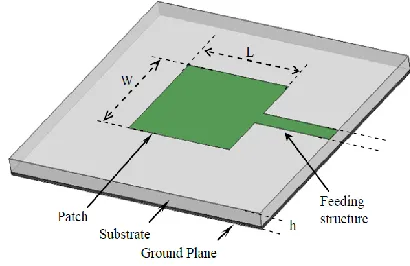
Figure 2.2: Patch with feed line [15]
2.4.2 Aperture coupling feed
Aperture coupling is more difficult to fabricate and leads to narrow band-width. The geometry consists of two substrates separated by a ground plane. The bottom side of the substrate is fed by a transmission-line and the energy is coupled to the patch through a slot [14].
The substrate on top has a low dielectric constant while the bottom substrate is a higher material with a non-contacting feed. By controlling the length of the slot or the width of the transmission-line, matching is performed.
[image:20.612.123.455.540.672.2]2.4.3 Coaxial probe feed
[image:21.612.159.493.230.443.2]The coaxial probe feed has a narrow bandwidth. It consists of two conductors. The outer conductor is connected with the ground plane while the inner conductor is connected to the radiating patch. Coaxial probe feed is easy to fabricate and match. It is very difficult to model for thick substrates.
Figure 2.4: Top and side view of coaxial feeding [15]
2.4.4 Proximity coupling feed
13
. Figure 2.5: Proximity-coupled Feed [15]
2.5Transmission Line Model Analysis.
The patch and ground-plane are separated by a dielectric. The patch conductor is normally copper. The patches are usually photoetched on the dielectric substrate. The substrate is usually non-magnetic. The relative permittivity of the substrate is normally in the region between 1 and 4, which enhances the fringing fields [16].
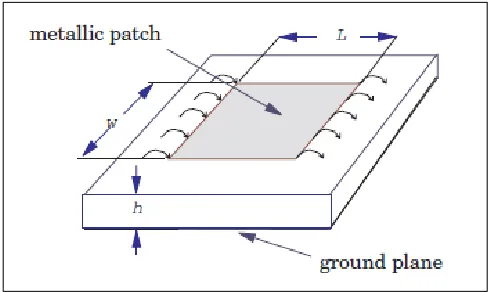
[image:22.612.205.452.481.627.2]The rectangular patch is characterized by its length L, width w and thickness h, as shown in Figure 2.6 below.
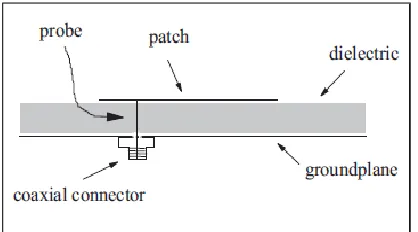
The inner conductor of the coaxial-line is connected to the radiating patch, while the outer conductor is connected to the ground-plane, as shown in Figure 2.7 below
Figure 2.7 A patch excited using coaxial probe
An effective dielectric constant (ε reff ) must be obtained in order to account for the fringing and the wave propagation in the line. The value of ε reff is slightly less then ε r because the fringing fields around the periphery of the patch are not confined in the dielectric substrate but are also spread in the air. It can be expressed by[13]:
2 1
12 1 2
1 2
1
w h r
r
reff
(2.1)
Where
ε reff = Effective dielectric constant
εr = Dielectric constant of substrate
h = Height of dielectric substrate
[image:23.612.224.433.149.265.2]15
For a given resonance frequency fo, the effective length is given by [13]:
reff fo c Leff 2
(2.2)
The fringing fields along the width can be modeled as radiating slots and electrically the patch of the microstrip antenna looks greater than its physical dimensions. The dimensions of the patch along its length have now been extended on each end by a distance, ΔL.
The ΔL can be expressed as [13]:
ΔL = 0.412h
8 . 0 264 . 0 258 . 0 3 . 0 h W h W reff reff (2.3
The effective length of the patch Leff now becomes:
Leff = L + 2 ΔL
Where
ΔL = Length due to fringing effects
L = Length of patch
Leff = Effective length of the patch
h = Height of dielectric substrate
W = Width of patch
For efficient radiation the width, W is given by[13]:
2 1
2
r fo
c W
(2.4)
2.6 Technology Development
2.6.1 Application: WiMAX
WiMAX [4] is short for Worldwide Interoperability for Microwave Access. It is a metropolitan wireless standard created by the Intel and Alvarion in 2002 and ratified by the IEEE (Institute of Electrical and Electronics Engineers) under the name IEEE-802.16. More precisely, WiMAX is the commercial designation that the WiMAX forum gives to devices which conform to the IEEE 802.16 standard, in order to ensure a high level of interoperability among them.
2.6.2 Application: Radar
17
Table 2.1: Radar Frequency Bands and General Usage [6].
Band Designation Frequency Range General Usage
VHF 50-300 MHz Very Long-Range Surveillance UHF 300-1000 MHz Very Long-Range Surveillance
L 1-2 GHz Long-Range Surveillance
Enroute Traffic Control
S 2-4 GHz Moderate Range Surveillance
Terminal Traffic Control Long-Range Weather
C 4-8 GHz Long-Range Tracking
Airborne Weather Detection
X 8-12 GHz Short Range Tracking
Missile Guidance Mapping Marine Radar Airborne Intercept
Ku 12-18 GHz High Resolution Mapping
Satellite Altimetry
K 18-27 GHZ Water Vapor Absorption
2.7 Previous Work
This chapter gives a detailed review of different technologies and designs adopted by different researchers in the case of printed antennas for compact and multiband applications. Recent developments in antenna design for mobile and WLAN applications have been referred. Different techniques for broadband and multiband designs that have been reported recently are also highlighted. A number of papers on compact multiband antennas are reviewed here.
2.7.1 Antennas for mobile/WLAN applications
Wireless communications have progressed very rapidly in recent years, and many mobile units are becoming smaller and smaller. To meet the miniaturization requirement, compact antennas are required. Planar printed antennas have the attractive features of low profile, small size and conformability to mounting hosts. They are very promising candidates for satisfying the above applications. For this reason, compact and broadband design techniques for planar antennas have attracted much attention from antenna researchers.
Very recently, especially after the year 2000, many novel planar antenna designs to satisfy specific bandwidth specifications of present-day mobile cellular communication systems, including the global system for mobile communication (GSM: 890–960MHz), the digital communication system (DCS: 1710–1880MHz), the personal communication system (PCS: 1850–1990MHz), and the universal mobile telecommunication system (UMTS: 1920– 2170MHz), have been developed and published in the open literature.
19
Jen Yea Jan et al. [17] proposed a microstrip fed dual band planar monopole antenna with shorted parasitic inverted L wire for 2.4/5.2/5.8 WLAN bands. In this design inverted L shaped monopole is the exciting element and which controls the higher frequency. Another shorted inverted L shaped parasitic strip etched nearer to the monopole controls the lower frequency.
Wong et al. [18] presented a low-profile planar monopole antenna for multiband operation of mobile handsets. The proposed antenna has a planar rectangular radiating patch in which a folded slit is inserted at the patch’s bottom edge. The folded slit separates the rectangular patch into two sub patches, one smaller inner sub patch encircled by the larger outer one. The proposed antenna is then operated with the inner sub-patch resonating as a quarter-wavelength structure and the outer one resonating as both a quarter-wavelength and a half-wavelength structure.
A multiband folded planar monopole antenna has been proposed for mobile handset by Shun-Yun Lin [19]. This paper introduces a folded planar monopole antenna, which has a very low profile of about one twentieth of the wavelength of the lowest operating frequency. The effect is achieved by using a bended rectangular radiating patch and an inverted L-shaped ground plane.
In another attempt Ching Yuan Chiu et al. [20] proposed a shorted, folded planar monopole antenna for dual-band mobile phone. The antenna is fabricated from stamping a single metal plate, which is then folded onto a foam base. The antenna has two separate branches of different sizes: the larger one supports a longer resonant path (path1) for generating a lower mode for GSM operation, while the smaller one provides a shorter resonant path (path2) for generating a higher mode for DCS operation.
Jan and Kuo [21] discussed a CPW-fed wideband planar monopole antenna with a symmetrically slope ground plane. Antenna has an impedance bandwidth of 1162 MHz extends from 1700MHz to 2862 MHz, which covers DCS, PCS and Bluetooth bands.
In this case wideband operations can be controlled by choosing the slope angle of the symmetrical ground plane.
Yacouba Coulibaly et al. [23] presented a broadband CPW fed printed monopole antenna. This configuration comprise of a coplanar waveguide fed monopole antenna with two parasitic strips placed symmetrically on both sides of the monopole. The two parasitic strips adds capacitive coupling and hence improves the impedance bandwidth to 47% with center frequency 2.35GHz .
Cho et al. [24] proposed a PIFA configuration for 2.4/5GHz applications. This configuration offers 110MHz bandwidth in bluetooth band and 900MHz in WLAN band.
Hao Chun Tung et al. [25] proposed a printed dual band monopole antenna for 2.4/5.2GHz WLAN access point. The trident monopole antenna comprises a central arm for the 2.4 GHz band (2.4–2.484GHz) operation and two side arms for the 5.2 GHz band (5.15– 5.35GHz) operation.
A compact dual band planar branched monopole antenna has been proposed by Suma et al. [26] for DCS/2.4GHz WLAN Application. The two resonant modes of the proposed antenna are associated with various lengths of the monopoles, in which a longer arm contributes for the lower resonant frequency and a shorter arm for higher resonant frequency.
Raj et al. [27] discussed a compact dual band coplanar antenna for WLAN application. The antenna comprises of a rectangular center strip and two lateral strips printed on a dielectric substrate and excited using a 50Ω microstrip transmission line. The lower resonant frequency of the antenna is due to a “U” shaped resonant path on the center strip and the upper resonant frequency is obtained due to the width of the center strip, corresponding to a half wavelength variation in substrate.
Jeun-Wen Wu et al. [28] proposed a planar meander-line antenna consisting of three branched strips for very-low-profile GSM/DCS/PCS/WLAN triple-band operation of mobile phones. The branch strips are designed to operate as quarter-wavelength structures at 900 and 1800 MHz, respectively, and covering GSM/DCS/PCS and WLAN bands.
21
Shao Lun Chien et al. [30] proposed a Planar Inverted-F Antenna with a hollow shorting cylinder for internal mobile phone antenna applications.
Fa Shian Chang et al. [31] presented a folded meandered-patch monopole antenna for triple-band operation. The proposed antenna is suitable for applications in mobile phones for GSM, DCS and PCS triple- band operations.
An internal GSM/DCS antenna backed by a step-shaped ground plane for a PDA Phone was proposed by K.L. Wong et al. [32]. The antenna has two radiating strips designed to operate at about 900 and 1800MHz for GSM/DCS operation, and is backed by a step-shaped ground plane.
Zi Dong Liu et al. [33] presented a dual frequency planar inverted-F antenna which operates at 0.9GHz and 1.8GHz bands. In this paper two configurations of dual band antennas are proposed. The antenna with two input ports and single-port are described. The two port antenna consists of two separate radiating elements with the rectangular radiating element for 1.8 GHz and the L-shaped radiating element for 0.9 GHz.
Raj et al. [34] presented a compact planar multiband antenna for GPS, DCS, 2.4/5.8 GHz WLAN applications. Antenna has two longer arms on either side separated by a short middle element. A simple 50Ω probe is used to excite the antenna. A metallic patch is embedded on the bottom side of the substrate, which acts as a reflector and controls the impedance matching.
Deepu et al. [35] presented a compact uniplanar antenna for WLAN applications. The dual-band antenna is obtained by modifying one of the lateral strips of a slot line, thereby producing two different current paths. The antenna resonates with two bands from 2.2 to 2.52 GHz and from 5 to10 GHz with good matching, good radiation characteristics and
moderate gain.
Bybi et al. [37] presented a quasi-omnidirectional antenna for modern wireless communication gadgets. The antenna has been derived from the conventional CPW by embedding a modified short, which results in an appreciable improvement in the impedance bandwidth while retaining an almost omnidirectional radiation behavior.
A compact dual band planar antenna has been proposed by Gijo Augustin et al. [38]. It is a finite ground CPW fed, dual-band monopole configuration. The dual-band operation is achieved by loading the flared monopole antenna with a “V”-shaped sleeve.
A dual wide-band CPW-fed modified Koch fractal printed slot antenna, suitable for WLAN and WiMAX operations is proposed by Krishna et al. [39] Here the operating frequency of a triangular slot antenna is lowered by the Koch iteration technique resulting in a compact antenna. Koch fractal slot antenna has an impedance bandwidth from 2.38-3.95GHz and 4.95–6.05GHz covering 2.4/5.2/5.8GHz WLAN bands and the 2.5/3.5/5.5 GHz WiMAX bands.
Deepu et al. [40] presented an ACS fed printed F-shaped uniplanar antenna for dual band WLAN applications. Asymmetric coplanar strip is used as the feed for this uniplanar configuration.
23
2.7.2 Broad band /Multiband antennas
In this section some of the works related to broadband and multiband antennas are presented.
George et al. [42] presented a single-feed dual frequency compact microstrip antenna with a shorting pin. This new antenna configuration gives a large variation in frequency ratio of the two operating frequencies, without increasing the overall size of the antenna.
Liu et al [43] proposed a CPW-fed notched planar monopole antenna for multiband operations using a genetic algorithm. By introducing a suitable notch to a rectangular CPW-fed patch, the desired multi-frequency resonant modes and broad impedance bandwidths can be obtained.
Kundukulam et al [44] presented a dual-frequency antenna arrived from a compact microstrip antenna by loading a pair of narrow slots close to its radiating edges. The two frequencies have parallel polarization planes and similar radiation characteristics.
Puente et al. [45] proposed a fractal multiband antenna based on sierpinski gasket. In this the self-similarity properties of the antenna's fractal shape has been utilized for achieving the multiband behavior.
Aanandan et al. [46] presented a broad band gap coupled microstrip antenna for broad band operation using parasitic elements. The antenna is compact and produces less distortion in the radiation pattern.
The closed form expression for calculating the impedance bandwidth of a wide band printed dipole is proposed by S. Dey et al. [47]
coverage almost as same as that of the rectangular microstrip antenna fed by conventional methods.
An electromagnetically coupled T-shaped microstrip feed to enhance the impedance bandwidth of a rectangular microstrip antenna has been proposed by Lethakumary et al. [49].
Manju Paulson et al. [50] described an arrow-shaped microstrip antenna with a pair of narrow slots embedded near the non-radiating edges to provide wide impedance bandwidth.
Lethakumary et al. [51] introduced a hook shaped feeding technique for bandwidth enhancement of a rectangular microstrip antenna. This antenna offers an impedance bandwidth of 22% without degrading the efficiency.
Jacob et al. [52] proposed the development of a compact microstrip-fed, branched monopole antenna for ultra wide band (UWB) applications. By suitably embedding branches on the top edge of the strip monopole, UWB response can be easily achieved by merging different resonances.
Suma et al. [53] proposed a planar monopole antenna suitable for broadband wireless communication. With the use of a truncated ground plane, the proposed printed monopole antenna offers nearly 60% 2:1 VSWR bandwidth and good radiation characteristics for the frequencies across the operating band. The antenna can be easily integrated into wireless circuitry and is convenient for application in laptop computers.
A novel modified T shaped planar monopole antenna has been proposed for multiband operation by Sheng Bing Chen et al. in [54]. In this paper, a T-shaped planar monopole antenna in that two asymmetric horizontal strips are used as additional resonators to produce the lower and upper resonant modes are proposed. As
61
REFERENCES
[1] P. Rastogi and K. Cecil, “S and C Bands Multilayer T-Slot Photonic Band gap Micro Strip Antenna,” IOSR Journal of Engineering, vol. 2, no. 4, pp. 773–776, 2012.
[2] R. J. Chitra, “Design of Double L-slot Microstrip Path for WiMAX and WLAN Application,” Science and Technology (CREST) Journals, vol 2, pp. 2–5, 2012.
[3] B. Mazumdar and W. Bengal, “A Compact Printed Antenna For Wimax , Wlan & C Band Applications,” International Journal Of Computational Engineering Research, vol. 2, no. 4, pp. 1035–1037, 2012.
[4] M.Almaghazi, “WIMAX Spectrum.” National Telecom Regulatory Authority Egypt, 2011
[5] C. Jung and F. De Flaviis, “A Dual-Band Antenna for WLAN Applications by Double Rectangular Patch with 4-Bridges,” pp. 4–7.
[6] H. Sabri and Z. Atlasbaf, “WLAN APPLICATIONS,” Progress In Electromagnetics Research Letters, vol. 5, pp. 87–98, 2008.
[7] S. Tignath, L. Shrivastava, and D. Sharma, “Triple Band Square Patch Antenna,” Science and Technology (CREST) Journals, vol. 01, no. 02, pp. 45–49, 2013.
[8] A. Das and B. Datta, “Multi-Band Microstrip Slotted Patch Antenna for Application in Microwave Communication,” International Journal of Science and Advanced Technolog, vol. 2, no. 9, pp. 91–95, 2012.
[9] N. Rao and V. D. Kumar, “Gain and Bandwidth Enhancement of a Microstrip Antenna Using Partial Substrate Removal in Multiple-layer Dielectric Substrate,” Progress In Electromagnetics Research Symposium Proceedings, pp. 1285–1289, 2011.
[10] A. Singh, A. Arya, and S. Sharma, “High Gain of C Shape Slotted Microstrip Patch Antenna for Wireless System Abstract :,” International Journal of Applied Engineering Research, vol. 7, no. 11, pp. 11–13, 2012.
[11] Kumar, Girish and Ray.K.P. “Broadband Microstrip Antennas” Artech House, 2003. [12] Kin- Lu Wong, “Compact and Broadband Microstrip Antennas” John Wiley & Sons,
[13] C. A. Balanis, Antenna Theory, Analysis and Design, 3rd edition, John Wiley & Sons, Inc., 2005.
[14] J. Yang; Chen Wu; Litva, J. “Microstrip Ring Antennas for PCS Application” Publication Year: 1996, Page(s): 1594 - 1597 vol.3
[15] S K Behera, “Novel Tuned Rectangular Patch Antenna As a Load for Phase Power Combining” Ph.D Thesis, Jadavpur University, Kolkata.
[16] J. R. Jame, P. S Hall and C. Wood “Microstrip Antenna Theory and Design “.London, United Kingdom Peter Peregrinus Ltd.67-71. 2006.
[17]. Jen Yea Jan and Liang Chih Tseng, Small Planar Monopole Antenna With a Shorted Parasitic Inverted-L Wire for Wireless Communications in the 2.4, 5.2, and 5.8-GHz Bands, IEEE Transactions on Antennas and Propagation, Vol. 52, No. 7, pp.1903-1905, July 2004.
[18]. Kin Lu Wong, Gwo Yun Lee, and Tzung Wern Chiou, A Low-Profile PlanarMonopole Antenna for Multiband Operation of Mobile
Handsets, IEEE Transactions on Antennas and Propagation, Vol. 51, No. 1, pp.121-125, January 2003.
[19]. Shun Yun Lin, Multiband Folded Planar Monopole Antenna for Mobile Handset, IEEE Transactions on Antennas and Propagation, Vol. 52, No. 7, pp. 1790-1794, July 2004
[20]. Ching Yuan Chiu, Pey Ling Teng and Kin Lu Wong, Shorted, folded planar monopole antenna for dual-band mobile phone, IEE Electronics Letters, Vol. 39 No. 18, pp.1301 - 1302, September 2003.
[21]. J.Y. Jan and T.M. Kuo, CPW-fed wideband planar monopole antenna for operations in DCS, PCS, 3G, and Bluetooth bands, IEE Electronics Letters, Vol. 41 No. 18, pp.991-993, September 2005.
[22]. W.C. Liu and C.F. Hsu, Dual-band CPW-fed Y-shaped monopole antenna for PCS/WLAN applications, IEE Electronics Letters, Vol. 41 No., pp. 390-391, March 2005.
[23]. Yacouba Coulibaly, Tayeb A. Dendini, Larbi talbi and Abdel R. Sebak, A new single layer broadband cpw fed printed monopole antenna for wireless applications, IEEE CCECE, Niagra Falls, Vol.3, pp-1541 -1544, May 2004.
63
[25]. Hao Chun Tung, Shyh Tirng Fang and Kin Lu Wong, Printed Dual- Band Monopole Antenna for 2.4/5.2 GHz WLAN Access Point, Microwave and Optical Technology Letters, Vol. 35, No. 4, pp. 286-288, November 2002.
[26]. M.N. Suma, Rohith K Raj, Manoj Joseph, P.C. Bybi and P. Mohanan, A Compact Dual Band Planar Branched Monopole Antenna for DCS/2.4GHz WLAN Applications, IEEE Microwave and Wireless Components Letters, Vol. 16, No.5, pp. 275-277, May 2006.
[27]. Rohith K. Raj, Manoj Joseph, K. Vasudevan, C. K. Aanandan and P.Mohanan A New Compact Microstrip-fed Dual-band Coplanar Antenna for WLAN applications, IEEE Transactions on Antennas and Propagation, Vol.54, No.12, pp. 3755-3762, December 2006.
[28]. Jeun Wen Wu, Chun Ren Lin, Jui Han Lu, A planar meander-line antenna for triple-band operation of mobile, Microwave and optical technology letters, Vol. 41, No. 5, pp. 380 - 386, Apr 2004
[29]. Yong Sun Shin, Seong Ook Park, and Manjai Lee, A Broadband Interior Antenna of Planar Monopole Type in Handsets, IEEE Antennas and Wireless Propagation Letters, Vol. 4, pp. 9-12, 2005.
[30]. Shao Lun Chien, Hong Twu Chen, Chih Ming Su, Fu Ren Hsiao and Kin Lu Wong, Planar Inverted-F Antenna with a Hollow Shorting Cylinder for Internal Mobile Phone Antenna, IEEE Antennas and propagation International symposium, Vol.2, pp. 1947-1950, 2004.
[31]. Fa Shian Chang, Wen Kuan Su and Kin Lu Wong, Folded Meandered- Patch Monopole Antenna for Triple-Band Operation, IEEE Antennas and Propagation International symposium, Vol.1, pp. 278-281, 2003.
[32]. Kin Lu Wong and Chun Lin, Internal GSM/DCS Antenna Backed by a Step-Shaped Ground Plane for a PDA Phone, IEEE Transactions on Antennas and Propagation, Vol. 54, No. 8, pp. 2408-2410, August 2006.
[33]. Zi Dong Liu, Peter S. Hall, and David Wake, Dual-Frequency Planar Inverted-FAntenna, IEEE Transactions on Antennas and Propagation, Vol. 45, No. 10, pp. 1451-1458, October 1997.
[34]. Rohith K Raj, Manoj Joseph, B. Paul and P. Mohanan, Compact planar multiband antenna for GPS, DCS, 2.4/5.8 GHz WLAN applications, IEE Electronics Letters, Vol.41, No.6, pp. 290-291, March 2005.
[35]. V. Deepu, , Rohith K Raj, Manoj Joseph, M.N. Suma, K. Vasudevan, C.K. Aanandan and P. Mohanan, Compact uniplanar antenna for WLAN applications, IEE Electronics Letters, Vol.43, No.2, pp.70-72, January 2007.
[37]. P. C. Bybi, Gijo Augustin, B. Jitha, C. K. Aanandan, K. Vasudevan and P. Mohanan, A Quasi-Omnidirectional Antenna for Modern Wireless Communication Gadgets, IEEE Antennas and wireless propagation letters, Vol. 7, pp-505-508, 2008
[38]. Gijo Augustin, P.C Bybi, V.P. Sarin, P. Mohanan, C.K Aanandan and K. Vasudevan, A compact dual band plannar antenna for DCS-1900/PCS/ PHS, WCDMA/IMT-2000 and WLAN applications, IEEE Antennas and wireless propagation letters, Vol. 7, pp- 108-111, January, 2008.
[39]. D.D. Krishna, M. Gopikrishna, C. K. Anandan, P. Mohanan, and K. Vasudevan, CPW-Fed Koch Fractal Slot Antenna for WLAN/WiMAX Applications, IEEE Antennas and wireless propagation letters, Vol.7, pp-389-392, 2008.
[40]. V. Deepu, R. Sujith, S. Mridula, C. K. Aanandan, K.Vasudevan, P. Mohanan, ACS fed printed F-shaped uniplanar antenna for dual band WLAN applications, Microwave and Optical Technology Letters, Vol. 51, No. 8, pp. 1852 – 1856, May 2009.
[41]. V.P. Sarin, Nisha Nassar, V. Deepu, C.K Aanandan, P. Mohanan and K. Vasudevan, Wide band printed microstrip antenna for Wireless communications, IEEE Antennas and wireless propogation letters, Vol. 8, pp. 779-781, 2009.
[42]. J. George, K. Vasudevan, P. Mohanan and K.G. Nair, Dual frequency miniature microstrip antenna, , IEE Electronics Letters, Vol. 34, No. 12, pp. 1168-1170, June 1998.
[43]. W.C. Liu, Design of a CPW-fed notched planar monopole antenna for multiband operations using a genetic algorithm, IEE Proc. Microw. Antennas Propag., Vol. 152, No. 4, pp.273-277, August 2005.
[44]. O. Sona, Kundukulam, Manju Paulson, C. K. Aanandan and P. Mohanan, Slot-loaded compact microstrip antenna for dual-frequency operation, Microwave and Optical Technology Letters, Vol. 31, No. 5 , pp. 379 – 381, October 2001.
[45]. C. Puente, J. Romeu, R. Pous, X. Garcia and F. Benitez, Fractal multiband antenna based on the Sierpinski gasket, IEE Electronics Letters, Vol. 32, No.1 pp 1-2, January 1996.
[46]. C. K. Aanandan, P. Mohanan and K. G. Nair, Broad band gap coupled microstrip antenna, IEEE Transactionas on Antennas and Propagation, Vol. 38, No. 10, pp. 1581-1586, October 1990.
[47]. S. Dey, C.K. Aanandan, P. Mohanan and K.G. Nair, Analysis of cavity backed printed dipoles, IEE Electronics Letters, Vol. 30 No. 3, pp. 173- 174, February 1994.
65
[49]. B. Lethakumary, Sreedevi K. Menon, C. K. Aanandan and P. Mohanan, A wideband rectangular microstrip antenna using an asymmetric T-shaped feed, Microwave and Optical Technology Letters, Vol. 37, No. 1 , pp. 31-32, February 2003. [50]. Manju Paulson, O. Sona, Kundukulam, C. K. Aanandan, P. Mohanan and K.
Vasudevan, Compact microstrip slot antenna for broadband operation, Microwave and Optical Technology Letters, Vol. 37, No. 4 , pp. 248 -250, March 2003.
[51]. B. Lethakumary, Sreedevi K. Menon, Priya Francis, C. K. Aanandan, K. Vasudevan and P. Mohanan, Wideband microstrip antenna using hook-shaped feed, Microwave and Optical Technology Letters, Vol. 44, No. 2 , pp. 169 - 171, Decenber 2004.
[52]. K. Francis Jacob, M. N. Suma, Rohith K. Raj, Manoj Joseph and P. Mohanan Planar branched monopole antenna for UWB applications, Microwave and Optical Technology Letters, Vol. 49, No. 1 , pp. 45 – 47, November 2006.
[53]. M. N. Suma, P. C. Bybi and P. Mohanan, A wideband printed monopole antenna for 2.4-GHz WLAN applications, Microwave and Optical Technology Letters, Vol. 48, No. 5 , pp. 871-873, March 2006.
[54]. Sheng Bing Chen, Yong Chang Jiao, Wei Wang and Fu-Shun Zhang, Modified T-Shaped Planar Monopole Antennas for Multiband Operation, IEEE Transactions on Microwave Theory and Techniques, Vol. 54, No. 8, pp 3267-3270, August 2006. [55]. RongLin Li, Bo Pan, Joy Laskar and Manos M. Tentzeris, A Compact Broadband
Planar Antenna for GPS, DCS-1800, IMT-2000 and WLAN Applications, IEEE Antennas and Wireless Propagation Letters, Vol.6, pp 25-27, 2007.
[56]. W.C. Liu, W.R. Chen and C.M. Wu, Printed double S-shaped monopole antenna for wideband and multiband operation ofwireless communications, IEE Proc. Microw. Antennas Propag., Vol. 151, No. 6, pp 473-476, December 2004.
[57]. V.A. Shameena, M.N. Suma, Rohith K. Raj, P.C. Bybi and P. Mohanan, Compact ultra-wideband planar serrated antenna with notch band ON/OFF control, IEE Electronics Letters, Vol. 42, No. 23, pp.1323-1324, November 2006.
![Figure 2.2: Patch with feed line [15]](https://thumb-us.123doks.com/thumbv2/123dok_us/8766917.896921/20.612.123.455.540.672/figure-patch-with-feed-line.webp)
![Figure 2.4: Top and side view of coaxial feeding [15]](https://thumb-us.123doks.com/thumbv2/123dok_us/8766917.896921/21.612.159.493.230.443/figure-view-coaxial-feeding.webp)
![Table 2.1: Radar Frequency Bands and General Usage [6].](https://thumb-us.123doks.com/thumbv2/123dok_us/8766917.896921/26.612.109.504.95.563/table-radar-frequency-bands-general-usage.webp)
