Journal of Chemical and Pharmaceutical Research, 2015, 7(3):2491-2496
Research Article
CODEN(USA) : JCPRC5
ISSN : 0975-7384
Conversion of furfural residue to biofertilizer usingBacillus subtilisL7 by
solid-state fermentation method
DeFei Liu
§, Lin Zhao
§,YuZhen Gao, HaiXia Ren and XinLi Liu*
Shandong Provincial Key Lab. of Microbial Engineering, College of Bioengineering, Qi Lu
University of Technology, Jinan, P. R. China
§These authors contributed equally to this work
_____________________________________________________________________________________________
ABSTRACT
A strain characterized as Bacillus subtilis isolated from soil was used to convertfurfural residue (FR) to biofertilizerbysolid-state fermentation (SSF). Medium for the SSF fermentation was composed of 5% glucose, 2.5% soybean meal, 2.5% rice husk as nutrients and 90% grounddriedFR as structure material.The test organisms increased to 2.32×10¹⁰ CFU/g in the medium after 6 days fermentation. Serial dilution plate and PCR-DGGE method were used to investigate the soil microflora. The application of biofertilizersignificantly (p < 0.05) improved the growth of spinach and controlled fungiin soil compared to control.
Keywords:Bacillus subtilis;Biofertilizer; Furfural residue; Biological control.
_____________________________________________________________________________________________
INTRODUCTION
Studies showed that Plant Growth-Promoting Bacteria (PGPB) could be used and have no harm to the environment, food security and human health[1].For this reason, research on the use of PGPB as biofertilizers and antagonists of pathogenshas received extensive attention in many countries.Inoculation of plants with PGPB is able to substitute, at least partly, applications of chemical fertilizerand fungicides and also bring economic benefits for the farmers since they are less costly than the conventionally used chemicals.
Bacillus subtilis(B. subtilis) were found in so many regions of the world and widely used in enhancement of plant growth, control of pathogens andremediation of soil asa PGPB for years[1-4]. B. subtilis were shown significantly increase the plant growth in root length, number of leaves, fresh, dry biomass and yield of tomato, cotton and lettuce compared to control[3, 5-7].In addition,some reports showed that B.subtilis strains were highly effective for crop protection from the pathogens Fusarium and Rhizoctonia, as well as in stimulating plant growth [3, 5, 7].
Furfural residue (FR)is a kind of biomasswaste which generated from the furfural production.It’s consisted of cellulose, hemicellulose, lignocellulose and lignin.There are abundant of FRs in China for the numerous furfural productions[4, 8,9]. So, recycling of this low cost, extensive and renewable biomass sources using a biotechnology have the important potential economic and environmental significance.
______________________________________________________________________________
EXPERIMENTAL SECTION
1. Isolation and identification of the Bacillus strain
The bacterial strainBacillus subtilisL7 was isolated from soil samples in wheat fields at Jinan, China.Biochemical and morphological analysis wereperformed according to the Bergey’s Manual of Systematic Bacteriology. The genomic DNA was extracted using the bacteria DNA kit (TIANGEN Biotechnology, China)and as template for 16S rDNA amplification(primers: 27F and 1492R)[10].Amplification was sequencedby Sangon Biotech Corporation in Shanghai and Blast inGenBank sequence databases for homology analysis [11]. Multiple sequence alignment and neighbor-joining phylogenetic analysis were carried out with CLUSTAL W andMEGA6 program respectively [12, 13].
2. Microorganisms and inocula preparation
The strain was streaked on beef extract-peptone (BP) agar mediumand then incubated for 24 h at 37 ℃. To prepare inoculum, a loopof bacteria from the BP medium was inoculated into a 300 mL Erlenmeyerflask containing 50 mL sterilized BP medium. The inoculumflasks were then incubated in a reciprocating shaker (160 rpm) at37℃for 12-16 h.
3. Production of biofertilizer by solid-state fermentation(SSF)
The materialwas prepared from FR,which was ground and then passed through18 mesh screen. Theanalysis showed that the FRmoisture content 50.3%, pH 5.0-6.0, 1% total N, 2.3% total K and 0.2% total P.Fermentation was performed by inoculating about 5×10⁶ test L7 of exponential phase into 200 g of autoclaved media (5% glucose,2.5% soybean meal, 2.5%rise husk and 90% dried FR) in 500 ml beaker at an initial moisture content of 60%, pH 7.0. The compost was turned over every 12 h for 6days and then dried in the 45℃until moisture content of 25-30% was attained. The pH and moisture content of the SSF were detected every day. The number of the isolate was estimated by counting colony-forming units on agar plates.
4. Efficacy ofbiofertilizer
Soil for this experiment was semi-hydromorphic gathered from Jinan, China, with a pH of 7.26, 223 mg/kg total P,organic matter content 0.38%.It was air-dried, passed through a 20 mesh screen and mixed. A local variety of a chenopodiaceae, spinach [Spinaciaoleracea L. Sp.] was used as test plant. A pot culture experiment was carried out for 60 daysand watered regularly.Treatmentswere consisted of the following:
T0 Control : no biofertilizer T1 Applied with powder of L7
T2 Applied with fermentation broth of L7 T3 Applied with solid fermentation of L7
Biofertilizer of each treatment was applied before planting and adjusted to 105 CFU/g soil.Spinachplantlets were carefully uprooted, washed clean of soil particles and dried at 50 ℃ for 72 h at the end of this period. Plant height, root length, number of leaves, fresh and drymatter of shoots and roots were determined for each treatment after harvest.
5. Soil sampling and DNA extraction
Soil sampling wasperformedafter the spinaches were harvested, according to a method modifiedfrom Bonilla et al.
[14]. All soilsamples were collected in sterilized EP tubes and were storedat 4℃for subsequent use. Total soil DNA wasextracted using the Soil DNA Isolation Kits (MoBioLaboratories Inc., Carlsbad, USA) according to the manufacturer’sprotocol.
6. Soil microbiological analysis
Total numberof cultivable microorganisms was determined as colony forming units (CFUs) on agar plates by Serial Dilution Plate method using soil agar medium.The incubation for total number of microorganisms took 3 days at 30℃ temperature[15].
JUNYI DONGFANG Electrophoresis Co., Ltd, China.). Strengthened intensityDGGE bands from the T1 were excised andsequenced, as described by Lang et al[17].
The DGGE images were analyzed by the Quantity One softwareprogram (Version 4.6.2, Bio-Rad Laboratories) for band detectionand intensity. Cluster analysis was determined by the UPGMA algorithm(Quantity One Version 4.6.2, Bio-Rad Laboratories). TheShannon-Wiener diversity index (H) was calculated using theformula: H= − ∑ ln = − ∑ ⁄ ln ⁄ , where pi is the ratiobetween the number of bands in a specific group and the totalnumber, niwas the intensity of a band and N was the sum of allband intensities in the densitometry profile [17].
7. Data analysis
The statistical analysis was performed with the SPSS 19.0 software program (SPSS Inc., Chicago, IL). For all parameters, data werecompared with a one-way analysis of variance (ANOVA) at the endof each bioassay. A comparison of means was performed by aFisher’s least significant difference test (LSD) and the Duncanmultiple range test with a significance level of p< 0.05.
RESULTS AND DISCUSSION
1. Identification of the isolateBacillus strain
This strain was characterized morphologically and biochemically by following Bergey’s Manual of Systematic Bacteriology and was found to be agram positive, rod shaped, spore forming rodand aerobic Bacillus sp. The phylogenetic analysis based on BLAST search using 16S rDNA gene sequence exhibited its maximum homology (100 %) with Bacillus subtilis strain MB8 and thus designated as Bacillus subtilis strain L7 (Fig. 1).The 16S rDNA sequence of L7 has been deposited in GenBank under the accession numbers KP100527. And the strain has been preserved into the Shandong Center of IndustrialMicroorganism Collection.
2. Analyses of SSF and characteristics of biofertilizer
Fermentation conditions were optimized using orthogonal optimization (data not shown). During the fermentation, water content of the medium reduced slightly from60% at the beginning of fermentation to 54.3% atthe end(Fig. 2). A rapid increase in relative biomass concentrationwas observed within the initial four days of fermentation. Up to2.32×1010 CFU/g could be detected in the fourth day. Growth was slowed down during the later stages of fermentation (Fig. 2), probably due to the limitation of nutrients and other factors associated with the batch growth of microorganisms. The growthtrend of sporesimilar to thatof bacterial and thespore forming rate reached 92.9% in the end. A gradual rise inpH from 7.0 at the onset of fermentation to 7.46 towardsthe end was also observed for the strain L7 (Fig. 2).
At the end of 6 daysfermentation, the medium was considerably modified, becoming more loosely to touch due tothe degradation of the FR by the inoculum, and lighter in color with visible white bacterial colony on the surface of medium. Many species of B.subtilis with cellulolytic activities and a potential to degrade FR have been reported
[18-20]. The ability of the isolates to utilize cellulose is an important property during fermentation will enhance interaction of the biofertilizer organisms with the material. Degradation of the FR achieved during this process has positive implications for the disposal of FR, which currently pose problems of disposal and environmental pollution. Otherwise, biofertilizercould have along shelf life at room temperaturebased uponhigh spore forming rate.
3. Efficacy of biofertilizer
The three treatments which applied with strain L7showed significant (p< 0.05) increases in the fresh and dry weightof spinachroots when compared to the controlat the inoculum concentration of 105CFU/g soil under experimental conditions (Table 1). Meanwhile, remarkable differences were shown in treatment T3 contrasted with T0 or T1 onall the growth parameters except number of leaves, including plant height, root length, fresh and dry weight of shoots, fresh and dry weight of roots (Table 1). Compared to T1 (cell powder, which only contain spores without metabolites),T2 (liquid fermentation broth) and T3 (SSF product) contained more secondary metabolites, such as amino acids and peptides produced during fermentation, which stimulated the growth of plant roots.Plants applied with T2 and T3 showed similar growth situation under greenhouse conditions (Table 1). Even though, the application of biofertilizer by SSF gave the highest results in plant growth properties for its more organic matters than T2. Among the three treatments, T3 has a cost advantage forthe affordable technology and reuse of locally available industrial wastes.
______________________________________________________________________________
4. Soil microbiological analysis
Resultsshowed that the number and community ofcultivable microorganismswere very different compared to control.Most of cultivable microorganisms were obviously different from L7 in morphological characteristics. While biomass of strain L7 were increased to 1.5×10⁶, 2.1×10⁶and 3.0×10⁶ CFU/g soil in T1, T2 and T3 respectively after the experiments.
The DGGE fingerprint analyses of soil samples amended with different treatments are shown in Fig. 3. Based on an UPGMA method analysis, the DGGE lanes grouped into 4distinctive clusters. The three-replicate cluster for T3 was different compared to the other clusters from amended soil samples. Thefirst-order clusters for each treatment group were identified at a similarity score of 60%. The results indicated that the fungalstructure of soil fromT3 was significantly altered compared to the control and other selected treatments.
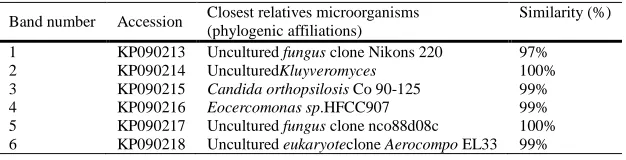
DGGE fingerprint analysis (Fig. 3) and Table 2 demonstrated thatthe visiblefungal band numbers of T3 was 4.6 while T0, T1, T2 reached 10.7, 9.3, 6.0 respectively, showing an obvious change after applied with biofertilizer by SSF. Moreover, treatment T3 and T2 had adistinctlydecrease in the diversity index (H) of the fungal community compared to T0 and T1.Furthermore, all the treatments showed a significant different in R and H compared to control applied with L7 (table 2). This demonstrated that fungal biomass and diversity of T0 is greater than any other treatments in the soil.
Six strengthened bands of T1 in DGGE were excised for sequencing and analyzed by a BLAST search subsequently. The highest identitiesbased on comparison to known and putative species in the NCBIdatabase (table 3).
Through the DGGE results, we could find that the SSF application decreased the fungal population and community structure in the soil.Changes in the community of cultivable microorganisms and fungi groups as well as alterations in their microbial biomass in soil inferred that L7 could survive well in soils and prevailed over indigenous microorganisms by using biofertilizers, particularly treatment T3. This prevalence can be a result of the inoculum strength, which may have favored its competitiveness, but it can also be due to the antagonistic effect, especially considering the fungi growth inhibition observed.Combined all the results in the present study, we can infer that one mechanism by which the SSF application reduced the fungal population might be attributed to the fact that the specific bioorganic fertilizer containing L7 increased the soil isolate population compared to the control and resulted in a general suppression.
Fig.1 Phylogenetic tree constructed with the 16S rDNA sequences.
Bacillus subtilis strain S64 (FJ763648.1)
Bacillus subtilis strain MB8 (KM013814.1)
Bacillus subtilis L7
Bacillus subtilis strain Y1 (JQ579620.1)
Bacillus subtilis subsp. subtilis str. 168 (NC 000964.3)
Bacillus endophyticus (AF295302.1)
Bacillus drentensis G18 (FJ009411.1)
Bacillus simplex BLSH95 (GU969131.1)
Anoxybacillus sp. MGA110 (HQ696615.1)
Brevibacillus agri ST15c10 (HM446043.1)
Brevibacillus agri DSM 6348T (AB112716.1)
Brevibacillus brevis BHK68 (AB360818.1)
82 100 99
76 66
100 96
Fig. 2 Changes in biomass, pH and water content during SSF.
0 1 2 3 4 5 6 0
50 100 150 200 250
p
H
W
a
te
r
c
o
n
te
n
t(
w
/%
)
Q
u
a
n
ti
ty
(1
0
8 C
F
U
⋅
g
-1 )
Bacterial number (108
CFU/g) Spore number (108
CFU/g) Water content (w/%) pH
Time (day)
54 56 58 60 62 64
[image:5.595.152.473.153.338.2]6.5 7.0 7.5 8.0 8.5 9.0
[image:5.595.68.447.385.548.2]Fig.3 Effect of biofertilizers on the fungal community structure of soil from different soil samples (T0, T1, T2, T3). Arabic numbers at the nodes represent cophenetic correlation values as percentages. 1-6 indicate the six successfully excised and sequenced DGGE bands.
Table 1 Effects of strain L7 on the growth of spinach with different treatments.
Treatment T0 T1 T2 T3
Plant height (cm) 21.57±3.42c 21.97±2.10bc 24.91±2.97ab 25.42±4.21a
Root length (cm) 3.90±1.30b 4.06±1.12b 4.83±0.80ab 5.08±1.23a
No. of leaves 11.00±2.17 9.78±1.96 10.44±2.57 10.83±2.94 Fresh weight of shoots (g) 4.79±1.49c 5.68±1.40bc 7.30±1.33ab 8.05±0.07a
Dry weight of shoots (g) 0.42±0.02c 0.49±0.03bc 0.58±0.05ab 0.65±0.07a
Fresh weight of roots (g) 0.37±0.02c 0.48±0.01b 0.66±0.02a 0.70±0.02a
Dry weight of roots (g) 0.025±0.002c 0.029±0.001b 0.043±0.001a 0.046±0.001a
[image:5.595.242.372.711.760.2]a,b,cMeans with identical letter superscripts are not significantly different at p<0.05.
Table 2 Richness (R) and Shannon-Wiener diversity indices (H) for soil samples from treatments analyzed by PCR-DGGE.
Treatment R H
T0 10.7±0.6a 2.24±0.23a
T1 9.3±0.6b 1.84±0.17b
T2 6.0±0.0c 1.45±0.12c T3 4.6±0.6d 1.26±0.02c
______________________________________________________________________________
Table 3 Phylogenetic relationships of the extracted PCR-DGGE DNA sequences
Band number Accession Closest relatives microorganisms (phylogenic affiliations)
Similarity (%)
1 KP090213 Uncultured fungus clone Nikons 220 97% 2 KP090214 UnculturedKluyveromyces 100% 3 KP090215 Candida orthopsilosis Co 90-125 99% 4 KP090216 Eocercomonas sp.HFCC907 99% 5 KP090217 Uncultured fungus clone nco88d08c 100% 6 KP090218 Uncultured eukaryoteclone Aerocompo EL33 99%
CONCLUSION
This work demonstrated therecycling and application of FR in producingan environment-friendly biofertilizers by solid-state fermentation of strain L7.It showed a significant (p< 0.05) improvement of the growth of spinach and a remarkablebiological controleffects, which showed a potential application in agriculture.
Acknowledgements
This work was supported by the National Natural Science Fund NO.31370110, Science and Technology Development Project of Shandong Province NO.2012YD11010 and NO.2013GNC11104 and Taishan Scholar Construction Project.
REFERENCES
[1] Compant, Stéphane, Clément, Christophe, Sessitsch, Angela, Soil Biol Biochem, 2010,42(5):669-78. [2] Ahmad F, Ahmad I, Khan M, Microbiological research, 2008,163(2):173-81.
[3] Xu M, Sheng J, Chen L, Men Y, Gan L, Guo S, et al., World journal of microbiology & biotechnology,
2014,20(3):835-45.
[4] Yu H, Xing Y, Lei F, Liu Z, Liu Z, Jiang J, Bioresour Technol, 2014,167:46-52.
[5] Arkhipova TN, Veselov SU, Melentiev AI, Martynenko EV, G.R.Kudoyarova, Plant and Soil,
2005,272(1-2):201-9.
[6] Hernández-Suárez M, Hernández-Castillo FD, Gallegos-Morales G, Lira-Saldivar RH, Rodríguez-Herrera R, Aguilar CN, American Journal of Agricultural and Biological Sciences, 2011,6(2):189-95.
[7] Yao AV, Bochow DH, Karimov S, Boturov U, S.Sanginboy, Sharipov AK, Archives of Phytopathology and Plant Protection, 2006,39(4):323-8.
[8] Wang K, Yang H, Chen Q, Sun R, Bioresour Technol, 2013,146:208-14. [9] Yu HL, Tang Y, Xing Y, Zhu LW, Jiang JX, Bioresour Technol, 2013,147:29-36.
[10] Weisburg W, Barns S, Pelletier D, Lane D, Journal of bacteriology, 1991,173(2):697-703.
[11] Altschul SF, Madden TL, Schaffer AA, Zhang J, Zhang Z, Miller W, et al., Nucleic Acids Res,
1997,25(17):3389-402.
[12] Thompson J, Higgins D, Gibson T, Nucleic acids research, 1994,22(22):4673-80. [13] Tamura K, Dudley J, Nei M, Kumar S, Mol Biol Evol 2007,24(8):1596-9.
[14] Bonilla N, Cazorla FM, Martínez-Alonso M, Hermoso JM, González-Fernández JJ, Gaju N, et al., Plant Soil,
2012,357(1-2):1-12.
[15] Pešaković M, Karaklajić-Stajić Ž, Milenković S, Mitrović O, Scientia Horticulturae, 2013,150:238-43.
[16] Vainio EJ, Hantula J, Mycological Research, 2000,104(8):927-36.
[17] Lang J, Hu J, Ran W, Xu Y, Shen Q, C Biol Fertil Soils, 2012,48(2):191-203. [18] Asha BM, Sakthivel N, Annals of Microbiology, 2014,64(4):1839-48. [19] Ashwini N, Srividya S, 3 Biotech, 2013,4(2):127-36.
[20] Rawat R, Tewari L,: life under extreme conditions, 2012,16(4):637-44.
[21] Falcao LL, Silva-Werneck JO, Vilarinho BR, da Silva JP, Pomella AW, Marcellino LH, Journal of applied microbiology, 2014,116(6):1584-92.
[22] Liu H-X, Li S-M, Luo Y-M, Luo L-X, Li J-Q, Guo J-H, B European Journal of Plant Pathology,
2014,139(1):107-16.