International Journal of Emerging Technology and Advanced Engineering
Website: www.ijetae.com (ISSN 2250-2459,ISO 9001:2008 Certified Journal, Volume 2, Issue 12, December 2012)
708
Transient Stability Analysis of Power System With UPFC
Using PSAT
Rajesh Kr Ahuja,
Mukul Chankaya
Dept. of Electrical Engineering, YMCA University of Science &Technology, Faridabad (Haryana), India
Abstract—UPFC is a versatile FACTS controller that can regulate the Power Flow through the Line by controlling its Series and shunt parameters. In shunt it is having STATCOM and in series SSSC are employed can independently control the Line Power Flow. Two Converters improves the flexibility and provide additional degree of freedom in Power System. With the application of UPFC, Transient stability of the system can be Improved. This Paper shows that how Transient Stability of the Inter Area system is Improved. The Mathematical Model of Transient Stability is also given in this Paper.
Keywords—Power system, FACTS, Transient stability, Inter area power system
.
I. INTRODUCTION
In recent years, energy, environment, deregulation of power utilities have delayed the construction of both generation facilities and new transmission lines. FACTS devices are available, which can help Power Engineers to deal with problems like Large Signal Stability and economic Factors that gives strong incentives to raise the Stability limit of the System, depending upon the diverse conditions. Facts devices can provide fast control of Active and Reactive power through Power system. Among the converter based FACTS devices Static Synchronous Compensator (STATCOM) and Unified Power Flow Controller (UPFC) are the popular FACTS devices. They play an important role, not only in increasing the amount of energy transported over the lines, but also in oscillatory and transient-stability enhancement, system reliability, and controllability over the power flow. Considering the practical application of the UPFC in power systems, it is of importance and interest to investigate the benefits as well as model of these devices for power system Transient Analysis. Unified Power Flow Controller (UPFC) is a power electronic based device that has capability of controlling the power flow through the line by controlling appropriate its series and shunt parameter. It has been reported that UPFC can improve transient stability of a system.
II. PRINCIPLE OF UPFC
One FACTS controller in particular, the Unified Power Flow Controller (UPFC), is capable of concurrently or selectively controlling transmission line power flows, voltage magnitudes and phase angles in a power system. Here in fig.1 given below UPFC is shown with both PWM and Phase Control strategy.
The Unified Power Flow Controller (UPFC) concept was proposed by Gyugi in 1991. UPFC is an electrical device for providing fast-acting reactive power compensation on high-voltage electricity transmission networks. The UPFC is a combination of a Static Synchronous Compensator (STATCOM) and a Static Synchronous Series Compensator (SSSC) coupled via a common DC voltage link. The UPFC is made out of two voltage-source converters (VSC) with semiconductor devices having turn-off capability, sharing a common dc capacitor and connected to a power system through coupling transformers.
The basic UPFC structure is depicted in Figure shown above. This figure represents control strategies (pulse-width modulation (PWM) and phase control). The reactive power is generated/absorbed independently by each converter and does not flow through the dc link. There are two basic control strategies that can be utilized to control the switching of the semiconductor switches in the converters, i.e., PWM and phase controls.
International Journal of Emerging Technology and Advanced Engineering
Website: www.ijetae.com (ISSN 2250-2459,ISO 9001:2008 Certified Journal, Volume 2, Issue 12, December 2012)
709
control
V refZ ref Q ref Q* ref Measured VariableParameter Settings
V dc ac
Supply Transformer
Converter 1
+ _
Converter 2 Series Transformer
V pq
V+ V pq
[image:2.612.64.295.124.356.2]ac Transmission Line
Figure 1.UPFC is shown with both PWM and Phase Control strategy.
However, recent advances in high voltage IGBT technology have led to the development of the Integrated Gate Commutated Thyristor (IGCT), which is basically an optimum combination of thyristor and GTO technology at low cost, low complexity, and high efficiency. It can handle higher switching frequencies with relatively low losses, allowing for the practical implementation of PWM control methodologies.
III. PSAT SIMULATION MODEL
SYSTEM ( I )UNDER STUDY
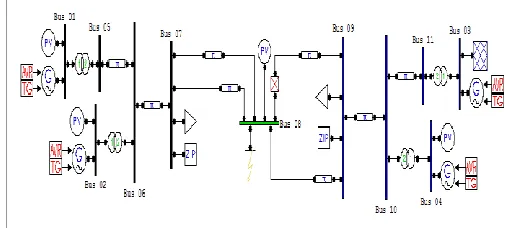
In this Model there are 11 Buses, Bus No. 3 is kept as Slack bus which maintain its voltage at 1 p.u. and Bus 1,2 & 4 are Generator (PV) Buses. Fault is simulated at Bus 8 at 1sec. and Fault clearing time at 1.05 sec.
Figure 2 11 Bus test System Without FACTS devices
The all four Generators has been modeled with Power Rating of 900MVA and 20KV at 60HZ frequency. All buses connected to each other by π- Section of transmission line.
The automatic voltage regulator used is type 3 in PSAT tool of MATLAB with the range of +100KV to -100KV and having the gain of 200p.u. for maintaining the voltage level as near to 1p.u. Turbine Governor is used of type 2 and having the ref. speed of 1 p.u. and the droop is kept 0.02p.u. with max. torque and min. torque limit at1.2 and 0.3p.u.
Generators are connected to the system via transformers maintaining the system voltage at 230KV and 100MVA. Load is also connected to the Bus7 and Bus8.
In this Model, Voltage profile at all 11 buses and Rotor angle are studied without any FACTS devices.
SYSTEM ( II )UNDER STUDY
[image:2.612.321.576.132.246.2]International Journal of Emerging Technology and Advanced Engineering
Website: www.ijetae.com (ISSN 2250-2459,ISO 9001:2008 Certified Journal, Volume 2, Issue 12, December 2012)
710
Figure3 11Bus test System With United Power Flow Controller
IV. SIMULATION RESULTS
Fig 4 – 14 show the simulation results of rotor angle, voltage at different buses and angular frequencies in PSAT
ROTOR ANGLE
The graphs shows the Generator rotor angles w.r.t. time in case with and without UPFC.
[image:3.612.315.588.101.251.2]Figure 4 Rotor angle 1,2,3& 4 without UPFC.
[image:3.612.53.310.151.268.2]Figure 5 Rotor angle 1,2,3& 4 with UPFC at fault clearing time a 1.05sec..
Figure 6 Rotor angle 1,2,3& 4 with UPFC at fault clearing time at 1.2sec.
.
Without using the UPFC the Rotor Angle are increasing and go out of synchronism but with the UPFC they remain in synchronism at time 1.05sec. and 1.2 sec. both.
VOLTAGE PROFILE
The graph shows the voltages at various buses with and without UPFC at different fault clearing time.
Voltage at Bus1
[image:3.612.260.562.405.685.2]International Journal of Emerging Technology and Advanced Engineering
Website: www.ijetae.com (ISSN 2250-2459,ISO 9001:2008 Certified Journal, Volume 2, Issue 12, December 2012)
711 As shown in the fig.7 voltage profile of Bus1 at different fault clearing time with and without UPFC. With FACTS Device (UPFC) the voltage is settling down at 1.2 sec without any oscillatory behavior, whereas without UPFC it takes more then 2 sec due to the oscillations after the major disturbance settles at 1.2 sec. Bus 1 is a PV bus.
[image:4.612.323.560.134.521.2]Voltage at Bus 2
Figure 8 Voltage profile at bus 2
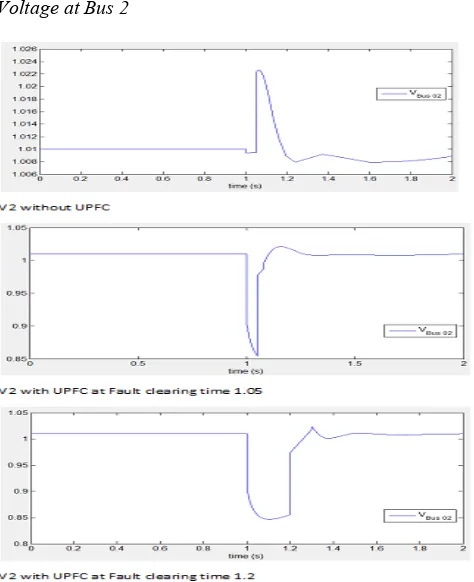
Voltage profile of Bus2 is again a PV bus and showing voltage rise after fault clearance time without UPFC and take more time to settle down but with UPFC it follows the normal profile and settles down quickly.
Bus 3 is a Slack bus so Voltage profile will be same with and without FACTS device.
Bus 4 is a PV Bus and the settling time is reduced with UPFC
[image:4.612.50.287.225.516.2]Voltage at Bus3
Figure 9. Voltage profile at Bus 3
[image:4.612.323.563.429.689.2]Voltage at Bus4
International Journal of Emerging Technology and Advanced Engineering
Website: www.ijetae.com (ISSN 2250-2459,ISO 9001:2008 Certified Journal, Volume 2, Issue 12, December 2012)
712
Voltage at Bus 11
Figure 11 Voltage profile at bus 11
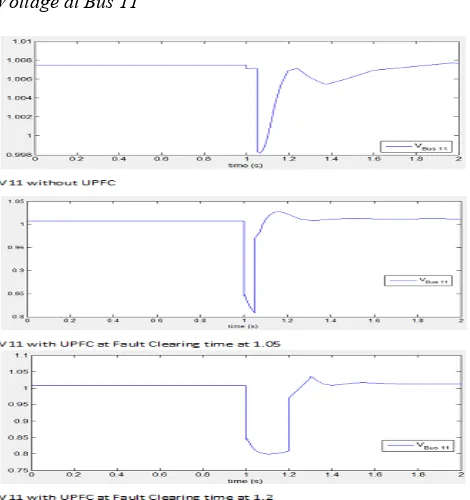
At Bus11 settling time is reduced and Voltage reaches to its pre fault value quickly without oscillations.
ANGULAR FREQUENCY
[image:5.612.50.285.127.377.2]Figure 12 Angular freq at all generator Buses
Fig. 12 shows Angular freq at all generator Buses without UPFC. The peak value of remain at 1.0012
[image:5.612.324.577.180.337.2]The fault is simulated at 1sec and cleared at 1.05sec.
Figure 13 Angular freq with UPFC
[image:5.612.325.576.425.576.2]Fig.13 shows Angular freq with UPFC at fault clearing time 1.05sec.
Figure 14 Angular freq with UPFC
Fig.14 shows Angular freq with UPFC at Fault clearing time 1.2sec.
[image:5.612.48.299.466.661.2]International Journal of Emerging Technology and Advanced Engineering
Website: www.ijetae.com (ISSN 2250-2459,ISO 9001:2008 Certified Journal, Volume 2, Issue 12, December 2012)
713 V. CONCLUSION
This paper investigates the capability of UPFC on transient stability of a Two-area power system. The analysis of Generator Rotor angle, Voltage Profile and Angular Freq is done with and without UPFC at different fault clearing time.
Without UPFC the Rotor angle of all the buses increases and will lead the system out of synchronism whereas without UPFC they are decreasing and settling down. System will remain in synchronism.
The Buses of Area 1 i.e. Bus 1,2,5,6 and 7 and The Buses of area 2 Bus 3,4,9,10 and 11 their settling time is more then 2sec without UPFC.With the application of UPFC the settling time is reduced to 1.18 sec. for all buses.
The Angular Freq without UPFC settles to 1 p.u. value after 20sec. with UPFC Angular freq starts settling down after 15sec. at fault clearing time 1.05 sec. and 1.2 sec.
REFERENCES
[1] N.G. Hingorani and L. Gyugyi, “Understanding FACTS: concepts and technology of flexible ac transmission systems”, IEEE Press, NY, 1999.
[2] Y.H. Song and A.T. Johns, “Flexible ac transmission systems (FACTS)”, The Institute of Electrical Engineers, London, 1999.
[3] Claudio Cañizares, Edvina Uzunovic, and John Reeve,” Transient Stability and Power Flow Models of the Unified Power Flow Controller for Various Control Strategies”
[4] K. R. Padiyar and A. M. Kulkarni, “Control Design and Simulation of Unified Power Flow Controller,” IEEE Trans. Power Delivery, vol. 13, no. 4, pp. 1348–1354, Oct. 1998.
[5] L. Gyugyi, “Dynamic compensation of ac transmission line by solid-state synchronous voltage sources”, IEEE Trans. Power Delivery, Vol. 9, pp. 904-911, Apr. 1994.
[6] V.Vital, N. Bhatia and A.A. Fouad, “Analysis of the Inter-area Mode Phenomenon in Power Systems Following Large Disturbances”, IEEE Transactions on Power System, Vol. 6, No. 4, 1991.
[7] P. Kundur, “ Power System Stability and Control”, Mc Graw-Hill, Singapore.
[8] K.R.Padiyar and A.M.Kulkarni. “Control Design and Simulation of Unified Power Flow Controller” IEEE Transaction on Power delivery, Vol.13 No 4, October (1998).