A Unified Cloud Computing Model towards Developing
‘E-learning as a Service’ based Education System
Shah Murtaza Rashid Al
Masud
Faculty of Computer Science and Information Systems
Najran University Najran, Saudi Arabia
ABSTRACT
E-learning is the use of computer, electronic device, mobile and communication devices in some way to provide training, just-in-time-information, guidance from experts, and educational or learning material among learners. E-learning facilitates and enables learners to learn anytime and anywhere. E-learning systems usually require many hardware and software resources to electronically transfer skills and knowledge. Many education institutions do not have the resources and infrastructure needed to run top e-learning solutions and cloud computing is the best solution. Cloud computing is growing rapidly in almost every sector including education and learning process with its promising infrastructure, platform and applications. In this paper the author studied and analyzed the challenges and scopes of cloud computing environment that will be helpful to build a reliable, cost effective and scalable education system, namely e-learning as a service. In this paper the author has proposed a fundamental and unified cloud computing model which is obliging both for vendors, clients, users, professionals, academicians, and researchers involved in development and enlargement of cloud computing services and solutions in education system.
General Terms
Distributed System, Cloud Computing
Keywords
Cloud Computing, Education System, E-learning, Education Institutions
1.
INTRODUCTION
The increasing rate of cloud adoption, services and implementations per year in all around the world is very rapid and remarkable. Due to this important reason the overall behavior and functionaries of cloud computing (CC) are changing every day which influence the architecture, taxonomy of CC, and its services. Many hardware and software industries, such as IBM, Intel, Microsoft, Cisco, as well as other Internet technology industries, including Google and Amazon, Security Company, such as Semantic, knowledge groups and even several businesses, also those not technically oriented, want to explore the possibilities and benefits of CC are joining the development of cloud services [1]-[9]. Although there are huge scopes in developing, implementing, and updating CC but there is a lack of standardization of cloud computing services [3]-[4], [10], which makes interoperability when working with multiple services or migrating to new services difficult.
The NIST (National Institute of Standards and Technology) proposed the following definition of cloud computing: “Cloud computing is a model for enabling convenient, on-demand network access to a shared pool of configurable computing resources (e.g., networks, servers, storage, applications, and services) that can be rapidly provisioned and released with minimal management effort or service provider interaction” [11]. This cloud model promotes availability.
Currently three service models are being differentiated- Software as a Service (SaaS), i.e. online applications, such as web-based email; Platform as a Service (PaaS), which allows customers to deploy their own applications, and Infrastructure as a Service (IaaS), which provides, for example, processing power or storage [12]. Service models of CC recognize and specify the components of cloud computing that are providing basic knowledge underpinning management and implementation of the cloud spectrum and environment.
Cloud computing scenario in education system, the beneficiary, such as universities, e-learning centers, education service providers, just need services and they do not need to undergo the challenges posed by technology, administration and implementation in computerization. Technologically challenging tasks of designing, implementing and maintaining a Data Center/Server, Databases, and Application etc are all eliminated and is left to such service providers of information technology (IT) industry. With education service providers „e-learning as a service‟, distance education, online education system looking at automating processes at lower cost and higher gains CC which can act as an ideal platform in the education system based IT space. A number of departments could share infrastructure with large number of systems linked together towards providing e-learning system in higher education. By this pooling the education institutions automatically reduce the cost and increase utilization. The resources are delivered only when they are required. This also means real-time availability of instructors‟ information for students, learners and other support services personnel like community members from any internet enabled device. Though some models are existed to support education and e-learning services, but still system faces many limitations like: capacity building, integration of prevailing education system, promotion of inter-operability using universal standards, cost, and e-learning observatory.
CC service model as a platform for e-learning environment that will help CC service providers, users, and also academia, researchers, professionals, stakeholders of IT as well as enterprise to provide e-learning services in academic environment. A short comparative study of different issues directly related to CC based education and e-learning systems and services are also studied and analyzed in order to address and find the proper way to find problems and get solutions.
This paper is organized as follows: Section II Major entities and characteristics in E-learning system. Section III Benefits, risks, and limitations of cloud computing in „E-learning as a Service‟ based education System. Section IV Cloud computing taxonomy towards building a unified model, Section V Proposed unified cloud computing model for education system. Section VI Advantages of using this proposed model in education sector Section VII Existing Cloud Computing Supports in Education System and finally Section VIII concludes the paper.
2.
MAJOR ENTITIES AND
CHARACTERISTICS IN E-LEARNING
SYSTEM
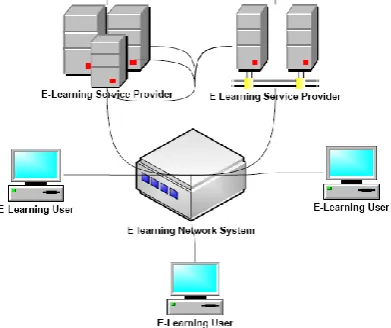
E-learning is an internet-based learning process is using to improve the efficiency of education. E-learning in education system is developed as distributed applications using internet technology to initiate, plan, analyze, design, implement, select, manage, support and extend learning. The architecture of a disseminated e-learning system includes software components, like the client application, an application server, a database server and the necessary hardware components such client computer or users, communication infrastructure and servers and service providers as shown in Figure 1.
[image:2.595.314.542.87.695.2]Today e-learning is extensively used on different educational levels such as continuous education, company trainings, academic courses, and community services. Education institutions need resources and infrastructure to run top e-learning solution. There are various e-e-learning features, benefits, limitations and solutions from open source to commercial as presented in Table 1. There are at least two entities involved in an e-learning system: the students and the teachers. Major benefits include expediency and portability, cost and selection, elasticity or flexibility, higher maintenance, broader collaboration and association and global opportunities.
[image:2.595.61.257.561.725.2]Figure 1: E-learning environment
Table 1: Features, benefits and major entities in e-learning system
Features Benefits
Learning or education is self-motivated and a speedy or rapid process that provides students a possibility to speed up or slow down as necessary.
Expediency and
portability:
Courses are accessible on your schedule
Online learning does not require physical attendance
Learning is self-paced (not too slow, not too fast)
You're unbound by time - courses are available 24/7
You're unbound by place - study at home, work, or on the road
Read materials online or download them for reading later
Self-directed learning permits students to choose contents and tools appropriate to their differing interests, needs, knowledge and skill levels
Cost and Selection:
Choose from a wide range of courses to meet your needs
Degree, Vocational, and Certificate programs
Continuing Education
Individual courses
Wide range of prices to fit your budget
Go back to school to get a degree, learn a new skill, learn a new craft, or just have fun!
From art to zoology you can do it all online in a price range to fit your budget.
Contains multiple learning styles using a variety of deliverance methods or mechanisms geared to different learners
Flexibility and Elasticity:
Online learning accommodates your preferences and needs - it's student-centered
Choose instructor-led or self-study courses
Skip over material you already know and focus on topics you'd like to learn
Use the tools best suited to your learning styles Designed around the learner Higher Maintenance or
Retention:
geographical barriers and narrow or limited education systems for opening up broader education options.
Technology tools make relationship among students much easier even in some cases learners don't have to be face-to-face.
All time or 24/7 accessibility makes scheduling easy and permits a greater number of people to attend classes
Global Opportunities: It gives the chance to the learners to online resources that they never see in traditional classrooms. The technologies utilized give online instructional designers the ability to construct in tools that take the learners to resources they may.
Learning can happen precisely when needed which is called on-demand access.
Travel time and related costs are reduced or eliminated. Overall student costs such as tuition, residence, food, child care are frequently less. Training cost, supply cost, cost for providers are also potentially less.
Promotes better student interaction and collaboration Fosters greater contact between students and instructors
Improves knowledge and skills related to computer and Internet
Represents and draws upon ancient and famous pedagogical principles Has the interest and attention of renowned university in the world having online degrees, certificates, and individual courses
Major Entities
Students:
Take online course
Take exams, quiz
Send feedback
Send homework, projects
Send online surveys
Teachers:
Deal with content management
Prepare tests, quizzes, assignments
Deliver courses, presentations
Assess tests, homework, projects taken by students
Send feedback
Communicate with students
3.
BENEFITS, RISKS AND LIMITATION
OF CLOUD COMPUTING IN
‘E-LEARNING AS A SERVICE’ BASED
EDUCATION SYSTEM
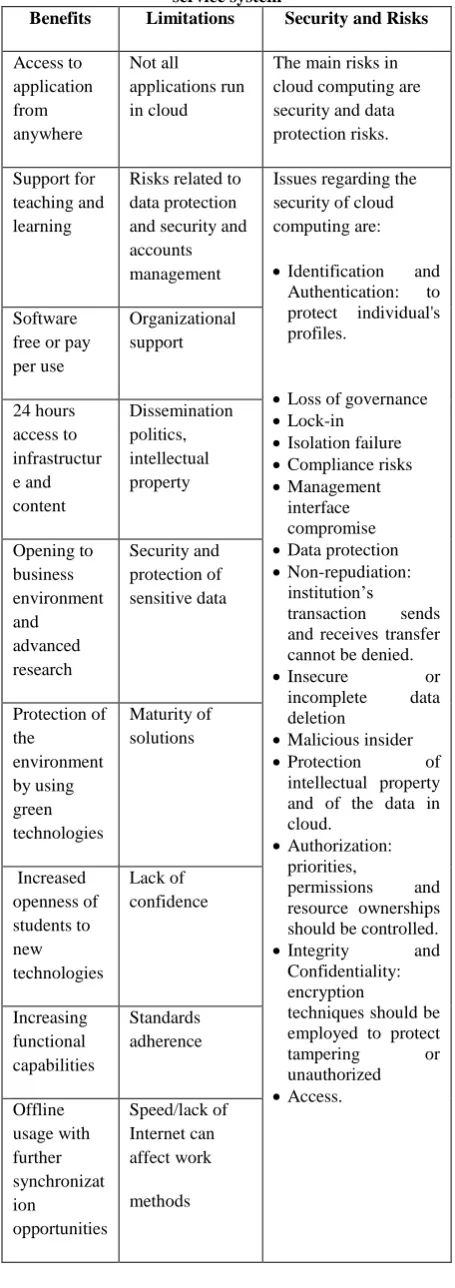
Table 2: Cloud computing characteristics: benefits, limitations, security and risks towards e-learning as a
service system
Security and Risks Limitations
Benefits
The main risks in cloud computing are security and data protection risks. Not all applications run in cloud Access to application from anywhere
Issues regarding the security of cloud computing are:
Identification and Authentication: to protect individual's profiles.
Loss of governance
Lock-in
Isolation failure
Compliance risks
Management interface compromise
Data protection
Non-repudiation: institution‟s transaction sends and receives transfer cannot be denied.
Insecure or incomplete data deletion
Malicious insider
Protection of intellectual property and of the data in cloud.
Authorization: priorities,
permissions and resource ownerships should be controlled.
Integrity and Confidentiality: encryption
techniques should be employed to protect tampering or unauthorized
Access. Risks related to
data protection and security and accounts management Support for teaching and learning Organizational support Software
free or pay per use Dissemination politics, intellectual property 24 hours access to infrastructur e and content Security and protection of sensitive data Opening to business environment and advanced research Maturity of solutions Protection of the environment by using green technologies Lack of confidence Increased openness of students to new technologies Standards adherence Increasing functional capabilities Speed/lack of Internet can affect work methods Offline usage with further synchronizat ion opportunities
Some other benefits: User Level:
Increasing availability and integrity of data and applications for administrators, teachers and others
Increasing mobility for students, faculty and staff
Reducing local application and system resource footprint
Increasing application and computing performance
Increasing server and data storage capacity IT Department:
Cost reduction
Centralized management of data and Applications
Standardization of applications and Processes
Increased flexibility for resource allocation
Higher utilization of resources
Rapid provisioning of software, resources and management of data
Reduced burden of software version control
Increase in available funds for innovation
4.
CLOUD COMPUTING TAXONOMY
TOWARDS BUILDING A UNIFIED
MODEL
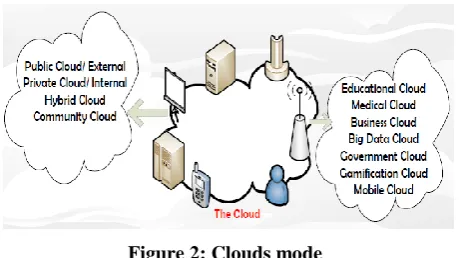
Cloud computing is a multidimensional computing model based on Internet technology to ensure that users can simply use the computing effectively and efficiently resources on demand [22]. Cloud computing consists of three layers, these are: Infrastructure as a service (IaaS), Platform as a service (PaaS), and Software as a service (SaaS) layer. Where IaaS is innovation or fundamental model, PaaS is developing applications model and SaaS is using applications or applications delivery model. One of the major concerns of CC is to provide services are accessible anywhere in the world with the cloud appearing as a single point of access for all the computing needs of consumers at affordable cost, elastic scalability, high performance and security. This section details an extended taxonomy that illustrates various aspects of CC. One of the major aspects of CC is its mode. Modes of CC can be defined by four major categories. These are: public cloud, private cloud, hybrid cloud and community cloud. Cloud adoption and implementations rate in various regions increase dramatically every year that encourage the academia and researchers to think about the advancements of CS. Beside the major clouds mode of CC discussed before there are some other new trends highlighted in year 2011-2012, such as big data cloud, business cloud, mobile cloud, gamification cloud, medical cloud, education cloud, and government cloud [23]-[27]. Clouds mode and its recent advancements are shown in Figure 2 [1].
Major Clouds Mode
1) Public Cloud: in public cloud the cloud infrastructure and resources are made available to the general public or a large industry group via web applications and services from third party organizations who share and selling resources and services.
2) Private Cloud: The cloud infrastructure, such as data and processes are processed and operated within single organization.
3) Hybrid Cloud: Two or more clouds are combined together to form a unique cloud infrastructure enabling data and application portability.
Figure 2: Clouds mode
Newly Proposed Mode
1) Big Data Cloud: The big data cloud enables an economical way to extract value from very large volumes of a wide variety of data by high-velocity capture, discovery, transformation, and analysis.
2) Business Cloud: Business-context clouds are projected to bring into line openly with the industry verticals and offer unique solutions addressing the specific business and technical challenges in the individual sectors, such as education, healthcare and financial services.
3) Mobile Cloud: Mobile applications will persist to develop with the communal facilities and pioneering mobility devices, which will drive the accelerated progress of cloud computing to empower the users and consumerization: anybody, anywhere, anytime, and any device. The mobile cloud will push many organizations to rethink their business models.
4) Gamification Cloud: The gamification cloud makes technology edutainment, guide a participant with a path to mastery and autonomy, encourage users to involve in desired behaviors, and make use of humans' psychological predisposition to engage in gaming.
5) Educational Cloud: It deals with the tasks of cloud computing technology to improve education and learning methodologies.
6) Medical cloud: A new cloud base platform allows securing access to medical records. The idea is to speed up communication between patients, consultants and general practitioners through accessing files through the internet. 7) Government cloud: In order to increase efficiency and
reducing cost the Governments around the world is actively looking into cloud computing systems and services.
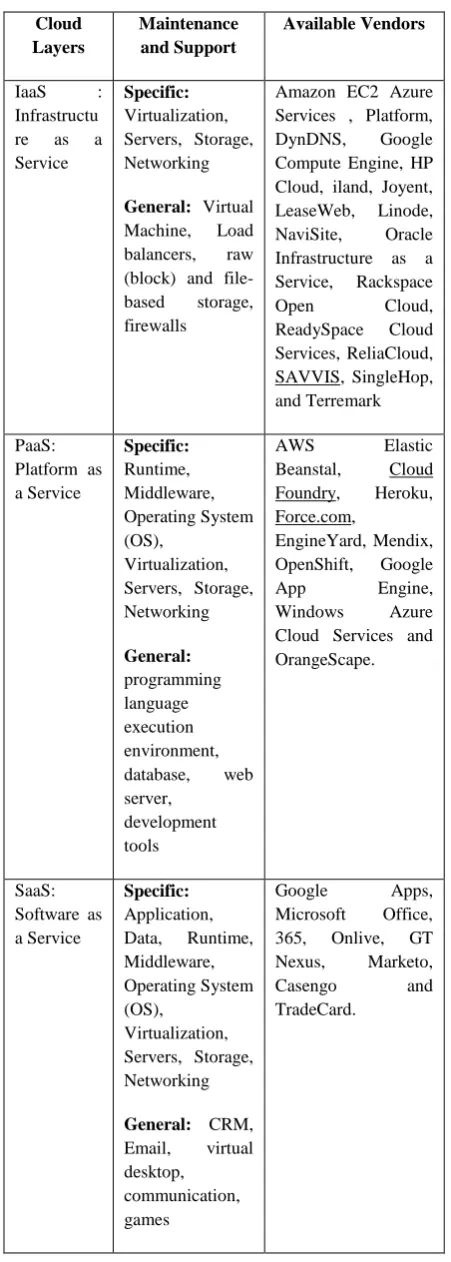
The major CC layers, their major functionalities, and available vendors providing cloud services to education system are illustrated in Table 3. Depending on the requirements, the customers can choose one or more services provided. The customers are renting or simply accessing the needed processing capacity from the data center using the client applications. The quality of the service becomes a crucial factor of the cloud computing success. Cloud computing is highly scalable and creates virtualized resources that can be made available to users [28].
5.
PROPOSED UNIFIED CLOUD
COMPUTING MODEL FOR
EDUCATION SYSTEM
The edges of cost and effort in education system are always increasing. E-learning is a center for inclusive knowledge societies to sharing, exchange and promote low cost or free access of knowledge and skills with minimal effort. The major advantages derived from the proposed model are:
a) Potential and powerful computing and storage capacity: cloud enabled e-learning as a service based education system model detects the computing and data in a huge number of distributed or internet computers, the ocean of clouds in the tens of thousands of computers to provide potential and powerful computing power and huge data storage space, therefore puts the cloud as a service available to students via the Internet technology.
b) High availability: this system must provide a higher quality of service through the integration of mass storage and high-performance computing power. Cloud computing does not affect the regular operation of the system; it can spontaneously detect the node failure and exclude it.
c) High security: in the cloud computing model, data is storied intensively. Depending and relying on one or more data center, the managers manage the amalgamated or unified data, distribute or allocate the resources, equilibrium or balance load, organize or deploy the software, regulate, manage or control security, and do the consistent or reliable real time monitoring, in this way guarantee the clients or users‟, for our case students-teachers data security to the greatest possible degree.
Table 3: Major functionalities of cloud computing layers
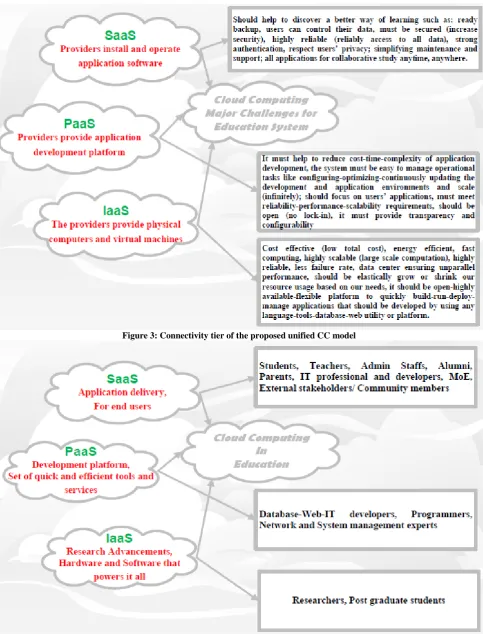
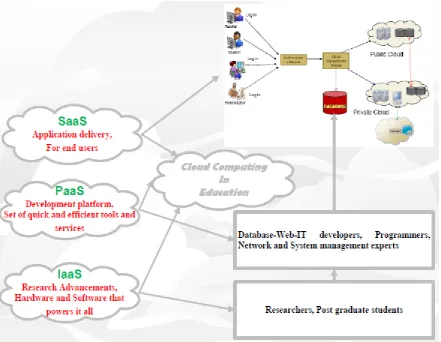
e) The foremost benefit of the proposed unified CC model is that it aims at providing easy access to costly software running on high performance processors to rural students at institutions which lack considerable facilities. Substantial speculation and investment would be required to implement this architecture, but the benefits would easily justify the cost. This advantage can be visualized from the following Figure 3 which illustrate the connectivity tier of the proposed architecture must be managed by web collaboration services. f) In the generic e- learning model, teachers allot teaching tasks, conduct regular lectures, or train students‟ skills. The students attend the online self-governing learning act and accommodating learning sessions, or complete teachers‟ assignments. But in the proposed unified model teachers also answer students‟ questions and offer essential teaching to major and difficult points. Teachers can also use multimedia technology to augmenting teaching contents. Students work out their own learning strategies, defining learning methods independently. They conduct on-line self-directed learning when they study each unit, finish its test via Internet and do some statistics to the test and exam results. Teachers also embolden students to collaborate with each other to finish simple learning tasks or complex group-based projects. Through supportive and cooperative learning, students cannot simply obtain knowledge, their team spirit and coordination will also be raised, skills in dealing with people will be improved and abilities to express themselves will be enhanced. Hence the learning and teaching will be more collaborative; interactive which is the request of the new era. The interactive mode of the proposed unified CC model is furnished in the Figure 4 and Figure 5.
The fundamental factors interests in CC are rapid decrease in hardware cost, increase in computing power, increase in storage capacity, rising data size in scientific instrumentation-internet publishing-archiving services, wide-spread implementation of services computing [29].
To reduce university's IT complexity, maintenance and security hazards, and cost the trend CC is to replacing applications programs and software traditionally installed on campus computers with the same delivered distributed via the net or internet [30]. It also reduces many of the time-related constrictions for students, making learning tools accessible for a larger number of students [31]. There are many benefits of using CC in educational institute and system like e-learning, such as: universities based technology infrastructures for research advancements, universities can coup up with ever-growing resource requirements and energy costs, helps the students and help to manage projects and massive workloads in new and different ways, the universities or education communalities will can easily and better understand the value of new technologies [32]. CC permits students and teachers to use applications without installing them on their computers and allows access to saved files from any computer with an Internet connection [33].
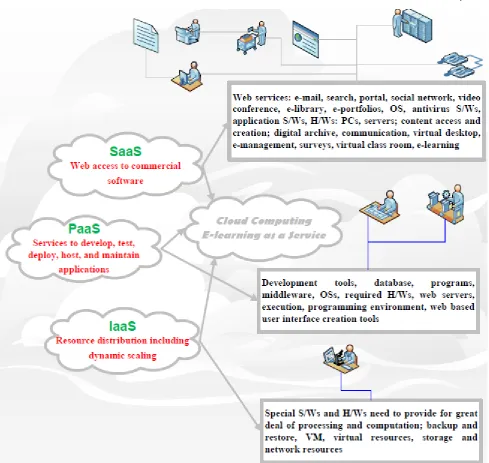
In this research paper the author emphasized and highlighted a new model for educational area by introducing the cloud computing in order to increase the scalability, flexibility and availability of e-learning systems. The author has studied, analyzed and appraised the outmoded e-learning networking model, with its advances and issues, and the possibility to move the e-learning system out of schools-colleges-universities, inside a CC infrastructure and platform that is a cloud system. The roles of different layers of CC in respect to Available Vendors
Maintenance and Support Cloud
Layers
Amazon EC2 Azure Services , Platform, DynDNS, Google Compute Engine, HP Cloud, iland, Joyent, LeaseWeb, Linode, NaviSite, Oracle Infrastructure as a Service, Rackspace
Open Cloud,
ReadySpace Cloud Services, ReliaCloud, SAVVIS, SingleHop, and Terremark Specific:
Virtualization, Servers, Storage, Networking
General: Virtual Machine, Load balancers, raw (block) and file-based storage, firewalls IaaS :
Infrastructu re as a Service
AWS Elastic
Beanstal, Cloud Foundry, Heroku, Force.com,
EngineYard, Mendix, OpenShift, Google
App Engine,
Windows Azure Cloud Services and OrangeScape. Specific: Runtime, Middleware, Operating System (OS), Virtualization, Servers, Storage, Networking General: programming language execution environment, database, web server,
development tools PaaS:
Platform as a Service
Google Apps, Microsoft Office, 365, Onlive, GT Nexus, Marketo,
Casengo and
TradeCard. Specific:
Application, Data, Runtime, Middleware, Operating System (OS),
Virtualization, Servers, Storage, Networking
General: CRM, Email, virtual desktop,
communication, games
education process and responsibilities from both vendors and clients‟ points of view are illustrated in Figure 6.
[image:7.595.58.542.103.738.2]Figure 3: Connectivity tier of the proposed unified CC model
Figure 6: The roles of different layers of CC in respect to education process and responsibilities
The education institutions will be accountable for the education process, content management and delivery, and the vendors take care of system construction, maintenance, development and management. The e-learning system can be scaled, both horizontally and vertically, and the educational organization is charged according to the number of used servers that depends on the number of students. A services catalog can include education specific user services including e-assessment service for managing student assessments, grade book, roster, lesson plan, classroom management services for teachers, content management services that teachers use to assign curriculum content to students and that students use to access the assigned content, an online community service that teachers use to interact with peers and share lesson plans, a professional development service that teachers use to manage their career development path and become more proficient on the use of technology in the classroom. The services catalog can also include additional user services that are accessible from the cloud but are not directly related to the delivery of education. These additional services might include a
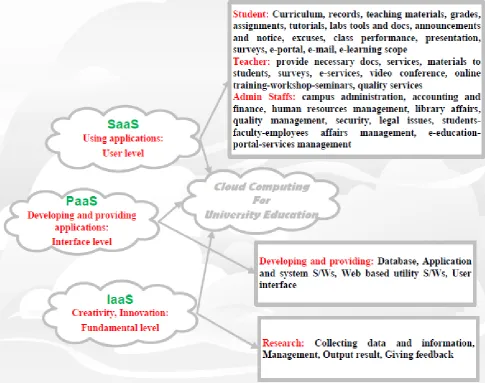
fundraising service to track contribution and fundraising events, a university asset tracking service to track equipment and supplies, a university bulletin service to inform parents and the entire community of university activities. A generic CC service model that supports a total education system is illustrated in figure 7.
6.
ADVANTAGES
OF
USING
THE
PROPOSED MODEL IN EDUCATION
SECTOR
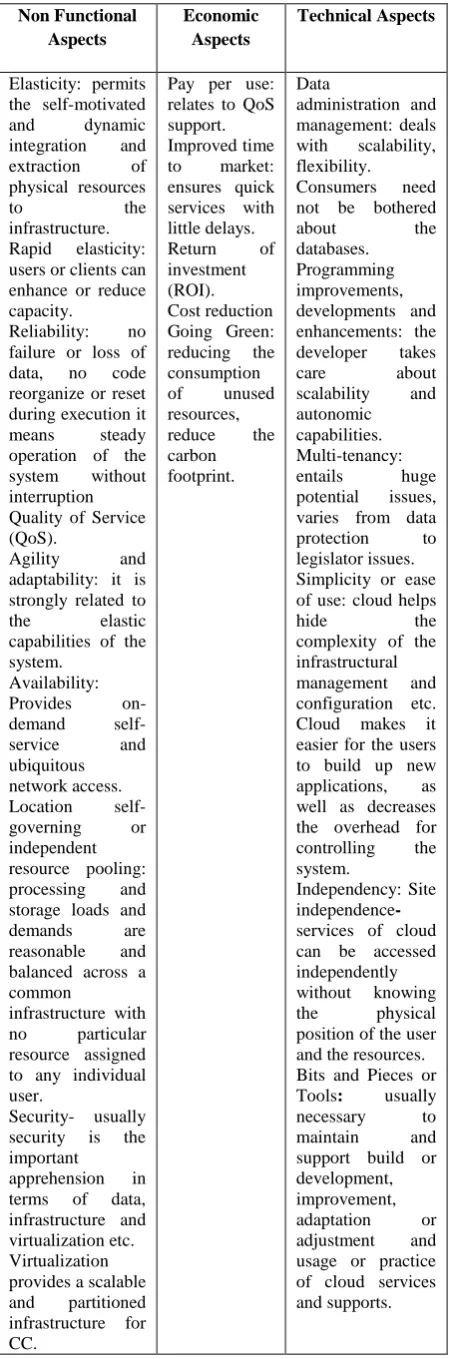
The advantages of using this unified cloud model in educational institutions or systems for any learning process are considered in the non-functional, economic and technological areas.
Figure 7: A unified and generic cloud computing service model for education system
Economic Aspect: Cost reductionis one of the first concerns to build up a cloud system that can adapt to changing consumer behavior and reduce cost for infrastructure maintenance and acquisition. Scalability and Pay per Use are essential aspects of this issue.
Table 4: Various aspects of cloud computing in education sector Non Functional Aspects Economic Aspects Technical Aspects
Elasticity: permits the self-motivated and dynamic integration and extraction of physical resources
to the
infrastructure. Rapid elasticity: users or clients can enhance or reduce capacity.
Reliability: no failure or loss of data, no code reorganize or reset during execution it means steady operation of the system without interruption Quality of Service (QoS).
Agility and adaptability: it is strongly related to the elastic capabilities of the system.
Availability: Provides on-demand self-service and ubiquitous network access. Location self-governing or independent resource pooling: processing and storage loads and demands are reasonable and balanced across a common
infrastructure with no particular resource assigned to any individual user.
Security- usually security is the important
apprehension in terms of data, infrastructure and virtualization etc. Virtualization provides a scalable and partitioned infrastructure for CC.
Pay per use: relates to QoS support. Improved time to market: ensures quick services with little delays. Return of investment (ROI). Cost reduction Going Green: reducing the consumption of unused resources, reduce the carbon footprint.
Data
administration and management: deals with scalability, flexibility. Consumers need not be bothered
about the
databases. Programming improvements, developments and enhancements: the developer takes care about scalability and autonomic capabilities. Multi-tenancy: entails huge potential issues, varies from data protection to legislator issues. Simplicity or ease of use: cloud helps
hide the
complexity of the infrastructural management and configuration etc. Cloud makes it easier for the users to build up new applications, as well as decreases the overhead for controlling the system.
Independency: Site independence -services of cloud can be accessed independently without knowing the physical position of the user and the resources. Bits and Pieces or Tools: usually necessary to maintain and support build or development, improvement, adaptation or adjustment and usage or practice of cloud services and supports.
7.
EXISTING CLOUD COMPUTING
SUPPORTS IN EDUCATION SYSTEM
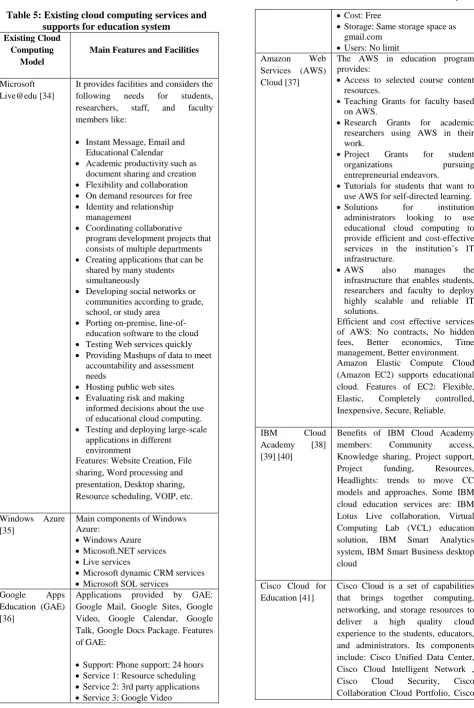
Table 5: Existing cloud computing services and supports for education system
Existing Cloud Computing
Model
Main Features and Facilities
Microsoft Live@edu [34]
It provides facilities and considers the following needs for students, researchers, staff, and faculty members like:
Instant Message, Email and Educational Calendar
Academic productivity such as document sharing and creation
Flexibility and collaboration
On demand resources for free
Identity and relationship management
Coordinating collaborative program development projects that consists of multiple departments
Creating applications that can be shared by many students simultaneously
Developing social networks or communities according to grade, school, or study area
Porting on-premise, line-of-education software to the cloud
Testing Web services quickly
Providing Mashups of data to meet accountability and assessment needs
Hosting public web sites
Evaluating risk and making informed decisions about the use of educational cloud computing.
Testing and deploying large-scale applications in different
environment
Features: Website Creation, File sharing, Word processing and presentation, Desktop sharing, Resource scheduling, VOIP, etc.
Windows Azure [35]
Main components of Windows Azure:
Windows Azure
Micosoft.NET services
Live services
Microsoft dynamic CRM services
Microsoft SOL services Google Apps
Education (GAE) [36]
Applications provided by GAE: Google Mail, Google Sites, Google Video, Google Calendar, Google Talk, Google Docs Package. Features of GAE:
Support: Phone support; 24 hours
Service 1: Resource scheduling
Service 2: 3rd party applications
Service 3: Google Video
Cost: Free
Storage: Same storage space as gmail.com
Users: No limit Amazon Web
Services (AWS) Cloud [37]
The AWS in education program provides:
Access to selected course content resources.
Teaching Grants for faculty based on AWS.
Research Grants for academic researchers using AWS in their work.
Project Grants for student organizations pursuing entrepreneurial endeavors.
Tutorials for students that want to use AWS for self-directed learning.
Solutions for institution administrators looking to use educational cloud computing to provide efficient and cost-effective services in the institution‟s IT infrastructure.
AWS also manages the infrastructure that enables students, researchers and faculty to deploy highly scalable and reliable IT solutions.
Efficient and cost effective services of AWS: No contracts, No hidden fees, Better economics, Time management, Better environment. Amazon Elastic Compute Cloud (Amazon EC2) supports educational cloud. Features of EC2: Flexible, Elastic, Completely controlled, Inexpensive, Secure, Reliable.
IBM Cloud
Academy [38] [39] [40]
Benefits of IBM Cloud Academy members: Community access, Knowledge sharing, Project support, Project funding, Resources, Headlights: trends to move CC models and approaches. Some IBM cloud education services are: IBM Lotus Live collaboration, Virtual Computing Lab (VCL) education solution, IBM Smart Analytics system, IBM Smart Business desktop cloud
Cisco Cloud for Education [41]
Services.
Benefits of Cisco education cloud: Reshaping teaching by extending interactive multimedia learning environments to anyone, anywhere. Accelerating delivery of administrative services. Simplifying operations, saving time, and cutting cost.
Reducing risk and strengthening security.
Salesforce.com Education Cloud Platform [42]
Services provided by Salesforce cloud for Education includes: Constituent Relationship, Alumni Advancement, Student Recruiting, Knowledge Management, Alumni and Applicant Portals, Student Retention, Faculty Collaboration, Student Tracking, and Study Abroad.
ZMANDA Application for Education [43]
Zmanda offers an alternative to traditional storage, backup and retrieve the data based on Amazon Web Services and Zmanda Internet Backup. Zmanda launched the Amazon S3 backup solution to educational organizations.
HP Cloud
Computing [44]
With HP Cloud System, students, faculty and researchers get a single, seamless cloud including:
Manages and delivers End-to-End automated application:
Unifies and controls self-service portal with a built in service catalog.
Completes lifecycle management.
Tracks the development of a cloud service catalog.
Supports for multiple departments and clients such as students, faculty and researchers.
Provides scalability and one-click, just in time provisioning.
Innovates open standards to support multiple types of applications.
Provides security, privacy and compliance.
8.
CONCLUSION AND FUTURE WORK
Cloud computing has newly appeared as a persuasive archetype for managing and delivering services over the internet using distributed method. The enhancement of cloud computing is hastily changing the vista of information technology and eventually turning to the long-held promise of utility computing into a reality. Cloud computing can facilitate communities and nations, can transform education.
The knowledge, information, and education services can now be made available and accessible to teachers, students, researchers along with any stakeholder of education community through cloud based services that can be accessed anytime, anywhere, from any device simply, effectively with low cost and efforts. In order to compete and succeed in the present universal information society cloud computing helps the students to acquire skills and training and face the challenges of 21st century through its education systems and services like e-learning, distance education. Present economic circumstances of many countries around the world will force different educational institutions and organizations to deem implementing a cloud solution. Many universities have already begun to adhere to this initiative, many service providers already have started to deliver their services, platforms, and infrastructure and there are proofs that indicate significant decreasing of expenses due to the implementation of cloud decision. The aim of this research was to study and analyze the overall cloud situation towards developing a unified cloud computing model which will be using within higher education to solve various learning process. Future research will include the implementation of the proposed cloud computing model to enhance and bridging the gap in education system.
9.
REFERENCES
[1] Shah Murtaza Rashid Al Masud, "An Extended and Granular Classification of Cloud‟s Taxonomy and Services", International Journal of Soft Computing and Engineering, ISSN: 2231-2307, Volume-2, Issue-2, May 2012.
[2] M. Armbrust, A. Fox, R. Griffith, A. D. Joseph, R. H. Katz, A. Konwinski, G. Lee, D. A. Patterson, A. Rabki I. Stoica, and M. Zaharia, “Above the Clouds: A Berkeley View of Cloud Computing,” EECS Dept., Uni. of California, Berkeley, Tech. Rep. UCB/EECS 2009-28, Feb ‟09.
[3] L. Qian, Z. Luo, Y. Du, and L. Guo, “Cloud computing: An overview,” in CloudCom ‟09: Proceedings of the 1st International Conference on Cloud Computing. Springer-Verlag, 2009, pp. 626–631.
[4] G. Lin, D. Fu, J. Zhu, and G. Dasmalchi, “Cloud computing: It as a service,” IT Professional, vol. 11, no. 2, pp. 10–13, 2009.
[5] P. Murray, “Enterprise grade cloud computing,” in WDDM ‟09: Proceedings of the Third Workshop on Dependable Distributed Data Management. New York, NY, USA: ACM, 2009, pp. 1–1.
[6] A. Weiss, “Computing in the clouds,” NetWorker, vol. 11, no. 4, pp. 16–25, 2007.
[7] D. Hilley, “Cloud computing: A taxonomy of platform and infrastructure-level offerings,” CERCS, Georgia Institute of Technology, Tech. Rep. GIT-CERCS-09-13, April 2009.
[8] Cloud-outlook-for-2012.html:
http://cloudonomic.blogspot.com/2011/12/cloud-outlook-for-2012.html#!/2011/12/cloud-outlook-for-2012.html [9] T. Jowitt, “Four out of five enterprises giving cloud a
try,” August 27, 2009. Computerworld UK, (visited: 2010, May 7). [Online]. Available: http://www.computerworlduk.com/management/ it business/services
sourcing/news/index.cfm?newsId=16355
[11] P. Mell and T. Grance, “The NIST definition of cloud computing (v15),” National Institute of Standards and Technology, Tech. Rep., 2009.
[12] A. Plesser, “CC is hyped and overblown, Forrester‟s Frank Gillett...Big tech companies have ‟cloud envy‟,” Sep ‟08, interview video (visited: 2010, Apr 23). [Online]. Available: http://www.beet.tv/2008/ 09/cloud-computing.html
[13] Patterson, D. (2010). “Cloud Computing and the RAD Lab," UC Berkeley, Reliable Adaptive Distributed Systems Lab,” [Online], [Retrieved October 5, 2010], http://www.mvdirona.com/jrh/TalksAndPapers/Patterson MSCloudComputingRADLab.pdf
[14] NIST, (2009). “Presentation on Effectively and Securely Using the Cloud Computing Paradigm v25,” [Online],
[Retrieved August 29, 2009],
http://csrc.nist.gov/groups/SNS/cloudcomputing/cloud-computing-v25.ppt
[15] Catteddu, D. & Hogben, G. (2009). “Cloud Computing: Benefits, Risks and Recommendations for Information Security,” European Network and Information Security Agency. [Online], [Retrieved October 5, 2010], http://www.enisa.europa.eu/act/rm/files/deliverables/clou d-computing-riskassessment
[16] Goldstein, P. J. (2009). “Alternative IT Sourcing Strategies: From the Campus to the Cloud,” EDUCAUSE Center for Applied Research. [Online],
[Retrieved October 5, 2010],
http://net.educause.edu/ir/library/pdf/EKF /EKF0905.pdf [17] Jitterbit (2009). “Five Integration Tips to Cloud
Computing Success,” Jitterbit, Inc. [Online], [Retrieved
October 5, 2010],
http://www.prweb.com/pdfdownload/2326314.pdf [18] Luther, M. (2009). “Federated Key Management as the
Basis for Secure Cloud Computing,” SC Magazine [19] Mcirvine, S. (2010). “Making Cloud Computing Safe
Trust, Security, Resiliency, Availability and Complexity,” IBM Corporation. [Online], [Retrieved
October 5, 2010],
https://www950.ibm.com/events/wwe/grp/grp004.nsf/vL ookupPDFs/Security%20&%20Cloud%20PCTY%20%2 0McIrvine/$9ile/Security%20&%20Cloud%20PCTY%2 0%20McIrvine.pdf
[20] SafeNet, (2010). “SafeNet Solutions Secure Cloud Computing Deployments,” SafeNet, Inc, [Online], [Retrieved October 5, 2010], http://www.safenetinc. com/About_SafeNet/News_and_Media/News_and_Medi
a_Items/2010/ SafeNet Solutions
Secure_Cloud_Computing_Deployments.aspx
[21] Tout, S., Sverdlik, W., & Lawver, G. (2009). “Cloud Computing and its Security in Higher Education,” Proc ISECON, v26 (Washington DC): §2314, EDSIG, [Online], [Retrieved October 5, 2010] http://proc.isecon.org/2009/2314/ISECON.
2009.Tout.pdf
[22] Z. Chengyun, “Cloud Security: The security risks of cloud computing, models and strategies”, Programmer, May.2010, pp.71-73.
[23] Cloud computing conference in China, May 2012, “http://www.ciecloud.org/2012/schedule03_en.html”
[24] Cloud outlook for 2012,
http://cloudonomic.blogspot.com/2011/12/cloud-outlook-for 2012.html#!/2011/12/cloud-outlook-http://cloudonomic.blogspot.com/2011/12/cloud-outlook-for-2012.html. [25] Gurdev Singh, and others, “cloud computing future
solution for educational systems”: http://www.ijecbs.com/January2012/29.pdf, Vol. 2 Issue 1 January 2012.
[26] Medical cloud: http://www.backup-technology.com/5988/the-medical-cloud/
[27] Kevin L. Jackson, “Government Cloud Computing”, SOA-R Cloud Computing, Dataline, LLC.
[28] Furht,B., and Escalante,A. (2010). Handbook of Cloud
Computing. New York: Springer
http://searchcloudcomputing.techtarget.com/definition/pr ivate-cloud
[29] Foster, I., Zhao, Y., Raicu, I., & Lu, S. (2008). Cloud Computing and Grid Computing 360-Degree Compared. Grid Computing Environments Workshop (pp. 1 - 10). Austin: GCE.
[30] Sasikala, S., & Prema, S. (2010). Massive Centralized Cloud Computing (MCCC) Exploration in Higher Education. Advances in Computational Sciences and Technology , 3 (2), 111–118.
[31] Behrend, T. S., Wiebe, E. N., London, J. E., & Johnson, E. C. (2011). Cloud computing adoption and usage in community colleges. Behaviour & Information Technology , 30 (2), 231–240.
[32] IBM. (n.d.). Cloud Computing. Retrieved March 20, 2011, from IBM Academic Initiative : https://www.ibm.com/developerworks/university/cloud/ [33] Siegle, D. (2010). Cloud Computing: A Free Technology
Option to Promote Collaborative Learning. Gifted Child Today , 33 (4), 41-45.
[34] Microsoft, Cloud Computing Web Site. Cloud
Computing in Education.
http://www.microsoft.com/education/enus/solutions/Page s/cloud_computing.aspx
[35] Microsoft News Center. Windows Azure and the Azure Services Platform: Making Microsofts
Software-plus-Services Vision a Reality.
http://www.microsoft.com/presspass/features/2008/oct08 /10- 27pdcfeature1.mspx/
[36] Google Apps Education Edition: communication, collaboration, and security in the cloud. http://www.google.com/a/edu/
[37] Amazon Web Services (AWS) Web Site. What is AWS? A comprehensive cloud computing platform. http://aws.amazon.com/what-is-aws/
[38] IBM Academic Initiative. Cloud computing: Delivering Internet-based information and technology services in
real time.
https://www.ibm.com/developerworks/university/cloud/ [39] IBM Sales and Distribution, Solution Brief for
Education. IBM Cloud Academy Education for a smarter planet.
ftp://ftp.software.ibm.com/common/ssi/ecm/en/eds03007 usen/EDS03007USEN.PDF
[40] http://www.ibm.com/solutions/education/cloudacademy/ us/en/
[41] http://www.cisco.com/web/strategy/education/cloud_co mputing.html
[42] Salesforce.com foundation, Higher Education. The Real-Time Cloud for Higher Education. http://www.salesforcefoundation.org/products/higher_ed ucation_solution/
[43] Zmanda: Zmanda Application.
http://www.zmanda.com/amanda-enterprise-edition.html
[44] HP cloud system.