A Certificateless Authentication Key Agreement
Protocol to mitigate MITM and Key-Compromise
Impersonation Attacks
Renu Srivastava
IGNOU Study Centre (2777P) Motilal Nehru National Institute of Technology
Allahabad, India
A.K. Misra
Computer Science &Engineering Department Motilal Nehru National Institute of Technology
Allahabad, India
ABSTRACT
To overcome the key escrow issues of the identity based cryptography, Shi Yijuan and Ll Jianhua [11] proposed a new Certificateless Two-party Authentication Key Agreement (CL-2AKA) protocol. In this paper an improved CL-2AKA Protocol has been proposed. The proposed protocol CAKA (Certificateless Authentication Key Agreement Protocol) is based on the algebraic properties of the pairing. The proposed protocol attempts to mitigate the man-in-the middle and Key-compromise impersonation attacks. is found to be more efficient on computation and has more compact cipher text than the existing schemes.
Keywords
Information Security, Cryptography.
1.
INTRODUCTION
Protection of data on Internet from any unauthorised usage is an important issue. The techniques used for security of data during transmission in the networks are mostly based on the cryptography, which is an art of secret writing and a method to protect the information from unauthorized usage. Cryptography is either symmetric, which uses the private key or is asymmetric that uses both i.e. the private key and public key. The method to apply the key on the plain text is known as encryption and the method to apply the key on the encrypted data called cipher text for getting the plain text is known as decryption. During transmission of the data, the opponents try to attack in two ways; the first one is human like cracker or hacker and second one is software like worms, viruses etc.
An authentication mechanism prohibits the use of the system (or some resource of the system) by un-authenticated user by verifying the identity of a user before permitting access to the requested resource in any of the following three ways:
User logins or One-way authentication
Two-way authentication of communicating entities
Three-way authentication of communicating entities Shamir [10] proposed the identity-based public key cryptography (ID-PKC) in 1994, in which the public key of each party is obtained directly from certain aspects of its identity [2, 4, 10]. In 2003 Riyami [8] proposed a new authentication protocol called Certificateless authentication protocol for reducing the certificate provided by the KDC
(Key Distribution Centre) due to strong security in place of traditional PKI (Public Key Infrastructure). But, it is possible that the KDC acts as an intruder or opponent because it has the certificates of the sender/initiator and recipient. A single compromise of KDC will make the modes vulnerable over the subscribers of KDC, because the KDC knows the certificates of all the users and they may use it according to the requirement of hacking or any other compromise. Riyami & Paterson [9] also introduced the notion of Certificateless Public Key Cryptography (CL-PKC), which can overcome the key escrow limitation of ID-PKC without introducing certificates and the management overheads. It combines the advantages of the ID-PKC and the PKI.
protocol which required ten times pairing computation, and thus efficiency of the protocol reduced considerably. Since the introduction of CL-PKC, many Certificateless Public Key Encryption (CL-PKE) and signature schemes have been proposed but all these certificateless authenticated key agreement protocols were introduced without security analysis.
An active adversary can intercept and properly modify the messages exchanged between two parties, and force two parties to accept the same session key even when two parties really do not want to agree on. The key replicating attack has been analysed in the BR93 security model. Through a detailed study of key replicating attack on the CL-2AKA protocol, it has been demonstrated that the protocol is insecure if the adversary is allowed to reveal non-partner players, who share the same session key and obtain a fresh session key. Trivially this implies the violation of the key establishment security goal.
In order to solve the aforementioned problems, a new Certificateless two party Key Agreement (CL-KA) protocol was proposed in 2010 [5]. The security attributes are analyzed in the eCK security model. This scheme is secure even if key generation centre learns the ephemeral secrets or reveals secret values / replaces public keys but not both. The one-round CL-KA protocol only requires each entity to compute two pairing. Up to now; it turns out to be the most efficient one of all the previously known CL-KA schemes. This protocol has the following properties:
The protocol is secure only if BDH (Bilinear Diffie-Hellman) and CDH (Computational Diffie-Diffie-Hellman) assumptions hold.
The protocol is not certificateless authentication protocol; but it is an alternative of the certificate authentication protocol because it depends on the trusted third party for partial private key.
2.
SECURITY ANALYSIS
In the new CL-2AKA, the attack and its effect can be described as follows:
[image:2.595.324.550.594.730.2] [image:2.595.49.299.655.706.2]The existing problem of man-in-the-middle attack and Key-compromise impersonation attack are defined in the following table:
Table 1: Existing problem in this protocol
Protocol Pairing Exponentiation Security
Model
Main Attacks
SL[1] 1 1 No MA+KCI
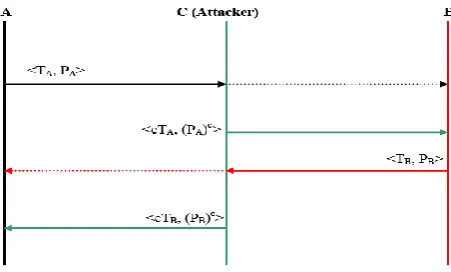
A key replicating attack is fond out in the CL-2AKA protocol during the illustration of an execution of the protocols in the presence of a malicious adversary A as below.
Let sender A and receiver B wants to agree to a session key for secure communication. Then,
A B: <TA, PA> Where
TA = a(H1(IDB)P + Ppub) Public Key of A, PA=g
x A
The adversary
A
intercepts and deletes the message from A, compute cTA and (PA)c with a random c R( is a group with multiplication modulo n and is called the group of units modulo n or the group of primitive classes modulo n.) and sends <cTA (PA)c> to B impersonating A, i.e..
A
A B: <cTA, (PA) c>
B A: <TB, PB>
Where TB = b(H1(IDA)P+Ppub) Public Key of B, PB=gxB
The adversary
A
intercepts and deletes the message from B, compute cTB and (PB)c with a random c selected as above, and sends <cTB, (PB)c> to A impersonating B.A
B A: <cTB, (PB) c>
A and B compute the session keys KA and KB respectively, with
SA= xADA: Private key of A SB = xBDB: Private key of B
A compute:KA=e(cTB, SA)(PBc)a=gcbxA* gacxB= g(bxA+axB)c
B compute:KB = e (cTA, SB)(PAc)b=gcaxB*gcbx=g(bxB + axA)c The key replicating attack is as follows:
KA = KB i.e. KAB= KAA Attacker B
B Attacker : g(bxA + axB)c
It is obvious that KAB= KAA, this means that A and B compute and accept the same session key g(bxA+ axB)c (Actually, A and B should agree on the session key gbxA + axB). At last A sends a Reveal query to B, B will return the agreed session key:
A B: Reveal B A: g(bxA + axB)c
In the attack sequences shown above, both A and B have accepted the same session key. However, both A and B are non-partners since they do not have matching conversations. In addition, both A and B are uncorrupted since they have not been sent a corrupt query. By sending a Reveal query to either A or B, the malicious adversary A is able to obtain the session key of a fresh oracle of a non-partner oracle [7]. In order to minimize the short comings of the CK-2AKA protocol, an improved certificate less authentication key agreement protocol named CAKA has been proposed and is described in the section below.
3.
PROPOSED IMPROVED CL-2AKA
PROTOCOL CAKA
In this section an improved certificate less authentication key agreement protocol named CAKA has been proposed. This protocol is based on the principles of CL-2AKA protocol and tries to mitigate the MITM attack and key compromised impersonation attack. This new CAKA protocol is better than the protocol proposed by Liu Wenhao et al. in 2010 because this protocol requires one time pairing computation and exponentiation, which in turn results in very high efficiency of the protocol. This protocol involves three entities, the communicating A (Sender) and B (Receiver) and the Trusted Third Party in which the protocol participants are issued their respective partial private keys. The new CAKA protocol consists of the following:
3.1
Bilinear Pairings & Some Assumptions
Let G1 be a cyclic additive group of prime order q and G2 be a cyclic multiplicative group also of prime order q. P is a generator of G1. Assume that the discrete logarithm problem (DLP) is hard in both G1 and G2. An admissible pairing e is a bilinear map e: G1 * G1 G2, which satisfies the following three properties:
Bilinear: for P,Q G and , a b , we have e(aP,bQ) = e(P,Q)ab ;
Non-degenerate: e(P,P) 1.
Computable: If P, QG1, one can compute e(P,Q) G2 in polynomial time efficiently.
3.2 Computational Diffie-Hellman
assumption (CDH)
For g G2 is the generator of G2, and, a b , given ga and gb, computing gab is hard.
3.3 Bilinear Inverse Diffie-Hellman
assumption (BIDH)
For, a b , P is a generator of G1, given aP and bP, computing e(P,P)a-1 b is hard.
3.4 The p-Bilinear Diffie-Hellman Inversion
Assumption (p-BDHI):
Given <P, aP, a2 P,…, ap > G1p+1, computing e(P, P)1/a G2 is hard.
3.5
Key Agreement
Assume user A and B want to agree to a common session key. To compute this session key, each party computes: A is sending a message to B and B is sending to A by EA and EB respectively.
EA=( TA, PA) EB=( TB, PB )
TA = aP: Public ephemeral key aP G1, TB=bP: Public ephemeral key bP G1 ,
xA, xB :Random number chosen by A and B respectively PB = xBP : Public key of B,
PA = xAP: Public key of A, DB = sQB: Partial Private key of B. DA = sQA: Partial Private key of A YA= QAPA
YB= QBPB
SB = xBDB: Private key of B, SA= xADA: Private key of A
To compute the session key, each user computes. K1 = aTB = a.bP = b(aP) = b.TA,
In this way K1 = aTB = bTA
K2 = xAPB=xA(xBP)= xB (xAP) = xB PA, Computation K2 = xAPB = xB PA,
Session Key = H [A, B, EPA, EPB, K1, K2, K3 ].
This session key is used for secure communication between both parties.
3.6 Architecture
Four way authentications for establishment of session and confirmation to each level for authentication has been proposed in CAKA. The architecture of the protocol is as follows:
The steps of Certificateless Authentication Key Agreement protocol are as follows:
A want to communicate with B. A sends to B the parameter <TA, PA> encrypted with the public key of B, where PA is public key of A and TA = aP. (A and B wish to agree on a session key and they each select a private ephemeral key a, b and generate the corresponding public ephemeral key aP, bP G1 respectively. A then send TA = aP to B).
(A and B are two parties. Each party has a key pair i. e. a public key and a private key).
B receives the computational parameter and decrypt with the help of own private key such as SB and send the parameter <TB, PB> back to A (where PB is public key of B and TB = bP G1 is public ephemeral key of B) encrypted with the public key of A.
A send to B, the Message Authentication Key MACk (IDA || IDB || TA || TB || PA || PB). MACk key is known by A and B. This is a shared secret key between A and B.
Again, B send to A, the Message Authentication Key MACk (IDB || IDA || TB || TA || PB || PA). This key is used for verified by B to establish a secure session.
Therefore, the session is established between A and B and both is known that the establishment is authenticated. The computation and communication complexity of the certificateless protocols are compared in the table 2, which is based on [5]:
Table 2: A comparison of Certificateless Authentication protocols
Protocol Pai
ring
Exponentiation Security Model
Main Attacks AP[4]
(2003)
4 1 No MA
MT[12]
(2006)
2 1 No MA+K
CI
WCW[18]
(2006)
1 0 No MA+K
CI
SL[1]
(2007)
1 1 No MA+K
CI
Lippold[11]
(2009)
10 5 eCK No
Liu[3]
(2010)
2 2 eCK No
Our
(2012)
1 1 No No
3.7 Advantages of Introducing Hash
The hash function has been used for better security because hash is a one way function.
3.8 Security Analysis
Based on [9] the security attributes in the proposed certificateless authentication key agreement protocol are as follows:
3.8.1
Implicit Key Authentication
In the proposed protocol the security attribute implicit key authentication exists because the users are assured that no other users except partners can possibly learn the value of a particular secret key.
3.8.2
Known Session Key Security
Each run of the protocol computes a different session key which depends on the ephemeral private keys a and b.
3.8.3
Forward Secrecy
The adversary has got some messages such as DA and DB but he does not compute abP without the knowledge of a and b. Therefore, the proposed protocol can satisfy the security attribute forward secrecy.
3.8.4
No Key-compromise Impersonation
The proposed protocol satisfies key-compromised impersonation (KCI) resilience because if an adversary got XA, DA, b, DB but not a, XB, it can not compute it.
3.8.5
No Unknown Key-share
The session key SK associated with his elements satisfy both parties has no unknown key-share.
3.8.6
Performance Analysis
This protocol only requires two round communications and each party needs only two pairing operations to perform common session key. This protocol is fully protected to the man-in-the-middle attack (MITM) and Key Compromise Impersonation attack (KCI).
3.8.7
One Pairing Computation
This protocol requires two round communications and each user needs only one pairing computation to perform common session key. Therefore, it is most efficient as compared to Liu Wenhao’s new CL-KA protocol in which two pairing operations are required to perform common session key.
3.8.8
One Exponentiation
Public key of a user in the CAKA protocol consists of only one element rather than two elements as in Liu Wenhao’s CL-KA protocol.
4.
CONCLUSION
of this protocol confirms not only authenticity but it also provides privacy, integrity and confidentiality of data in communication. The protocol is also able to mitigate the MITM and the Key compromised impersonation attacks.
5.
ACKNOWLEDGMENTS
Our thanks to the experts who have contributed towards development of CL-KA, CL-2AKA protocols.
6.
REFERENCES
[1] B. Libert and J.J. Quisquater, “On constructing
certificateless cryptosystems from identity based encryption”, Public Key Cryptography - PKC 2006, Springer Berlin/Heidelberg, Vol. 3958 of Lecture Notes in Computer Science, 2006, pp. 474-490, doi: 10.1007/11745853_31.
[2] Chen L, Kudla C., “Identity Based Authenticated Key
Agreement from Pairings”, 2004.
[3] Georg. L., Colin.B, J.M.G..Nieto, “Stronger Secure
Certificateless Key Agreement pairing 2009”, LNCS
5671,pp.206-230,2009, Springer-Verlag Berlin Heidelberg 2009
[4] Joonsang Baek, et. al. “A Survey of Identity-Based
Cryptography”, 2004.
[5] Liu Wenhao, Xu Chuxiang, Xu Jian., “Certificateless
Two Party Key Agreement Protocol”,
IEEE-2010 International Conference on Multimedia Information Networking and Security, pp 520-525. [6] Mandt, T.K., “Certificateless Authenticated
Two-Party Key Agreement Protocols”, Master Thesis, University of Gjovik (2006).
[7] Mengbo Hou and Qiuliang Xu., “Key Replicating
Attack on Certificateless Authenticated Key
Agreement Protocol”, IEEE-2009, Asia-Pacific
Conference on Information Processing, pp 574-577.
[8] S.S. Al-Riyami and K. Paterson., “Certificateless Public
Key Cryptography”, In C.S. Laih, editor, Advances in Cryptology - Asiacrypt 2003, volume 2894 of Lecture Notes in Computer Science, pages 452-473. Springer-Verlag, 2003.
[9] S.S. Al-Riyami and K. Paterson., “CBE from CL-PKE:
A Generic Construction and Efficient Schemes”,
In S. Vaudenay, editor, PKC 2005, volume 3386 of Lecture Notes in Computer Science, pages 398-415. Springer-Verlag, Berlin 2005.
[10] Shamir A., “Identity-Based Cryptosystems and
Signature Schemes”, [j]. Lecture Notes in Computer
Science,1994, 196: 47-53.
[11] Shi,Y., Li,J., “Two-Party Authenticated Key
Agreement in Cerfiticateless Public Key
Cryptography”, Wuhan University Journal of Natural Sciences, 12(1),071-074 (2007).
[12] Swanson, C, Jao,D., “A Study of Two-Party
Certificateless Authenticated Key Agreement
Protocols”, INDOCRYPT 2009, LNCS
5922,pp.57-71,2009, Springer-Verlag Berlin Heidelberg 2009, 53234.
[13] Swanson, C.M., “Security in Key Agreement:
Two-Party Certificateless Schemes”, Masters Thesis, University of Waterloo (2009)
[14] Xia,L., Wang,S., Shen,J., Xu,G., “Breaking and
repairing the certificateless key agreement protocol from ASIAN 2006”, Wuhan University Journal of Natural Science 13(5), 562-566 (2008)
[15] Wang, S., Coa, Z., Wang L., “Efficient Certificateless
Authenticated Key Agreement Protocol form Pairing”, Wuhan University Journal of Natural Sciences: 11(5), 1278- 1282 (2006).