Carrier Sense Multiple Access & Collision Avoidance–
Visualisation Teaching Tool (CSMA/CA-VTT)
Raghu Nitin Alapati
1, Chava Pavan Kumar
2, Peruri Adithya
2, T.Ravi
3, T.PraveenBlessington
31,2
Final Year B.Tech Students, Dept of Electronics and Communications Eng., KL University, Vaddeswaram, Andhra Pradesh, India 3
Assistant Professor in Electronics and Communications Dept at KL University, Vaddeswaram, Andhra Pradesh, India
Abstract- A Carrier-Sense Multiple-Access/Collision Avoidance (CSMA/CA) was a telecommunication protocol that first listened before sending a frame through a medium in order to avoid collision among heterogeneous sites across a network. To teach such a mechanism to students in the traditional format, especially to the ones from the Sub-Saharan region was a difficult to visualize such a concept. In view of that, Carrier-Sense Multiple-Access/Collision Avoidance – Visualisation Teaching Tool (CSMA/CA- VTT) was envisaged to demonstrate step-by-step the phenomenon of “listen-before-talk”, the mechanism of Inter Frame Spacing (IFS) and Back off Timer (BOT) decremented generated random time to zero (0) to give one station high priority to send a frame. The CSMA/CA-VTT proved to be useful teaching aid in practice by showing sixty percent (60%) of the Regular group of twenty five (25) students that were taught using that tool, reported that they visualised the concept very high. In contrast, the Controlled group that were taught without using the tool, only four percent (4%) of students claimed that they were able to visualize the concept very high, whereas sixty eight percent (68%) of this same group regrettably lamented that their visualization to this concept was low. Such a result really suggested that the institutions especially in the sub-Saharan region did not have relevant telecommunications infrastructure that would be demonstrated before the learners. This showed that much of teaching-learning was done theoretically. It was against this background that alternative solutions of employing teaching tools like CSMA/CA-VTT were developed and used in learning institutions.
Index Terms- Visualisation, collision avoidance, single medium, backoff timer (BOT), inter frame spacing (IFS), frame, CSMA/CA, CSMA/CA-VTT and heterogeneous sites.
I. INTRODUCTION
Carrier-Sense Multiple-Access/Collision Avoidance (CSMA/CA) a MAC method used in wireless LAN that deploys the phenomenon of “listen-before-talk” and the mechanism of Inter Frame Spacing (IFS) and Backoff Timer (BOT) to avoid the frame collision across network had been difficult to teach in the learning institutions, especially the sub-Saharan region where the infrastructure is scarce. In such institutions, learners find it practically impossible to visualize such concepts. In view of this, a simulation teaching model called Carrier- SenseMultiple-Access/CollisionAvoidance– Visualisation Teaching Tool (CSMA/CA-VTT) was envisaged to demonstrate step-by-step the phenomenon of “listen-before-talk”,
the mechanism of IFS and BOT decrementing generated random time to zero (0) to accord one of the stations high priority to send a frame at a time into a single medium.
The frame is transported into a remote site which receives the transmitted packet. To ascertain the effectiveness of the model, CSMA/CA-VTT, an experiment of two groups of students, twenty five (25) each were administered. In the first experiment, this teaching tool was used for the first twenty five (25) students, and was referred to as the Regular group. The other group where the tool was not used was called Control group. The results were compiled and analysed for an assessment of the two groups.
II. THE PROBLEM STATEMENT
CSMA/CA and CSMA/CD are one of very crucial topics and technologies in the telecommunication and academic industry. Their mechanisms of avoiding and detecting collision across the network had been very challenging, especially in the sub-Saharan institutions where telecommunication resources are scarce. Students find it difficulty to visualize how heterogeneous stations build up a random backoff procedure, that generate a random backoff time, an integer value corresponding to the number of time slots. This procedure runs the timer giving heterogeneous stations allocations of random numbers until the timer decrement to zero. As each station decrements to zero, that particular site transmits the frame through the single medium. Understanding such a mechanism especially to the learners, particularly of the sub-Saharan region who have not yet seen such infrastructure becomes a nightmare. It is in view of this that this work was envisaged to design and build a hands-on teaching model that demonstrates step-by-step the whole mechanism of CSMA/CA, utilizing the phenomenon of “listen before you talk”.
III. RELATED WORK
The method of CSMA/CA had been envisaged by other scholars. However, our work is not to re-event the wheel, but to simplify step-by-step the teaching of the CSMA/CA access mechanism, especially to those students from an environment that does not have such telecommunications infrastructure. Joseph Deng et al. (2005) pointed out that the core of the underlying collision avoidance mechanism in Carrier Sense Multiple Access with Collision Avoidanc (CSMA/CA) was built upon a random backoff procedure, which generated a random backoff time, an integer value corresponding to the number of time slots. In this regard, a station computed a backoff time in the range of 0-7. If a station with a frame to transmit initially sensed
a busy channel, it waited until the channel became idle, and then, the station decremented its backoff timer until either the medium became busy again or the timer reached zero. If the medium became busy before the timer reached zero, the station freezed its timer. When the timer finally decremented to zero, the station transmitted its frame. If two or more stations decremented to zero at the same time, a collision occurred, and each station had to re-generate a new backoff time in the range of 0-15. For each retransmitted attempt, the backoff time grew. Also Bonaventure O (2010) talked about the CSMA/CA as a relied on back off timer. He said the backoff timer was a random delay that was chosen by each device in a range that depended on the number of retransmissions for the current frame. He said the range grew exponentially with the retransmissions as in CSMA/CD. The minimum range for the backoff timer was where the slotTime was a parameter that depended on the underlying physical layer. He narrated that the CSMA/CA device must regularly sense the transmission channel during its back off timer. If the channel became busy, because another device was transmitting, then the back off timer must be frozen until the channel became free again. Once the channel became free, the back off timer was restarted.
Bonaventure O (2010), further mentioned that algorithm was designed for the popular WiFi wireless network technology, 802.11. He said the CSMA/CA sensed the transmission channel before transmitting a frame and it tried to avoid collisions by carefully tuning the timers used by CSMA/CA devices. In this way, the CSMA/CA introduced a small delay, named Short Inter Frame Spacing (SIFS), between the reception of a frame and the transmission of the acknowledgement frame. This delay corresponded to the time that was required to switch the radio of a device between the reception and transmission modes. Also, the CSMA/CA defined two delays : DIFS and EIFS. To send a frame, a device must first wait until the channel has been idle for at least the Distributed Coordination Function Inter Frame Space (DIFS) if the previous frame was received correctly. However, if the previously received frame was corrupted, this indicated that there were collisions and the device must sense if the channel was idle for at least the Extended Inter Frame Space (EIFS), with SIFS < DIFS < EIFS.
Koubaa et al. (2006), discussed CSMA/CA algorithm as based on a basic time unit called Backoff Period (BP), which was equal to aUnitBackoffPeriod = 80 bits (0.32 ms). That slotted the CSMA/CA backoff algorithm mainly depended on three variables: Backoff Exponent (BE), Contention Window and Number of Backoffs (NB). The Backoff Exponent (BE) enables the computation of the backoff delay, which is the time before performing the CCAs. The backoff delay is a random variable between 0 and (2BE −1). The Contention Window (CW) represents the number of backoff periods during which the channel must be sensed idle before accessing to the channel. The standard set the default initialization value to CW = 2 (corresponding to two CCAs). In each backoff period, channel sensing is done during the 8 first symbols of the BP. The Number of Backoffs (NB) represents the number of times the CSMA/CA algorithm was required to backoff while attempting to access the channel. This value is initialized to zero (NB = 0) before each new transmission attempt.
[image:2.612.317.572.334.486.2]Kuo et al. (2003), discussed the basic idea ofCSMA/CA as “listen before talk”, where a station which desired to transmit must probe the medium before transmission to determine whether another user was transmitting. In this regard, the CSMA/CA employed an immediate positive acknowledgment scheme to make sure successful reception of packets. If the medium is sensed to be free for a DIFS interval, the transmission may proceed. On the other hand, if the medium is busy, the station must defer its transmission until the end of the current transmission. Then, it will wait for an additional DIFS interval and generate a random backoff delay to initialize the backoff timer before transmission. The backoff timer is decreased as long as the medium is sensed as idle, and frozen when a transmission is detected on the channel, and resumed when the medium is sensed as idle again for more than a DIFS interval. Only when the backoff timer reaches zero, the station transmits its packet. For IEEE 802.11, time is slotted in a basic time unit, denoted by Slot_Time, which is equal to the time needed to detect the transmission of a packet from any other station. The backoff delay is an integer uniformly chosen in the range [0, W-1], which is called the backoff window or the contention window, and corresponds to the number of time slots that must elapse before the station can sense the channel again.
Figure 1 Infrastructure of the CSMA/CA Mechanism
Wireless Internet: IEEE 802.11b pointed out that a ready station with a frame to transmit must first listen to the channel. If the channel was idle, the station could then begin transmitting its frame. If the channel was busy, the station must defer (i.e., refrain from sending), because transmitting would surely caused a collision on the network and a variable called the Contention Window (CW) was used for this purpose. A station wishing to transmit a frame chooses a random BackOff (BO) time between 0 and CW, and this extra BO delay must elapse before the actual frame transmission could begin. If the channel was busy and collisions were observed, stations dynamically increased (e.g., double) CW. If frame transmissions were routinely successful, CW could be reset to its default value CWmin. It was emphasized that CSMA/CA protocol reduced the number of collisions on the channel, but did not eliminate collisions entirely.
Space). After channel was idle for IFS, it used a random number generator to set a random backoff time. In the coming slots, the user decreased its backoff time by one if it found the channel idle. In case where the channel was found busy, the backoff time counting should have been frozen till channel being idle for IFS again. Khattab et al. (2002), added that a CSMA/CA device must regularly sense the transmission channel during its back off timer. If the channel becomes busy (i.e. because another device is transmitting), then the back off timer must be frozen until the channel becomes free again. Once the channel becomes free, the back off timer is restarted. Also Marsic (2010), added that, CSMA/CA deliberately introduced delay in transmission in order to avoid collision. He said avoiding collisions increased the protocol efficiency in terms of the percentage of packets that get successfully transmitted(useful throughput).
[image:3.612.60.280.413.544.2]Ergen (2002) narrated that 802.11 MAC uses collision avoidance rather than the collision detection of IEEE 802.3. He said it was also unusual for all wireless devices in LAN to be able to communicate directly with all other devices. For this reason, IEEE 802.11 MAC implemented a network allocation vector (NAV). The NAV was a value that indicated to a station the amount of time that remained before the medium would become available. Even if the medium did not appear to be carrying a transmission by the physical carrier sense, the station may avoid transmitting. The NAV, then, was a virtual carrier sensing mechanism. By combining the virtual carrier sensing mechanism with the physical carrier sensing mechanism, the MAC implemented the collision avoidance portion of the CSMA/CA access mechanism.
Figure 3 backoff Timer (BOT) and Inter Frame Space (IFS) Mechanism
IV. THE CSMA/CA-VTT INFRASTRUCTURE AND IMPLEMENTATION
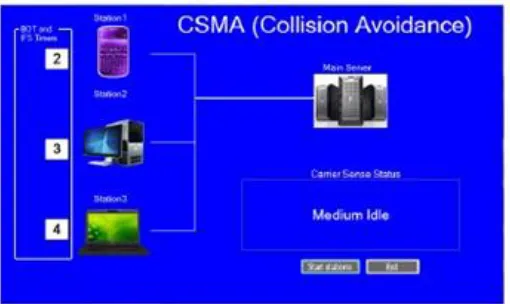
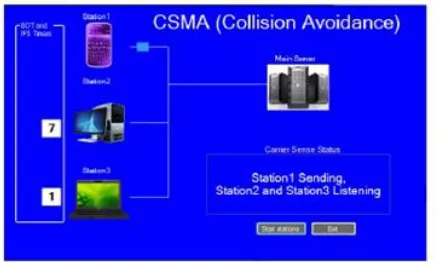
The CSMA/CA frame work is composed of the following infrastructure: in Figure 1, to the extreme left is the BOT and IFS Timers box, followed by in a column form are a series heterogeneous sites or stations that are connected to the main server through a single medium. At the bottom right hand side is a Carrier Sense Status box. The first box on the left hand side has the two functional components, the Backoff Timer (BOT) and Inter Frame Space (IFS). The BOT component is the backoff procedure, which generates a random backoff time, an integer corresponding to the number of slots. When the system is switched on or started, the Carrier Sense Status box indicates that the “Medium is Idle”. Thereafter, each one of the heterogeneous stations randomly starts computing the backoff time, when the medium is idle. These stations continue computing the timer and then compete in decrementing or decreasing to zero. The station which is the first to decrease or decrement to zero acquires the highest priority and the system allows it to transmit the frame successfully as demonstrated in Figure 2.
As indicated in Figure 2, station 1 has decremented to zero, followed by station 3 which decreased to 1 and lastly station 2 reduced to 7. At this juncture, the medium is busy, as station 1 occupies the channel during the backoff time of the stations. In the Carrier Sense Status box it reads that “Station 1 is Sending: Station 2 and Station 3 are Listening”. In this regard, the backoff timer stops giving fairness to the rest of the stations and thereafter, these sites have to re-set their timers. The second part IFS, is a mechanism that handles a period of time a backoff takes to decrease or decrement to zero when the stations sensed the medium to be idle. If the medium is free for the duration of an IFS, the station can start sending frame into the single channel as demonstrated in Figure 2. However, if the medium is busy, the stations have to wait for free IFS, then the stations must additionally wait a random back-off time, that’s forms the collision avoidance scenario, in multiple of slot-time. The whole mechanism of implementation by the backoff timer (BOT) and inter frame space (IFS) components is technically demonstrated in Figure 3.
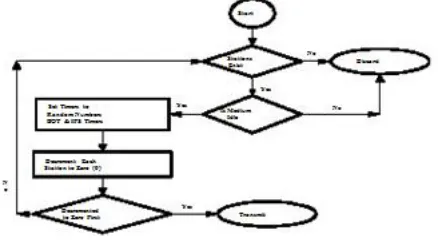
Figure 6 CSMA/CA Teaching Tool Flow Diagram
At this point the medium isbusy as station 2 occupies the channel during the backoff time of the stations. In this regard, the backoff timer stopped to give fairness to the remaining site 3 and thereafter, the sites have to re-set their timer. Station 3 being the last to be given the priority waits until frame from site 2 is successfully transmitted. Once the frame reaches the destination at the Main Server, the system in the Carrier Sense Status dialog box indicates that the “Medium is Free”. Then Station 3 acquires the priority and start sending the frame into the single medium as illustrated in Figure 5. Again, the Carrier Sense Status dialog box writes that “Station 3 is Sending”.
From Figure 5 in the Carrier Sense Status box, the system writes the current activity, in this case it shows the Station 3 is sending. single medium and this accomplishes the mechanism of the CSMA/CA.
V. THE DATA FLOW DIAGRAM OF CSMA/CA-VTT
Figure 6 shows a complete the CSMA/CA method that demonstrates step-by-step the phenomenon of “listen before you talk”, a mechanism of resolving a collision of frames sent from heterogeneous stations into a single medium.
VI. RESULTS AND DISCUSSION
A class of fifty (50) students was divided into two groups of twenty-five (25) each: a Regular and Controlled group. A questionnaire was designed to test the rating levels of visualization of the concept of the CSMA/CA in the following categories: low, average, high and higher. These ratings were: low=1, Average = 2, high = 4 and higher = 5.
The Regular group was taught using the teaching tool, the CSMA/CA-VTT. During the lecture, the system was used against the Regular group to demonstrate step-by-step the mechanism that utilized the principles of “listen- before talk” to resolve collision across the network. The students from this group were able to follow and assimilate the mechanism of heterogeneous stations listen to the single medium, the timers reducing to zero and the first site to decrement was accorded highest priority to send. The students saw how the rest of stations back-off, and listened to the medium before trying to send as the other one was transmitting. As the lecture went on, the student’s visualization to the concept of the CSMA/CA was disseminating into their minds effectively. When the questionnaires were circulated to the Regular group, the overwhelming response of visualizing the concept was very high as demonstrated in Table 1a.
The Controlled group was taught without using teaching tool, the CSMA/CA-VTT. As the lecture went on, the students were getting more confused especially on the phenomenon of “listen-before-talk”. The learners could not understand the mechanism of timer’s decrementing to zero and the system accords the first site that reduced to zero. The relationship of heterogeneous stations and timers mechanism could not make sense to the learners. The whole of this mechanism was absolute to the students. When the questionnaire was administered to this Controlled group, the response was very low and poor as illustrated in Table 1b.
Figure 8 Students’ Responses Did not Use the Education Tool
From the comparison table, the Regular group had fifteen (15) students expressing that through the use of the teaching tool they visualized the topic very high, which was sixty percent (60%) of the total response. The rest of responses in this category were: high was twenty percent (20%), average scored sixteen
percent (16) and the last was low with four percent (4%) as demonstrated in Figure 7.
From the same comparison table, the Controlled group 2 had eighteen (17) who indicated that they could not visualize the topic of the CSMA/CA and this makes approximately sixty eight percent (68%), which was low response. The rest of responses in this category were: average had twenty-four percent (24%), high and very high each had four percent (4%) as illustrated in Figure 8.
In comparison of the two groups, the results indicated that the teaching tool in this work named the CSMA/CA-VTT added value to the Regular group which was tangibly experiencing the steps involved in the teaching of the CSMA/CA mechanism. The students could physically see the simulation of the CSMA/CA infrastructure ranging from single medium, heterogeneous stations, and recipient in this case the server and BOT/timer unit. As simulation was start on, all the sites started listening before sending. The animation showed that the single medium was idle. Thereafter the BOTs/timers started decrementing from their assigned random numbers. Students continued to see the timers decreasing until one of them (timers) decremented to zero. The learners saw the station which reduced to zero being given high priority and was allowed to transmit the frame into the single medium. The heterogeneous stations were seen back-off, and started the listen-before- send process. The process continued until all the sites transmitted the frames and this accomplished the CSMA/CA mechanism that utilizes the listen-before-talk phenomenon.
As the Controlled group, they could not be availed the simulation of the entire infrastructure, that depriving them to see all the necessary components that make the CSMA/CA structure. When the lecturer was talking about the whole mechanism of the CSMA/CA, they could not imagine the nature of the single medium and topology of the heterogeneous station. As the lecturer was explaining the mechanism of listen-before-talk, the learners could not make sense out of it. Worse still, when the lecturer talked about the BOT/timers decrementing to zero, the students could not visualise such an absolute mechanism. As a result they could not visualize the sixty- eight percent of the topic. Such statistics provides vivid evidence that the learners had difficulties to imagine of what was being imparted to them. This clearly demonstrates that had they used the teaching tool, CSMA/CA-VTT, the simulation would have helped to display the stages involved on such mechanism of listen- before-talk.
VII. CONCLUSION
opportunity of seeing a station which is the first one decreasing to zero and being given a high priority to send the frame into the single medium. The rest of the stations are shown backing-off and start listen-before-talk to ensure that the medium was idle, before each one of them acquires the priority to send a frame.
REFERENCES
[1] Bonaventure O (2010). Carrier-Sense-Multiple-Access-with-Collision- https://scm.info.ucl.ac.be/release/cnp3/Book/0.2/html/lan/lan.html. [2] Deng J and Hsu-Chun Y (2005). Quality-of-Service Provisioning System
for Multimedia Transmission in IEEE 802.11 Wireless LANs.
[3] Ergen M (2002). IEEE 802.11 Tutorial. University of California [email protected].
[4] Khattab TMS, El-Hadidi MT and Mourad HM (2002). Analysis of Wireless CSMA/CA Network Using Single Station Superposition (SSS). International Journal of Electronics and Communications (IJEC). 56 (2): 71−81.
[5] Kuo W and Kuo CC J (2003). Enhanced Backoff Scheme in CSMA/CA for IEEE 802.11.
[6] Marsic I (2010). Wireless Networks: Local and Ad Hoc Networks.
[7] Department of Electrical and Computer Engineering and the CAIP Center. Rutgers University.
AUTHORS
First Author – Raghu Nitin Alapati was born in 1991 at Krishna
district. He is currently pursuing B.Tech from K L University. He is interested in wireless systems and telecommunication. Email – [email protected], Contact no- 8553751731
Second Author – Pavan Kumar Chava was born in 1992 at
krishna District. He is currently persuing B.Tech from K L University. He is interested in telecommmunication and networking.
Third Author – Peruri Adithya born in 1992 in,Andhra
Pradesh.He is pursuing his B.tech from K L University. He is interested in Communications and wireless networks.
Fourth Author – T.Praveen Blessington was born in 1972 at