3227
DEVELOPMENT OF SUSTAINABILITY SYSTEMS
FOR OPEN GOVERNMENT DATA (OGD) MANAGEMENT
BY COMBINING THE SHEL MODEL AND SOFT SYSTEMS
METHODOLOGY ANALYSIS
1RETNOWATI RETNOWATI, 2DANNY MANONGGA, 3HARI SUNARTO
1PhD Student at Faculty of Economy and Business, UKSW, Indonesia
2Postgraduate Program in Information Systems. Faculty of Information Technology, UKSW, Indonesia 3Postgraduate Program in Management. Faculty of Economy and Business, UKSW, Indonesia
E-mail: 1 [email protected], 2 [email protected], 2 [email protected]
ABSTRACT
OGD is an agreement of countries in the world to implement disclosure of public information. This agreement is also applied in Indonesia. One of the most important problems in managing Open Government Data (OGD) is the ability to collect, classify information, publish, and present information. OGD management in Indonesia is carried out by the Information and Document Management Officer (IDMO). Research on OGD in Indonesia is still very minimal and limited to the issue of initiating the implementation of OGD. In fact, the problems that occur are not only at the organizational level, but also need to be focused on the actors or information management employees working on IDMOs. The important thing is how OGD should be managed, so that all information which are produced must be carried out for the benefit of the community. When the right OGD management model can be carried out, then the concept of service to the community should also be developed and implemented as better as possible as a manifestation of the sustainability of OGD implementation. This study uses a qualitative method with the chosen rationality approach is the soft systems methodology (SSM). The results obtained from this study are the OGD management model that adopts the SHEL concept, namely strengthening the understanding, use and strengthening of software, hardware, environment and life-ware. And when the SHEL can be done well, the concept of service to the community must also be improved by adopting the concept of RATER (Reliability, Assurance, Tangible, Empathy, and Responsiveness). The combination of SHEL and RATER is a conceptual model and change plan to strengthen management and maintain the sustainability of OGD implementation in Indonesia through IDMO in all local governments.
Keywords: Shel Model, RATER, Soft-System Methodology, OGD Management, OGD Sustainability
1. INTRODUCTION
Public information disclosure is a necessity for every country in the millennial era.) Governments in various countries realize that information disclosure is a necessity and the right of the people to information is something that must be fulfilled, so that some countries that are aware of it begin to establish the emergence of open government partnerships (OGP movement) [1]. When OGP applies the concept of public information disclosure, OG actually encourages OGD reform and innovation to increase transparency, accountability and citizen involvement [2], [3]. Indonesia has been one of the OGP initiator countries. OGP is implemented in
Indonesia through the OGI (Open Government Indonesia) program.
3228 sustainable investment[4]. The keyword of sustainability has an important meaning. Furthermore, it is known that research that produces the right method of OGD sustainability is currently not adequately explored, especially in the area of local government institutions.
Indonesia has implemented information disclosure since 2008 where the OGD implementation was on Act number 14 of 2008, the Public Information Disclosure Act, assigned by the President of Indonesia[5]. The application of OGD requires management so that the Information and
Documentation Management Officer (IDMO) is
appointed based on the Decree of the Minister of Home Affairs regarding IDMO. In fact, there are some obstacles which are faced by IDMO in order to implement OGD. Those obstacles are influenced by both from internal and external sides. For example, some day, employees who manage IDMO can be rotated because their duties and responsibilities to other unit. It can be a problem for the sustainability of the implementation of OGD itself. Therefore this study focuses on information and document providers who work as providing, maintaining and serve information and documents as a consequences of the implementation of OGD. that role would be the responsibility of IDMO so that the IDMO can be able to create services that are oriented towards information citizens needs. It would support local government to build good governance.
The resposibility of IDMO is quite complex. therefore it needs an effort to find the root of the problem in order to help IDMO to improve and strengthen their management by using the soft system methodology (SSM) approach.
This approach is a good choice because SSM is used not to create new output but to improve unstructured and complex situations and increase the intensity and quality of learning in learning organizations. Therefore, the main purpose of this article is to contribute to the management of OGD from a human perspective as a provider, manager and manager, in order to maintain the sustainability of better and stronger OGD implementation. It is hoped that the results of this study will be able to provide an understanding of some of the key factors and processes needed to improve and maintain OGD implementation. This is important because a correct understanding of management aspects can reduce the failure of the implementation of OGD management and reduce the potential for conflict with the community.
2 LITERATURE REVIEW
2.1 Previous Research
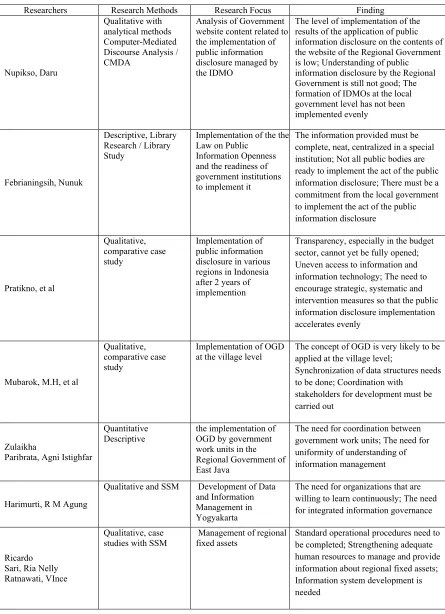
Public information disclosure in Indonesia has only been implemented in 2010, even though the regulation has been in place since 2008. In fact, there has been little research in the field of public information disclosure managed by the IDMO. As presented in table 2.1, there are some Indonesian’s researchers [6]–[10] who focus on the theme of IDMO in Indonesia. The researchers generally provide an explanation that the application of the public information disclosure in Indonesia is not yet in line with what is expected and provides recommendations that research in the public information disclosure field needs to be explored in greater depth from various perspectives. From these researchers the advice given to improve the implementation of public information disclosure in Indonesia is still general in nature and has not considered the sustainability aspects of public information disclosure implementation in detail. Even so, Pratikno et al [8] has provided an overview of the aspects of achievement, constraints and opportunities in the application of public information disclosure in Indonesia, but this description is a general description at the level of management of the Main IDMO and has not touched on each level of management.
In terms of information technology, only Nupikso and Mubarok et al discussed more about the role of information technology compared to three other researchers [6], [9]. Nupikso focuses on web content that is used as a transparency tool in the management of public information disclosure by the Regional Government [6]. While Mubarok et al [9] explained about the importance of synchronizing data structures in public information disclosure management and coordination among stakeholders. Even so, the researchers did not clarify the relevance of the use of information technology to maintain the sustainability of the application of public information disclosure.
Based on methodology, research in the field of public information disclosure implementation by IDMOs in Indonesia uses a qualitative approach, but not many researchers use SSM as an approach to problem solving. Harimurti [11] and Ricardo et al [12] are using SSM in the context of qualitative research that provides recommendations so that the management of organizations related to systems and information is carried out in an integrated manner. This study also provides recommendations that are still very general and normative.
3229 and the importance of deepening the management of data and information in the context of public information disclosure, the researcher sees that there is a need to deepen the issue more deeply towards the managers (employees) at the IDMO. This is very important because the actors which are the employees at the IDMO are one of the keys to the sustainability of the application of public information disclosure in Indonesia, in addition to other factors.
To support this research, there will be needed some literatures related to efforts in order to maintain the application of public information disclosure by IDMO employees, as will be described in point 2.2.
2.2 Supporting Literature
One of the obstacles that may occur in the implementation of OGD is a conflict of interest between the right to obtain information from the community side and an effort to close the obligation to share data from the government side [13]–[15]. This issue is also confirmed by several researchers about the potential problems for deciding which is a private data protection , state secret or business secret. [16], [17]. Stakeholders generally have a fear
of the consequences of the open data, where there can be a possibility of privacy violations if the document is shared and known by the public. It would be also possibility to misuse of documents, misinterpretation of data which are uploaded through website. [18]–[20]. Thus the local government through the IDMO must provide information and documents. Transparency is a necessity [17]. In fact
that in Indonesia, information disclosure is not free without rules. This means that identification of information must be categorized by taking into four types of information and documents, namely (1) periodic information, (2) immediate information, (3) anytime information and (4) excluded information[5], [21], [22].
was also added that one aspect that could cause obstacles to the implementation of OGD was the problem of managing data through the phase of identifying data, release decisions, publishing data and using data [23]. Thus the management of OGD by institutions, especially local governments, can still be explored [24]–[27].
An important note that also needs to be given primary attention is the situation and condition of its employees, namely employees as providers of information and documents. This is reinforced by research that states that employee resistance to the application of OGD can be a serious internal obstacle [28]. Management of information and documents must be prepared as well as possible and employees
must serve professionally, so that the objectives of OGD can be achieved and challenges and obstacles can be minimized [17], [29], [30].
To provide good service for the community, service orientation must support user satisfaction. In the introduction section, it was explained that the management of OGD is closely related to human factors as the manager. A supporting reference is needed that can be used to understand human factors when interacting with new systems in the work environment. In this study, the human factor analysis model to be used is the Shell Model while the service model to be used is the RATER model.
3230
Tabel 2.1 Summaries of some previous research
Researchers Research Methods Research Focus Finding
Nupikso, Daru
Qualitative with analytical methods Computer-Mediated Discourse Analysis / CMDA
Analysis of Government website content related to the implementation of public information disclosure managed by the IDMO
The level of implementation of the results of the application of public information disclosure on the contents of the website of the Regional Government is low; Understanding of public information disclosure by the Regional Government is still not good; The formation of IDMOs at the local government level has not been implemented evenly
Febrianingsih, Nunuk
Descriptive, Library Research / Library Study
Implementation of the the Law on Public
Information Openness and the readiness of government institutions to implement it
The information provided must be complete, neat, centralized in a special institution; Not all public bodies are ready to implement the act of the public information disclosure; There must be a commitment from the local government to implement the act of the public information disclosure
Pratikno, et al
Qualitative, comparative case study
Implementation of public information disclosure in various regions in Indonesia after 2 years of implemention
Transparency, especially in the budget sector, cannot yet be fully opened; Uneven access to information and information technology; The need to encourage strategic, systematic and intervention measures so that the public information disclosure implementation accelerates evenly
Mubarok, M.H, et al
Qualitative, comparative case study
Implementation of OGD
at the village level The concept of OGD is very likely to be applied at the village level; Synchronization of data structures needs to be done; Coordination with
stakeholders for development must be carried out
Zulaikha
Paribrata, Agni Istighfar
Quantitative Descriptive
the implementation of OGD by government work units in the Regional Government of East Java
The need for coordination between government work units; The need for uniformity of understanding of information management
Harimurti, R M Agung
Qualitative and SSM Development of Data and Information Management in Yogyakarta
The need for organizations that are willing to learn continuously; The need for integrated information governance
Ricardo Sari, Ria Nelly Ratnawati, VInce
Qualitative, case
3231 The basic principles of SHEEL are models that show the linkages between Software, Hardware, Environment, individual Life ware and team Life ware [31]–[33]. That's why SHELL is stated as an abbreviation of these five components. S means how individuals interact and understand the scope of the software they're manage. H is related to the understanding and interaction of individuals on the hardware used in the scope of their work. E means individual interactions with the working environment. L as an individual life ware is how each individual has an effort to increase his capacity to face the duties and responsibilities of managing S, H and E in his work. And the last is L as a team life ware used to represent the attitude of the team to increase the capacity of the team to face the task of managing S, H, E in the scope of their work. In the study of e-Gov, Liu only used one L, which meant individual and team life ware was considered as a single unit[35]. The image of the SHEEL model can be seen in Figure 2.1
Figure 2.1 SHELL Model (adopted by Federal Aviation Administration [36])
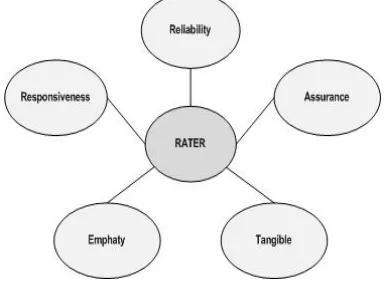
The RATER model is a model that looks at the human perspective where the main purpose of this model is to show the important components that must be considered by managers of each system or service, for customer satisfaction. In the RATER model there are five components, namely Responsibility, Assurance, Tangible, Empathy and Responsiveness [37]–[39]. RATER is a model that has been refined and proposed by Parasuraman et al [40], where the solution is then referred to as the SERVQUAL model [41], [42]. Reliability is the first component of RATER which requires that each service be measured correctly, both in terms of time and predetermined service appointments. Reliability is a service focusing on the service principles that have been used as service guidelines. Assurance is the second component of RATER which focuses on all services should be trustable so that there would give good feeling to all customers. Customers will belief that the services provided are good,
professional services for all consumers. Tangible is the third component which means that the facilities available in the service are truly available and provide support for the service process to consumers. Letter E which means Empathy is the fourth component, which focuses on the essence of understanding the principle of service to consumers, with full and sincere attention to them. While the final component, i.e. Responsiveness, is another part of the services provided through the willingness to help all consumers when they face difficulties. Services provided should be able to give a very good attention and problem solving clearly with predetermined service standards. The responsiveness in giving services will provide a good image of the services.
This Rater model is also appropriate to be used in the context of OGD management, because the people served to obtain information must be satisfied with the services of the managers in IDMO. The rater model image can be seen in Figure 2.2.
Figure 2.2 RATER Model (adopted by Parasuraman, et al in Mulder [37])
Literacy is a method used by someone to improve the ability to find, analyze and evaluate something new knowledge, new activities and then use information correctly. Based on the understanding of literacy, then if literacy is associated with information, it implies a series of activities that must be carried out by someone before an information is used. The stages of efforts to digest information begin from the stage of finding the source of information (searching), identifying, selecting, classifying, and evaluating information that has been obtained (evaluating) and the last is the stage of using information correctly in accordance with procedures (usage)[43]–[45]. Figure 2.3 describes the relevance of activities in information literacy.
[image:5.612.326.520.366.508.2]3232 evaluate and use, not only used limitedly in certain scientific fields. Information literacy was also agreed on in the fields of literature, the world of education [46] and other research and knowledge sectors [44]. In the context of OGD, staff and leaders who manage OGD must be careful in classifying information, so that an understanding of information literacy becomes a competency that must be possessed by them.
Figure 2.3 Information Literacy (adapted from : ALA[43])
Not only literacy in the field of information, staffs and managers who work and have responsibility to provide information, need to have a good capacity of of Literacy of Technology. Understanding technology literacy, not only includes understanding the hardware but also the network that connects hardware and information. This is supported by several organizations in the world that define standards of technological literacy such as [46]–[49].
3 RESEARCH METHODS
In the field of Information Systems research, experts classify the Information System research paradigm into three classifications, namely positivist, interpretive and critical [50]. In this study, the interpretative paradigm is used as a form of an ontological approach. In this study, the interpretative paradigm is used as a form of an ontological approach. The interpretive paradigm aims to produce an understanding of the context of information systems and processes that influence each other [51] In addition, in general, the purpose of all interpretive research is to understand how members of social groups, through their participation in social processes, impose the reality they do, interpret and believe everything that each member does to build their own social world [52]. Thus it can be understood that the interpretive approach emphasizes the understanding of human behavior and actions.
This study focused on the activities of a group of people, namely employees who were at the Communication and Information Office (Diskominfo) of the Pekalongan City, who received an appointment letter as part of the Information and Documentation Management Officer (IDMO). Every employee who manages data, information and documents in the implementation of OGD that must be provided for the benefit of the right to information of the community, certainly has a number of activities that are worth observing as an important
part of this research. Every action taken in the management of OGD is certainly based on certain reasons. The implementation of OGD that is still running well to date has also become one of the observations, why this has happened, even though there have been several changes to the leadership. Thus this process can also be described as an effort to understand the phenomenon of the reasons behind an action taken by individuals, who are employees, actively creating their own world through their own consciousness. Thus, this research is interpretive qualitative research with a phenomenological approach, as revealed by [53] which places the researched subject as a critical and problematic subject, where the knowledge possessed by the researched subjects is included in this study.
By paying attention to the main objectives of this study, the research method on the application of OGD is a case study research, which is to understand in full and in depth about how OGD is managed and efforts to maintain its application to the IDMO of Pekalongan City. This is based on the understanding that choosing a research method requires a strategy through consideration of three things, namely the research question that is submitted, control or control possessed by the researcher on the observed events and the focus on events that occur in the present [54]. Yin explained [54] that (1) the research question in the case study is how and why, and corresponds to this research question, namely how to manage OGD and maintain it, (2) researchers have no control or control over events in case or research subject, and in this research on OGD management researchers are not involved as actors in the management process, (3) case studies focus on actual events of the present, while OGD is one of the international issues that has been pursued to date throughout the world for the balance between the rights and obligations of the community, so that it is expected to be able to encourage an increase in human development in its entirety.
3233 characters, models, signs or images of certain conditions, situations or phenomena [56].
SSM is a methodology that tries to analyze, with a systematic focus, real organizational problems, and is an analytical action for real world improvement [57]. There are several other reasons why to use SSM in building information systems. SSM is a methodology that tries to analyze, with a systematic focus, real organizational problems, and is an analytical action for real world improvement [57]. SSM is a methodology that is not only used in the social field, but can also be used to analyze the implementation of a system that has an impact on society such as analyzing fraud problems by students [58], analyzing e-government [59], risk governance in hyper-connected society[60]. There are several other reasons why to use SSM in building information systems. These reasons can be stated as follows [56]: 1) systemic thinking, supported by the introduction of characteristics that emerge in the system and activities carried out together in monitoring and controlling, (2) in the social aspects and information system development organizations, recognized in the form of analytical currents, which are constantly examined and updated. (3) the technical process needed to develop the system can be represented by Logic Streaming Analysis, although not with the original process, (4) offering an inbuilt learning process, (5) assuming the participation of all stakeholders, (6) expected historical information (7 ) do not assume that all answers can be identified, but act as a means of structuring discussion to identify appropriate and appropriate solutions in a particular organization at a certain time, (8) the context of information system development is determined by stakeholders.
The characteristics of SSM are useful ways to capture user needs. SSM concentrates on the stakeholder perspective and thus can facilitate user involvement. In addition, the tools used namely CATWOE and Rich Picture are quite easy to use and understand. This allows continued participation of user groups. Thus the main benefit of SSM is to change unstructured problems to be structured according to the desired changes. CATWOE can also help to reduce complex situations into relevant keys.
SSM with CATWOE and Rich Picture tools can also handle human behavior problems. In this case study, the SSM methodology is systemically used as a guideline for discussions about IDMO situations as managers of information and documentation to serve the community's information needs. According to Checkland [55], SSM contains logical explanations for scientific applications which are divided into 7
stages as follows [57]: Stage 1: Situation Considered Problematic. The problem that is intended to be more appropriate is called the problem situation. Generally, there are more than one problems that need to be solved therefore there need efforts to identify those problems one by one; Stage 2: Problem Situation Expressed. Collecting data & information by conducting observations, interviews, workshops & discussions followed by the formulation & presentation of these problems. Those acitivites will be described in form of a rich pictures; Stage 3: root definition of relevant purposeful activity systems, is the stage to build the root of the problem which includes a particular view of the problem situation in accordance with the relevant perspective. In this stage relevant systems are controlled in the CATWOE concept. C is Customers, is beneficiaries of the transformation process. A is an Actors, which is the actor who transforms. P is Process is conversion from input to output. W Weltanschauung is a Worldview that makes meaningful transformation in context. O is the Owner who can stop the transformation. E is an environment that is an element outside the system that affects the transformation process. Stage 4: is a conceptual system model (holons). It called in the root definition, where at this stage a conceptual model will be produced that contains the system workflow in accordance with the problem under study. The system at this stage describes the input and output in transformation which is the goal. Stage 5: is the stage where a comparison of models and the real world will be carried out, where the conceptual model that has been built in stage 4 must be compared with real-world expressions based on existing basic theories. At this stage new ideas are possible. Stage 6: is the stage for thinking about change, which is desired systematically, culturally feasible, which is the stage where the researcher will discuss the desired changes with the parties concerned. These changes can include (a) changes in procedures, (b) structural changes, (c) changes in attitude and culture. Stage 7: is the stage to see and make decisions to improve the problem situation, where the decision should be an agreement between the researcher and the resource person, with the aim of making improvements to the problem situation.
3234 information complaints section, (3) the public information service operator, (4) information and coding management staff.
figure 3.2 SSM Model (source Checkland [55])
4. RESULT AND DISCUSSION
4.1 STUDY OF UNSTRUCTURED PROBLEMS
Information and Documentation Management Officer (IDMO) is an official who is responsible for managing and providing public information services, including the process of collecting, providing, classifying, storing, documenting and providing information services. Data, information and documents can be obtained from the Assistant IDMO.
The important task of each Assistant IDMO or IDMO is to classify information into four important groups, namely immediately, at any time, periodically and excluded. This classification has been protected by law. The first problem arises when the Assistant of IDMO is not 100% able to provide timely information support. Of the 35 Assistant IDMOs, there are still around 23% who have not been able to provide these needs on time. The second problem is the difficulty of some Assistant IDMOs for classifying information, especially information that is included in excluded information. The Assistant IDMO has the right to submit a list of excluded information, namely information that must be protected because it has confidentiality values: state, business and personal. This often creates a potential conflict or dispute between the applicant and the manager. Even so, efforts to anticipate the
two problems mentioned above have been carried out, among others by preparing the SOP for the Consequences of Information and also the SOP for Disputing Facilitation. The third problem that can arise is when the Assistant of IDMO submits a list of excluded information, the mechanism taken is through consequential testing, carried out in a meeting mechanism that has the potential to subjectively pass the wishes of the Assistant of IDMO, and ignore the needs and rights of the applicant to obtain information.
The fourth problem that also arises in the field is the fact that IDMO staff competencies are not uniform. This means that not all IDMO Assistant employees have sufficient competency in information literacy and technology, so they have the potential to stutter to serve applicants and provide documents and liability information for Main IDMO to upload, related to periodic information, all the time and immediately. Even so The main IDMO and the Regional Government have imposed rewards and punishments on the indiscipline of employees, especially IDMO Assistant. Once a year, the City Government shows IDMO which simultaneously announces the 5 best IDMO Assistants and 5 worst IDMO Assistants. Some of the efforts that have been made should be done consistently.
The fifth and quite important problem is the fact that each employee can experience the rotation of tasks to other units within a certain period. The risk that can occur is that when the phase of knowledge sharing between employees is not properly implemented, the application of OGD can be threatened, because its sustainability is limited by the willingness of employees to learn quickly and independently.
The sixth problem is the potential for information disputes due to the rejection of requests for information, which could be caused by differences in perceptions between the applicant, namely the community and the respondent, namely IDMO towards the categorization of information mandated by law.
3235
4.2 EXPRESS THE PROBLEMS
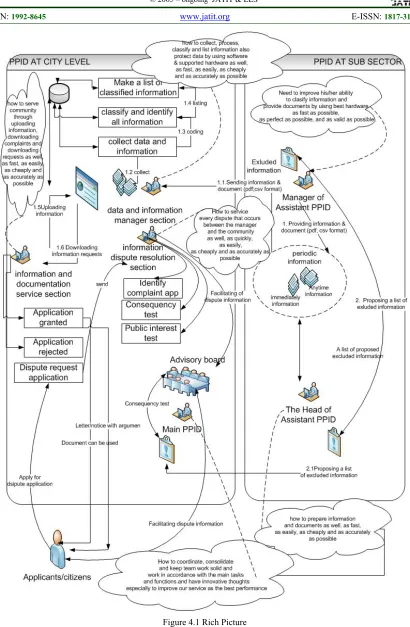
To show the situation of managing information and documentation in IDMO, rich imaged are displayed with various perspectives that emphazes structures, processes, relationships, conflicts and values that are believed by stakeholders.
From the rich picture (figure 4.1), it can be seen that the obstacles to the management of OGD must be addressed because the potential for conflict, the potential ability and capacity of employees in information and technology literacy and efforts to maintain conducive work environment and
commitment are part of the problem that must be observed. Each stakeholder has the intention and earnest effort to provide the best service to the community.
4.3 ROOT DEFINITION
3236
3237
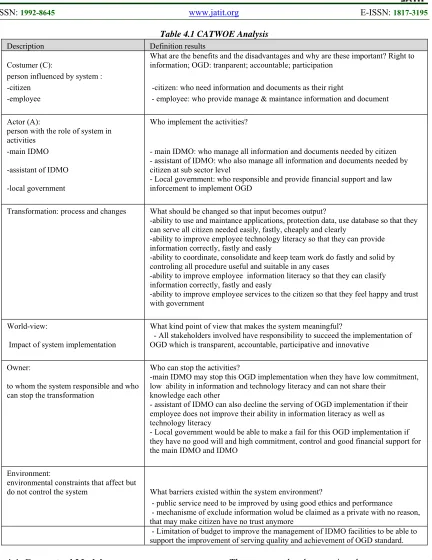
Table 4.1 CATWOE Analysis Description Definition results
Costumer (C):
What are the benefits and the disadvantages and why are these important? Right to information; OGD: tranparent; accountable; participation
person influenced by system :
-citizen ‐citizen: who need information and documents as their right
-employee ‐ employee: who provide manage & maintance information and document
Actor (A): Who implement the activities? person with the role of system in
activities
-main IDMO ‐ main IDMO: who manage all information and documents needed by citizen
-assistant of IDMO
‐ assistant of IDMO: who also manage all information and documents needed by citizen at sub sector level
-local government ‐ Local government: who responsible and provide financial support and law inforcement to implement OGD
Transformation: process and changes What should be changed so that input becomes output?
-ability to use and maintance applications, protection data, use database so that they can serve all citizen needed easily, fastly, cheaply and clearly
-ability to improve employee technology literacy so that they can provide information correctly, fastly and easly
-ability to coordinate, consolidate and keep team work do fastly and solid by controling all procedure useful and suitable in any cases
-ability to improve employee information literacy so that they can clasify information correctly, fastly and easly
-ability to improve employee services to the citizen so that they feel happy and trust with government
World-view: What kind point of view that makes the system meaningful?
Impact of system implementation
‐ All stakeholders involved have responsibility to succeed the implementation of OGD which is transparent, accountable, participative and innovative
Owner: Who can stop the activities?
to whom the system responsible and who can stop the transformation
-main IDMO may stop this OGD implementation when they have low commitment, low ability in information and technology literacy and can not share their knowledge each other
- assistant of IDMO can also decline the serving of OGD implementation if their employee does not improve their ability in information literacy as well as technology literacy
- Local government would be able to make a fail for this OGD implementation if they have no good will and high commitment, control and good financial support for the main IDMO and IDMO
Environment:
environmental constraints that affect but
do not control the system What barriers existed within the system environment?
‐ public service need to be improved by using good ethics and performance
‐ mechanisme of exclude information wolud be claimed as a private with no reason, that may make citizen have no trust anymore
‐ Limitation of budget to improve the management of IDMO facilities to be able to support the improvement of serving quality and achievement of OGD standard.
4.4. Conceptual Model
By referring to the root definition, the conceptual model is compiled to identify activities needed in developing a system that can improve OGD management. Figure 4.3 represents the Conceptual Model, where there is a relation between the activities of the actors and processes in the system.
3238 stakeholders, then based on the root problem analysis we propose our conceptual model by focusing on the SHELL model.
The explanation of this conceptual model can be explained as follows:
1. The use of software in IDMO is good enough considering minimum requirements, such as having web application, database application. But from software component point of view it need to be improved by (1) an ability and understandibility of OGD data lifecycle for each employees. This OGD lifecycle would be: pre processing -exploitation –maintenance. (2) implement some kinds of sistem temu kembali in order to accelerate data and information retreaval. Now, they do to find and retreave data by identify documents and then they query data by using its code of the documents. It needs a time. Therefore, Retreiving System Applicaton will help them to find out information and document faster. (3) in order to solve a conflict between people and IDMO, it is better to implement a decision support systems application. (4) It needs to improve and add any securities appliaction so that data and information can be protected from any viruses or hackers. Those 1-4 advisory should be implemented in all IDMO which is main IDMO as well as assistants of IDMO 2. From hardware point of view, now, the main
IDMO has quite good infrastructures such as Fiber Optic cabling, network, server, PCs, printers, scanners, etc. However some of the assistant of IDMO may not have all of those tools completely. Therefore, it need to empower them by providing good enough hardwares and technologies so that they would be able to improve their service to the society. Some of proposes hardware would be (1) empowering IT equipment with good performance and specifications, (2) providing adequite server (3) empowering and maintaining network technology
3. From environment point of view, the local government should be able to (1) do controlling and supervision, (2) make a very good and strenghthen of communication among them, (3) implement reward and punishment concistently (4) provide and strenghthen of the budget
4. From the perspective of the lifeware, all employees must be able to improve and enhance their abilities in competencies, such as (1) strengthen service ethics by applying the RATER principle, (2) strengthen information literacy with the principle of loc-evalu-use (3) strengthen
technology literacy, especially understanding hardware and network architecture.
By using the intervention stage, an overview of complicated situations is obtained which involves various factors that must be realized. All of these factors have a purpose to strengthen the sustainability of OGD implementation. The important thing to be noted is the consideration of stakeholders. Their subjective perspective is intended to ensure that the model design that is built is truly in accordance with the business process and work culture in the IDMO of Pekalongan city.
In the last stage of SSM, a knowledge-based documentation and information management model proposal was developed from the results of in-depth interviews, confirmation and literature review. This model was created to support the knowledge sharing process and strengthen the sustainability of OGD implementation for staff and managers of public information disclosure at IDMO at the local government level.
Based on figure 4.2, the proposed model is an effort to manage and maintain the sustainability of the application of information and documentation for the community, it can be seen that there are four main interrelated components, namely competence and capability in the software, hardware, life ware and environment fields, such as obtained read back from the reference SHELL model.
In terms of software, managers must understand at least four important things, first, applying the OGD Lifecycle principle: pre-exploitation-maintenance, implementing a retrieval system to facilitate document searches, implementing decision support systems to facilitate information dispute resolution and strengthening data protection and information through a powerful software tool.
3239
Figure 4.2. The information management model and knowledge-based document adoption of the SHEL Model[36]
If it viewed from an environmental perspective, all IDMO staff and OGD managers must be able to strengthen the implementation of OGD management at IDMO, through a kind of control and supervision that is constantly inherent, in accordance with existing SOPs, strengthen communication between all IDMO units, implement awards and consistent punishment and strengthening the budget for the smooth operation of OGD management activities at IDMO.
The last perspective is life ware, where OGD managers, both individually and in teams, must strengthen service competencies to the community by referring to the RATER principle, having adequate competence regarding information literacy and technology literacy. Good service must be able to show that they are serving with the assurance that
what is given is timely, fast and easy, so that the community has a good sense of trust in the mechanism of service provided by IDMO's employees. In addition, facilities provided physically and in reality must be appropriate and adequate.
3240 4.5. Comparison of Models and The Real World
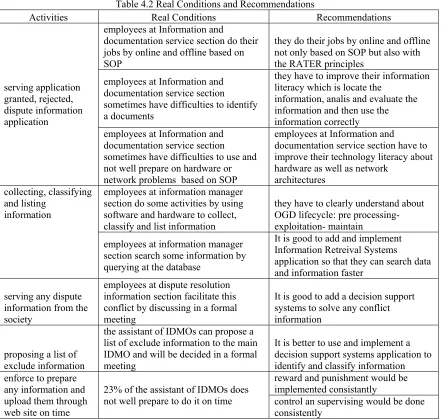
[image:14.612.91.533.199.619.2]Once the conceptual model is obtained, the next step is to compare conceptual model (human activity system) with real world which resulted in recommendation of what to maintain, to improve or to create a new one. Recommendation delivered in the process covers six points that shown in details on the Table 4.2:
Table 4.2 Real Conditions and Recommendations
Activities Real Conditions Recommendations
serving application granted, rejected, dispute information application
employees at Information and
documentation service section do their jobs by online and offline based on SOP
they do their jobs by online and offline not only based on SOP but also with the RATER principles
employees at Information and documentation service section sometimes have difficulties to identify a documents
they have to improve their information literacy which is locate the
information, analis and evaluate the information and then use the information correctly employees at Information and
documentation service section sometimes have difficulties to use and not well prepare on hardware or network problems based on SOP
employees at Information and documentation service section have to improve their technology literacy about hardware as well as network
architectures collecting, classifying
and listing information
employees at information manager section do some activities by using software and hardware to collect, classify and list information
they have to clearly understand about OGD lifecycle: pre processing-exploitation- maintain
employees at information manager section search some information by querying at the database
It is good to add and implement Information Retreival Systems
application so that they can search data and information faster
serving any dispute information from the society
employees at dispute resolution information section facilitate this conflict by discussing in a formal meeting
It is good to add a decision support systems to solve any conflict information
proposing a list of exclude information
the assistant of IDMOs can propose a list of exclude information to the main IDMO and will be decided in a formal meeting
It is better to use and implement a decision support systems application to identify and classify information enforce to prepare
any information and upload them through web site on time
23% of the assistant of IDMOs does not well prepare to do it on time
reward and punishment would be implemented consistantly
control an supervising would be done consistently
4.6. Planning of Change
The main purpose of the IDMO management is to provide an excelent services to the society in order to have their information and document’s right. The government wishes that the quality of services have the same standards throughout main IDMO as well as the assistant of IDMO. But this cannot be achieved as the very diverse condition of assistant of IDMOs and employees competency. This diversity
3241
4.7. Discussion About the research Finding
Versus Prior Research
In the previous studies, the focus of the research was mostly carried out at the level of initiation, such as knowing the level of readiness, the level of success, the weakness of the application of OGD management which was very general and normative. Whereas in this research conducted by researcher at this time, the focus of the research was expanded and deepened, not only from the side of initiation but found the OGD management model. The OGD model is constructed based on four main aspects that are interrelated with each other, by adopting the SHEL (Software, Hardware, Environment and Life-ware) model.
From the Previous researches, they focused more on the management aspects of the organization, while the results of the current research would be able to capture the understanding of each individual information manager to be able to recognize, discover, evaluate, store and disseminate the information correctly and with quality.
In the previous researches, the focus of the research conducted was not extended to aspects of the importance of services as an impact of good OGD management to the user community. In this study, if an understanding of information management based on a strong SHEL model can be carried out, then service improvements will be realized with the best service orientation to the community with the RATER principles as adopted form Parasuraman et al [40]
In this study, even though it has produced an OGD management model that combines SHEL and RATER, it still needs to be deepened from a data security perspective as well as strengthening software that supports standard decisions on information presented to the public. In addition, this research focuses on institutional perspectives. In future research, observations are needed from a community perspective.
5. CONCLUSION
OGD management cannot stop at the level of initiation but must also be maintained and endeavored so that services for information and documents needed by the community can run better. By using the SSM method from the case study on the IDMO of Pekalongan city, a knowledge-based OGD management model can be built by taking into account the four main aspects that are interrelated with each other. The four elements are strengthening
in terms of software, hardware, environment and life ware.
From these four perspectives, it provides an understanding that, every individual who manages information must be able to recognize, find, evaluate and store information and then disseminate information accurately and with quality. All understanding of those processes must be manifested in good performance, vertically and horizontally, verbally and non-verbally, online and offline. In addition, each individual can also adjust public information services according to their development, with a service mindset that is based on an orientation to the needs of the community (users of information) so that services are truly carried out sincerely. Good service must be based on RATER.
Therefore, quality and sustainable OGD management will create good trust and cooperation between all parts and units involved in public bodies and communities.
REFRENCES:
[1] B. Obama, “About Open Governmenth,”
The White House, 2011. [Online].
Available:
https://obamawhitehouse.archives.gov/open /about. [Accessed: 07-Dec-2015].
[2] Open Government Working Group, “8 Principles of Open Government Data,” The
United Nation, 2007. [Online]. Available:
http://workspace.unpan.org/sites/internet/D ocuments/UNPAN042947.pdf.
[3] UNDESA United Nation, “Guide on Lessons for Open Government Data Action Planning for Sustainable Development,” New York, 2017.
[4] Open Data Barometer, “Key Findings OGD by Open Data Barometer 2nd edition,”
World Wide Web Foundation, 2015.
[Online]. Available: https://opendatabarometer.org/2ndEdition/s ummary/. [Accessed: 10-Oct-2016]. [5] Tim Open Government Indonesia,
“Laporan Pelaksanaan Open Government Indonesia Tahun 2012 Open Government Indonesia: Era Baru Keterbukaan Pemerintah,” Jakarta, 2012.
[6] D. Nupikso, “Implementasi Keterbukaan Informasi Publik Dalam Website Pemerintah Daerah Implementing Public Information Disclosure in Local Government Websites,” IPTEK-KOM, vol.
17, no. 2, pp. 113–128, 2015.
3242 Informasi Publik Dalam Pemerintahan Terbuka Menuju Tata Pemerintahan Yang Baik,” J. Rechts Vinding, vol. 1, no. 1, pp.
135–156, 2012.
[8] Pratikno et al., Kajian Implementasi Keterbukaan Informasi dalam Pemerintahan Lokal Pasca
Undang-Undang Nomor 14 Tahun 2008, 1st ed.
Yogyakarta: Fisipol UGM Yogyakarta dan Yayasan TIFA, 2012.
[9] M. H. Mubarok, H. Adi Nugroho, and E. Nugroho, “Landasan Hukum dan Kesesuaian Keterbukaan Desa Berbasis Open Government Data,” in Semnaskit,
2015.
[10] Zulaikha and A. I. Paribrata, “Implementasi Kebijakan Keterbukaan Informasi Publik di Jawa Timur Tahun 2016,” J. Stud. Komun.,
vol. 1, no. 2, pp. 131–162, 2017.
[11] R. M. A. Harimurti, “Pengembangan Manajemen Data dan Informasi Menggunakan Analisis Soft Systems Methodology Pada Pemerintah Daerah DIY,” J. Penelit. Pos dan Inform., vol. 6,
no. 1, pp. 37–58, 2016.
[12] Ricardo, R. N. Sari, and Vi. Ratnawati, “Optimalisasi Pengelolaan Aset Tetap Dengan Pendekatan Soft System Methodology (Studi Kasus Pada Badan Pengelolaan Keuangan dan Aset Daerah Kota Pekanbaru),” J. Ekon., vol. 25, no.
September, pp. 15–34, 2017.
[13] K. Janssen, “Open Government Data and the Right to Information: Opportunities and Obstacles,” J. Community Informatics, vol.
8, no. 2, 2012.
[14] V. Williamson and N. Eisen, “The impact of open government: Assessing the evidence,” Washington, DC, 2016.
[15] Open Knowledge Foundation, “Beyond Access : Open Government Data & the Right to ( Re ) use Public Information,” Madrid, Spain, 2011.
[16] S. Fumega, “Freedom of information and open government data communities could benefit from closer collaboration,” World
Wide Web Foundation, 2015. .
[17] T. Scassa, “Privacy and Open Government,” Future Internet. pp. 397–
413, 2014.
[18] A. Zuiderwijk and M. Janssen, “The negative effects of open government data - Investigating the dark side of open data,” in
Proceedings of the 15th Annual International Conference on Digital
Government Research, 2014, pp. 147–152.
[19] J. Kucera and D. Chlapek, “Benefits and Risks of Open Government Data,” J. Syst.
Integr., pp. 30–41, 2014.
[20] Ulf MELIN, “Challenges and Benefits in an Open Data Initiative – A Local Government Case Study of Myths and Realities,”
Electron. Gov. Electron. Particip. H.J., vol.
0, 2016.
[21] M. Abdullah, “Panduan Masyarakat Mendapatkan Informasi,” Jakarta, 2010. [22] Pemerintah Republik Indonesia, UU KIP
No. 14 Tahun 2008. Indonesia:
www.legalitas.org, 2008.
[23] J. Crusoe and U. Melin, “Investigating open government data barriers : A literature review and conceptualization,” Electron. Gov., pp. 169–183, 2018.
[24] I. Safarov, “Institutional Dimensions of Open Government Data Implementation : Evidence from the Netherlands, Sweden, and the UK,” Public Perform. Manag. Rev.,
vol. 0, no. 0, pp. 1–24, 2018.
[25] E. Styrin, L. F. Luna-reyes, and T. M. Harrison, “Open Data and Open Government : From Abstract Principles to Institutionalized Practices,” in Proceedings of the 17th International Digital Government Research Conference on
Digital Government Research, 2016, pp.
76–85.
[26] M. D. De Rosnay and K. Janssen, “Legal and Institutional Challenges for Opening Data across Public Sectors : Towards Common Policy Solutions,” J. Theor. Appl.
Electron. Commer. Res., vol. 9, no. 3, pp.
1–14, 2014.
[27] M. Janssen, Y. Charalabidis, and A. Zuiderwijk, “Benefits , Adoption Barriers and Myths of Open Data and Open Government,” Inf. Syst. Manag. ISSN, vol.
29, no. 4, pp. 258–268, 2012.
[28] B. W. Wirtz et al., “Resistance of Public
Personnel to Open Government : A cognitive theory view of implementation barriers towards open government data,”
Public Manag. Rev., vol. 9037, no.
February 2016, 2015.
3243 United Kingdom, 2015.
[30] Department of Internal Affairs, “Data and Information Governance: Methodology for Data and Information Governance.” New Zeiland, 2017.
[31] AviationKnowledge, “Human factors models (in aviation) - AviationKnowledge,” AviationKnowledge
Wiki & Forum, 2010. .
[32] M. Perry and J. Perezgonzalez, “The Educators shell model,” The Educators,
2015. .
[33] H. Itoh, N. Mitomo, and T. Matsuoka, “An Extension of m-SHEL Model for Analysis of Human Factors at Ship Operation An Extension of m-SHEL Model for Analysis of Human Factors at Ship Operation Hiroko Itoh Nobuo Mitomo Takeshi Matsuoka Youji Murohara,” no. July 2014, 2004. [34] N. Karanikas, “Defining the
Interrelationship between safety and Quality Management Systems,” Int. J.
Manag., no. September, 2014.
[35] L. Liu and L. Xiao-ming, “On SHEL Model Analysis and Constitution,” in Cross Strait Quad-Regional Radio Science and Wireless
Technology Conference On, 2011.
[36] F. A. Administration, “Chapter 3 : Principles of System Safety,” in FAA
System Safety Handbook, 2000, pp. 1–19.
[37] P. Mulder, “RATER Model, a model for measuring customer expectations,”
ToolsHero, 2018. [Online]. Available:
https://www.toolshero.com/marketing/rater-model/. [Accessed: 07-Feb-2019].
[38] S. Wawak, “RATER model,” CEOpedia _
Management online, 2018. .
[39] A. J. Czaplewski, E. M. Olson, and S. F. Slater, “Case in point: Applying the RATER Model for Service Success,”
Marketing Management, no. January 2002,
2002.
[40] A. Parasuraman, V. A. Zeithaml, and L. L. Berry, “Model Service Its Quality and Implications for Future,” J. Mark., vol. 49,
no. 4, pp. 41–50, 2009.
[41] L. L. Berry and V. A. Zeithaml, “Refinement and reassessment of the SERVQUAL scale,” J. Retail., no. January,
1991.
[42] J. Cronin, “SERVPERF Versus SERVQUAL : Reconciling Performance-Based and Measurement of Service
Quality,” J. Mark., no. January, 1994.
[43] ALA, “Information Literacy - Evaluating Information - LibGuides at American Library Association,” American Library
Association, 1989. .
[44] R. Catts and J. Lau, “Towards Information Literacy Indicators: Conceptual Framework Paper,” Paris, 2008.
[45] ACRL, “Information Literacy Competency Standards for Higher Education,” Chicago, 2000.
[46] ITEA, “Standards for Technological Literacy.” The International Technology Education Association (ITEA), 2000. [47] Maryland Technology Literacy
Consortium, “Working definition of technology literacy.” Maryland, 2009. [48] C. Hasse and J. Wallace, “Technological
Literacy,” Technucations, 2015. .
[49] EMCC, “Technological Literacy,” Estrella
Mountain Community College, 2018. .
[50] J. Mingers, “Combining IS Research Methods: Towards a Pluralist Methodology,” Inf. Syst. Res., vol. 12, no.
3, pp. 240–259, 2001.
[51] G. Walsham, Interpreting Information Systems in Organizations Interpreting
Information Systems in Organizations.
Zurich, Switzerland: the Jacobs Foundation, Zurich, Switzerland, 2009.
[52] M. D. Myers and D. Avison, Qualitative Research in Information Systems: A
Reader. UK: Sage Publications, Inc., 2002.
[53] A. Chariri, “Landasan Filsafat Dan Metode Penelitian Kualitatif,” 2016, no. August 2009.
[54] Robert K. Yin, Case Study Research:
Design and Methods, 3rd ed. California:
Sage Publications, Inc., 2003.
[55] P. Checkland, “Soft Systems Methodology : A Thirty Year Retrospective,” vol. 58, pp. 11–58, 2000.
[56] P. D. C. Bennetts, A. T. Wood-harper, and S. Mills, “An Holistic Approach to the Management of Information Systems Development — A View Using a Soft Systems Approach and Multiple Viewpoints,” Syst. Pract. Action Res., vol.
13, pp. 189–205, 2000.
3244
Information and Communication
Technology, 2009, no. January 2016.
[58] A. Iriani and D. Manongga, “Using Soft Systems Mehtodology As An Approach To Evaluate Cheating In The National Examination,” J. Theor. Appl. Inf. Technol.,
vol. 96, no. 11, 2018.
[59] D. I. Sensuse and A. Ramadhan, “Enriching Soft Systems Methodology ( SSM ) With Hermeneutic in e-Government Systems Development Process,” IJCSI Int. J.
Comput. Sci. Issues, vol. 9, no. 1, 2012.
[60] I. Taylor, “Using First Nations Systems Thinking to Operationalize Sustainable Development,” in Managing Complexity From Problem Framing to Problem
![Figure 4.2. The information management model and knowledge-based document adoption of the SHEL Model[36]](https://thumb-us.123doks.com/thumbv2/123dok_us/8899115.954199/13.612.95.519.58.496/figure-information-management-model-knowledge-document-adoption-model.webp)