ORIGINAL RESEARCH ARTICLE
FACTORS AFFECTING THE ACADEMIC PERFORMANCE OF THE SOFTWARE ENGINEERING
STUDENTS IN SALALAH COLLEGE OF TECHNOLOGY
*Bernard Ugalde
Salalah College of Technology Salalah, Dhofar, Sultanate of Oman
ARTICLE INFO ABSTRACT
This study sought to determine the factors affecting the academic performance of students in the software engineering course at Salalah College of Technology. In line with this, a qualitative-descriptive design was employed. Data gathering was conducted through a self-reporting questionnaire. The average weighted mean was used to determine the level of impact of the different factors affecting the respondents’ academic performance. Among the five domains, the teacher-related factors have the most impact on the respondent’s academic performance. The school-related factors rank second while home-related factors rank third. Conversely, study habits and personal conditions were the least deemed factor that affects student achievement and have no impact at all. This finding is significant as it can help the student understand better the factors that affect their academic performance. It can also be used by school administrators and teachers alike as a basis for designing and implementing an intervention program geared towards an improved academic performance among students in the college.
Copyright © 2019,Bernard Ugalde. This is an open access article distributed under the Creative Commons Attribution License, which permits unrestricted use,
distribution, and reproduction in any medium, provided the original work is properly cited.
INTRODUCTION
Student performance plays a very vital role in producing the best quality graduate in today’s increasingly globalized and competitive world. It has been observed that the measurement of students’ previous educational outcomes is the most important indicators of students’ future achievement (Faust, 2010). Such educational institutions have long been interested in exploring variables which significantly contribute to the performance of students. This basically because educational institutional performance depends upon the academic accomplishment of its students (S. Ali, 2013). The factors affecting a student’s academic performance arise from both internal and external reasons (Yahya Alfifi, 2017). Internal factors include personal conditions and study habits which are mostly student-related and may lead to good academic performance (Endalamaw Yigermal, 2017). External factors, on the other hand, include home-related, school-related and teacher-related factors and are contributed to the external environment of students that are beyond their control. External related factors such as family stress lead to poor academic performance (Erdem, 2013).
*Corresponding author: Bernard Ugalde,
Salalah College of Technology Salalah, Dhofar, Sultanate of Oman
Student-related factors identified in the given study include student’s efforts, age, and self-motivation, learning preference, entry qualification and previous school (Pushkarna, 2017). External factor includes educational background of parents,
socioeconomic status of parents (Atinaf et al., 2016 and
Hossain et al., 2017), parents engage in at home and school
(Badasyan et al., 2012; Uwaifo, 2008; and Cornelius-Ukpepi
et al., 2015), qualifications of teachers (Juan et al., 2016 and
Sapalo, 2015), and teacher’s methods of instruction (Sapalo, 2015). The number of failure of a student in Software Engineering (SE) in Salalah College of Technology (SCT) has recently been on the rise. Although, software engineering classes are designed to educate and train Information Technology (IT) students to become competent and qualified IT professionals that student who takes this course find it difficult to hone this technical knowledge and skills. SE is the discipline in Information Technology which is focused on the application of theory, knowledge, and practice build software systems that are reliable, effective and efficient (Sommerville, 2011).The course is offered usually the last course before taken by the students before completing their diploma. However, no formal studies have been conducted so far to determine what factors influence the academic performance of these students. This will be the first of its kind. Yet, it was always a concern for the college to devise plans and remedial
ISSN: 2230-9926
International Journal of Development Research
Vol. 09, Issue, 03, pp.26418-26424, March, 2019
Article History:
Received 14th December, 2018
Received in revised form 18th January, 2019
Accepted 16th February, 2019
Published online 31st March, 2019
Available online at http://www.journalijdr.com
Key Words:
Academic performance, Software engineering,
Factors on academic performance.
Citation: Bernard Ugalde. 2019. “Factors affecting the academic performance of the software engineering students in salalah college of technology”,
International Journal of Development Research, 09, (03), 26418-26424.
actions on how to help these students perform well in this course. This prompted the researcher of this study to investigate the factors affecting the academic performance of SE students at the SCT to institute change geared towards the improvement of the students’ academic performance. The value of this study lies in the passionate drive to make a difference by undertaking corrective measures that would help improve the academic performance of students. Findings that are established by this study can benefit students, teachers, and school administrators. A student will be able to understand better the factors that can affect their academic performance. Teachers will have the opportunity to recognize the problems encountered by the students that may pose an effect on their performance and alternatively find ways how to handle these students. The administrators will have the opportunity to promote thinking skills assessment, letting the teachers understand the influences of their student’s preferred learning styles that will promote adequate learning opportunities and effective instructions.
The study aimed to answer the following research questions: 1) What is the relationship between the factors and mean ratings? 2) What is the mean using one sample test of differences using a test value of 3.0? 3) What are the factors inacademic performanceby factor analysis?
This study is based on the teaching-learning process framework which aims to provide high-quality teaching and learning practices to ultimately improve the ability of the students to learn and understand the course that they are being taught. This research revolves around the paradigm where students who are enrolled in the Software Engineering class is considered as the independent variable. The dependent variables include the factors affecting the academic performance namely: a) personal, b) study habits, c) home-related, d) school-home-related, and e) teacher-related factors. The paper is organized to present the materials and methodology of the study in the succeeding section, followed by result and
findings, conclusion, acknowledgment and references
respectively.
MATERIALS AND METHODOLOGY
Quantitative type of research was used in this study utilizing a descriptive-survey method of research. The study was
conductedat Salalah College of Technology, Oman.
Respondents were 19 software engineering students consisting of 6 males and 13 females. Total enumeration sampling was used. Self-reporting questionnaire was employed to gather data on the factors affecting students’ academic performance along with personal conditions, study habits, home-related factors, school-related factors, and teacher-related factors. The instrument is already considered valid and reliable since it was
already used by Chadya et al. (2008), and Alos et al. (2011).
Each factor has subset indicators which were given the corresponding rating by the respondents using Likert Scale of 5 composed of 5 (always), 4 (often), 3 (sometimes), 2 (rarely) and 1 (never). The questionnaires were distributed to the respondents after thoroughly explaining the purpose of research to them. Tabulations were done from the answers to address the research questions. Mean analysis, Pearson correlation, Scatter plot diagram was used in the statistical computations and analysis in the research. Furthermore, request for cooperation and assurance that all information gathered were treated strictly with confidentiality.
RESULTS AND DISCUSSION
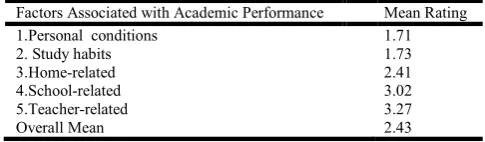
[image:2.595.311.554.355.426.2]The Relationshipbetween the Factors and Mean Ratings: Table 1.0 shows the summary of the set of factors affecting the academic performance of the student in software engineering classes. The result shows that teacher-related factor has the highest influence on the academic performance of the respondents. It is followed by school-related and home-related factors. Conversely, the least factors that affect the academic performance of students in SE are study habits and personal conditions. Determining the association between the factors and academic performance of students shown in Table 1.0 when statistically treated generated a statistic mean, 2.43 ± 0.718 (SD) with a calculated p-value (0.006) and r (+0.971) in Table 2.0. The result showed that the association was strong between the factors and performance. This means that as ratings on the X-Axis (horizontal) vs. Y-axis (vertical) increased, the association increased. As the rating on the X-Axis (Factors) slide towards 1 from right to left, the lesser was the association. School and teacher-related factors were strongly associated with the academic performance of the students, slightly related to home factors and less likely related to the other factors as position number moved towards 1.
Table 1. Five Factors on Academic Performance
Factors Associated with Academic Performance Mean Rating
1.Personal conditions 1.71
2. Study habits 1.73
3.Home-related 2.41
4.School-related 3.02
5.Teacher-related 3.27
Overall Mean 2.43
Table 2.Statistical Analysis of Table 1.0 Data Using
Pearson Correlation Descriptive Statistics
Mean Std. Deviation N Factors on Academicsa 3.0000 1.58114 5
Mean Ratingsb 2.4280 .71807 5
Correlations
Factors on Academics
Mean Ratings Factors on
Academicsa
Pearson Correlation 1 .971**
Sig. (2-tailed) .006
N 5 5
Mean Ratingsb Pearson Correlation .971** 1
Sig. (2-tailed) .006
N 5 5
**. Correlation is significant at the 0.01 level (2-tailed).
a- Five related factors studied in relation to academic performance b- Mean ratings given by respondents on each of the factors
Graphical analysis on the relationship between the factors and mean ratings: Scatter Plot Diagram is shown in Figure 1. Association between academic performance and related factors were strongly related (r=+0.971) at 0.01 level of significance.
One Sample Mean Test Of Differences Using a Test Value of 3.0: The test value of 3.0 was arbitrarily selected as the test value since it fell into the median of 1 to 5 scales used in the
rating system. Using Table 1.0 showed that when statistically
treated by using one sample mean test, the p-value (0.149)>0.05 at 95% confidence level with a mean difference of -0.572 and difference range from -1.46 and +0.3196. This signifies that the means in Table 1.0 differ significantly since the range is below and above zero.
Figure 1. Scatter Plot Diagram on Academic Performance and Associated Factors
Ratings (Table 1.0) below 3.0 were significantly different from ratings above zero. This result backed up the Scatter Plot analysis in Figure 1.0 and the statistic r-result (Pearson r) as the position number (from 1 to 5) increased,
also increased (which fell into the position number for “ (4) School-related” and “(5) Teacher related “ factors. signifies that school and teacher-related factors were positively related to academic performance while the rest have very less effect on the association.
Table 3. One Sample Mean Test
One-Sample Statistics
N Mean Std. Deviation Mean Ratings 5 2.4280 .71807
One-Sample Test Test Value = 3 t df Sig.
(2-tailed)
Mean Difference
95% Confidence Interval of the Difference
Lower Mean
Ratings -1.781
4 .149 -.57200 -1.4636
Factors on Academic Performance by Factor Analysis This section presents a detailed analysis of the five factors affecting the academic performance of students
Engineering. Each section presents the factor together with the ratings. Followed by the statistical analysis using correlation and its corresponding scatter plot diagram.
Personal Condition: Figure 2.0 shows that personal conditions
were negatively related to performance (r=
p>0.05 level. Thus this implies that personal condition impact on the academic performance of the students in Software Engineering.
Table 4. Personal Conditions and Ratings
SN Personal Conditions Ratings 1 Feeling sleepy in class 1.89 2 Feeling hungry in class 2.16 3 Difficulty in seeing 1.63 4 Difficulty in hearing 1.68 5 Difficulty in breathing 1.16
Overall Mean 1.71
26420 International Journal of Development Research,
Scatter Plot Diagram on Academic Performance and
Ratings (Table 1.0) below 3.0 were significantly different from ratings above zero. This result backed up the Scatter Plot result (Pearson r) that as the position number (from 1 to 5) increased, the association also increased (which fell into the position number for “ (4) ” and “(5) Teacher related “ factors. This factors were positively lated to academic performance while the rest have very less
One Sample Mean Test
Std. Error Mean .32113
95% Confidence Interval of the Difference
Lower Upper 1.4636 .3196
by Factor Analysis: This section presents a detailed analysis of the five factors affecting the academic performance of students in Software Engineering. Each section presents the factor together with the ratings. Followed by the statistical analysis using correlation
Figure 2.0 shows that personal conditions were negatively related to performance (r= -0.831) where p>0.05 level. Thus this implies that personal condition has no impact on the academic performance of the students in
Personal Conditions and Ratings
Ratings
Table 5. Statistical Analysis for Personal Condition
Correlations
Personal conditions Pearson Correlation Sig. (2-tailed) N
Factors on Academics
Pearson Correlation Sig. (2-tailed) N
Figure 2. Scatter Plot Diagram on Personal Conditions
Despite that personal condition was interpreted to have no impact on academic performance
extensive effect on the academic performance of the respondents. This result is consistent Kusurkar
which claims that good physical wellbeing of a student affects his performance in class. On the other hand,
student who is hungry or sleepy in class has poor academic performance.
Study Habit: Study habit has
performance (negative correlation), r =
statistic was greater than 0.05. Study habits and perfo were negatively correlated.
Table 5. Study Habits and Ratings
SN Study Habits
1 I study only when there is a quiz 2 I feel tired, bored and sleepy 3 I prefer listening to radio 4 I am lazy to study
5 I am disturbed when studying 6 I have no time to study at home 7 I study only when I like
8 I don’t have a comfortable place to study 9 I copy the assignments from friends
Mean
Table 6. Statistical Analysis for
Correlations
Factors on study habit
Pearson Correlation Sig. (2-tailed) N
Study Habits Pearson Correlation Sig. (2-tailed) N
ional Journal of Development Research, Vol. 09, Issue, 03, pp.26418-26424, March
Statistical Analysis for Personal Condition
Personal conditions
Factors on Academics Pearson Correlation 1 -.831
tailed) .081
5 5
Pearson Correlation -.831 1 tailed) .081
5 5
Scatter Plot Diagram on Personal Conditions
Despite that personal condition was interpreted to have no performance. Evidently, this still has an effect on the academic performance of the
respondents. This result is consistent Kusurkar et al.(2012)
which claims that good physical wellbeing of a student affects his performance in class. On the other hand, a fully capable hungry or sleepy in class has poor academic
Study habit has a negative correlation to performance (negative correlation), r =-0.449 where p-value statistic was greater than 0.05. Study habits and performance
Study Habits and Ratings
Ratings when there is a quiz 1.68 , bored and sleepy 2.00 radio, watching TV, etc 2.16 1.42 I am disturbed when studying 1.58 I have no time to study at home 2.11
when I like 1.68
I don’t have a comfortable place to study 1.68 I copy the assignments from friends 1.21 1.73
Table 6. Statistical Analysis for Study Habits
Factors on Study Habit
Study Habits Pearson Correlation 1 -.449
.225
9 9
Pearson Correlation -.449 1 .225
9 9
Figure 3. Scatter Plot Diagram on Study Habit
Again, despite that study habits were interpreted to have no impact. Evidently, it still hasan extensive
academic performance of the respondents. As per Kumar (2015), the student learns when they are willing to be taught, and intend to learn when they know the purpose of learning. It is when the student is willing and intending to learn that the student becomes more active and participative. Diaz
reveals that students need to develop a positive academic self concept through the internalization of their social image
fulfill their goals. Tom et al. (2014), further indicate that the
diversity in socio-cultural background and language
differences of both students and teachers might in academic performance students.
It is within that diversity of culture, background
that the teacher tries to facilitate learning for all the students. Moreover, students who lack self-discipline and self confidence are likely to acquire problem behavior from their peers such as absenteeism, substance abuse and paying less time on their school work which influences their academic performance (Thill, 2016). It may also result
teacher relationship, time wastage, ineffective learning, and
poor peer adjustment (Nyoroge et al., 2014
student's interest, motivation and attitude, teachers need to observe the students way and method in following learning process and participation in class activities
2016).
Home-Related Factor: Tables 6.0 and 7.0 were the data and
analysis of home-related factors on academic performance. Correlation value (r= 0.578, p>0.05) showed that home factors were associated with academic performance. The association is shown in Figure 4.0.Home-related
associated positively. As the position number increased, the association also increased. Checking Table 6.0,
contributed significantly to the association.
household chores and some siblings affected their performance (from often to always). Home-related factors have extensive evidently effect on the academic performance of the respondents. The word home is relatively an extensive term,but in this study, these factors include people and things found in the respondent’s house that influence their academic performance. These include the parents, siblings, and
capability of the respondents.
26421 Bernard Ugalde, Factors affecting the academic performance of the software engineering students in salalah college of technol
Scatter Plot Diagram on Study Habit
Again, despite that study habits were interpreted to have no extensive effect on the academic performance of the respondents. As per Kumar learns when they are willing to be taught, and intend to learn when they know the purpose of learning. It is when the student is willing and intending to learn that the student becomes more active and participative. Diaz (2003) to develop a positive academic
self-of their social image to further indicate that the cultural background and language might influence the
It is within that diversity of culture, background, and language that the teacher tries to facilitate learning for all the students. discipline and self-ly to acquire problem behavior from their peers such as absenteeism, substance abuse and paying less fluences their academic result in apoor student-ineffective learning, and
., 2014). To aid in the interest, motivation and attitude, teachers need to observe the students way and method in following learning process and participation in class activities (Shoebottom,
Tables 6.0 and 7.0 were the data and related factors on academic performance. 0.05) showed that home-related factors were associated with academic performance. The related factors were associated positively. As the position number increased, the association also increased. Checking Table 6.0, items 5 and 6 contributed significantly to the association. This means that siblings affected their performance related factors have extensive effect on the academic performance of the ondents. The word home is relatively an extensive in this study, these factors include people and things fluence their academic performance. These include the parents, siblings, and financial
Table 6. Home-Related Factors and Ratings
SN Home-related factors 1 I live far from school 2 I live near the school 3 I don’t live with my parents 4 Both my parents are working 5 I do too many households 6 I have many brothers and sisters
Overall mean
Table 7. Statistical Analysis for Home
Correlations
Home-related factors Pearson Correlation Sig. (2-tailed) N
Rating on home factors Pearson Correlation Sig. (2-tailed) N
Figure 4. Scatter Plot Diagram on Home
Bonci (2008) noted that home support plays an important role in the academic performance of students. Researches posit that lack of support from home leads to a decline in the academic student’s achievement (Evans
2014 and Lourenco et al., 2013
both parents are working and are too busy to care for their children’s schooling (Nnamani
these working parents are harming their children’s education since the students who get lack of
trapped in social media addiction or internet gaming. Furthermore, socio-economic status of the students affects the quality of their mental and physical well
influences their academic performance
The study by Farooq et al. (2011
financial problems have poor
they cannot afford to buy prescribed books and basic needs remain unfulfilled. Howard (2004
to invest more energy in getting to know their students and which group they belongto. Problems in the relationship such as lack of support and assistance from friends and family members can affect the academic performance of the student; this can cause emotional problems, lack of concentration in Bernard Ugalde, Factors affecting the academic performance of the software engineering students in salalah college of technol
Related Factors and Ratings
Ratings 2.58 1.89 I don’t live with my parents 1.26 Both my parents are working 2.00
households 3.32
I have many brothers and sisters 3.42 2.41
Statistical Analysis for Home-Related Factors
Home-Related Factors
Rating on Home-Factors Pearson Correlation 1 .578
tailed) .229
6 6
Pearson Correlation .578 1 tailed) .229
6 6
Scatter Plot Diagram on Home-RelatedFactors
noted that home support plays an important role in the academic performance of students. Researches posit that lack of support from home leads to a decline in the academic
et al., 2013; Wentworth et al.,
., 2013). This normally happens when both parents are working and are too busy to care for their
Nnamani et al., 2014). Unintentionally,
these working parents are harming their children’s education since the students who get lack of attention eventually are trapped in social media addiction or internet gaming. economic status of the students affects the quality of their mental and physical well-being which in turn
fluences their academic performance (Nnamani et al., 2014).
class and lack of confidence in everything that the student is doing (Endalamaw Yigermal, 2017).
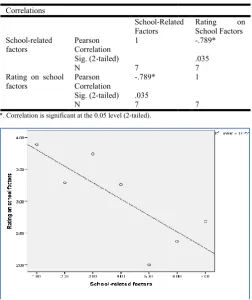
School-Related Factor: Tables 8.0 and 9.0 showed the means
and statistical correlations, respectively. The correlation showed that r= -0.789 and p<0.05. The scatter plot diagram was shown in Figure 5.0. This means that items 1
negatively the performance while items 5
[image:5.595.54.268.183.274.2]affected the performance based on the negative correlation.
Table 8. School –Related Factors and Ratings
SN School-Related Factors 1 The scheduleis followed 2 There are school programs
3 There are available library references 4 The classroom is comfortable enough 5 There is fast internet access in the library 6 There is enough space in the library 7 Location of classrooms
[image:5.595.36.289.294.595.2]Overall mean
Table 9. Statistical Analysis for School-Related Factors
Correlations
School-Related Factors School-related
factors
Pearson Correlation
1 Sig. (2-tailed)
N 7
Rating on school factors
Pearson Correlation
-.789* Sig. (2-tailed) .035
N 7
[image:5.595.314.556.331.444.2]*. Correlation is significant at the 0.05 level (2-tailed).
Figure 5. Scatter Plot Diagram for School-Related Factors
Poor academic performance in class is likewise in school-related factors. In this study, school
have been found to have a low impact on the academic performance of the respondents. These factors include the availability and perceived quality of learning facilities such as the library, classrooms, internet connection as well as schedule. It has been proven that schools without basic resource facilities like textbooks, periodicals, and reference materials often have low academic performance
2013) Owoeye and Yara (2011), stipulate that school libraries may not be effective if the books therein are not adequate and up to date. The library environment should have comfortable chairs and rich in literature with plenty of books, computers and other learning aids that help the student to perform well and that they may need sufficient space for their study so that they do not need to squeeze themselves
26422 International Journal of Development Research,
fidence in everything that the student is
Tables 8.0 and 9.0 showed the means and statistical correlations, respectively. The correlation 0.789 and p<0.05. The scatter plot diagram means that items 1 -4 affect while items 5- 7 less likely affected the performance based on the negative correlation.
Related Factors and Ratings
Ratings 3.89 3.29 3.74 3.26 2.00 2.37 2.68 3.02
Related Factors
Related Rating on School Factors -.789* .035 7 1
7
Related Factors
Poor academic performance in class is likewise influenced by related factors. In this study, school-related factors have been found to have a low impact on the academic performance of the respondents. These factors include the ved quality of learning facilities such as the library, classrooms, internet connection as well as time that schools without basic resource facilities like textbooks, periodicals, and reference
performance (S. Ali et al.,
stipulate that school libraries may not be effective if the books therein are not adequate and up to date. The library environment should have comfortable of books, computers and other learning aids that help the student to perform well ficient space for their study so that
(Badasyan et al.,
2012). Studies show that the students will not perfo
academically if the environment has an uncomfortable temperature because the students’ concentration deteriorates, feel either tired or drowsy and their cognition, intellectual productivity and creativeness will be affected
Inadequate heating and air conditioning
students’ learning and academic performance no matter how expert and good the teacher is
helpful physical learning environment facilitates learning Therefore teachers and administrators should provide students with such environment (Tanvi
supported by the study of Uline and Tschannen
noted that school facilities affect health, behavior, engagement and improvement in academic performance
Teacher-Related Factor:Calculated r (
and scatter plot diagram as shown in Figure 6.0 signified that items from left to right tends to have less to no association with performance. Mean data also showed that items 7, 8, and 9 have less to no association with performance. Moving from right to left items, showed that items 6 to 1 tend to have more association with performance.
Table 10. Teacher-Related Factors and Ratings
SN Teacher Related Factors
1 The teacher has mastery of the subject matter 2 Teacher discussesmanytopic
3 The teacher uses audio visual 4 Teacher gives too much memory work 5 Teacher provides varied activities 6 The teacher uses the lecture 7 The teacher always scolds students
8 The teacher is frequently out/absent from class 9 The teacher is always late
[image:5.595.305.566.463.784.2]Overall mean
Table 11. Statistical Analysis for Teacher
Correlations
Teacher-related factors
Pearson Correlation Sig. (2-tailed) N
Teacher-related rating Pearson Correlation Sig. (2-tailed) N
**. Correlation is significant at the 0.01 level (2
Figure 6. Scatter Plot Diagram for Teacher
International Journal of Development Research, Vol. 09, Issue, 03, pp.26418-26424, March
Studies show that the students will not perform well academically if the environment has an uncomfortable temperature because the students’ concentration deteriorates, feel either tired or drowsy and their cognition, intellectual productivity and creativeness will be affected (Uwaifo, 2008). te heating and air conditioning have an impact on the students’ learning and academic performance no matter how expert and good the teacher is (Listphoria., 2011). This helpful physical learning environment facilitates learning. inistrators should provide students Tanvi, 2011). Such a result is by the study of Uline and Tschannen (2008), which noted that school facilities affect health, behavior, engagement,
improvement in academic performance.
Calculated r (-0.891) with p<0.05 and scatter plot diagram as shown in Figure 6.0 signified that items from left to right tends to have less to no association with performance. Mean data also showed that items 7, 8, and less to no association with performance. Moving from right to left items, showed that items 6 to 1 tend to have more
Related Factors and Ratings
Rating has mastery of the subject matter 4.53
smanytopics in a short period of time 4.00
audio visual aids 4.26
Teacher gives too much memory work 4.21 Teacher provides varied activities 3.89 lecture method only 3.84 always scolds students 2.32 is frequently out/absent from class 1.21 1.21 3.27
Table 11. Statistical Analysis for Teacher-Related Factors
Teacher-Related Factors
Teacher-Related Rating Correlation
1 -.891**
tailed) .001
9 9
Correlation
-.891** 1 tailed) .001
9 9
the 0.01 level (2-tailed).
[image:5.595.314.557.470.587.2]Results revealed that among the five-given factors, teacher-related factors have the greatest impact on academic performance as indicated by the mean value of 3.27. This indicates that the respondents felt that teacher’s competence, teaching strategies, and student-teacher relationship hinder their academic performance. This supports the result of the
study conducted by Alos et al. (2011), which concluded
teacher-related factors have the greatest impact among several factors on the academic performance of students. Thisalso indicates that teachers play the most significant role in student performance and are therefore greatly responsible for contributing to the failure or success of students. Previous studies likewise indicate that teachers have the greatest influence on the academic performance of students. Ganyaupfu (2013), claims that teacher competence is reflected in expertise in subject matter, diligence in preparation of lessons, clarity in lecture presentation, and effectiveness in communication. He said that the influence of teaching competence on students’ learning outcomes is measured through students’ academic achievements. Teacher’s lack of knowledge in the course material may lead to student’s frustration. It is when student’s expectations are not fulfilled that their academic performance
is compromised (Alos et al., 2011, Mushtaq et al., 2012).
Ganyaupfu (2013), emphasizes that in order to enhance the learning experience development teachers should create an atmosphere conducive to learning.
Richardson et al. (2001) concluded that students might not be
able to develop a comprehensive understanding of their subject matter if a teacher lacks experience in teaching and classroom management. Furthermore, mismanage classroom can hinder fruitful class discussions that can promote collaborative learning. It can also deter the maximum application of the student’s abilities. Rane (2010), indicates that teachers should increase their teaching methodology and master the class to increase student academic success. In confronting these
setbacks in teaching methods, Tom et al. (2014) stress that
teachers and students need to sit together, share their expectations, and jointly develop strategies that will increase the achievement of the student. As stated by Gillespie (2002), the student-teacher relationship is the key to humanistic education. This student-teacher relationship is based on professional caring, competence, wholeness, compassion, confidence, conscience and commitment. Furthermore, he accentuates the positive effects that the student-teacher relationship has on the academic performance of the student as well as the “maximization of positive student outcomes and the support in student personal and professional growth.” These recommendations all point to the overwhelming influence teachers have on the academic achievement or performance of students.
Conclusion
Analysis of the results of this study indicated among the five domains, teacher-related and school-related factors pose a low impact on student’s academic performance. While home-related factors have very low impact.Conversely, study habits and personal conditions were the least deemed factor that affects student achievement and have no impact at all. It is then recommended that teachers should use varied methods and strategies inside the classroom. It is also suggested that student-centered learning activities should be utilized in the class because by nature the course is purely theoretical. The findings fall under low impact, and below, thus it is suggested
to use or devise another tool to look into other factors that affect the academic performance of the students.
Acknowledgment
The authors wish to thank Salalah College of Technology, Oman for the wonderful opportunity and continuing support on this kind of work.
REFERENCES
Alos, S.B., Caranto, L.C., David, J.J.T. 2011. Factors Affecting the Academic Performance of Student Nurses of BSU. 2011.
Atinaf W. and P. Petros, "Socio Economic Factors Affecting Female Students Academic Performance at Higher Education", Health Care : Current Reviews, vol. 04, no. 01, 2016.
Badasyan N. and S. Silva, "The Impact of Internet Access at Home and/or School on Students’ Academic Performance in Brazil", SSRN Electronic Journal, 2012.
Bonci, A. 2008. Aresearchreview: the importance of families and the home environment, National Literacy Trust. Chadya, A.S., Basilia, P. 2008. Factors Affecting Academic
Performance of the Intermediate Grade Pupils in Filipino at Easter College, Baguio City.
Cornelius-Ukpepi, B. and R. Ndifon, 2015. "Home Stress and Academic Performance of Junior Secondary School
Students in Integrated Science",Journal of Scientific
Research and Reports, vol. 4, no. 6, pp. 533-542.
Diaz AL. Personal, family, and academic factors affecting low achievement in secondary school. Electronic Journal of Research in Educational Psychology and Psychopedagogy. 2003 Jan; 1(1): 43-66
Endalamaw Yigermal,M. 2017. "The Determinants of Academic Performance of Under Graduate Students: In the
Case of Arba Minch University Chamo Campus",Advances
in Sciences and Humanities, vol. 3, no. 4, p. 35.
Erdem,H. "A Cross-Sectional Survey in Progress on Factors Affecting Students’ Academic Performance at a Turkish University", Procedia - Social and Behavioral Sciences, vol. 70, pp. 691-695, 2013.
Evans G, Kim P. Childhood poverty, chronic stress, self-regulation, andcoping. Child Development Perspectives. 2013;7: 43-48.https: //doi.org/10.1111/cdep.12013
Farooq, M.S.,Chandhry, A.H.,Shafiq, M,et.al. Factors affecting students quality of academic performance: A case of
Sunday school level. Journal of Quality and Technology
Management. 2011.
Faust, D. 2010. "The Role of the University in a Changing
World", Harvard University, [Online]. Available:
https://www.harvard.edu/president/speech/2010/role-university-changing-world. [Accessed: 31- May- 2018].
Ganyaupfu, E.M. Teaching methods and students’
performance. International Journal of Humanities and
Social Science Invention. 2013 Sep; 2(9): 29-35.
Gillespie, M. Student-teacher connection in clinical nursing education. Issues and innovations in nursing education.
Journal of Advanced Nursing. 2002 March; 37(6):
566-576. PMid:11879421
https://doi.org/10.1046/j.1365-2648.2002.02131.x
Bangladesh”",Asian Research Journal of Mathematics, vol. 7, no. 3, pp. 1-16, 2017.
Howard, N.M. 2004. Peer influence in relation to academic performance and socialization among adolescents: A literature review. A research paper submitted in partial fulfillment of Masters of Science degree with a major in school Psychology; University of Wisconsin-stout.
Juan M. and R. Lasaten, "Relationship between Teacher Education Students’ Oral Communication Apprehensions
in English and Their Academic Performance",
International Journal of Languages, Literature and
Linguistics, vol. 2, no. 2, pp. 65-72, 2016.
Kumar, S. 2015. What are the factors that affect learning? [Internet]. Know cliff education for all. Available from: http://www.publishyourarticles.net/knowledge-hub/e ducation/what-are-the-factors-that-affe
Kusurkar, R.A., Ten Cate, T.J., Vos, C.M.P., et al. How
motivation affects academic performance: A structural equation modelling analysis. Advances in Health Sciences
Education. 2012; 18(1): 57-69. PMid:22354335
https://doi.org/10.1007/s10459-012-935 4-3
Listphoria. Don’t blame teachers! Factors that influence student learning. Internet] Listphoria. 2011. Available from: http://listphoria.blospot.com/2011/08/factors-tha t-influence-student-learning.html
Lourenco LM, Baptista MN, Senra LX, et al. Consequences of
exposure to domestic violence for children: A systematic review of the literature. Paideia (Ribeirao Preto). 2013;
23(55): 263-271.
https://doi.org/10.1590/1982-43272355201314
Mushtaq I, Khan SN. Factors affecting students’ academic
performance. Global Journal of Management and Business
Research. 2012 Jun; 12(9): 17-22. Available from:
https://pdfs.semanticscholar.org/.../25923a3873037 204abdc494ea59b54b14b67.pdf
Nnamani CN, Dikko HG, Kinta LM. Impact of student’s financial strength on their academic performance: Kaduna
Polytechnic experience. An International Multidisciplinary
Journal, Ethiopia. 2014 Jan; 8(1): 83- 89.
Nyoroge, P.M., Nyabuto, A.I.N. 2014. Discipline as a factor in
academic performance in Kenya. Journal of Education and
Social Research. 2014 Jan; 4(1): 289-307.
Owoeye JS, Yara PO. School facilities and academic achievement of secondary school agricultural science in
Ekiti State, Nigeria. A Sian Social Science. 2011 Jul; 7(7):
64-74.
Pushkarna, M. 2017."Factors of Self-Esteem Contributing to
Academic Performance in Adolescents", Indian Journal of
Youth and Adolescent Health, vol. 4, no. 2, pp. 17-25,
2017.
Rane ZA. Factors that influence students learning
achievement. [Internet]. Rumah Anthares Cari Blog Ini. 2010. Available from: http://rumahanthares.blogspot.com/ 2010/09/fac tors-that-influence-students.html
Richardson V, Fallona C. Classroom management as method
and manner. Journal of Curriculum Studies. 2001; 6:
705-728
Sapalo, F. 2015. "Teaching Strategies, Administrative Support and Assistance in School Assignments as Determinants of
Academic Performance of the Students",SMCC Higher
Education Research Journal, 2015.
Shoebottom P. The factors that influence the acquisition of a second language [Internet]. 1996-2016.
Sommerville, I. 2011. Software engineering. Boston: Pearson S. Ali, Z. Haider, F. Munir, H. Khan and A. Ahmed, "Factors
Contributing to the Students Academic Performance: A
Case Study of Islamia University Sub-Campus",American
Journal of Educational Research, vol. 1, no. 8, pp.
283-289, 2013.
Tanvi J. How environmental factors affects our learning process. [Internet]. 2011. Available from: http://www. preservearticles.com/2011082912251/how-environmental-factors-affects-our-learning-process.htmlhttps:
//doi.org/10.1108/09578230810849817
Thill RF. The importance of self-discipline for success in school [Internet].Self-discipline and your tween’s school success. 2016. Available from: https://www.verywell.com/ self-discipline-and-school-success-3288069
Tom F, Coetzee I, Heyns T. Factors influencing academic performance in biological sciences among students in a nursing education institution in the Eastern Cape Province: An appreciative inquiry approach. African Journal for Physical, Health Education, Recreation and Dance. 2014
Sept; supplement 3: 102-115. Available from:
http://reference.sabinet.co.za/document/EJC162341 Uline C, Tschannen MM. The walls speak: The interplay of
quality facilities, school climate, and student achievement. Journal of Educational Administration. 2008; 46(1): 55-73. Uwaifo,V. "The Effects of Family Structure and Parenthood
on the Academic Performance of Nigerian University Students", Studies on Home and Community Science, vol. 2, no. 2, pp. 121-124, 2008.
Wentworth DK, Middleton JH. Technology use and academic performance. Computers & Education. 2014; 78: 306-311.https: //doi.org/10.1016/j.compedu.2014.06.012 Yahya Alfifi, H. 2017. "Factors Contributing to Students’
Academic Performance in the Education College at
Dammam University",Education Journal, vol. 6, no. 2, p.
77, 2017.