3513
MEASURING CONTINUANCE PARTICIPATION IN ONLINE
COMMUNITIES
1MOHANA SHANMUGAM, 2 YUSMADI YAH JUSOH, MARZANAH A. JABAR, ROZI NOR
HAIZAN NOR
1Department of Information Systems, UNITEN, Malaysia
2Department of Software Engineering and Information Systems, UPM, Malaysia
E-mail: 1[email protected], 2[email protected], [email protected], [email protected]
ABSTRACT
Social commerce is an emerging digital trend that involves participation from online communities. Members of online communities have become influential in ensuring the prolonged usage of social commerce sites. Drawing on the theories of planned behavior and social support as well as satisfaction and perceived value constructs, the purpose of this manuscript is to propose a continuance participation measurement framework. The framework integrates pertinent constructs that drive continuance participation measurement process, which applies the weighted checklist method. A simulation is performed to measure the significance level of online community sites. Additionally, data gathered from four experts confirm the efficacy of the proposed framework. The simulation discussed serves as a guideline and can be useful for developers and managers of social commerce sites for measuring the performance of their online community sites.
Keywords:Social Commerce, Theory of Planned Behaviour, Social Support Theory, Online Communities,
Continuance Participation, Weighted Checklist
1. INTRODUCTION
Social commerce, a new stream in e-commerce is an emerging platform with the increased popularity of Social Networking Sites (SNSs) such as the Facebook, LinkedIn, Twitter, wikis and micro blogging (M. Hajli & Khani, 2013; Z. Huang & Benyoucef, 2013; Liang, Ho, Li, & Turban, 2011). Past research has investigated on social constructs contributing to the continuance participation of online communities because the operability of websites is highly dependent on the continuance usage and engagement of online communities (Al-Debei, Al-Lozi, & Papazafeiropoulou, 2013; M. Hajli, Mohana, Powell, & Love, 2015). Constructs such as emotional and informational support, subjective norms, perceived behavioural control, perceived value and attitude have been reported to be highly significant in driving continuance participation (M. Hajli, 2014; M. Hajli et al., 2015; K.-Y. Huang, Nambisan, & Uzuner, 2010).
Many prior researches though have empirically reported on the social behaviour constructs that influence prolonged use of online community sites still lack guidelines for measuring the performance of these sites (Al-Debei et al., 2013; M. Hajli,
2014). It is essential to propose a continuance participation measurement framework for evaluating continuance participation of online community sites (Mohana, Yusmadi Yah, Rozi Nor, & Marzanah, 2015) which this paper aims to address. The framework proposed in this research indicate that (1) the effect of both the independent and dependent variables influence continuance participation measurement process and (2) the weighted checklist adapted is significant in measuring the performance of online community sites.
The rest of the paper is organized as follows. The next sections review on theoretical background of this study followed by the methodology and development of the research framework assisted by simulation. The final sections conclude the paper and present its implications from both practical and theoretical point of view.
2. LITERATURE REVIEW
3514 communities were included with advanced query on social support, theory of planned behavior, satisfaction and perceived value. However, articles on pre-adoption studies were excluded from this study.
2.1 Social Support
The construct social support (emotional and informational) which contributes to the development of online community framework has been extensively discussed in (M. Hajli et al., 2015; Mohana & Yusmadi Yah, 2015; Mohana et al., 2015).
However, very few literatures have covered the measures associated to social support which is a pertinent requirement when developing online community sites. Recent research has reported the measures of social support to be in the form of informational and emotional support (Al-Debei et al., 2013; M. Hajli, 2014; M. Hajli et al., 2015; S. Kim & Park, 2013; Liang et al., 2011).
Social support enables users to share and exchange valuable knowledge and experiences, provide and receive supportive resources, reduce uncertainty and increase trust (M. Hajli, 2014; M. Hajli, Khani, & Hajli, 2013) which leads to the persuasion of individuals reusing system (Bhattacherjee, 2001). For the purpose of designing online community sites, the social support features should be incorporated so users can provide and obtain social support to and from other users. The measures discussed are pertinent for online community sites for ensuring the continuance participation intention and behaviour of users aside promoting long term usage of the sites. An online community site should create a caring community that motivates each other as well as be a platform for the exchange of information.
2.2 Theory of Planned Behaviour
The Theory of Planned Behaviour (TPB) is a multi-dimensional construct which comprises of attitude, subjective norms and perceived behavioural control (M. Hajli et al., 2015; Mohana & Yusmadi Yah, 2015). The TPB is a widely accepted theory in both the marketing and information systems domain (De Cannière, De Pelsmacker, & Geuens, 2009; M. H. Hsu & Chiu, 2004; Mathieson, 1991).
The existing literature on these multi-dimensional constructs describe the measures as privacy features, system reliability, system
connectivity for both desktop and mobile environment, system usability particularly navigation, graphical design which is kept simple, userfriendly and appealing as well as personalized user interface and optimal sense of control (Al-Debei et al., 2013; Conner & Armitage, 1998; Leone, Perugini, & Ercolani, 2004; Orbell, Hodgkins, & Sheeran, 1997; Perugini & Bagozzi, 2001). In addition, these measures are also consistent with the software quality measures, ISO 9126-1 Quality Model (Chirinos, Losavio, & Boegh, 2005) and software evaluation factors by Brien (2002). These measures are prominent for the continuance participation intention and behaviour as reported in a recent research studying on Facebook (Al-Debei et al., 2013). These measures should be incorporated in online community sites and treated with high importance for ensuring prolonged usage.
2.3 Satisfaction
The construct satisfaction derived from the IS Success Model (DeLone, 2003) is a psychological construct which is influential in driving continuance intention (Mohana et al., 2015). This research defines satisfaction as the overall experience usage of online community sites. In parallel, past research has reported that the main measures associated to this construct includes content, accuracy, format, ease of use and timeliness (Aggelidis & Chatzoglou, 2012; Doll & Torkzadeh, 1988; Torkzadeh & Doll, 1999). Content in the context of this research simply means an intended system provides precise and sufficient information and content that meets the need of the users. Accuracy whereas defines the satisfaction attained from the accurateness of a system. Format is observed through the output and clarity of presentation whilst ease of use is measured by the user friendliness and simplicity of the system. Finally, timeliness means getting the needed up-to-date information in time (Deng et al., 2008). These measures are vital in ensuring the continuance usage of online community sites and therefore should be made fundamental.
2.4 Perceived Value
3515 value of an individual which leads to optimal application performance as it deals with user experiences. Altogether, from the context of this research perceived value defines the value acquired by an individual when participating in online community sites. As a result, including the features of the perceived value construct warrants continuance participation intention and behaviour of online communities.
2.5 Continuance Participation Intention and
Actual Behaviour
Behavioural intention is referred to as the intention of an individual to execute an action. Previous literature suggests that behavioural intention is measured through a person’s willingness and effort in conducting a specific action to meet their goal (Fishbein & Ajzen, 1975). It has been reported that TPB is the most vital construct influencing behavioural intention (Al-Debei et al., 2013) and its measures are uniform to that of TPB. This construct is often used to predict or explain the demonstration of actual behaviour (M. C. Hsu, 2013).
3 METHODOLOGY
The present research adopts the interview method that allows a deeper reach into understanding the measures concerning continuance participation in online communities.
3.1 Data Collection and Sampling
Face-to-face interviews were conducted with four social commerce experts involving both practitioners and academics. The roles represented include two associate professors, a web developer and an IT Manager. Each interview session lasted close to 2 hours and was constructive in nature. The semi-structured interview process served as an effective means in improving the weighted checklist method, the measurement process of the framework as well as the simulation conducted. To avoid selection bias, only qualified respondents with at least 5 years of social commerce or software development background participated in the interview. The questions involved in the semi-structured interview are first pilot tested by two academics and was found to be well-structured and understandable. The questions are as shown in Annexure 1.
3.2 Measures
Past studies concerning online communities identified prominent measures for designing an
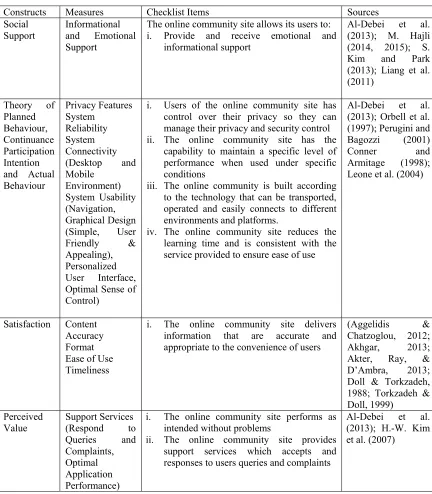
online community site (Al-Debei et al., 2013; M. Hajli et al., 2015; K.-Y. Huang et al., 2010; Liang et al., 2011; Mohana & Yusmadi Yah, 2015; Mohana et al., 2015). These measures are crucial inensuring the continuance participation of online communities and are intended to guide online community web developers and web managers for development as well as measuring the performance of their online community sites. These measures are socially inclined and are treated as fundamental requirements when developing online community sites. The measures associated to the study constructs are then further expanded into checklist items to allow for it to be weighted accordingly for determining the final score. Table 1 lists down the pertinent measures and checklist items required for each construct for evaluating the continuance participation performance of online community sites. The breakdown to each checklist item is shown in Table 2.
Insert Table 1
3.3 Weighted Checklist
This research adapts the weighted checklist method by Davies (2009) primarily due to its suitability to assess the overall merit, worth or importance of an attribute. A weighted checklist consists of i) a list of items, each of which describes an attribute that may or may not be present. These items are indicated by a 1 or 0 or it may be present in a degree measured in a simple scale ranging from 0 to 3; ii) a set of weights, which describes the relative importance of each item and iii) a summary score, based on the number of items identified as present, but adjusted by their individual weights.
Due to the nature of this research, the weighted checklist measurement is adapted to evaluate the overall continuance participation performance. For this, constructs contributing to the continuance participation of online communities are assigned with category weight while the measures are assigned to item weight. From here, the weighted score is calculated against the total possible score based on the checklist input. The category weight and item weight are listed in percentages and carries a fixed value derived from the Importance Performance Map Analysis (IPMA) results obtained from prior research when validating theoretical model (Mohana et al., 2015).
4 PROPOSED FRAMEWORK
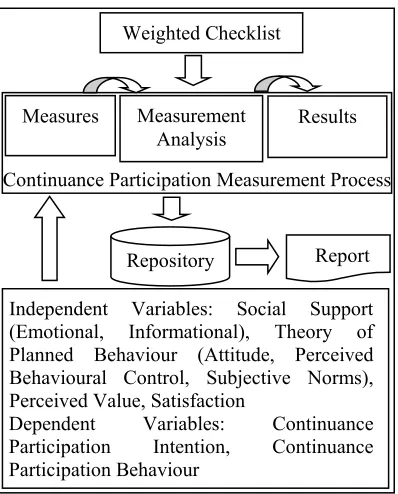
3516 (emotional and informational), constructs of the theory of planned behaviour (attitude, perceived behavioural control, subjective norms), perceived value and satisfaction whilst the dependent variables include continuance participation intention and continuance participation behaviour. All these constructs are empirically validated (Mohana et al., 2015) and contribute to the measures required for the measurement analysis.
[image:4.612.91.290.300.547.2]The weighted checklist is later applied on the measurement process for producing results on the status of the online community sites. The continuance participation measurement framework presented in Fig. 1, is formulated, based on the preceding discussions, to assist in the evaluation of online community sites performances.
Figure 1: Continuance Participation Measurement Framework
5 RESULTS
5.1 Simulation
The weighted checklist is intended for the online community web developers as well as web managers handling online community sites to evaluate the continuance participation performance of their sites. The constructs and measures are fundamental requirements that are essential for ensuring the continuance participation of online communities, which also acts as a guideline for web development. At the same time, web developers can assess the significance level of their developed
online community sites through the simulation. Table 2 represents the weighted checklist for a Significant scenario where;
Raw score R is represented by 1 or 0 indicating present or absent for the checklist items listed. Weighted score W is total possible score, T multiplied by raw score, R.
Total possible score T is the multiplication of item weight, I and category weight, C.
The formula for average weighted score is adapted from Davies (2009) and is as shown:
Final Score, S = ∑W/T * 100 Where W is the weighted score and
T is the total possible score
The results obtained from the weighted checklist determine the continuance participation level of online community sites (Table 3). The significance levels are based on the P Values of the PLS-SEM applied when testing the theoretical model in the study by M. Hajli et al. (2015); Mohana and Yusmadi Yah (2015); (Mohana et al., 2015).
Final score, S as % of maximum possible for the scenario simulated is 5000/10000, 50%. The final score indicates that the online community developed is likely to survive and likely to have a prolonged usage from its users because the mandatory requirements of a social site are moderately fulfilled.
Insert Table 2
Table 3: Results
Average Weighted Score (%)
Significance Level Results
0-25 Not Significant Likely to Fail
26-50 Significant Likely to Survive
51-75 Very Significant Very Likely to
Survive
76-100 Extremely
Significant
Extremely Likely to Survive
6 FINDINGS AND DISCUSSIONS
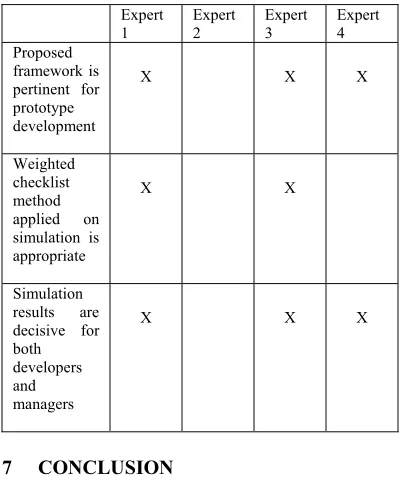
The findings of interviews from all the four experts confirmed the efficacy of the framework. These experts further affirmed that the weighted checklist adapted is viable for the simulation Continuance Participation Measurement Process
Repository
Weighted Checklist
Measures Measurement
Analysis Results
Report
Independent Variables: Social Support (Emotional, Informational), Theory of Planned Behaviour (Attitude, Perceived Behavioural Control, Subjective Norms), Perceived Value, Satisfaction
[image:4.612.313.529.553.652.2]3517 process however suggested room for refinement and improvement. Expert 2 for instance suggested that the checklist items be further expanded for a more informed decision and evaluation of the continuance participation performance. Expert 3 on the other hand expressed that pertinent features that fall under each construct and its items should be exhibited so it makes a more complete guideline for the practitioners.
Overall, the reviews by the experts were positive and constructive in nature. The idea was to create a complete, workable and practical simulation so it can be deployed in the form of a prototype that is automated and easy to use which this research aims to address in future research. The highlights to the interviews conducted on all the four experts are as depicted in Table 4.
[image:5.612.89.290.448.689.2]Additionally, the findings of this study support that constructs attitude, perceived behavioural control and subjective norms of the theory of planned behavior, alongside social support, satisfaction and perceived value constructs influence the continuance participation intention and behavior. The measures associated to these constructs as validated by four expert reviewers further affirm this notion.
Table 4: Expert Review Feedback Summary
Expert 1
Expert 2
Expert 3
Expert 4 Proposed
framework is pertinent for prototype development
X X X
Weighted checklist method applied on simulation is appropriate
X X
Simulation results are decisive for both developers and managers
X X X
7 CONCLUSION
This paper has advanced knowledge by addressing the related constructs from prominent social psychology theories aided by a weighted
checklist through the use of an integrated model and simulation for evaluating the continuance participation of online communities. Many past researches have reported on the constructs required for ensuring prolonged usage of online community sites however lacks a practical tool to assess the performance level. This research further undertook a simulation to address this gap by putting forth a continuance participation measurement framework that adapts the weighted checklist method for measuring the continuance participation of online communities. The proposed framework articulates required measures that serve as a guideline to managers and web developers involved in the policy making and development of online community sites. In addition, the simulation supplements the framework by measuring the continuance participation of online communities and reports on its sustainability from a social perspective.
As hypothesized, the findings of this study show that the effect of both the independent and dependent variables influence continuance participation measurement process and the weighted checklist adapted is significant in measuring the performance of online community sites. This is in relation to the data gathered from the expert reviewers as well as the simulation conducted. From a theoretical perspective, the continuance participation measurement framework aids both academics and practitioners in continuance studies particularly social commerce and online communities. As for the practical implication, this study through its simulation enables the web developers and managers to evaluate their developed online community sites and further manage them to ensure continuance participation from online communities.
ACKNOWLEDGMENT
The authors gratefully acknowledge the helpful comments of all the four expert reviewers’ from Universiti Teknologi Malaysia, Universiti Islam Antarabangsa, VICT Systems Sdn. Bhd. and HP Enterprise.
REFERENCES
[1] Aggelidis, V. P., & Chatzoglou, P. D. (2012). Hospital information systems: Measuring end user computing satisfaction (EUCS). Journal of Biomedical Informatics, 45(3), 566-579. [2] Akhgar, M. S. B. (2013). Designing a scientific
3518 methodology. Journal of Systems and Information Technology, 15(4), 292-303. [3] Akter, S., Ray, P., & D’Ambra, J. (2013).
Continuance of mHealth services at the bottom of the pyramid: the roles of service quality and trust. Electronic Markets, 23(1), 29-47. [4] Al-Debei, M. M., Al-Lozi, E., &
Papazafeiropoulou, A. (2013). Why people keep coming back to Facebook: Explaining and predicting continuance participation from an extended theory of planned behaviour perspective. Decision Support Systems, 55(1),
43-54. doi:
http://dx.doi.org/10.1016/j.dss.2012.12.032 [5] Bhattacherjee, A. (2001). An empirical
analysis of the antecedents of electronic commerce service continuance. Decision Support Systems, 32(2), 201-214.
[6] Brien, O. (2002). Introduction to Information Systems Vol. Chapter 10. Essentials for the Internetworked E-Business Enterprise [7] Chirinos, L., Losavio, F., & Boegh, J. (2005).
Characterizing a data model for software measurement. Journal of System and Software, 74, 207-226.
[8] Conner, M., & Armitage, C. J. (1998). Extending the Theory of Planned Behavior: A Review and Avenues for Further Research. Journal of Applied Social Psychology, 28(15), 1429-1464.
[9] Davies, R. (2009). Weighted checklists as an evaluation tool
[10]De Cannière, M. H., De Pelsmacker, P., & Geuens, M. (2009). Relationship Quality and the Theory of Planned Behavior models of behavioral intentions and purchase behavior. Journal of Business Research, 62(1), 82-92. doi:
http://dx.doi.org/10.1016/j.jbusres.2008.01.001 [11]DeLone, W. H. M., E. R. (2003). The DeLone and McLean Model of Information Systems Success: A Ten-Year Update. Journal of Management Information Systems, 19(4), 9-30. [12]Deng, X., Doll, W. J., Al-Gahtani, S. S.,
Larsen, T. J., Pearson, J. M., & Raghunathan, T. S. (2008). A cross-cultural analysis of the end-user computing satisfaction instrument: A multi-group invariance analysis. Information & Management, 45, 211-220.
[13]Doll, W., & Torkzadeh, G. (1988). The measurement of end-user computing satisfaction. MIS Quarterly, 12, 259-227.
[14]Fishbein, M., & Ajzen, I. (1975). Belief, Attitude, Intention and Behavior: An Introduction to Theory and Research: Addison-Wesley, Reading, MA.
[15]Hajli, M. (2014). The role of social support on relationship quality and social commerce. Technological Forecasting and Social Change, 87, 17-27.
[16]Hajli, M. (2015). Social commerce constructs and consumer's intention to buy. International Journal of Information Management, 35(2),
183-191. doi:
http://dx.doi.org/10.1016/j.ijinfomgt.2014.12.0 05
[17]Hajli, M., & Khani, F. (2013). Establishing Trust in Social Commerce through Social Word of Mouth. International Journal of Information Science and Management, 39-54. [18]Hajli, M., Khani, F., & Hajli, M. (2013).
Establishing Trust in Social Commerce through Social Word of Mouth. Paper presented at the e-Commerce in Developing Countries: With Focus on e-Security (ECDC), 7th International Conference on e-Commerce. [19]Hajli, M., Mohana, S., Powell, P., & Love, P.
E. D. (2015). Continuance Participation in On-line Communities: a Social Commerce Perspective. Technological Forecasting and Social Change Journal, 96, 232-241.
[20]Hsu, M. C. (2013). The Management of Sports Tourism: A Causal Modeling Test of the Theory of Planned Behaviour. International Journal of Management, 30(2), 474-491. [21]Hsu, M. H., & Chiu, C. M. (2004). Predicting
electronic service continuance with a decomposed theory of planned behaviour. Behaviour & Information Technology, 23(5), 359–373.
[22]Huang, K.-Y., Nambisan, P., & Uzuner, Ö. (2010). Informational support or emotional support: Preliminary study of an automated approach to analyze online support community contents. Paper presented at the International Conference on Information Systems (ICIS 2010), St. Louis, MO.
[23]Huang, Z., & Benyoucef, M. (2013). From e-commerce to social e-commerce: A close look at design features. Electronic Commerce Research and Applications. doi: http://dx.doi.org/10.1016/j.elerap.2012.12.003 [24]Kim, H.-W., Chan, H. C., & Gupta, S. (2007).
3519 empirical investigation. Decision Support Systems, 43(1), 111-126.
[25]Kim, S., & Park, H. (2013). Effects of various characteristics of social commerce (s-commerce) on consumers’ trust and trust performance. International Journal of Information Management, 33(2), 318-332. [26]Leone, L., Perugini, M., & Ercolani, A. P.
(2004). Studying, Practicing, and Mastering: A Test of the Model of Goal-Directed Behavior (MGB) in the Software Learning Domain. Journal of Applied Social Psychology, 34(9), 1945-1973.
[27]Liang, T. P., Ho, Y. T., Li, Y. W., & Turban, E. (2011). What Drives Social Commerce: The Role of Social Support and Relationship Quality. International Journal of Electronic Commerce, 16(2), 69–90.
[28]Mathieson, K. (1991). Predicting User Intentions: Comparing the Technology Acceptance Model with the Theory of Planned Behavior. Information Systems Research, 2(3), 173-191.
[29]Mohana, S., & Yusmadi Yah, J. (2015). A Continuance Model for Optimized Participation in Virtual Communities Handbook of Research on Integrating Social Media into Strategic Marketing, IGI Global (pp. 187-206).
[30]Mohana, S., Yusmadi Yah, J., Rozi Nor, H. N., & Marzanah, A. J. (2015). A Theoretic Extension and Empirical Investigation for Continuance Participation in Online Communities ARPN Journal of Engineering and Applied Sciences, 10(23).
[31]Orbell, S., Hodgkins, S., & Sheeran, P. (1997). Implementation intentions and the theory of planned behavior. Personality and Social Psychology Bulletin, 23, 945-954.
[32]Perugini, M., & Bagozzi, R. P. (2001). The role of desires and anticipated emotions in goal directed behaviours: Broadening and deepening the theory of planned behaviour. British Journal of Social Psychology, 40(1), 79-98.
3520 Table 1: Checklist Items
Constructs Measures Checklist Items Sources
Social
Support Informational and Emotional Support
The online community site allows its users to: i. Provide and receive emotional and
informational support
Al-Debei et al. (2013); M. Hajli (2014, 2015); S. Kim and Park (2013); Liang et al. (2011)
Theory of Planned Behaviour, Continuance Participation Intention and Actual Behaviour
Privacy Features System
Reliability System Connectivity (Desktop and Mobile
Environment) System Usability (Navigation, Graphical Design (Simple, User Friendly & Appealing), Personalized User Interface, Optimal Sense of Control)
i. Users of the online community site has control over their privacy so they can manage their privacy and security control ii. The online community site has the
capability to maintain a specific level of performance when used under specific conditions
iii. The online community is built according to the technology that can be transported, operated and easily connects to different environments and platforms.
iv. The online community site reduces the learning time and is consistent with the service provided to ensure ease of use
Al-Debei et al. (2013); Orbell et al. (1997); Perugini and Bagozzi (2001)
Conner and
Armitage (1998); Leone et al. (2004)
Satisfaction Content Accuracy Format Ease of Use Timeliness
i. The online community site delivers information that are accurate and appropriate to the convenience of users
(Aggelidis & Chatzoglou, 2012; Akhgar, 2013; Akter, Ray, & D’Ambra, 2013; Doll & Torkzadeh, 1988; Torkzadeh & Doll, 1999)
Perceived
Value Support Services (Respond to Queries and Complaints, Optimal Application Performance)
i. The online community site performs as intended without problems
ii. The online community site provides support services which accepts and responses to users queries and complaints
3521 Weight
(%)
Weight (%)
Score (R)
Score (W)
Possible Score
(T) Social
Support
40 The online community site allows its users to:
i. Provide and receive emotional and
informational support
a. Users can interact with system through a variety interfaces
b.System has private and public messaging options
c. Functionality is based on social interaction and networking with other users
d.Social feature such as online support group is existent
20 1 800 800
Theory of Planned Behaviour
30 i. Users of the online community site has control over their privacy so they can manage their privacy and security control
a. Privacy features are customizable
b.Users can restrict content under privacy features
30 0 0 900
ii. The online community site has the capability to maintain a specific level of performance when used under specific conditions
a. System provides overall support for user activities
b.System is technically reliable
30 0 0 900
iii. The online community is built according to the technology that can be transported, operated and easily connects to different environments and platforms
a. The system can be used on different devices and platforms
b.Users have access to system in different places at different times
c. Switching between different devices when using the system is easy
20 1 600 600
iv. The online community site reduces the learning time and is consistent with the service provided to ensure ease of use
a. System is designed in an user-friendly manner b.Users can easily navigate between activities c. The components of the system are consistent
with each other
20 0 0 600
Satisfaction 10 i. The online community site delivers information that are accurate and appropriate to the convenience of users
a. System provides precise and sufficient information for users
b.System delivers up-to-date information in timely manner
c. System content is dynamic in nature
100 1 1000 1000
Perceived Value
20 i. The online community site performs as intended without problems
a. The system performs as desired and is fault free
50 1 1000 1000
ii. The online community site provides support services which accepts and responses to users queries and complaints
a. System provides support inbox for channelling queries and complaints
b.Support is continuous and prompt
50 0 0 1000
3522
Table 2: Weighted Checklist
Annexure 1
1. Are the measures associated to constructs in the Theoretical Model appropriate and valid?
2. Are the checklist items for each construct relevant for measuring continuance participation of online communities?
3. The weighted checklist has been adapted from Davies (2009). Is the breakdown of technique accurate and complete?
4. Is the formula involved in the weighted checklist calculation valid and precise?
5. Does the weighted checklist technique provide accurate results for both the web developers and managers when making decisions on online community sites?
6. Is the proposed simulation on both scenarios valid?
7. Both the category weight and item weight are assigned by the end users based on the requirement of the online community site. Is this method acceptable?
8. The steps involved in the weighted checklist technique are supported by an automated prototype. Will the tool be useful for the end users?
9. The checklist items in the tool are open for insertion, in other words dynamic for future entries. Is there a need for this?
10.Are the mapping of significance level for the weighted score and its results acceptable?
11.Are the measures contributed by the constructs of the Theoretical Model sufficient for the evaluation of continuance participation of online communities?
12.Is the continuance participation measurement process clear and precise?