2323
A NEW COLOR IMAGE WATERMARKING TECHNIQUE
USING MULTIPLE DECOMPOSITIONS
1,*
SALAM ABDULNABI THAJEEL, 1LAMYAA MOHAMMED KADHIM,
1
SALLY ALI ABDLATEEF
1Department of Computer Science, College of Education, AL-Mustansiriyah University, Baghdad, Iraq *[email protected]
ABSTRACT
Continuous and rapid development of network technologies has made communication faster and simpler nowadays. This improvement has led to an increasing amount and variety of data (i.e., texts, videos, images, speech, and audio), which are distributed and exchanged through networks. However, many issues have emerged, such as illegitimate copying and proof of illusory ownership. Watermarking is widely used as a technique to copyright protection of digital images. In this study, we propose a robust watermarking technique for color images using multiple decompositions to keep the copyright of the owner. Arnold transform is used to encrypt the watermark image to increase security. The given cover image is subjected to slantlet transform, contourlet transform, Schur decomposition, and discrete cosine transform. Eventually, the encrypted watermark is embedded. Experimental results show that the proposed scheme achieves good imperceptibility and high resistance against various attacks.
Keywords:Image Watermark, SLT, Arnold Transform, Contourlet Transform, Schur Decomposition.
1. INTRODUCTION
In the digital era, image and video are essential vehicles to convey large volumes of information. Generally, digital multimedia is highly capable of articulating, disseminating, and storing information easily; thus, it has become a significant avenue for transferring information as a result of the great development in information technology and communication devices [1]. Currently, various types of graphics tools for easy tampering of digital media by illegitimate users are available. Thus, copyright protection has become a crucial issue in the digital world. One of the common techniques that are currently used is digital watermarking. The watermarking process consists of inserting a digital watermark into the original multimedia objects (such as digital images, text, and audio and video clips) and extracting it after confirmation to inspect whether the image is corrupted or not [2, 3].
During the past decades, numerous watermarking techniques have been proposed, which can be classified into two categories based on the domain of embedding watermark, which is used to hide the watermark in a host image, namely, spatial and transform (frequency) domains. In the spatial domain, the watermark image is directly embedded into the pixel value of
the cover image, whereas in the frequency domain, the watermark is embedded into the transform domain. Watermarking in the spatial domain is an easy technique, but it is less effective in terms of robustness and imperceptibility than the frequency domain [4-6].
Thus, most watermarking schemes have been applied in the frequency domain in the last few years. Discrete sine transform, discrete Fourier transform, discrete wavelet transform (DWT), discrete cosine transform (DCT), slantlet transform (SLT), and contourlet transform (CT) are the most common frequency domains utilized in watermarking techniques [5]. In recent years, researchers have sought to further improve the performance of transform domain techniques by joining two or more transform domains [7, 8].
Based on the literature, the subordinate weaknesses of the present algorithms have been specified. where the Majority of the presently algorithms ,researchers have employ binary or gray scale image as watermark ,addition to that the current algorithms may focussed to increase and ameliorate the robustness or imperceptibility of watermarking versus attacks or both of them but not with all type of attacks such as
2324 and robustness and in the same time ready to retrieve the original watermarking without altered. Consequently, we took into consideration all the above aforementioned weakness points. Therefore the color image has been utilize as a watermark image and embedded into a color host image .Moreover ,this study proposes a robust color-image watermarking algorithm that adopts the features of SLT, CT, DCT, and Arnold transform (AT) to achieve high robustness, imperceptibility, and security versus all types of attacks. The rest of this paper is structured as follows. Section 2 provides a brief background of DWT, SVD, DCT, and Arnold cat map transformation. Section 3 describes the details of the proposed watermarking scheme. Sections 4 discusses experimental results to demonstrate the performance of this scheme. Finally, Section 5 concludes the paper.
2. PRELIMINARIES
This section presents different terminologies used in the proposed method.
2.1 Slantlet Transform
SLT is an amended form of DWT with two-zero moments and improved time localization [9]. It is performed as filter bank with parallel structure. Unlike DWT, which is used in iterated filters, SLT utilizes parallel processing to configure different filters for different scales. SLT filters are shorter than those of the equivalent DWT. As a result, SLT is widely used in various applications and has accomplished better results. Identical to DWT, an image in a 2D environment is divided into four parts: low–low (LL), low–high (LH), high–low (HL), and high–high (HH), as shown in Figure 1. L and H indicate the low- and high-frequency bands, respectively. Each band conveys various image data. LL indicates the low-frequency band component that carries the original image information, while the information related to the edge, contour, and other details of the image is carried via LH, HL, and HH, which refer to medium- and high-frequency bands. Important information in the image is represented by high coefficients. Thus, the HL decomposition commonly is used to embed the watermarking to gain high robustness [10].
2.2 Contourlet Transform
CT is an efficient geometrical image transform [11] that has better ability to capture smooth contours in various directional edges of an image
than wavelets. This process utilizes a double-filter bank, which is a Laplacian pyramid (LP) and directional filter bank (DFB), where the discontinuities in an image are captured via LP; thus, DFB is applied to bind discontinuities into linear structures. The pyramidal directional filter bank (PDFB) is produced after integration of both LP and DFB decompositions. CT includes many stages of PDFB. Following [12, 13], we use “9−7” pyramid filter and “pkva” directional filter in our proposed method, where the low-pass image of the contourlet decomposition has been selected to embed the watermark to achieve robustness. In Figure 2, the contourlet decomposition is where the input image decomposes via LP to low-pass and band-pass images, while each band pass is decomposed by DFB.
2.3 Schur decomposition
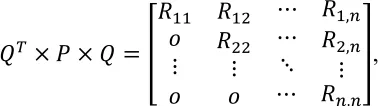
The Schur decomposition is sometimes called Schur triangulation. Currently, it is a significant tool in numerical linear algebra, where it is a main intermediate step in SVD decomposition. It represents matrix decomposition [14]. When we have matrix A ∈Rn×n, which represents a gray-scale image, the Schur decomposition of A is given as follows:
⋯
,⋮
⋮
⋯
⋱
⋮
,⋯
,,
where Q indicates a unitary matrix, QT denotes the transposed matrix of Q, and P is an upper triangular matrix, which represents a Schur form of G including eigenvalues on the diagonal for each block matrix R. The Schur form contains complex eigenvalues, either 1 × 1 real or a 2 × 2 matrix [15].
2.4 Discrete Cosine Transform
[image:2.612.325.514.424.477.2]
2325
C u, v
a u a v ∑
∑
%+, cos
! "# $%& cos '
! (# )*
(,-%+
",-
An image is divided by DCT into three types of frequency bands, namely, high, low, and middle. According to (20), low frequency is ticklish for human visual systems, whereas high frequency can resist diverse attacks. A DCT’s middle-band frequency preserves watermarks from being affected by compression and noise attacks. Therefore, middle-frequency bands are utilized as a compromise between robustness and imperceptibility [17].
2.5 Arnold Transform
AT is also commonly called Arnold’s cat map. It is a simple scrambling method that is widely used to alter the location of pixels in any image to make it an altogether different and senseless image. If the pixel locations have been changed several times, the image will seem messy. At present, AT is widely used to scramble the watermark image to ensure its security [18]. Similar to Refs. [19] and [20], we also used AT. AT for an image with size N×N is given by
. ̀̀0 1
1 1
1 24 1 4 5 6 7 1
where (x,y) and ((x,y ̀) ̀ denote the pixel coordinates in the original watermark image and after scrambling image, respectively, while N indicates the size of the watermark image. To restore the original image from a scrambling image, the inverse AT would be applied as follows:
1 4 1 2 81
81 1 4 .
̀
̀0 5 6 7, 2
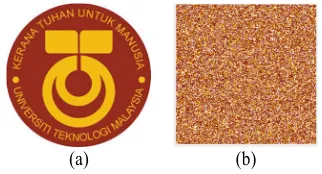
where (x,y) refers to the coordinates of the descrambled image, (x,y ̀) indicates the pixel coordinate of the scrambled image, and M represents the image size. Figure 3 represents an example of the Arnold transform after application on the watermark image.
3. PROPOSED METHOD
The proposed color-image watermarking scheme consists of two algorithms, namely, watermark embedding and watermark extraction.
The two algorithms are described in the following subsections.
3.1 Embedded watermarking scheme
Watermark embedding is based on SLT, CT, Schur decomposition, and DCT, with the following steps:
1. The cover image is represented by R, G, and B component images. Then, the blue channel will be transformed using the SLT matrix into four sub-bands (i.e., LL, LH, HL, and HH). The HL sub-band is chosen for further decomposition using CT. 2. A first-level CT is applied to the sub-bands
selected in the previous step. Thereafter, the low sub-band (directional sub-bands) of the CT is selected for further decomposition on the next step.
3. The selected low sub-band of CT is divided into 8×8 non-overlapping blocks. The Schur decomposition is applied for each block.
4. DCT is applied for each Schur form, where the upper triangular matrix is selected to further decompose using DCT. 5. The watermark is divided into red, green,
and blue channels. The blue channel is selected to scramble via AT for N times, where N represents the secret key. The watermark is reconstructed to the vector consisting of zeros and ones.
6. Two unconnected pseudorandom series (i.e., PN_S_0 and PN_S_1) will be created. The first pseudorandom series helps in embedding the bit “0” of the scrambled watermarked image, whereas the second pseudorandom series is used to embed the watermark bit “1”. The size of a pseudorandom series is equivalent to the number of elements in the middle-frequency band of the 8×8 DCT blocks. 7. In the middle-band frequency of the 8×8
DCT blocks, the coefficients of the chosen sub-band will be modified by inserting two random sequences (i.e., PN_S_0 and PN_S_1) with the gain factor k according to the following equations:
If the watermark bit is “0,” then X′ =X +α × PN −0.
2326 X′ =X +α × PN −1,
8. where X is the coefficient of the middle-frequency band of the 8×8 DCT blocks and Xʹ is a coefficient matrix of the middle-frequency band of DCT after watermark embedding. An appropriate gain factor must be selected to achieve the best tradeoff between visibility and robustness.
9. Upon completion of the embedding process, inverse DCT is applied to all 8×8 blocks.
10. Inverse Schur decomposition is performed. 11. ICT is conducted using the selected
sub-bands of each level, followed by the performance of inverse SLT. Eventually, the R, G, and B channels are grouped to obtain the secure the watermarked image.
3.2 Watermark extraction scheme
The steps of the watermark extraction algorithm are as follows:
1. Similar to the embedded process, the watermarking image is also split into R, G, and B channels. Then, the SLT is applied to decompose the blue channel of the watermarked image to obtain four non-overlapping multi-resolution sub-bands: LL, HL, LH, and HH. The HL sub-band is then chosen for further decomposition using CT.
2. CT is applied to the selected sub-bands in the previous step. Directional sub-bands are chosen to embed the watermark on it. 3. The selected low sub-band of CT is
divided into 8×8 non-overlapping blocks. The Schur decomposition is applied for each block.
4. DCT is applied on each Schur form block. 5. The same technique used during watermark embedding is used to generate two pseudorandom sequences, namely, PN-0 and PN-1.
6. The correlation between the middle-frequency band of the DCT block is calculated and compared with the random sequences (i.e., PN0 and PN1). If a correlation value with PN-0 is higher than PN-1, the watermark bit becomes “0.” Otherwise, the watermark bit becomes “1.” 7. The original watermarked image is reconstructed using the extracted watermark bits by applying the inverse AT for N times, where N is a period of AT.
8. All the color channels are merged to obtain the watermark logo.
4. PERFORMANCE METRICS OF IMAGE WATERMARKING
The proposed watermarking method performance is evaluated in terms of imperceptibility and robustness using three standard measurements: peak signal-to-noise ratio (PSNR), mean squared error (MSE) for measuring imperceptibility, and normalized cross correlation (NCC) for determining robustness. NCC is a metric commonly employed to measure the robustness of the watermark by evaluating the degree of similarity (or dissimilarity) between the original and extracted watermark images [18], where it estimates the correlation between the original watermark and the extracted watermark after an attack. When the NCC value is equal to 1, which represents the ideal value, the original and extracted watermarks are similar [7]. When the NCC value is equal or higher than 0.75, it would be agreeable in practice. NCC can be obtained using the following equation
NCC
∑@+A,-∑>+?,- w m, n w= m, n
B∑@+ w m, n
A, w m, n ∑>+?,-w= m, n w= m, n
where W(a, b), w ̃(m,n) refer to the values of the pixel (a, b) of the original and extracted watermark images, respectively.
The PSNR is used to estimate the imperceptibility of watermarking. The perceptual similarity between the cover image and a watermarked image is calculated to determine the PSNR. The calculation formula of PSNR is specified by the following equation:
CD 20. G H-. 7IJK
√7CM 0
where MSE is a quantified parameter that measures the mean-square error between the original image and the attacked watermarked, which can be obtained using the following equation:
MSE m ∗ n R1 R'I i, j 8 K i, j *
W+
X,-Y+
2327 Normally, MSE is inversely related to PSNR [19], and both of them are used to check the degradation caused by watermarking. Ideally, the PSNR greater than 20 dB is still acceptable
5. PERFORMANCE EVALUATION
The experimental results are presented and explained to prove the effectiveness of the proposed method. Our simulation of the proposed image watermarking system was implemented through MATLAB 2016a. For a relatively fair judgment, several experiments were conducted using a standard dataset of RGB color image with 512 x 512 pixels. Six images, namely, Lena, Baboon, Car, Pepper, Airplane, and Sailboat, which are shown in Figure 4 (from a to f), were adopted as cover image, and the watermark logo is a color image shown in Figure 3(a).
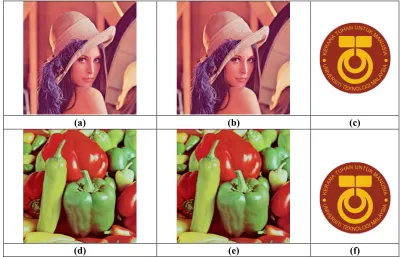
Figure 5 depicts an excerpt which demonstrates examples of the original cover images with their watermarked after embedding a watermark image in the absence of attacks. In the same context, Table 1 lists the PSNR value for the watermarked images of all images used in practical experiments of the proposed system.
Results in Table 1 have revealed that, of all the datasets, PSNR values are very high, which indicates that the original host and their watermarked images are roughly identical.
Meanwhile, from Table 1, the NCC is almost equal to 1 in case of watermarked images with non-exposure to any type of attacks.
Moreover, the watermarked image is exposed to several types of attacks, such as sharpening attacks, median filter, motion blur, salt-and-pepper noise, Gaussian noise, and speckle noise with density 0.01, to evaluate the robustness of the proposed scheme. In this context, Table 2 summarizes the NCC values of the watermarked image extracted from the attacked watermarked image.
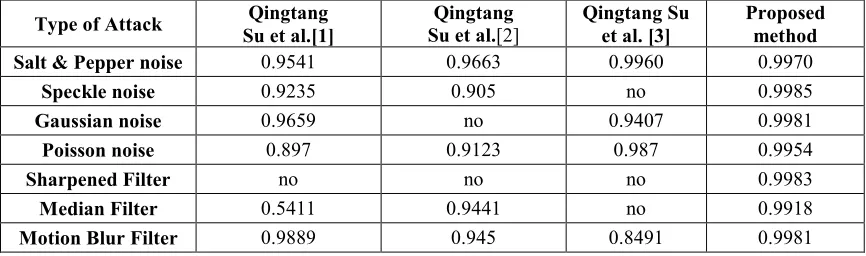
Thus, comparing the proposed watermarking method with the state-of-the-art method found in the latest literature is important. The proposed method has been compared in terms of NCC with three of the previous existing works, which are [12, 14, 21]. The performed techniques use various decompositions but in space, color image. According to the benchmark result, which is shown in Table 3, the proposed method outperformed other works almost in all the attacks.
Moreover, the watermark is extracted completely without any damage to information in the proposed scheme.
6. CONCLUSION
In this paper, a robust color-image watermarking method is proposed on the basis of multiple decompositions such as SLT, CT, Schur transform, and DCT. To achieve imperceptibility, security, and robustness of watermarking requirements, we utilized all these transformations. Moreover, prior to insertion of a watermarking logo, the watermark was scrambled through the AT to improve security and robustness. The performance of the proposed algorithm was validated via MATLAB and compared with those of previous studies on color-image watermarking. Based on the experimental results of the proposed method, the proposed watermarking scheme ensures imperceptibility, security, and effectiveness against powerful image processing attacks. Although the proposed method has very encouraging results, however, it has a problem where it is time consuming especially in the high resolution images. So we can reduce the computational cost via making the proposed system working in parallelization using graphical processing unit .addition to that. In the future, we will further develop our proposed scheme to make it suitable for color video watermarking
ACKNOWLEDGMENT
The authors are thankful to the University of Al-Mustansiriyah in Iraq to assistance complete the search, The facilities provided by the University Technology Malaysia (UTM), Johor are gratefully acknowledged.
REFERENCES
[1] Thajeel, S.A.-N. and G. Sulong, A novel approach for detection of copy move forgery using completed robust local binary pattern. J Inf Hiding Multimed Signal Process, 2015. 6(2): p. 351-364.
[2] Shao, Z., et al., Combining double random phase encoding for color image watermarking in quaternion gyrator domain. Optics Communications, 2015. 343: p. 56-65. [3] Agilandeeswari, L. and K. Ganesan, A robust
2328 Tools and Applications, 2016. 75(14): p. 8745-8780.
[4] An, L., et al., Robust reversible watermarking via clustering and enhanced pixel-wise masking. IEEE Transactions on image processing, 2012. 21(8): p. 3598-3611. [5] Bhatnagar, G., Q.J. Wu, and B. Raman, A new
aspect in robust digital watermarking. Multimedia tools and applications, 2013. 66(2): p. 179-200.
[6] Rey, C. and J.-L. Dugelay, A survey of watermarking algorithms for image authentication. EURASIP Journal on Advances in Signal Processing, 2002. 2002(6): p. 218932.
[7] Wang, J. and Y. Liu. Schur Decomposition Based Robust Watermarking Algorithm in Contourlet Domain. in International Conference on Cloud Computing and Security. 2016. Springer.
[8] Mehta, R., N. Rajpal, and V.P. Vishwakarma, LWT-QR decomposition based robust and efficient image watermarking scheme using Lagrangian SVR. Multimedia Tools and Applications, 2016. 75(7): p. 4129-4150. [9] Selesnick, I.W., The slantlet transform. IEEE
transactions on signal processing, 1999. 47(5): p. 1304-1313.
[10]Mohammed, R.T. and B.E. Khoo. Image watermarking using slantlet transform. in Industrial Electronics and Applications (ISIEA), 2012 IEEE Symposium on. 2012. IEEE.
[11]Do, M.N. and M. Vetterli, The contourlet transform: an efficient directional multiresolution image representation. IEEE Transactions on image processing, 2005. 14(12): p. 2091-2106.
[12]Su, Q., et al., A novel blind color image watermarking based on Contourlet transform and Hessenberg decomposition. Multimedia Tools and Applications, 2016: p. 1-21. [13]Khalighi, S., P. Tirdad, and H. Rabiee, A
contourlet-based image watermarking scheme with high resistance to removal and geometrical attacks. EURASIP Journal on Advances in Signal Processing, 2010. 2010(1): p. 540723.
[14]Su, Q., et al., Embedding color watermarks in color images based on Schur decomposition. Optics Communications, 2012. 285(7): p. 1792-1802.
[15]Paige, C. and C. Van Loan, A Schur decomposition for Hamiltonian matrices. Linear Algebra and its Applications, 1981. 41: p. 11-32.
[16]Deb, K., et al. Combined DWT-DCT based digital image watermarking technique for copyright protection. in Electrical & Computer Engineering (ICECE), 2012 7th International Conference on. 2012. IEEE. [17]Choi, D., et al., A blind MPEG-2 video
watermarking robust to camcorder recording. Signal processing, 2010. 90(4): p. 1327-1332. [18]Arnold, M., et al., A phase-based audio
watermarking system robust to acoustic path propagation. IEEE Transactions on Information Forensics and Security, 2014. 9(3): p. 411-425.
[19]Makbol, N.M. and B.E. Khoo. A Hybrid Robust Image Watermarking Scheme Using Integer Wavelet Transform, Singular Value Decomposition and Arnold Transform. in International Visual Informatics Conference. 2013. Springer.
[20]Saikrishna, N. and M. Resmipriya, An Invisible Logo Watermarking Using Arnold Transform. Procedia Computer Science, 2016. 93: p. 808-815.
2329
Table (1) PSNR Value For Watermarked Images
Host image Lena baboon Car Pepper Sailboat Airplane PSNR 50.976 52.156 51.876 51.543 52.7654 51.024
NCC 1.0000 0.9997 1.0000 0.9998 0.9996 1.0000
Table (2) NCC Values Of Extracted Watermark After Varying Attack
Type of attacks Lena baboon Car Pepper Sailboat Airplane Sharping attacks 1.0000 0.9975 0.9986 0.9987 0.9990 0.9961
median filter 0.9947 0.9865 0.9967 0.9872 0.9885 0.9974 motion blur 1.00 0.9977 0.9965 0.9980 0.9971 0.9998 Salt and Pepper noise 0.9975 0.9965 0.9978 0.9975 0.9969 0.9964 Gaussian noise 0.9978 0.9994 0.9982 0.9968 0.9976 0.9988 Speckle noise with density 0.01 0.9989 0.9996 0.9985 0.9979 0.9986 0.9978
Table (3) Comparison Results Between Our Proposed Method And Other Existing Methods In Terms Of NCC
Type of Attack Qingtang Su et al.[1]
Qingtang Su et al.[2]
Qingtang Su et al. [3]
[image:7.612.82.533.205.309.2] [image:7.612.90.523.353.481.2][image:8.612.90.515.62.421.2]
2330
[image:8.612.134.468.250.390.2]Figure 1. 2D STL Decomposition Schemes
Figure 2. Block Diagram Of The CT Double-Filter Bank
[image:8.612.225.386.448.535.2](a) (b)
[image:9.612.87.548.60.363.2]
2331
Figure 4. A Dataset Of Standard RGB Images (A) Lena Image. (B) Baboon Image. (C) Car Image. (D) Pepper Image. (E) Sailboat Image. (F) Airplane Image
Figure 5. Lena And Pepper Original Images With Their Watermarked (A & D) Original Host Image (B &E) Watermarked Image (C & F) Extracted Watermark Images From B And E Respectively
(a) (b) (c)
(d) (e) (f)
(a) (b) (c)
[image:9.612.105.507.435.692.2]