IJPSR (2016), Vol. 7, Issue 9 (Research Article)
Received on 21 April, 2016; received in revised form, 02 June, 2016; accepted, 13 June, 2016; published 01 September, 2016
SIMULTANEOUS ESTIMATION OF DOXOFYLLINE AND AMBROXOL IN TABLET
DOSAGE FORM BY REVERSE PHASE HIGH PERFORMANCE LIQUID
CHROMATOGRAPHY
K. Sonia *1, M. Nappinnai 2 and K. Manikandan1
Department of Pharmaceutical Analysis 1, SRM College of Pharmacy, Kattankulathur, Tamil Nadu, India. Department of Pharmaceutics 2, Surya College of Pharmacy, Vikravandi, Villupuram, Tamil Nadu, India.
ABSTRACT: A new, simple, accurate, linear, precise, efficient and
reproducible Reverse Phase-High Performance Liquid Chromatography (RP-HPLC) method for the simultaneous determination of Ambroxol and Doxofylline in combined tablet dosage form. The chromatographic method was standardized using a Kromosil C18, 150mm × 4.6 mm, 3.5 𝜇 (particle size), Thermo scientific from Germany with isocratic conditions, and mobile phase containing potassium dihydrogen orthophosphate buffer-pH 6.8 (0.01M KH2PO4): acetonitrile (25: 75) at flow rate of 1ml/min using UV detection at 257
nm. The retention times of Ambroxol and Doxofylline were 5min and 2min, respectively. The method was linear over the concentration range for Ambroxol 0.6–36 𝜇g/mL and for Doxofylline 16-96 𝜇g/mL. The recovery of Ambroxol and Doxofylline was found to be in the range of 98.13–99.85% and 98.09–99.66%, respectively. The validation of method was carried out using ICH guidelines. The described HPLC method was successfully employed for the analysis of pharmaceutical formulations containing combined dosage form. From the comprehensive validation conducted, it was concluded that the method is stable and could be used throughout shelf life of the drug.
INTRODUCTION: A combination drug or fixed-dose combination is a formulation of two or more active ingredients combined in a single dosage form, available in certain fixed doses. Fixed-dose combination therapies are hypothesized to enhance compliance by decreasing the number of required pills. Fixed dose combinations of drugs used to treat different cardiovascular diseases are available in different dosage forms like tablet, capsules, modified release formulations, controlled release formulations and prolonged release combinations.
QUICK RESPONSE CODE
DOI:
10.13040/IJPSR.0975-8232.7(9).3721-27
Article can be accessed online on: www.ijpsr.com DOI link: http://dx.doi.org/10.13040/IJPSR.0975-8232.7 (9).3721-27
As the physio-chemical properties of the combined drugs lead to practical difficulties during execution of assay specified for the individual drugs in official compendia, necessity is present to separate, identify and determine the relative amount of the component in sample mixture. Monitoring of pharmaceutical product for the identity, strength, quality and purity, is necessary to ensure the safety, efficacy throughout the shelf life including storage, distribution and use.
A combination drug or fixed-dose combination is a formulation of two or more active ingredients combined in a single dosage form, available in certain fixed doses. Fixed-dose combination therapies are hypothesized to enhance compliance by decreasing the number of required pills. Fixed dose combinations of drugs used to treat different cardiovascular diseases are available in Keywords:
Ambroxol, Doxofylline, RP-HPLC, method development and validation
Correspondence to Author: K. Sonia
Assistant Professor,
Department of Pharmaceutical Analysis, SRM College of Pharmacy,
Kattankulathur - 603203, Kancheepuram District, Tamil Nadu, India.
different dosage forms like tablet, capsules, modified release formulations, controlled release formulations and prolonged release combinations. As the physio-chemical properties of the combined drugs lead to practical difficulties during execution of assay specified for the individual drugs in official compendia, necessity is present to separate, identify and determine the relative amount of the component in sample mixture. Monitoring of pharmaceutical product for the identity, strength, quality and purity, is necessary to ensure the safety, efficacy throughout the shelf life including storage, distribution and use1.
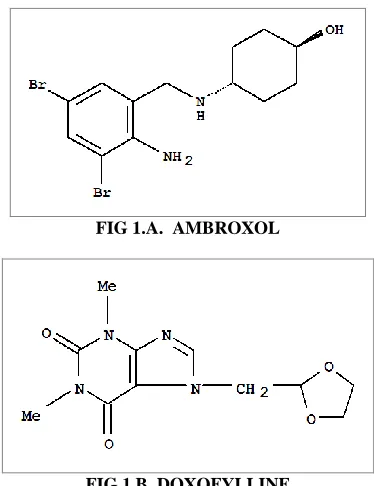
Ambroxol (Fig. 1.A) is a secretolytic agent used in the treatment of respiratory diseases associated with viscid or excessive mucus. It is chemically Trans-4 - (2-Amino-3, 5-dibrombenzylamino)-cyclohexanol 2. Ambroxol is a very potent inhibitor of the neuronal Na+ channels. It is clinically proven systemically active mucolytic agent. When administered orally onset of action occurs after about 30 minutes. The breakdown of acid muco-polysaccharide fibers makes the sputum thinner and less viscous and therefore more easily removed by coughing. Although sputum volume eventually decreases, its viscosity remains low 3, 4. It is white, hygroscopic and crystalline powder. Freely soluble in water, methanol and ethanol. Doxofylline (Fig. 2) (also known as doxofylline) is a xanthine derivative drug used in the treatment of asthma. It is phosphodiesterase inhibitor 5, 6.
[image:2.612.79.266.506.749.2]FIG 1.A. AMBROXOL
FIG 1.B. DOXOFYLLINE
It is white to beige, odourless, crystalline solid. Its mechanism of action is related to the inhibition of phosphodiesterase activities, resulting in bronchodilating effects 7, 8. Chemically it is 7-(1, 3-dioxolan-2-ylmethyl)-1, 3-dimethylpurine-2, 6-dione 9. The literature survey reveals that many methods have been reported for estimation of Ambroxol and Doxofylline individually and in combination with other drugs, and no HPLC method for simultaneous estimation of Ambroxol and Doxofylline has been reported. Hence an attempt has been made to develop new HPLC method which is simple, rapid, accurate, reproducible and linear method for simultaneous estimation of Ambroxol and Doxofylline in combined tablet dosage form has been validated 10.
MATERIALS AND METHODS: Chemicals and reagent:
Methanol, Acetonitrile of HPLC grade was purchased from Merck (India) Ltd., Mumbai. Potassium di hydrogen phosphate, Sodium di hydrogen phosphate, Sodium hydroxide, Hydrochloric acid, ortho phosphoric acid of Analytical grade was obtained from Merck (India) Ltd., Mumbai. Triethylamine of Analytical grade was obtained from Spectrochem. Doxofylline and Ambroxol sample obtained from Chandra labs Pvt., Ltd., Hyderabad. Prandimet tablets containing 400mg Doxofyllinee and 15 mg Ambroxol procured from the local market.
Apparatus and chromatographic condition: The chromatographic separation was carried out on HPLC system (Shimadzu LC-2010 Japan) with UV- Visible dual absorbance detector (PDA), Kromosil C18(150x4.6mm,3.5µ SS column). The
Preparation of mobile phase:
0.01mole of sodium dihydrogen phosphate was dissolved in 1000ml of water and adjust the pH-6.8 using acetonitrile; mix filtered and degassed mixture of acetonitrile and buffer in the ratio of 25:75.
Preparation of Doxofylline working standard solution:
40mg of Doxofylline working standard was weighed and transferred into 100 ml volumetric flask. 15 ml of mobile phase was added sonicated about 10 min until all the content has been dissolved, then the volume was made up to the mark with mobile phase. 2 ml of above solution was diluted to 50 ml with mobile phase to get concentration of 16µg/ml 12, 13.
Preparation of Ambroxol working standard solution:
1.5mg of Ambroxol working standard was weighed and transferred into 100 ml volumetric flask.15 ml of mobile phase was added sonicate about 10 min until all the content has been dissolved, then the volume was made up to the mark with mobile phase. 2 ml of above solution was diluted to 50 ml with mobile phase to get concentration of 0.6 µg/ml.
Preparation of sample solution:
Weigh about 10 tablets and powdered. From that an equivalent amount of 16 mg of Doxofylline and 0.6 mg of Ambroxol was taken into 100 ml volumetric flask. Add about 10 ml of mobile phase and sonicate until the content was dissolved. Filter the content by using 0.45µ membrane filter by applying vacuum. Made the volume up to the mark with the mobile phase.
Method Validation:
The objective of validation of an analytical procedure is to demonstrate its intended purpose were proposed according to ICH guidelines, the validation parameters were:
System Suitability:
It is essential for the assurance of the quality performance of chromatographic system. From the standard solution of Doxofylline and Ambroxol five replicated injections were made. Various
system suitability parameters like plate number (N), asymmetry factor, retention time, resolution, tailing factor, were evaluated from the standard chromatogram. Standard deviation & % RSD were also being calculated for the standard drug solutions. It was observed that all the values are within the limits 14, 15. The results were tabulated in Table 1.
TABLE 1: SYSTEM SUITABILITY FOR DOXOFYLLINE AND AMBROXOL
S. no Parameters Doxofylline Ambroxol
1. Resolution 15.579 2. No of
theoretical plates
2694 7639
3. Retention time 2.040 5.570
4. Asymmetry 1.263 1.576
Specificity:
Specificity is the ability to assess unequivocally of an analyte in the presence of components that may be expected to be present. For the simultaneous determination of Doxofylline and Ambroxol the specificity requires that the method should not be affected by the presence of other components. Specificity is performed under stressed conditions. In addition, there was no any interference at the retention time of in the chromatogram of placebo solution. In peak purity analysis with PDA, purity angle was always less than purity threshold for the analyte. This shows that the peaks of analyte were pure and excipients in the formulation does not interfere the analyte 16, 17.
i) Treating with Acids:
To 1 ml of stock solution, add 1 ml of 0.1M hydrochloric acid into a 10 ml flask, made up to the volume with the mobile phase. Observed for any change took place in the retention of the peak.
ii) Treating with Base:
To 1 ml of stock solution, add 1 ml of 0.1 M sodium hydroxide into a 10 ml flask, made up to the volume with the mobile phase. Observed for any change took place in the retention of the peak.
iii) Heating:
[image:3.612.312.563.197.281.2]The results were tabulated in Table 2.
TABLE 2: SPECIFICITY RESULTS FOR DOXOFYLLINE AND AMBROXOL UNDER STRESS CONDITIONS
S. no Stress Conditions Observed Result
1. Heated on water bath No degradation occurred 2. Treated with acids No change in retention of
the peak 3. Treated with base No degradents formed
Linearity and Range:
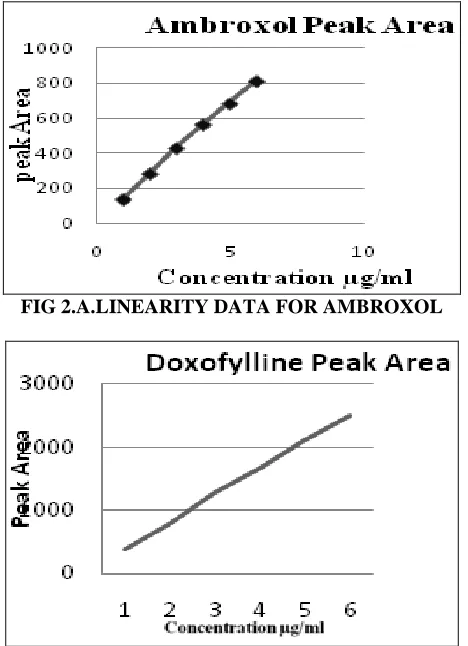
[image:4.612.57.291.420.743.2]Various concentrations of the Doxofylline was made by diluting stock solution to get the concentration of 16 to 96 μg and Ambroxol was made by diluting stock solution to get the concentration of 0.6 to 3.6 μg it was shown in Table 3. The plots of peak area of each sample against respective concentration of Doxofylline and Ambroxol were found to be linear (Fig.2.A and 2.B). The dilution volumes used and peak area obtained are presented below. The relationship between the concentration and the peak response of Doxofylline was linear in specific range and the regression coefficient was found to be 0.999 and for Ambroxol is 0.998. It observed that correlation coefficient and regression analysis are within the limits.
FIG 2.A.LINEARITY DATA FOR AMBROXOL
FIG 2.B.LINEARITY DATA FOR DOXOFYLLINE
TABLE 3: LINEARITY DATA FOR AMBROXOL S.no Ambroxol Doxofylline
Concentration µg/ml
Peak Area
Concentration µg/ml
Peak Area
1. 0.6 134.936 16 391.222
2. 1.2 281.806 32 794.883
3. 1.8 427.687 48 1278.733 4. 2.4 563.173 64 1690.916
5. 3 682.895 80 2111.89
6. 3.6 811.054 96 2510.84
Slope 224.7 Slope 26.71 Intercept 11.65 Intercept 33.04 Correlation coefficient 0.998 Correlation coefficient 0.999
Preparation of sample stock solution:
About 40mg of doxofylline and1.5mg of ambroxol were weighed and transferred into 50ml volumetric flask. 15 ml of mobile phase was added sonicate about 10min until all the content has been dissolved, then the volume was made up to the mark with mobile phase. Diluted to 50 ml with mobile phase to get concentration of 0.8mg/ml of doxofylline and 0.03 mg/ml of ambroxol.
Preparation of linearity solution-I:
Transfer 0.2 ml from stock solution to 10 ml with mobile phase (the solution contains 16 mcg of Doxofylline and 0.6 mcg of Ambroxol).
Preparation of linearity solution-II:
Transfer 0.4ml from stock solution to 10 ml with mobile phase (the solution contains 32mcg of Doxofylline and 1.2mcg of Ambroxol).
Preparation of linearity solution-III:
Transfer 0.6ml from stock solution to 10 ml with mobile phase (the solution contains 48mcg of Doxofylline and 1.8 mcg of Ambroxol).
Preparation of linearity solution-IV:
Transfer 0.8 ml from stock solution to 10 ml with mobile phase (the solution contains 64mcg of Doxofylline and 2.4mcg of Ambroxol).
Preparation of linearity solution-V:
Transfer 1ml from stock solution to 10 ml with mobile phase (the solution contains 96mcg of Doxofylline and 3.6 mcg of Ambroxol).
Accuracy:
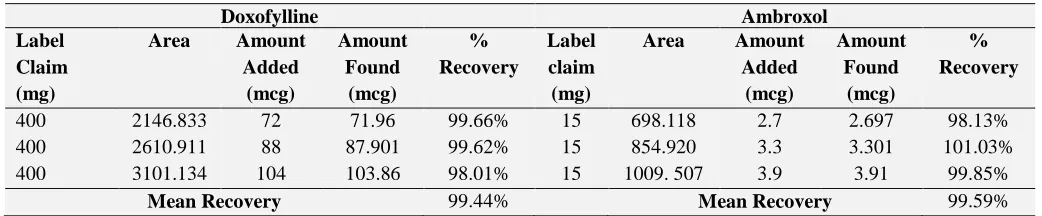
table below. The accuracy of an analytical method is determined by applying the method to analyzed samples, to which known amounts of analyte have been added. The accuracy is calculated from the test results as the percentage of analyte recovered by the assay.
The accuracy of the method is determined by recovery with spiked concentration of pure drug at three levels for Doxofylline and Ambroxol.
Preparation of Stock Solution:
Weigh 400mg of Doxofylline and 15 mg of Ambroxol in 50 ml volumetric flask dilute to volume with mobile phase.
Preparation of Spiking standard:
Transfer 1 ml from stock solution to 100 ml with mobile phase.
Preparation of Accuracy solution 1:
Transfer 0.8ml from stock solution to 100 ml with mobile phase (the solution contains 64mcg of Doxofylline and 2.4 mcg of Ambroxol) and add 1 ml of spiking standard.
Preparation of Accuracy solution 2:
Transfer 1ml from stock solution to 100 ml with mobile phase (The solution contains 80mcg of
Doxofylline and 3mcg of Ambroxol) and add 1 ml of spiking standard.
Preparation of Accuracy solution 3:
Transfer 1.2ml from stock solution to 100 ml with mobile phase (The solution contains 96mcg of Doxofylline and 3.6mcg of Ambroxol) and add 1 ml of spiking standard. The recovery of drug is well within the acceptance limits of 97-103%.It was observed that the mean percentage recoveries were found to be for Doxofylline and Ambroxol respectively which demonstrated that the method was highly accurate. The results were tabulated in Table 4.
Precision:
[image:5.612.46.567.475.583.2]The precision of an analytical procedure expresses the closeness of agreement between a series of measurements obtained from multiple sampling of the homogenous sample under the prescribed conditions. The repeatability of the analytical method is done by estimating the assay for 5 sample proportion of the same batch under normal operating conditions. The % RSD for Doxofylline and Ambroxol were found to be 0.2148 and 0.4921 respectively. Hence, the precision of the system as found to be well within the acceptance criteria (not less than 2%).The results were tabulated in Table 5.
TABLE 4: ACCURACY RESULTS FOR DOXOFYLLINE AND AMBROXOL
Doxofylline Ambroxol
Label Claim (mg)
Area Amount
Added (mcg)
Amount Found
(mcg)
% Recovery
Label claim (mg)
Area Amount
Added (mcg)
Amount Found
(mcg)
% Recovery
400 2146.833 72 71.96 99.66% 15 698.118 2.7 2.697 98.13% 400 2610.911 88 87.901 99.62% 15 854.920 3.3 3.301 101.03% 400 3101.134 104 103.86 98.01% 15 1009. 507 3.9 3.91 99.85%
Mean Recovery 99.44% Mean Recovery 99.59%
TABLE 5: PRECISION DATA FOR DOXOFYLLINE AND AMBROXOL
S.no
Doxofylline Ambroxol
Retention Area Retention Area
1 2.06 1932.082 5.657 641.129
2 2.067 2026.902 5.663 668.891
3 2.083 2003.853 5.70 664.579
4 2.103 2040.405 5.733 668.247
5 2.113 2027.124 5.773 674.987
Avg 2.085 2006.073 5.705 663.566
Std dev 0.007 15.6769 0.02198 5.3605
Reproducibility:
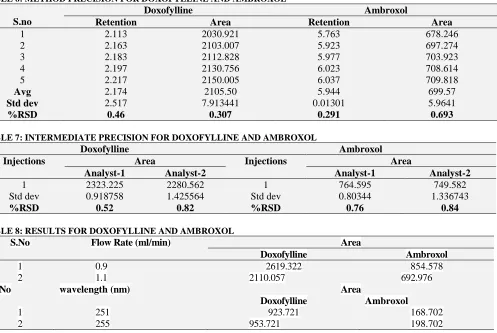
Reproducibility data for Doxofylline and Ambroxol were shown in Table 6. This indicated that method was highly precise. From the precision data of the method, the % RSD for Doxofylline and Ambroxol were found to be 0.46 and 0.29 respectively. The results were tabulated in Table 6.
Intermediate Precision:
Intermediate precision study was carried out by repeating the completed experiment with different analyst, on different days to verify that in the same laboratory the method provides the same results
once the development phase is over. Intermediate
precision for Doxofylline and Ambroxol were
[image:6.612.66.563.197.530.2]shown in Table 7 by using different analyst on different days. This indicated that method was highly precise.
TABLE 6: METHOD PRECISION FOR DOXOFYLLINE AND AMBROXOL
S.no
Doxofylline Ambroxol
Retention Area Retention Area
1 2.113 2030.921 5.763 678.246
2 2.163 2103.007 5.923 697.274
3 2.183 2112.828 5.977 703.923
4 2.197 2130.756 6.023 708.614
5 2.217 2150.005 6.037 709.818
Avg 2.174 2105.50 5.944 699.57
Std dev 2.517 7.913441 0.01301 5.9641
%RSD 0.46 0.307 0.291 0.693
TABLE 7: INTERMEDIATE PRECISION FOR DOXOFYLLINE AND AMBROXOL
Doxofylline Ambroxol
Injections Area Injections Area
Analyst-1 Analyst-2 Analyst-1 Analyst-2
1 2323.225 2280.562 1 764.595 749.582
Std dev 0.918758 1.425564 Std dev 0.80344 1.336743
%RSD 0.52 0.82 %RSD 0.76 0.84
TABLE 8: RESULTS FOR DOXOFYLLINE AND AMBROXOL
S.No Flow Rate (ml/min) Area
Doxofylline Ambroxol
1 0.9 2619.322 854.578
2 1.1 2110.057 692.976
S.No wavelength (nm) Area
Doxofylline Ambroxol
1 251 923.721 168.702
2 255 953.721 198.702
Robustness:
Preparation of Sample Solution:
400 mg of Doxofylline and 15 mg of Ambroxol were accurately weighed into 50 ml volumetric flask and dilute to volume with mobile phase. Transfer 1ml from stock solution to 100 ml with mobile phase (the solution becomes 80mcg of Doxofylline and 3mcg of Ambroxol).
Effect of variation of flow rate:
A study was conducted to determine the effect of variation in flow rate. The flow rate was varied at 0.9 ml/min to 1.1ml/min. On evaluation of the above results, it can be concluded that the variation in flow rate and wavelength not affected the
method significantly. Hence it indicates that the method is suitable even by change in the flow rate and wavelength ±10%. The robustness of the method established by making minor variations in the method parameters like, change in flow rate by ± 10 % of actual flow rate.
coefficient was found to be 0.999 and for Ambroxol is 0.998. Accuracy for the Doxofylline and Ambroxol was carried out at three different levels. The accuracy of the method is determined by recovery with spiked concentration of pure drug at three levels for Doxofylline and Ambroxol. The mean recovery for Ambroxol is 99.59% and Doxofylline is 99.44%. The % RSD for Doxofylline and Ambroxol is 0.2148 and 0.4921 respectively. In method precision the % RSD for Doxofylline and Ambroxol is 0.46 and 0.291 respectively. The flow rate was varied at 0.9 ml/min to 1.1ml/min. On evaluation of the results, it is concluded that the variation in flow rate and wavelength not affected the method significantly. Hence it indicates that the method is suitable even by change in the flow rate and wavelength ±10%.
CONCLUSION: The Proposed study describes new and simple RP-HPLC method capable of analyzing a large number of samples in a short time period with good accuracy and precision. The main purpose of the study was to develop accurate, precise and economic methods for the determination of Doxofylline and Ambroxol. Spectrophotometric technique, and post column derivatization method were applied without using any prior chemical pretreatment in the presence of the strongly overlapping spectra can generate large amounts of data within a short period of analysis.
REFERENCES:
1. European Medicines Agency ICH. Topic Q1B Photostability Testing of New Active Substances and Medicinal Products. Note for guidance on the photostability testing of new active Substances and medicinal products. January 1998
2. Indian pharmacopcoeia. The Indian Pharmacopoeia Commission Ghaziabad. Edition 7, Vol. II, 2014:1025. 3. Seifart Carola, Clostermann Ursula, Seifart Ulf, Müller
Bernd, Vogelmeier Claus, von Wichert Peter, Fehrenbach Heinz. Cell-specific modulation of surfactant proteins by ambroxol treatment. Toxicology and Applied Pharmacology 2004; 203 (1): 27–35.
4. Fois Giorgio, Hobi, Nina, Felder Edward, Ziegler Andreas, MiklavcPika, Walther Paul, Radermacher
Peter, Haller Thomas, Diet, Paul. A new role for an old drug: Ambroxol triggers lysosomal exocytosis via pH-dependent Ca2+ release from acidic Ca2+ stores. Cell Calcium 2015; 58(6):628–637.
5. Cirillo R, Barone D, Franzone JS. "Doxofylline, an antiasthmatic drug lacking affinity for adenosine receptors". Arch Int Pharmacodyn Ther 1988; 295: 221– 237.
6. Poggi R, Brandolese R, Bernasconi M, Manzin E, Rossi A (October 1989). Doxofylline and respiratory mechanics. Short-term effects in mechanically ventilated patients with airflow obstruction and respiratory failure. Chest 1989; 96 (4):772–780.
7. Dini FL, Cogo R. "Doxofylline: a new generation xanthine bronchodilator devoid of major cardiovascular adverse effects". Curr Med Res Opin 2001; 16 (4): 258–268. 8. Indian pharmacopcoeia. The Indian Pharmacopoeia
Commission Ghaziabad. Edition 7,Vol.III, 2014:1625 9. Sankar J, Lodha R, Kabra SK (March). "Doxofylline: The
next generation methylxanthine". Indian J Pediatr 2008; 75 (3):251–255.
10. Rashmitha, Joseph Sunderraj T, Srinivas CH, Srinivas N, Ray UK and Hemant Kumar Sharma and Mukkanti K. A validated RP- HPLC method for the determination of impurities inmontelukast sodium. E-Journal of chemistry2010; 7(2):555-563.
11. Sing RM, Saini PK, Mathur SC, Sing GV, and Lal B. development and validation of a RP-HPLC method for estimation of montelukast sodium in bulk and in tablet dosage form. Current trends in Biotechnology and pharmacy2010; 72(2):235-237.
12. Nimmagada S, lakshminarasu M and Praba Shankar B. Development and validation of a sensitive LC-MS/MS method with eletrospray ionization for quantification of Doxofylline in human serum. Biomed chromatography2008; 22(6): 654-61.
13. Riccioni G, Vecchia RD, D’ Orazio N, Sensi S and Guagnano MT. Comparison of montelukast and budesonide on bronchial reactivity in subjects with mild-moderate persistent asthma. Pulm Pharmacol Ther. 2003; 16:111- 115.
14. Simons FE, Villa JR, Lee BW, Teper AM, Lyttle B, Ristizabal G, Laessing W, Schuster A, Perez-Frias J, Sekerel BE, Menten J and Leff JA. Montelukast added to budesonide in children with persistent asthma: a randomized, doubleblinded, crossover study. J Pediatr. 138, 2001, 694-702.
15. Claesson HE and Dahlén SE. Asthma and leukotrienes: ntileukotrienes as novel anti-asthmatic drugs. J Inter Med1999; 245: 205-27.
16. SmitaPatil, Pore YV, Kuchekar BS, Aruna Mane and Khire UG. Determination of Montelukast sodium and Bambuteral hydrochloride in tablets using RP-HPLC. Indian J Pharm Sci2009; 71(1): 36.
17. Kamila MM, Mondal N and Ghosh LK. Development and validation of Spectrophotometric method for estimation of Doxofylline in bulk drug and pharmaceutical preparation. Ind. Jou of Che. Tec 2007; 14:523-528.
All © 2013 are reserved by International Journal of Pharmaceutical Sciences and Research. This Journal licensed under a Creative Commons Attribution-NonCommercial-ShareAlike 3.0 Unported License.
This article can be downloaded to ANDROID OS based mobile. Scan QR Code using Code/Bar Scanner from your mobile. (Scanners are available on Google Playstore)
How to cite this article: