Journal of Criminal Law and Criminology
Volume 56
Issue 3
September
Article 17
Fall 1965
A Further Look at Writing Standards
Ordway Hilton
Follow this and additional works at:
https://scholarlycommons.law.northwestern.edu/jclc
Part of the
Criminal Law Commons
,
Criminology Commons
, and the
Criminology and Criminal
Justice Commons
This Criminology is brought to you for free and open access by Northwestern University School of Law Scholarly Commons. It has been accepted for inclusion in Journal of Criminal Law and Criminology by an authorized editor of Northwestern University School of Law Scholarly Commons.
Recommended Citation
THE JOURNAL O CRIMINAL LAW, CRIMOLOGY AND POLICE SCIENCE Vol. 56, No. 3 Copyright @ 1965 by Northwetern University School of Law Prina in U.S.A.
A FURTHER LOOK AT WRITING STANDARDS
ORDWAY HILTON
Ordway Hilton is an examiner of questioned documents in New York City. He has served as Police Science Editor of this Journal for a number of years, has published extensively in the field
of questioned document examination, and is the author of the Scientifr Examination of Questioned
Documents (Caliaghan and Company, 1956). This paper was read at the First International
Meet-ing in Questioned Documents, London, 1963, of which Hilton was one of the conveners and the presiding officer, and it was subsequently translated into German and published in Kriminolistik, December, 1963. It is republished with permission.
The accuracy of handwriting opinions depends upon the accuracy of the known writing. Writing standards may be defined as specimens which tell how a person writes. To obtain such writing sounds like a simple operation, but actually, it may be one of the most complex and difficult parts of the whole
writing investigation.
Standards must reveal how a person writes. The problem is complicated, however, by the require-ment that they must show how he writes at the time at which the questioned material was, or was supposed, to have been executed. In a certain per-centage of writing investigations, a person would not write in his usual way at this particular mo-ment.
How a person writes suggests to many laymen a rather static situation. A person has certain fixed habits which identify his writing. It is a common concept that this fact tells the whole story of writ-ing identification, and with this idea in mind, in-vestigators seeking handwriting samples generally feel that one, two, or three pieces of writing cer-tainly show how the person writes. Unfortunately, writing is not static. Personal variation encoun-tered under normal writing conditions is also a highly important element of identification.
The qualities of personal variation include both its nature and its extent. Writing standards must accurately define both aspects. This requires writ-ing in quantity. If the quantity of standards is somewhat limited, experienced examiners learn to evaluate slight divergencies from the known spec-imens in terms of whether they can be attributed to normal or expected variation. Here is a judg-ment factor imposed by restricted standards which in the hands of different examiners can lead to some divergency of conclusions. Here is a judgment fac-tor which if applied too liberally or too restrictively can lead to serious error.
We must also recognize that there is the occa-sional writer whose writing presents abnormal as-pects of variation. Furthermore, writing under conditions of extreme haste and lack of care may display variables which are "abnormal" for the writer under consideration. Thus, good writing standards should be sufficient to define accurately both the identifying habits and qualities as well as the kind and extent of variation typical of the writer's handwriting under any specific writing
conditions.
Factors which cause deviation from normal writ-ing are well known. There is deliberate disguise, but this paper is concerned with temporary and more permanent physical conditions which cause changes from normal writing. Factors which can cause a particular signature to appear abnormal include writing under adverse writing conditions, such as in bed or on a pad held in the hand; illness of a serious but short duration which produces a weakness in the writing; physical exhaustion, in-toxication, and other physical conditions which affect some writers' handwriting. More continued or lasting deterioration may come with old age, terminal illnesses; diseases of the nervous system, i.e., Parkinson disease, strokes, arthritis of the hand, and the like. If a questioned signature may have been influenced by any of these conditions, it is necessary to look for known writing prepared under comparable circumstances.
A FURTHER LOOK AT WRITING STANDARDS
more accurately describe a universe, that is the whole, than a very large, unselected sample. The catch in this is that there must be careful selection, and even then the sample must not be too small. Statisticians might shudder at the restricted sam-ple size, 6 to 12 signatures, which we sometimes use. In document work because of the small sam-ple, selection must be very carefully controlled if the standards are to describe accurately and com-pletely how a person writes.
The selected writing standards need not fully describe how a person writes throughout a major portion of his life. We are concerned only with a specific time, a particular day, week, or month. The period in question may not be too accurately de-fined by the circumstances of the case, but even if not, the questioned writing was most likely pre-pared within a very short interval in a person's life. The known writing certainly must be selected, however, so that it will describe this person's writ-ing in the interval in question.
We have now created a criteria for accurate standards which in certain cases at least involves real problems-problems which sometimes can only be solved in part. The examiner and the in-vestigator must both recognize these problems and strive to solve them completely. If they cannot, then it must be recognized that the accuracy of findings are subject to greater probable error.
Let us get down to practical questions, and par-ticularly those which bother us most in handwrit-ing studies. If the writhandwrit-ing in question was prepared under normal writing conditions, both in respect to the physical surroundings and the writer's health, by an individual of average or better writing abil-ity, the selection of writing standards does not present a particularly difficult problem. Cases of this nature are routine although they may have some small challenging quirk, but otherwise can be solved on the basis of 10 or 20 contemporary sig-natures written under comparable physical condi-tions, or a few pages of general writing if this is the particular problem. But all problems are not of
this nature.
It id the special cases which give trouble. They may involve the physically able person of certain writing groups and under certain circumstances; they may involve the physically handicapped writer. The individual cases which are to be con-sidered are not exhaustive but are typical. Since signature problems are both more common and more difficult, signature standards are our present
concern. With the physically able writer some rep-resentative "headaches" include:
1. Signatures of the careless or highly erratic writer
2. Receipt signatures
3. Signatures of the near-illiterate writer. Among special problems encountered in handwrit-ing by persons sufferhandwrit-ing from some physical dis-ability we find problems such as:
4. Signatures while intoxicated
5. Signatures of the aged and on the death bed 6. Signatures during severe illness.
These problems are particularly perplexing when there is only a single questioned signature and the obvious alternative to genuineness is that some person who might benefit from the document forged it or caused it to be forged.
Technically these problems are among the more difficult which confront the document examiner, but they are usually made more troublesome by the lack of appropriate standards.
Signatures represent a limited amouitof
writ-ing, but a form of writing which is generally the most individual of any a person executes. Never-theless, because of the small quantity of writing, any abnormal variation or any deterioration due to physical causes complicates the identification problem. Unfortunately, the document examiner is not asked whether the questioned and known sig-natures are sufficiently alike to be the work of one writer, but rather, he is asked the more difficult question did the person who wrote the known
spec-imens write the questioned signature. Under some conditions we are considering, the known speci-mens may fail to show adequately how the person
wrote at this period of time. Possibly, better
spec-imens can be procured if both the examiner and the investigator recognize and face up to the prob-lem.
UNUSUAL SIGNATURES OF THE PHYSICALLY
ABLE WITER
The Eratic Writer. There is a certain group of
writers who dash off signatures with virtually no consistency. Often the signature has little distinc-tive frn. Half a dozen specimens selected at ran-dom may cause one to wonder whether they were actually done by the same person. These are cases in which the number of known specimens must be
great. With 75 or 100 known signatures, the exam-iner may still be struggling to account for some rare peculiarity which occurs in the questioned signature.
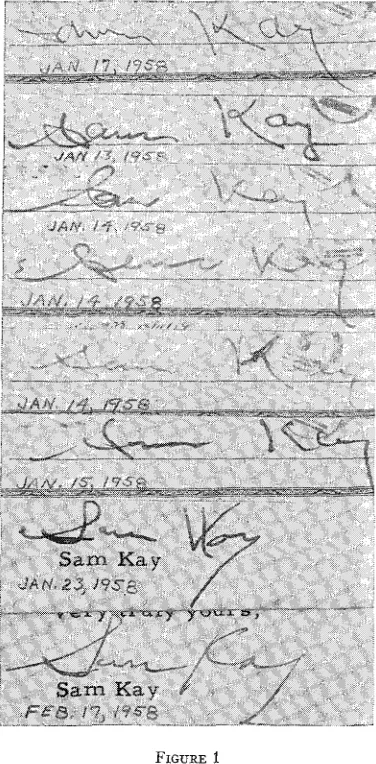
FIGURE 1
Eight signatures prepared within a period of five weeks showing variables in letter design and other identifying elements. In all between 70 and 80 signa-tures were necessary to account for the various details in a denied signature. Wide variation, rapid writing, and an apparent lack of attention to details was charac-teristic of all signatures of the writer.
With a writer of this type, even a series of sig-natures written within a week or so of the ques-tioned signature may show great variation (figure 1). In fact, the truly erratic writer almost creates one questioned signature after another. About all he actually has to do is to scribble another signa-ture on a new document and subsequently deny or dispute its authenticity. Gradually, however, with the accumulation of more and more standards, the various unusual qualities of a questioned signature, especially a denied one, are accounted for. One need
not think, however, that these are going to be ac-counted for in a precise manner. Instead, it is nec-essary to set up rather wide limits within which the signatures vary, and then to evaluate the ques-tioned signature to determine whether it fals within or outside of these limits. Judging by large sets of standards, a signature may be genuine and still have one or two elements varying beyond the usual limits. Attorneys and investigators handling problems of this nature may become weary of the constant cry for more standards, but if the matter has to be presented to a jury, it is highly desirable to continue the search until virtually every eccen-tricity is explained. This continued search should go on even though the examiner believes the ques-tioned signature is authentic despite some still un-explained divergencies.
Variation in signatures of this nature are most usually found in form elements. However, the speed with which the writing is produced and its general quality of execution may also vary to some extent. From time to time a signature is found in which special care has been given to its form by subduing the usual impulse of haste and abandon.
Adequate standards must be numerous. Signa-tures in these cases must be made up primarily of collected specimens for such a writer can com-pletely confuse the examiner with request speci-mens in which he writes his best or takes the pains to put all of the letters in his signature. With his day to day signatures, it is not unusual to find some in which several letters have been completely ig-nored.
The intended purpose of the questioned signa-ture should of course be considered, but it is gen-erally found that check signatures and signatures to correspondence or to formal documents have comparable variable qualities. In the end, any available authentic signature assists in the solution of the problem. The major task is to establish ac-curately a full picture of how the writer signs his name.
The Receipt Signature. The carelessly written
receipt signature really represents a special class of erratic signatures. It has the same lack of con-sistency but only when the writer is signing for a delivery, for example, of a letter or a telegram. With this writer under other conditions his signa-ture is reasonably uniform and superior in ioun and
execution.
A FURTHER LOOK AT WRITING STANDARDS
FIGURE 2
Two receipt signatures are shown below a formal signature of Thomas Regan. Note the lack of detail in the receipt signatures and the different capital letter forms. While this writer's receipt signatures were somewhat uni-form, they differ sharply from his formal signature.
They could have been signed against a rough plas-ter wall reflecting both the irregularities of the writing surface and the poor writing position. They could have been signed with the paper attached to a clip board while held in the hand. They could have been signed with the paper resting on the knee or in the other hand and with no support for the writing hand. To complicate the problem fur-ther, the writer may have been annoyed at having to sign at all. With the scrawled receipt signature, it is obvious that he has taken very little pains. When these receipt signatures are compared with formal signatures, the divergencies are shocking (figure 2). The scrawled, almost illegible receipt signature may bear little relationship to signatures on checks, letters, or legal documents. If denied, the layman is sure at a glance that it must be a
forgery.
With problems of this nature, the only signatures of real value are other receipt signatures. In most cases, 15 or 20 formally written signatures add al-most nothing to the picture. Request signatures may be of little value since they are usually written with care. It is very likely to be the case if the re-ceipt signature is denied. The search for additional signatures of comparable nature may be long and difficult since this class of signature is not generally preserved for long periods of time. They are, how-ever, essential if an accurate conclusion is to be reached. Certainly if trial demonstration becomes necessary, adequate, comparable receipt signatures are almost mandatory.
The Near-Illiterate Writer. With a person whose
total writing ability can be summed up as being able to "sign his name," production of a signature
is apt to be a slow, laborious task. His signature probably never has developed beyond the stage of creating it letter by letter. His writing is a deliber-ate act rather than semi-automatic. The signature is nearly drawn, plodding, and its design is primi-tive. This kind of writer only signs his name when he has no other alternative so he has created few examples. Problems involving these signatures tend to be troublesome.
First we are faced with the difficulty of locating a sufficient quantity of genuine signatures. A few of these writers produce fairly uniform signatures, but with many it is extremely difficult for them to repeat forms with the consistent pattern found in more developed writing. The genuine signatures are filled with strokes which are slow and drawn, with forms which are crude and may have been put together stroke by stroke. Many signatures stand-ing alone suggest forgery. The amount of variation from one to the next may be excessive. So the dif-ficulty in finding an adequate quantity of signa-tures is frequently complicated by the serious need for more than the usual number of standards. Fortunately, collected standards can be supple-mented by request specimens if the writer is living. While the search for an adequate number of stand-ards may be long and arduous, when they are as-sembled the identification can be very accurate and convincing.
SIGNATURES OF PHYSICALLY IMPAIRED WRITERS
The Intoxicated Signature. Excessive
ORDWA Y HILTON
FIonio 3
A formal signature of Dickinson together with four signatures signed on a single night for drinks at a club bar. Note the progressive lack of detail that is encountered in each signature compared to the earlier ones. Not only is there the element of the influence of alcohol in these signatures; but judging by the first signature, a further
element of lack of care in signing such an informal signature.
quantities of alcohol before their signature is in-fluenced. In general excessive consumption of al-cohol introduces some deterioration in writing, a lack of accurate coordination which leads to in-ferior signature design. The overall writing skill declines, although writers with developed, con-nected writing still strive to write this way. In more extreme instances, while the signature as-sumes "a drunken stagger," some parts are formed with an "I don't care" abandon. Successive signa-tures wander away from the normal design and also the design of the immediately preceding sig-nature in somewhat unpredictable ways-in other words variations become great. Successive speci-mens written during the same night of drinking-i.e., signing club chits for successive rounds of
drinks-vary greatly in many identifying elements (figure 3). What we are concerned with in this dis-cussion is not the extent that alcohol affects writ-ing but how to obtain comparable specimens which can be used effectively in accurately identifying a signature which clearly reflects the influence of excess alcohol.
When confronted with a signature which reflects a degree of intoxication, the problem of obtaining known specimens may be less difficult than with
other classes of abnormal signatures. A writer who may have signed a questioned document under the influence of alcohol probably has signed others on other occasions. In most cases involving heavy drinkers, proper investigation uncovers a number of signatures showing various evidences of intox-ication. Again, wider range of variation requires more authentic specimens, and these specimens should be "intoxicated" rather than "sober" sig-natures, sometimes a substantial obstacle.
A FURTHER LOOK AT WRITING STANDARDS
FIGURE 4
The top signature of William Boyne was written ten years before the five lower signatures. For several years prior to death, Boyne's signature had seriously deteriorated, and these check signatures were typical of his sig-natures during the last years of his life. It was reported that Boyne was active and was not confined to his home
during much of this time, but yet his signature had lost much of its coordination and skill.
ciently drunk to prepare appropriate specimens of writing.
In passing, it should be observed that the use of drugs, and once in a while physical disability from other causes, produces physical symptoms sug-gesting intoxication. If the reaction is carried over into the writing, comparable observations on these standard requirements can be made.
Old Age Deterioration. Very difficult problems may be encountered with signatures which have seriously deteriorated due to the writer's age or to terminal illness. Of these, the death bed signature is particularly perplexing since the deterioration may have been rapid with little or no forewarning in earlier signatures. With decrepit signatures of an aged writer, the decline normally occurs grad-ually over a period of months or years. More known specimens revealing writing weaknesses are there-fore available than with death bed signatures.
Writing of this nature is characterized by a lack of fluency in execution and inaccuracy and incon-sistency in details of form. It is not as good writing as earlier signatures by the same person (figure 4). Study of a series of signatures by an infirm writer reveals much greater variation from signature to signature than was typical of vigorous signatures
of earlier years. The inconsistency of these signa-tures, which in some cases is very prominent, com-plicates the problem. In order to reach the most accurate conclusions, two or three times the normal number of signatures may be needed, and they must be closer in date to the signature in question than in the usual case. Although a sufficient num-ber of signatures may have been executed, it is often hard to locate them.
We are confronted with the same identification problem with the death bed signature. But a dying person is not signing his name frequently. In fact, he signs his name only for the most urgent reasons. With many, this is only once or twice. Oftentimes, available genuine signatures are almost as suspect as the death bed signature, since circumstances surrounding their preparation are so like the ques-tioned signature (figure 5). (E.g., at the time all specimens were written, the writer was being cared for by the one member of the family who is strongly favored by a disputed will.) Because of the very small number of signatures which are comparable to the death bed signature, it is virtually essential that all be studied. It is still likely that the total signature production will be far too few.
in-ORDWA Y HILTON
FIGURE 5
The Erlwein signatures shown above reveal a rather rapid decline due to illness. The lower three signatures were written in early August, a month or a month and a half before death. The check signature at the top was written in February of the same year.
elude as many signatures written during the period of decline as can be obtained. There is advantage in supplementing them by earlier, more vigorous signatures, even though they are not representative of the questioned period. These specimens do give the examiner some idea of the basic model which the writer is attempting to duplicate. When a large group of infirm signatures, say at least 25, can be obtained reasonably accurate solutions can be reached. Usually far fewer signatures are located. Then there must be serious "leaning on experience" to judge whether the questioned signature would digress from the standards in the way that it seems to. The fewer infirm signatures there are for study, the less accurately the usual case can be answered. Opinions rendered must frequently be treated most cautiously and conservatively in order to minimize
errors.
The Sick Bed Signature. Infirm signatures
writ-ten on a sick bed, as opposed to death bed signa-tures, represent badly deteriorated signatures of a writer who subsequently regains some or all of his writing vigor. A signature of this kind may have been written immediately after a serious accident .or operation when it was believed essential to ex-ecute the particular document. Periods of illness, especially severe illness, are not times when one is apt to do much writing, and so there may be only
limited numbers of signatures written. Thus, the right kind of standards, therefore, are extremely difficult to locate, if they exist at all.
The writer's weakened condition is normally complicated by the fact that the signature was written while propped up in a bed or at times under worse writing conditions. The writing position, as much as the physical weakness, leads to a low qua.. ity signature. These factors must be considered in collecting standards and examining the case.
Sick bed signatures, like most of these special signature cases we are considering, can most ef-fectively be solved with more signatures than in the general run of cases. Unfortunately, the writer may never have executed a sufficient number of signatures while sick to satisfy the true needs of the examiner. In fact, the questioned signature may be the only example written during the illness. Writing at request after recovery does not help much if the person has completely regained his writing vigor. In some instances, the person may have gone through a long recovery period during which he did some writing, and the quality of the signatures are below his pre-illness or post-recovery vigor. These specimens can be of help in giving some idea of how his signature declined and are certainly better than having to depend exclusively on his normal specimens.
A FURTHER LOOK AT WRITING STANDARDS
CONCLUSIONS
The routine signature problem does not require the close control in selection of standards that is necessary in the class of cases discussed in this paper. Normally, ten or twenty authentic signa-tures written near the date in question and for the same general purpose are satisfactory standards.
We have seen, however, that there are ques-tioned signatures by abnormal writers and signa-tures prepared under special conditions in which the problem of getting adequate and accurate known specimens is the most difficult phase of the