Using Semantic Mapping for Semantic
Based Publish/Subscribe System
A thesis submitted to the University of Dublin, Trinity College
for the degree of Doctor in Philosophy
Song Guo
Knowledge and Data Engineering Group, School of Computer Science and Statistics,
Trinity College, Dublin
Declaration
I, the undersigned, declare that this work has not been previously submitted as an exercise for a degree at this or any other University, and that, unless otherwise stated, it is entirely my own work.
Permission to lend or copy
I, the undersigned, agree that the Trinity College Library may lend or copy this thesis upon request.
ACKNOWLEGDEMENTS
I would like to take this opportunity to express my gratitude to those who helped me with various aspects of conducting research and the writing of this thesis. First and formost, I would like to thank my superviors Declan O’Sullivan and David Lewis for their education, support, patience and gentle persistence keep me motivated throughout my Ph.D. study and the many revisions of this thesis. They taught me a lot on how to conduct research, write quality papers, and present academic talks. Especially thanks to John Keeney, for his posdoctorial support and contributions to this work. Many research works I completed were attributed to his insights and innovative ideas.
I would like to especially thank my love Yanhua Lu for her absolute belief, constant encourage, unwavering support and the many sacrifices.
Thank you to my parents, I own thanks for their wonderful love and encouragement. I would also like to thank my brother, since he insisted that I should do so.
ABSTRACT
Routing of information within heterogeneous, distributed network domains (e.g. communication networks, ubiquitous computing environments) is a key challenge that must be tackled for such environments to be successful. Increasingly, it is accepted that such routing systems need to cope with mobile and volatile sources and destinations of heterogeneous information, and Semantic-based Publish/Subscribe (SBPS) systems have been proposed as a means to support this. However such systems typically assume a common semantic model underpinning the routing.
Devices, network resources and applications within network domain environments are likely to be heterogeneous, as they will be produced by different vendors who will each have different priorities and design philosophies. It is unlikely that a single standardized semantic model for communication will gain widespread adoption and the need for exchange of heterogeneous information will persist. The SBPS systems must allow applications/SBPS routers to use different semantic models to communicate with each other without the necessity of custom building gateways. Finally the system must support flexible, adaptive semantic interoperability to cater for the dynamics of such environments.
The KBNMap system proposed in this thesis uses an adaptive, multi-strategy mapping service approach (comprising a set of mapping strategies and adaptive strategy selection mechanism) for the purpose of supporting multiple semantic models within a SBPS, in support of routing heterogeneous information over a network in an appropriate and adaptive manner. The mapping strategies are used for efficiently loading semantic mappings for use with distributed and heterogeneous knowledge-based applications. The probabilistic-based strategy selection mechanism enables the system to dynamically select the appropriate mapping strategy, in order to adapt to the dynamics of the environment where aspects of the semantic models, applications and network environment are constantly changing.
TABLE OF CONTENTS
DECLARATION ... I
PERMISSION TO LEND OR COPY ... II
ACKNOWLEGDEMENTS ... III
ABSTRACT ... IV
TABLE OF CONTENTS ... V
TABLE OF FIGURES ... X
TABLE OF TABLES ... XII
ABBREVIATIONS ... XIII
1
INTRODUCTION ... 1
1.1
M
OTIVATION... 1
1.2
R
ESEARCHQ
UESTION... 3
1.3
T
HESISC
ONTRIBUTIONS... 5
1.4
T
ECHNICALO
VERVIEW... 7
1.4.1
Research Approach ... 7
1.4.2
Overview of Thesis ... 8
2
BACKGROUND ... 10
2.1
I
NTRODUCTION... 10
2.2
I
NTRODUCTION TOO
NTOLOGY... 10
2.2.1
Ontologies ... 11
2.2.2
Ontology Language ... 13
2.3
S
EMANTICI
NTEROPERABILITY BETWEENO
NTOLOGIES... 15
2.3.1
Ontology Heterogeneity ... 15
2.3.2
Overview of Ontology Mapping ... 16
2.4
“XG
P
OLICYD
ISTRIBUTION”
S
CENARIO... 21
2.5
P
UBLISH/S
UBSCRIBEM
IDDLEWARE... 23
2.5.1
Traditional Pub/Sub Systems ... 24
2.5.2
Advantages of Pub/Sub Systems ... 24
2.5.3
Disadvantages of Traditional Pub/Sub Systems ... 25
2.6
C
ONTENT-
BASEDN
ETWORKING... 26
2.6.1
Siena ... 27
2.6.2
Elvin ... 29
2.6.3
Hermes ... 30
2.6.5
Advantages of CBN ... 30
2.6.6
Disadvantages of CBN ... 31
2.7
XML-
BASEDP
UB/S
UBS
YSTEM... 31
2.8
K
NOWLEDGE-
BASEDN
ETWORKING... 32
2.9
C
ONCLUSION... 32
3
STATE OF THE ART: SBPS SYSTEMS WITH SEMANTIC
INTEROPERABILITY ... 34
3.1
I
NTRODUCTION... 34
3.2
B
ASICT
AXONOMY OFSBPS
S WITH RESPECT TOK
EYF
EATURES... 35
3.2.1
Structural Taxonomy ... 35
3.2.2
Key Features ... 38
3.3
A
DVANCEDT
AXONOMY OFSBPS
S WITH RESPECT TOS
EMANTICI
NTEROPERABILITY... 44
3.3.1
Semantic Interoperability Support ... 45
3.3.2
Adaptive Configuration of Semantic Interoperability ... 48
3.4
E
XISTINGS
EMANTIC-
BASEDP
UB/S
UBS
YSTEMS... 54
3.4.1
Semantic-Toronto Pub/Sub System (S-ToPSS) ... 55
3.4.2
Ontology Pub/Sub System (OPS) ... 57
3.4.3
Ontology-based Pub/Sub System (OBPS) ... 58
3.4.4
Continuous Querying Syndication System (CQS) ... 59
3.4.5
Elvin with Ontology-Elvin(O) ... 60
3.4.6
Semantic Pub/Sub with Super-Peers (SPS-SP) ... 61
3.4.7
Knowledge-based Networking Implementation (KBNImpl) ... 62
3.4.8
Cashua ... 67
3.5
C
OMPARATIVEA
NALYSIS... 69
3.5.1
Comparison of SBPSs with respect to Key Features ... 69
3.5.2
Comparison of SBPSs with respect to Semantic Interoperability Support ... 73
3.6
K
EYC
HALLENGES OFSBPS
S
YSTEMS... 76
3.7
C
ONCLUSION... 77
4
AN ADAPTIVE SEMANTIC MAPPING SERVICE ... 78
4.1
I
NTRODUCTION... 78
4.2
D
ESIGN TOA
DDRESSK
EYC
HALLENGES... 78
4.2.1
Addressing “Support for Multiple Semantic Models” ... 78
4.2.2
Addressing “Adaptation to Changes” ... 79
4.3
S
EMANTICM
APPINGE
NHANCEDKBNI
MPLA
RCHITECTURE(KBNM
AP) ... 80
4.3.2
Overall Architecture of KBNMap ... 83
4.3.3
Components Supporting Heterogeneity ... 85
4.3.4
Semantic Mapping Strategies ... 86
4.3.5
Initial Evaluation/Discussion of Mapping Strategies ... 93
4.4
H
ETEROGENEITYR
ESOLUTIONE
XAMPLE... 95
4.5
D
ESIGND
ISCUSSION... 98
4.6
C
ONCLUSION... 100
5
MAPPING STRATEGY SELECTION MECHANISM ... 101
5.1
I
NTRODUCTION... 101
5.2
I
DENTIFICATION OFT
RIGGER FACTORS... 101
5.2.1
Ontology-based Trigger factors ... 102
5.2.2
Application-based Trigger Factors ... 116
5.2.3
Environment-based Trigger Factors ... 117
5.3
G
ENESIS OF THEP
ROBABILISTICA
PPROACHU
SED... 118
5.4
U
SINGB
AYESIANN
ETWORKS FORS
ELECTINGM
APPINGS
TRATEGY... 124
5.4.1
Motivation of Using Bayesian Network ... 124
5.4.2
Overview of Bayesian Network ... 126
5.4.3
Methodology: Constructing BN Model for Predicting Appropriate
Mapping Strategy ... 127
5.4.4
Evaluating BN Model with Representative Cases ... 144
5.5
E
NTIREP
ROCESS... 147
5.6
C
ONCLUSION... 149
6
IMPLEMENTATION ... 150
6.1
I
NTRODUCTION... 150
6.2
T
ECHNOLOGYU
SED... 151
6.3
R
EGISTRATIONI
NTERFACES ANDM
ODELS
TORE... 153
6.3.1
Client Register Interface ... 153
6.3.2
Router Connection Interface ... 153
6.3.3
Model Registration Interface ... 153
6.3.4
Ontology/Mapping Model Stores ... 154
6.4
A
DAPTIVES
EMANTICM
APPINGS
ERVICEB
LOCK... 155
6.4.1
Trigger Factor Value Collector ... 156
6.4.2
Evidence Processor ... 157
6.4.3
Adaptive Strategy Selection Engine ... 159
6.4.5
Semantic Mapping Strategies ... 163
6.5
U
SING THEKBNM
APS
YSTEM... 166
6.5.1
Starting a KBNMap Router ... 167
6.5.2
Implementing a Subscriber ... 167
6.5.3
Implementing a Publisher ... 168
6.5.4
Configuring Ontologies for a KBNMap Router ... 168
6.5.5
Implementing a Network Administrator ... 169
6.5.6
Running the example ... 169
6.6
C
ONCLUSION... 171
7
EVALUATION ... 173
7.1
I
NTRODUCTION... 173
7.2
E
VALUATIONG
OALS... 174
7.3
E
VALUATIOND
ESIGNO
VERVIEW... 175
7.4
S
TAGE1:
C
HARACTERISATION OFT
ESTINGS
ETS... 177
7.4.1
Selected Trigger Factors ... 178
7.4.2
Three Categorized Testing Sets ... 179
7.5
S
TAGE2:
T
HEO
NTOLOGIESU
SED... 181
7.5.1
Dataset Description ... 182
7.5.2
Routing and Referenced Ontologies ... 182
7.5.3
Mapping Ontologies ... 184
7.6
S
TAGE3:
D
ESIGN OFG
ENERALS
ETUP... 185
7.6.1
Design of KBNMap Network Topology ... 185
7.6.2
Characteristics of Subscriber ... 187
7.6.3
Characteristics of Publisher ... 188
7.7
S
TAGE4:
E
XPERIMENTS
ETUP... 189
7.7.1
Measured Metrics ... 189
7.8
E
XPERIMENT1:
C
OMPARING THES
TRATEGIES... 191
7.8.1
Design ... 191
7.8.2
Results ... 192
7.8.3
Overall Experiment Findings ... 200
7.9
E
XPERIMENT2:
T
HEKBNM
APP
ERFORMANCE... 202
7.9.1
Overview ... 202
7.9.2
Design ... 203
7.9.3
Testing Set A: Unknown Data Rate with Message Rate ... 204
7.9.5
Testing Set C: Unknown Data Rate with Memory Resources ... 211
7.9.6
Overall Analysis of KBNMap’s Performance ... 215
7.10
E
XPERIMENT3:
THEA
DAPTABILITY OFKBNM
AP... 216
7.10.1
Overview ... 216
7.10.2
Results ... 217
7.10.3
Overall Analysis of KBNMap’s Adaptability ... 220
7.11
C
ONCLUSION... 221
8
CONCLUSIONS ... 225
8.1
I
NTRODUCTION... 225
8.2
S
TATE OF THEA
RTE
VALUATION... 225
8.3
O
BJECTIVES ANDA
CHIEVEMENTS... 228
8.4
C
ONTRIBUTIONS... 233
8.5
F
UTUREW
ORK... 237
8.6
F
INALR
EMARKS... 238
TABLE OF FIGURES
Figure 2-1: Global hierarchy of region mapping ontology ... 22
Figure 2-2: Publish/Subscribe middleware ... 23
Figure 2-3: Hierarchical client/server topology (Carzaniga et. al., 2001) ... 28
Figure 3-1: Fundamental characteristics of Pub/Sub systems (Meier et. al., 2005) ... 36
Figure 3-2: Key features of SBPS system ... 37
Figure 3-4: Hierarchical client/server topology (Carzaniga et. al., 2001) ... 41
Figure 3-3: Architecture model of SBPS Systems ... 41
Figure 3-5: Semantic clustering topology (Keeney et. al., 2008b) ... 42
Figure 3-6: Peer-to-peer topology with super peers (Chirita et. al., 2004) ... 42
Figure 3-7: Basic taxonomy of Semantic Interoperability in SBPS ... 45
Figure 3-8: Semantic Interoperability Support in SBPS system ... 46
Figure 3-9: Trigger factors for supporting adaptive Semantic Interoperability ... 50
Figure 3-10: A graphical representation of an excerpt from the Wine ontology ... 64
Figure 4-1: A high level architecture of the SBPS Router extended with the Adaptive
Semantic Mapping Service ... 81
Figure 4-2: KBNMap Architecture ... 83
Figure 4-3: Workflow of Mapping Strategies ... 88
Figure 4-4: Subscription/Publication Resolution Process ... 97
Figure 5-1: Illustration of classes positions in class hierarchical tree ... 104
Figure 5-2: The effect of ontology size on reasoning time ... 110
Figure 5-3: Classification performance for different operators ... 113
Figure 5-4: Realisation performance for different operators ... 114
Figure 5-5: Classification performance for different concept positions ... 114
Figure 5-6: Realisation performance for different concept positions ... 115
Figure 5-7: Influences of trigger factors on Strategy Selection ... 119
Figure 5-8: Connection or causality relations between the variables ... 127
Figure 5-9: BN Model (Alpha_version) illustrating the favourable combinations of
influential factors for selecting mapping strategy ... 130
Figure 5-10: Changing the findings of UnknownData ... 142
Figure 5-11: Mapping Strategy Decision BN Model (Beta_level) ... 143
Figure 5-12: A sample of case file ... 145
Figure 5-13: the Logarithmic loss value of BN model ... 147
Figure 5-15: Process of adaptively selecting mapping strategy in KBNMap router .... 148
Figure 6-1: KBNMap router architecture ... 151
Figure 6-2: Adaptive semantic mapping service block ... 156
Figure 6-3: Snippet of configuration file for monitoring trigger factors ... 156
Figure 6-4: Snippet of Data Translation Table ... 158
Figure 6-5: Snippet of Configuration Table ... 158
Figure 6-6: UML class diagram for adaptive strategy selection engine classes ... 161
Figure 6-7: Snippet of Bayesian Network model for strategy selection ... 162
Figure 6-8: A simple Subscriber ... 167
Figure 6-9: A simple publisher ... 168
Figure 6-10: Snippet of OntSienaConfig class. ... 169
Figure 6-11: Snapshot of master server at network runtime ... 170
Figure 6-12: A snapshot of master router when it deals with an unknown publication 171
Figure 7-1: An experimental hierarchical KBN topology for evaluation ... 186
Figure 7-2: Small unknown data case: publication matches of KBNFix deployments 193
Figure 7-3: Small unknown data case: publication end-to-end delay times of KBNFix
deployments ... 194
Figure 7-4: Medium unknown data case: publication matches of KBNFix deployments
... 196
Figure 7-5: Medium unknown data case: publication end-to-end delay of KBNFix
deployments ... 197
Figure 7-6: Large unknown data: publication matches of KBNFix deployments ... 198
Figure 7-7: Large unknown data case: Publication end-to-end delay time ... 199
Figure 7-8: Comparing the semantic interoperability strategies ... 200
Figure 7-9: Pub matching times: large unknown data rate with high message rate ... 206
Figure 7-10: Pub end-to-end delay: large unknown data rate with large message rate 206
Figure 7-11: Pub matching times: small unknown data rate with medium tolerance ... 209
Figure 7-12: Pub end-to-end delay: small unknown data rate with medium tolerance 210
Figure 7-13: Pub matching time: High Unknown Data Rate with High Memory
Resources ... 213
TABLE OF TABLES
Table 3-1: Covering relations between semantic operators ... 65
Table 3-2: Comparison of Selected SOA systems wrt key features ... 71
Table 3-3: Comparison of Selected SOA systems wrt Semantic Interoperability ... 75
Table 4-1: Conditions of Loading Second Ontology ... 91
Table 4-2: Characteristics of Mapping Strategies ... 95
Table 5-1: Individual ontology characteristics ... 105
Table 5-2: Characteristics of ontologies merged using manually created mappings .... 106
Table 5-3: 70 mapping ontologies, categorised in 7 types ... 107
Table 5-4: Provides a summary of the reasoning metrics ... 109
Table 5-5: Comparing the analysis time of a merged ontology with the reasoning time of
its constituent ontologies ... 112
Table 5-6: Comparing the runtime query time of a merged ontology with the runtime
query time of its constituent ontologies ... 112
Table 5-7: Which strategy is appropriate for some factors ... 123
Table 5-8: The Assignment of Boundary Values for Node State ... 132
Table 5-9: Conditional Possibility Table for the Stategy_Selection Node ... 137
Table 5-10: Sensitivity of Strategy_Selection due to findings at its parent nodes ... 141
Table 5-11: Sensitivity of Strategy_Selection due to findings at parentless nodes ... 141
Table 7-1: Individual Ontology Characteristics ... 183
Table 7-2: Characteristics of Mapping Ontologies ... 184
Table 7-3: Factor configurations to compare semantic interoperability strategies ... 192
Table 7-4: Testing set A: factor configurations to KBNMap and KBNRan deployments
... 205
Table 7-5: Testing Set B: factor configurations to KBNMap and KBNRan deployments
... 208
Table 7-6: Testing Set C: factor configurations to KBNMap and KBNRan deployments
... 212
Table 7-7: Testing Set A: weightings of mapping strategies in KBNMap ... 217
Table 7-8: Testing Set B: weightings of mapping strategies in KBNMap ... 218
Table 7-9: Testing Set C: weightings of mapping strategies in KBNMap ... 219
Table 8-1: Comparison of KBNMap with State of the Art SBPSs ... 227
ABBREVIATIONS
API Application Programmers Interface
CBN Content-Based Networking
CIM Common Information Model
CQS Continuous Querying Syndication System
DAML DARPA Agent Mark-up Language
DL Description logic
DMTF Distributed Management Task Force
HTML Hypertext Mark-up Language
IETF Internet Engineering Task Force
KBN Knowledge-based Networking
KBNFix A special version of KBNMap that is encoded with a fixed strategy KBNImpl The Implementation of Knowledge-based Networking
KBNMap Knowledge-based Networking with Mapping
KBNRan A special version of KBNMap that randomly selects Mapping Strategy
MIB Management Information Base
NGN Next Generation Network
NGS Next Generation Service
OAEI Ontology Alignment Evaluation Initiative OPS Ontology-based Publish/Subscribe System
OWL Web Ontology Language
OWL-S Web Services Ontology Languages
P2P Peer to Peer
RDF Resource Description Framework
RDFS Resource Description Framework Schema
SBPS Semantic-based Publish/Subscribe System
SOA Service-oriented Architecture
SPS-SP Semantic Publish/Subscribe with Super-Peers S-ToPSS Semantic Toronto Publish/Subscribe System
TMN Telecommunication Management Network
UML Unified Modelling Language
W3C World Wide Web Consortium
1 INTRODUCTION
In this thesis, the key challenges of distributing semantic information drawn from different semantic models in Semantic-based Publish/Subscribe (SBPS) networks will be identified. A novel adaptive, multi-strategy seman
tic mapping approach will be presented in order to allow SBPS systems to efficiently make use of semantic mappings for addressing these key challenges.
In this chapter, the motivation of this thesis is given in Section 1.1. Then Section 1.2 identifies the research question of the thesis on the basis of the motivation. Section 1.3 outlines the contributions of this thesis to the area of Semantic-based Publish/Subscribe systems. Finally the research approaches adopted and overview of the thesis chapters is outlined in Section 1.4.
1.1
Motivation
Increasingly, coping with extreme heterogeneity and rapid evolution of applications and information, in combination with the need for high throughput, low-latency of messages between large, volatile populations of applications, is a key challenge identified in (Goksel et. al., 1999; Wong et. al., 2005; Chakraborty et. al., 2005; Patrick et. al., 2006; Deng et. al., 2007; ) that needs to be addressed in several important networked domains. These include communication network environments (Strassner et. al., 2007); and ubiquitous computing environments (Power 2008).
In the area of communication networks, network resources will always be heterogeneous and thus have different functionalities and programming models (Strassner et. al., 2007). For example, information models used within network devices, network elements and services can be different (e.g. Distributed Management Task Force’s (DMTF) - Common Information Model (CIM); TeleManagement Forum (TMF) - Shared Information/Data Model (SID); Internet Engineering Task Force (IETF) - Structure of Management Information (SMI) and so on). When management information is passed between such heterogeneous devices, network elements, services and managed networks, it is desirable to support the publication of information from these information models in their own format rather than forcing them to use a common canonical information model.
example, when it comes to contextual information, many applications choose to design their own context model, rather than reusing existing ones (Power 2008). These models evolve over time, as applications evolve and new devices and application emerge. Thus, it is unlikely that a single standardised model for context will gain widespread adoption and the need for exchange of heterogeneous information will persist.
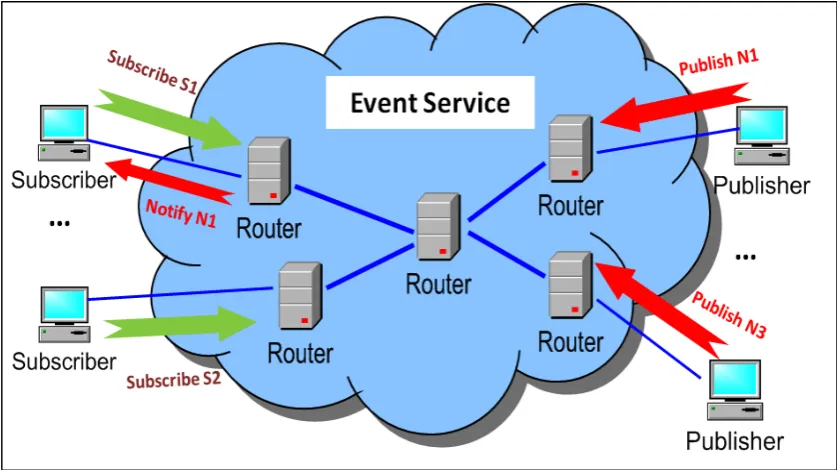
The Publish/Subscribe (Pub/Sub) paradigm (Meier et. al., 2005) holds promise for providing loosely coupled communication between various applications and distributing information in such large scaled, distributed networked environments. Applications can subscribe to information that are of interest to them without considering the origin of the information, while applications simply publish information without addressing it to any destination in particular. However, existing Pub/Sub systems require that decoupled publishers and subscribers either share a common type set in order to express their mutual interests such as subject-based Pub/Sub; or match messages to consuming client interests by specifying a filter on the messages’s attribute values such as Content-based Pub/Sub. However, there is increasingly a need for Pub/Sub systems to support a richer expressiveness that can cope with frequently changing range of message content and consumer subscriptions. The standardisation of ontology languages by the Semantic Web initiative at the World Wide Web Consortium (W3C) has spurred an increasing number of researchers to use ontology-based semantics as a means to support richer descriptions of information based on a shared encoding of semantic model. (Wang et. al., 2004; Masuoka et. al., 2004; Belecheanu et. al., 2004).
Several researchers have attempted to combine ontology-based semantics with Pub/Sub systems (Halaschek-Wiener et. al., 2007; Skovronski et. al., 2006; Chirita et. al., 2004; Wang et. al., 2004; Burcea et. al., 2003), such that the semantics of the message play an important part in the matching of publications to subscriptions. Such systems are termed Semantic-based Publish/Subscribe (SBPS) systems. The majority of developed SBPSs to date have been focused on applications that assume an homogeneous domain, and so mainly enable the publisher and subscriber applications share a single agreed common semantic model. Thus the common semantic model allows communication and knowledge sharing among distributed applications by providing a semantically rich description and a common understanding of a domain of interests.
this perspective, it is desirable to have a solution for SBPSs to allow interoperability between semantically related, but heterogeneously instantiated semantic models.
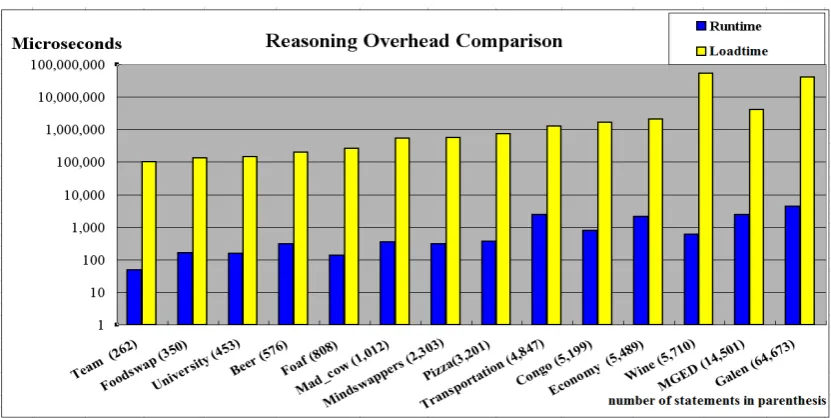
Rather than force multiple parties in different domains to agree on shared semantic model, a more tractable approach is to support interoperability between different semantic models. To solve this kind of heterogeneity, semantic mappings are typically used to express semantic correspondence between diverse semantic models. Thus, in order to support the distribution of knowledge based on different models in a Pub/Sub manner, SBPS system can leverage such use of semantic mappings. The incorporation of semantic mappings within the SBPS routers would mean that applications or brokers that subscribe to information according to one semantic model can expect to receive information published according to a different semantic model, if there exists a mapping between the semantic models. However, the introduction of such a feature inevitably would have an impact on the performance of the system. This is clear from the research described in (Lewis et. al., 2006b), which shows the impact of introducing different semantic models into a SBPS router’s knowledge base at loadtime, or indeed runtime. In addition, the dynamic nature and diversity of the networked domains mentioned, require that the handling of multiple semantic models and mappings in the SBPS routers will need to be designed in a flexible fashion, so that the performance of SBPS systems can be tuned depending on the deployment scenario.
1.2
Research Question
The research question answered in this thesis is how to enable the management of a Semantic-based Publish/Subscribe system to distribute heterogeneous information, in an application and ontology appropriate manner. Here “heterogeneous” refers to the heterogeneity between the multiple semantic models that applications or routers use to express their information. Rather than focus on any one particular application domain or set of ontologies, it was decided to design a general solution applicable to several domains and types of ontologies. Thus, the phrase “... application and ontology appropriate manner” indicates that the solution developed must be based on a characterisation of both ontology, environment and application features. To aid readability, the thesis however provides some examples applications throughout generally in the pervasive computing/networking domain.
called Knowledge Based Networking with Mapping (KBNMap). As the research area of semantic mapping is itself quite large, it was decided to focus only on approaches that would use semantic mappings rather than discover or create semantic mappings. In addition only one-to-one mappings, expressed in OWL (OWL 2004a; OWL 2004b) were used. These mappings provide a set of semantic correspondences between entities in different semantic models using the following operators: semantic equivalence, subclass, superclass, subproperty, superproperty. To address the presented research question, the following objectives were derived:
Objective 1:Identify the key features, semantic heterogeneity and criteria
to influence how to handle heterogeneity in SBPS systems
The first objective was to conduct a survey on existing approaches that use semantic-web technologies for enhancing Pub/Sub systems, to establish the state of the art in this area. This survey identified the key features identified by others when building Semantic-based Pub/Sub systems. In addition, the author proposes a set of criteria that are needed in the classification for related to support for semantic interoperability. A survey was undertaken to identify the key factors that influence how to address heterogeneous information in SBPSs.
Objective 2:Present a comprehensive framework to handle heterogeneous
information in SBPS systems
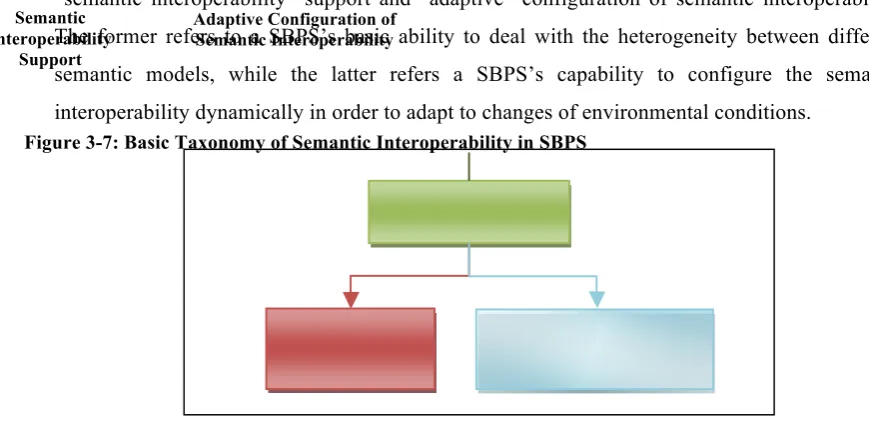
The second objective was to present a comprehensive framework to deal with heterogeneous information in SBPS systems in an appropriate manner. Taking account of the diversity of the identified influential factors in objective 1, a range of semantic mapping strategies was required, along with a dynamic mechanism to adaptively select one of the mapping strategies. The multiple mapping strategies aim at addressing semantic heterogeneity for SBPS systems in different situations while the mapping strategy selection method enables the dynamic selection of the appropriate mapping strategy to adapt to the changes of ontology, application and environment based characteristics.
Objective 3:Implement, evaluate and verify this presented approach.
comprehensive evaluation and verification of the implemented approach was achieved through a series of experiments using KBNMap.
1.3
Thesis Contributions
1.
Design of a multi-strategy mapping approach for SBPS systems to deal with
heterogeneous semantic information
The first major contribution of this thesis is the design of a multi-strategy mapping framework for any SBPS systems to deal with semantic heterogeneity. The semantic mapping approach uses semantic mappings to resolve heterogeneous information and allow multiple diverse semantic models to coexist in SBPS networks, which is a current gap in the state of the art. This is important, as relying on a single common semantic model shared among applications in a heterogeneous, distributed deployment environment is unrealistic. The proposed multi-strategy mapping approach also enables SBPS systems to cater for different deployments and situations through the provision of multiple mapping strategies. This is also important, as providing a fixed mapping service to handle all situations and to satisfy various requirements is impracticable. The enhanced SBPS network could therefore supports both heterogeneity and dynamism in the environment.
2.
A comprehensive literature review of existing SBPS systems and a taxonomy of
key features for evaluating SBPS systems
3.
Identification of key factors that influence provision of a semantic mapping
service in a SBPS system
Another contribution is the findings arising from both the literature review and the experimentation that a characterisation of the ontologies, applications, and environment for a given SBPS deployment is very useful in determining which semantic interoperability strategy is appropriate to ensure efficient performance of the SBPS system. To support the dynamics of networks, a SBPS system might have multiple semantic interoperability strategies to address heterogeneity. A critical challenge arises with the appropriate management and runtime configuration of multiple mapping strategy mechanisms, adapting to the semantic complexity of the ontologies, dynamism of applications and constant changes of environmental conditions within the network. For example, the environmental state of a network may be changed (e.g., nodes dynamically join and leave); messages that are semantically ambiguous at one time may be unambiguous if viewed later after the range of possible messages becomes more refined.
4.
Provide an adaptive mapping strategies selection approach, based on the
identified influential factors above.
Another major contribution is the provision of an adaptive mapping strategy selection approach to support SBPS systems to dynamically and adaptively respond to changes of key factors identified above. This is important, as the dynamic and constantly changing nature of the large-scale networked domains will inevitably lead to unpredictable and unobservable changes of the environmental conditions, which in turn will influence the efficiency of the mapping service. Through a probabilistic-based mechanism, KBNMap has the capability to adapt to the dynamics of environmental conditions to ensure the efficiency of its mapping service. As conditions change, the developed adaptive mechanism can realise automatic selection of an appropriate semantic interoperability service. Through experimentation it has been demonstrated that the adoption of a static or inappropriate strategy for executing mappings in the SBPS can lead to significant performance degradation. This mechanism also allows easier configuration of SBPS semantic interoperability aspects without requiring significant human intervention.
5.
Provide a reference for implementation and a benchmark for evaluation.
1.4
Technical Overview
This section presents the technical approach taken in the investigation of the thesis and provides an overview of how the thesis report is structured.
1.4.1 Research Approach
In this thesis, the research approach adopted consists of designing, implementing, and evaluating an extended SBPS system that would use semantic mappings for supporting heterogeneous information delivery, while using a Bayesian Network (BN) to support the dynamic configuration of multiple semantic interoperability strategies to adapt to the dynamics of ontology, application and environmental characteristics.
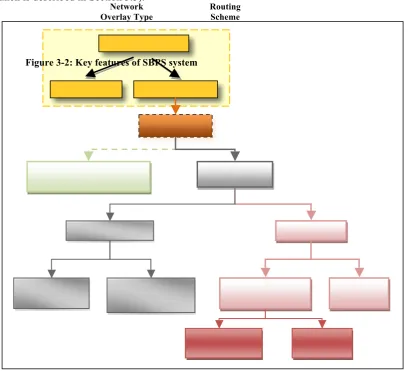
A comprehensive literature review was carried out to identify the key features of Semantic-based Pub/Sub systems and to form the basis of a proposed taxonomy for classifying SBPSs with respect to key features. This characterises the key features for defining expressiveness and scalability of a SBPS system. For example, the languages used by a SBPS for expressing subscriptions could demonstrate aspect of its expressiveness level and the routing scheme used by a SBPS for routing subscriptions and publications could demonstrate its scalability. The key criteria to use semantic mappings for flexibly resolving heterogeneous information in an adaptive manner was then explored, which also contributes to an advanced taxonomy for classifying SBPSs with respect to semantic interoperability support. A comparative analysis of the state of the art SBPS systems on the basis of the proposed taxonomies was conducted. The results of the analysis led to the identification of key challenges and requirements that need to be addressed by SBPS systems in the context of efficiently distributing heterogeneous information.
selected as the key factors, while the concept relations and class hierarchy of the ontology are not.
A large number of experiments were designed to evaluate various aspects of the KBNMap system. The ontologies used for the experiments were selected from current popular ontology databases such as Swoogle (Swoogle 2008), OAEI (OAEI 2007). The detailed mappings of the selected ontologies were generated by the author. The results from the experiments were analysed, supporting the claim that the use of semantic mappings can bring important flexibility and performance benefits for SBPS system in the distribution of heterogeneous information. Additionally, a training and validation process was also conducted to validate the BN model developed for driving strategy selection.
1.4.2 Overview of Thesis
Chapter 2 – Background: provides a basic grounding of ontology engineering, especially the importance of semantic mappings to address heterogeneity between different ontologies. An initial literature review of the publish/subscribe communication paradigm and Knowledge-Based Networking is also given.
Chapter 3 – State of the Art: first constructs a basic taxonomy for classifying SBPS systems with respect to key features, with an advanced taxonomy for classifying SBPS systems with respect to semantic interoperability support. A selected set of SBPS systems are described and reviewed according to the taxonomies identified. The chapter then presents the key challenges that need to be addressed for SBPS systems in order to distribute heterogeneous information in an appropriate manner.
Chapter 4 – Adaptive Semantic Mapping Service: first describes the approaches taken to address the two key challenges identified in Chapter 3. Afterwards, the chapter then presents the high-level architecture of using the adaptive semantic mapping service in SBPS systems. The design of the extension of the KBNImpl with semantic interoperability strategies that use semantic mappings presented. A detailed description of how to extend KBNImpl with designed semantic mapping strategies is given. An initial evaluation of proposed semantic mapping strategies is presented in Appendix C.
Chapter 5 – Mapping Strategy Selection: describes the identification of key factors that influence strategy selection, along with the design of the strategy selection mechanism according to the key factors identified.
Chapter 7 – Evaluation presents how KBNMap was evaluated. The performance of KBNMap was evaluated respectively in twenty one cases that are derived from different combinations of key factors. Each of the tests that were undertaken is described, results are presented and findings discussed. In addition, the correct operation and adaptability of KBNMap to cater for the key factors were verified by using the identified cases above.
2 BACKGROUND
In the previous chapter, the motivation and research question of this thesis are presented. This chapter presents the background knowledge to support the thesis.
2.1
Introduction
This chapter investigates the area of semantic interoperability especially focusing on ontology mapping techniques. This chapter also provides the background information related to the publish/subscribe paradigm and briefly introduces the concept of Knowledge-Based Networking for the purpose of helping readers become familiar with the essential technology, concept, terminologies, and definitions used throughout this thesis.
Section 2.2 first introduces the basic concept of ontology. Section 2.3 provides the definition of semantic interoperability and an overview of the ontology mapping technique. In Section 2.4 a “XG policy distribution service” scenario is also presented in order to illustrate the importance of using ontology mapping to address heterogeneity between different ontologies. Section 2.5 provides the background information for the Publish/Subscribe paradigm. Section 2.6 briefly introduces the concept of Content-based Networking. Section 2.7 briefly introduces XML-based Pub/Sub systems then. Finally an overview of Knowledge-based Networking is given in Section 2.8.
2.2
Introduction to Ontology
To define semantic models used by SBPS systems, a formal definition of the application level knowledge that describes what data means and where it fits in the SBPS systems is required. Ontologies can model the semantics of entities managed or used by the applications and the relationships existing between them. The following subsection gives an overview of ontology knowledge representation, particularly in the way to define and represent ontology.
2.2.1 Ontologies
It is possible to find in literature several definitions of ontologies. One of the most cited is the one proposed by the author in (Gruber 1993): an ontology is a formal explicit specification of a shared conceptualisation. The author in (Fensel 2003) analyses this definition in four aspects: A conceptualisation refers to an abstract model of some phenomenon in the world that identifies relevant concepts of the phenomenon. Explicit means that types of concepts used and the constraints on their used are explicitly defined. Formal means that the ontology should be machine understandable, while share refers to the fact that consensual knowledge captured by ontology is not restricted to one individual but accepted among a group (Fensel 2003). In addition, the sharing aspects also indicate the reusability of that knowledge which enables semantic interoperability between intelligent agents and applications.
The definition proposed above is general, however ontologies can be defined in specific contexts. For example, taking into account the paradigm of agents, the authors in (Russell et. al., 1995) define ontology is a formal description of the concepts and relations which can exist in a community of agents. In addition, the importance of terms of an ontology can be perceived by the next definition that is proposed in (Swartout et. al., 1996): an ontology is a hierarchically structured set of terms to describe a domain that can be used as a skeletal foundation for a knowledge base. More definitions of ontologies are described as follows:
l An ontology is a common, shared and formal description of important concepts in an specific domain (Fensel 2000);
l An Ontology is a set of knowledge terms, including the vocabulary, the semantic interconnections, and some simple rules of inference and logic for some participants (Hendler 2001);
l An ontology is a formal explicit representation of concepts in a domain, properties of each concept describes characteristics and attributes of the concepts known as slots and constrains on the slots (Noy et. al., 2001);
agreements to determine the meaning of these terms, along with the relationships between them (Starlab 2003).
From these definitions, some essential aspects of ontologies can be identified: l Ontologies are used to describe a specific domain.
l The terms and relations are clearly defined in that domain.
l There is a mechanism to organise the terms, for example, a hierarchical structure is used as well as IS-A or HAS-A relationships.
l There is an agreement between users of an ontology in such a way the meaning of the terms is used consistently..
In summary, the ontology can be considered as a formal data model that represents a set of concepts within a domain, individuals and the relations between these concepts. It is used to reason about the concepts in the domain and properties of that domain, which are described formally so that logic reasoners can make implicit information explicit Ontologies are also deterministic in nature.
The basic components of ontology are shown as follows:
l Classes: families of objects. They may contain individuals, other classes or the combination of both.
l Individuals: the basic components of an ontology. Individuals may refer to concrete objects as well as abstract individuals such as numbers and words.
l Attributes: each attribute has at least a name and a value, and is used to describe information of objects such as properties, features, characteristics, or parameters. l Relations: an important usage of attributes is to describe the relations between objects.
Normally, relations are the attributes whose attribute values are other objects in the ontology.
semantic integration of information sources for large-scale distributed heterogeneous networks (e.g., ubiquitous computing network). Some applications use a domain ontology to integrate information resources and others allow each resources to uses its own ontology. Each application can also have his own ontology according to his interests, languages, or role in a determine domain.
2.2.2 Ontology Language
An ontology language is a formal language used to encode the ontology. They encode the knowledge of a specific domain into the ontology as well as include the reasoning rules that are used to process that knowledge. Over the years, a number of ontology languages have been developed, focusing on different aspects of ontology modelling. For example, traditional ontology language (e.g., Ontolongua, F-logic) are only focusing on modelling ontology in a formal way, while web-based ontology languages (e.g., RDF, OWL) are more concerned with expressing and annotating metadata of information and data published by the web. As most Semantic Based Pub/Sub systems are using web-based ontology languages to express their information, the web-based ontology specification languages are only briefly presented here:
2.2.2.1
RDF & RDF Schema
RDF (RDF 2004) is a graph-based data model that provides foundations for representing and processing metadata. An RDF graph is a set of statements, which describe information of web resources in the form of subject-predicate-object expressions, or triples. The subject of an RDF statement is a resource, either anonymous, or named by a URI. The predicate shows the traits and aspects of resources and expresses a relation between subject and object. The object is a resource or a literal data value.
RDFS (RDF Schema (RDFS 2004)) is an extensible knowledge representation language that builds on the top of RDF and provides mechanisms for describing specific domains. Some of the key primitive ontology constructs provided by RDFS shown are:
l rdfs:Resource is the class of all resources. l rdfs:Class is the class of all classes. l rdf:Property is the class of all properties. l rdf:type relates resource to its class.
l rdfs:subClassOf allows declaration of hierarchy of classes.
l rdfs:range of a rdf:Property declares the class or datatype of the object in a triple using this property as predicate.
2.2.2.2
DAML+OIL
DAML+OIL (Horrocks et. al., 2002) is a product of efforts in merging two languages – DAML (DARPA Agent Modeling Languages) and OIL (Ontology Inference Layer) aiming at providing a general-purpose markup language for the semantic web (Fensel et. al, 2000). DAML+OIL builds on RDF(S) for providing richer modelling primitives than RDF(S) and assigning a specific meaning to certain RDF triples. The model-theoretic semantics (DAML Model 2001) specifies exactly which triples are assigned a specific meaning, and what this meaning is. It provides an additional way to constrain the allowed values of properties, and what properties a class may have. For example, there are two kinds of restrictions provided for properties. The first kind is ObjectRestriction properties that relate objects to other objects. The second kind is DatatypeRestriction properties that relate objects to datatype values. Both kinds of restrictions are created using the same syntax, with the only difference being whether a class element or a datatype reference is used.
2.2.2.3
OWL
RDF and RDFS provide a limited representation of ontological knowledge. Their primary concern is the organisation of concepts in typed hierarchies. However, some sophisticated ontology constructs are missing. For example, using RDF and RDFS it is impossible to express that some classes are disjoint; or to create class definitions that are union, intersections, or complements of other classes. It is also not possible to express cardinality expressions. These are realised by the Web Ontology Language: OWL (OWL 2004a, OWL 2004b), which is a family of knowledge representation languages that emphasises support for richer logical inference. OWL is an extension of RDF and RDFS with a larger and more semantic vocabulary. Three variants of OWL trade off computational complexity and the expressiveness of ontology constructs:
l OWL-Lite: is the simple variant and basically consists of class, property, subclass relation, and restrictions. OWL-Lite does not use the entire OWL vocabulary and some OWL terms are used under restriction.
Logic is decidable with complexity between polynomial and exponential time. The strong Set Theory background makes Description Logic suitable for capturing knowledge about a domain in which instances can be grouped into classes and relationships among classes are binary. OWL-DL uses all OWL ontology constructs with restrictions.
l OWL-Full: is the most expressive version of OWL but it does not guarantee decidability. The biggest difference between OWL-DL and OWL-Full is that class space and instance space are disjoint in OWL-DL but not in OWL-Full. That is, a class can be interpreted simultaneously as a set of individuals and as an individual belonging to another class in OWL-Full. The entire OWL vocabulary can be used without any restrictions in OWL-Full.
2.3
Semantic Interoperability between Ontologies
Interoperability is the ability of two or more computer systems to exchange information and have the meaning of that information automatically interpreted by the receiving system accurately enough to produce useful results, as defined by the end users of both systems (Heflin et. al., 2000). In order to achieve interoperability, the applications should have a common understanding of the meaning of the exchanged information. Ontologies are generally considered useful for providing interoperability (Gruber 1993), since they provide a shared semantically rich description and common understanding of a domain of interests that can be exchanged between people and application systems. For example, a core part of semantic web ontology is to enable interoperability between applications (Berners-Lee 2001), since they allow applications to agree on the terms that they use when communicating. It facilitates communication by providing precise notions that can be used to compose messages (queries, statements) about the domain. For the receiving party, the ontology helps to understand messages by providing the correct interpretation context. The advantage of using ontology in networking domain has been demonstrated through the conversion of various network management information models (e.g., CIM and SMI) into OWL representations (Vergara et. al., 2002). Such features are also desirable in large scale web commerce environments (Omelayenko 2002; Fensel et. at., 2003) or open networked systems (Castano et. al., 2005).
2.3.1 Ontology Heterogeneity
their semantics and the representation they use. In other words, applications may wish to interact with each other on the basis of their own independent ontologies. It seems clear that ontologies face the same or even harder problems with respect to heterogeneity as any other piece of information (Valente et. al., 1999). For example, given the decentralised nature of the development of the networked domains described in Chapter 1, the number of ontologies will become huge as the number of applications grows. Many of these ontologies will describe similar domains, but using different terminologies, structures, relationships and others will have overlapping domains. Therefore, it is necessary to find a solution to reconcile these different ontologies in order to have a shared aggregate composed model that is understood by the heterogeneous applications. The multiplicity and diversity of independent ontologies is termed as ontology heterogeneity and can be characterised by different kinds of mismatches between ontologies (Hakimpour et. al., 2001):
2.3.1.1
Ontology Mismatches
The authors in (Chalupsky 2000; Klein 2001) categorise the different types of mismatches between ontologies into language level and ontology level. The former refers to syntax and expressivity while the latter refers to the semantic layer. As the main concern in SBPS is more focusing on mismatches between ontologies at semantic level rather than language level, the general ontology level is only described here: the mismatches happen when two or more ontologies that describe partly overlapping domains are combined. The mismatches are further divided into conceptualisation mismatch and explication mismatch. The conceptualisation mismatch is a difference in the way a domain is interpreted, which leads to different concepts or relations between those concepts; whereas the explication mismatch is a difference in the way the conceptualisation is specified. The conceptualisation mismatches are further categorised into:
l concept scope that describe the scenario that two classes represents the same concept, however, the instances belongs to each class are different, although they may intersect. l model coverage refers to a mismatch in the part of the domain that is covered by the
ontology, or the level of detail to which that domain is modelled. Explication mismatches are further characterised as terminological, modelling style and encoding.
2.3.2 Overview of Ontology Mapping
mappings in SBPS systems, the administrators of SBPS systems can use these mappings to integrate applications’ different semantic models into the single shared common semantic model thereby building an aggregate model between different semantic models. These mappings can be specified by an administrator who has no access to the application or SBPS system source code, only to their semantic models. These mappings are therefore the functional unit of semantic interoperability- they provide the bridge between heterogeneous applications with heterogeneous semantic models. As application domains are updated, and provide updated ontologies to express their semantic models, these mappings can also be updated accordingly without requiring source code modification to either the SBPS systems or to other applications. A brief overview of ontology mapping technique is given in this section. However, in this thesis the use of ontology mappings by Semantic-based Pub/Sub systems is the main focus, rather than how to discover, characterise, create mappings between different ontologies. While the type of mappings the SBPSs would use is presented in Chapter 3, this section introduces some common mapping representations.
2.3.2.1
Ontology Mapping
Ontology Mapping is the common technique being adopted to achieve semantic interoperability between heterogeneous ontologies (Noy et. al., 2000; Ouksel et. al., 1999; Orgun et. al., 2006). A general definition of Ontology Mapping in (Noy et. al., 2000) is used in this thesis: to establish correspondences among the source ontologies, and to determine the set of overlapping concepts, (concepts that are similar in meaning but have different names or structure), and concepts that are unique to each of the sources.
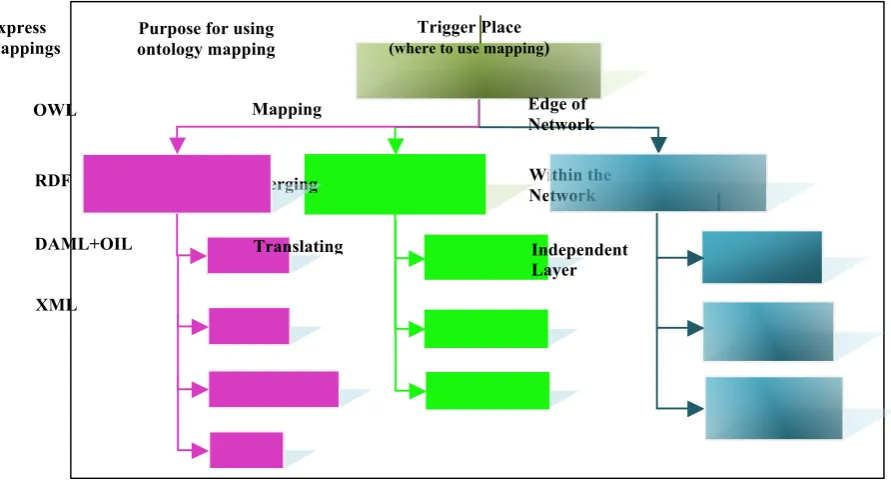
The author in (Su 2004) summarises that “mapping” activity can be used for a range of purposes, including merging, mapping, integrating, aligning, and translation of ontologies:
l Merging, integrating: provide a single coherent newly ontology that is created from two or more existing ontologies with overlapping concepts.
l Aligning: bring two or more ontologies into mutual agreement, making them consistent and coherent with one and another.
l Mapping: make explicit the correspondences (i.e. through creation of a separate ontology) referring to but without changing the original ontologies.
l Transforming: changing the semantics of an ontology slightly (possibly also changing the representation) to make it suitable for purpose other than the original one. l Combining: using two or more different ontologies for a task in which their mutual
relations are relevant.
2.3.2.2
Ontology Matching Techniques
As stated in (Castano et. al., 2005), ontology matching techniques are essential to enable knowledge discovery and sharing in open networked systems, in order to determine ontology mappings between semantically related concepts, relations, individuals of different ontologies. The relationship between ontology matches and mappings is that: ontology matches (Euzenat et. al., 2007) only provide a set of correspondences between semantically related entities of different ontologies while ontology mappings are established after an analysis of the similarity of the entities in the ontology matches. For example, given two different things an “animal having four legs” and a “dog with 4 legs” respectively, it can be said that the concept “four leg” is simply matched to the concept “4 legs” as the two concepts have the same name. However, if taking into account the whole context of concepts, the “four leg” of animal is not mapped to “4 legs” of chair, as “dog” is a kind of animal, while “chair” is a kind of furniture.
2.3.2.3
Mapping Representation
Prior to representing mappings, the mapping correspondences between different ontology elements with similar meanings must be discovered and identified. Mappings are discovered in two ways: 1) detecting mismatches between ontologies by applying a set of matching rules; 2) evaluating interesting similarity measures that compare a set of possible correspondence and help to choose valid correspondence from them. A detailed description about mapping discovery can be found in (Doan et. al., 2003; Ehrig et. al., 2004; Kalfoglou et. al., 2002; Noy et. al., 2003).
Mapping representation reflects the sophisticated structure of ontology mappings and the relations among different concepts, therefore this representation needs to have well-defined semantic to enable reasoning and comparison between mappings (Madhavan et. al., 2002). According to different requirements and specifications, the mappings identified or derived from mapping discovery process can be represented in various ways. However, the way of representing mapping should be on the basis of three criteria (Noy 2004; Su 2004):
l Clear semantics: the meaning of mappings should be formally defined, since the semantics provide a basis for reasoning about mappings (e.g., deterring if two mappings are equivalent or if a certain mapping formula is entailed by a mapping). l Accommodate incompleteness: the loss of information when two ontologies cover
different domains could lead to incompleteness. However, even if the mapping is incomplete, it still may suffice for a particular task.
l Heterogeneity allowance: mapping between ontologies may involve multiple representation languages. Therefore, a mapping language needs to be able to represent mappings between models in different languages. An alternative way would be to first translate all the ontologies into a common representation languages, and then specify the mappings as formulas in this language.
The representation approaches are generally classified into two groups: 1 to 1 instance mapping representation, and complex mapping representation (Noy 2004).
ontology mappings, especially for one to many concepts mappings.
l Complex mapping representation: it is using ontology to represent mappings. In this approach, mappings between elements are usually expressed as a pair of related entities in some mapping format that is normally output as a separate ontology. This approach provides more accurate and effective representation solutions for complex ontology mappings and this attributes to the expressive power of ontology itself. For example, mapping ontology provided by (Crubezy et. al., 2003) defines the structure of specific mappings and the transformation function to transfer instances from one to another. This mapping ontology can then be used by systems to perform the transformation between two different ontologies. Additionally, comparing to 1 to 1 instance mapping approach, such a mapping ontology usually provides more complex mapping relations (i.e., more specific, inverse, disjoint etc.) rather than simple equivalence relation encoded between elements. For example, class a in source ontology is more specific than class b in target ontology. Then the mapping can be used by applications to translate data from the source ontology to target ontology. The mapping ontology could also provide many-to-one aggregation relations between concepts in the source and target ontologies, as well as one-to-many concept-decomposition relations. It also allows specification of recursive mappings, complex mappings between that collect information from several related concepts, and other mechanisms.
Several software systems have been developed to analyse two ontologies and identify potential correspondences between them. This includes systems such as GLUE (Doan et. al., 2002), ONION (ONtology compositION system) (Mitra et. al., 2002) , OKMS (Ontology-based knowledge management system) (Maedche et. al., 2003) and OISIN (O’Sullivan et. al., 2004). Other systems are surveyed by authors in (Choi et. al., 2006). These tools can be used to greatly speed up the process of integration, and also to identify potential mismatches where a more complex mapping may be required to bridge the heterogeneity between the two domains. Many of these systems produce mappings in a proprietary format. For example, the OntoMerge system (Dou 2004) uses bridging axioms written in first order logic language to express the translation rules between the concepts in the ontologies. Another example is the MAFRA system (Maedche et. al., 2002), which uses Semantic Bridges based on an ontology called the Semantic Bridging Ontology (SBO).
OWL’s standardisation and direct support for semantic relations (i.e., equivalence, subclassof etc) made it the ideal choice for use in our designed KBNMap. If KBNMap were to support more complex mapping types, another mapping language might be chosen. However, the choice of mapping languages must be considered carefully in order to maximise interoperability and mapping reusability. The semantic relations provided by OWL were sufficient to demonstrate the operation of model mapping for the purposes of this work, since KBNMap is the extension of KBNImpl which makes use of OWL ontologies to express its semantic models, subscriptions and event models. Mapping specification tools such as those described above can be used to partially automate the process of mapping between two ontologies. Typically they present a side-by-side hierarchical structure of concepts, and use a variety of techniques such as lexical analysis of concept names and structural analysis of the ontology to identify candidate matches between concepts. These candidates are presented to the user for verification, after which the user can choose to add additional matches to complete the mapping.
2.4
“XG Policy Distribution” Scenario
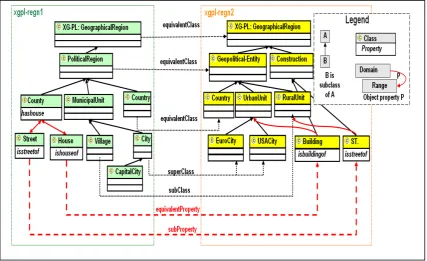
In order to provide examples of the kind of mappings that would be possible in this scenario, two sample geographical region ontologies are used. Figure 2-1 describes a hierarchical structure of mapping relations between classes and properties from the two OWL ontologies. xgpl-regn1 and xgpl-regn2 are region description ontologies made by author for XG policies delivery between communication service providers (CSP). To create OWL mappings between these two ontologies, firstly, there is a need to reference them from the independent mapping ontology so that the rest of the ontology description will be able to refer to the existing elements that are previously defined in an involved ontology. Second, mappings between elements of the involved ontologies were established. The core OWL mapping constructs are: owl:equivalentClass, owl:equivalentProperty, owl:sameAs, owl:subClass and owl:subProperty because they explicitly relate classes to classes, properties to properties or individuals to individuals (OWL 2006). Therefore, these mapping constructs were only presented in this example. Figure 2-1 shows a number of possible mappings. One class of an ontology may be considered as a subclass of another class of another ontology (Village is subclass of RuralUnit). Two relations (subsumption and equivalence ) between properties from the involved ontologies can be determined by comparing their members ( ishouseof is subProperty of isbuildingof in Figure 2-1).
Now, let us assume that a SBPS system is employed to deliver policies between policy providers, and xgpl-regn1 is the main routing ontology distributed among the SBPS routers. If there is a service provider interested in polices within city range, it subscribes to a query expressed by concept city to its closest router. If this router receives a notification that has the
[image:36.595.86.514.401.662.2]